My Fantastic Four-ay: Part Nine.
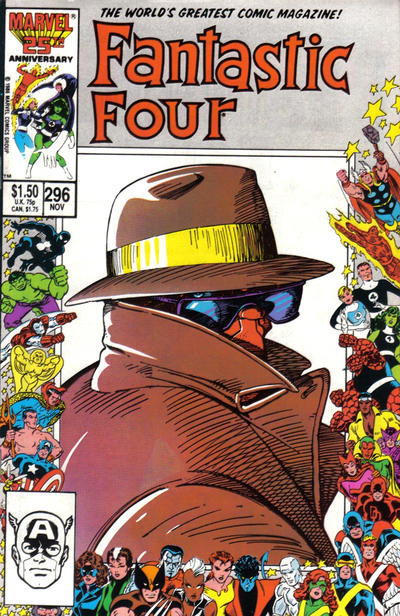
Listen, this is one humdinger of a cover. Drawn by Barry Windsor-Smith, it effectively depicts the state of the Thing as it had been at this time…alienated and alone, divided from the rest of the Fantastic Four.
You would think the moodiness of the piece might be slightly diminished by Marvel’s 25th anniversary framing border, which appeared on all the Marvel comics around this time, showing a parade of celebratory heroes. If anything, it enhances the Thing’s isolation, his somber demeanor separating him from the party that literally surrounds him. Yes, the Thing is also in the border:

…which maybe undermines my point a little, but that is the Heroic Part-of-the-Team Thing, not the put-upon, feeling-his-inhumanity Thing.
In short, what I’m saying is this is a good cover, one that even leans into the forced company-wide cover layout to give it additional meaning. Was that Windsor-Smith’s intent? Probably not, but that’s how it works.
Anyway, this is an extra-sized issue, 64 pages or thereabouts, marking not only the 25th anniversary of the modern Marvel superhero universe, but the 25th anniversary of the comic what kicked it all off. It’s hard to believe now that there was ever a time the FF was around only for 25 years. I mean, I’ve been in the comic book business for nearly 38 years now, and I’m just trying to imagine the FF starting 13 years ago and hitting its 25th anniversary now.
And frankly, it’s difficult to think of the series as having been around only 25 years, at that point, given just how much has gone on with its pages over that timeframe, and how many interpretations of the team. And, yes, how many repeated plot points (a problem the series still hasn’t shed, as we approach its 65th anniversary this year).
When this issue came out in 1986, I’d been reading the comic since about 1983, and had bought the back issues of the John Byrne run back to its beginning in 1981’s #232. The wrap-up of Byrne’s final storyline, which he departed partway throough, had actually been a relatively smooth transition, with sympathetic creators following in his footsteps and applying familiar story beats and styles of artwork. And, yes, working at least partially from Byrne’s plot points.
That all means we hadn’t yet seen a Fantastic Four issue free of Byrne’s influence post his departure. This issue, #296, would be the first in six years. But is it really free of that influence? The issue is literally about the Thing’s emotional and literal separation from the team that had been his family, a situation that Byrne himself instigated (assisted by creative teams over on The Thing solo series) and didn’t resolve before he left.
(On top of that, there’s the whole “Johnny Storm dating Alicia Masters” business that Byrne introduced, which also played into the Thing’s current situation. And I realize I said in a previous installment that I was going to address this particular twist on the title’s formula in a “future installment.” Don’t worry, it’s still coming, but it’s going to be a little bit down the line, when a certain something happens.)
All this means that this giant anniversary issue (released so close to the 300th issue, which is probably why that one is regular-sized) seemed as if it would be our first taste of where the FF would go. Ultimately (spoiler for the next installment of these posts) it isn’t really, beyond a reinstatement of the membership’s status quo, given its one-off nature and the gimmick of a Stan Lee script (over Jim Shooter’s plot). Plus, given some information that I just discovered, it may not be as free of Byrne’s influence as I thought! But more on that next time.
I imagine I was probably ready to drop the book once that final Byrne story wrapped up in #295. But, boy, I’d been a sucker for Oversized Anniversary Issues almost from the start of my comics collecting, and the timing of that 25th anniversary issue kept me on the title for at least one more issue. Which itself kept me reading until that #300, and then beyond…at least for a bit.
I’ll dip into the actual contents of the issue with the next part of these posts. That cover, though…that cover is the stuff. It wasn’t just that this was a big special issue that got me to pick it up, it was that great, evocative drawing of my favorite FF character, which said so much with so little effort. But don’t you worry…there’s a whole lot of effort expended within, to not nearly the same effect.
The Lone Variant Rides Again!
So anyway, as I was saying back in 2021, I hadn’t seen one of the apparently-rare “red shirt” editions of Lone Ranger #37 “in the wild,” as it were. There was that image of it on the Grand Comics Database (which I’m not linking directly to just yet, for reasons that will become apparent), that looked…not quite natural to me, for some reason. I mean, I could have been wrong, but I still wanted to see another copy to compare.
Well, in steps my Bluesky pal Comics in the Golden Age (an old family name, I’m presuming, but a good follow if you like comics!), who informed me that on the Lone Ranger Fan Club Facebook page, someone posted about having the red shirt variant, and was asking for information about it.
Mr. Comics in the Golden Age replied, pointing this person to my (eep) five year old post on the topic…and the end result is that I am in contact with Cedric, the owner of these comics, and he graciously offered photos of them for me to present here.
Just a little bit of background: these used to belong to Cedric’s father, who recently passed away and for which I’m sure we all offer our condolences. Cedric says he vaguely recalls that it was his father who notified the Overstreet Price Guide of the existence of this red-shirt variant, which is why that bit of info was even in the guide for me to find in the first place.
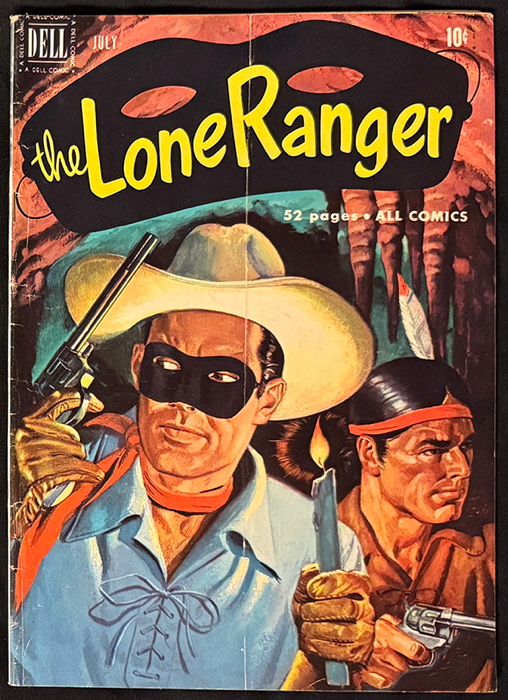
And to remind you all, the change seemingly came as the owners of the Lone Ranger wanted the licensed material to feature the blue-shirted costume, as opposed to the red shirt he had previously worn. Given that a few copies of Lone Ranger #37 got printed with the red shirt, this may have been a real “STOP THE PRESSES!” situation so that the publisher could slap some blue paint on everything.
Thus, here is the main attraction…Cedric’s copy of the Red-Shirted Ranger:
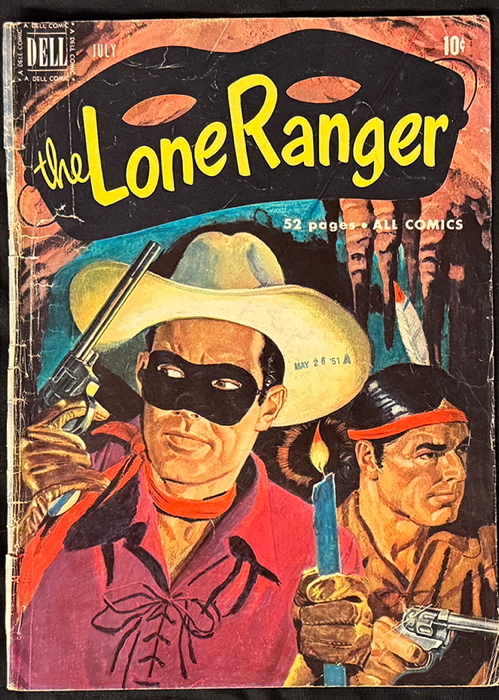
…which, by the way, someone already used an image of Cedric’s copy to replace the one that had been on the Grand Comics Database page for this issue. You can see the image that used to be there in my original post.
Here’s Cedric’s copy of the vastly more common Blue-Shirted Ranger edition:
The changes extended inside as well, with the red shirt version looking like this:
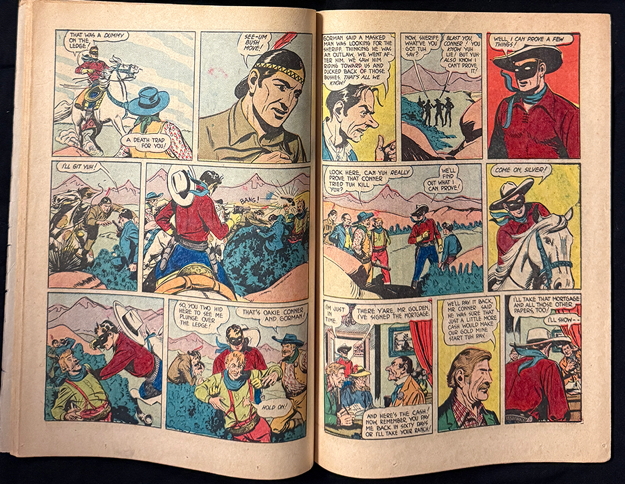
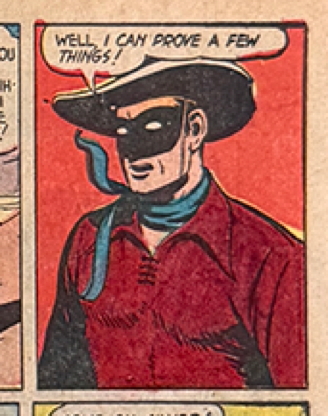
…and the blue one appearing as so:
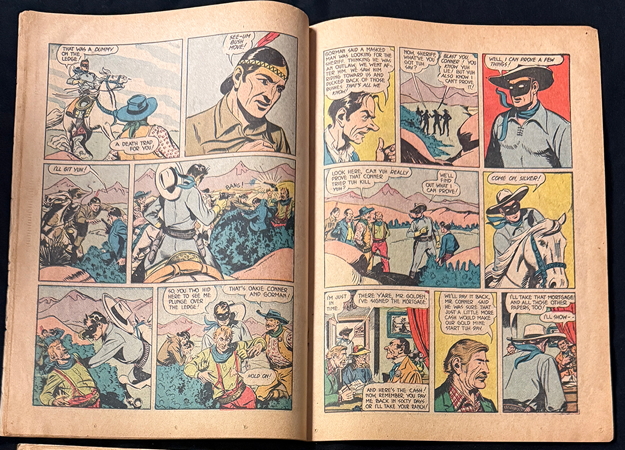
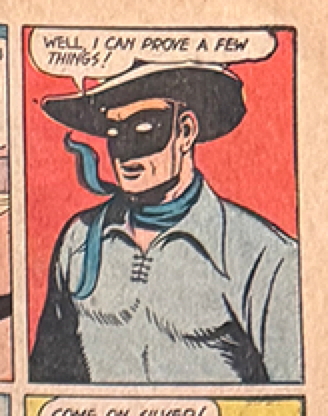
Cedric also sent along a pic of the indicia of one of these issues, if you needed a little more authenticity for these items:
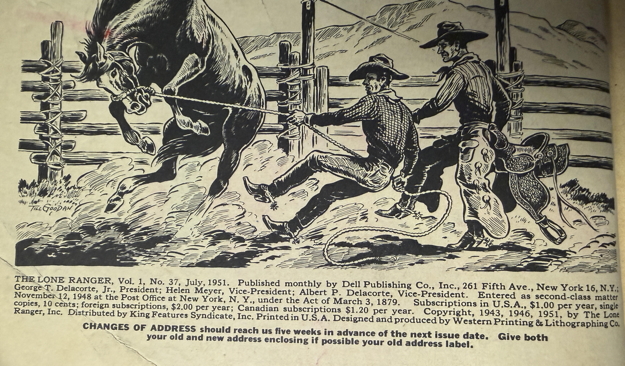
Finally, let’s get a good look at that arrival stamp, letting us know just when, at least at whatever newsstand this was sold from, when the comic arrived:
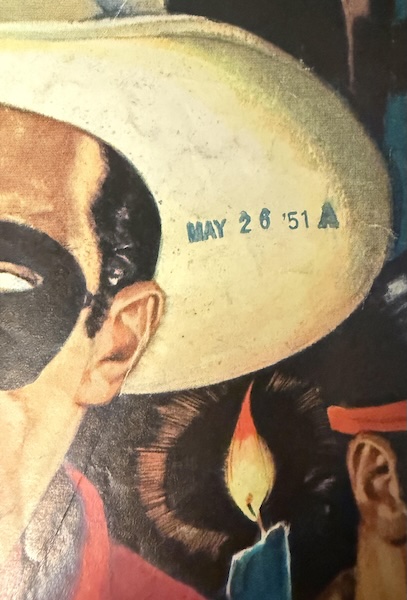
Only a couple of months ahead of the July 1951 cover date! Note that this was on the rare red-shirt variant, which seems to confirm that copies of this version did in fact get distributed, and weren’t just, like, office copies or whatever.
This was not a follow-up I expected to post, though I’m glad I got the opportunity. This is indeed a rare item and it’s nice to see actual additional visual proof of its existence. A big ol’ thanks to Cedric for allowing me to share this ere (and be sure to visit his site for his illustrative services), and to Comics in the Golden Age for helping to make this happen.
Now let the debate begin: do you prefer the Lone Ranger with the blue shirt, or are you wrong? Let me know in the comments!
Not really an End of Civilization post.
So it’s been a while since I’ve done an End of Civilization post (this notwithstanding) in which I go through the distributor catalogs and crack wise about some of the goodies appearing therein.
Part of the reason this series of posts went into decline is the lack of time I’ve had to put them together since opening my own shop back in 2014. Another is that my mindset seemed to have changed slightly because I was now a store owner, and…I don’t know, I don’t think I was more sympathetic to distributors, publishers and their products by any means, but I felt perhaps a little less inclined to be openly mocking them as I had been .
And of course, with the demise of the original Diamond Comic Distributors and their Diamond Previews print catalog, my main source of material has fallen to the wayside. Yes, every current comics distributor has their own catalog, or set of catalogs, that they release monthly, but making fun of just comic books isn’t quite the same as pointing out some new ridiculous Monopoly variant or a PVC statue of a schoolgirl in a bikini or whatever.
Plus, it was easier, at least in terms of “planning out a hopefuly-humorous blog post” if not “placing orders for the shop” to have everything in one spot. Now that it’s decentralized, I have to work harder for the laughs, and you all know how much I hate to work.
That said, I do have an account with the current owners of the Diamond brand, via which they primarily sell just toys and game pieces, and from whom I’ve received exactly one item (a Halloween Michael Myers action figure, ordered from the old Diamond long before its final collapse). I’ve spent many a week looking through their offerings, new releases and final calls to order, and have found basically nothing making it worth the effort I took to get an account at this new company in the first place.
But I found something this past weekend that almost makes me think End of Civilization could perhaps rise from the ashes. And that’s the “Star Wars: Rogue One Director Krennic Cape,” available in multiple sizes:
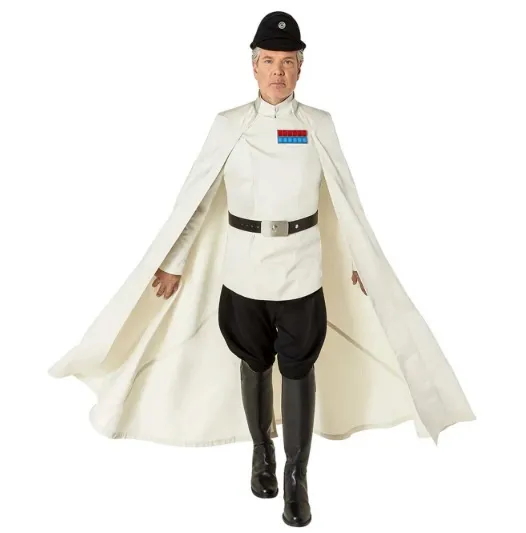
Yes, for only $200, you can have a cape that you’ll want to wear to work, to jury duty, to weddings, pretty much every waking hour to justify dropping two C-notes. When I pointed this price out on the Blueskies, that I hadn’t priced capes in a while and had no idea if this cost was in line with your standard cape expenses, I was told “yeah, it’s in the proper range.” I don’t recall if the rest of the costume as shown in that picture was also available for sale, but maybe the manufacturer just assumes you have the clothes already. I mean, don’t you?
The Final ’90s Countdown, Part Twenty-One.
Here it comes, the next entry in the Final ’90s Countdown of YOUR top votes for the best comics of an otherwise maligned decade in the industry. We’re almost done with the one-vote getters, and it’s kind of a two-fer — or four-fer — here:
Stormwatch #37-44 (Image 1996-7), Stormwatch #1-#11 (1997-1998), WildC.A.T.s/Aliens one-shot (1998) and The Authority #1-12 (Wildstorm 1999-2000)
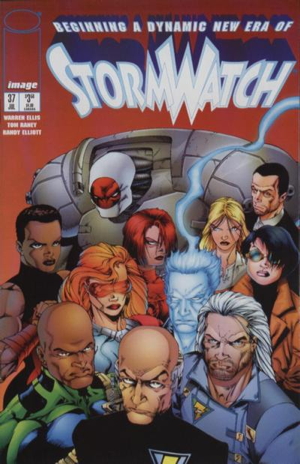
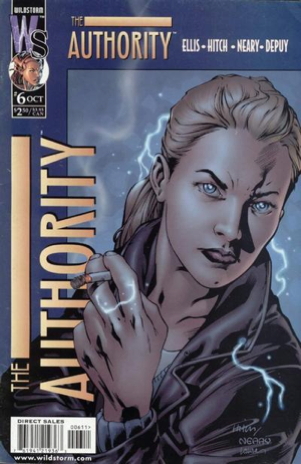
This breaks format just a little, and it’s more than what was actually submitted, but they are of a piece, as one title flows right into another. The connecting thread here is writer Warren Ellis, currently kinda persona non grata in the business, but at the time was a cutting edge writer of interesting and influential comics.
But anyway, as you can see from the list of titles there, it’s bit of a complicated road to follow. Starting with #37 of the original Stormwatch series, Ellis, along with artists Tom Raney and Randy Elliott retool the book into a more “real world” (relatively speaking) setting, with more of a political edge, versus the 1990s “Image Style” book it had been previously. (Think of when Alan Moore took over Supreme, turning it from…whatever it was into the Silver Age-y deconstructive tribute it became.)
The Ellis storylines wrapped up the original Stormwatch series with #50, leading into a second volume of Stormwatch that ran 11 issues, all written by Ellis and joined by artists Oscar Jimenez, Joe Phillips, and Jason Gorder in the first issue, plus other aritsts along the way. Eventually Bryan Hitch and Paul Neary come aboard, and suddenly it’s a whole new game.
Now I have to jump in here and admit…I have not read this particular period of Stormwatch. I’m just sorta cruisin’ around, picking up details and overviews from hither and yon upon the internets. So, I do not have specific first hand knowledge of these books, beyond selling them when they were new. (And noticing the huge jump in back issue demand for these once Authority got rolling.)
So when I say “Hitch and Neary were a new game,” that comes mainly from my knowledge of their art. Bringing in a more cinematic and exciting depiction on the comics that they draw, bringing a more mature form of the energy that early Image tried to produce with their crosshatching and movement lines.
Oddly, right after (or during the conclusion) of this second Stormwatch series comes the WildC.A.T.s/ALIENS one-shot by Ellis and Chris Sprouse, in which some Stormwatch characters were done away with. Interesting that a book crossing over their characters with another company’s licensed property would be the place to make changes like this, given the unreliability of availability in future reprints, but here we are.
And now, finally, we get to The Big One, The Authority, where Ellis and Hitch take the pieces from what had come previously, and reweave them into the very end-of-the-century comic that we know and love. And I did at least read this title, so I’m not completely out of the loop here. It was for this series in particular that I believe folks first started batting around the “widesceen comics” descriptor, based on the, again, cinematic storytelling of the artists and the large scale action scenes/set pieces presented via that style.
It was edgy, political, brutal and effective, making each issue into a real page-turner. It took what should have been a clichéd and childish joke idea, a “what if Batman and Superman were gay lovers,” and actually made those characters’ analgoues on the team, Midnighter and Apollo, enjoyable and fascinating. Jenny Sparks, the “Spirit of the Century” created by Ellis in his initial Stormwatch issue, gets the conclusion of her story as the series approaches the millennium. (More or less, but I think this is addressed in the comics if I remember correctly.) The stakes kept rising, with Ellis and Hitch’s final story on the book involving the team fighting “God.” It was a wild time.
These comics were very much Of A Time…it’s easy to look at these and say “oh, yeah, that’s definitely the early 2000s.” Several folks tried to emulate the art style, and Ellis himself would go to this “tough bastards versus the world or whatever” scripting again and again. Mark Millar, who took on writing chores on Authority after Ellis’s departure, had attempted to follow in his footsteps, but it felt as if the proper “balance of bastardry” was off as the characters seemed to lean a little too hard in one direction. Nice Frank Quitely art, though.
Reprints: all this guff’s been reprinted in that convenient trade paperback/hardcover format over the years, but most recently there was a papperback Authority TP Book One, which reprints all the Authority issues by Ellis and Hitch, along with the crossover Planetary/Authority that mixes the team with another of Ellis’s properties. A large omnibus includes all the Ellis work, as well as Millar’s run, and a short run by Tom Peyer (which I liked!).
All the Stormwatch comics by Ellis have been most recently reprinted in Stormwatch: The Raod to Authority Compendium.
Odd man out is the WildC.A.T.s/Aliens one-shot, which, by its nature, makes it hard to reprint in context with the work around it. A paperback from 2001, Stormwatch: Final Orbit, reprints the story with Stormwatch Vol. 2 #11, and DC/Dark Horse: Aliens from 2016 includes this along with some of the other DC/DH Aliens crossover titles. Neither is currently in print, far as I can tell.
So someday I may get around to reading those Stormwatches, though my current ambivalence toward Ellis may put that off a bit. But the ultimate payoff to those, Authority, did have an impact, at least for a while, on how we thought about superheroes and how they could be presented. That proposed Authority movie might have been interesting, though I suspect some of the edges would have been smoothed down for maximum box office…a moot point now, since it’s been moved to the back burner. Ah well, someday we’ll see a DC movie where our heroes fight God.
I mean, if that happened to me, I’d have titled my book that too.

So I acquired another issue for my Comic Reader collection, this one being #69 from 1968. I believe this gives me a complete run from this number all the way to the final issue, 1984’s #219, but I need to double check my collection. You can click on that picture above and get a larger image if you want to read the front page. Anyhoo, I gots it now. Here’s a John Romita head sketch of Daredevil from within:

I’m also in the process of reading this book:
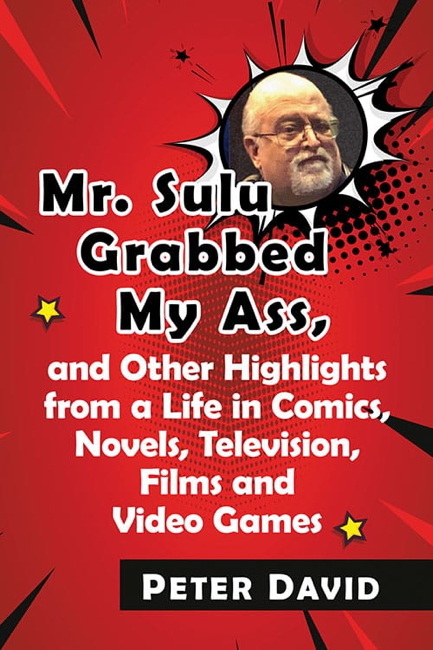
…a collection of Peter David’s various anecdotes about his life and career, several of which I’ve heard before (like how he got the assignment to write Incredible Hulk) and some I hadn’t (like his involvement with two Will Smith movies, one of which never got made, and the other probably shouldn’t have been made). It was published in 2020, so it’s very much among his latter works, and in some cases it pulls no punches about some of the people he’s worked with. In other cases, specifically with a couple of family (or former family) members, he’s intentionally vague about on negative details. I mean, I know the negative details about one of those people, he’s not been shy writing about it in the past, but it feels weird to just imply “bad things happened” then not talk about them. I get it, it’s family stuff, just felt weird to leave it out.
Another odd quirk I noted is when he talks about getting that job to write a Phantom mini for DC. He mentions that he got to meet the Phantom’s creator, Lee Falk, but he’s only referred to as “Falk” and never identified as the creator of the character. You can kind of infer that he was important to the Phantom character by some of the things David writes, but I think there may have been a line or two edited out that left out any explicit identification.
But I’m only about halfway through the book, and I see by the index that the Phantom comes up again later, so maybe I’ll see some clarification then. But so far, it’s been an interesting “behind the scenes” of what was happening in comics in the 1980s/1990s. And, you know, other media. Like Will Smith movies. And yes, the book lives up to its title…Mr. David gets to said ass-grabbing right away.
There was a line in the book talking about comics distribution that alas I can’t track down now, but he’d written something along the lines of “I hope Diamond Comics doesn’t suffer financial failure and then got purchased by Disney.” I don’t know how much attention he was paying to the comics business and Diamond’s collapse when it happened, so close to the end of his life, but I wonder if he thought “did I predict the future? Will Disney buy Diamond?”
In which I speak of Swamp Thing a lot.
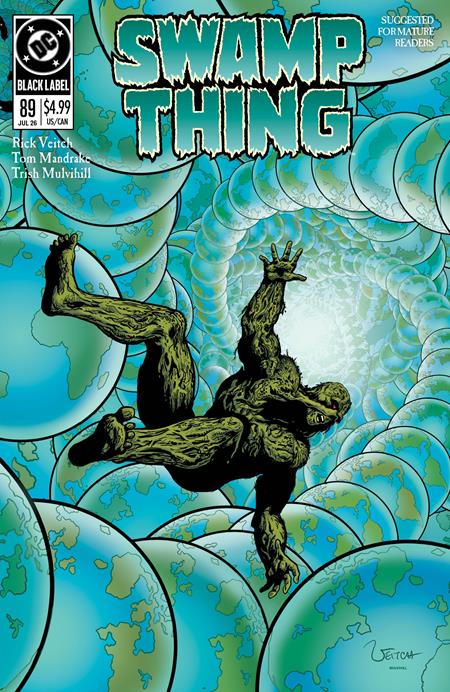
Hard to believe, but here we are, with issue #2 of the long-delayed ending to Rick Veitch’s 1980s run of Swamp Thing. It was the previous issue what got all the attention of course, with Special Guest Star Jesus, and the inciting incident as to why the whole thing got canned in the first place.
But there’s still a story to be told beyond that big event, and it’s continued in fine style with new artwork by Tom Mandrake, colored by Trish Mulvihill, and lettered by Todd Klein in original letterer John Constanza’s style. And yes, pal Rich Handley still knocks it out of the park with his 1980s-style editorial page inside the front cover! (Rich has pointed out at least one online commentator was sufficiently convinced his column was in fact from the 1980s and not newly written for this comic. That’s how good a job he’s doing!)
Again, our mossy hero bumps into more DC Universe characters, this time more time travelers, as one of them attempts to rescue Swamp Thing from his uncontrolled journey into the past. Plus, we check in with Abby and her pregnancy in the present day, as further groundwork is laid for the eventual conclusion of this story.
Which has me wondering…way back when, as things went down and Veitch quit the book, he relayed his plans for the final four issues to Comics Buyer’s Guide, which I mostly remember (since I don’t have that copy of the paper anymore, shockingly). Without going into spoilers, I do know that what Veitch had worked out is contrary to what passes for DC’s continuity now in regards to the Swampiverse. I mean, things have been rebooted and retooled enough at DC in recent years that one could easily just say “well, Veitch’s Swamp Thing conclusion is now canon,” though one could point to the Black Label imprint on the cover there and just declare all this “not official.”
One particular point (and this is a slight spoiler, but c’mon, Abby’s pregnant, there’s gonna be a baby) is that Veitch had something specific planned for the child (name and presumably powers) that he kept to himself once DC put the kibosh on his story. In official DC continuity, Abby had a daughter that was named Tefé, who bridged the plant and animal worlds with her own elemental powers and had her own adventures (and even her own series). She is still around as of the recent Swamp Thing series with the new Levi Kamei version of the character.
So I suspect Tefé will remain the default child of Swampy, with whatever Veitch has cookin’ with this “1989” series remaining an alternate version. Ah well. Once it’s all said and done, maybe I can do a side by side comparison of Veitch’s intended ending to this storyline with the one by Doug Wheeler, Tom Yeates, and Pat Broderick that DC published in its stead.
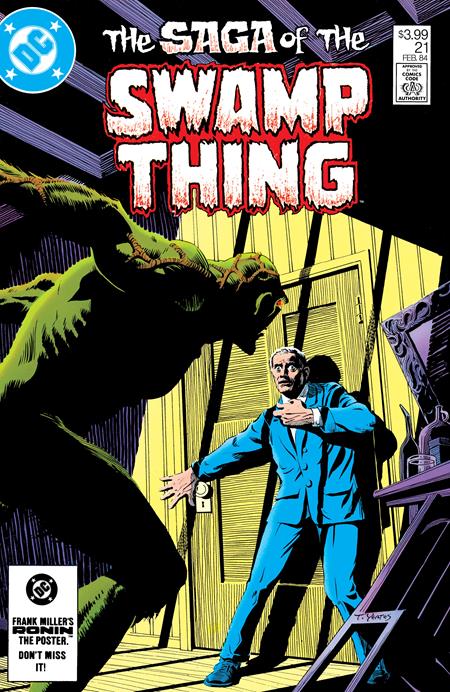
Speaking of Swamp Thing, and when aren’t I, DC also released this week a facsimile edition of Saga of the Swamp Thing #21, the issue in which Swampy learns his true origin, and (spoiler) does away with the previously mostly off-panel menace of General Sunderland. (He does pop up once or twice in earlier issues, but not nearly as craggly and menacing as he does in this comic, drawn by Steve Bissette and John Totleben).
Anyway, if you rememnber this post from, oh, only eight years ago, I griped a bit about how the digital version of this issue left out the “color hold” imagery, where it looked like this:
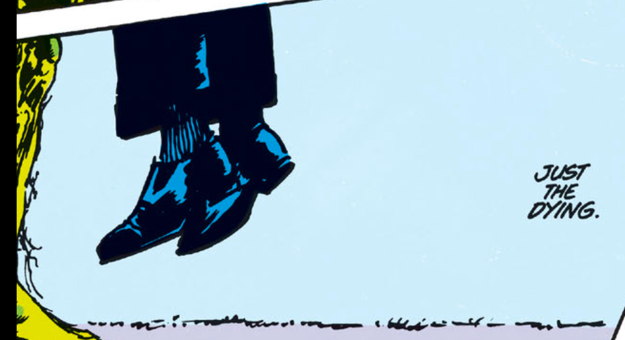
Instead of like this, how it appeared in the original comic:
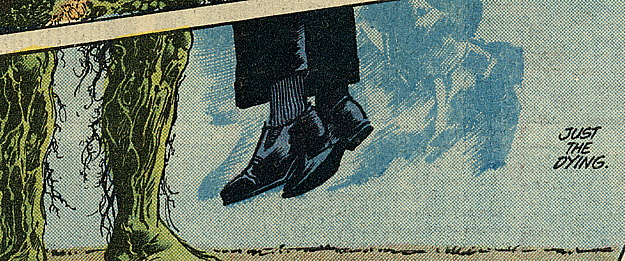
Well, I’m pleased to report that the color-hold drawings are back in this new facsimile, appearing as such:
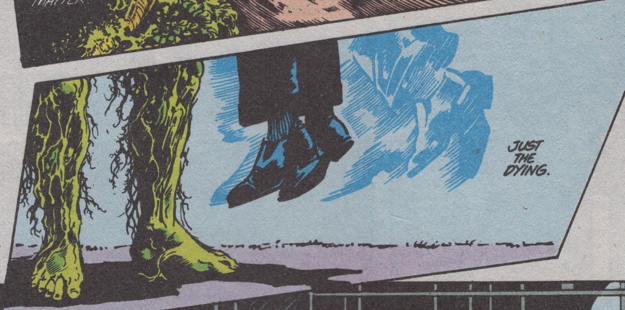
…even if the texture looks a little odd, since the new color printing is flat, not “dotted” like the original and interacting with the linework in the color held bits.
That gives me hope for future reproductions. I’d been told that the person currently in charge of the Swamp Thing restorations for coming reprints is trying to do right by the work, and this is a good start!
Continuing to speak of Swamp Thing, old pal Ben (whom you’ve seen pop up in the comments here on occasion) informed me that he was on Facebook at just the right time, which is how he was able to purchase this illustrated sketch cover direct from Roarin’ Rick Veitch his own self:
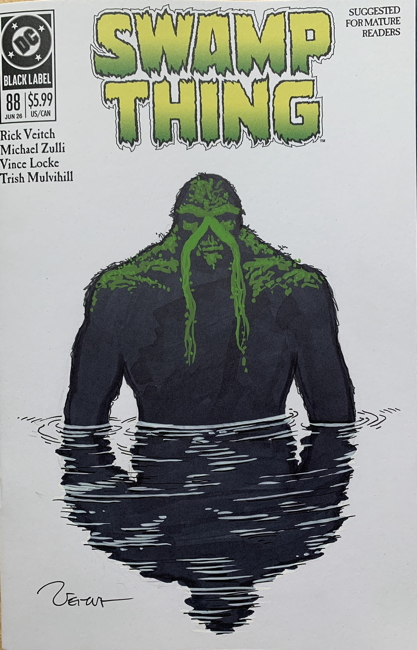
Pretty cool. Anyway, if that disappears out of Ben’s house one night, I assure you I have an alibi for the evening.
And speaking of Swamp Thing just one more time, I would be remiss if I didn’t mention this variant cover by Bruno Redondo for Justice League Unlimited #19, also out this week:
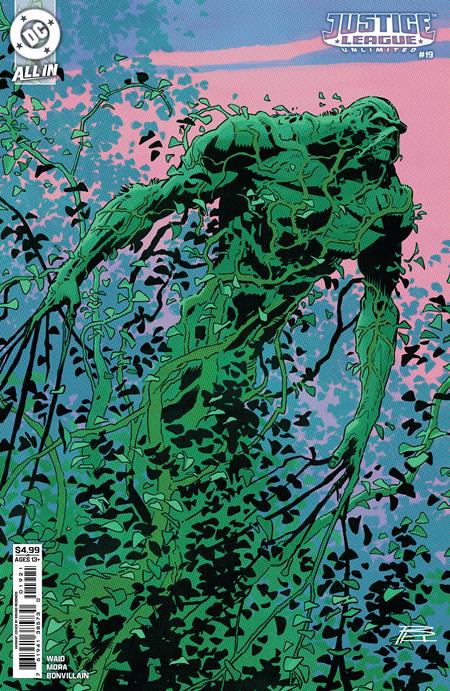
Nicely done. Bruno can add himself to the list of Redondos who draw a good Swamp Thing. Now Swamp Thing himself isn’t featured in this issue’s story (unless he’s in the background somewhere that I missed), but it’s enough to know that he’s a card-carrying member of the Justice League now. Just as Wein and Wrightson intended.
BREAKING NEWS…
…from The Comic Reader #87 (July 1972):
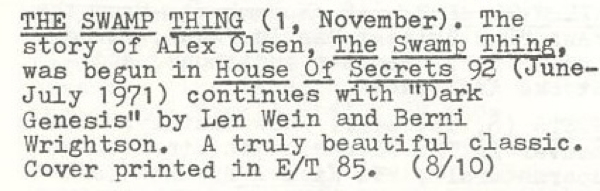
Well, kinda sorta but not exactly on the “Alex Olsen” tip there. That particular connection to this new The Swamp Thing won’t be established for another decade or so.
Anyway, don’t forget to check out the latest Ant Man news, from The Comic Reader #90, October 1972:
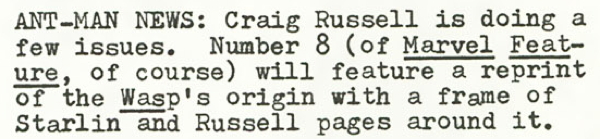
From the July/August 1976 issue, #133, comes this exciting news. NOTE: don’t hold your breath for it.

And finally, from May 1976, #130 of Thge Comic Reader comes the news that Marvel is working with George Lucas on doing comic book tie-ins to his Star Wars movie.
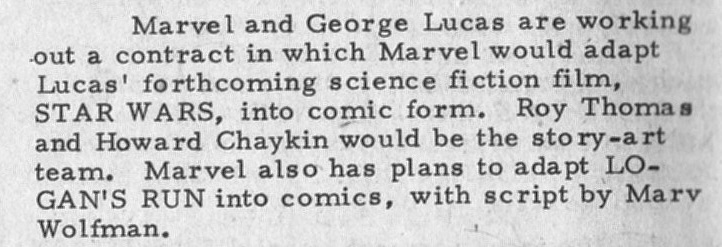
Well, we’ll see how that goes. My money’s on Logan’s Run, though.
Just don’t ask me how that new Ultimate comic is selling.
Wayne queries
“[Another store] will keep as many back issues as they can, I can’t travel anymore, but I know this from THE WALKING DEAD and a few others back in the day.
“But keeping copies of ABSOLUTE BATMAN #1 in its tenth printing mean anything at all to a collector? Though I’d bet you only go back to maybe #15 now.
“Or is it that you’ll still get new customers.Buying the trade and then finding more recent issues on the racks for them to buy means you continue to get more people buying the book and possible other Absolute books?”
Believe it or not, Wayne, whatever issues in whatever current printings I can get of any of DC’s Absolute line go on the new comics rack. As of right now, especially after the restock I received earlier in the week, I have nearly every issue of Absolute Batman on the shelf, from the eleventh printing of #1 all the way to the most recent issue, the “hideously mangled” #20, plus the Ark-M special the and the annual. Note that’s not every issue, as I’m currently out of one of the issues in the teens, can’t remember which at the moment, but as soon as it’s reprinted, I’ll have it in!
And it’s a good sales tool to have ’em all on the shelf like that, as it attracts folks who have heard of these comics but don’t want to dig deep into their pocketbooks to splurge for the trade paperbacks. They sample a first issue, maybe a second, then come roarin’ back for all the rest. Having them all up and on display makes for an impressive sight, and certainly encourages sales from the curious.
Mostly, this is working for the main three, the Batman, Superman, and Wonder Woman titles, which probably isn’t a surprise, and those seem to be the titles that get the most reprintings. Absolute Martian Manhunter is probably the next in demand, followed by the relatively low (but still present) demand for Absolute Green Lantern and Absolute Flash. (And for anyone wondering, the newly-released first issue of Absolute Green Arrow is selling quite well for me, thank you.)
I’ve said multiple times I’ve never back issued any of the Absolute line, but strictly speaking, that’s not true. I did have a copy of Absolute Batman #1, first printing, that had a color-breaking corner fold on the front cover that I’d set aside and completely forgotten about until well after the book was determined by the comics-noscenti to be a Hot Item, when I found it again. Priced it up (probably well too cheaply in retrospect), put it in the New Arrivals back issue bins, and watched it get purchased and carried away by a grateful customer, holding it aloft upon a silken pillow.
Are these taking up space on my new comics rack? Well, yes. Even with the Gigant-o-Rack that I have taking up an enormous amout of wallspace in my store, the Absolute comics consume a lot of real estate. However, in terms of space used vs. dollars made, it’s well worth it. And given this is one of the few Big Hits the American direct comics market has, actually bringing in new readers excited about picking up monthly single issues, I happily will devote the space to them.
Is this something I can keep up forever? Or is this something DC Comics can keep up forever, maintaining the backlist of single issues of the Absolute books in print in perpetuity? Honestly, I don’t know which will give first…my shelf space, DC’s continuing willingness to go back to press, or trees. Right now it is in DC’s best interest to keep printing these comics so long as there’s this sort of demand, and it’s in my best interest to keep them displayed and available, so long as they’re getting new customers and making money.
Realistically, I can’t keep ’em all on display forever. I’m already overlapping the issues on the shelves so that I can still make room for other new comics. Or else I just devote the entire rack to nothing but Absolute books, and put all the other releases in a short box by the register witih a sign that reads “MISC. NEW COMICS.” But I haven’t quite hit that day yet.
Now Wayne, funny you mention the “does a tenth printing of Absolute Batman #1 mean anything to a collector” thing, as I was just talking about that with a customer the other day. I mean, technically, the later printings do generally have smaller print runs than the first printings. Thus, they are in shorter supply, which could mean, I guess, higher prices should demand arise. Now, it’s not likely now that the printings are in the double digits, but who knows?
This does happen in the real world on occasion. I forget which issue exactly, but there’s like a second or third print of an issue of Ms. Marvel that goes for dumb money, and those later printings of The Killing Joke with the differently colored embossed logos tend to be pricey since they’re not always easy to find. I don’t remember the last time I saw the blue-embossed eight printing, for example. And I haven’t really checked, but I’m sure the earlier reprintings of some of the Absolute books, especially the Batman one, are gaining some pricing traction.
Those are the exceptions rather than the rule, as decades of comics collecting and pricing have told folks that “reprints aren’t as expensive as first prints.” So no, that tenth, or even eleventh, printing of Absolute Batman #1 is unlikely (but not outside the realm of possibility) to get collector demand and go for premium prices. Its real value is in getting new readers to try out comics.
My Fantastic Four-ay: Part Eight.
And so it came to pass, in the mid-1980s, that John Byrne wrapped up his five year run on Fantastic Four, as reported here in the March 1986 issue of The Comics Journal:

(Please forgive the pixelation, as I increased the size from the source image from here.)
It’s all very…politic, with Byrne’s “on everything” seemingly bearin a lot of weight, especially in light of some later interviews. The Comics Journal mentions instances of editorial interference on some of Byrne’s books in then-recent months, such as pages of Fantastic Four #286 being redrawn, and an issue of his Incredible Hulk run being pulled from publication*.
A link found on this page shows up this 2005 Comic Book Resources interview, now accessible at archive.org, where Byrne says
“JB: A lot of factors, most internal office politics, contributed to my finding myself in a position, creatively, where doing the best work I could was simply not good enough. Not for the FF, anyway. I fear I am one of those artists who is heavily impacted by the environment in which he works. The work suffers if I am not happy, and in those final years of Shooter’s reign, I was most definitely not happy!”
This 1999 interview on Sequential Tart (linked at the same Fandom page) adds the detail that he’d likely reached the end of wanting to work on the title:
“JB: Six years on the same book, basically. That works out as a long time, even when you love the characters as much as I love the FF. It simply started to get old, and, around the same time, things in the office got dicey, and I used that as an excuse to leave.”
In the Comics Journal article, he notes that he’s still open to working for Marvel, even though the only work he had going at that moment was the covers to the Official Handbook to the Marvel Universe Deluxe Edition covers (which he leaves after #11 from October 1986). But, at that point he had his Superman reboot gig over at DC Comics (which he also leaves after about a year, but that’s another story).
I was reading the ‘zines at the time, as well as the Marvel books Byrne was working on, so I knew about the abrupt departures and editorial shenanigans that may or may not have brought Byrne to his decision.
And it was abrupt, as Byrne started a multi-part story in what would end up being his last full issue, #293, which I talked about last time. A huge bubble covers a city, and the FF enter to find that time passes much more quickly inside than outside, resulting in centuries having passed. Also in the issue, Kristof (the young boy programmed with Doctor Doom’s memories) is briefly shown, setting up threads for a possible future plotline.
But with #294, Byrne was no longer writing or drawing, and credited only with the plot as Roger Stern took over scripting, with Jerry Ordway and Al Gordon on art chores. With #295, the conclusion to the story, Byrne’s contribution is reduced to a “special thanks” in the credit box.
To be honest, as creative team transitions go, this was an easy one to make. Roger Stern is of course an absolute pro, and can write entertaining superhero comics with the best of them. And the art team of Ordway and Gordon is a pleasure to look at:
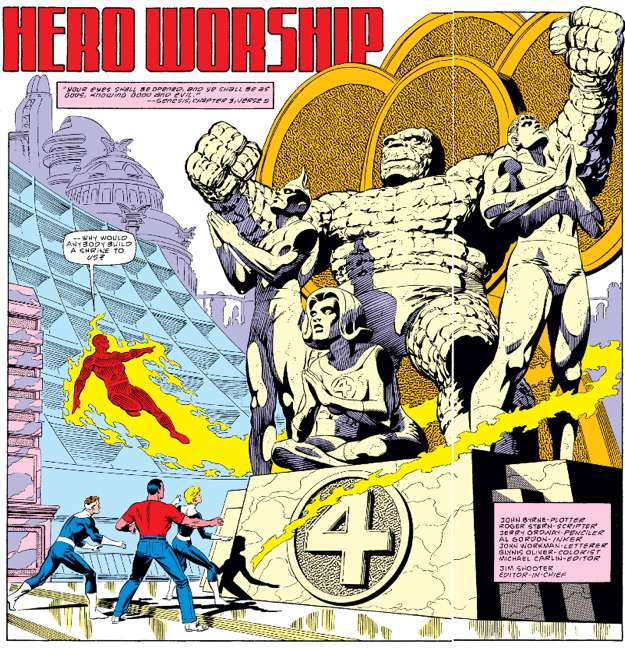
Whether it was due to the influence of Byrne’s plot or not, these two issues following up on the opening chapter for this story very much retained the look ‘n’ feel we’d been accustomed to during Byrne’s run on the book. Maybe the art was a little more smoothly refined compared to Byrne’s own self-inked work (which, don’t get me wrong, appealed greatly to me), but certainly of a piece compared to the art in Byrne’s later issues that was inked by others (including Ordway and Gordon, in fact, adding to artistic continuity). The overall tone of the story felt familiar to what we’d been reading for the previous half-decade, so the pain of losing one creator was mollified by the excellence of the replacements.
And so, I thought, that was that. Things were going to be fine. We were still getting our regular dose of John Byrne over on the Superman books, and this swell replacement team of Stern, Ordway and Gordon were going to be knockouts on the FF.
It didn’t quite work out that way, alas. Stern would stay on the book for a bit, though with a different, if fascinating, art team, and the title would slowly move away from the Byrne era of The Superstar Creator Doing His Thing and more toward something a little more…traditional, maybe? While still dealing with the repercussions of what had gone before.
It was an interesting time for the team, and while I had primarily stayed on the book for Byrne’s work, I found myself wondering how Marvel was going to follow that act. Thus, I stuck around for quite a while after his departure to see what they’d try next. And while Stern and that Mysterious Art Team (that you can totally Google, I don’t know why I’m being coy about it) would give us some readable entertainment, we had a giant anniversary issue in #296 to get through first.
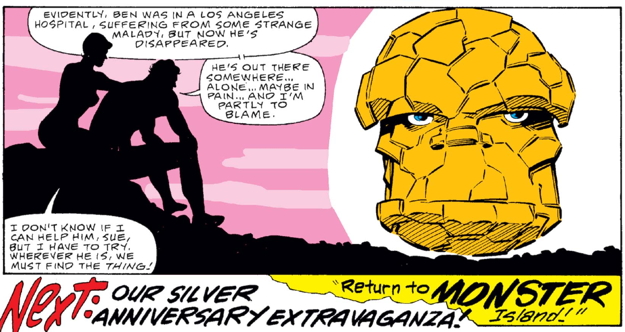
And, hoo boy, it’s certainly somethin’.