[SPOILERS for Doomsday Clock #12 ahead]
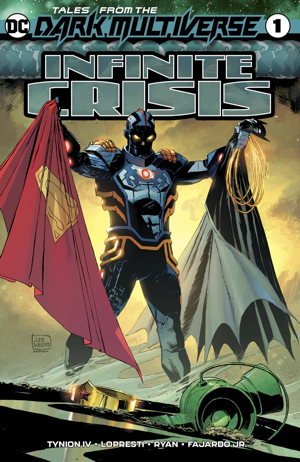
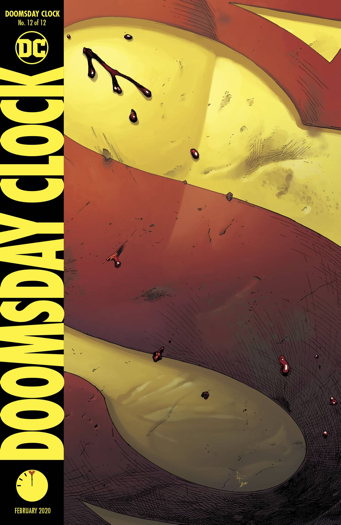
Last week saw the release — finally — of the last chapter of Doomsday Clock, the extremely popular sales-wise, if internetally-reviled, mini-series intermingling Alan Moore and Dave Gibbons’ Watchmen with the mainline DC Universe. While it feels like DC was pushing this new series as being somehow on par with the original, and while it did superficially ape the look-and-feel, Doomsday Clock will probably ultimately be remembered as “hey, remember that one time DC superheroes were in a comic book that also featured full-frontal male nudity?”
Not that it wasn’t sort of fun and intriguing…the series itself, that is, not just the full-frontal male nudity, though that was sort of amusing in its own right just by how uncomfortable a fit that was with what is basically your standard superhero fare. (As the boys on War Rocket Ajax have pointed out, having Dr. Manhattan’s Lower Manhattan right there for Mary Marvel to see is…something else.)
Anyway, the “fun and intriguing” part. Right. I’ve noted (and demonstrated several times) on this site that I have an ongoing fascination with Watchmen ephemera, the mostly unsupported-by-the-creators tie-ins and exploitations of the property. Doomsday Clock, obviously, is one of those things, yet another bullet point in that long list of what Watchmen has wrought. And while I read and followed along with the story as presented, I have to admit my primary interest wasn’t so much in said story but how they told it, what decisions were made to mix what elements of each milieu and to what purpose. It was the observation of the construction of Doomsday Clock to serve whatever specific purpose it was serving that intrigued, more so than whatever plot threads were offered.
Even so, I do like the idea of “the metaverse,” the idea that the DC Universe reconstructs itself around the continual reinvention of Superman to reflect whatever time period in which he’s published…basically, I’ve been observing the construction of a comic book that itself observes the construction of the fiction in which it exists, which I can’t help but appreciate. I suspect the very same point could have been made without involving the Watchmen characters, but by grabbing remora-like onto the former series for the attention it would bring, perhaps the hope was that the results of this particular event series may have more staying power than most. It would be nice to think that this could be the last word on reboots/relaunches in the DC Universe, that, like the idea of Hypertime before it, anyone reading comics long enough to notice significant changes in continuity should just realize that the in-universe explanation is that “it’s just a thing that happens, man” and requires no more thought or finagling than that, really.
Interestingly, the story itself seems to acknowledge that may not be the case, hypothesizing future “Big Event” series in the DC Universe for decades to come (including, amusingly, at least one that involves the Marvel Universe). Implicit in these Big Events is the idea of providing more in-universe explanations for whatever is happening to the fictional universe at the time due to real-life marketing and editorial decisions…to borrow a turn of phrase from a certainly naked blue guy of some note, “nothing ever ends” — even with the metaverse explanation, more explanations will be forthcoming, regardless.
A week or so ago on the Twitters, I did a short thread about the impact of big crossover event comics at Marvel and DC. Mostly, I was pointing out that Marvel Super Heroes Secret Wars promised big changes that were mostly temporary (Spidey’s black costume possibly being the most significant exception), and even those initial promises were downplayed by the writer himself. In contrast, DC’s contemporaneous Crisis on Infinite Earths promised and delivered big changes…but then spent the next decades backpedaling from what they had done, ironically making its fictional universe far more complicated and convoluted than the previous state of affairs Crisis was supposed to fix.
I wrote a bit about the big changes these series supposedly bring about a couple years into this blog, where you’ll see those same Shooter quotes again, so I don’t need to go into that in too much detail. Crisis, certainly, was the most successful in creating lasting changes, in that it pretty much futzed everything up from then ’til now, with several more series (from Zero Hour to Infinite Crisis to the one being discussed in this very post) trying to deal with its aftereffects. It would be nice if Doomsday Clock‘s “metaverse” idea held fast, changing the way we approach the way this shared universe works, accepting the changes without metatextual event series explaining why the changes, but as I said, even Doomsday Clock itself admits this is futile.
The other big change is that we now have the Legion of Super-Heroes and the Justice Society of America back, but that’s more the reestablishment of a previous status quo…a rolling-back of changes that, again, can be traced back to that original Crisis. There are also some small character bits, too, primarily to Superman’s history and supporting cast, which is fine, but the recasting of Martin Stein as a villain who deliberately created the events that brought about Firestorm kinda stick in my fanboy craw, but What Can You Do?
Possibly the biggest change is that the barrier has been breached: Watchmen characters are fair game for use in the DCU. I mean, they can’t piss off Alan Moore any more, right? I know at some point somebody probably paid some lip service to “this is an important event” and “we don’t use these characters lightly” but I’ve mentioned the idea of Rorschach Team-Up before and I think we all know it’s coming. Plus, there’s that eyeroll of an ending to this series to which someone will not be able to resist slapping together a follow-up. With Before Watchmen in 2012, and this series starting in 2017, I’m guessing Doomsday+1 Clock we can look forward to in the early-to-mid 2020s.