Well, this went off on a tangent.

Robcat17 says

“And as much as I may question your Swamp Thing collection, I will buy Legion of Superhero books… every reboot, every time Giffen kills Karate Kid, I’m there. Which makes me ask other collectors ‘What’s your “sucker” book?’ You know the one. It may be bad, but you buy it anyway because you’re hopeful, or loyal, or whatever… but you really just love the character…”

You are indeed wise to question my Swamp Thing collection. No reasonable human should own a pair of these.

But yeah, “sucker books,” I get that. I’ve followed many a character through, shall we say, rough times, simply because that character was a particular favorite of mine. It goes without saying that Swamp Thing is one of those characters for me, though fortunately there have been very few Swamp Thing comics over the years from which I haven’t derived any entertainment value. Yes, there have been some stinkers here and there that I feel no need to revisit, but, eh, no biggie.

An example of a book that I kinda stuck through for the entire run despite things going, well, I won’t say “bad” but “not entirely to my liking” is the second Firestorm series, the one that run 100 issues. I used to say “the first 20 were good, the last 20 were good, the middle 60…um, maybe not so much.” But did I continue buying through that 60-issue slump? Oh yes I did, because I sure liked Firestorm, and though I didn’t much care for the stories they were in, I was still interested in what was going on with Ronnie and Martin (and Cliff).

To be fair, I’ve softened a bit on my opinion on those middle issues. I still bought them, I still enjoyed them, even if I thought they weren’t quite up to the standards of the entries at either end of the series. And I still have them…when the time came to populate the back issue bins in my store with material from my own collection, the Firestorms I kept. Maybe a big chunk of them were dopey comics, but they were my dopey comics and part of my life, a monthly ritual I followed from that first issue in my grade school days until that final issue came out when I was in college.

And I’ll still buy Firestorm whenever he (or they?) turns (or turn) up. But the main impulse, to follow a character, is somewhat undermined by the various reboots/relaunches that have happened. I followed the ongoing subplots and development of Ronnie and Martin in Firestorm, even through the lean years, because I liked those characters and wanted to know what happened to them, how each incident in their lives built on each other and moved forward. The reboots etc. break that chain…suddenly a character can be back at square one, all previous development removed from the story, and my need to see where things go is lost.

Now, it can be done and still maintain reader involvement. The mid-80s reboot of Superman kept my interest, and even as creative teams changed and fictional universes got fiddled with, it still felt like I was following the same character that got re-introduced in Man of Steel #1. The New 52 initiative kinda broke that line for a while, but it’s kinda come around again with, well, more universal retooling shenanigans, and while not quite back to where we were with Supes, it at least is within spitting distance.

One place where it didn’t work with me was the Legion of Super-Heroes, which I read for years and years and years and through a couple of reboots (both soft: the Five Years Later thing – and hard: Zero Hour)…and then finally the New 52 relaunch was just one new beginning too many. I’m willing to give the new Legion of Super-Heroes title a try, but….

…Well, sometimes I’m at war with my own nostalgia and that can get in the way of reading a new take on a character (or team of characters) that I like. Yes, I would like some consistency to the characters that I follow. But no, I can’t honestly expect everything to be of a piece with a comic I read 20, 30, 40 years ago. Things change with the times, and concepts have to be retooled to be appeal to current audiences, even if that retooling means casting away the old to make way for the new.

The way the Superman comics were done, I still feel like I’m reading the same guy (with a couple of exceptions) that’s been around since the 1980s. Legion of Super-Heroes, I feel like maybe they bent it ’til they broke it, and they lost me. Maybe they’ll grab me again with this new run, I don’t know.

Anyway, that got a bit away from Robcat17’s question, maybe. I think what I was trying to say is that a seeming consistency (if not necessarily explicit continuity) of the characters can be enough to carry you through any quote-unquote “bad” comics they may appear in. When that consistency is disrupted, suddenly it’s harder to tolerate even what was once a favorite character in a comic you don’t care for.

I’m probably way overthinking this. And I’m aware of the irony of ballyhooing the seeming consistency of the Superman character starting in ’86, given that one of thee main complaints about the Superman relaunch then was that this new iteration didn’t feel like Superman. For some people, that Byrne reboot was the disruption in the line…”this isn’t the same character I irst started reading in 1938!” …Hey, you don’t know, it could have happened.

Thanks for reading…whatever that was. I’ll get back to more of your comments and questions soon.
So if this year is Marvel’s 80th anniversary, that means their 25th anniversary in 1986 was 55 years ago.

Not to get all Inception on you, but I’m going to address some comments made to a post where I was addressing your comments from a previous post, before returning to responding to more comments from the initial post. Got it? Good.

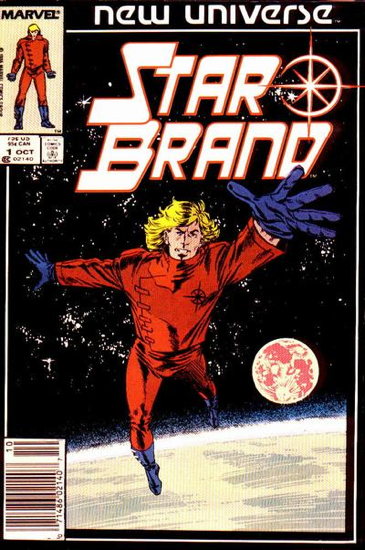
Anyway, I wanted to say just a few words about Marvel’s (or editor-in-chief Jim Shooter’s) “New Universe” publishing initiative, in which on the event of Marvel’s 25th anniversary (counting from the publication of Fantastic Four #1) they were going to introduce a whole “new universe” (hence the name) of superheroes completely unrelated to the shared world with Spider-Man, the Hulk, etc. The tagline was that this would be “the world outside your window,” with a somewhat more realistic take on what supeheroes would be like and what impact they would have on the society and people around them. Even the time scale in which the comics operated was “real time,” with a month passing in story time between each monthly issue. (Not sure how long that was kept up, to be honest.)

This dovetails nicely with a post I made recently about “realism in superhero comics, and I’m sure much of New Universe’s inspiration was informed by the success of Watchmen and Squadron Supreme. Star Brand, the one NU title I followed all the way through, had several examples of this sort of thing, such as pointing out a superhero costume wouldn’t really hide one’s identity very well, or the main character getting lost while flying around…little things, but details that commented on that nature of the genre.

Like I said, Star Brand was the one I kept on with, though I liked early issues of D.P. 7 (a superhero team) and tried out an issue of Merc or two. Star Brand, being the work of the NU creator Jim Shooter, would probably be the title that most exemplified what the whole imprint was about…at least in my opinionl, since as noted I didn’t really read too many of these titles. But it did try to tell a superhero story in a different and unconventional way. The hero’s “costume,” as such, was kinda drab, the hero himself wasn’t exactly the sharpest knife in the drawer, as I recall…at the very least, he was a flawed human and no paragon of perfection. He even flew funny, in an upright, “standing” position instead of the usual “one fist forward” Superman pose. Even when John Byrne took over the book for the final few issues, and it began to look like a somewhat more conventional superhero comic, it still underminded the genre here and there, even if seemingly biting a particular plot point from Miracleman.

Even the trade dress of the comics was unusual, at least for the initial couple of years, with each cover framed in a black border, like they were in mourning for something. It gave everything a sheen of solemnity, that this wasn’t some flashy comic with dudes punching each other. It was something different, something somber, with dudes punching each other realistically. Or perhaps the more obvious interpretation was that black frame was a window frame, tying back into the “world outside your window” concept…you’re lookiing through your “window” at the New Universe that’s outside it.

The imprint was shaken up a bit with The Pitt (not to be confused with, well, you know) in which “the world outside your window” was distanced from the New Universe with the destruction of Pittsburgh. And then that was follwed by The Draft™ and then The War™ and my sense was that emphasis was less on keeping the New Universe “realistic” and more “something customers might keep buying.”

Anyway, the imprint eventually came to an end, with the last issues of the series reading “# [x} of a [x]-Part Limited Series,” which was sort of clever. And that was that, ’til elements of the New Universe started to creep into the regular Marvel Universe (a crossover that was once verboten). It started with some stuff in Spider-Man 2099 and in Quasar early on, and continues even today, with reboot series and character appearances and such.

I don’t think the original New Universe was a bad idea…kinda beat the big rush to everyone starting up their own “new universes” a few years later during the Big Comics Boom/Crash. And I think, in a way, the “Ultimate Universe” was a continuatino of the idea with marginally more realistic/deconstructive takes on the standard Marvel heroes. Of course, it ended the same way, eventually petering out with shake-ups to the premise and then getting folded into regular Marvel Universe continuity. But what probably did the New Universe in wasn’t necessarily the execution, but the rejection of Marvel fans to buying new Marvel comics that weren’t part of the regular Marvel universe they’d been following. I mean, sure, the Ultimate Universe books did fine at first, but those featured the familiar characters…this was a whole new batch of weirdos and unless they were going to fight Wolverine at some point, why bother reading them?

Or maybe it was the execution. A couple of them were pretty bad.

Now this all started prior to my entering the world of comics retail in 1988, so I don’t know what initial sales/customer reaction was like at the shop. I’ll have to ask former boss Ralph when next I see hiim…or maybe I can finally start going through these stacks of ancient invoices he passed along to me for research purposes, now that my eyes are a little more up to the task.

In the meantime, you should at least read John’s comment explaining his Spitfire #1 collection.

Maybe I’d collect every copy of All-Star Batman and Robin the Boy Wonder. You know which one.

So y’all left a lot of good comments on last week’s post about being a comic book completist (and I continued on a bit in a second post). Thank you for participating…sometimes I feel like we’re kind of past the heyday of people wanting to leave comments on small hobby blogs like this one, but every once in a while you folks come through and remind me “hey, sometimes people actually read my site!” So, thanks pals.

Anyway, let’s dig into some of those comments from that initial post and see how much typing I can do around them:

Thom, the fella what started all this in the first place, had this to say:

“For the record, I knew that completism was a thing, but I had no idea Swamp-Thing completism was being practiced by more than one person.”

Oh, sure, sorry about implying otherwise. But yeah, I’m not the only Swamp Thing completist out there. I’ve encounted a few through the years, online and in the respective shops I’ve worked at. Granted, not many completists have gone so far as to get Swamp Thing Chalk, but more have than you might think! But I gotta be one of the very few to have this.

• • •

Brad Walker strolls in with

“So have you ever talked about Richie Rich and Casper #1?”

Ah, you mean how Casper is clearly the departed spirit of Richie Rich, condemned to roam the mortal world until he has sufficiently counterbalanced his excessive avarice in life, therefor the two of them appearing together in one adventure is a blunt expression of Harvey Comics’ belief in the dualism of mind and body?

Or is it the “swamp creatures” thing in that first issue you linked? Yeah, on second thought, it’s probably that. Well, to be honest, while those monsters are clearly planning to eat Richie Rich and thus certainly have my sympathies, but that doesn’t really trigger the “swamp monster collector” instinct in me. I suppose I want something a little more…Swamp Thing-ish, I suppose, more green and humanoid and/or transoformed by science goine awry, as opposed to a couple of critters that just happen to live in a swamp. A fine line to draw, I understand, and probably exposes something disturbing about me psychologically,, but this issue just doesn’t float my airboat.

• • •

The infamous John Lancaster had more to say, but I wanted to focus on this bit:

“One that I may have mentioned here before; collecting every #1 issue of Spitfire and the Troubleshooters. As of my last count and based on publishing records, I own approximately 4% of the print run on this one. It’s not because I love that character or anything, I just want to wipe their existence off the earth. It’s basically a Scrooge McDuck gambit.”

Whoa nelly. Imagine finally getting all extant issues of this in one place. Just mountains of Spitfire, taking up every room in the house, filling the bathtub, falling out of the attic, stacked around the Ford Festiva in the garage, etc.

But even that’s an aspect of collecting I’ve come across once or thrice over the years, with folks trying to buy multiple copies of the same issue. I mean, aside from the investment side of things, I saw that a lot during the ’90s boom. Or, you know, whatever the hell was going on here. I mean, just got a wild hair to get, say, every copy of the “Spore” issue of Iron Man, as Mag ‘n’ H were trying to do at one point over at the Comic Treadmill. Or the customer I have now who’s way into Green Lantern, and wants as many copies as he can get of the 3-issue “Emerald Twilight” series.

I can’t say I’ve ever wanted to do that, myself. I mean, sure, I guess it would be a little funny if I bought every copy of Swamp Thing #24 I could find…just, like, corner the market on them, be the world’s ultimate collector of Thrudvang, but…yeah, nothing’s ever tickled my fancy that way. …I seem to remember former employee and old pal Rob decided he was going to get every copy of the Art Adams “Fin Fang Foom” trading card from the ’91 Marvel set. I helped him with that a bit, that’s probably as close as I’ve come.

• • •

Andrew Davison schools us on

“In the past I’ve used GCD to search for a character’s appearances.

“Any top tips for finding comics on a theme?”

That is admittedly a bit harder. Other than looking at hundreds of comic book covers nearly every day, like I do, perhaps you can plug in various keywords into the Grand Comics Database’s story title search function. Or if you’ve got time to kill (and who doesn’t, we’re all swimming in free time) you can just poke through the various cover galleries of likely titles there. Yeah, that’s kind of a crapshoot, but you never know.

Also, there are plenty of blogs and Tumblrs and, um, Myspaces, I guess, out there where folks have already done the work and pieced together their own lists of comics that cover their specific interests. That’s my guess, anyway…I don’t really know, I don’t go on the internet.

• • •

Paul Di Filippo (a fella who himself isn’t unfamiliar with swamp critters) wades in with

“What?!? No love for swamp monster Solomon Grundy?!?”

I ain’t got no beef with Mr. Grundy, no sir. It’s easy to forget that he fits right into the genre of “man transformed by science and/or magic into swamp beast” since he isn’t, y’know, green. OKay, he was getting a bit green in that one Swamp Thing story, but that was pretty much it. I talked about his first meeting with Swamp Thing not too long ago, and I’ve mentioned a couple of times how DC wanted Grundy to fill Swamp Thing’s niche in the DC Universe (as Swampy was tied up over at Vertigo) and put out a series to do just that.

But despite the connection to Swamp Thing, I never felt obligated to add “all appearances of Solomon Grundy” to the collection. That would being getting some pretty pricey early comics there. And I think I’ve bought ‘n’ read a sufficient numbers of more recent appearances so…I’m probably good on the guy for now. I won’t say no to future comics, but I’m probably not going to be dipping into back issues to fill holes in that particualar accumulation. Sorry Paul!

• • •

Eep, that’s a lot of typing. Okay, back soon with more. Leave more comments on that first post if you’d like, and of course read everything everyone has to say there. Lots of good comments…remember when comments were good? Now you can relive those halcyon days right here on Progressive Ruin Dot Com.

I think this blog can stand at least one Walt Simonson appreciation post every decade.

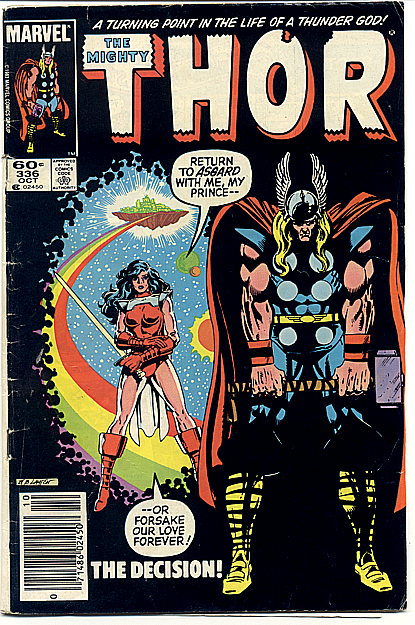
So I recently took in a few short boxes of, shall we say, well-loved comics from the ’70s and ’80s that I’ve been going through and pricing cheap cheap cheap, and in there was this comic:


This is Thor #336 from 1983, probably best known for being the issue before the following month’s #337, with the beginning of Walt Simonson’s highly-regarded run on the title. (I wrote a bit about that, eep, 12 years ago.) It’s a cover I’d seen plenty of times, over and over again, mostly at the previous place of employment. And it did sell, on occasion…it’s, I think, weirdly a connected artifact to the Simonson era, if only as an example of what had come before Beta Ray Bill was on the scene.

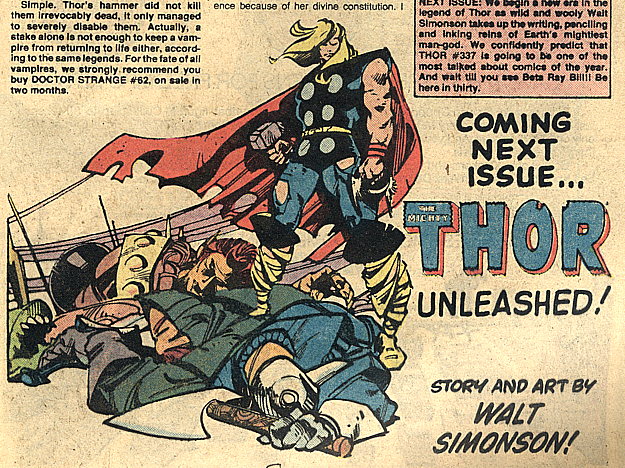
Though perhaps, if you’re a completist, to bring up a topic much discussed on the site this week, you may want #336 for the ballyhooing of the next issue featuring a piece of Simonson’s art:


To be honest, I’ve never read #336, despite seeing it plenty. In fact, I still haven’t really read it, despite that very copy pictured above currently sitting on the desk next to me as I type this. I mostly just kinda flipped through it, trying to get an idea of what Thor ‘n’ pals were up to before the big Unleashing of Thor, as per that letters page ad.

I actually hadn’t read much Thor prior to picking up that first Simonson issue…I think mostly just whatever was in the old Origins of Marvel Comics paperback (and if anything was in Sons of Origins). Simonson was, more or less, my introduction to the character. I knew the basics from reading the origin in that paperback way back when, and maybe saw him in some comic or ‘nother as I expanding into sampling various Marvel comics, but hadn’t really had any Big Thor Action via his own book.

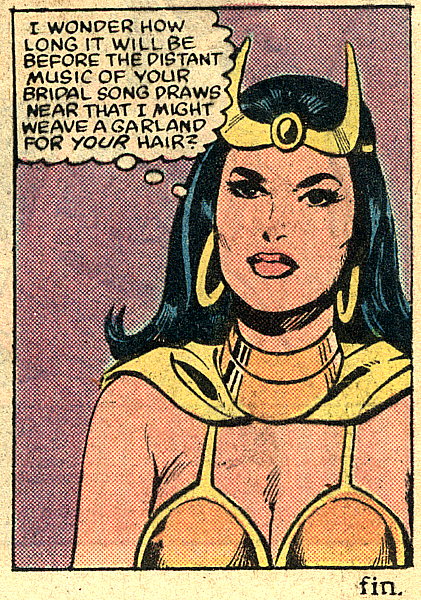
Anyway, looking through #336, I can really see the contrast between what had been coming out and what Simonson was about to serve unto an unsuspecting public. Like, this is the last panel of #336:


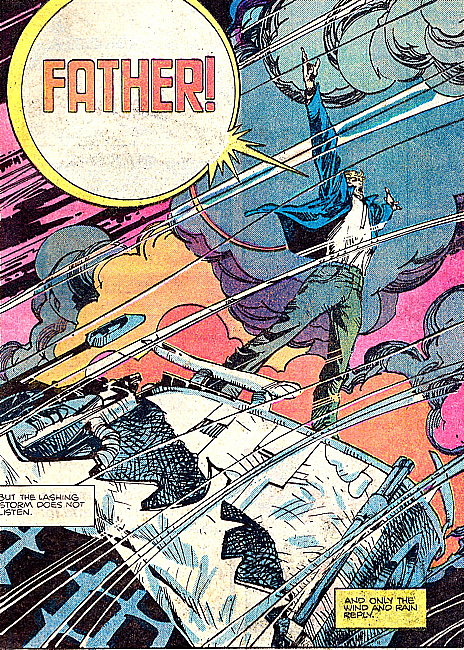
…And then, suddenly, this is the last panel, or rather full-page splash, of #337:


Hokey smokes, hold on to your winged hat because ol’ Walt’s got a roller coaster for you to ride.

Okay, this isn’t entirely fair, I’m comparing golden apples with…well, regular apples, I guess, here…one’s the concluding panel to a mostly low-key Marvel-style soap opera-esque thingie, with Thor’s mom being wistful and worried about her son’s love, Sif. And it’s the second of two stories…the first ending with Sif being kinda sad about Thor’s double life as a regular human taking him away from her. Basically, an issue of mostly quiet character conflict.

As opposed to that #337 ending, which is meant to propel you into more action after hitting you with a bunch of action already. It’s the big ol’ beginning of an adventure, not the downbeat ending of characters at emotional odds. Not really trying to say anything was “bad,” as such, just pointing out the contrast. What Simonson was doing was just so different from what had come before…only the Thor comics by Kirby himself (which I had read since experiencing Simonson’s run) could compare to the new visual excitement that was brought to this book.

I like Simonson’s Thor run, is what I’m saying. A big, hold, dynamic presentation that didn’t skimp on actual storytelling…again, not trying to diminish anyone else’s work on the character, but Simonson sure upped the ante for tales starring our Thunder God. Even thirty years on, Marvel still dips into the richness of that run for stories today. Even good ol’ Beta Ray Bill is still around, which would probably shock those Thor fans back in ’83, reading that #337 and wondering just what the heck was going on.

Special thanks to Bully, the Little God of Stuffing, for production assistance on this post!

Actually now I kind of regret not getting that Swamp Thang comic.

So to continue from my last post, there are other aspects to my Swamp Thing collecting that I neglected to mention.

1. FOREIGN EDITIONS: I mean, sure, when I can find them. I have Swampy in handful of different languages, some I can kinda sorta read, and others I can’t comprehend at all. I still regret missing out a bunch of first series Swamp Things on eBay that were published in Mexico during the ’70s. Ah well. But I’m generally open to buying any of these that I can find.

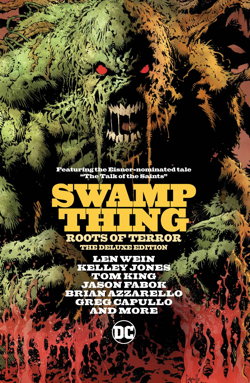
2. REPRINTS: Nowadays “reprints” generally means “trade paperback collections” or “hardcovers,” and I usually don’t buy them if they’re just duplicating content I already own. I’ve made exceptions, like the recent Roots of Terror hardcover collecting together a bunch of one-shot stories in one place. But generally, if it’s just, say, a straight reprinting of issues, unless there’s some kind of new content, I’ll probably pass.

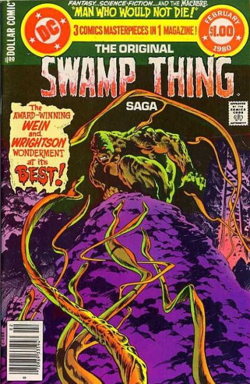
Now I did get that Bronze Age omnibus because it was the first time a lot of that material had been reprinted, and on nice paper to boot, like the Pasko/Yeates run, the latter portion of the original series, etc.

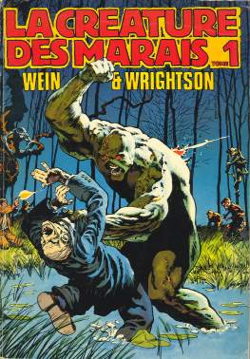
Iin the early days of my Swamp Thing collecting, like I mentioned last time, I did buy the comic book reprints DC had published of the original 10 issue run by Wein and Wrightson, partially because of new covers on the first two collections, and partially just out of the need for gettin’ ’em all. And, of course, I will keep buying reprints of House of Secrets #92 just because it amuses me to do so, and nobody’s been able to stop me.

3. PARODIES: Not that there’s been too many, but Swamp Thing parodies do pop up now and again. I generally buy these as I see ’em, though I admit to passing on the Spoof Comics Swamp Thang one-shot [COVER MARGINALLY NOT-SAFE-FOR-WORK] which was perhaps a little too far off from the character it was parodying. I did, however, totally get this Mighty Mites issue.

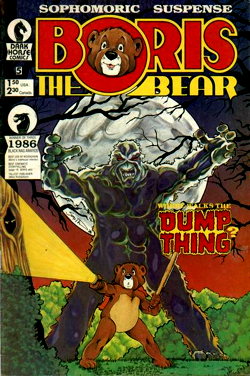
There haven’t been a whole lot of parodies of Swamp Thing over the years…or maybe there have been, and you’re all just hiding them from me to spare my feelings. In general, I’ve been pretty lucky as they’ve just turned up in things I was already reading, like Cerebus or Boris the Bear and so on. But I keep my mostly-working eye open, in case any others turn up.

So anyway, that’s that. Folks have been popping up in my comments section for that last post talking about what and how they collect, which has made for some good reading, and I encourage you to join in. I’ll probably go back and respond to some of those comments in a future post.

My apoologies to regular commenter Turan, who had one of his comments grabbed by whatever algorithm decides to hold entries for moderation…it’s approved now, Turan! He also mentions the Heap stories from the black and white mags of the ’70s have shown up in a print-on-demand collection, which may be of interest to some of you folks, as well as to me. The color comic isn’t included, but that’s okay, I already have it!

Okay, enough SWAMP TALK for today…will return to this topic next week, as I have something else planned for Friday. Thanks for reading and commenting, pals.

I’m also a Fatman the Human Flying Saucer completist.

Thom H. asks, in response to my recent post regarding House of Secrets #92 tribute covers:

“How many Swamp Thing completists are there or do you know of? I had never heard of that type of fandom until I started reading this blog. And I didn’t think to ask about it until I realized there were multiple people into collecting every appearance of ‘ol Swampy.

“I’m sincerely interested in knowing about the different degrees of completism and extensions of that completism to characters like Man-Thing and The Plot (I assume he’s swamp-based, as well?). Does it extend to other characters?

“And it sounds like it includes things like cameo appearances and mentions by other characters. I guess I’m wondering: what are the rules completists use to define the boundaries of their collections?

“No disrespect intended. I’m not a completist of any character, but I do buy multiples of comics I like so I can keep one ‘nice.’ I think all comic collectors have their own ways of collecting, and I’d like to know more about yours.”

Now, longtime ProgRuin reader John Lancaster had his own lengthy response, which I suggest you all read (since I’ve plugged enough quoted material from the comments into this post). I’ll try to answer Thom’s queries best I can, though I doubt my own notorious predilection for excessive typing can match Mr. Lancaster’s prodigious efforts.

First off, completism is a common trait among comic book collectors, even above and beyond the the standard “get every issue of the series” that’s pretty much built into the DNA of the hobby, what with things having issue numbers an’ all. (OF course, in recent years, with many long-running titles having their chains broken by reboots and relaunches, that sort of collection has become less prominent, or at least concerned with gathering every issue of a specific series while eschewing other iterations of the same title.

The “theme” collectors, the ones who want every appearance of a character, or every comic by a certain artist or writer…I’ve encountered many of those over the years, too. The fella who wanted every appearance of Taskmaster. That one guy who wanted to own every comic drawn by John Byrne. There can even be folks looking for things like “every comic where a superhero fights one of the traditional movie monsters, like Dracula or the Wolfman.” Former coworker Rob used to collect Archie comics that featured bowling on the cover. Pal Cully used to get every appearance of the Hulk. Right now I have a customer who wants every appearnce of Iron Fist and that ol’ master of kung-fu Shang-Chi.

So no, it’s not really uncommon. People collect lots of different things for different reasons, and, you know, whatever floats their respective boats. If it makes you happy, what the hell…go for it.

Now for me personally…after coming across Swamp Thing for the first time in the early ’80s, via found copies in a second-hand book shop as well as that proto-Nickelodeon TV show Video Comics. For whatever reason, the character appealed, and I spent a lot of time gathering Swampy appearances, both in his own title and otherwise. Plus, a brand new series, Saga of the Swamp Thing, started around the same time to tie in to what could only be the blockbluster success of that first film, so I had new stories to collect, too!

One of the things that helped was that there were a limited number of Swamp Thing appearancs in comics. Outside of his own initial series, which only ran 24 issues (despite Overstreet mistakenly listing a 25th issue for a few years, which was a little annoying), a couple team-ups with Batman in Brave and the Bold, one in DC Comics Presents, that weird run in Challengers of the Unknown, a cameo in Super Friends, and probably a couple others I’m missing.

One of the first signs this wasn’t just going to be an ordinary collection for me was that I sought out the reprints, too. I mean, sure, a couple of them had brand new covers by Berni(e) Wrightson, but the others didn’t, and besides, they were reprinting stories I already had (or was about to have, once I found those original issues for my collection). So, already, I was on my “every iteration of Swamp Thing” kick.

Eventually I got my copy of House of Secrets #92…I had it in reprint form, of course, but didn’t have my own original one ’til I actually started working at the comic shop in the late ’80s. It was…the worst copy, apparently used as a coaster for a can of shellac, but I had one! Some years later, I managed to trade up for another copy of #92, a much nicer one, sold to us by Jan, a longtime friend of the shop. …As far as I can recall, those were the only two copies that the shop ever saw during my tenure there.

(QUICK ASIDE: Former boss Ralph used to tell the story of going through some dealer’s quarter boxes at a convention he was working at sometime in the late ’70s. He went through most of the boxes, not finding much, stopping before he finished going through them. A day or two later, when the con was about to wrap up, Ralph gave those same boxes one last shot…and in the back part of the last box, there was a copy of House of Secrets #92, which had apparently eluded congoers the rest of the weekend.)

As to the topic of being a completist to the point of cameo appearances and such…well, yeah, sure, I do my best. I noted on this site years ago that I was picking up variants on Brightest Day because both covers featured Swamp Thing…even getting a variant Justice League comic because of a cover word balloon mentioning Swampy. So, yes, I was buying comics for even the barest Swamp Thing connections.

However, I made an exception not too long ago. I even made a big ol’ post about it, where I decided I wasn’t going to buy every single Convergence tie-in comic with that one tiny image of Swamp Thing with a woman who was sometimes Abby Arcane, sometimes not. Ever since then…well, I’ve still been picking up Swamp appearances in comics when they occur, as generally they tend to be a bit more substatial than those Convergence ones. Also, due to DC’s multi-cover publishing scheme, I’ve been known to pick up two copies of Justice League Dark because each cover had Swamp Thing on it.

Oh, wait, I thought of another exception…there was an issue of Wonder Woman some time ago which had a 1/100 ratio variant that I didn’t get. One, I wasn’t ordering a hundred copies of Wonder Woman, and wasn’t about to bump my orders just to get my mitts on it. Two, it was crazy expensive on eBay at the time, though to be fair I haven’t checked lately, and 3) as I recall the picture of Swamp Thing was pretty off-model anyway, so I felt no particular rush to acquire it.

So, as of right now, I will still get all comics featuring Swamp Thing as I notice them, though some of the more obscure ones (like dialogue mentions or tiny one-panel cameos or whatever) may slip past me. However, I’m pretty good about picking up everything that has Swamp Thing in an active role or even just decor, I guess (like that one Guy Gardner comic by Howard Chaykin). My limit is probably too much duplicated content all at once, like that Convergence thing I mentioned.

How I eventually ended up getting in Marvel’s own muck-monster, Man-Thing…well, I don’t really recall. I probably just thought “huh, another swamp monster, I’ll check it out” and that was that. I was something of a completist on Man-Thing as well, picking up all his early appearances, though I didn’t try to maintain a collection of all newer appearances. I picked some up here and there, as they caught my eye, but I wasn’t grabbing everything like I was with Swamp Thing.

This weird swamp monster thing does get me to pick up other related titles…I have all those nice hardcovers reprinting The Heap, the original muck-encrusted comic character. And there have been other instances, too, like maybe if a swamp monster popped up in House of Mystery or some other horror anthology title. Man, I don’t get it either. I don’t think I’ve ever even been to a swamp.

Like I said above, there weren’t a lot of Swamp Thing appearances to start with. It was like that for a while, especially during that time when Swamp Thing was under DC’s Vertigo imprint, which restricted the character from appearing in the regular line (though he occasionally would sneak by, like his hand in that one issue of Infnite Crisis). Once Brightest Day brought him back to the regular DCU, the floodgates opened and…well, I don’t have it as bad as the poor bastard who’s trying to collect every Batman appearance, but still, it keeps me on my toes.

There’s probably more detail I could go into, but that’s enough for now. I’ll try to touch on this topic again if any more thoughts come to mind…like parodies and homages, which just occurred to me. Oh, and foreign editions. SIGH…look, I gotta get to sleep sometime, so I’ll talk about those soon enough. Thanks for reading, pals, and we’ll be back at it on Wednesday.

Maybe someday Tarot Witch of the Black Rose will do one of these covers.

So this was pointed out on the Twitters and lo, I did search low and high to find my own copy and now, here it is:


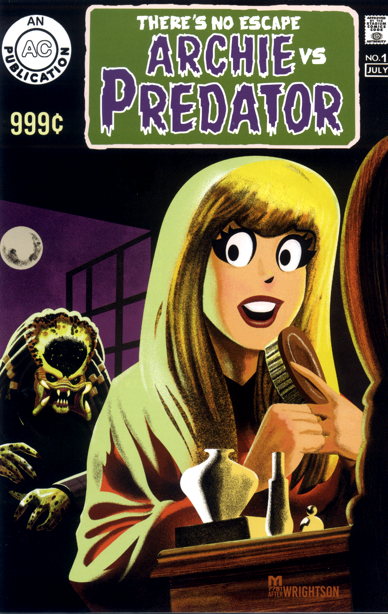
It is one of those Retailer Exclusive variant covers (not offered through Diamond) for Archie Vs. Predator II #1, Pretty neat, right? There’s also a “virgin” variant without the logos and text, but I passed since the mimicking of the original House of Secrets down to the trade dress is half the fun.

Anyway, only 300 of these made (plus another 300 for the virgin variants) so grab it while you can if you want it.

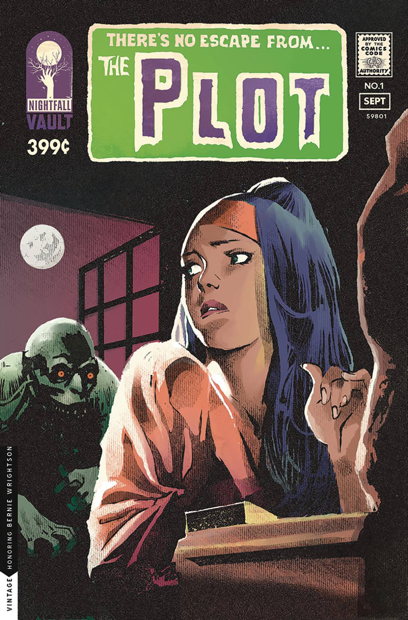
Another House of Secrets #92 tribute is coming later this month from Vault Comics, with Cover B of their new series The Plot:


So, look, I’m not only buying assorted reprints of House of Secrets #92, now I’m collecting comics that look like it. This seems perfectly rational to me.

“It’s Superman’s Fist o’clock.”

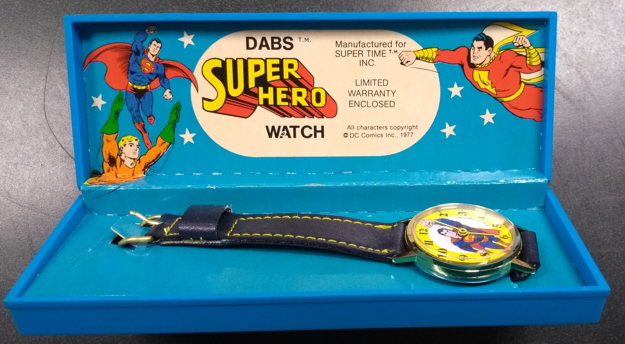
So the other day I had a gentlemen bring in this item to see if I’d like to sell it on consignment. I was kinda busy at that moment but I said I’d do some research and see what they were selling for online.

As it turns out, they weren’t selling at high enough prices for his liking (around $60 to $80) so he passed, but I still have these photos I took for reference:


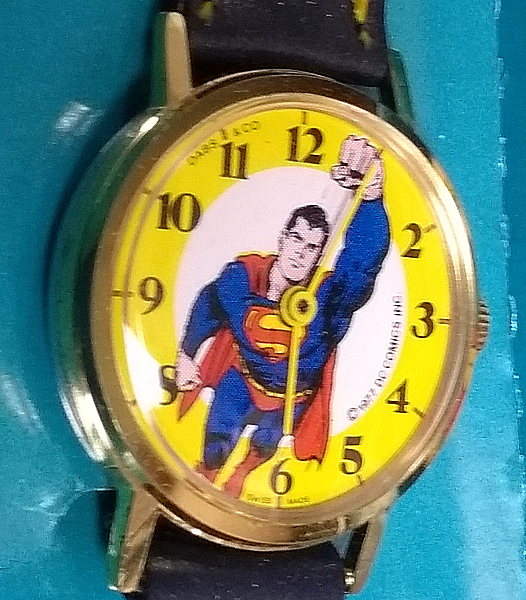
This is one of the Super Heroes watches you used to see advertised all the time in 1970s comic books. This particular example, a Superman watch, is dated 1977.

Here’s a better look at the watch face:


This is actually the first one of these I’d ever seen in person…well, okay, maybe I saw someone wearing one at some point and didn’t realize it, but this is definitely the first time I’d seen one in the original packaging. Kind of a strange feeling to see the actual physical object that I’d seen advertised countless times in all the comics I’ve read. Nice to know there’s still weird stuff I’ve not seen yet even after 31 years in the business.

SOMEONE IS WRONG ON THE INTERNET! …Oh, wait, it’s me.

[SPOILERS for Watchmen ahead, if anyone needs to be warned still]

So I spent some quality Twitter time on Sunday botching an observation I had about Watchmen. Basically, what I said was that, as a counterpoint to the idea that Dr. Manhattan was the only superpowered being in the Watchmen universe, there was also that island full of psychics, also gifted with supernatural powers that don’t exist in the real world.

Couple things wrong with that. One thankfully dawned on me all by my lonesome without someone having to come in and say “DUH MIKE YOU SO STUPID.” No, not thing about psychic powers being fake, that’s totally true, but the bit of business about “island full of psychics.” It’s an island of artists recruited by Adrian “Ozymandias” Veidt to generate horrible images that the “alien” brain would be prgrammed with, and then transmit upon teleportation to its destination, adding mental trauma to the physical destruction.

Wait a second, gonna add a spoiler warning to the beginning of the post here in case anyone still hasn’t read Watchmen.

Okay, done. Anyway, that’s the deal. I tried to amend my original statement by saying brains of psychics were cloned or whatever to make the alien brain, and one of my oldest internet pals, Mr. Dan Kelly, reminded me that it was just one psychic used in the alien brainn production. Specifically, a “human sensitive,” to use the actual phrase that Veidt initially uses. Basically the same thing, since the purpose is to send out a “psychic shockwave [to kill] half the city.”

My intent, to demonstrate that Dr. Manhattan was not the only superpowered being on Earth in this fictional universe, was correct. Just the details were wrong, and to what degree of “psychics” were implied to exist. Though Veidt does reference in issue #12 (or Chapter 12) that the event will affect other sensitives for years to come, but as will be shown in a moment, he may not be the most reliable source of information. LOOK, I’M GIVING MYSELF HALF CREDIT, SO THERE.

But then there’s something I haven’t considered. Twitter pal Bob Clark had some comments about Watchmen, and the character of Adrian Veidt specifically, to which I hadn’t paid enough attention. That Veidt himself, with all his grand schemes and plans and such, his controlled manner and his poise, is just totally off his chump. Bob notes that we’re so used to Rorschach being, quote/unquote, “the crazy one,” that we overlook the fact that Ozymandias is even more so. Ultimately, as Bob says, there might not be any “psychics” at all, just Veidt, in his unbalanced state, thinking he has access to a psychic brain, to go along with all the other improbable plans he’s made.

In the text, it’s left vague enough as to whether any “psychic shockwave” actually occurred. The death total is three million, but perhaps that was caused by the very act of the teleportation event itself. On Veidt’s wall o’monitors, we hear refernces to “the insane” (which, you know, who wouldn’t be knocked off kilter by a giant freaking alien suddenly appearing in town), and about a “pregnant woman convinced her unborn child was eating her” (again, losing one’s cool in reaction to an out-there event like this wouldn’t be surprising). Anyway, just trying to say, Bob could be right, maybe Veidt just believed psychics were a thing, and the actual physical element of this plan was enough to cause the mental trauma being reported.

Or maybe psychics are a thing here, because comic books. I mean, not trying to be a debunker or anything, just found Bob’s interpretation interesting and worth considering, particularly in the context of what this says about Veidt’s own state of mind.

There’s also the point made in the story (again, by Veidt, so take it as you will) that the psychic’s brain that was used for the “alien” was made “bigger and more powerful” by his science guys, so who knows what they did to it to make it generate the effect (not necessarily psychic, but perhaps something sufficiently physically disrupting to nearby brains) that could injure or kill. Again, despite the real world trappings of the series, it’s still a comic book, and the ol’ “comic book science” card is in play here.

Thanks, Bob, for the interesting thoughts on Watchmen. Always glad to see it can still stir up conversation after all this time!

By the way, the psychic’s name is given as “Robert Deschains,” in case you need it for your next trivia contest.

• • •

What brought all this on was commenter Randal observing

“Wait…that was a year before…did…did Watchmen copy Squadron?!?”

And yes, there are some similarities, particularly in the short-version high-concept description of “what if SUPERHEROES were REAL!?!?” But these are definitely two different entities, with varying agendas and executions, and I’m pretty sure Watchmen was being developed without any knowledge of Squadrons Surpreme‘s existence. If anything, I’d say Alan Moore took more inspiration from the political/social implications of his own Marvelman stories, not to mention the novel Super Folks.

Plus, let’s not forget that the idea of “superheroes in the real world” was an idea that had been floating around in comics for a while, not just the idea of what the very existence of superheroes do to the world around them, but simply “what would an actual real life superhero be like?” Not nearly to the extent of Squadron Surpreme or Watchmen, of course, but it was there. Superheroes tackling issues beyond, say, punching Kanjar Ro in the nose for the 80th time…pretty much the entire Denny O’Neil/Neal Adams run on Green Lantern/Green Arrow was this very thing, talking on drugs, overpopulation, pollution, etc.

The shared Marvel Universe was founded on a version of this, with heroes existing in real cities (primarily New York) instead of invented places like Metropolis or Gotham City. Even little things like Peter Parker catching a cold but still having to go out and fight crime as Spider-Man, or worrying about money, or worrying about how superheroing is impacting his normal life…all humanizing problems presented in a superhero context that directly address the issue of “what would doing this sort of thing actually do to someone’s life?”

A long time ago, on this very site, I noted that the very act of putting actual human beings into the costumes and acting out the stories made the 1960s Batman TV show just as much as deconstruction of the genre as anything Watchmen did.

And even further back…that Wikipedia lnk to Super Folks mentions Moore admitting inspiration from the Mad Magazine parody “Superduperman,” itself a relatively savage demolishing of superhero tropes. And there’s the issue of All-Star Comics where the Justice Society of America addresses the topic of disabled veterans.

And, look, there are countless other examples and I can probably spend all day typing them in here. But the point is…as a medium for expression, of course comics, even superhero comics, are going to try to make their stories more relevant and relatable to real world issues. Sure, having two 12-part “maxi-series” at around the same time dealing with the same sort of thing, kinda sorta, was unusual timing, but more coincidental than anything else. Just sort of the natural outcome of what had come before. Both series were above and beyond what we’d seen in the past, of course, but not entirely without antecedent.

Maybe if the Champions showed up in the Life of Pope John Paul comic.

So Marvel’s been teasing an upcoming series/event/thingie that involves a murder, prompting folks to draw comparisons to DC’s recently concluded murder mystery even comic Heroes in Crisis. Which, you know, fair enough…there’s no shortage of times Marvel’s copied something successful of DC’s, and DC’s copied something successful of Marvel’s. I’d just mentioned Marvel Comics #1000 a few days ago as a very recent example.

This time around, the general assumption seems to be that Marvel is biting DC’s recently concluded mini-series Heroes in Crisis, which also centered around a superhero-related murder mystery. I saw the reaction online from here and there wondering why Marvel “didn’t learn from DC’s mistake,” why they would model one of their own projects on something their competitors did that was “bad” and a “disgrace” or whatnot.

The answer, of course, was that Heroes in Crisis, despite what anyone may have thought of it online, despite what perhaps you thought of it…it still did very well. Sold well enough for individual issues to go into multiple printings to meet demand. And just from personal experience, many of my customers were really into it and greatly anticipated each succeeding issue. It had a base of readers who did like it quite a bit.

Despite online grousing, was well received by the comic buying public. Of course other companies would take inspiration from it. It has nothing to do with how good or bad you might think the actual story is — and personally, I thought it was 5 pounds of story in a 30-pound bag, with good intentions but questionable results — it made money, which is the most important metric for publishers.

Reminds me a bit of that classic Batman comic book series y’all liked so much, All-Star Batman and Robin the Boy Wonder, nearly every issue receiving an enormous amount of derision online. And yes, and I even said this at the time, as I recall, at least at our store it was one of the highest-selling, if not the highest selling comic for that period. Outsold X-Men, the other Batman titles, Amazing Spider-Man, several others…lots of people hating on it online, but someone was buying it. And it wasn’t all bloggers picking up copies to scan and mock on their sites.

Anyway, if you find yourself wondering why a publisher puts out this comic or that comic, or why they’d emulate someething their competitor did that you didn’t care for…it’s all about the…Washingtons? Lincolns? I don’t know your youth slang of today. But you get what I mean.

It did get me thinking a bit about different publishers mimicking the sales strategies of others. Especially after reading this week’s new issue of Doomsday Clock — only one issue to go, where hopefully the previous 11 issues of set-ups and mysteries will get resolved in a normal-sized comic and not an 80-giant giant like it seems it will require.

But despite that, what I was thinking was what Marvel-published work that had previous been standalone, but also highly regarded, would be the equivalent of DC’s ,cite>Watchmen? And, would also be highly inappropriate to mix Marvel’s modern superhero universe with it. Most of the things I was thinking of were either under the Epic imprint and not technically owned by Marvel…like an Avengers/Moonshadow crossover or something…or like The ‘Nam, but that had a Punisher appearance of all things, so I guess that was kinda done.

Marvels doesn’t really count, because that’s just the regular Marvel Universe, told with a then-fresh viewpoint and art style. Unless Marvel took a month to have all their titles transform their contents into Marvels-a-likes. We did have Marvel’s anniversary celebration of that series with tribute variant covers, so we got kind of a taste of that, with mixed results.

So anyway, if you think of a good one, let me know.