So I was happy to discover the other day that I, in fact, did not give up all my copies of Dark Horse Presents to the store when I opened back in 2014, but kept them in what remains of the Vast Mikester Comic Archives. In particular, I was happy because I had a sudden urge to reread the short Concrete stories that appeared therein, inspired by the release of the new series.
Amongst my DHP collection was issue #24 from 1988, notable for containing an early Aliens story:
Now, I had rid myself of all my Dark Horse Aliens comics via the shop, so I figured “might as well get rid of this one, too.” I seemed to remember it usually selling for a good price, especially if it were in nice shape (as my copy was, natch), and thus put it aside for the “destined for the shop” pile.
However, a quick perusal of the price guide startled me with this notation:
Okay, wait, hold on, I’m still a fan of Michael T. Gilbert’s Mr. Monster, and as such I now can’t sell this comic, because Sluggo forbid that I have a hole in my collection.
I decided to take a quick peek inside, handling this precious artifact with my weathered and weary hands, and…no Mr. Monster. Not a bit of him. Not even an ad. Not even hiding behind a Xenomorph. This comic was entirely befeft of Mr. Monster.
Searching online, I saw several references to this comic in sales listings far and wide, all proclaiming that, along with this Aliens story, Mr. Monster also appeared within.
I looked again inside the comic; Mr. Monster had not sneakily made his way into the pages in the interim, and the comic remained free of his presence. I even double-checked the Grand Comics Database listing, which confirms said lack of character. Er, that character.
However, in my investigations, I did notice something interesting. In #24 of the third series of Dark Horse Presents, published in 2016, Mr. Monster does appear. The source of the confusion, perhaps? If so, it’s lightly reassuring if somewhat dismaying to know even Overstreet has trouble keeping all these straight.
Therefore, let it be shouted to the hilltops: despite what Overstreet says, despite what various online sellers say, Dark Horse Presents #24 (1988) does not have any any Mr. Monster. So let it be written, so let it be done.
And that’s how my copy of Dark Horse Presents #24, in NM condition, has ended up in my shop, ready for sale:
Before you ask…yes, I will feel a slight twinge when it eventually sells. I bought that comic new off the stand and I’ve had it in my possession for nearly the same length of time I’ve been in the comics retail biz. Hopefully it goes to someone who will appreciate it.
“[Another store] will keep as many back issues as they can, I can’t travel anymore, but I know this from THE WALKING DEAD and a few others back in the day.
“But keeping copies of ABSOLUTE BATMAN #1 in its tenth printing mean anything at all to a collector? Though I’d bet you only go back to maybe #15 now.
“Or is it that you’ll still get new customers.Buying the trade and then finding more recent issues on the racks for them to buy means you continue to get more people buying the book and possible other Absolute books?”
Believe it or not, Wayne, whatever issues in whatever current printings I can get of any of DC’s Absolute line go on the new comics rack. As of right now, especially after the restock I received earlier in the week, I have nearly every issue of Absolute Batman on the shelf, from the eleventh printing of #1 all the way to the most recent issue, the “hideously mangled” #20, plus the Ark-M special the and the annual. Note that’s not every issue, as I’m currently out of one of the issues in the teens, can’t remember which at the moment, but as soon as it’s reprinted, I’ll have it in!
And it’s a good sales tool to have ’em all on the shelf like that, as it attracts folks who have heard of these comics but don’t want to dig deep into their pocketbooks to splurge for the trade paperbacks. They sample a first issue, maybe a second, then come roarin’ back for all the rest. Having them all up and on display makes for an impressive sight, and certainly encourages sales from the curious.
Mostly, this is working for the main three, the Batman, Superman, and Wonder Woman titles, which probably isn’t a surprise, and those seem to be the titles that get the most reprintings. Absolute Martian Manhunter is probably the next in demand, followed by the relatively low (but still present) demand for Absolute Green Lantern and Absolute Flash. (And for anyone wondering, the newly-released first issue of Absolute Green Arrow is selling quite well for me, thank you.)
I’ve said multiple times I’ve never back issued any of the Absolute line, but strictly speaking, that’s not true. I did have a copy of Absolute Batman #1, first printing, that had a color-breaking corner fold on the front cover that I’d set aside and completely forgotten about until well after the book was determined by the comics-noscenti to be a Hot Item, when I found it again. Priced it up (probably well too cheaply in retrospect), put it in the New Arrivals back issue bins, and watched it get purchased and carried away by a grateful customer, holding it aloft upon a silken pillow.
Are these taking up space on my new comics rack? Well, yes. Even with the Gigant-o-Rack that I have taking up an enormous amout of wallspace in my store, the Absolute comics consume a lot of real estate. However, in terms of space used vs. dollars made, it’s well worth it. And given this is one of the few Big Hits the American direct comics market has, actually bringing in new readers excited about picking up monthly single issues, I happily will devote the space to them.
Is this something I can keep up forever? Or is this something DC Comics can keep up forever, maintaining the backlist of single issues of the Absolute books in print in perpetuity? Honestly, I don’t know which will give first…my shelf space, DC’s continuing willingness to go back to press, or trees. Right now it is in DC’s best interest to keep printing these comics so long as there’s this sort of demand, and it’s in my best interest to keep them displayed and available, so long as they’re getting new customers and making money.
Realistically, I can’t keep ’em all on display forever. I’m already overlapping the issues on the shelves so that I can still make room for other new comics. Or else I just devote the entire rack to nothing but Absolute books, and put all the other releases in a short box by the register witih a sign that reads “MISC. NEW COMICS.” But I haven’t quite hit that day yet.
Now Wayne, funny you mention the “does a tenth printing of Absolute Batman #1 mean anything to a collector” thing, as I was just talking about that with a customer the other day. I mean, technically, the later printings do generally have smaller print runs than the first printings. Thus, they are in shorter supply, which could mean, I guess, higher prices should demand arise. Now, it’s not likely now that the printings are in the double digits, but who knows?
This does happen in the real world on occasion. I forget which issue exactly, but there’s like a second or third print of an issue of Ms. Marvel that goes for dumb money, and those later printings of The Killing Joke with the differently colored embossed logos tend to be pricey since they’re not always easy to find. I don’t remember the last time I saw the blue-embossed eight printing, for example. And I haven’t really checked, but I’m sure the earlier reprintings of some of the Absolute books, especially the Batman one, are gaining some pricing traction.
Those are the exceptions rather than the rule, as decades of comics collecting and pricing have told folks that “reprints aren’t as expensive as first prints.” So no, that tenth, or even eleventh, printing of Absolute Batman #1 is unlikely (but not outside the realm of possibility) to get collector demand and go for premium prices. Its real value is in getting new readers to try out comics.
Thanks, pals, for being patient as my blogging batteries recharge. I plan to have another “My Fantastic Four-ay” post this week, and should have another installment of the Final ’90s Countdown coming along in short order.
In the meantime, let me address a question that came up in the last post, about the supposedly-damaged Absolute Batman #20s, from D:
“So are people buying 2 copies of AbBat every month, one to read & one to slab at 9.8 to flip? Or is no one actually reading the book at all and just having their issues encased?”
I’m reminded of that one creator, during the height of the pandemic-inspired comic speculation frenzy where every first appearance of anything was snapped up in desparation for making that big eBay killing, who was so excited at the huge jump in demand for their comic. “Wow! Sales are through the roof! Thanks everyone for your support!” and I just didn’t have the heart to tell ’em that this was only a speculation-fueled bump, that sales were going to drop right back down to where they were previously. And the book ended shortly thereafter (it was a Marvel book, so “ending shortly thereafter” is pretty much a given, what with current publishing stragegies).
I think the point I’m trying to make here is that if Absolute Batman was purely a title supported by speculators, I don’t think it would have lasted this long and at its current high sales volume. That said, speculation is part of the formula here, as most issues have something to generate that sort of interest (1st Absolute Catwoman! 1st Absolute Bane! 1st Absolute Robin(s)!), so that sort of investment behavior is certainly subsidizing the sales.
In general I order around the same numbers for each new issue of Absolute Batman, and I can tell the difference between the issues that have something Hot and Investable in them and those that do not, given on how many I have left over after the initial sales week. However, the amount of demand from people who seem to be actually interested in reading the comic is enough that even if the issue has extra remaining copies, they will continue to sell through the following weeks.
Here’s the thing…I haven’t back-issued any Absolute Batman. (Or any of the Absolute books, for that matter.) I keep every available issue up on the rack and for sale. DC seems intent on keeping the periodicals in print, even if they’ve been reprinted in hardcovers/trade paperbacks, which is unusual. But DC seems to recognize the strong continuing sales of the individual comics and their appeal to new readers, and keeping them in print is money in the bank for themselves and the retailers. I just placed a reorder for more reprints of the entire run, and expect to sell through those again. We’re up to an 11th printing on #1, if you can believe it.
I’m not a mind-reader, so I can’t say for certain that the majority of sales for Absolute Batman is by readers, and not by people immediately shipping them off to CGC to be slabbed and graded. But the general vibe that I’m getting is that they are being bought by readers, and said readers find the comics exciting and compelling. Nearly all my sales in the shop are single copies to customers. Only occasionally do I have someone picking up two or three copies for themselves.
Now, this is just my store. Maybe other stores that are more CGC-oriented than mine (which ain’t hard to achieve) are seeing people buy Absolute Batman by the handful for immediate flipping. I can’t deny that speculation isn’t rampant with this comic, because otherwise this recent controversy over the “damaged” copies of #20 wouldn’t have happened if a significant number of people weren’t upset about not being able to get their coveted “9.8s.” But my sense is that, given the continuing reprinting of the individual issues, given the sales patterns I see at the store, given the general buzz around the actual contents of the stories, this book is getting more reader-driven demand than speculator-driven.
So the big news this week is that several new comics showed up “damaged” to retailers this week…and to be honest, this damage wasn’t immediately obvious to me, so I figured I lucked out and didn’t get any of those copies. However, a customer did later point out a couple of minor spine creases on Absolute Batman #20, which apparently affected the entire print run (along with Absolute Martian Manhunter #11 and Barbara Gordon: Breakout #1).
I mean, honestly, the “damage” I’ve seen so far on these books appear to be well within the acceptability of new sales. I just looked at my own copy of Absolute Batman #20 and there is one single little spine break…I’ve seen a lot worse on new comics I’ve received that didn’t get all this hubbub. I also examined my personal copy of the new Absolute Martian Manhunter and I don’t see anything I’d call damage.
The instigation for this is, of course, the people who want to get those “9.8” returns on the Absolute Batmans submitted to CGC, since those are Big Money right now. Had this same thing happened to, I don’t know, Aquaman, we wouldn’t be hearing a peep. I don’t know, maybe I did get lucky and only have minor issues with my copies. Maybe other stores’ copies were absolute (heh) disasters.
Anyway, DC is putting out free “2nd printing” replacements for all these, which…I don’t know, I suppose that’ll keep the comic-flippers happy since Absolute Batman reprints also still seem to be “hot” and “collectible.” And DC announced that they’ll be talking to the grading companies like CGC about the linewide damage on these books, to…I don’t know, make them consider these books “Near Mint” even with the spine ticks? Or call them “Qualified 9.8” which, as I’ve probably noted before here or on the socials, a meaningless grade?
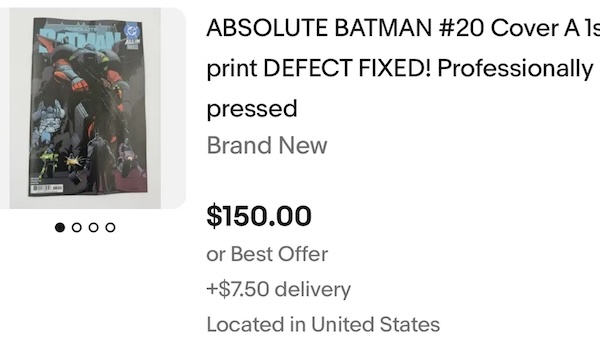
Sigh. But still, it’s an ill wind that blows no one any good (as per this eBay listing sent to me by former employee Aaron):
So technically, still not Near Mint because it’s been repaired. Would’ve been better off just leaving the comic alone.
And frankly, given the printing, handling, and shipping processes comics go through to get to the local comic shop, folks should be glad they show up in one piece at all.
Someone came by the shop and donated a short box full of comics…not really much of interest in there, the usual smattering of random ’90s Marvel comics, but it did have:
…nineteen copies of West Coast Avengers Annual #3 from 1988. That’s a book value of up to tens of dollars!
You know, I’ve never actually read this particular comic. Now’s my chance to…well, probably not do so again.
…as speculation on Image Comics first issues is beginning to ramp up again. A few years back, my general sense of the Image speculation then was people hoping to twig onto whatever will be the new Walking Dead, a comic that expanded into other popular media and drove back issue prices into the stratosphere.
Now the speculation appears to be leaning towards first issues that are perhaps lower ordered, or otherwise under the radar. Titles that when they’re announced, and when it comes time for me to do my ordering, I don’t hear a peep about from anyone. And then, when it’s the day before the comic goes on sale, I start to get the requests.
From what I hear on the social medias, when I noted this, was that the comics folks on the YouTubes and the TikToks started to hype up these particular comics as “investable collectibles” within the last week or two. Of course, this is well past the time I’m able to get more copies, so even if I saw any of these videos (which I wouldn’t since I avoid most comics content on those platforms) what good was that going to do.
I haven’t noted the titles of the comics in question if only because the onus is not on them; they’re by creators doing books with stories they want to tell. And while I’m sure they’re pleased with the sales (and the attendant reprints), I’m not sure how happy they’d be to know that the primary push for sales is as a commodity, not as a storytelling medium. Look, I’m sure a bushel of twenties is a healing balm, but there must be some disappointment.
It reminds me of a creator at Marvel during initial COVID times, when speculators were desperate for anything to invest in, getting excited that an issue of their book suddenly shot through the roof in demand and sales. They seemed to think it portended future success, not realizing it was a one-off fluke as that issue featured an “invesetable” first appearance, and sales went right back to normal levels with the next issue.
So we have high demand for these new first issues, but no real indication of how many of those sales are to people looking to actually read it, and no indication as to what the sales will eventually settle down to once the investment opportunity is over. I’m just sorry that it may take two or three cycles of printings before the books can find their audiences. Unless they want to go on eBay and pick up the $20 or more copies of the first printings that were listed as such even before the release dates.
Collection and investment has always been part and parcel of the comics hobby — the phrase “must-have double-bag item” obviously came from somewhere. But in these days when comic orders are hewn close to the bone as it is, the surprise last-second demand for a low-ordered book is a frustration.
I’m not sure what my actual first issue of Fantastic Four was. I know I certainly encountered it as a younger child, having the vague memory of reading a 1970s-era issue at my cousin’s house. I know I definitely read (and owned) a copy of Marvel Two-in-One #18 when it was new, or close to, so that was very likely my introduction to the delicate sensibilities of a certain Mr. Grimm.
Eventually I would encounter the Origins of Marvel Comics paperback in the local library, possibly in the late-ish ’70s, which not only gave me my crash course on what the FF were about, but got me up to speed on several other Marvel characters to boot.
When I was reading comics in the ’70s, while I did get a superhero comic from time to time (like the aforementioned lightly-terrifying issue of Marvel Two-in-One), I mostly gravitated towards other topics. I read Disney comics, I enjoyed Pink Panther, I’d get the occasional sci-fi or horror comic somehow (like this comic with a worrisome sci-fi story from Denny O’Neil and Tom Sutton), that sort of thing. When I did get superhero comics, I primarily angled myself at DC’s characters.
Obviously, if you’ve been following my site for any period of time, you can guess that an early DC fave was Swamp Thing. I also got the occasional Superman or Green Lantern comic, or that one Superboy giant with the Legion of Super-Heroes. Oh, and all the digest reprints, and so on and so forth.
I would get the occasional Marvel superhero book, and even had a brief subscription to Amazing Spider-Man around issue #200, to fill out the rest of my subscription to Pizazz, which had been cancelled shortly after I started getting them in the mail. But I wasn’t a regular follower of any of them…mostly it would just be one issue here and there, if I had a particular need to read a new comic and I already had all the DCs I wanted from the latest shipments to the newsstands.
It was sometime in ’83 when I started making a more concentrated effort to follow certain Marvel titles, like Incredible Hulk, or Uncanny X-Men. But I remembered liking the Thing from those long-ago comics I read in the ’70s, and picked up a copy of this:
Given that my first issue of Incredible Hulk also featured the title character fighting other superheroes, maybe there was a specific attraction about such an event that attracted me to those issues. Regardless, I enjoyed this comic quite a bit, having a definitely different look ‘n’ feel from the DCs I’d been buying, and kept on buying more Marvels.
It’s not like Marvel replaced DC in my comic buying habits. I still predominately bought DC superhero comics. But I made room in my budget for more Marvel titles, including, eventually, Fantastic Four.
It was also about this time I started to discover that most peculiar of retail outlets, the “comic book store.” My first visit to one was well out of town, a place called Comic Book Nook in Simi Valley, which I’d found out about via a newspaper ad with a couple for so-and-so off the price of a back issue. However, a schoolmate of mine clued me into a place by the name of “Ralph’s Comic Corner” in the much closer city of Ventura, which is where, in short order, the greater percentage of my comics custom would be applied. (And I would also get a job there a few years later, leading to where I’m at now, but that’s another story.)
It was at Ralph’s where I could not only get the new comics usually a week or two ahead of the newsstands, but I could also delve deep into the back issues and fill in holes in my reading, picking up comics I long ago missed on the newsstands, or filling in runs of newer comics I’d just started. Like, you know, a lot of those Marvel comics that I just started picking up, which, unlike many of their DC counterparts, were a little more continuity-focused with more ongoing subplots and such. Reading the past history could often enhance the experience future stories, versus a Superman story that would exist in a vacuum separate from other Superman stories, and certainly other DC comics.
So I don’t recall where I started, exactly, with John Byrne’s run on the Fantastic Four from this period, but I absolutely used my access to the comic shop’s back issue bins to work my way back to the beginning of his stint on the title. That may very well be the first time I did such a thing with a comic book series I was following…not just going back a couple of issues to get the start of the current storyline, or working my way back to an actual #1, but liking a creator’s work on a specific title enough to get all the issues that creator did.
And reading that run of Fantastic Four started me on an on-again/off-again journey of reading that title, one that continues to even now and the great work being done by Ryan North and Humberto Ramos. But before I get to there, I’m going to start back here, and talk about what it was that grabbed my attention about Byrne’s tenure on Fantastic Four. And after that, what did and did not keep me following Marvel’s First Family over the succeeding decades.
This will be an intermittent series of entries on this site, probably at least one a week. I certainly hope you follow along, and I look forward to your comments on your favorite FF stories and why you read, or maybe didn’t read, the title.
Hi pals. First off, I’ve shut down the comments on Friday’s post, and I’m going to consider the matter closed here for the time being. So, please don’t revive the discussion/debate in today’s comments. If something changes, I’ll put up a new post and start a new thread, but I think the topic has been covered sufficiently for the time being. Thanks to everyone for participating, and to Matthew for being a trooper.
Second, I’ll be returning to responding to your queries from the last Question Time post, as well as continuing the Final ’90s Countdown, in short order. I promise to finish both series sometime in 2026. Well, at least I’ll try with the Final ’90s Countdown.
Third, I know it’s an unpleasant world out there right now, and people are rightfully upset and afraid and angry at what’s happening. It may seem a bit silly focusing on comics like I am, but it helps to relax and center myself and escape from the world at least momentarily, at least for my mental health and yours as well. I’m not ignoring current events, but doing something quiet that I can control and enjoy really recharges the ol’ brain batteries. I hope everyone can find some similar respite.
โขย โขย โข
Okay, I’m letting Wayne skip the question line a bit to answer this inquiry of his from last Wednesday:
“What is the deal with ABSOLUTE BATMAN?
[…]
“What is the main selling point? Is it violent like I’m the goddamn Batman? Is it Batman with no [other] bad guys or girls yet? I’m not checking Wikipedia.
“I want YOU to tell me why YOU buy so many copies and WHY it sells for you.You are in the middle of a desert, yet you sell more than the comic shop in downtown Chicago.”
Ever since Marvel hit it big with its fresh-start, continuity-lite (’til it wasn’t) Ultimate line, DC’s been trying to find a way to do something similar with their own titles. Essentially, “rebooting” their big characters with new hopefully-new-audience-grabbing titles and stories while still keeping the regular versions around in order to not alienate their already-existing readers. Sort of a have-your-cake-and-eat-it-too situation.
The initial two attempts were the All-Star line, started in 2005, which resulted in one genuine classic (All-Star Superman), and one still-as-yet-uncompleted run that received slightly more…mixed reviews (All-Star Batman and Robin the Boy Wonder). Both were not part of “official” DC continuity (however that usually stands), and were not connected to each other in any way. And while they both sold very well, the “All-Star” line faded out once the Superman story was done, and it became apparent that the Batman series had stalled out. Other series, like All-Star Batgirl and All-Star Wonder Woman, were planned but never released.
DC’s next attempt at an Ultimate-esque imprint as the “Earth One” line, a series of graphic novels aimed at the book market. And while a number of these were released, some with multiple volumes (like Superman: Earth One, have three volumes so far). I think, technically, this imprint may still be A Thing, even though the last graphic novel in the line, Green Lantern: Earth One volume 2, came out in 2020. (And Wonder Woman Earth One received a Compact Comics paperback edition within the last year.)
DC’s newest attempt at Ultimizing their comics, the “Absolute” imprint, certainly seems to have the most traction out, with current titles selling well, and new titles on the way. Unlike the previous imprints, “Absolute” has its origin in the regular DC Universe, via various Darkseid-related shenanigans that began in the DC All-In Special and are now coming to some kind of head in the DC K.O. event, currently running in a comic shop near you.
It’s possible, that at least for some readers, that connection means the comics “count” in their ongoing investment into the DC Comics Universe at large. And that pays off, in its way, with that current crossover I mentioned. I don’t know if that’s a significant factor in the Absolute line’s current popularity, but it’s not not one.
But when it comes specifically to the Absolute Batman series and why it’s popular, the biggest reason is that…
…it’s Batman.
And I know that sounds like a facile answer, but it’s really the big one. Batman is arguably the most popular superhero character of all time — or at least in the top three, behind Swamp Thing and Krypto — and having him headline the brand new imprint of comics is usually going to lead to big sales. Absolute Batman was first out of the gate with a comic book series, it showed everyone how this new line was going to work, and remains the flagship title of the imprint. It is the face of this publishing endeavor.
It helps that it stands alone, with (so far) only some minor crossing over with Absolute Wonder Woman, even though all the “Absolute” titles exist in the same world and the characters certainly will all meet each other. (Not counting whatever’s going to happen in DC K.O., of course.)
The quality of the art and writing is top notch, drawn by Nick Dragotta and written by Scott Snyder, with Snyder being already generally well-regarded for previous Batman work. I know when Absolute Batman was first announced, and the art was released, many fan reacted with “uh, Batman looks weird” but now that everyone’s seen it in action, those same fans are now “we love our chonky boy.”
But the two of them together have produced a work that is dense with information, both textually and visually. And given issue of Absolute Batman feels like it contains the equivalent of two other comics, and in these days of high prices and concern over cost-versus-content, it makes for an appealing buy. It feels…modern, taking these nearly 90-year-old characters and reinventing them via current sensibilities and storytelling techniques.
Now, I’m trying not to step too much on what WizarDru and William have already said in their correct and valuable responses regarding the actual contents of the books. These are new takes on old characters, from Batman/Bruce Wayne himself, all the way to his rogue’s gallery (many of who are, at least at first, friends of Bruce and privy to his secret). As William notes, emotion plays more into the proceedings, supporting the previous be-all Batman tropes of problem solving and punch-outs. And making Bruce poor, or at least not rich, puts paid to all the criticisms of “why doesn’t he stop crime with money” and “rich guy punching down, literally, on the underprivileged.” Every battle Bruce has is an uphill one.
And in concession to our online meme-full world, there are more cool elements in each story. More examples of pure radness and badassery that makes for lively discussion and scanned images on TikTok or Instagram or wherever. “Look at Absolute Batman just wiping out these white supremacists” sells more people on how cool a comic this is, making more people look for it, meaning more sales, more sell-outs, more reprints, so on and so forth. Making comics cool again, or at least these “Absolute” comics, can’t be underestimated as a factor, especially wit younger people not in the habit of buying physical media.
Another reason Absolute Batman sells well is for a reason that may not immediately come to mind unless you’re a comic shop owner observing comic sales. Or if you’re participating in this yourself…but investment. Not the kind of “investment” I mentioned previously, but “buy multiple copies, get ’em CGCed and put on eBay” kind of investment. The comic sells well, therefore there’s demand, therefore there’s opportunities. First appearances of Absolute Catwoman, Absolute Harley Quinn (that one kinda slipped past people), and of course Absolute Joker, that gets the investors excited.
Plus, the multiple printings each issue receives (#1 just had its tenth) attracts not just readers trying to catch up, but investment collectors who think the lower print runs on some of these may lead to a financial boon. And the more readers part = more demand for issues = more chances of higher prices on the secondary market.
I’m sure that’s not all the reasons, and that the sales on this book will continue like this forever. I’ve said a number of times that some days at the shop, I feel like I’m an Absolute Batman store and nothing else, as I get customer after customer, new customer after new customer, passing through my doors and asking where the new issue is, or where any issues are. And anything that’s getting new readers in is a good thing.
So let’s see…do I start off my next year of blogging with a post about our relative sense of “old” comics, or do I start it off looking at the trend of comics about real life murders and serial killers?
Well, let’s do that first one today, because that second one is going to take a little more digging than I’ve left myself blogging time for today. Let us go back to a comment left by longtime reader Chris G. who sez
“…Thank you for making me realize that back when I was a comic collector looking for ‘old comics,’ I was in fact looking for comics from thirty years earlier.
“Why did 1965 seem far away in 1995, but 1995 seems like yesterday?”
There are certainly a lot of reasons for that, particularly in reference to comic book collecting. One main reason is the wild overordering of comics in the ’90s, leaving plenty of stock around for folks to find. Now, generally, it may not be as easy to find now as it once was, given that many of the stores that did said reordering have since shut down and vanished along with their inventories (my former stomping grounds included). But even that is only a minor change in availability. If you want a Turok Dinosaur Hunter #1, you can find one in short order.
Related to that is the very nature of the direct market. Comics ordered by shops were, for the most part, theirs to keep. There were rarely “stripped cover returns” that newsstands, the primary retail arena for comics in the decades prior to the ’80s, were able to do. Thus, to use the years Chris offered up, a comic from 1995 that didn’t sell was just the retailer’s problem to store in the backroom forever or throw in the bargain bin. In 1965, a comic that didn’t sell would have the cover striped off and returned to the distributor for credit, the rest of the comic being disposed of.
Another possibility depends on the age of the collector in question. If you weren’t around, or at least old enough to buy comics, in 1965, those will always seem to be from ye olden tymes to you. But you may have been old enough to start collecting in the ’90s and are still collecting now, so there is a continuity of acquisition that makes you see those ’90s comics as “the earlier part of my collection” versus “hokey smoke those are three decades old.” I get that feeling sometimes when I’m at the shop: “I remember buying this issue of Spanner’s Galaxy off the shelf, it can’t be old!”
One more thing that would make a “30 year old comic from 1965” seem that much older than a “30 year old comic from 1995” is simple aesthetics. If you’re in 1995 looking back at a 1965 comic, it just looks old. I don’t mean wear and tear and other matters of condition, I mean the artwork, the storytelling, the coloring, the paper stock, everything…a 1965 comic would just look dated to the eyes of someone thirty years later.
Someone in 2025, like, y’know, all of us at this moment, looking thirty years back at a comic from 1995: it’s still going to have elements that are dated. Maybe some Liefeld-isms in the art, more dialogue on the page, more cover blurbs, some crazy cover gimmicks…but you can still usually draw a straight line from that 1995 comic to the comics of today. You can see how one may have evolved into the other.
If I had to put my nickel down on any of these, I’d say it would be just the sheer number of 1995 comics left out there in the marketplace to buy now. You can probably go into most comic shops and ask for a Spawn #27 and chances are good they’d have it. But if you were in 1995 asking for a thirty year old copy of Star Spangled War Stories #120, you might be out of luck.
I still wouldn’t quite rule out “being old enough to buy the ’90s comics when they were new,” because that’s the one that hits old farts like me the hardest.
So I started reading the Green Lantern series sometime around 1980, picking up issues here and there until getting it every month starting with #141 in 1981, the first appearance of the Omega Men.
Eventually, I dropped the book after #157 (1982):
…which was still near the beginning of the “Hal Jordan in Space” storyline (more on that in a bit). I seem to recall enjoying that specific issue, since I liked Hector Hammond as a villain, but GL being stuck in space all the time began to wear a bit thin on me, I guess, or the next issue didn’t grab me. Whatever the reason, I stopped with that #157.
While I did check in with a random issue partway through the run (the infamous “exploding boy” cover on #162, which I wrote about…21 years ago? Really?) I didn’t hop back on the Green Lantern train ’til #171, the infamous Alex Toth issue that all the writers removed their names from:
Now I don’t know if I knew it at the time, and given my love of fanzines I can’t see how I didn’t know, but the whole Hal in Space thing was coming to an end, with a brand new creative team and direction for the book starting in #172 (1984). I presume everyone else was sick of the space stories, or sales had dipped far enough that they were ready to try literally anything else, or maybe they just ran out of Gil Kane inventory covers to run. But I kept reading, Len Wein and Dave Gibbons showed up, turned things around, everything was great, and so on.
And it was all well and good for, oh, another decade or so.
That Green Lantern comic went through a few more creative changes over the next few years, with everyone doing interesting and sometimes peculiar work, before that series wrapped up in 1988. I followed the GL franchise into Action Comics Weekly, DC’s new serialized format that was released…well, you can guess how often it came out. And there were the well-received Emerald Dawn minis retelling Hal’s early years as a Lantern, and a new ongoing series that launched in 1990.
That 1990 series was also quite popular, and I enjoyed it quite a bit myself, even if the writer for that series is now considered persona non grata in the comics business, or, well, anywhere for that matter. It was a thoughtful, imaginative run that culminated in a tie-in to the whole “Death and Return of Superman” storyline going on elsewhere in the DC Universe. A storyline in which GL’s stomping grounds, Coast City, is destroyed.
The final issue of that writer’s run is #47, in which Hal comes to terms with that huge loss with his old partner, Green Arrow. And, when the writer actually did a signing at my previous place of employment waaaay back when, before His Troubles were known, he’d basically said as such, that he had other plans for the big 50th issue, that the Coast City thing was dealt with.
But DC was still chasing that “Death of Superman” dollar and wanted Big Changes for the characters that had been around a while and seemed possibly moribund compared to the edgier, “hipper” comics being produced by their competitors. So word came down from on high that Hal was to go away and be replaced with a new fella. And as it turned out, the way Hal went away was to make him go crazy over the destruction of Coast City and start killing his fellow Lanterns to gain enough power to resurrect the city and its inhabitants.
Am I sure this is exactly how it went down? I mean, that this was ordered by DC, not that was what happened in the comics, because that was definitely what happened in the comics. All I have is The Former Writer’s statement on the matter, and given how many brains “The Death of Superman” story broke, it all seems plausible.
At any rate, Hal was gone, we had a new guy, Kyle Rayner, on board as the one (and only!) Green Lantern. And I read his comics up through issue #55:
…and it wasn’t so much that I didn’t like Kyle Rayner, as I didn’t like what they did with Hal Jordan, and I gave up reading Green Lantern again. That was 1994.
Now they did a lot of things with Hal Jordan in the meantime…he popped up in that Day of Judgement mini-series, he was the Spectre for a bit in his own comic, and I read all of those. But it wasn’t until 2004 and the series Green Lantern: Rebirth that DC finally put Hal back in the green and black space togs. That is what finally got me back into reading GL comics, correcting a bizarre decision to try to push a new version of the Golden Age/Silver Age transition without just sort of letting it occur naturally.
From Rebirth we went right into a new ongoing series launching in 2005, and I’ve been reading Green Lantern comics in all their various incarnations ever since.
Until, I’m thinking, right about now. It may be time for the third big Green Lantern break.
I was trying to talk this out on Bluesky, and I think about as far as I got was that it was “too much.” Every comic is crowded with characters, crowded with lore, crowded with ever increasing stakes and risks…it’s practically sensory overload. The alien Lanterns are no longer fun guest-stars, they’re just more noise.
The exact example I used was that it seemed like after the Sinestro Corps War, a genuinely fun and interesting multipart super-battle amongst opposing Lantern armies, every Green Lantern event continued to chase that high. It seemed fine at first, particularly with the introduction of new Lantern Corps based around different spectra (I don’t care what anyone says, I liked the Red Lanterns). But it all just seemed to go on and on and on until this last one, the GL Corps versus the…Starbreakers, I guess? It’s just one more mass of action figures to throw at the GL action figures.
Going back to that 1980s GL series, when I was talking about the “Hal in Space” story. That storyline kicks off with Hal’s bosses, the Guardians of the Universe, calling him on the carpet to remind him that he’s got an entire sector of space he’s supposed to be watching over, not just Earth. As such, the Guardians banish him from Earth for a year, and tell him to work his beat for once. It actually does come across as odd to see Hal not in his regular earthbound stomping grounds.
Which of course isn’t to say Hal didn’t take off into space occasionally prior to this, But there was a balance…sure he may have left Earth once in a while, but he always started there and usually ended up back there, if not at the end of the issue, but eventually at the end of the story. It made him slightly more relatable.
Now, it feels like it’s the opposite, with stories beginning and ending in space and if Earth is seen at all, it’s only sporadically. Even the early issues of the current Green Lantern run, with Hal stuck on Earth, while good and maintaining my interest, were mostly about Hal trying to figure out how to leave Earth.
And while the lore and history of the Corps have always been part of the comics, they weren’t the be-all/end-all like they seem to be now. It felt more special when we got the Deep Lore once in a while, not with every outing.
This may be the first time and last time I’m doing this, but I’m going to refer to something from the Family Guy TV show. There is a line Peter says, in regards to The Godfather, a line that the show’s creator Seth McFarlane apparently liberated from a college professor, in which he says the film “insists upon itself.”
It is a weird critique to make about anything: it’s both exacting enough to sound like a very specific jibe, and it’s vague enough to be wide open to interpretation. But regardless, you sort of get what’s being said here.
This is the Green Lantern franchise as it is currently: it insists upon itself. It’s self-referential, it’s repetitive, it’s Green Lanterns solving Green Lantern problems.
I tried to stick with it, I really did. But I’m just not feeling it right now, and who’s to say if I will again? Am I going to go back to new GL stories when I’m 70? Feels unlikely.
And it’s a real shame, too, because they’re bringing back the old GL villain Krona for a new story, and I have bit of a nostalgic fondness for him. But Krona is who you bring in when you want some big, universe-shaking threat and frankly, what’s one more to add to the pile here.