Okay, it’s been exactly a month since I last dipped into the most recent question pool, so let’s knock out a couple right here:
William Burns lights a fire under my butt about
“Do the Black Mask Studios comics sell much for you?”
They do…okay, I suppose. Some better than others. There was a while there, a year or two back, where the investor-types were looking into new releases from indie companies for their next fortunes. It’s still happening to a somewhat limited extent, but mostly with, say, Aftershock and Scout, possibly because nobody’s quite sure how to order on a lot of these, meaning if one catches one, any given store is likely to be caught short.
But with Black Mask, Four Kids Walk into a Bank and Young Terrorists still get a small bit of attention…in fact, I just turned a customer on to the latter title, and he thinks it’s great, so, you know, they’re still capable of finding new readers. It’s hard, though, in the current marketplace, to get any sort of traction, but I’m glad companies like Black Mask, and Aftershock, and the rest are still hanging in there.
Rob Staeger grills me with
“I’ve recently been reading a bunch of old Warlord issues. They’re so enthusiastically batty! I was wondering what your thoughts are on Mike Grell and the evolution of his career. Are you/were you ever a fan?”
Sure, I liked Mike Grell well enough. I wasn’t a huge follower of Warlord but I had this digest collecting his several-issue battle with his wizardly arch-nemesis Deimos, and that was pretty good. I tried the monthly series for a while (though at this point I can’t remember if Grell was still involved with the series or not) but I didn’t like those single issues as much as that digest, so I didn’t keep reading.
I don’t know if I would say I was a “fan” in that I was a devotee of his work, but usually his art was professional and effectively presented the the stories it was illustrating, like in Green Lantern or in Legion of Super-Heroes. I haven’t read Green Arrow: The Longbow Hunters in a while, so I don’t know how that holds up…all I seem to remember are some unfortunately violent bits that may not have aged well in the nearly 30 years since its release. And I read Jon Sable Freelance for a time, too, and the “usually” qualifier I used just a moment ago applies to this title, as the art got a little…sketchier that I preferred in the later issues of this series. I never did get around to reading Starslayer, though I own several issues for the Grimjack back-up stories and that early appearance of Groo the Wanderer. Should probably look at the stories in the fronts of those books someday.
Overall, I think his work is fine. I know he’s done a few covers for the recent Green Arrow series, and those have been nice. I can’t recall how much interior work he’s done of late (aside from a couple of those Arrow TV show tie-ins), but I wouldn’t mind seeing his storytelling in action on a regular basis again. I mean, if they can give Neal Adams regular Batman and Superman minis for him to be his Neal Adams-est, why not give Grell a short-run Green Arrow or Green Lantern (or Green Arrow AND Green Lantern) series? I’d read that.
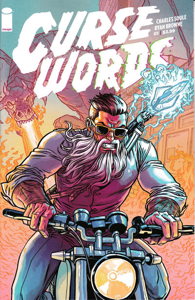 It’s hard to be surprised by things, too…even back in ye olden tymes when I was but a mere customer, like many of you, I still had access to ‘zines and publisher handouts and such that kept me informed as to what was coming. That was nothing compared to today, with an internet rife with spoilers, and solicitation information easily accessible, and…well, I don’t have to tell you. Very few surprises catch us off guard any more, since most everything is telegraphed one way or another in advance. Even Marvel is ballyhooing some last page “internet-breaking” reveal in a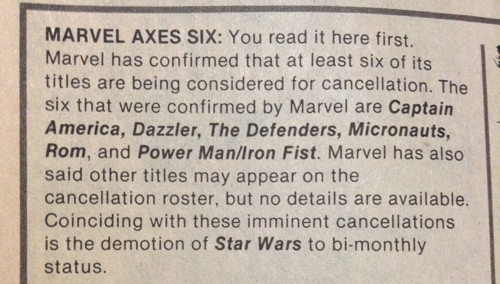
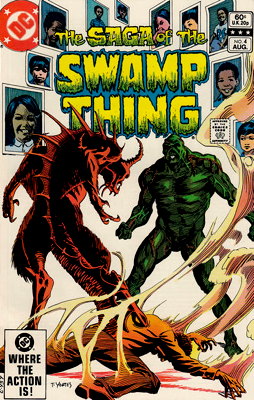 The Marty Pasko/Tom Yeates run that opened the Saga of the Swamp Thing series that returned the character to newsstands is one worth revisiting as well. Its lengthier storyline, pulling together a new cast of supporting characters and giving more of a focus on ongoing subplots, was one that, if I recall some of the letter columns correctly, met with some resistance from older fans of the character. Things were maybe a little too wordy, and subplots stretched out a little too long, for their tastes, though I suspect that’s more a generational change in reader expectations from serialized comic books. Multi-part soap opera-esque stories were more the norm at DC as the 1980s rolled on, perhaps inspired by the success Marvel had along those lines in their own books. Looking back, the initial story wrapped up after only 13 issues, which…well, come to think of it, many stories nowadays come in 5 to 6 issue easily-trade paperback-able chunks, which are only approximately half the size of this Swamp Thing story. But, the point is, people are more used to not getting done-in-one stories in their comics today, which they weren’t back then, which may have affected their perceptions of this then-new Swamp Thing comic. Particularly since it couldn’t help but be compared to the classic ’70s run, which was mostly self-contained stories with only the barest minimum of subplots connecting issues together.