Marvel publishing a comic with “666” in the title would have been something to see.

First, an update to the Wolfman Jack comic I discussed last time…reader Matthew found that one of the creators of the comic has a website and is selling copies! I’ve updated Friday’s post, but you can go straight to that website right from this little ol’ link here.

And now, there are only two questions left in the Question Time pile from way back when, so let’s see if we can wrap them both up.

Tim sez

“Out of the titles published by the late, (maybe) lamented CrossGen, are there any that you think with the right push might have been a success for Marvel?

“I say Ruse, and I know that it had a failed 4-issue Marvel mini, but it was basically shoved out there to die.”
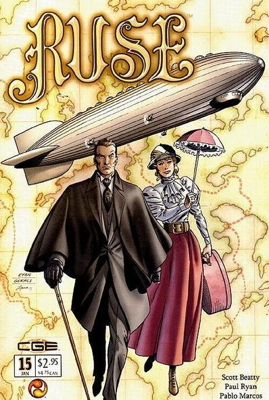
Boy oh boy, CrossGen, that sure was a thing. Definitely a lot of money spent there to make it a thing, and those were certainly a whole lot of good-looking comics. However, the company went bankrupt in 2004, with its various assets eventually purchased by Disney.

I was not a big CrossGen guy…I mean, I didn’t have anything against it, and happily sold it when it was still an active thing. I just didn’t follow the comics, either for financial or time reasons, though in retrospect I wish I had at least bought the Sherlock Holmes-inspired Ruse. Part of what may have kept me away was the “shared universe” business, where there was some kind of connection or ‘nother amongst all the Crossgen titles, and man, I just didn’t have room in my heart then to allow that in.

That said, I did read a couple of CrossGen books. I enjoyed El Cazador, the pirate comic, unusual in the CrossGen-iverse in that it was set on Earth, and it’s been a while so I can’t recall if it had any overt connections to said universe. I also liked the fantasy title Abadazad, by J. M. DeMatteis and Mike Ploog, which was not part of the overall CrossGenening, This was one of the few CrossGen properties continued by Disney after they acquired everything.

Ruse also continued post-Disney acquisition, as did a couple of other titles, published as mini-series during a brief, unsuccessful attempt at a revival.

Now, if I were to pick any titles to have been continued by Marvel and possibly been a success…well, I’d probably lean more towards their initial offerings, like Sigil and Sojourn, or whatever else that may have been sufficiently rejiggered to be part of the actual Marvel Universe and thus of increased interest to today’s Marvel fans. Route 666, CrossGen’s horror title, might have made for a good catch-all for Marvel’s monster characters.

And personally, El Cazador would have been nice to see again, though pinning it more closely to the Marvel Universe might have altered it a little too much.

In essence, the success of these comics under a Marvel imprint would have been tied to integration into the Marvel Universe at large, as asking fans to buy into a whole new Marvel-published imprint of a standalone setting probably wouldn’t have worked. Probably, like my El Cazador example above, would have altered the nature of all these books to the point where most of them became unrecognizable.

• • •

And at long last, our final question from ScienceGiant

“Hey, did we ever come to a consensus on Ben Grimm’s eyebrows? If The Thing should be drawn with no brow, or a unibrow ridge, or something else. Mike started the debate by n 2023.”

I did indeed start it, right here in this post.

I think I more or less wrap it all up a few days later, saying “every Thing is beautiful in its own way,” even as I look at a couple of other brow options for Aunt Petunia’s favorite nephew. Anyway, the ultimate answer is “whatever you prefer is perfectly fine,” but the correct answer is still “no brow.” Glad that’s settled at last.

• • •

Thanks for all the questions, pals, and I’m glad I finally got around to answering them all. Hopefully those of you owed answers were still around to see them. Um, “still around” as in continuing to read the site, not as in “not dead yet.”

You should see he size of that tape dispenser.

Yes, I’m going to answer another reader question, because it’s been a long day and I want to do something that’s a little less labor/thought intensive. “SLACKING OFF — that’s the ProgRuin promise!”

Anyhoo, Matthew Murray asks

“What are the worst ‘preserved’ comics you’ve ever seen in collections? Duct tape? Hot glue? Cereal boxes cut into backing boards?”

Hoo boy, the things I’ve seen. And smelled. But “smell” is more involved with damage, and you’re talking about comics where someone tried to “preserve” or repair or whatever. And I’ve seen some horrors.

One particularly awful thing I’ve seen is an original Amazing Spider-Man #1 — yes, the one from the ’60s — where at some point someone got some kind of wide piece of clear tape and applied it to the covers. And I mean it was wide enough that a single piece spanned the entire width of the book. Were we still able to sell it? Oh, sure, it sold (for how much, I can’t remember…this was long before the price on this book had skyrocketed post-some prominent auctions).

Another tricky situation was a 1940s Wonder Woman #1, where there was a curved black plastic strip taped to the spine as “protection.” Lots of dry browning tape just all over the left hand side of that otherwise okay-looking book. We did sell it, and the buyer later told us he was able to get that plastic strip pulled off, and the tape was just dry enough to be able to be peeled off without much trouble. Well, we sure as heck weren’t going to do that.

These are the two biggies that stick out in my mind. But I’ve seen the homemade “backing boards” cut from cardboard boxes (and yes, even cereral boxes) shoved into the Ziploc bags used to hold the comics. Or I’ve seen comics and boards in a bag, with the bag stapled shut through the small overhang of the board. Or I’ve seen comics in bags and with pinholes though the top center of the comic when these were displayed on a wall.

I’ve often railed against using tape to seal your comic bags…that flapping strip can easily catch on a cover, or eventually deteriorate, or sneak out at night and attack your pets, all kinds of problems. But I’ve seen bags with so much taple sealing the bags that it’s easier to cut the comic out of its overpackaging. Or the bags and tape have deteriorated and gone “gooey” that even handling them makes your hands a sticky mess, making it bit of a trick to rescue the comics and avoiding getting any of said “goo” on them.

When it comes to storing the books, putting them in a proper comic book box is probably the ideal. But so often I’ve had bulk comics stored in huge plastic tubs, which usually results in more than a few of them being warped or outright bend when the piles in the crate eventually fall over on each other. I’ve seen lots of regular cardboard boxes or shoeboxes or those cartons that held either loose paper or the dot-matrix type of printer paper with the punched holes at the sides, used for comic storage, but at least those mostly had square corners and flat surfaces. The plastic storage boxes had wide curved sides and uneven interior widths and whatnot, facilitating comic shifting.

There was that one collection of several long boxes, containing multiple copies of nearly every comic published by Marvel from the ’60s through the ’80s., All well and good, but none of the comics were in bags, and a small flood of water in the area where they were stored resulted in water damage across the bottom halves of every issue.

And of course, the collection of comics where someone used a holepunch on each spine so that the books could be kept in a three-ring binder. Oh, and these were Golden Age books, too.

Those are the ones that immediately come to mind. I’m sure I’ll be surprised by some new wildly-awful comic protection in short order.

The color out of comics.

Following up on the second part of Thom H.’s question, this time regarding my favorite colorists and why. But here are a couple of notable ones

Like I said last time, I don’t know if I’ve got quite the skills to adequately describe the qualities of colorists’ performances.

I’ll start off with Tom Ziuko, whose work I started to notice when he was coloring Atar Force, as seen on this page I had to copy from some dubious source on the internet since my copies are currently not in a readily available place:


I appreciated the boldness of the coloring on the foreground characters, while the background characters are painted with a single hue as to emphasize just what exactly we’re supposed to be looking at here. I know it’s not an uncommon strategy, but I really first noticed it with Ziuko and he’s stuck in my head ever since as a colorist to watch for.

Next up is the late Tom Luth, the brave soul who tackled Sergio Aragones’ Groo the Wanderer for decades:


All of Sergio’s meticulous detail required a colorist just as meticulous, and that man was Mr. Luth. Other capable hands have taken the coloring reins on this series, but Luth remains the gold standard.

Now here’s where it gets tricky. As a Swamp Thing fan, I particularly appreciated the color on these series, most notably the original ’70s run. Coloring a horror comic definitely requires a different tone from coloring a Superman story, and the colorists on the first Swamp Thing run were up to the challenge.

So, I picked a solid, attention grabbing page from Swamp Thing #9 (1973), with some nice coloring (scanned here from my personal copy):


…and I had to go look up the credits online since DC titles at this point didn’t credit colorists or letterers, usually. My assumption was that it was Tatjana Wood, as customer Sean notes, the person usually associated with coloring the early Swampies.

I look up this issue on the Grand Comics Database, and…the colorist is not known. Another site says the same thing. The later reprint in Roots of the Swamp Thing also gives no indication.

Interestingly, the GCD says earlier issues were colored by Bernie Wrightson himself, including a note on #1 citing a letter from a later issue as a source. Wood doesn’t start getting credited, at least on the CGD, ’til #11, after Wrightson leaves the title.

Anyway, I still don’t know who colored that above page, or the issue #9 it came from, so…Good Job, Anonymous Person! And I don’t know the full story on Wood vs. Wrightson on the other coloring jobs. Thus, let’s just say Whoever Colored 1970s Swamp Thing is one of my favorite colorists. If anyone can straighten this out for sure, that’d be great. I don’t have the time to investigate further as I write this, but I’ll look into it as I can.

Like in the previous post about letterers, I’m sure there’s plenty more colorists all of you can name in the comments. (Like, I forgot to mention Master Letterer Ken Bruzenak? Or Chris Ware?)

“Wuffa wuffa.”

So here we go, back to the ol’ Question Time post to answer more of your queries!

Thom H. scrawls into the margins

“You know who we don’t talk about enough? Colorists and letterers. Do you have favorites? If so, who and why?”

You’re right, we don’t, and there have been, and still are, great people at work in these positions in the comic book field. I’m going to start today just by showing some examples of some of my favorite letterers, mostly decided by those I appreciated the most when I was young. First one should be no surprise…


…Gaspar Saladino, who lettered a whole lotta those early 1970s Swamp Thing comics. That just slightly angular, slightly-off style added to the creepy flavor of the book. Look at the “S,” or look at how the bottom lines on the “L” and “E” is angled. Big, bold lettering for a big, bold horror comic.

Next up is the all-time heavyweight champion of comics lettering, far as I’m concerned:


…John Costanza, who seemed to be everywhere for a while. Just clean, simple lettering, that relates the information without drawing attention to itself. (And it should be noted that Mr. Costanza was a cartoonist of some note as well, having drawn for Disney and the Simpsons.

Another favorite…


…is Todd Klein, shown in this example lettering one of the rare Alan Moore Swamp Things not lettered by Costanza. Another multi-talented gent in the field, he wrote a number of comics as well (including an old fave of mine, Omega Men), and designed several logos. You can visit his info-packed site right here.

And I’d be remiss if I didn’t mention…


…Dave Sim, who’s known for, among other things, writing and drawing Cerebus the Aardvark, but was a master letterer as well, who exuded emotion and action with his stylings.

Here’s another example of his work, one that gets brought up quite often when discussing his lettering skills, and who am I not to bring it up too? (Click the pic to make it slightly more legible.)


Boy, that’s the stuff.

There is of course no end to letterers out there whose work I love…John Workman, who was as much a part of Walt Simonson’s Thor as Simonson himself. Or Bob Lappan’s wild work on Atari Force, presenting alien languages in unique and appealing ways. Or Stan Sakai, whose lettering for Usagi Yojimbo is just one more bit of excellence in his overall artistic presentation (and don’t forget, he also letters Groo the Wanderer!).

I could probably go on all day just listing great letterers, and I’m sure some of you folks will drop some worthy names in the comments. Lettering really is a fascinating and expressive art form unto itself, and one we should all appreciate more.

Speaking of which…I’m probably going to have to address favorite colorists next week, as I need a little more to think about it. With rare exceptions, I can’t look at coloring work and immediately identify who colored what. I just don’t have that skill. But there are plenty of comics where I’ve very much appreciated the color work, so maybe I’ll just have to go through a couple of those. Come back next week and see how I pulled myself out of this one.

Mind the apostrophe.

I’ve decided that I’ll just do one more post replying to Isaac’s question, as I’m sure I’ve hit the big ones here. Specifically, as you may remember, he asked about the different “universes” publishers were cranking ouit in the ’90s, which titles I wish had been successes (i.e. still published ’til today) and what memories I had of these companies at the time.

I’ve already tacked Valiant and Ultraverse, and I know there are plenty more, but I’ve got to move on to other stuff. But you never know, I may come back to this topic when you least expect it.

But to wrap things up, for now, let’s talk about Dark Horse’s superhero universe initiative, Comics’ Greatest World:


Launched in 1993 as a series of one-shots, each centered around a different character or team. Y’know, like the one above, which is where the character Ghost first appeared. The one-shots themselves were released in themed sets, after a fashion, with characters attached to four different locations across the U.S., represented by a symbol on the cover. Like, some of the books would be tied to Steel Harbor, others to Arcadia, and so on. That “scales of justice” with the anti-sign over it on the Ghost cover? That represents Arcadia.

Anyway, I don’t know how much attention fans paid to that region-specific distinction. As I recall, customers either just bought all of the CGW books, didn’t buy any at all, or just bought one or two, like Ghost because Adam Hughes did the art. I seem to recall these one-shots selling…okay, not great. It was just too much all at once with too many new characters that didn’t grab a lot of interest.

Didn’t stop Dark Horse from continuing to push it along, with attempts at ongoing series and mini-series spinning out of this initial launch. Ghost was relatively popular at our shop from the get-go, particularly with the Adam Hughes boost when he was on the book, and I feel like this is the one I wished had continued on ’til today. I mean, she sorta has, having had a mini within the last ten years, so they’re still trying with her. But it ran for quite a few issues in the mid to late ’80s, making this probably the most successful comic of the bunch.

Another title I wish was still around was Barb Wire:


…which…yes, I know, the Pamela Anderson movie, yuck, but it’s probably because of that movie folks even remember Barb Wire today. I know they tried another Barb Wire series a few years back, but it’d be nice to have it back on the stands. Folks seem to have a soft spot for it.

X is another title that had a following at our shop:


…both the initial series, and this revival series that ended about a decade ago. This Punisher-esque vigilante character still had a little bit of a following around here.

So there. you go, those are the three properties from Comics’ Greatest World I wished had been successful enough to continue non-stop from the get-go, no relaunches required. (To be fair, they did come close.) Or, maybe, a series of mini-series, one or two a year, Hellboy-style. That would have been nice. Just this little circle of books in a shared universe that might have been the focal point for future spin-offs and crossovers with other CGW characters.

This isn’t a fair assessment, I realize, since I’ve not read the majority of the comics under the Comics’ Greatest World banner. I mean, I don’t know, The Machine could’ve been good, but I suppose there is no way for us to ever know. And some of the above comics I singled out had been revived within the last decade, but departed fairly quickly.

This brings us back to the post were this all started, where I relate how I saw the Comics’ Greatest World on the cover of Diamond Previews and wondered how anyone could afford all these. Which really is the most prominent memory I have of this influx of new publishers and imprints at the time. So many companies just desperate for attention in a marketplace that had recently explosvely shrunk and wasn’t getting much larger.

Okay, that’s enough on the topic for now, and I’ll try to get back to it later in the month if interest warrants. And I’m sure I’ll see something in the comments sections that I’ll want to address. But ’til then, thanks for reading all this, and I should be back Wednesday with more typing on a different topic.

Yes, I do remember which writer it was, too.

First order of business: get me your 2026 comic industry predictions! Read the rules, then submit! SUBMIT, I tell you.

Next, back to Isaac P.’s question about ’90s comic publishers. Specifically:

“Is there one of these [oublishers/imprints] that you, as a reader, wish had been a success? Alternatively, are there any particular memories of this era that stick out to you from the sales side of things?”

Well, one I would have liked to see stick around is the Ultraverse line from Malibu, later purchased by Marvel Comics:


Yup, that’s Sludge there, Steve Gerber’s attempt at doing a new variation on the Swamp Thing/Man-Thing formula. Haven’t read it in a while, but I remember enjoying it, because, hey, Gerber writing a man-monster comic, of course I’d like it. (The initial artist of the book, Aaron Lopresti, would occasionally plot an issue and there are a couple he outright wrote himself.)

Anyway, I would have liked to have seen more of that book. And most of the Ultraverse in general. (Prime, a Shazam!-esque comic about a young man who can turn into a grotesquely-overmuscled adult hero, was one I enjoyed, until it turned out one of its original writers was a sex offender, tainting that particular property for all time.) But other books had their followings, like Mantra (an immortal male warrior reincarnated into the body of a woman), Rune (an evil demonic entity that got up to plenty of trouble, early issues written and drawn by Barry Windsor-Smith), Firearm (a non-superpowered private detective)…all quite popular at the time. And I know I’m leaving out your favorite, sorry.

Now, of the ’90s imprints that came and went, it would seem like Ultraverse would be the one that had at least one foot in the door for a full revival. The publisher was purchased by Marvel Comics, and for a time, there were several crossovers between the Marvel Universe and the Ultraverse. But, eventually, the Ultraverse characters just stopped appearing, even though Marvel still owns them.

There’s no official reason given, and there’s a whole section on the Wikipedia page about the current status of those properties. Revivals were planned and discarded, and it’s been suggested that the line’s former publisher maintains business interests in the Ultraverse titles, which I guess put the kibosh on any relaunches.

It’s a shame those titles can’t be revived or reprinted, at least at this time, as there was a lot of good work in there. I already mentioned Windsor-Smith, but there was a whole of of George Pérez in there, too. Ah, well, it’s just (maybe) a bunch of legal red tape, maybe it’ll get unknotted someday and we can see these books again.

One particular memory I have from the ’90s was when one of the Ultraverse writers happened to come to our store to do a little shopping. Now, back then, we did a lot of business in recent back issues, and we had several boxes of Ultraverse backstock marked and shelves in the back room, just visible through one of the doorways into that back area. The writer happened to spot those boxes and mentioned to his friend (but within my earshot, which I don’t think he realized) “oh, they’re never going to sell those.”

Well, ha HA mister, we did sell all of those! Eventually. In the 2000s. In a bulk sale for about a dime apiece. BUT WE SOLD THEM.

Anyway, Ultraverse…I think it would have been okay if it kept going. Maybe not even as its own standalone thing, but just fully integrated into the Marvel Universe like they were trying to do. I mean, 30+ years of Firearm comics? C’mon, that would’ve been pretty cool. And Rune, maybe not as his own standalone title, but as one of the many wildly-powered adversaries who menaces our heroes on a regular basis. He could have been the Big Bad in a series of Marvel movies by now. Brings a tear to one’s eye.

Next ’90s company/imprint to discuss: oh, what the heck, let’s talk about Comics’ Greatest World, even though I’ve read, like, almost none of it. But I’ll give it a shot in a few days.

Because someone’s gonna mention it, yes, I know the actual first iteration of Valiant was all those Nintendo comics.

So when we last met, I was looking at an inquiry from Isaac P. regarding the 1990s New Superhero Universe Explosion. One of his questions was “do you wish any of them had been a success?” vis-à-vis my comics fandom (as opposed to being a comics retailer).

Well, in a way, most of them were successes, at least briefly, in that many comics from that period of the industry managed to pull in some numbers. I remember specifically Valiant Comics having a slow start with us, as Harbinger #1 showed up and I don’t think we sold a single copy.


That quickly changed as Wizard Magazine got on board the Valiant/hot comics train for whatever reason, and suddenly all Valiants were suddenly in demand. (At least until Turok Dinosaur Hunter #1 came out, but you don’t need me to write about that again.)

Now, for Isaac’s use of the term “success,” I’m going to presume “continuing to publish past the ’90s boom/crash and perhaps even ’til today” as the definition of the term, instead of the short-term windfalls these companies acquired. And while there are still Valiant titles being published today, it is not the same company it once was. It’s changed owners, titles have been relaunched and rebooted, so on and so forth.

The Valiant I’m thinking of, the era where I believe it was the best it had ever been, was its initial superhero universe from the early 1990s. X-O Manowar, Shadowman, the aforementioned Harbinger, and titles featuring licensed characters as part of their shared universe, Solar Man of the Atom and Magnus Robot Fighter (and eventually Turok, yes, yes). This was overseen, and some titles written by, former Marvel editor-in-chief Jim Shooter, and everything wove together more or less smoothly and it was all a lot of fun.

Once Shooter left Valiant, and more and more titles started to be added, it became a little more difficult for most readers to stay immersed in the entirety of this superhero universe. I didn’t much care for how things went post-Shooter, but Your Mileage May Vary, of course.

But I think of all the new shared universes that popped up in ’90s, I wish that early period of Valiant had been able to continue on ’til today, without all the reboots/relaunches/changes in ownership, and still including the licensed books as part of the whole (as most of those moved on to other publishers after the first iteration of Valiant ended).

And I know people have soft spots for some of the later 1990s Valiant books, like Second Life of Dr. Mirage, Bloodshot and Quantum and Woody, so…what the hell, let’s keep them around, too.

I don’t mean to disparage any work being done on Valiant properties currently (except the anti-trans horseshit in that Bloodshot book, off to the sea with that garbage). I’m mostly just waxing nostalgic for a period of that company’s publishing endeavors that kept me entertained and invested as a fan, not just as a guy slinging comics from behind the counter.

Anyway, remember when I said this was going to be a two-part answer to Isaac’s question? With today being part two? Well, I lied, I guess, because I’ll continue on with Ultraverse Comics in the next installment. I may have other stuff posted in the meantime, like the long-awaited new entry in the Final ’90s Countdown. But I’ll come back to it in short order, Isaac, honest!

I would’ve read a Grim Ghost/Tarantula team-up comic.

Isaac P. wants to know

“I’m fascinated by the ‘every publisher launches a superhero universe’ era of the 90’s that brought us the Ultraverse, Comics Greatest World, & the like. Is there one of these that you, as a reader, wish had been a success? Alternatively, are there any particular memories of this era that stick out to you from the sales side of things?”

I will tell you the one big memory I have of this particular period in the comics industry history. It’s probably one I’ve mentioned before, but it’s well worth repeating.

I very strongly recall getting in the new copy of the Diamond Previews catalog, which features Dark Horse’s “Comics’ Greatest World” on the cover, ballyhooing the arrival of A New Superhero Universe™!

Courtesy the folks over at the Longbox Heroes podcast, here is a scan of that Previews cover from April 1993:


And as you may be able to see, there’s a split down the center, where you could swing open those parts of the cover and reveal the Comics’ Greatest World gang lurking within:


Which is all well and good, but 30+ years later, I can still remember the thoughts I had upon seeing this cover. I thought about all the other Superhero Universes and such that were coming into existence around this time, and I thought of Dark Horse’s entry into that already-burgeoning playing field, and I wondered “how do they expect comic readers to pay for all these New Universes?”

And that was the real problem. Here’s Valiant, here’s Ultraverse, here’s Comics’ Greatest World, here’s…I don’t know, Triumphant, here’s that other shared superhero universe Malibu was doing aside from Ultraverse, and then there’s DC and Marvel of course, and probably more I’m not thinking of at the moment.

It was just too much…new comic readers weren’t suddenly going to appear from nowhere to read all these comics, especially during a market downturn. The fans that already comprised comic book readership were either going to have to cough up more money to buy additional books, or they’d have to drop other books to make room for some of these new titles. It wasn’t a huge growth move for the industry, it was more a lateral move.

You know how there was a huge push to make shared universe movies after Marvel’s success with that strategy, only for several studios to find out that it wasn’t quite as easy as all that? (And that even Marvel isn’t finding it so easy lately?) What’s going on in the comic book industry about this time is sort of similar to that, except 1) publishers had a slightly better hit rate, and 2) there was a whole lot less money at stake.

The rise and fall of the Superhero Universe in comics was enough of a thing for the Overstreet Price Guide to release a side-guide a few years back, the Overstreet Price Guide to Lost Universes. And as you can see at the link, it doesn’t just concern itself with ’90s efforts, as it includes the ’70s Seaboard/Atlas books…though, were they in a shared universe? I can’t recall any crossovers there. Anyway, I think I actually grabbed a copy of this for myself, so I’m going to try to dig that out and give it a once-through before I continue here.

Yes indeedy, this is going to be a two-parter, at least. I kinda want to spend some time with some of these departed Universes and not rush through ’em at the end of this post, so I hope you forgive the cliffhanger.

Hey kids, comics.

So Smichal smasks

“How do kids factor in as a demographic at your shop? Is it bigger/smaller than in the past? What are they buying? Do they stay invested in the medium, or is it a passing interest?
For argument’s sake, lets define kids as 16 and under for this question.”

Well, sure, I actually get lots of kids coming through the store, largely due to my location. My store is located in a strip of stores that includes a couple of restaurants, a popular pizza place, a music store/school/venue, and one tiny storefront at the end that seems to be used as a storage area for some other business, but that’s perhaps a tale for another day.

Anyway, with all these schools and restaurants and pizzas, I get a lot of walk-in traffic, particularly from families with children. And thus, I have sort of a captive audience here, with parents unwittingly passing by on their way to eat, when their children spot my store and start shouting “LOOK, COMICS!” and the like.

In that way, I’m very fortunate. I know at the previous place of employment, we were down the road from a high school, and we’d get a lot of foot traffic when classes were out and kids were heading home. However, we weren’t surrounded by other locations that regularly brought in families with children — we had a dry cleaners, an optometrist, a tattoo parlor, a place that sold prosthetic limbs. I mean, yeah, sure, any of those places might cater to young folks (I mean, Junior’s gotta get himself inked sometime), but by and large it was the comics/games shop that was the sole attractor for families.

Now, back to my shop, what are those kids after at my store, anyway? I mean, yes, it’s a pretty good mix of just about everything. People have their ideas about what kids actually want from comic book stores, but I tell them “I had a little girl ask for and buy several Hulk comics” and those preconceived notions can just go right out the window.

But yes, some of it is What You Expect. My Little Pony, manga (especially One Piece right now), Dog Man (slowed down a bit since the movie), the Raina Telgemeier books, that sort of thing. And when it comes to the traditional comic book-type stuff, kids usually ask for Spider-Man or Batman. I get some very light interest from young folks in the Thundercats revival books, but just about every other ’60s-’80s cartoon-based comic book is For Grown-Ups Only. Simpsons comics would do incredibly well based on the demand I have for them from kids, but darned if Disney/Marvel/Whoever is leaving money on the table by not getting another comic for them out on the stands.

Along with comics, kids are also buying lots of the Little Golden Books, the thin illustrated storybook hardcovers for which I have a giant spinner rack by the door. That and the slowly dwindling supply of Funko Pops are what grabs children’s eyes and pulls them into the shop.

As for whether it’s more or less than in the past, all I can really say is that the percentage of kid clientele at my store is steadily increasing. How many are sticking with the hobby as they age…that’s hard to say. I know a handful of kids who have been coming into my shop since they were barely able to walk on their own, so at least some have maintained their interest.

Still waiting for that Usagi Yojimbo/Groo the Wanderer crossover.

David wants to know

“I’m really interested and intrigued by Usagi Yojimbo, but I’m overwhelmed by the number and variety of books that collect these stories. Given that money is not an issue, where should I start?”


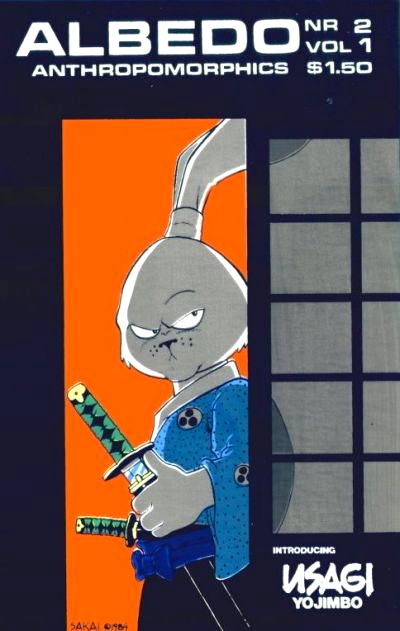
Well, what you do is you find yourself a copy of Usagi’s first appearance from 1983, in Albedo Anthropomorphics #2 (pictured above), and just work forward from there.

…Well, okay, maybe that’s not quite workable. Albedo is notoriously small press, even by small press standards, and this comic being in low supply and enormous demand…well, you did say “money is not an issue.” Currently a copy can be found on eBay for $6,400, or another in one of those “professionally graded” plastic boxes for $46,000 — good news, shipping is free in both cases.

But presumably you don’t want to be messing around with single issues. That said, as someone who personally hasn’t read every Usagi Yojimbo comic that’s ever been published, it’s been my experience that these comics are highly accessible to new readers. Yes, characters have a history and there’s a measure of continuity to the proceedings, but anyone just coming aboard is given all the info they need to follow along, if necessary. So, basically, you can just jump on with the next Usagi mini-series that comes out.

Again, though, if you don’t feel like doing the single issue thing, there are no shortage of reprint collections to get you started. And because of the very nature of Usagi stories, you can probably start pretty much anywhere and you’ll be fine. I realize there are a lot of books, and that not all of them are in print at all times. There are 41 of the smaller trade paperbacks, 33 of which are collected into the Omnibus Editions from Dark Horse, and there are several other books aside from that run. This section of the Wikipedia entry details what’s in each book, if that helps.

The honest answer would be “just pick up the collections as you find them.” The phrase “boy, this issue of Usagi Yojimbo sucked” has never been uttered by a human being, and therefore you’re good wherever you start.

The only advice I’d give is maybe read the classic feudal Japan era of Usagi, before diving into spin-offs like Space Usagi, or maybe even the Teenage Mutant Ninja Turtles crossovers. But then again, tons of kids were introduced to Usagi Yojimbo via the TMNT cartoon in the ’80s and that worked out okay, so what do I know.

So anyway, David, that’s a lot of reading, so you better get crackin’. There’s gonna be a quiz next week.