I didn’t forget about The Losers, just didn’t have anything to say about it.

Okay, on to the DC Comics films. But first, Thom reminds me that I forgot Into the Spider-Verse, which really is a fantastic film and quite possibly the best of the bunch.

Also, if folks want to leave long ol’ comments on my posts, that’s fine with me! So long as they’re reasonably on-topic, y’know? And everyone has been lately…haven’t had epic-length disturbed rants show up in quite a while. I mean, c’mon, leave those to me.

So, DC Comics movies. Hm. I’d been thinking about how I was going to approach this topic, since there’s definitely a shift in filmmaking between the Christopher Reeve Superman films and, like, Birds of Prey, and my initial instinct is to split them up into different “ages” but, sheesh, that would be too confusing, what industry would do something like that?

The elephant in the room is the Snyder-verse films Man of Steel, Batman V Superman, Justice League, which are pretty divisive among fans. Personally, I generally like them, though I can completely understand why people wouldn’t. The dark tone, the odd choices (jar of urine in my superhero movie? sure, load it up) adding up to productions that seem like the exact opposite of what the characters are about. Well, okay, maybe not Batman, but surely Superman should be bright and cheerful and Henry Cavill has such a winning smile it’s a shame it was barely used.

But I did enjoy this more somber rendition of the characters, while realizing, yeah, maybe a lighter touch might have been more appropriate. So, mixed feelings on these, but generally positive. And I’ve noted that Justice League, while having some of the tone problems of the other pictures, I thought was successful in being a bit more of a cheery adventure. With grave-robbing, sure, and the buckets of “we gotta get that Avengers money” flopsweat, but it was all in good fun. And I have to say, my favorite scene in any modern DC superhero movie is still that fight sequence between a newly revived Superman and the rest of the heroes (particularly as he “slowly” becomes aware of the Flash).

The Snyder-verse-adjacent flicks, Wonder Woman and Aquaman, were more to everyone’s tastes, I’d imagine. Certainly lighter in tone, well, aside from the whole “World War I” thing in WW, but seemed to be more crowd-pleasing than their dour brethren. Of all the films, Aquaman was the one that felt the most Marvel-like, extremely jokey and high in the “we’re having a good time here!” energy. But that was the film, I’ve said before, where I felt like I was seeing the seams in superhero movie-making, where every point felt predictable, every reveal unsurprising. I don’t know, not saying it wasn’t likeable, and that the actors weren’t all watchable and entertaining. Maybe it was just my mood that day, but for whatever reason this film felt more like “product” than the others, like something specifically constructed to get after some of that Marvel money. Maybe I’ll need to rewatch it at some point and see if my opinion improves.

Okay, this is going to go on forever if I keep up all this typing. So:

Shazam – good, still don’t like the Billy/Captain Marvel relationship has been altered to “Tom Hanks in Big” status, but that’s how it is now and I have to live with it. Also hate he’s called “Shazam” now, because I’m a nerd. Anyway, Shazam’s characterization put me off, but I get it’s the “has to learn to be a hero” trope and that’s just how it’s done.

All the Batman movies – the 1966 one is a favorite because Adam West is Best Batman, of course. The Keaton-etc. films were an exercise in diminishing returns, with Keaton’s performances elevating the first two, along with the Tim Burton weirdness. The fourth is goofy fun, brightly colored and very silly and enjoyable on those terms.

The Nolan films may have been better as a duology, but then we wouldn’t have had a million impressions of Bane from the third film, which is just straight-up comedy gold. I remember when the first one had trailers in theaters, folks groaned when they realized it was a Batman film, as the previous movie Batman and Robin was still fresh in everyone’s minds. But that film turned out good (actually convincing you “well, of course he had to dress up as a bat”), but I think the second one is the best. Heath Ledger’s performance as the Joker is one for the ages, and it’s a film about moral ambiguity and moral choices and it’s all amazingly effective.

Of the Reeve Super-films, the first is of course the best…I know people like the second one quite a bit, and it is fun, but I don’t think it’s as…well, well-made as the first. Third is fun and goofy, and the fourth is an abomination. Reeve is great in them all, of course, but I wish he was surrounded by better material. Definitely classic scenes in those first two films, combined with some inexplicable ones (levitate-people-with-your-finger-beam power, Superman’s magic chest-emblem cellophane net).

And there are a few others: Superman Returns, in which Brandon Routh is great, but everything’s too mired in trying to be the Reeve film. Birds of Prey, a fine, and funny, adventure romp which gives Margot Robbie’s Harley Quinn a proper venue. Constantine, which turned out a lot better than it had any reason to be, despite not quite getting the title character right (I mean, beyond the hair and accent). Watchmen, which I adore but recognize it falls apart the farther away it gets from the original plot…great cast, though. Catwoman, which almost seems like it might be okay, at first, but it’s all lies.

And there are others, but let’s get this down to “worst” and “best” so we can all move on with our lives.

WORST is definitely Superman IV, and I say this even though I couldn’t even finish Supergirl. Supergirl at least had the charm of Helen Slater. Superman IV looks like, if I can borrow a phrase from Mystery Science Theater 3000, everyone’s last known photo. It’s cheap looking, it’s unpleasant, it’s made by people who seemingly had contempt for the material. I know Reeve cowrote it or plotted it or something, but it’s dire.

I want to plug Jonah Hex in here too, but folks are rewatching it and finding new entertainment in it, and I’d like to see it again before it vanishes. Suicide Squad wasn’t great, but it had good performances (Will Smith, the aforementioned Robbie) so it may live.

BEST is…well, I think Joker is actually the best-made of the bunch. It holds together as a story, the deterioration of the main character is tragically fascinating, and it just plain looks great. I understand the qualms one could have with it, but maybe that’s part of what makes it so fascinating.

But I think I’d watch The Dark Knight before I’d see Joker again. It’s more fun and a little easier to take. And it’s a little thought-provoking as well, which I appreciate from my funnybook movies.

Now, like I did with the Spider-Verse movie, I left out the animated feature films (and I’ve seen them all!). And I still want to say Return of Swamp Thing is my favorite. Do any of these other movies have Swamp Thing driving a jeep with Heather Locklear? I submit to you, dear reader, that no they do not.
Yes, I know Howard was in the second one, too.

So there’s been a little back-and-forth about superhero movies in Friday’s comments section (along with some now deleted reactions from folks upset about…socialism, I guess?), and while I think we can all agree what the best superhero film is, I just wanted to put in my two cents. And conveniently, this is my blog, so I can do so.

I’ve seen in the past some comments about how there’s a “sameness” to the Marvel Universe movies, and as has been noted, surely that’s by design. It’s brand-building…you go to a Marvel movie, you know what you’re going to get. Not really any different from Marvel the Publisher having a “house style,” really. Does this prevent the studio from reaching any “highs” by a purposeful maintenance of a consistent level of expression? Not necessarily, no more than Marvel’s “house style” kept Gerber’s Howard the Duck from happening.

I don’t know what would be the “Howard the Duck” of the Marvel Cinematic Universe, aside from the first Guardians of the Galaxy movie, which was 1) a really out-there move for the studio, and 2) literally had Howard the Duck in it. Other than that, I’d say the films that stretched the formula the most would be the Deadpool films (which weren’t under the main Marvel Studios room at the time), and possibly Logan (see previous parenthetical note).

“Yes, yes, but were any of these any good?” I think Marvel’s done a good job, he said about the company that’s raked in billions at the box office, building that brand and making each of their films a must-attend event for the fans, just so you can keep up with what’s going on and be properly informed for the next installment. And yeah, I realize that’s probably a thing that makes film purists wince, and I probably can’t blame them, but I honestly don’t see anything wrong with what’s basically big budget movie serials, looking at the nine movies of Star Wars and saying “oh yeah, here’s twenty and counting!”

Okay, okay, the first Guardians of the Galaxy is probably my favorite, with Thor: Ragnarok a close second. Avengers: Age of Ultron was my least favorite, at least upon initial viewing, but I find that occasionally catching a few minutes of it here and there as it’s rerun on TV or as the nieces and nephews watch it on Disney+ has made me a little more forgiving of it. Perhaps that’s the best way to watch it…snippets at a time, and not necessarily in order.

Of course, special mention must be made of Iron Man, which took a second-or-third stringer character published by Marvel, and, despite a lot of fans thinking “Iron Man? Really?” gave us a solid film. Solid enough to kick off one of, if not the biggest, moneymaking things ever.

Outside of the mainline “Avengers-verse” Marvel films, I think my favorites may be…well, surprisingly, the Deadpool films. I say “surprisingly” because I’ve been mostly indifferent to the character’s comics. But the movies are a refreshing mockery of your standard superhero movie nonsense, and frankly I’m shocked they even still use the “superhero landing pose” after one of the Deadpool movies pretty well demolished it.

Also, I think I’ve mentioned here that I saw the first one in a “4-D” theater, where the seats moved around in relation to the film’s action, and lights flashed at you and you occasionally got air blown in your face or whatever, and that’s pretty much the only way one should see a Deadpool movie.

Outside of that…I think of the X-Men films, the first one is still my favorite, Storm’s “frog hit by lightning” dialogue and all, if maybe only because I can still feel the amazement that they actually managed to make a halfway decent X-Men movie. And the Wolverine movies are all fun, and Logan was a real achievement. Dark Phoenix, the last film, was…not great, and given their attempts at trying to glue together the initial X-Men films with the First Class continuity, you essentially have Jean become Dark Phoenix twice and hoo boy that seems weird to me.

The many and varied Spider-Man films, prior to Disney getting involved, are…mostly good, I think. I like the Raimi movies a lot more than the two “reboots” that followed (though Amazing had Emma Stone as Gwen Stacy, which ain’t nothin’ to sneeze at). Spider-Man 3 had “Evil Peter Parker,” which may be the greatest cinematic Spider-moment of all time, and if you don’t agree, I’ll have to ask you to leave this lecture hall.

All in all, I still have a soft spot for Howard the Duck, which isn’t part of the modern wave of Marvel movies, but I saw that on opening night in a theater with a small handful of other people and by God I’m going to treasure that memory forever.

Okay, that’s too much typing, so I’ll hit DC next time. I may decide Return of Swamp Thing is the best DC movie, just so you’re warned.

So what I did on my Thanksgiving…

…was not expose myself to unnecessary health risks, but stayed home, did some laundry, ate some homecooked food with my girlfriend, watched a movie, and switched over to a new desktop computer.

The “switching over to a new desktop computer” thing is what’s standing in the way of a proper update to this site here…I mean, I’m writing this post on the new computer right now, but I still have a few things to do to it to beat it into a shape I’m familiar with.

And “new” is perhaps not quite the right term…it’s a Mac Mini from 2010 which I know is half-past-dead in terms of computer lifespans, but my previous Mac Mini from 2009 was a pretty robust machine up until the CD/DVD drive decided to die out on me this week. In fact, the 2009 machine probably would have been fine to continue using as, aside from that particular mechanical failure, it was still chugging along swimmingly.

But since I had this 2010 Mac Mini here (given to me by my parents, as they upgraded to a newer machine a few years back), I just went ahead and made the switch.

It’s a stopgap measure, I realize…the last three or four Mac system software updates don’t seem to be installable on this particular Mac’s hardware configuration. And eventually, the programs I depend on will require more recent system updates. But for now, it’s fine…everything from the startup and the actual operation seems to be significantly faster, so I’m probably good for a while. Hopefully after my eyeball situation, and now my teeth situation, ha ha, come to some sort of resolution I can save up for a new home computron.

Anyway, that’s more than you probably wanted to know. Thankfully everyone’s too busy doing Black Friday stuff to read this.

Oh, and the movie I watched was Joker. Turned out the girlfriend got a year’s worth of free HBO as a promo thing from the cable company, and that comes with an HBO Max login, so I took a break from watching 50-year-old episodes of Sesame Street to watch the only DC Comics film to be nominated for a “Best Picture” Oscar. (And the second Joker portrayal to win an Oscar.)

It’s…certainly depressing. And a little horrifying. The cinematography was certainly excellent. Gotham definitely looked like a city that would need a guy who dressed like a bat to protect it someday. Watching Joaquin Phoenix play a guy who ultimately seemed doomed from the start was…affecting, worrying, and definitely appropriately cringe-y in parts. Removed from the real world concerns that surrounded its release, I’d recommend it as an interesting take on the character, but given the more social and political ramifications it feeds from, I can understand why folks would give it a pass.

I did see in an interview somewhere where (I think) the director of the film was intrigued by the idea of what kind of Batman would arise from the world created in this film, and I have to say…you know, I realize there’s no shortage of Batmanning in Hollywood, but I’d kinda like to see that too. Especially if it, like the Joker film, was told entirely from the point of view of the Joker. I mean, who wouldn’t want to see an adaptation of this series? I call dibs on playing Willie the Weeper.

(EDITED to correct my poor Oscars memories.)

Though come to think of it, “not enough” and “all over the place” describes this blog, too.

So a new issue of Spawn is out this week, and if you’re aware of the comic at all, you know they’ve been doing the multiple-cover thing for quite a while now. I mean, which is fine…well, not “fine” in that the reliance on multiple covers hopefully to boost retailer orders upward is likely indicative of a weakened marketplace, but rather “fine” in that “it’s not like they’re the only ones doing it.” And anyway, each issue of Spawn has its three, four, five or so variants every month.

A while back, for the release of Spawn #250, I wrote a bit about its sales, how it was essentially a pullbox-only title with few rack sales at my previous place of employment, and that at the new shop was beginning to show some signs of increased demand.

And in the six years since…well, it’s complicated, especially of late. On average, sales on the book for me are higher than they had been. It’s no best-seller, but it’s a solid middling title and there ain’t no shame in that. It has a consistent readership that picks it up each and every month and that’s great.

But on top of the consistent monthly sales, for which I can plan and order, there’s the complicated bit. I’ve written before about the current wave of comics speculation, spurred on by phone apps and websites and YouTube videos, which invariably results in a notable increase of demand the day of, or perhaps the day before, the release of a speculated-upon book. Too late to place raise orders, so not enough of the item is available…but if there were time to place reorders, then there’d be plenty of the item available, and thus no speculation.

Spawn, with its various covers, has been the target of investment-minded folks of late, but almost always for just one of the covers. And there’s no way to predict which one will the the one ahead of time. Well, maybe a little ahead of time, as a couple of my regular pull list folks for Spawn specified they wanted cover “C” of the new issue, and that feels like a good sign that’s the one I’m going to be hearing about on the phone for the next few weeks.

So that’s the trick…order what I need, order a few extra for rack sales, and get ready to hear about the one variant that you sell out of right away for a while, least ’til the next issue arrives. The only consistent thing about the excess demand for the series is that there is consistent demand of this sort for every issue. Maybe not every cover of every issue, but I can always depend on thinking “rats, shoulda ordered more of that one” in my late Wednesday afternoons.

• • •

A little more comment catch-up:

Allen M notes that he’d like to hear me on a certain podcast, and, well, that stirred up old podcasting feelings of my own that I’d have for a while. In fact, it’s baked into this site, with a subdomain that I created 17 years ago and with which I never did anything.

I do think about it a lot, though, especially since it’s easier than ever to put one together now. Main issue is…me. For all the typing I do here, I’m not a particularly good extemporaneous speaker…either I don’t say enough, or I’m just kind all over the place. As I noted before, the phrase “edited for clarity” in this interview with me is carrying quite the load.

On the other hand…I do have to speak off the cuff to customers all the time, expounding on whatever query they’ve made the mistake of asking me, so I have some practicee talking about comics. (“Some practice” = “oh, only about 32 years worth.”) Maybe a podcast isn’t an entirely lost cause for me after all…I have a format semi-figured out, and even have theme music that I’d, ahem, “borrow” from some friends of mine (well, okay, I’d probably ask their permission eventually). We’ll see if that’s something I think I can consistently do, with the time I have available and the minimal skill set I’d bring to it.

Plus side, you get to hear my malodorous — er, mellifluous voice. Minus side, you’d get to hear me say “uh” a lot while I read you my sponsors’ ads for underwear and mail-order mattresses.

I have been on podcasts twice before…I mean, aside from sending in annoying questions to my pals over at War Rocket Ajax. A very long time ago Kid Chris…remember Kid Chris? You know, this guy:


…and his pal Dafna (yes, this Dafna) had a podcast called “Bispectacult,” one episode of which featured an interview with yours truly. It was part one of two, but alas part two never escaped the labs and I can only assume my presence killed the show. I’d link, but no trace of the site and/or the podcast itself seem to remain online, not even on the ol’ Wayback Machine thingie (far as I can tell).

One podcast I managed not to kill was Look at His Butt, a William Shatner-centric podcast that featured my droning monotone going on about my Trek fandom. That was (egads) eleven years ago, but as you can tell by the link, the podcast is still available for your listening pleasure! (And Look at His Butt is still going strong…episode 283 just came out a few days ago! And I still listen to every installment!)

So…more podcasts in my future? We’ll see, if either I do my own or I somehow sneak onto someone else’s podcast in disguise so they don’t realize it’s me.

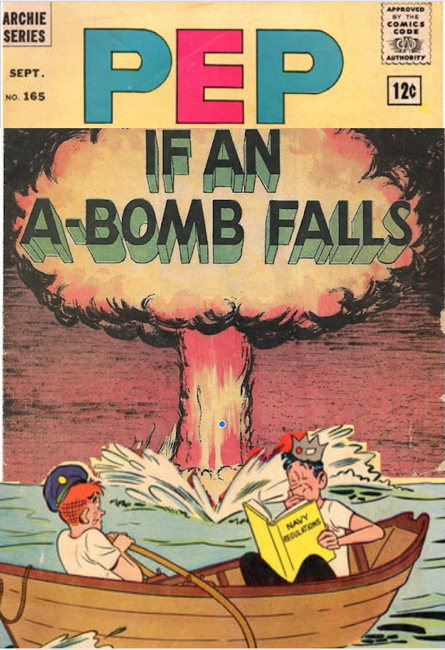
“Now I am become Dilton, the destroyer of worlds.”

As per my wondering if there were any Archie atomic bomb covers from the “Atomic Age” era, along comes longtime reader Paul with his meticulously hand-crafted piece of speculative comical-booking:


Yes, yes, if it were “Atomic Age” it would be ten cents not twelve, but c’mon, what’s two cents between friends? But boy, that’s a comic I’d read in a heartbeat.

So anyway, I’m getting myself all discombobulated answering questions left on my most recent questions post and then answering questions and comments left for me in response to those answers and I promise, I’m reading everyone’s input and will reply to what needs replyin’. Between busier evenings, the frailty of the flesh and some new health type stuff (not COVID, not serious, don’t worry…just a tad dear) my bloggin’ time is somewhat impacted. But I’m not going anywhere, and the people MUST BE ANSWERED so I’ll get around to it all in short order.

Speaking of which, let me go back to my post about the “Omaha” The Cat Dancer record where P.J. left the following inquiry just a few days ago:

“Hey Mike, not sure if you’ve covered it, and it’s comic strips, not comic books, but are you familiar with the floppy record that was packaged with one of the Doonesbury collections in the mid-80s? Don’t ask me to recall the name of it. I had it as a kid, not sure what ever happened to it.”

No, in fact, I’m not, and I had…well, still have, actually…a full set of the Doonsebury collections starting from that very first one, just called Doonesbuy, until well into the 1990s, maybe even early 2000s. Can’t say for sure why I fell off at that point, but boy I was sure into the strip for a long time.

And I have to say, I don’t recall any flexidiscs. Not saying there wasn’t one, as there very well could have been one, but I never came across any in any of the volumes I own. It’s possible that there was a special edition of strip reprints containing material I already had in other books which could have had a record insert, and I passed on buying it. That Action Figure! collection, which came with, as the title would suggest, an action figure toy of Duke (and I definitely bought that!).

Googling “Doonesbury flexidisc” just brings up the “Billy and the Boingers” record that came with a Bloom County collection. But it did lead me to the Wiki entry on Doonsebury which told me about some actual musical releases (a single and a full LP) with songs by the strip’s character “Jimmy Thudpucker,” and now I guess that’s on the ol’ want list now too.

So, no, P.J., I can’t think of a Doonsebury flexi, but I’m sure if someone reading this knows about one, we’ll hear about it in the comments! I hope there is one, honestly!

The “Mike Sterling Age” has kind of a ring to it.

Fellow oldie John Lancaster creaks

“I’ve always kind of liked the brief go-between of the Atomic Age (1948-1955). I know it isn’t widely used or recognized but a lot of the comics of that era just don’t ‘feel’ like Golden Age books, and they’re not quite Silver Age yet either.”

I almost brought up the “Atomic Age” label in that post, but in a very rare instance of me actually editing something out of my writing, I decided not to bring it up. But I suppose I should have, given its informal use for…geez, I can’t even remember the first time I saw it. It must have been in the ’80s sometime, and if I still had access to my former boss Ralph’s archives of old Overstreet guides I’d start a few decades back and spot-check my way forward, seeing if it turned up in the ads or the glossaries.

There have been attempts at trying to name these “grey” areas in comics history before…I seem to recall “pre-Golden Age” being used here and there, for example. I know Overstreet has “Victorian” and “Platinum” ages for anything older than, say, the 1920s I guess, but I don’t know if there’s enough trade in that material to make its usage commonplace, at least in our particular neck of the hobby. (I’ve had a grand total of one person in probably the entire 3+ decades I’ve been at this nonsense bring in a copy of a “Platinum” age comic, and she wasn’t willing to sell it for anywhere close to what the Guide suggested.)

(And an aside: consider that one instance of a Platinum Age comic to the literally HUNDREDS of times I wished Overstreet had any kind of comprehensive Undergrounds section.)

Anyway, back to “Atomic Age” – look, I know this is me taking that particular appellation at face value, but I always associated the term with the atomic-bomb covers that were prevalent during that period. I’d have a hard time calling a random issue of, say, Betty and Veronica an “Atomic Age” comic, as such, though I honestly wouldn’t put it past Archie Comics to have actually had a mushroom cloud on one of their comics during this period.

But I think at this point, splitting the hairs more finely than “Golden” and “Silver” for the comics of that time will likely not get more “officially” codified beyond the terms already in place. As cool as it sounds, and it does sound cool, I think “Atomic Age” will remain mostly informal. Unless Overstreet decides otherwise, of course.

John continues:

“It does feel like we’ve got to insert some kind of identifier for a chunk after ‘copper.’ We’re coming up on 30 years in the ‘Modern Age’ – almost the entirety of the Gold and Silver age combined. I certainly don’t know what that should be called, but whatever it is I’m sure I’ll hate it and refuse to use it until 20 years after it becomes popular.”

Well, Copper Age (a term John doesn’t much care for, and doesn’t exactly levitate my Lusitania either) I can at least see the reasoning behind, with the effective ending of what began in the Silver Age with the advent of Crisis on Infinite Earths in ’85, and taking us to the paradigm shift (if in ownership, not so much in content) of Image Comics. I’ve said…well, somewhere, maybe here or on Twitter, that “Image Age” may be a good name for the new emphasis on creator-owned books and competing superhero universes and of course the full-on flop sweat the industry gave off as they desperately tried to pull out of the ’90s crash. In fact, “Crash Age” may be a good name for that period…a period in many ways we sort of find ourselves in today.

And I’ve suggested “Rebirth Age” for the most recent period of comics and its focus on relaunching/rebooting everything at the drop of a hat or the change of a creative team in pursuit of a temporary bump upward in sales numbers. And we can even tie it to a Flash thing by having it begin with this Flash series, relaunched as a new ongoing before being quickly canned and reverting back to the previous numbering, sticking retailers with piles of stock ordered under the assumption it’d be around for a while feeding back issue sales. You may notice retailers not exactly ordering any new series with much confidence since then.

…Okay, kinda ran out my clock with all this typing. Will pick up again shortly.

Yes, I know he doesn’t really turn into Mr. A.


It’s interesting how DC can’t seem to get away from their shared-universe navel-gazing in their events, where everything is a Crisis and the very nature of the universe in which they exist is at stake. I’ve gone on before about how DC has, time and time again, tried to make that Crisis on Infinite Earths “never not was” as they try to put all the pieces back to the way they were, or at least find viable workarounds (like “hypertime”).

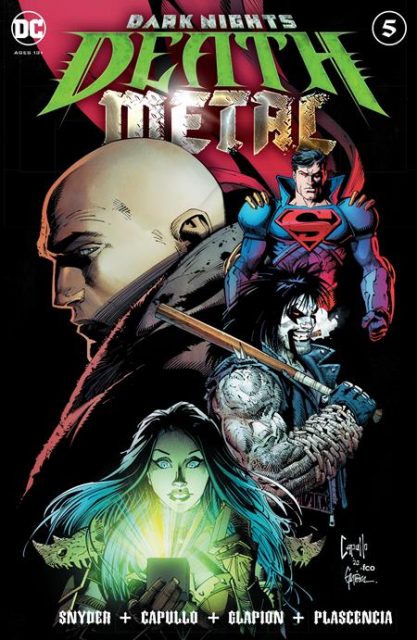
Not to say Death Metal isn’t entertaining, because it is. Tossing all the pieces of the DCU into the air, and printing however it falls to ground. Okay, there’s a little more planning to it than that, but if we’re going to have constant explorations of how the DC Universe works, at least let it be entertaining like this.

I would like to thank whoever decided to change the Batman Who Laughs’ dialogue from red-on-black to white-on-black, so that my beleaguered eyeballs may more easily read them. And while I get DC’s glad to have a hit on their hands, maybe for their next Dark Nights series (and there will be one, surely), maybe have fewer $5.99 one-shot tie-ins? While, again, they’ve all been entertaining, the constant onslaught of them is beginning to bum people out. I mean, find a way to squeeze all this into the main series, somehow, honestly.


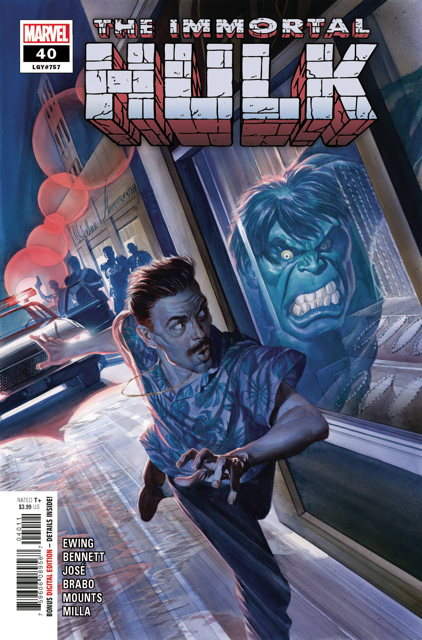
Apparently the Al Ewing/Joe Bennett run is ending at issue #50, so we only, what, seven, eight months to go? Well, plus tie-ins to events like “King in Black” and whatever other one-shots they’re gonna get in before the end. And I can’t help but wonder how Marvel is going to follow this series with a new Hulk #1. Well, okay, we know they will, but this series has been such a bull-in-a-china-shop when it comes to the character’s premise, its twisting about of the Hulk’s multiple personas in a horror context, that’s been so excellently done that’s it hard to imagine where one would go after that. I mean, they have to, Hulk’s not going away, but as good as this run is, I am sort of excited to see what comes next. I’m pushing for some sort of domestic comedy.


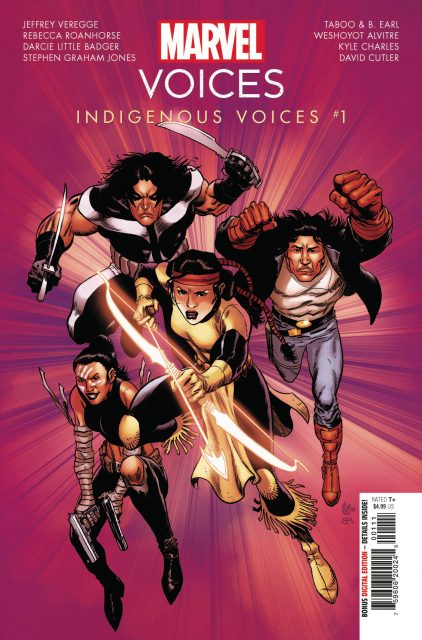
Look, my pal Weshoyot drew a story in this, so you should pick it up. I’ve known her since she was a kid coming into my previous place of employment, and over the ensuring years she’s become a wonderfully talented artist. So glad to see how much success she’s achieved, and look forward to seeing what she does next.


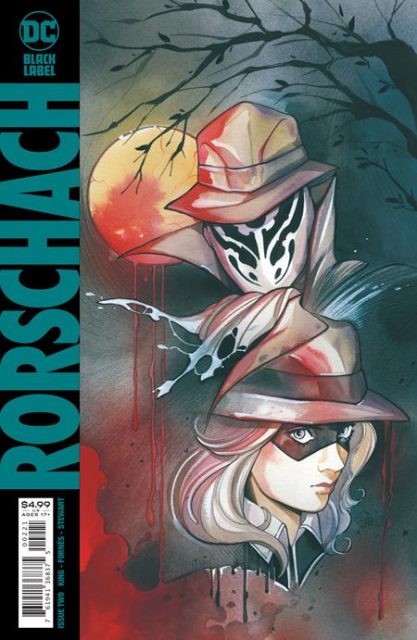
Boy, this is a weird comic. I mean, aside from the fact that there are ads in this book and one moment, you’re in someone’s idea of the Watchmen universe, and the next you’re nose-deep in a Snickers ad. Previous Watchmen knock-offs have had ads in them, I realize, but it seems somewhat more egregious in this title. Particularly that Snickers ad, I swear to God it gets me every time I’m reading a DC.

Anyway, the comic is basically about “What If Steve Ditko Actually Became Mr. A?” and I was amused at first but…I can’t exactly say it’s mean-spirited, but the inspiration it takes from Ditko’s actual life feels just a tad disrespectful. Part of me finds it oddly interesting, part of me is like “yes, we get it, Ditko was kind of an oddball, quit piling on.” Also, this doesn’t really feel like something that should be a twelve-issue series, but who knows, maybe “Kack Jirby” will show up to punch Nazis or something.


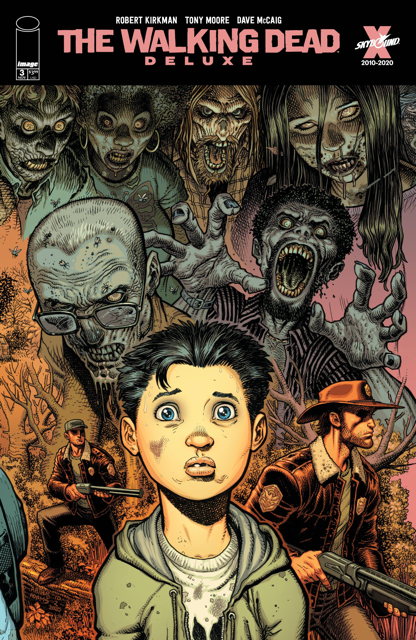
Well, what can I tell you, I missed out the first time, so I’m jumping on now. Whether they’ll actually manage complete reprinting of the entire series issue-by-issue is something of a longshot, but hopefully there are enough 1) people like me who missed out and didn’t get trades for whatever reason, and 2) completists who are buying every variant cover for every issue, I suspect there’s a non-zero chance of reaching the end.

That said, I think this is a good package, with plenty of backmatter notes on the making of the issue before you. It is also kinda weird to be reading this in serialized form when, while not having read it as such, I have flipped through enough of the comics as I unpacked them out of the shipping boxes to have at least a mild appreciation of what had been going on, so actually reading the comic now gives me, to say the least, a little more understanding of the nuances of storytelling. You know, like that splash page of Rick shouting “We ARE the walking dead!” which, if there is any justice in this fallen world, will have every letter in that balloon a different color once the reprints reach that point.

Yes, I misspelled “Palisades.”

My blogging time is going to be somewhat curtailed over the next couple of days, so don’t expect to the typical Progressive Ruin Wall O’Text™ at least ’til Friday, thanks to some too-early morning appointments over the next couple of days.

So let me answer Wayne’s question very briefly here, where he asks if anyone’s seen the Palisades Park coupons you used to see in Silver Age DCs ever clipped out.

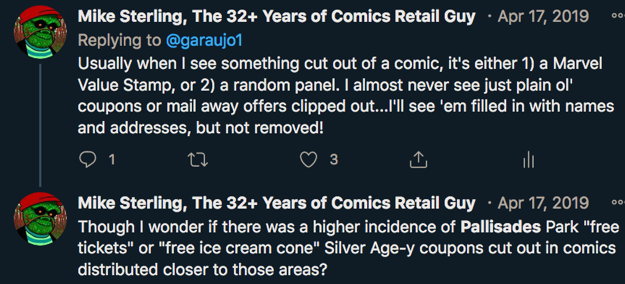
I actually wondered about this myself about a year and a half ago on the Twitters, on the slightly broader topic of finding clipped coupons in comics:


And as you see there, the answer is “nope,” presuming that most of the comics I’ve come across were not from the general area of said park, thus presenting a reduced incidence of clipped coupons. Or kids didn’t want to cut up their comics, which is also possible given the number of surprisingly not-cut-up comics I’ve encountered in collections over the decades. Not saying there were none, but not nearly as many as you’d think, especially with the puzzles and dioramas and whatnot you’d see in Dell Comics, which practically begged kids to ask their parents for permission to use the scissors.

Okay, the primary exception to this is Incredible Hulk #181, which, like, 90% of the time is missing the Marvel Value Stamp. DARN YOU SHANNA THE SHE-DEVIL FANS! …Actually, my theory as to why we see H181 missing the stamp so often where other comics with stamps usually still retain them is because H181 still has significant value and remains sought after even without the stamp. Most other Marvel books with the stamp cut out get tossed in the dollar box or just tossed out…okay, maybe not “tossed out” but boy they don’t go for much, usually.

Anyway, off track, and I want this short. Any of you notice Palisades Park coupons missing from your books? Just curious if anyone’s noticed this.

Well, technically, I’m Silver Age.

So Matthew asked last week sometime

“Speaking of the ‘copper age,’ What years and terms do you use to define different eras of comics?”

Which, you know, fair enough, since I’m very vocally not a huge fan of that very term “copper age,” which still to my ear smacks very much of a marketing term generated to make back issues of Nomad sound rare and collectible.

I’ve gone into detail on this before, actually also in response to a query from the very selfsame Matthew, in this post from last year. Actually, I’m glad for the chance to revisit that post becuase just the briefest of glances revealed some pretty awful typos (which I’ve since fixed), and more to be found, I’m sure. I’m guessing this was written during one of my “cloudy vision” periods, of which there have been too many. But I presume most of you got the gist of my typical too-long foray into the nomenclature of comic ages then, despite my obfuscated spelling and word use.

But to defy tradition and provide a more succinct answer to this most recent query, let me say to you, Matthew, that I use “Golden” and “Silver” frequently, and “Bronze” less so. However, as we get farther away from the period supposedly defined by “Bronze,” i.e. circa 1970 through 1984, I find my incidences of usage increasing, perhaps identifying a psychological barrier against acceptance. “Why, there can’t be an ancient sounding ‘age’ for that period…that’s my time frame!”

A naming of ages is, almost by definition, a matter of historical definition, and one tends not to think of a time lived through as being “historical,” no matter how long ago, in truth, that time may be. However, I suppose, 35 to 50 years on, I must bite that bullet and accept that the range of years is thusly dubbed.

As has been pointed out by some, including me in that very post from last year I linked above, some distance is needed to fully appreciate the characteristics of the industry’s behavior before one can really begin to divvy up specific eras into “ages.” I go into a little detail at the end of that post about what I think the current “age” might be called [attention Allen M, who brought this up last week], but we’re still way, way too close. So long as it isn’t “the Final Age,” a joke I’ve made at some point in the past here or on Twitter, though truth be told I’m only about half-joking.

Okay, I clearly didn’t defy any ProgRuin traditions with that answer, so let me move on to another response to last week’s post.

• • •

Tenzil Kem, Esq., bites off more than I can chew with

“I get the argument about the ‘rarity’ of newsstand comics vs. direct market, although I’m not sure if newsstand copies from the 70’s/80’s are truly that much rarer (since, as you know, print runs were hundreds of thousands of copies and available widely back then). I think the argument is stronger for comics from this century, such as DC New 52 newsstand issues with the higher cover prices, but I still don’t know that it should translate into higher valuations.”

Oh, sure, I’m not sure I was clear on that, but yeah, with comics from when newsstand distribution was still a major thing, there really shouldn’t be much of a difference, if any, in secondary market pricing. It should be restricted to more modern releases, though, as I noted in that post, I’m not a fan of that sort of pricing behavior anyway. I understand the impulse, but it still feels like making a collector’s item out of nothing for no really solid reason. (Like, as you say, the price differences on those DCs, but even then that’s bit of a stretch).

Now look, when it comes to collector’s markets, it’s the money that talks, not me, and history will side with whatever makes some people’s wallets fatter while I walk the streets with my sandwich board filled with tiny scrawled handwriting. I’m sure eventually I’ll fall into line if the back issue market leans in that direction, but rest assured I’ll be making passive-aggressive complaints about it on whatever Nazi-free microblogging platform eventually replaces Twitter.

“For that matter, I don’t like the inflated back issue pricing on comics with Mark’s Jewelers ads, and I have several of those that my grandparents bought me from the Fort McClellan PX near Anniston, AL.”

Yeah, that’s been a thing for years, but I think tradition has won over any objections we might have had. To be fair, if a comic came with some kind of insert, and that insert is removed, then that comic is not “as new” and should be graded accordingly. While I think advertisements should be treated differently from inserts more directly related to the comic book, or comics in general (like, say, trading card inserts that Marvel would occasionally include in their books throughout the ’90s), the problem of “where is the line drawn” does begin to creep in.

The imperfect analogy that immediately comes to mind is the usual comic grading policy of “age is not an issue.” A comic from the 1940s is held to the same grading standards as a comic that came out last Wednesday (or Tuesday, if it’s a DC). Otherwise you have to create sliding scales for what is considered “mint” or whatever for multiple time periods, and frankly, that sounds like an enormous pain the All-Star Squadron. With that as precedent, one can perhaps see where trying to distinguish between the kinds of inserts would eventually turn problematic, and it’s simply easier to apply the same pricing/grading rules to any comic with any insert.

As a side note, you’d think having the stiff-paper trading card inserts or jeweler ads would create a wider prevalence of these comics being in higher conditions with less spine creasing. Let me tell you, friends, that this is not the case.

“I’ll go full grumpy old man and complain about Canadian price variants and British price variants because I feel those are just “rare” here in the USA.”

An issue I recently experienced when I acquired a large number of 1960s Marvels and DCs from a lady who’d spent her youth in England. The DCs were all stamped with ink impressions featuring the price in, I don’t know, ha’pennies or whatever was goin’ on there, but were otherwise as distributed in the U.S. with the American prices printed thereon.

The Marvels, however, were printed with British pricing replacing the U.S. pricing on their covers (for the most part…there were one or two that also had to be stamped). I wasn’t quite sure what to do with these in regards to back issue pricing…especially as some of them were quite the in-demand books (such as the first appearance of Black Panther).

Did a little research, consulted with former boss Ralph, and eventually decided to just price ’em up as normal. I mean, these weren’t new, different foreign editions produced specifically for their markets. It’s the exact same contents, exact same covers and ads, the only difference is that the U.S. price was swapped out with another price at some point during the printing process. This minor cosmetic change might increase demand as “a variant,” might decrease demand as “a repint” (which I don’t think it is), so I just split the difference.

“With all of these examples, I think sellers are just trying to justify why someone should pay more for their specific copy, but the market seems to be looking for rarity wherever it can find it.”

As I’d noted…or rather, as a customer brought to my attention and I shared here, as older comics become less available folks are looking for reasons to make newer, more common comics into collector’s items. Even with brand new comics, as almost any “first appearance” that turns up in a recent release inspires the purchase of multiple copies, even when more often than not any increased value that accrues is more of a self-fulfilling prophecy than any indication of organic widespread demand. Investors create the scarcity that increase the demand from those who need the issue and couldn’t get it because investors bought them all. Artificial rarity…those who forget the ’80s are doomed to repeat them.

A tale of two DC Comics Presents.

So one of the series I’m reading on the DC Universe app is DC Comics Presents, the Superman team-up series that ran for 97 issues plus four annuals, from the ’70s into the ’80s. I read, probably, about a third of the run just buying it off the stands. The earliest issue I owned was a Whitman edition of #3, either out of a bagged three pack of comics, or perhaps in one of those batches of comics my grandmother purchased for me from a second-hand store. I’m pretty sure the first issue I actually bought fresh off a newsstand was #29, wrapping up the Mongul trilogy, the first two parts of which I wouldn’t read ’til I started going to comic shops with back issue bins on a regular basis. I would then proceed to pick up further issues of the series, on and off, for the rest of its run.

Like I said, I read about a third of the series that way. I probably read another third, more or less (look, don’t press me on my math skills) via back issue purchases or by reading stories reprinted in digests. And now, with the aforementioned DC app, I am slowly working my way through the issues I hadn’t read yet via either method.

I’m two issues closer to having read the full run as of last weekend, as I decided to peruse DC Comics Presents #48 from 1982 (Superman and Aquaman), and DC Comics Presents #51, also from 1982, with Superman and the Atom. And I found I had a very different response to the two stories.

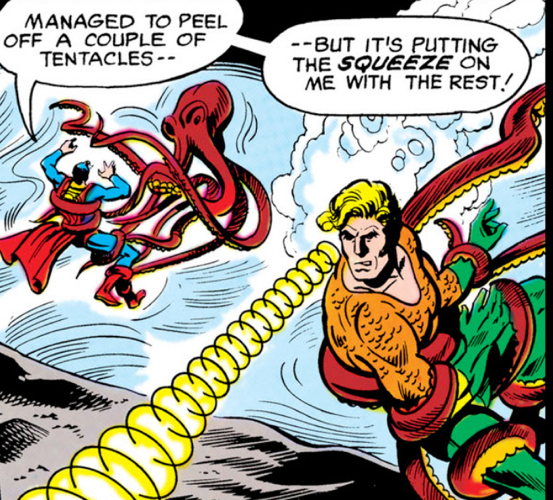
In the Aquaman team-up the King of the Seven Seas and the Fella in the Red Cape must join forces to defeat super-intelligent octopuses, which, sure, okay:


Of note, Aquaman uses his telepathic ability to control his unconscious body, citing the evolutionary connection to ancient sea life humans (and also, luckily for ol’ Arthur, Kryptonians) have. Pretty sure this is something Grant Morrison eventually picked up on decades later in JLA, if I recall correctly.

Anyway, point is, it was a perfectly fine, if odd, Superman story where he teams up with Aquaman. Superman does his thing, Aquaman does his watery stuff, the menace is defeated, and there, we’ve got a comic book. All very surface level (er, so to speak), basically shaking action figures at each other, but sometimes that’s what you need from a superhero comic to kill a few minutes.

Now the Atom team-up is just about as outlandish…the Atom, while visiting the past of 100 years ago, sees Superman there gettin’ killed by some alien invaders, and then he, Supes, and Professor Hyatt (who owns the time travel device the Atom had been using) return and try to solve the mystery. This also ties into an ongoing subplot from a previous issue I had read as new, involving the mystery of Superman’s ancestor Var-El.

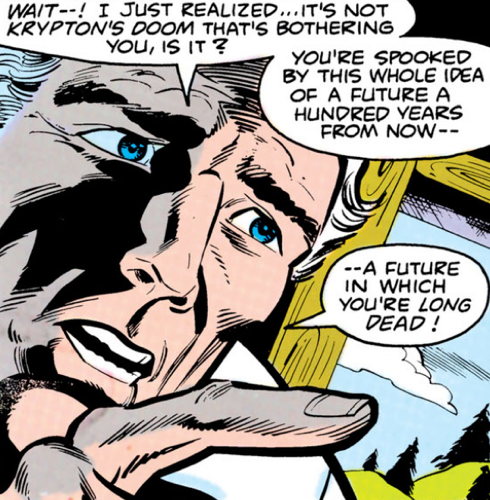
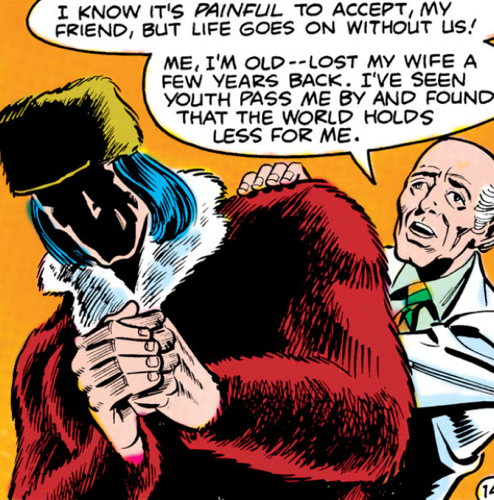
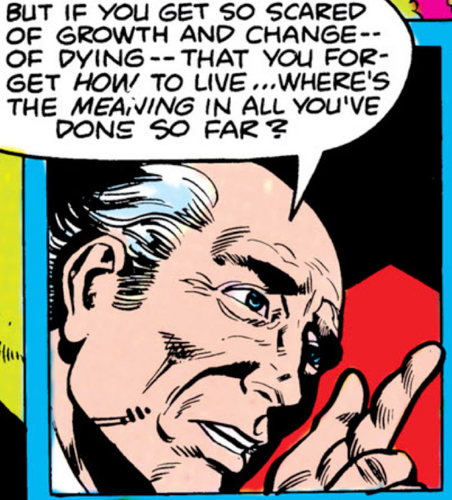
Stuff happens, the professor gets separated from the heroes, and he runs into Var-El his own self, living as a mountain man in this time period (hence the get-up you’ll see). The professor tries to get Var-El to speak to his descendant (after spilling the beans about, oh, his home planet exploding), but Var-El is reluctant. Which leads to this exchange:


And that…was a bit of unexpected depth that caught me by surprise in what I thought was going to be solely another “how does this combination of super powers solve this situation?” plot. Some thoughtful comments on dealing with age and the knowledge that the world doesn’t stop when you do? There’s a conflict you don’t often see in the pages of a superhero comic.

It’s not much, just a few panels, but it gives the proceedings a little extra emotional depth, some weight behind the time travel and aliens and all that hoohar. And that made all the difference. The Aquaman team-up was fine…silly and weird and enjoyable with nice Irv Novick art, but ultimately empty calories. The Atom team-up, with just that slightest pensive touch, is a story that sticks with you maybe a little longer than simply dissipating as soon as you closed the covers.

Just so we’re clear, I’m not saying the Aquaman story is “bad” or “inferior” — there is absolutely a place for a plain ol’ all-plot, shallow-as-a-sidewalk-puddle story with a big gimmick (Aquaman “controlling” Superman’s boy telepathically) to sell it. But it’s nice when that emotional content gets in there, too. And I wonder, if I’d read this at the age of 13 when it was originally released, if that bit in the Atom book would have hit me as strongly, as opposed to reading it for the first time now as I approach 52. I suppose I may know the answer to that already.

Oh, and by the way, the Var-El storyline gets wrapped up in issue #74 of this series, which I also hadn’t read yet. Guess that’s next up!


DC Comics Presents #48 (August 1982) by Dan Mishkin, Gary Cohn, Irv Novick and Frank McLaughlin

DC Comics Preens #51 (November 1982) by Dan Mishkin, Alex Saviuk and Frank McLaughlin