The only article you’ll see today mentioning both Lobo and The Scarlet Letter.

[This post contains SPOILERS for the endings of Supergirl: Woman of Tomorrow, the Supergirl movie, and also one chapter of The Ballad of Halo Jones.]

So one of my favorite incomplete works from Alan Moore is the science fiction strip The Ballad of Halo Jones, drawn by Ian Gibson, in which we follow the life and times of the titular character. Alas, a disagreement between Moore and the publisher truncated the comics’ run, and all we got is what we got.

I bring it up here because I wanted to point out this sequence (scanned from Quality Comics’ 1988 reprint of the story, in which the art was “stretched” to fit a standard comic book page). In this sequence, Halo Jones is a member of the military, and while on patrol on this planet, they shoot and kill an enemy sniper, to which the team has this response:


The obvious point here is that they can’t believe they just shot a child, and attempt to justify the incident by talking themselves into the idea that this wasn’t just a little girl, but an of-age adult. And as things progress, they talk themselves into thinking she’s progressively older and older until, as the caption says, “she’d practically died of old age.”

Now, it’s clear what’s going on here. The girl isn’t literally aging, it’s a psychological response by the squad to having killed a child and trying to rationalize it. The art shows what happened, the dialogue and captions tell a different story.

In a 1987 issue of The Comics Journal, in a review of an earlier reprint of Halo Jones from Titan Books, the otherwise insightful and informative article has this to say about that same sequence:


I mean, the person who wrote this article is a smart person, so I’m just chalking this up to a brain fart. “Whomst amongst us…” and all that. Who knows how he missed this? Was he reading just too many comics he had to write about, rushing through the volume and not allowing the implication to sink in? I don’t know. Regardless, what was written in that review is not what was happening in the comic.

Again, it happens. Look, even Roger Ebert didn’t quite get the “multiple choice origins” for the Joker in The Dark Knight, so none of us are infallible before God.

Which brings me to Supergirl: Woman of Tomorrow by Tom King and Bilquis Evely.

This 2021 comic book series was the primary inspiration for the new Supergirl movie, which heavily borrowed characters and plot elements from it, but not every detail. And the movie also included folks who did not appear in the comic, like, oh, say, Lobo. One of the frequent complaints I’ve seen about the translation of the comic to film is that the book’s ending had been altered, or drastically misinterpreted.

I hadn’t read the comic before I watched the movie, as I noted in my look at the film. However, I’ve since perused the source material, as well as did some searching online for more reactions.

And what I found was interesting: there is a portion of the comics’ readers who are confused by its ending. Which…I find puzzling.

Here is the last page of the book, more or less (I cropped the panels for increased legibility, where I could). At this point, the bad guy, Krem, has been released from the Phantom Zone, aged and repentant, begging Ruthye for forgiveness for what he’s done. Ruthye had been talked out of killing Krem as vengeance for her father’s death, and Supergirl stands by her here.

In panel one, we see Ruthye smack the kneeling Krem with her walking stick:


In panel two, we see Krem on the ground with his hands apparenly flailing in the air, as Ruthye walks away.


Then we see Supergirl and Krypto walk away in the opposite direction, as Krem reaches for his head.


And here, is Krem, alone, just remaining on the ground.


What Ruthye does to Krem here is slightly open to interpretation. Does she kill Krem, despite the point of entire book being about eschewing vengeance, giving the story a darkly ironic ending? Or does she simply bop him on the head, indicating that despite whatever personal growth he underwent while imprisoned, she still hates his guts?

Well, it’s the latter, Tom King his own self said so. Krem is still alive, just with a likely bleeding and sore crack on his noggin.

While there is admittedly some ambiguity there, there is no ambiguity about what’s going on in the captions. An additional note about what’s going on here: it’s been 300 years since the events earlier in the book. Ruthye is elderly. Supergirl and Krypto are, it seems, immortal. In that time that’s passed, Ruthye wrote a book about the events in this story, about which she’s said


Ruthye straight up tells Supergirl, and the reader, what she wrote is a whole lotta bullshit. As such, those excerpts, describing Supergirl’s dispatching of Krem with a sword, is a fictional rewriting of the actual end of the adventure. That book had been written as some point in the past, and since Krem is still alive now under the captions presenting those excerpts, clearly Supergirl ain’t killed nobody with no sword. (Apparently it was a ruse by Ruthye to keep Krem’s comrades from seeking their own vengeance on her.)

That all seeems pretty clear. And yet, when researching responses online, I found people confused by the ending. Okay, yes, I’ll give a pass to those who thought Old Ruthye killed Krem at the end. It’s contrary to the spirit of the book, and shouldn’t be interpreted as such, and c’mon Supergirl was standing right there, but you can’t put it past that wily Tom King to give such a dark punchline to a story that tried so hard to avoid it.

But there were folks confused by those captions. They were saying one thing, we were seeing something else in the artwork. Even though it should be understood that Supergirl hasn’t killed anyone, some readers were apparently still confused by what they were being told. It’s not what’s shown, the timing doesn’t work out (the book relating a death that happened in the past, though the person killed is still alive in the present), but the old Unreliable Narrator trick can still muddy the waters, it seems.

Interestingly, Ana Nogueira, the screenwriter for the Supergirl film, also didn’t quite grasp the book’s ending. She straight up says in this Variety article

“[Krem] essentially has changed, and she kills him anyway, because she still just has this anger, and you understand there’s this element of deserve, right?”

Now, again, I’m not going to fault someone entirely for not getting that, for all the reasons I stated previously, while also saying that same someone probably shouldn’t have thought that, also for previously-given reasons.

What that seemingly leads to, though, is that Krem’s death still has to happen in the film, and the responsibility is transferred to Supergirl.

“So, we wanted to craft a villain who would deserve this, but we also wanted Kara to really care about preserving Ruthye’s innocence, and to feel like she could take on [killing him], that she could be the one to bring justice to this man, and do it without burdening this child.”

This change to the story’s ending took on a more deliberate stategy, despite seemingly being based on a misunderstanding. In this article on Comic Book Resources, director Craig Gillespie related

“I met with James [Gunn, head of DC Studios], and we talked about it, and James was adamant about it. I think it’s an amazing thing. To lean into – knowing the kind of movie that we’re making, and where her character is heading, that she has to go through this emotional journey. There’s no other logical conclusion to what she would do.”

Realistically, I don’t know how this more brutal interpretation of Supergirl will play into future DC films, as frankly, how many more will feature the character? She’s on deck for the next Superman movie, but it certainly doesn’t seem likely we’re getting any more standalone Supergirl films. To whatever end this choice was made, to have Supergirl capable of taking a life, they probably just have the one shot for it to play out. Whatever arc they intended will likely never see a conclusion.

These are a couple of extreme examples of misinterpreting the text. One is a simple misunderstanding of a description of a mental state in an otherwise solid print article. The other dictated the course of a multi-million dollar franchise, for good or ill. (Possibly “ill,” given how the film’s doing.)

Does the change in the Supergirl ending ultimately matter? No, not really. Whatever story is there for the films to work out will either work out or it’ll just dry up into nothingness, awaiting the next attempt at getting DC superheroes onscreen. It’s probably disappointing to fans of the original comics, but hey, if they could fiddle with the ending of Watchmen, or even The Scarlet Letter, nothing is sacrosanct.

I still think Supergirl is a pretty good film. I also think Supergirl: Woman of Tomorrow is a pretty good comic. That one is different from the other is…nothing new, given the Hollywood of it all.

Of course, that hopefully still-upcoming Swamp Thing movie had better be 100% faithful to the comics or I’m writing letters. Letters, I tell you.

Supergirl (2026).


So ahead of seeing the new Supergirl movie, I believed I was in bit of a quandary. As you may have noticed, the film had already attracted some negative chatter, primarily from The Usual Suspects. You know, the folks that regularly dogpile upon any superhero-or-related-genre mass media that focuses on a character or characters that aren’t straight, while males. Or, to borrow phrasing from my review of the 2025 Superman movie, “the usual parade of grifters out for your attention and your wallet” griping about things being “WOKE,” whatever they think that means.

As the movie appears to have, shall we say, faltered at the box office, it’s those very folks out in force right now crowing about some imagined “victory” in the culture war they’re fighting in their heads. And, going back to that quandary I mentioned, it puts someone like me, Just Some Dude on the Internet, in the position of fearing to critique the movie and being lumped in with Those Folks. (AKA “The Last Jedi Syndrome.”)

Prior to seeing the movie, I had heard some real, actual critique of the movie from people who are presumably Not Insane, ranging from a simple “I liked it!” to actual concerns about the film’s structure/direction/scripting, etc. Nearly all noted that Milly Alcock, the titular Supergirl, was excellent, regardless of their opinion of the project in its entirety. As such, I had those thoughts with me as I entered the theater that evening.

And…I liked it!

Alcock does a wonderful job giving us a troubled Supergirl, submerging her trauma and her (literal) alienation in partying and alcohol, and her struggle to emerge from that emotional burden. I know, I know, that sounds like a bummer, but it really isn’t. Alcock is absolutely a riveting presence onscreen, and you can’t help but feel sympathy for her character.

There is a layer of melancholy laid over the story, regarding Supergirl’s personal history and flashbacks to her life on Argo City (which survied the destruction of Krypton). But there is a sense of fun, too, as we’re given some exciting action set pieces, especially when Supergirl lets loose at full power (which she isn’t always at, due to story demands). Jason Momoa as Lobo is an entertaining addition to the proceedings as well, and is involved far more than I was led to believe, since a number of people said he had no more than a cameo. Oh, no, he’s in there quite a bit.

I thought the storyline was clear and straightforward, and plot points like the color of various suns and their effects on Supergirl as they travel from star system to star system were handled well. The action scenes were clearly directed, which is a typical complaint I have about these sorts of movies, but here I could tell who was doing what and where. And overall, the pacing was good and the story kept my interest from beginning to end.

If I had any quibbles, it would be maybe not having a major established villain at the core…forgive me, but I didn’t read the Tom King/Bilquis Evely Supergirl: Woman of Tomorrow mini that apparently provied some inspiration for the film, so I don’t know if the bad guys are a transplant from that story. But on the other hand, a departure from formula probably didn’t hurt (or maybe it did, given the film’s performance, but more on that in a moment). I mean, it’s true enough that the Supergirl Rogues Gallery isn’t exactly overflowing with villains distinct from Superman’s own enemies (I mean, Lesla-Lar, sure, but I don’t think I would have wanted a “me, but evil” adversary. Again.)

The other qualm I have is (and here we enter some SPOILER territory, which I’ve tried to avoid so far, but really can’t for this point) how the main bad guy is ultimately…dealt with by Supergirl. I get this establishes her as a different person with different standards than her cousin Superman, but it seems contrary to the message of “being good” instilled in her by her mother, and brought up several times during the film. But then, her mother also added that “being good” isn’t the same as “being nice,” so that plays into her decision, as well.

I know this could upset the purists, of which I’m usually one, but in this case it makes for a morally complex character, and that could have been further developed in future Supergirl films, of which, it seems, there will be none. Maybe it’ll get touched on in other upcoming DC films, assuming Warner Bros. doesn’t pull the plug on the whole thing.

And why did this film do so poorly right out of the gate? Look, as the internet’s only champion of Frank Miller’s The Spririt, I’m used to having the outlaying opinion on a piece of media, but surely other people thought this movie was good, too. But maybe the tone of the film was a downer to most folks, not the Big, Flashy adventure that people want from their superhero films. Maybe not having that big name villain reduced interest. Maybe it’s just the now-typical “Superhero Fatique,” where audiences already had one Super-movie last year, that was enough for the time being.

Or maybe the Usual Suspects, the ones I mentioned at the beginning of this wall of text, succeeded in poisoning the discourse, convincing John and Jane Q. Public that the Supergirl movie was Bad, Actually. Which, may I say again, that would be wrong — it’s Good, Actually.

But maybe being good isn’t enough (ironic, given the advice from Supergirl’s mom). In this new post-COVID superhero film economic ecosystem, one of these types of films has to be an event. And it has to be something that at least appears new. Last year’s Superman was an event, the beginning of the new DC Cinematic Universe. This year’s Supergirl didn’t reach that perceived status, and, like I said, it came out on top of a another movie that had a hero with a big “S” on the chest. Superman turned into a must-see, Supergirl got the “wait for streaming” treatment.

And I hope the people who avoided it in theaters do discover it on streaming. By that point, it’ll be too late…Supergirl will be dubbed, by every metric important to the studio beancounters, a “failure,” even if everyone who catches it on MAX or whatever other service Warner Bros. sells the film to decides “hey, I like this!”

I say, give it a shot on the big screen. I was glad I did.

Also, Krypto the Superdog is in the film. Surely you want to see more Krypto.

I went out of my way to not use the phrase “here’s the Thing.”

[SPOILERS for Fantastic Four: First Steps ahead]

There are a couple of very specific details I appreciated about the newest Fantastic Four movie.

First, the film avoided the usual character tropes of having Ben Grimm mope over being a huge rocky monster, or Johnny Storm being immature and irresponsible. He’s still impulsive, but never seemingly in a way that makes the rest of the family kinda roll their eyes and think “not again.”

That the movie starts with the FF having been around for four years, we can assume a lot of this behavior may have already run its course. Not that Ben is any happier about being the Thing, but he’s clearly dealing with it a little more easily now.

Second, that the idea (pushed hard by John Byrne during his legendary FF run) that the Invisible Woman is the most powerful member of the team. Not just in terms of literal superpowers (though single-handedly pushing back Galactus is certainly an expression of that), but in terms of leadership ability (defending herself against an angry crowd, negotiating peace with the Mole Man).

Third — speaking of Galactus, I think they pretty much nailed the character, after being disappointed the first time they almost had him in a movie. We wanted a giant dude in Kirby gear, we got a giant guy in Kirby gear, stomping his way through New York.

Fourth, the whole portion of the film where the FF were all, “well, better hop into the spaceship and travel through hyperspace to where all these planets are disappearing.” Not something I was expecting, a full-on sci-fi epic with the team wandering through a giant, unknowable landscape to meet a menacing demigod. It’s a weird, strangely modern/futuristic setting in the midst of all this ’60s-esque aesthetic.

Okay, I can’t count any higher than four, so I’ll mention a couple of other things, like how early on in the film we only saw quick snippets/clips of Reed Richards stretching, so I figured the stretching effects tech hadn’t yet advanced so far beyond where it was for the previous movies. But then we get plenty of it later on in the film, and the stretchiness looks fine.

I think what I liked most of all was the overall look ‘n’ feel of the film, which of course I’m sure wasn’t missed by anyone. More than just the previously stated ’60s-style aesthetic, it just seemed like a…gentler film, not so loud or abrasive as other Marvel movies could be. It was simply fun, a comic book movie that didn’t shy away from its origins, name-checked several of the FF’s bad guys, and straight up showed us at least one of the Red Ghost’s Super-Apes.

The one concession to the Marvel Cinematic Universe at large (which you don’t need to watch as homework for this film) is the opening caption telling you this is “Earth-883” or whatever the number was in the Multiverse. (EDIT: I am reminded in the comments that it is Earth-828, AKA 8/28 as in Jack Kirby’s birthday!) (The main Marvel Earth in the films is 616, same as the main Earth in the Marvel comics, though if I recall correctly the Cinematic Earth in the Marvel Comics Multiverse is given a different number, while its inhabitants still call it 616…anyway, I have a nosebleed now.)

It shall come as no surprise that eventually the twain shall meet and the FF will cross over to the main Marvel Movie-verse…we’ve seen something pointing to this already as a post-credits scene in ThunderboltsAsterisk. Trying to merge the FF’s storytelling sensibilities with the somewhat sharper-edged primary MCU would be a shame…it feels like the former would have to fit the latter, costing some of the appeal.

I don’t know, we’ll see what eventually happens, since we’re promised as the end of the film that the FF will return in Avengers: Doomsday (you know, the one where Superman dies) due out in 2026, maybe. I hope that doesn’t preclude the possibility of more standalone FF movies in the future…I think we as a people are owed an Impossible Man adventure.

Superman (2025).

[SPOILERS for the new Superman movie]


So I don’t know by what means, fair or foul, a fellow Discord-ian found the above image of Superman’s Kryptonian parents, Jor-El and Lara, from James Gunn’s new Superman movie. But, let me tell you, it sure definitely answered for me the question I had since I couldn’t recall propoerly, “did Jor-El have the Superman ‘S” crest on his outfit?”

I mean, I put the question out to a few people, in fact to a couple of folks who were going to be going out that very evening to see it again, and they promised me they would check and report back. And they did, in the negative. And another pal I asked said he specifically looked for that “S” on their costumes the first time he saw the film, and did not see it.

Thus, the evidence mounted, but the screenshot clinches it. And why was I so concerned about that particular costume detail, you may ask? I’ll get to that in a moment.

I’d also like to note that my questioning certainly brought up an important factor in the success (at least, thus far) of this film — repeat viewings! It’s been a while since I’ve heard about folks going back to see the same movie again and again, given 1) COVID, 2) ticket prices, and 3) it’ll be streaming in about 4 to 6 months. This, and its opening weekend box office, seems to indicate DC may have a hit with some traction on its hands.

I mean, it’s only been out a few days, who knows what will happen a week from now, or even when the Fantastic Four movie comes out later this month, but I had been genuinely curious if the public would really be interested in yet another Superman film. And so far, the answer seems to be “yes.” Most folks seem to really, really like it.

Most folks.

I have seen some criticism of this film…by which I mean, real, sincere criticism, not the screeches of “IT’S GONE WOKE” from the usual parade of grifters out for your attention and your wallet. And the specific criticism I’m thinking of, the one I feel a little more qualified to talk about, is the demonizing of Superman’s “foreign” parents and the apparent erasing of his heritage at the end of the film.

I really, really don’t think this was Gunn’s intention, but of course once art is out for the public to see, the public is free to interpret it as per their personal thoughts and experiences. And looking at the film, particularly in the historical moment in which my fellow Americans are living, where awareness of immigration and heritage is at sky-high levels, I can absolutely understand how they can see these elements of the film in the way they do. So, please, if any of them are reading this, what I’m writing here is not an attack on them.

But what I think is happening here is that we are seeing a conflict between Superman’s allegorical weight regarding the immigrant experience and Superman’s sci-fi plot tropes that arise from his being a literal extraterrestrial. More than anything else, I think the complaints are caused by a bit of bad timing regarding this conflict.

Yes, technically, Superman is an immigrant. Even an illegal immigrant, as per this episode of Smallville:


But that aspect tends to be downplayed, especially in more recent decades. The preference appears to be that Superman, while of Kryptonian heritage, is Of Earth, as per this page from #6 of John Byrne’s Man of Steel mini-series:


There are, in fact, multiple stories of Superman resisting the imposition of Kryptonian values upon Earth and himself. His battles against the Eradicator, and his conflict with Bar-El and Lilo-El.

But obviously Superman does not reject Kryptonian culture outright. He has a Fortress of Solitude, in some versions of the story based on Kryptonian architecture, that contains Kryptonian technology. He has (in some versions) a surviving city of Krypton, shrunken by his nemesis Brainiac, which he occasionally visits. He wears an outfit that emblazoned with what is, in some versions of the story, a Kryptonian symbol.

Speaking of that symbol, I said earlier on that I was wondering if Superman’s Kryptonian parents were wearing it. So many versions of Superman’s origin story, especially of late, put that “S” on Jor-El just so we know there’s a connection between that man we’re seeing onscreen and the baby that’s about to be rocketed into space.

As you saw, there’s no “S” there, which does away with my argument that ultimately, at the end of the film, when Superman has replaced images of Jor-El and Lara with images of the Kents, his Earth parents, for display in the Fortress, it’s hard to say that he’s rejected his heritage fully when he’s still got a Kryptonian symbol on his chest. Except, we don’t know that it is. In several versions of the Superman story, it is, but here, we’re not sure.

Despite that, the idea that he’s fully rejected where he comes from is still sort of belied by thge fact he’s still surrounded by presumably Kryptonian technology, robots seemingly built from that same advanced tech, in a Fortress that also seems to come from that same tech. Granted, yes, we don’t know any of that stuff for sure, but at the very least the Fortress’s appearance evokes every other cinematic version, all of which come from Krypton science.

The real problem arises when the sci-fi plot twist shows up, when the partially damaged final message from Jor-El and Lara is restored, and instead of simply being an expressive of love and hope for Kal-El, it reveals their desire for their son to subjugate the Earth, to take many wives and spread the Kryptonian bloodline. It makes Jor-El and Lara into villains, along the lines of other pro-Krypton adversaries like the Eradicator and (in Superman: The Animated Series) Brainiac. And Superman resists them, denies them this influence, by removing their images from his Fortress.

This is an interesting twist on the Superman story, one that we haven’t quite seen before in the mainline Superman comics. (The return of an older, crankier Jor-El in relatively recent Superman continuity may come close.) However, like I said, the problem is timing.

The demonizing of the foreign Els, who are sneaking their immigrant offspring into our county/planet in order to destroy us, only to have said offspring reject completely where he came from and meld into this new society…yeah, putting it that way, you can see why some people are upset, especially, like, right now.

I still think this is a good, solid superhero movie, with some minor issues (I don’t like one of the antagonists being killed off at the end…at the very least, they could have shown him in a wheelchair with casts on each limb to show he survived the fall). Given the number of other superheroes in the film, Gunn manages a good balance of keeping Superman the star while giving everyone else their moment or three.

I’m truly sorry what some folks saw in this film ruined it for them…nobody wanted that, for sure. There were more controversies than just this, but those are whole other posts I’m not quite ready to make yet.

At the very least we can all agree that Krypto is amazing. The Superdog heals all division.

I suppose that could be another Uncle Dudley from an Earth where he has powers.

[SPOILERS for the Crisis on Infinite Earths animated movies]

So you all know Uncle Dudley from the Marvel/Shazam Family, right? The good-natured codger who is privy to all the Marvel Family’s secret IDs, and hangs out with them, and when trouble comes a’callin’, he quickly doffs his outer clothes to reveal his homemade Captain Marvel costume beneath? Who then complains that his ol’ “Shazambago” is acting up and can’t use his powers (of which he has none) and one of the other Marvels picks him and carries him to their destination. And while they do, they usually think “We all know he doesn’t actually have any powers, but we love him anyway and play along with him!” You know, as they carry this civilian into outright danger.

Anyway, he makes a brief cameo in the new Justice League: Crisis on Infinite Earths where he flies under his own power through space with a glowing fist, and then shoots an energy blast out of that fist at the bad guy:


I watched all three of this Crisis on Infinite Earths direct-to-home-video animated features from DC Comics, and…well, it wasn’t great.


The premise is that the New Animated Universe that forms post the Flashpoint animated movie from 2013 is under attack, with parallel Earths being wiped out by an unknown enemy, and, well, you probably know the story.

Well, that story from the comics is not the story presented here in the film, which is an even more disjointed accumulation of nonsense than the source material, except lacking the the always-excellent George Pérez art to carry it along. There’s an awful lot of characters standing around looking at things, or staring and/or taping on displays that tell the viewer nothing. The Bad Guy isn’t defeated so much as conceded to, as the heroes run away to a safe bolthole and presumably the destruction of the parallel Earths won’t extend to this new one they just cobbled together.

Lots of your favorite characters show up, only to sit still in space and let anti-matter wash over them. Sorry, Booster Gold fans! And I’m never quite clear if the bad guy is destroying entire parallel universes or just targeting parallel Earths, because it sure looks like (and characters act like) it’s the latter.

Not to say there aren’t a few good points, the main one being Matt Ryan, the One True John Constantine in Media Adaptations, reprising the role yet again and stealing the show whenever the character shows up. In one of the twists I actually like in this reworking of Crisis, Constantine takes Pariah‘s role, as the man cursed to watch the multiverse die, and he’s the reason why it’s happening. (Okay, in the original it’s revealed Pariah wasn’t at fault, but John definitely is here).

Not so efficient a swap is Supergirl stepping in for the Harbinger role, which is primarily there to set up a version of her death, which ends up being moot anyway.

So, they throw a lot of parallel Earths at us, most of which mean nothing to us except maybe mildly duplicating Earths from print. It isn’t really until we start seeing some familiar multiversal faces that, hey, suddenly we’re intrigued. Like, here are decades-old properties that mean something to us, not Earth-221 that we see all of once, where Firestorm is left-handed instead of right-handed.

Two of the Earths we see just as they get destroyed is Super Friends Earth, featuring our heroes as they appeared in 1970s cartoons. And the Batman from the 1990s animated series, voiced for the last time by the now-deceased Kevin Conroy. And if that’s to be Batman’s last line ever spoken by Conroy, it’s a good one to go out on. …But where were these guys fighting alongside the other heroes in this film? That would have improved the proceedings. (Earth-One Wonder Woman: “Let’s go punch those guys!” Super Friends Wonder Woman: “Wait, hold on, let’s set up some traps!”)

I don’t know. This is all just clearing a path for however long the James Gunn and the other guy whose name I never can remember’s regime presides over the DC Comics media-that-ain’t-comics empire. The plan is for…everything to tie together now? With characters in live action films voicing their animated versions as well? We’ll see how long that lasts.

Probably lots more to say about this, but these are just the immediate thoughts on the matter. It’s not the worst of the animated films (that would the 2023 Legion of Super-Heroes flick) but it ain’t good.

Words not deeds.

So last time I was talking about Carmine Infantino’s alleged list of “things what you put onna cover to make a funnybook sell.” It’s just one of those things that’s generally common shared knowledge in the comics world.

But like many things that are common shared knowledge, there’s more to the story, and to the rescue is Comics Worth Reading‘s Johanna, who drops a link to a Bluesky interaction between Mark Waid (editor of that Secret Origins comic I presented last time) and Kurt Busiek, a couple of comics fellas who obviously know more about what’s going on here than I do.

In short, publisher Irwin Donenfeld came up with the list in the 1950s, which Infantino related to Waid in the ’80s. But I think we can all agree comics would be improved if we returned to list.

• • •

Hey, Old Timey Comics Blog Readers? You remember Dave Campbell, don’t you? The man who brought us “Dave’s Long Box,” which ended in 2008 and that seems like so long ago. Good gravy.

Anyway, Dave’s been busy lately, working on a documentary about Hal Needham’s 1982 film Megaforce, starring Barry Bostwick, and remembered by all of you for the “DEEDS NOT WORDS” ads that were all over the back covers of comics at the time. The doc, Making Megaforce, is currently funding on Indiegogo.

Plenty of contributor levels, which can get you Blu-rays and/or digital downloads of the doc, autographs, patches, screen credits, and at the top of the heap…an actual film-used (non-operable) dune buggy from the original movie! Only one of those buggies are being offered, so don’t worry, I didn’t take that option so it’s still available for you to get!

I like Dave, and hope this project reaches its goal. Looks like a lot of fun.

• • •

The latest comics drama to break out is a noted cartoonist allegedly being a creep to a young lady. I’m using the word “allegedly” for my own protection here, but…said alleged creep has shut down his social media, and I’d seen reports of the associated popular YouTube show being closed down as well. A quick look at YouTube shows ’em all still up and running, so who knows.

Now this just happened over the weekend, so we’ll probably get some actual reporting on these events in the next day or two (or likely a reposting of the chat screenshots and some additional commentary, like what everyone’s doing on Xwitter and Bluesky). It’s an ugly situation, and the person who was the object of the reported harassment (she is also a cartoonist) has been driven off social media by people attacking her because of course they are. Waiting to see how all this shakes out…it sure doesn’t seem good.

• • •

And on a much lighter topic…I watched Aquaman and the Lost Kingdom the other night, and I think I may have liked it more than the first one. Not that the initial installment was bad, it was enjoyable, but it just felt very “by the numbers” superhero filmmaking. It could be I’d just seen enough “superhero origin” movies by that point that getting yet another one was trying my patience.

The second one just felt more fun, with an enjoyable dynamic between Aquaman and his half-brother Orm AKA “Ocean Master.” I think the fact that the main antagonist of the film was Black Manta, who appeared briefly in the previous movie. He’s here full-time however, and there’s no logical reason in the world as to why that costume should work in live action, but boy it looks cool.

It’s goofy and outlandish and Randall Park’s character “Dr. Shin” should have died no less than like a half-dozen times during the course of this story, and if I never see a diaper-changing scene ever again where the dad gets a stream of pee directly to the face it’ll be too soon…but it’s a breezy ride and I enjoyed it. Two movies is probably enough, though, so it’s probably just as well it’s ending here 1) because I think the sequel only barely broke even at the box office, and 2) they’re clearing the way for the new DC Media Adaptation regime by James Gunn and that other guy whose name I never remember.

I think there’s been some talk about Aquaman star Jason Momoa turning up as Lobo, maybe possibly, and I can see that.

If you want to talk more about it, do it in the comments because I’m not doing a fourth installment.

Unlike the new edit of the Justice League movie, I wanted to try to keep this, the third installment of “Zack Snyder: Friend or Foe?” (parts the first and second) reasonably short, instead of throwing my usual Wall o’Text at you. But, um, doesn’t look like that’s happening, so let’s get into it, shall we?

First, I already responded to valued commenter Turan in the comments there, but I wanted to take issue with the idea that “Superman as Christ figure” should be left alone as it would be offensive to his Jewish creators, Jerry Siegel and Joe Shuster. Honestly, I don’t know if that would be offensive to them, but the simple matter of fact is that once art is out in the world, it’s open to interpretation beyond (and possibly even against) the creator’s intent. It’s just a thing, you know? Stan Lee and Jack Kirby may have been Jewish themselves, but that didn’t stop their creation the Silver Surfer from being hailed as Christ-like (though some may argue the point). I mean, Lee made the dude’s arch-nemesis the Devil, c’mon. And I’m sure Lee had no problem playing that up in Surfer’s solo series for the college kids he thought were taking this all seriously.

Anyway, in conclusion I think they should drop the “Superman as Christ” angle at least for a while, because they’ve been hitting it kind of heavily and not making any new points with it. Give me “Superman as Job” for a while. I mean, his life starts with his planet blowing up, he’s gotta feel kind of put upon just from that.

Anyhoo, that all in a way ties back in to an argument in support of Snyder’s interpretation of DC’s characters, but I don’t imagine I need to explicate that further. Besides, I think my initial point, more or less, was less “should ol’ Zack have done what he did” and more “why Marvel’s movies had more popular cultural traction.”

Daniel then wants to know “if someone could provide a quote from Snyder that expresses his support for [Ayn] Rand.” And I did look, mostly coming up with repeated reporting on how much Snyder’s admires The Fountainhead and what it says to him about the creative process. Depending on what one thinks about The Fountainhead, that likely should answer the question.

Getting back to my initial “Marvel movies vs. DC movies” thesis, Cassandra notes, in short, how the general tone of the Snyder films is antiethical to Superman’s nature…maybe not a bad movie, but not a good Superman film, in short, whereas the Marvel movies hew a tad more closely to the source material (with allowances, as always) and strike more of a chord with the public. That is essentially the same point I’ve been attempting to make, though I think I appreciate Snyder’s interpretation (there’s the word again!) of Superman and his story more than she does. I get where she’s coming from, same as I see Daniel’s point (of viewing this as a more mature and “realistic” paean on the nature of heroism). Yes, I’m planting my wishy-washy feet on both sides of the line…I lean towards Daniel’s thoughts on the matter, while nodding toward Cassandra’s thoughts on the film’s appeal.

Told you this wouldn’t be short.

Thom H. brings up that the grim ‘n’ gritty serious tone gets in the way of connecting with the characters, and in a way I believe that’s true. My initial comments on this topic on Twitter were about how I feel no real emotional connection to any of the characters in Snyder’s films…it’s all watching plot points progress, which for me was fine, but if he expected me to feel anything about Superman’s death at the end of Batman V Superman, well, sorry, dude. (Daniel, on the other hand, did find much to emotionally connect to, so clearly this isn’t the case for everyone.)

I think what connects audiences more to the Marvel characters is, of course, the humor. It draws us in, makes us relate to characters that are otherwise unrealistic, and strengthens that willing suspension of disbelief superhero movies need to keep audiences focused and in the story. Granted, anyone going to a movie called Iron Man is probably on board wtih a guy in a flying suit of armor to begin with, but having the man inside the suit be charming and witty goes a long way to caring about what happens to the guy once he’s face to face with a giant purple fella who can kill off half the universe by snapping the fingers inside his magical glove.

I honestly can’t think of a single funny, warmly humanizing moment in Man of Steel. Look, before anyone yells at me, I know there must have been…okay, I’m kind of remembering the shot of a Young Clark standing hands-on-hips, cape billowing behind him. There’s that. But I don’t feel like you’re ever really drawn into the character. He does heroic stuff, you see him struggle, you see him sacrifice, but that is, as I said, more intellectual exercise and following the story’s arc. Marvel did a better job making us feel for a CGI space raccoon’s loneliness hidden beneath his bluster.

Again, that’s just me. And possibly a lot of you. But not everyone. The emotional progression in the Snyder films I’m willing to be argued (and Daniel did strongly argue) into realizing it’s all a lot less on-the-sleeve…it’s all there, just not in the more cartoony Marvel manner.

It bears repeating that I like the Snyder films just fine. They’re just different animals from the Marvel movies. I know, “duh.”

Okay, just a couple more short points here and I’ll unlock the doors so you can all escape. If I’m skipping your specific comments, it’s just because I’ve either already discussed similar material or because I’m going to call you at 3 AM and talk your ear off about it. So, Robcat notes that he liked Ben Affleck as Batman. Hey, so did I! I thought he made a great, older, kinda done with it Batman. It’s a shame he won’t be back (beyond a possible cameo?) in future flicks, but I thought he did a good job. And I’m still okay with the “Martha” bit, don’t @ me.

Finally, JohnJ reminds me of a “groaning reaction” superhero story that I’ve related on this site before, but it was probably well over a decade ago, so here it is again.

So in 2004 or thereabouts, I was in a movie theater, maybe waiting to watch my 9th consecutive viewing of Napoleon Dynamite, when the trailers came on. And this one trailer started, it had a lot of dramatic goings-on and action and suspense and whatever, and the audience was paying close, quiet attention…

…until, like, a drawer was opened or a bag unzipped or something in the trailer, and the Batman cowl was exposed, and I swear to you, that one was hell of a loud shared groan from the audience that followed.

Now the Batman and Robin movie was about seven years prior to this, but apparently cast a long shadow and surely this is what prompted the response. “Not more Batman,” they essentially announced, not realizing the Batman will continue until Bat-morale improves.

Okay, let’s leave it at that…as I said in this post’s title, you want to talk about this further, let’s do it in the comments here. I did want to thank you all for your thoughtful and polite participation, and that I value your opinions whether I happen to agree with them or not. Even yours, Daniel, you nutty Snyder-lover, you!

Looks like it’s gonna be “Snyder Movies Week” here on the ol’ blog.

So folks had a lot (a lot) to say in response to my post about the forthcoming New And Maybe? Improved Zack Snyder’s Justice League, coming soon to a some device or ‘nother near you, which to be fair I suspected there was a chance that I’d be opening a can of worms here. A little can of worms, not more than a couple of ounces, but, y’know, enough. And frankly I’m not sure where to even start here.

But first, I’m grateful I had thoughtful, reasoned responses from regulars, and not drive-by one-shot comments from the ZS Superfans who would skim my post long enough to decide (wrongly) that I hate Snyder’s movies and drop some misspelled leavings protesting my very existence. So, you know, thank goodness for that.

Now the comments that were left seemed to be mostly negative regarding Snyder, with one person firmly in the positive column, and if I were to include myself, one person in the “okay with Snyder, with caveats” not-quite-middle-ground I often find myself in. That…probably reflects the overall online response to his films.

And I already said this to Daniel on the Twitters, but let me repeat it here…I know from feeling like The One Guy fighting that uphill battle supporting that project that everyone else seems to be determined to tear down, i.e. All-Star Batman and Robin the Boy Wonder and Frank Miller’s The Spirit. And I absolutely support and condone Daniel’s thought-out defense and championing of the Snyder-verse.

I also wanted to make sure Daniel knew that my opinions on his work, and its comparison to Marvel’s film success, weren’t intended to be the be-all, end-all Final Word on the topic, and that other opinions of course existed. But just the style (or “style”) I was writing in, the tack I was taking, was presenting a specific view of the situation that I believed generally represented the public consensus. If folks didn’t like it, or disagreed with it…well, my comments are open for a reason, and Daniel did the right thing leaving his rebuttals there, which I appreciate.

To that point that I like the Marvel movies more than the DC movies…well, I think there’s no disputing that Marvel was more successful in marketing, in making each movie an event that you had to see, in building a shared cinematic universe that reflects in its way the evolution of the print Marvel Universe. Also, doing it in such a way that the audience is (mostly) entirely on board with it. They spent years doing it, using the second-and-third string characters they had left over after selling off the rights to their heavy hitters to other studios. Making Iron Man the heart of a multi-billion dollar film franchise would have seemed unthinkable a couple of decades ago, but here we are. Making a movie based on a version of Guardians of the Galaxy (and that there would be two of them, and they would be huge, would have had anyone espousing that idea locked up for their own good.)

Yes, I think the Marvel movies, overall, are more of a good time, more of the upbeat fun I want from watching a superhero film. As commenters noted…yes, there is bit of a sameness in the look ‘n’ feel to that franchise. Having the same guy in charge of all of them, having them all fit “the house style,” isn’t necessarily surprising, really. Not to mention a lot of the movies are origin stories, so just in terms of structure those are all going to feel the same. But I feel like there’s just enough variety to them so that they don’t seem exactly the same. I mean, no one’s going to confuse Guardians with Thor: The Dark World (especially since one is good and the other…well). But enough of the Marvel movies have “Hero Vs. More Powerful But Evil Version of Hero,” but that’s just a long-standing action trope anyway.

In comparison, the DC movies, and in particular the Snyder films, are…certainly heaped with the gravitas that most of the Marvel movies lack. I’ve said in the past that the first Avengers movie is fun but absolutely as deep as a sidewalk puddle after a brief summer drizzle. Not to say Marvel’s films didn’t occasionally touch on weighty topics (like Iron Man’s PTSD). I don’t have a problem with the darker tone of the films, which I think is an entirely valid interpretation. I don’t agree with every creative choice made, and I think some of the choices made are unfairly derided (the whole “Martha” thing I thought was a good shorthand for Superman finally being “humanized” in Batman’s eyes).

I think my primary objection is that this is the film version of Superman we’re getting right now, a darker and more dour rendition of the character that mostly belies his primary nature. Now Daniel laid out the case why the Superman etc. films are optimistic, and I’m fine with that…not trying to argue that. But I feel like I would like to see a more balanced/more overtly traditionally heroic version. Not denying the right of the Snyder films to exist, just that maybe I’d like to see a different movie.

As I’ve said, I thought the Justice League movie was drifting in the right direction, with a somewhat lighter tone. A Man of Steel 2 or a Justice League 2 would have been interesting to see where exactly they would have gone, but that’s sort of a moot point now. And the other DC films are moving toward more more Marvel-like model (less so Wonder Wooman, absolutely Shazam, and I think we can guess how the new Suicide Squad will go). When I noted that the expanded Justice League may be the most Zack Snyder-est of Zack Snyder films, I’m not joking…one last hurrah for Snyder in this movie universe, throwing in everything in his bag of tricks for this four hour brouhaha. (I like the comment left that it was specifically made four hours long to avoid getting Rifftraxed.) Still looking forward to it…perhaps I give the nod to the success of the Marvel films, but at heart I’m a DC kid and those are the movies I really want to see.

Okay, I’ll try to respond to more comments Friday. I thank everyone for their thoughtful and polite contributions, and I hope they remain that way! Thanks for reading and I’ll see you in a couple of days.

I may have paraphrased a quote from Tom Lehrer somewhere in here.

So I was talking with a customer the other day about the repeated success of the Marvel movies versus the seeming uphill battle for DC’s films, and I noted that one of the major differences is “likability.” In that the characters in Marvel movies are all likeable and understandable, whereas, as least in the Superman films, where it’s perhaps the most unforgivable, we get a Superman that isn’t, really.

Nor Batman, for that matter, but we’re kind of used to a Batman who’s all grumbly and dour and that’s just Batman’s thing. But putting a grumpy Superman in an already downbeat movie with a grumpy Batman doesn’t really help matters really. Meanwhile, here’s Marvel with a bunch of quippy, funny, upbeat-even-when-they’re downbeat heroes who just seem like generally normal, relatable guys ‘n’ gals, even the space raccoon and the fella what turns into a big green behemoth.

And thus there goes Marvel, spending years introducing us to all these folks and getting us to like them, building with each successive film a shared universe in a way that the general non-comic reading audience would get, until finally we get The Avengers, a film with essentially, what, a half-dozen prologues that got everyone hyped to see Iron Man fight Thor or whathaveyou.

Then Warner Brothers sees how many literal billions of dollars these Marvel movies are making and decides they need to get their own billions-of-dollars shared superhero universe franchise going. Only, you know, without the long lead-up Marvel had. You got a court-ordered Superman movie, a sequel that also squeezed in Batman and Wonder Woman, and then BOOM, Justice League, which introduced a few new-to-cinema superheroes and set up plot lines for future films. Plot lines that have since been ignored because the Justice League film underperformed, the Batman and Superman actors departed their roles, and follow-up DC films seem to have eschewed the overt “shared universe” concept. (More on that in a moment, save those angry emails.)

Now just as a reminder, I generally like Man of Steel, Batman V. Superman, and Justice League. Unlike the general response from most folks I respect, I think these films do have some positive qualities, which, admittedly, “a cheerful demeanor” is not among them. And while I do mostly appreciate these movies, I can also appreciate that many did not, that the tone was too dark, too “off” from what we were looking for in a superhero movie. Particularly a superhero movie starring Superman.

I have said that Justice League seemed closer to what people wanted from a DC movie. I mean, it was still a Zack Snyder film, like MoS and BvS before it, but…things were a little peppier somehow, lighter and funnier, at least in part…more crazy action and adventure, some snappier dialogue. How much of this was courtesy fill-in director Joss Whedon (I know, I know, back to him in a minute) who stepped in when Snyder had to leave the project, I’m not sure. But I did think at the time it was an enjoyable, if certainly not perfect, film that maybe suffered from the reputation of its predecessors. And sure, suffered from its own flaws, I ain’t arguing.

And while it still feels like DC playing catch up with Marvel, perhaps introducing those new characters in one film and spinning them off into their own projects wasn’t a bad idea. Plus, the new characters were fun to see, and brought some energy to the film…particularly Jason Momoa’s boisterous Aquaman, owing more than a little to the animated version from the Batman: Brave and the Bold TV show. Ezra Miller’s Flash, despite his major showpiece in the film being preceded, and outshone, by Quicksilver in the X-Men movies, was a good addition, and Ray Fisher’s Cyborg was…well, it’s hard to really talk about his role in the film given what we know now.

In fact, the major problems I now have with Justice League stem from issues outside the film’s story itself. When I see Cyborg, I think about the reported mistreatment that actor underwent. When I see the Flash, I remember this unpleasant story. And then there’s Joss Whedon himself, the focus of Fisher’s complaints and undergoing some of his own reckoning at the moment. I realize everyone’s innocent ’til proven guilty, but it seems like there’s quite a bit of fire beneath that smoke.

Ultimately, this makes the original release version of Justice League difficult to revisit, which maybe this new, expanded version by Snyder, debuting soon on HBO Max, can rectify. Look, there’s more important stuff at stake here beyond “being able to watch a movie with a clear conscience” but it would be nice to have a cut of the film that hopefully expunges most of Whedon’s influence. I realize this maybe removes whatever lightness may have existed in the story, and that from all appearances this may be the most Zack Snyder-est of Zack Snyder superhero movies…but at least it’ll be all, or at least mostly, his.

That doesn’t solve Miller’s issues, or repair Fisher’s mistreatment, I understand.

With any luck this Justice League 2.0 will get all that moodiness ‘n’ such out of the DC Movies’ system. Going back to the main stream of tonight’s symposium, I’m hoping for more movies with “likeable” characters from DC. Not that there can’t be any drama or tragedy, but at least let there be some balance, some reminder of why these heroes are heroes. Other DC movies outside Snyder’s vision seem to approach that. The first Wonder Woman is a joy, retaining a light heart even amongst the setting of one of the worst military conflicts. Shazam is relentlessly happy, despite getting his name wrong*, and Aquaman, despite being one of the most by-the-numbers films I’ve ever seen, is entirely carried by Momoa’s exuberant charm. Even the oddly divisive Wonder Woman 1984 is inarguably an upbeat film, when all is said and done. Birds of Prey turned out to be a good showcase for Harley Quinn, one of the two characters (other than Deadshot) to really shine in the otherwise half-baked Suicide Squad.

Harder to say what’s going on with the new movies coming, like the seemingly forever-in-production Flash film. Supposedly it’ll be exploring DC’s Multiverse, so again it’ll be following in Marvel’s footsteps of Into the Spider-Verse, or at least tied with Marvel, depending on when the equally multiversal Dr. Strange sequel comes out. But it’s going to have Michael Keaton returning at Batman, and look, that’s gotta be worth some points there.

Well, I guess it’s not so hard to see where Robert Pattison’s The Batman, which looks like it’ll be as much of a laugh riot as the Caped Crusader’s recent cinematic appearances. Looks like it might be good, but…yeah. Hey, remember back in the ’80s when everyone was panicked that the next Batman movie would be funny and then the comic book industry would be ruined forever and all fans would have to wear hairshirts and flagellate themselves with their leather floggers? Wasn’t that something?

Oh, and the next Suicide Squad, under the guidance of Guardians of the Galaxy‘s James Gunn…well, that has to be a delight, don’t you think?

And maybe someday we’ll get a new Superman movie. With a happy Superman that acknowledges the tragic beginnings of his existence but in a story that finds a balance between these two sides. I wonder how audiences would respond to that. Oh wait, we do kind of know.

Again, I like the Snyder superhero films. Honestly. And I am curious as to what this revised Justice League will be like. But…I can use a change of pace.


* I’m going to die on this stupid “Captain Marvel” hill. I can’t help it. We’re all fanboys about something.

In your CGI tights/fighting for your rights.

As I’m sure you’re probably aware, the new Wonder Woman film, AKA WW1984, has been released for home streaming for HBO Max subscribers (along with a limited theatrical release). While I did end up watching the movie, I hadn’t really planned on doing any kind of extended discussion/review here, but in response to some of my tweetery on the topic, someone noted they’d wait for my Spoiler Discussion Zone…so, what the hey, here you go. Opinions seem to be pretty varied (from the more rational commentators, not counting the “g-g-g-irls!?” or “I hate all DC movies!” reactions from usual suspects who, from all appearances, may not have even seen the film in the first place), so I’d be curious what my readers here have to say.

My spoiler-free review…perfectly acceptable superhero film, though one wishes the Wonder Woman action was spread a little more evenly throughout the film, rather than primarily at the beginning and end. Generally light and optimistic in tone, with a resolution to the main conflict that manages to escape the slugfest/”giant thing exploding” solutions upon which most special effects epics (including the previous Wonder Woman film) tend to rely.

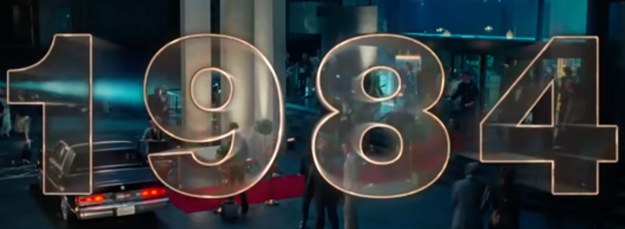
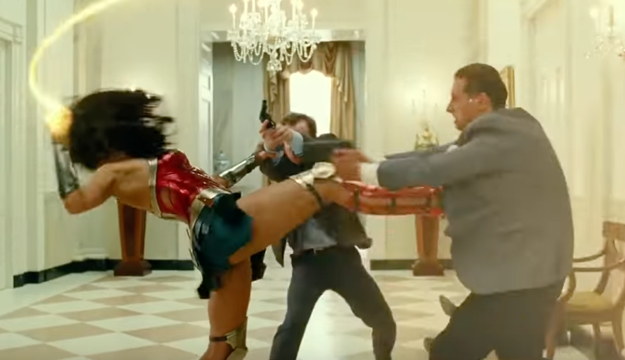
Okay, SPOILERS AHOY between these two screenshots I pulled from the trailer, and in the comments section to follow, so avert your eyes if you don’t want to know that Ares’ mustache survived the first film and has returned to exact vengeance upon the Amazons:

Okay, like I said, I didn’t watch the film with plans to write about it here, so here are just a few comments on what I saw.

The most impressive thing about the movie, as I alluded to above, is that it wasn’t Wonder Woman beating the tar out of Maxwell Lord. If you wanted your superhero vs. supervillain punchout, you got it the CGI-riffic Cheetah fight just prior (and you can tell how much confidence filmmakers have in a particular CGI effect based on how dark the lighting is), but Diana speaking to Lord (and through him, the world) trying to talk everyone down and renouncing their wishes…that was far more satisfying than having, I don’t know, Lord’s building exploding or whatever.

Also, that Lord’s apparent punishment at the end of the film is not being exploded along with a building, or dying in regret, or whatever the usual fate is for a bad guy. Instead, he begs forgiveness from his young son, openly admitting to him his failures. It’s an emotional punishment, and a hopeful one for a better future for the both of them.

Another nice nod to the comics was Lord occasionally dabbing at a bleeding nose after using his wish-granting powers (as comics Lord would do after psychically “pushing” someone). Yes, I know the ghost of Dr. Polite Scott would have some words about this (mostly along the lines of “brain trauma much”) but it was still a “hey, I remember that!” moment.

Speaking of character resolutions, I don’t recall seeing a post-Cheetah transformation Barbara at the end of the story. Did I miss her? I feel like she’d be the one with the most to resolve emotionally post-battle, trying to reconcile who she was with what she’d become once she had some power in her hands.

And so long as we’re at the end of the movie…literally the very second the “missing Amazon” was mentioned earlier in the story, I knew 1) who was going to play her, and 2) who the post or mid-credits scene would feature. I won’t note it here, just in case you haven’t seen the flick and are trying to spoil it for yourself by reading these comments…but c’mon, it doesn’t take a genius to guess just who I’m talkin’ about. Don’t know if this is just a nod to fans or if she’ll actually take part in the next film…frankly, I think just making it a one-off thing is fine. It was cutre, and I was glad to see it.

Some folks wondered about the 1980s setting, and I’m guessing a big part is the whole business involving the actual President of the United States may have been a big part of it. Having this as a period piece with an only sorta half-convincing Ronald Reagan, and playing on his Cold War involvement) probably goes over easier than a modern day film featuring a Trump impersonator (which would have been distracting and divisive no matter how he was portrayed) or the usual gambit of Old White Guy As A Fictional President (which may have taken folks out of a story about magical wishes and a strong lady in a star-spangled outfit). Also, can you imagine the opening mall fight in modern times? She wouldn’t have bothered having to take out the security cameras, because who was going to see her?

Plus, if we’re still pretending there’s a DC Comics Cinematic Universe, putting it in 1984 gets around the whole “where are Superman and Batman?” question. Okay, maybe it doesn’t avoid the “where’s the Challengers of the Unknown/Crimson Avenger/Doctor Occult/Scribbly” question, but…all right, you got me, I don’t really have a point here, I just wanted to namedrop Scribbly.

One thing I kept waiting for…look, it’s nice to have Chris Pine back as Steve Trevor. I liked him as Steve Trevor, a character in the comics that’s had a…mixed history, shall we say. And a character in the comics where, for years, was kind of a running gag in that he’d kept being killed off/written out and then brought back again. I presume that kinda went away when George Perez revamped the title in the ’80s, but I haven’t kept up lately and kind of hope they’ve reestablished that trope. Just aint’ Steve Trevor unless he keeps getting removed ‘n’ revived every few years.

Anyhoo, having Diana wish him back into existence is…well, it’s certainly a way to get him back. And it brings a bit of personal sacrifice into having to renounce her wish in order to save the day. (There’s a whole bit of business about a cost to getting one’s wishes granted…in this case, Diana’s wish for the return of Steve seemed to reduce her superpowered abilities, but Barbara’s wish to be like Diana also was implied to have taken her powers? I wasn’t clear on that, maybe I missed something.) But Steve is brought back, Deadman-style, possessing another dude’s body…which is barely addressed by anybody in the film. I mean, there are jokes about his apartment, but not a whole lot about “we’re totally hijacking this poor dude’s life here.” So that was all a bit uncomfortable. I do like that Steve departing that fella’s body was left offscreen once Diana renounced her wish.

I hope they find a way to bring Steve back for the third film. And in every film thereafter, as long as they’re making these. Just a different wild way every single time.

And while we’re on the topic of characters from the first movie…yes, that was definitely an old Etta Candy in that photo in Diana’s apartment, confirmed by Lucy “Etta” Davis her own self. I think few people would deny Etta was a real highlight of that movie, a delightful character that, in the comics, did not have the most dignified of origins. (“Ate A Candy,” indeed…geez louise.)

And one more thing about the conclusion of the film…while everyone’s wishes were renounced and undone, it’s made pretty clear a giant reset button wasn’t necessarily pushed, putting everyone and everything back to how it was. The wishes were granted, things happened, then suddenly things…didn’t exactly unhappen, but mostly just stopped happening. Yes, the woman who was wished dead came back to life, that was just straight up undone, but it’s not like the U.S. and Russia didn’t launch missiles at each other, whether or not those missiles disappeared. Seems like there are still consequences of those wishes existing in the world as left at the end of the story. That’s the main sticking point in the redemption of Maxwell Lord…he still screwed things up for everyone good ‘n’ proper.

Oh, and Simon Stagg is a character in the movie. Unlike his CW TV counterpart (killed off in Green Arrow or something) he survived, so there’s still hope for a big-budget Metamorpho movie. Don’t say you wouldn’t want to see this. DON’T YOU LIE TO ME.

And I’m sure I’m forgetting something, but I’ll let you folks in the comments remind me, as I’m sure you will!


…And can you believe how the Robot Kanga army took out Angle Man? Brutal.

Those were just a few thoughts I had…I may follow up in a future post if you folks remind me of anything (or if I see the movie again, which I may soon, since it’s leaving HBO Max in a month). And speaking of the future, please sign my petition to have the next Wonder Woman movie take place in the year 2050, just to mess with people. Also, the villain should be Doctor Psycho. Specifically, the version in the Harley Quinn cartoon. Ol’ WW giving a foul-mouthed misogynist what-for…it’s what he world needs.