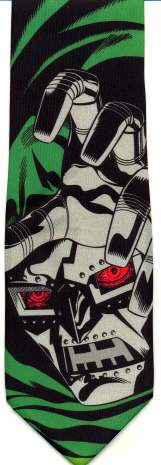
I’m in the process of prepping some neckties for consignment sale on the eBay on behalf of one of our customers, and…well, I’m not much of a tie-wearer (as in “almost never”), but if I were to wear a tie, let it be a Dr. Doom one:
There’s “power tie,” and then there’s “craving ultimate power and dominion over all space and time tie.”
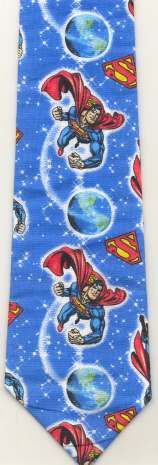
I kind of like this tie, too…Employee Aaron dubbed it the “Crisis on Infinite Earths tie,” what with the multiple Supermen and Earths an’ all:
Employee Jeff just sent Employee Aaron a text message from the San Diego Con, where he’s at the Joe Quesada panel. Apparently everyone’s hounding Big Joe for a new Devil Dinosaur series.
EDIT: Jeff says there’s word that more Frank Frazetta-inspired comics are planned, including one called Creature in which Teddy Roosevelt fights monsters. Hey, why not?
EDIT 2: Grant Morrison writing Final Crisis. Okay, it’s probably already on the big news sites by now (haven’t checked), but Jeff reports it, I pass it on.
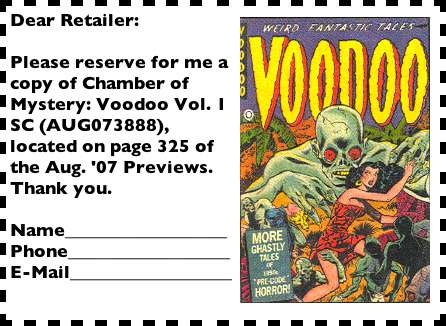
Okay, I promise you, I have no financial stake in this book or this publisher (aside from selling the books at the shop), this isn’t a paid ad, no one asked me to do this…but I loved the last book these guys did, and by God, I want to see more. So, out of a bit of enlightened self-interest, hoping this new volume will sell well enough to justify reprinting more off-brand horror comics, I give you this coupon you can print ‘n’ clip and give to your retailer:
That’s Chamber of Mystery: Voodoo volume 1, from Olympian Pubishing. I know some of you poor folks out there have retailers who get tired and a bit woozy by the time they reach “Wizard Entertainment” in Previews while ordering and don’t buy anything past that point. Be sure to give ’em this coupon and let ’em know you gots to have your Golden Age horror reprints!
“Say, what’s Batfatty been up to,” you’ve been asking. Well, Batfatty, AKA pal JP, has been tracking down some Bat-rarities, including:
A couple San Diego Convention tidbits, pulled from online sources as I’m not there, due to my inability to “socialize” or “afford anything” at the moment:
“‘…What’s the point of having 150 reporters with access to millions of readers sitting here?’ asked another critic, joining the pile-on. ‘You have the announcements. You can give them out. Instead you are going to hold them to give to people who have to pay to get into a convention.'”
The San Diego Con itself is summed up in this three-line description:
“Hundreds of years ago, Comic-Con was a sweet little comic book convention. But it’s been totally co-opted by the studios, and now, for four days each year, it’s the center of the cultural world.
“This year Comic-Con expects about 120,000 blogging geeks, who will rake in whatever the studios shovel out about upcoming movies and TV series.”
As mentioned on this site yesterday, as well as everywhere else on the internet, and confirmed yesterday at the con, Zachary Quinto of Heroes will be all Spocked up for the forthcoming Star Trek movie. Leonard Nimoy is apparently also in the film as well. The MSNBC article says it’s not clear if Nimoy is playing Old Spock, but the L.A. Times says he is, so there. Nyah.
Watchmen movie cast confirmed. They’re actually going through with it. Retailers, sell those Watchmen graphic novels now, because after the movie comes out, they’ll never sell again. Okay, I exaggerate slightly, but not by much.
I didn’t recognize a single name in the cast, save for “Billy Crudup,” which I only remembered because of the odd last name, not because I can remember anything he’s been in.
It’s the End of Civilization as we know it, and I feel just dandy, thank you. Come with me as I journey through the August 2007 edition of Diamond Previews and attempt not to weep openly. (The last two and a half years’ worth of this masochistic endeavour are linked in the sidebar.)
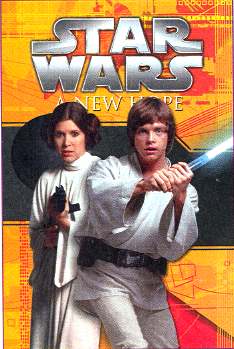
p. 45 – Star Wars Episode IV – A New Hope Photo Comic:
Seems to me this sort of book is just a couple decades too late, as the need for “photo-novels” has been supplanted by the availability of the actual films for home use. $9.95 for this book, or just a few bucks more for the DVD? (More discussion on a related topic here.)
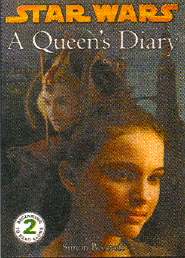
p. 412 – Star Wars Reader A Queen’s Diary SC:
In which you get the character development that probably would have been nice to have had in the actual movies.
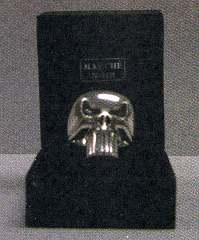
p. 429 – Punisher Sterling Silver Symbol Ring:
“Hey, wow! Cool ring! I love the Phantom!”
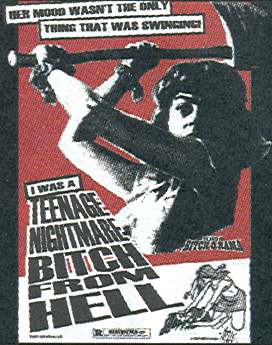
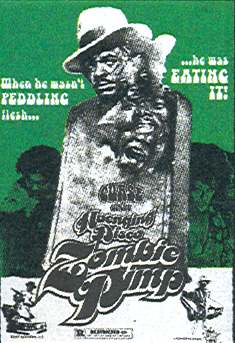
p. 432 – “Teenage Nightmare Bitch from Hell” Women’s t-shirt & “Disco Zombie Pimp” black work shirt:
Both these shirts are pretty amusing, I thought, but the pricing, the pricing. “Bitch from Hell” is $32.95 (all sizes), while “Disco Zombie Pimp” is $39.99 for sizes up to XL, and $43.99 for the larger sizes. God Lord Almighty, that’s like concert t-shirt pricing.
p. 448 – Harry Potter 12-inch Hermione Granger Action Figure with Sound:
And the sound it makes: “Quick looking up my skirt, you pervert!”
p. 454 – Upper Deck Authenticated Venom Bust:
Okay, first, “authenticated?” Is there a big bootleg market for Venom busts? And second, that’s a little more veiny than I prefer my Venom to be.
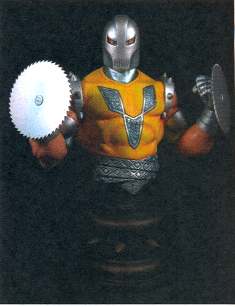
p. 454 – Gladiator Original Design Mini-bust:
“Slice your pizza for you, sir?”
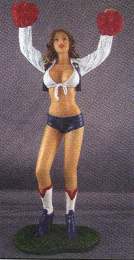
p. 460 – All-American Cheerleader Statue:
You kinda have to admire the straightforwardness of this item. “No, she’s not a 3-D representation of some art piece. She’s not a skimpily dressed warrior princess. She’s not a superheroine with a skin tight outfit. She’s just your plain ol’ run-of-the-mill basic-fetish cheerleader. Enjoy.”
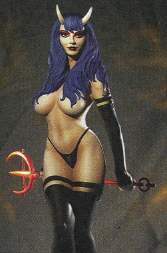
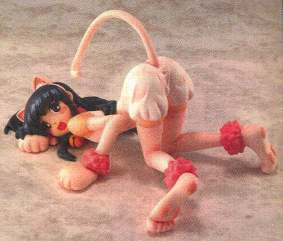
p. 460 – Sinful Suzi Statue:
Another in a long line of “this is gonna take some explaining to the loved ones” series of statues and busts offered through Previews.
p. 464 – Buffy the Vampire Slayer The Essense of Willow Statue:
Just for old time’s sake, since it was a piece of Buffy merchandise that kicked off the “End of Civilization” thing so long ago, I wanted to feature another ridiculous Buffy item. But, um, I actually kind of like the design of this item. Apparently it lights up, too. I guess if I wanted to make fun of a bad Buffy item being foist upon the public in this catalog, I should have stuck with the comic.
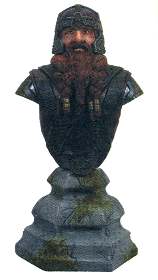
p. 466 – Lord of the Rings Classics Gimli Bust:
I think we may have gone past the “sell-by” date for Lord of the Rings merchandise specifically based on the movies. See also Harry Potter merchandise in a couple years.
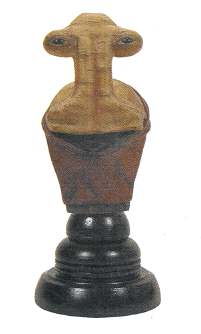
p. 471 – Star Wars Classics Momaw Nadon Hammerhead Bust:
First off, that’s just kind of creepy. Also, when I was a kid, this character was just “Hammerhead,” on screen in the cantina scene for all of a second or two, at most. But, because every single character who’s ever had any screen presence now has to have a name and backstory, he’s saddled with the name “Momaw Nadon.” Sorry, but he’ll always be “Hammerhead” to me.
“Ba-art, the fiendish ghost, the fiendish-est ghost you know….” You’re supposed to use this figure as a template for your own designs, but, heck, just leave him as is. That’s just plain scary.
Only $225. Almost guaranteed to be pulled out of the display case or your closet and played with by your children.
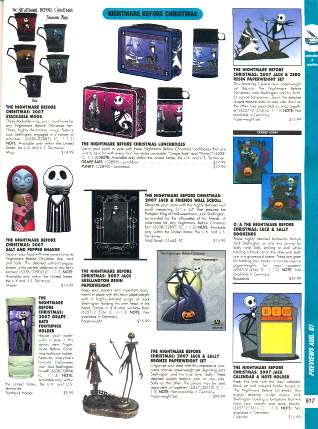
p. 517 – Nightmare Before Christmas merchandise:
If it’s July, it must be time for the yearly onslaught of Nightmare Before Christmas stuff. Here’s one of three and half pages of related merchandise in this month’s catalog:
Somewhere, a warehouse full of Corpse Bride merchandise is crying.
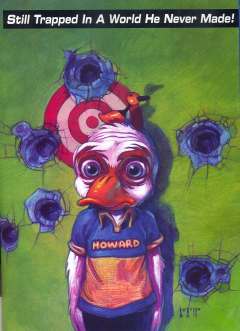
Marvel Previews p. 25 – Howard the Duck #1 (of 4):
“Just when you thought it was safe to read comics again…and Marvel has to do THIS?!?”
Probably the least self-aware quote in Marvel’s catalog this month. It’s a good thing it says “Howard” on the character’s shirt, because otherwise I never would have recognized him. And, nothing against Ty Templeton, but Howard not written by Steve Gerber is like Charlie Brown not written by Charles Schulz.
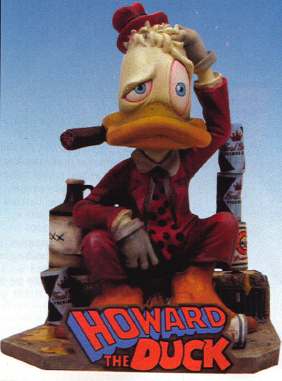
Marvel Previews p. 84 – Marvel Milestones Howard the Duck Statue:
Well, I asked for it, and now that it’s here, I’m not sure what to think about it. I do like the red-rimmed eyes, though.
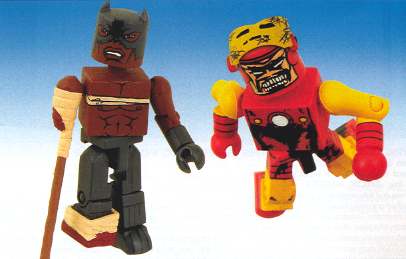
Marvel Previews p. 85 – Marvel Minimates PX Zombie Iron Man & Black Panther Two-Pack:
Featuring the exciting “Man on Crutch Missing a Foot” toy! And I know it’s how these Mini-Mate leg joints are designed, but posed like that…um, perhaps we see why Tony Stark (even Zombie Tony Stark) is popular with the ladies. BARN DOOR’S OPEN, TONY!
Jonah Hex is on his way to the silver screen, it seems. The headline of the article I linked actually reads “Comic anti-hero ‘Hex’ comes to the big screen,” which immediately made me think of this Hex, which would be fantastic.
I mean, honestly, how cool would that be? Everyone’s sitting there, watching what they think is yet another western flick, and suddenly Jonah’s whisked away into a distopian, Mad Max-ian future, with ray guns and giant mutant insects and gals in space bikinis. That’s the movie I want to see.
Apparently the actual direction they’re going with the Jonah Hex flick is based on the supernatural-themed Vertigo series by Joe R. Lansdale and Tim Truman, which is fine, too, I suppose. This means no giant robots, so don’t get your hopes up. Also, if some “tail wagging the dog” results from this Jonah Hex movie, as it usually does with most comic book movies, we’ll likely see a change in Hex’s facial scars to reflect whatever slightly more feasible scarring we’ll see in the film. Because, honestly, as has been pointed out several times before, there’s just no way that flap of skin over the side of his mouth would not have been cut off by Hex long, long ago.
I don’t imagine we’ll be seeing the Winter brothers on the soundtrack album.
That would be good casting…Quinto has a bit of an otherworldly look about him, handsome yet sort of off-kilter, and just plain kind of Vulcany, that would make an interesting interpretation of Spock. ‘Course, the handful of Trek fans still alive will probably have conniptions that they’re recasting the original crew, and the producers are taking the chance the reboot won’t attract a new audience while alienating the old fanbase and being left with nobody for their newest Star Trek attempt. But, who knows…people do like Quinto, and maybe a “going back to basics” approach will revive interest in a franchise that’s become increasingly insular and resistant to fresh fans.*
I still think a new animated Trek series, like Cartoon Network’s Star Wars: Clone Wars cartoon, would be the best way to get people (especially kids) excited about the Trek franchise again. Well, the real best way would be to let the franchise rest for about twenty years, and revive it with an actual fresh start like they did with Battlestar Galactica, but I doubt Paramount’s going to want to let one of its prime cash cows, diminished as it is, lay fallow for any longer than necessary.
For some reason, I just had a vision of the new Star Trek movie, with an entirely new set of actors and actresses portraying the Original Series characters, with the exception of Walter Koenig still playing Chekov. I picture him sitting behind the same old console, muttering “well, crap” under his breath the whole time.
I received an e-mailed press release for a forthcoming comic/celebrity convention, which had this to say in a short bio for one of the guests:
“Chris [Noel] co-starred with Elvis Presley in ‘Girl Happy’ and is the only actress to appear on the cover of a regular issue comic book.”
I suspect there’s some kind of qualifier missing, there. Doesn’t Dell’s I Love Lucy series count as a regular comic book, each issue of which featured a cover photo of Lucille Ball? Or how about, as Kevin suggested when I mentioned this to him, Dale Evans?
Anyway, a visit to her site reveals that the comic she appeared on was this issue of The ‘Nam. You know, I must have seen this cover a hundred times, and never realized the woman on the front was based on an actual person. That’s what I get for not reading it, I suppose. Well, I don’t have that excuse any more, since a PDF file of the story in question is available at that second link.
The whole site is actually a lot of fun, and Ms. Noel does good charity work for vets, so I’m glad that odd statement from the convention folk got me to seek out her site for more info. Plus, she dressed up as Margo Lane for a taping session for an upcoming documentary about the Shadow, and you can’t say that’s not cool.
* In fairness, I should note that Employee Aaron was helping a couple of ten year old kids with trading cards at our card counter, and they were awfully excited about, of all things, Star Trek: Voyager cards. “Are you sure they weren’t just short adults?” I asked Aaron. “No, they were definitely kids,” sez he.
So Employee Aaron came up with Crypt of Daylight, and I countered with Pantry of Terror, and then, suddenly, I’m trying to come up with a list of less-than-compelling horror comic titles. Here are a few:
Vault of Home Mortgages
Chamber of Stories (ahem) ‘Borrowed’ from EC Comics
Adventures into the Quite Well-Known, Actually
The Three Bedroom, Two and a Half Bath, Spacious Backyard, Close to a School and a Shopping Center, Newly Constructed Home of Horror
Someday I’d like to see a collection of all the space-filling short humor strips used to fill out comics back in the day. Also…was this Weird Watson’s only appearance? How can you not love that guy?
Weekly World News has had several connections to the comic book world, such as editors Paul Kupperburg and Bob Greenberger, writer Andy Mangels, and, of course, Peter Bagge’s run of initial “Bat Boy” comic strips, among others.
The supermarket just won’t be the same without Weekly World News staring back out at you at the checkout line. Another little piece of Americana slips away.
“One thing I’ve started wondering about your memories of the speculative boom – how much cash would your average collector buying multiple copies for investment value actually have sent down the toilet, in terms of purchase price versus current value?”
That’s a hard question to answer. Well, maybe not…the general response would be “a lot,” but it would depend really on what multiple copies they purchased (and assuming they kept them in sellable shape, which, as I noted Friday, was rarely the case).
But even if they did end up investing in a boom-era comic book with some current demand and a reasonable aftermarket price — say, for example, Spawn #1 — is the 30% to 50% (if you’re lucky) of that aftermarket price you’re going to get by selling it to a dealer, or on eBay, worth the fifteen years you’ve stored them? And if you have a lot of them, you might run into the problem I mentioned here…you might be able to sell 5 or 10 or even 20 copies of Spawn #1 to the same buyer, but it’s not likely you’ll be able to sell a full case of a couple hundred copies to that buyer. At least, not without taking an enormous loss on them. I can use some Spawn #1s for the shop, but I’m not going to tie up a lot of money in 200 copes that might take me a decade or more to sell. If you want me to buy a full case of Spawn #1, it better be cheap.
And if you’ve got something nobody wants, like, say, Brigade #1, you’ve gone from the “you may make a little bit of your money back” situation with Spawn to the “too bad it’s not soft enough to use as toilet paper” side of things. Sure, the price guide might say it’s worth cover price or so, but they’re not actually selling for that. To anyone. Ever. They’re not even selling in our bargain bins, much less at full price. Anyone who invested in Brigade will find themselves…well, I believe the technical term is “losing one’s ass.”
Speaking of asses and the loss thereof…another thing to consider, when it comes to value of many of the boom books…some of you folks may remember that our shop was clearing out some backstock, selling about 100,000 units to somebody who needed comic books in bulk, regardless of title or publisher. We unloaded tons of ’90s crash-era comics at the princely sum of one shiny nickel per funnybook. Alas, I doubt you’ll see that pricing reflected in the listings of your favorite price guide (“SECOND LIFE OF DR. MIRAGE #1 – $0.05 in NM condition”).
So, anyway, to actually answer the question: while I’m sure there are some success stories, the vast majority of people who invested in multiple copies probably only realized pennies for each dollar spent, if even that.
“Do you think 52 would have sold as well if DC published it as a monthly trade rather than a weekly pamphlet?”
If they had gone the monthly paperback route, 52 would have been a drastically different creature. (For one, they would have called it 12.) It was designed as a weekly serial, with cliffhangers, and its impact (and novelty) would have been diminished had it been yet another monthly publication. Not saying there isn’t room for DC to experiment with a superhero story serialized as a monthly trade paperback, but 52 was primarily designed to take advantage of the weekly new comic pamphlet release schedule, which contributed to its sale success.
Another good sequence from Adventures into Darkness #14:
I don’t normally buy current publications from Archie Comics, and when I do, it’s almost always books that reprint their work from the ’60s and earlier. Such was the case with last week’s Archie Digest #236, which reprints Archie’s first appearance from Pep #22, along with a full reprinting of Archie #1 from 1942.
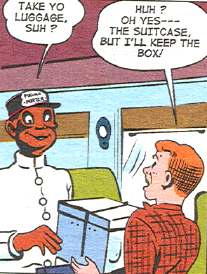
One of the stories from Archie #1 has Archie involved in a series of mix-ups on a train with another passenger, and the poor railroad porter gets caught in the shenanigans as well. The porter looks and talks like this:
I realize it’s no shock to anyone familiar with comic book history that racist caricatures of black people (and Asians, and Native Americans, and so on) were common in early stories (and this isn’t even the worst example from this particular story, with other panels including dialogue like “I done thought…” and “Mus’ be dat bump on yo’ had!”). Not having an original Archie #1 lying around the house, I’m going to assume the porter has been recolored slightly for the reprint, even though all his stereotypical dialogue appears to have remained intact.
I’m not saying this shouldn’t have been reprinted as is. If you’re going to reprint your old material for historical purposes, it should be reprinted as it was, warts and all*. And that’s what folks have been doing…a glance through your Shazam Archives and your Golden Age Wonder Woman Archives, among others, will show you examples of political incorrectness similar to that bit of business with the porter. But these are high end reprints, aimed at comic collectors, who are presumably familiar with the poor way minority groups were portrayed. Disclaimers aren’t uncommon, noting the usage of such caricatures were typical of the time, and left unchanged for historical reference.
This Archie digest, however, is aimed at a young, general audience. It’s one of the few modern comics actually sold in places where people who aren’t comic fans shop. At my grocery store, they’re right up there at the checkout line, next to the TV Guide and the Weekly World News. How will kids take the porter’s portrayal — how will the parents? — particularly since there is no disclaimer that I can find noting the historical reasons for that portrayal.
I’m very curious as to the response Archie Comics will receive.
Okay, one last round of “Mike Remembers Barely Making It Through the 1990s:”
“Do you think we’ll ever see comic books back in supermarkets and convenience stores?”
It’d be nice, and in some cases apparently you can find comics in some convenience stores…but a widespread revival of this manner of distribution? Not unless 1) comics get a whole lot more popular, and 2) the profit potential for them is enough for store owners to risk valuable space on them.
“Do you think Gemstone will keep publishing Disney comics for very long?”
Hard to say…my gut feeling says “no,” since their number of publications has declined, and their prices have gone up. Their last Don Rosa reprint book has sold very well for us, though, so maybe there’s some life there yet.
“There are those who insist that monthly super-hero comics will be dead sooner rather than later. Do you see a trend in that department? What’s your take on the viability of our beloved monthlies?”
I think if the price point of the standard comic book goes much higher, something is going to have to give. My guess is a regular comic book will eventually undergo some form of evolution, possibly into a much thicker publication with more stories, at a slightly higher price point (but giving a higher perceived value to the reader), and just loaded with ads to help subsidize the cost of the magazine.
There are a lot of economic factors there that I’m overlooking (such as whether or not a comic book publication could attract enough ads, and get enough money from them). At the very least, I don’t think monthly books will go away, but they’ll have to become something new to give readers more perceived value for their money.
“Where the hell did all these investors come from in the first place? I mean, why did everyone suddenly get the idea that these comics would be worth a lot of money? Comics had been around for decades and decades, and then — all of a sudden, out of nowhere — all these non-comic book fans start investing in them? Why? Was there some sort of triggering event? I don’t get it.”
Apparently there was a large crash in the sports card market just prior, and it was just a lateral shift from collecting one thing to another…I don’t have exact details, but it appeared to be common knowledge at the time. I can personally testify to the number of investor-types requesting “comic book Becketts” — Beckett being the publisher of several sports card price guides — so that lends credence to that theory.
Also, the greater awareness of comics among the general populace, driven by movies and media-hyped events, combined with a possible economic downturn and plenty of newspaper stories dragging out the old “did you know old comics are worth money?” thing…that made comics a large, attractive target for investing, without all that “dealing with brokers” stuff.
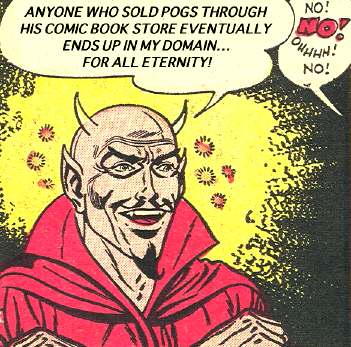
“Oh, another question — why are you so remorseful about selling pogs? How is that any worse than selling, say, a trading card or an action figure? People wanted pogs, and they wanted to give you money in order to own them. What’s the big crisis of conscience there?”
Because I can see the value of a trading card or an action figure. Though technically, I realize, there’s only a slight difference between a trading card and a POG, but least trading cards were numbered, sometimes had cardback text, and could be put into sets. They had something to them. POGs (or, rather, milkcaps) were, with some exceptions, just random pictures on bits of round cardboard, and just felt to me like it was worthless junk. The alleged “game” involving milkcaps was essentially jacks or marbles, without the skill….you threw a heavy disc down onto a pile of cardboard discs. and you kept the ones that turned over, or some damned thing.
I understand this might just be bias on my part, since there are plenty of folks who think comics are worthless junk too, but even if customers were willing to part with their money for POGs, I felt like I was giving them nothing of value in return. I was essentially turning their money into crap. I know I should feel like this when I sell someone a copy of, say, Purgatori, but I don’t.
Yeah, cheap shot at Purgatori, sorry, but I can accept that someone might find entertainment value in that comic. Somehow. I just don’t see that value in milkcaps.
* As far as story content goes, anyway…I realize the comics in question have been recolored and (it seems) relettered for clarity.
Okay, I’m gonna try to go through these a little more quickly…I’ve given you a lot to read this week, which means a lot of typing on my part, and a man’s gotta get some sleep sometime. Plus, that Doctor Who Genesis of the Daleks DVD I got from Netflix ain’t gonna watch itself.
So, here are a few more answers to questions posed to me about the comics market, the ’90s, and, God help us all, POGs:
“Did you as a retailer see any signs that comics were recovering in the late-’90s, or was it just a long period of malaise from the Bust until Quesada/Jemas at Marvel kicked off the Media Age?”
I think the simple departure of the investors meant a stabilization/correction of the market…unfortunately, that stabilization of the market also included the departure of fans who were present prior to the fad/boom, who left for a myriad of reasons (tired of the decline in quality, disgusted by the catering to investors, distracted by other hobbies, etc.).
At that point, there was no where to go but up, really, and with the shaking out of lesser books and a general increase in quality in what was left, you got the sense that a slightly healthier market was beginning to emerge. Retailers ordering more sanely, consumers showing a bit more discretion…we all went from “wild abandon” to “cautious penny-pinchers” right quick.
The Quesada/Jemas thing, if anything, probably stirred things up a bit more than the market was really ready to deal with at the time. It’s like taking someone out dancing two days after they broke both their legs…a little more recovery time is probably required. I’m thinking the whole “upping comics schedules to every three weeks instead of monthly” shenanigans they tried, briefly, before discovering everyone hated it.
“I was wondering if your shop saw a lot of customers who, like me, didn’t even notice the boom and bust.”
Probably…we had a few folks wondering where all their Punisher titles went, for example, or noting that a lot of the comics they were following suddenly dried up, or came out less frequently. Whether some of them were aware of the changing marketplace as a whole, I don’t know…I imagine some never really noticed. So long as we still had our doors open, still getting new comics every week for them to buy, then it was all Business As Usual.
“Rare, sought-after book = high value. Did speculators not realize that companies printing 300k-500k copies of a new book, and everyone buying five copies apiece to store away, meant that these books were by definition not rare and therefore not valuable?”
You’d think. I did a lot of explaining to people trying to sell us comics during the lean years why their stacks of Image #1s weren’t worth diddly squat.
On the other hand, there’s a particular phenomenon I’ve noticed when I see collections from people who bought multiple copies in large quantities. The vast majority of these people did not keep their comics in new condition. Of those 500,000 copy print runs, chances are the copies that actually made it into customers’ hands (and not just stored away in shop’s backrooms) are not longer in mint shape, if they were even kept at all and not just tossed out once the faddish fever broke.
So, maybe, just maybe, that one person who bought fifty copies of Secret Weapons #1 and managed to keep them in mint shape actually may have something, there. Still not going to buy ’em, though.
“You wouldn’t happen to have any packs of GHOST RIDER hero caps (aka; pogs) left over would ya?”
Nope, no more POGs. A year or two back I found one last cardboard box filled with POGs and associated paraphernalia still gathering dust in the back room, threw it as is on the eBay, and got about thirty bucks for it. Aside from maybe a POG promo or two in our card section, and that little tiny plastic POG case with a few caps in it that I use as both a paperweight and as a constant reminder of my retailing sins, POGs are no longer welcome in the store. Phooey, sez I.
FMguru has lotsa questions, so let’s see what kind of answers I can give him:
“When the boom was going on, did you believe that the market was ascending to a new plateau (i.e. that a lot of the boom was actual long-term growth in the market) or did you think it was all hot air and candyfloss and likely to end in tears (or, more positively, a nice little bump in sales and cashflow before things settled back to normal)?”
My expectations was that it was a faddish increase, and that things would eventually normalize…but I figured it would normalize with some extra folks joining the comics scene as regular readers, so that as a whole the market would be slightly larger than before. Alas, what ended up happening, as I noted earlier in this post, was that the investors went away, the fad-followers went away, and a bunch of the regular fans went away, leaving us with a shell of an industry.
“Also, what was the most traumatic event of the boom, from a retailer’s POV? What one thing (corporate decision, book delay, whatever) did the most damage to your business?”
I’ve discussed this in past posts of mine, trying to track down the book that killed the industry. In my mind, it’s still Turok Dinosaur Hunter #1 from Valiant, which every retailer overordered, and ended up not selling anywhere close to expectations. It might just be me creating connections in hindsight, but it seemed to me that this was the book that triggered the realization that investing in comics, particularly comics that had larger print runs than the Bible, was a really stupid thing to be doing.
“What was the most ludicrous waste of money that was clearly going to be an enormous failure? I’m thinking Tekno Comics, here.”
Tekno Comics is a good answer, featuring a lot of Big Famous Names on titles that they were only tangentially attached to, like, say, Isaac Asimov’s I-Bots. Not saying they were bad books, but having “Isaac Asimov’s” and “Neil Gaiman’s” and “Mickey Spillane’s” across the tops of the covers, and having someone else write the insides, was bound to disappoint somebody. Yeah, I know, what were they expecting, but still.
In general, though, I think the huge amounts of money spent to try to compete with Marvel and DC at their own shared-universe superhero game was a bad idea. And the whole “collect the trading cards to assemble the first issue of our series” idea for Defiant’s Warriors of Plasm and, I think, Dark Dominion, seemed like a good way to dissuade people from trying your books.
“What role did the Magic: The Gathering boom of 95-96 have in helping keep your store afloat during the comic market implosion?”
Games in general helped keep us going…half the store was devoted to role-playing and tabletop gaming, and that kept bringing in the bacon when the comic half was in the doldrums. I knew something was up with Magic almost from the start, when we’d get calls like this:
“Hi, I’m in Los Angeles. Do you have any Magic packs?”
“Uh, yeah, I have a couple left here.”
“HOLD THEM FOR ME I’M DRIVING UP THERE RIGHT NOW.”
So, yeah, RPGs, Magic, Warhammer…all that stuff definitely helped.
Not a question, but an observation:
“One other good side effect of the boom was that it created a huge demand for writers and artists, and a whole bunch of people who otherwise wouldn’t have broken into the industry got breaks.”
True enough…I was going to touch on that, but I kept wanting to phrase it as “consumer confidence was undermined by the influx of not-ready-for-prime-time artists and writers hired primarily for their ability to fill a page with something, regardless of quality, as all those books being pumped out each month couldn’t go out blank.”
But you’re right…the side effect of this was that, just by the sheer numbers involved, some of those people would actually turn out to be pretty good, and got their breaks during this creative influx. So that’s a good thing, but too bad about the trials we all had to endure for this to happen.
“Finally, of all the dumb cover enhancements that came along in the 90s, which was your favorite? I really liked a Superman cover that was just a Metropolis cityscape with a slightly waxy coating – and it came with a sheet of ColorForms(tm) you could peel off and make your own cover with. Reusable!”
“You know, I still can’t effin’ understand how POGs are played. Is player? Are played with? I can’t even get the prepositions right!”
It involves throwing a heavier POG, or a Slammer, at a stack of other caps, and whatever flipped over you got to keep, or something. Either that, or the point was to accumulate as many POGs as possible, so your mom will something to complain at you about leaving all over the floor of your room.
“About the black-and-white boom, it should be noted that some of those ‘failures’ were selling in numbers which would happily get them continued by a small black-and-white publisher today.”
True enough…though a portion of those b&w titles were selling to retailers, and not necessarily getting into the hands of any customers. Shadow of the Groundhog sold great to that convention guy I told you about yesterday…he just couldn’t sell ’em to anybody else!
But I get your point….lots of good b&w titles sold solid numbers, to actual readers…numbers that may have been sneered at by Marvel and DC at the time, but are probably looked at now as “pie in the sky hopes” dream numbers by the Big Two.
Speaking of Pal Nat, the (sniff) last issue of Licensable Bear™, #4, is now out in stores. Read more about the cutest little licensable bear ever at Licensablebeartm.com.
And here’s a Licensable Bear™ video that I seemed to have accidentally skipped featuring on my site when it was released. So, please, enjoy a lesson in branding and marketing from the only expert you can trust…a bear wearing a shirt:
Tim O’Neil continues his in-depth examination of the rise and fall and rise again of the Punisher comic book, inspired, at least in part, by a post of mine briefly discussing the character’s waning and waxing popularity. (Here’s part one of Tim’s Punisher posts.)