"Buy something you’d like to read, that way it’ll always be worth something to you."

So some of you folks had some good questions in response to this post of mine from yesterday…I’m mostly just answering direct questions today, but I’ll probably get around to speaking about some of your more general observations soon.

If you have more questions or comments, feel free to lay them on me.

Commenter Allan asks

“I would be curious if you could think of any possible bright sides of the bust. Did anything good come out of it (besides the death of a ton of lousy titles) or was it just a great big pile of suck without any glimmering glints of gold peeking out from underneath the rubble?”

Well, there were a few good things, I think:

1. A refocusing by certain publishers on comics that were worth reading, rather than just being foil-covered, die-cut objects for magpies to gather. (Though this is slowly coming undone.)

2. Shaking out some of the retailers who jumped into the market just to exploit their customer base with “investments” and “collectibles.”

3. And most importantly, teaching the surviving retailers a very important lesson about over-ordering, buying fads, and the transience of “investing” customers. You’ll find a lot more retailers nowadays swearing by their cycle sheets and ordering a lot more conservatively, particularly if they weathered the ’90s.


Commenter Larry E asks

“As a retailer, did you ever try to talk any customers out of buying multiple issues or otherwise contributing to the speculation bug? If you did, was it regular customers or just guys thinking they would cash in on the Death Of Superman or X-Men 1, etc?”

If someone came up to the register with multiple copies of a book, I wouldn’t necessarily try to dissuade them, but I would at least ask them something along the lines of “Are you sure you want this many?” Even if they had just two copies of a book, I’d say “Hey, you had two copies of this comic in your pile…did you mean to do that?” But, if they were adults, and they wanted to have multiple copies…hey, it’s their money.

Also, keep in mind we had ginormous distributor bills…we were raking in a ton of cash, but we were also doling out a lot of coin of the realm at the same time. If someone wanted to buy thirty copies of a book that otherwise was kind of sitting there, we weren’t in a position to say “no,” really. Multiple copy sales of that magnitude (or more, like full cases of books) rarely happened anyway, and it was usually as special-ordered wholesale items to people selling at swap meets, or via mail order, or what have you.

On the other hand, when customers asked me which comics would be a good investment, that’s where I drew the line. Depending on my mood (and how well I knew the customer) I’d say “If I could tell the future, I’d be at the racetrack,” or I’d just respond with a “Who can tell?” Or, more likely, I’d say “Buy something you’d like to read, that way it’ll always be worth something to you.” That particular mantra was repeated many a time.

At no time did I ever, ever, recommend a comic book as an investment. Aside from the fact that I’d prefer people read the books, the danger of that was, of course, recommending a book that turned out to be a turkey, and having the customer chase after me with a rusty clawhammer because I sold him four hundred copies of Team Youngblood #1.

Another thing that, hopefully, makes me look a little less bad was, at the time, I had set up a “RECOMMENDED READING” rack of good comics that I wanted to encourage people to actually read, as opposed to just dropping into a Mylar and waiting for the price to skyrocket. (That’s how we ended up regularly selling about 5% of the print run of a Pirate Corp$ issue, to bring up one fond memory.)


Commenter Scratchie asks

“I’ve often wondered if Overstreet and the other pricing guides acknowledged the crash, or whether their ‘market prices’ for various issues just kept going up, and up…”

You know, that’s a good question, and I think I probably have the magazines and guides at the shop to research it. But just as a hunch, I imagine it’s like this:

Overstreet, on the whole, is pretty conservative with pricing, so aside from some fluctuation on, say, Valiant titles, it probably didn’t alter its pricing too much, since they probably never acknowledged too much of the “hot title” pricing to begin with.

Wizard probably just dropped “hot” comics out of their price guide entirely as prices dropped, with “not enough interest in the title to justify using the space” as a reason.

And the other fly-by-night price guides all dried up before they could start running post-crash pricing.

I need to dig out some of the guides and take a look to see what they actually did. Watch this space!


Commenter Thelonious_Nick asks

“…Do you think there will ever be another time when comics are a mass medium, as they were from the 1940s-1990s? And if so, what changes in the comics industry and/or society will be necessary for that to happen?”

I think it was Dave Sim, of all people, who said that television is the only real mass medium, and everything else is a distant second. But, for a while there, comics were enormously popular, but I think the ’90s may have been the last hurrah of that particular market situation (no matter how hard the publishers are trying to revive it with all their variant covers).

1. We had an enormously popular Batman movie that created a faddish interest in comics.

2. The sports card market collapsed, driving investor types into the comic market looking for more collectibles (a drive pushed by the Batman-created fad, most likely).

3. This may just be crazy talk, but I’ve had a half-baked opinion that comic sales seem to bump upward during times of economic depression, and maybe someday I’ll get around to researching that a little more fully.

And I’m sure there are other reasons, but I think the main reason for the ’90s market being the way it was could be attributed to the faddish nature of comics’ popularity. There’s no real telling what will create a fad like this, how big it’ll get, or how long it’ll last…and now that comics have had their big fad moment, it’s unlikely it’ll happen again in the near future. (How many big “pet rock” revivals have there been since the ’70s, for example?*)

As it is, the comics market is improving slightly, as the focus moves ever so surely towards a trade paperback-based system. As awareness of comics increases, more people find things they like, and readership increases…and so long as the market grows naturally, and healthily, I don’t care if it does reach the heights of the ’90s. And frankly, the only way that would happen at this point is for another comics fad to hit, which I don’t know any of us really want to see.

By the way, in some instances, comics are doing enormously well. How many best seller lists is the Naruto manga on, for example?


Commenter Matt asks

“…Was there one “eureka” moment for you when you knew the crash was coming? When you knew things were falling apart, or about to fall apart?

“For that matter, did you smell the crash at all?”

I think I’ve noted before that the crash was pretty sudden. We had a few weeks when sales dipped a bit, and we thought it was just one of those periodic sales adjustments, and things would be back up to normal shortly.

And then things just kept dipping, and we thought “Well, this is going on a little longer than normal, surely those customers will be back. We’d better keep ordering our regular numbers so that we’ll have the back issues for them when they return.”

And then the sales continued dipping, and then we, along with every retailer in America and abroad, went “Oh, shit.”

The one thing that really made me think “Oh, this can’t be good” was a certain issue of the Diamond Previews catalog. For one, it was much thicker than previous issues. I think it was even thicker than the current Previews. And two, it contained the debut of (or at least special-featured solicitations for) at least three different superhero shared universes from three different publishers (one may have been Dark Horse’s Comics’ Greatest World). I remember looking at that and thinking “We don’t have the rack space to support this” and “How do they expect customers to afford to follow all these books?” I can still recall my very strong feeling of dread.


Commenter jimbo asks:

“I guess like Larry E, I’m interested in, for lack of a better word, the ‘ethics’ of the 90’s speculator boom. Did you feel a certain responsibility to dissuade folks from being a bit too silly with their money (multiple issues, ‘investing,’ etc.), or is this sort of like asking a liquor store owner if he feels bad about taking money off a guy who buys a 30 pack?

“I know you to be a generally swell and ethical guy, but were there ever any moments in the 90’s where you felt tested, or even points where you were like ‘No, this is not why I got into this business at. all.’?”

I addressed this at least partially with my response to Larry E…I think my responsibility was in telling people who asked about comic book investing was that it wasn’t a good idea. But, if people wanted to spend money on multiple issues, even after I asked them if they were sure…well, I’m not their mom, I’m not going to tell them what they can or can’t spend their money on. And like I’d said…most of the time, it was just people buying doubles, which was no big deal.

Was that healthy for the comics industry in the long run? Probably not. But not even a Mikester in his early 20s’ fightin’ prime could save the industry by himself, refusing to sell multiple copies and extolling his customers to turn away, turn away I say, from those five different X-Men #1s, stop rubbing the blood on Bloodstrike #1, and buy only comics you’ll enjoy reading! I did what I could to encourage reading and discourage investing, but the economic reality of it was that I had to accept the investors are part of the deal. Besides, if they didn’t buy ’em here, they’d go to one of the other half-dozen stores that popped up in our immediate area and buy ’em there. (‘Course, most of those stores dried up years ago.)

On the other hand, the kind of person who’d buy a case of any given issue at a time wasn’t someone who was going to stick around as a reader anyway. He was in it for short term profit, not long term entertainment.

As far as the “not why I got into this business” part…it wasn’t comics, but POGs what did the deed. I’ve written about this before, but POGs and their ilk are really the only thing I hated, hated selling. It honestly made me feel like a crook taking money from kids for POGs and POG supplies and POG sheets and slammers and what have you. I would have probably felt better about selling cigarettes to them, because then at least the kids would get cool menthol flavor, which is far more than they’d be getting from these stupid milkcaps. This was pretty much post-crash, however, and we were doing everything we could to get cash in the door and keeping the doors open. And, kids wanted POGs, we had no shortage of people wanting to wholesale POGs to us, and our will was weak.

When my time comes, I’ll have a lot of explaining to do to God.


Commenter David C asks

“Were you around for the ’80s ‘Black and White’ boom? If so, how was it similar and different?”

I was around as a reader and a fan for the black and white boom, but I wasn’t on the retail end of things until shortly afterward. Our shop didn’t fall for the b&w boom like some folks did…we may have carried Solson titles and assorted other small press titles cranked out to take advantage of the investors market created by the popularity of the Teenage Mutant Ninja Turtles, but never more copies than we thought we could sell. There was no investing in these b&w #1s in quantity, in the hopes a financial killing could be made (like the poor bastard I saw at a convention circa ’91, with a whole long box of the notoriously terrible Shadow of the Groundhog).

I would say, in general terms, that the primary difference between the black and white boom and the late ’80s/early ’90s boom was that the former was more publisher driven, while the latter was consumer driven. When TMNT came out, it was a huge hit, with early issues commanding enormous prices. Suddenly everyone was a comic book publisher, cranking out their own black and white titles hoping for that same success. Not saying there weren’t any good publishers that came out of that (like Slave Labor and Dark Horse), and that some titles didn’t sell well, but there was a metric assload of terrible, terrible comics, number ones pumped out one after another, in the hopes that if you threw enough crap at a wall, some of it would stick…and very, very little of it did. (And then there are the tales of some publishers holding back cases of their own titles, attempting to manipulate the market and create their own “hot” books….)


And Comic Bob wants a more detailed timeline of the ’90s, in regards to the rise and fall of the industry. I’ve sort of noted some of the things he mentions in past posts linked in yesterday’s post, but perhaps a more thorough timeline would be in order. I’ll see what I can cook up.

Related: Dick has been relating his history as a kid reading comics in the ’90s beginning with this post, which may be of interest to people curious about what the market was like from a reader’s point of view.
* A TRUE MIKESTER STORY: In grade school, we were given a project to create some kind of marketable product, along with its packaging, for…well, for some reason, I’m sure. Hey, it’s been 30 years, give me a break. Anyway, the product I created was a Pet Rock knockoff called the “Pet Stick,” a wooden stick packaged in a triangular tube I constructed (kind of like the priority mail tubes you get from the USPS). It came with a set of instructions that included games you could play with your Pet Stick, including “Fetch the Dog” — you throw the stick, it’ll attract a nearby dog, which will pick the stick up and bring it back to you. I’ll still defend that as being a pretty good joke.

In which I link back to people who linked to me recently. Plus: questions for you.

  • Tim O’Neil goes into deeper detail on the fall and rise of the Punisher that I’ve been discussing over the last couple of days, and comments on the efforts Marvel had to go through to rebuild a Punisher fanbase.
  • THE PROFESSOR SPEAKS! And among the things he speaks about is meeting me, in person…and surviving the experience. Yes, friends, it is safe to encounter me in the wild. I don’t bite or scratch, and I generally don’t spit a lot.
  • Warmth and Green Paper mentions my weblog here as a great comics site, which I appreciate. He also calls me “Tom Sterling,” but, hey, close enough. I’m not picky.
  • Found on Let’s Get Comical, a new weblog that recently linked to me: yes, it’s yet another YouTube video, and yes, it involves Batman, and, yes, it’s just a series of still photos…but it’s silly and it made me laugh, and that’s all I can ask for some days:


    Did I mention it’s in French? It’s in French.


Now, I tend to talk about the ’90s market crash a lot. Our store had to ride it out, and in some ways we’re still recovering from it…thus I have a first person perspective on that period. It was a very odd time to be trying to sell comics, particularly after the money we were making hand-over-fist during the comics boom. I’ve gone into detail about it here and here and here and here, and apparently that’s not enough, because I have the itch to talk about it some more.

So, I have two questions to ask you:

1. Do you have any particular questions for me in regards to the comics market bust, that I haven’t already covered in my other posts?

2. Do you have any memories or observations from this period? What was your perspective on the comic market crash, from either side of the counter?

Please let me know in the comments. I’d like to hear what you have to say.

This isn’t just an elaborate plug for my eBay auctions, I promise.

In response to my post from Sunday, where I briefly touch upon a reason or two for the mid-’90s decline of the Punisher’s popularity, Alan David Doane had this to say:

“Those Punisher comics that tanked in the 1990s? That had to be in part at least because they weren’t very good, like most Marvel comics prior to the Heroes Return event that briefly ushered in an era of quality storytelling in some of Marvel’s core titles.”

And he’s right, that was probably part of the reason as well, and one I should have mentioned. While one could argue that for some fans, the consideration of “quality” for a comics purchase may not be as strong as an imperative to “keep the run complete” (insert cheap shot at any given X-book here), there does come a point where there is some crap even the most ardent fanboy won’t eat.

Plus, considering the huge attrition of consumers the market experienced during that point in history, all the investors and casual readers and “just buying out of habit” folks were long gone, finding other investments (Beanie Babies! Action Figures!) and other time-wasters (Video Games! Sidehacking!) with which they could occupy themselves. All that were left were the people who were actually reading the comics (and, admittedly, some of the more diehard “buying out of habit” folks), and the big companies couldn’t so easily get away with filling 23 pages with junk, slapping a die-cut holographic scratch ‘n’ sniff cover around it, and expect it to sell.

I’m not saying this was a 100% turn-around in buyers’ attitudes…but I think enough of the audience rejected what was being offered to them that, along with the other reasons I touched upon (overall declining sales, character burn-out), it was enough to end the Punisher’s reign as a “hot” character.


On a somewhat related note, an odd phenomenon I’ve noticed from selling on the eBay is the still-strong demand for Valiant Comics. Not your standard issue, monthly issues of Valiant Comics, but rather the “gold” editions, or the variant cover editions, or the signed books.

I think most comic fans would agree that Valiant Comics were, on average, pretty good, particularly during its initial years. This was at a time when a number of new “superhero universes” were being started by a variety of publishers, but Valiant, for whatever reason, became the star that shined the brightest. Malibu Comics’ Ultraverse, Dark Horse’s Comics’ Greatest World — they had their fans, but Valiant had the most across-the-board success.

It didn’t start out that way…I can still remember looking at a stack of unsold Harbinger #1s and thinking “Oh boy, we’re stuck with these.” A big part of Valiant’s eventual boost in popularity may be attributable to the then-booming comics fad, the influx of investors from the crashed sports card market, encouraging in investment by Wizard, and so on.

But, eventually, when the comics crash came, Valiant went with it (though the beginning of the end probably started with the departure of Jim Shooter, who oversaw Valiant’s shared universe). It lurched on, in varying incarnations, backed with video game money (and found many of its properties converted into games), and even now a high-end Harbinger hardcover reprint (with a new story) is on its way.

Anyway, back to the variants: one day, a few years back, searching for some goodies to throw on the eBay, I noticed that we had in the backroom a set of the two Unity trade paperbacks produced by Diamond Comics (which you can see here and here). I figured, hey, Valiant’s pretty much dead, I don’t think I can move these books locally, and they’re not doing any good taking up shelf space in the back…I’ll just sell ’em on the internet.

So on the eBay they went, and a week later, I had winning bids on both of them in the hundreds of dollars.

Needless to say, I was a bit flabbergasted.

A little research, starting then and over the years since, has revealed a healthy aftermarket for the rarer Valiant items. Alas, I didn’t have too many left…I had a “platinum” Unity #1 that sold for about $16, a handful of blue-variant Harbinger trades for about $10 to $12, on average. That doesn’t seem like much, but compared to how the non-variant Valiants sell, in the store and online (i.e. hardly at all), it’s certainly something.

I’m seeing a little more action on an auction I’m currently running for a Shadowman #0 Valiant Validated Signature Series, which, as I write this, is up to $46.00. (According to this page, guide value is $45.00, last recorded auction sale, in ’05, was $48.00.)

I suppose it’s possible that it’s a small group of hardcore Valiant collectors all competing for the same items, but it may just be that there’s still a sizable following for these titles, and are simply using the eBay now to fill holes in collections and acquire rare items that were unavailable to them at the time. There have also been a number of in-store requests for last issues of Valiant series (i.e. the ones with lower print runs).

By comparison, when I tried to auction off a semi-rare Diamond-produced Youngblood trade paperback, similar to those Unity trades, I received no bids. (Yeah, I know, what was I expecting?) Some of the Ultraverse variants, with the full-cover holograms…those auctions ended with low bids, if any at all. And I think I’d have better luck selling Comics’ Greatest World stuff if I stapled dollar bills to the covers.

I find it interesting that a recently-defunct comics company like this, especially one from the heyday of comics faddishness, is still attracting collectors. Usually when “hot” popular items are past their sell-by date, that’s it for them. But Valiants — at least the “rare” items — still have their buyers. My confidence for the long-term staying power of the company would be stronger if we saw more general interest in the regular, non-collectible, non-rare issues. But that there’s still any interest at all, and that there’s enough apparent interest to justify a new hardcover collection…well, that’s unusual enough to keep me watching further marketplace developments involving Valiant.

(For lots more info on Valiant Comics, including print runs, average pricing, etc., I highly recommend the Valiant Comics fan site, which I’ve already taken advantage of several times throughout this post.)

Who doesn’t love Roadhouse?

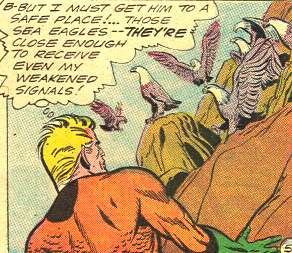
Okay, so in this story from World’s Finest #137 (Nov. 1963), both Aquaman and his young companion Aqualad are stricken by mysterious fumes that cause them to be weakened, rather than strengthened, when they are in the water. Aquaman has to go to Aqualad’s rescue, but he’s too weak, and too far away from the sea, to command some nearby fish to help. However, there is another sea creature of sorts nearby:


That almost seems like stretching the definition of “sea life” a bit…at least, considering the types of sea life with which Aquaman usually communicates. But I’d be willing to let that slide…

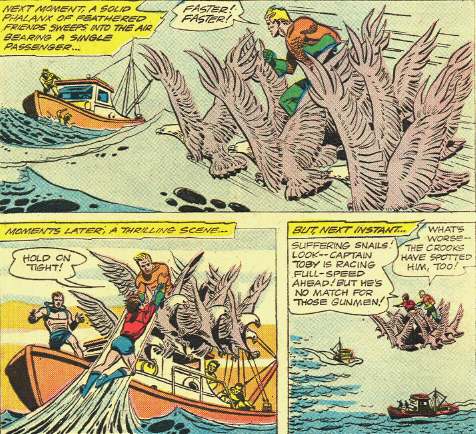
…Except I’m totally going to have to call “no way” on this sequence :


At most, Aquaman has two load-bearing eagles keeping him aloft, as I don’t believe the other eagles in this grouping would be able to get close enough to provide enough direct support and/or lift to handle Aquaman’s weight. Plus, it would seem as if Aquaman would continually be smacked in the face, sides, and, um, other body parts, by the flapping wings, which would be painful, or at least annoying for him, not to mention how that would interfere with the eagle’s ability to fly effectively. And I have my doubts that this group of five or six sea eagles, as powerful fliers as they are, would be able to handle Aquaman hauling a sopping wet kid-sized load out of the ocean, even briefly.

This is what I think about, when we’re having a slow Sunday afternoon at the shop.


In other news:

  • Sunday morning, I was interviewed by the darling Dafna and the cacophonic Kid Chris for their Bispectacult podcast. It went well, it was a lot of fun, and even though my very first response to a question didn’t come out in any kind of recognizable English (I believe the correct term is “word salad”), after that things went swimmingly. We were silly, we had a good time, we couldn’t keep ourselves on any topic for very long, aside from discussing the greatness of the movie Roadhouse.

    So, even as you read this, Kid Chris is feverishly working away at the post-production of the interview, and it should be up on their site in a couple of days. It’ll teach you nothing, you won’t be a better person for it, but maybe you’ll get a good laugh or two out of it. Hopefully “with me,” not “at me.”

  • A few days ago, I wondered if the printing error in the DC Universe: Stories of Alan Moore trade paperback had been corrected. (Briefly: the text intro to “Whatever Happened to the Man of Tomorrow?” was omitted.)

    In response to the more recent post, commenter Carl told me that a copy he flipped through at a major chain bookstore appeared to have the error corrected. So, one reorder placed through Diamond later…I can indeed confirm the book is on its second printing, and the text intro to the Superman story is back in its rightful place at the top of the splash page.

    The Killing Joke endpapers are still AWOL, however.

  • Harry Knowles of Ain’t It Cool News — once seen, it cannot be unseen:


    And yes, the text tag in that video refers to Harry’s marriage yesterday. Details, of sorts, can be found here (along with the video you just endured above). Congratulations to the happy couple.

Sorry, this domain is not for sale.

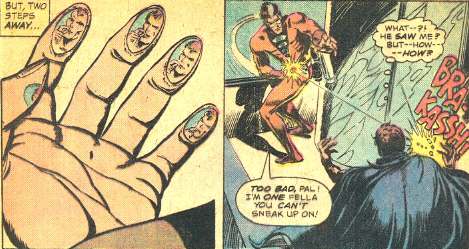
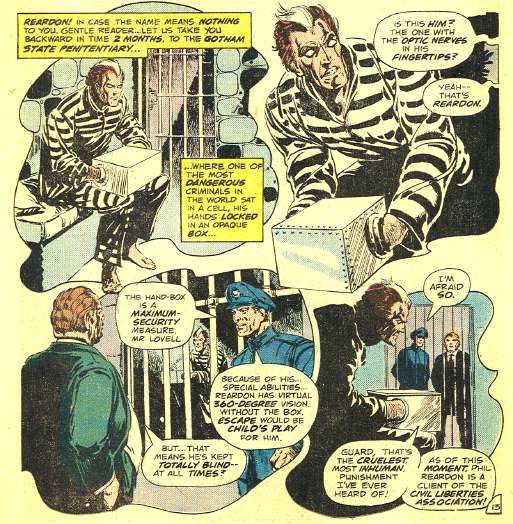
from Man-Bat #2 (Feb-Mar 1976) by Martin Pasko, Pablo Marcos & R. Villamonte


Three things the Ten-Eyed Man doesn’t like to do:

1. Pick his nose.

2. Thumbwrestle with the Ten-Penised Man.

3. Wipe.


Found on the eBay:

“ADAM West Signed Check BATMAN ZAP POW BAM….* REAL *”

“Authentic Autographed Check with original signature of Adam West best known as BATMAN…… Check is in very good condition with normal bank markings and cancellations. Check is from 1981 and payable to State Farm . It is boldly signed in Blue Ink.”

“BOLDY.” Take that, evildoers.


We got a couple Marvel key books in a collection the other day that we hadn’t had in the shop for a while: Giant-Size X-Men #1, introducing the new team, and it was all downhill from there; and Amazing Spider-Man #129, featuring the first appearance of the Punisher. I only mention them here because 1) in the case of the X-Men, I felt like being a smartass, and 2) the ASM #129 reminded me of the huge crash in popularity of the Punisher from the mid-’90s. That crash can probably be tied to the general comics market crash of about the same time, at least as a symptom of the overall damage being done to the marketplace. It wasn’t just that sales were dropping across the board, but that once popular characters were being outright rejected by the still-remaining fanbase. Just plain character burnout? A conscious (or even subconscious) realization of the usage of said character, as a sales-bumping guest-star, being part of the market’s poor health?

There’s probably an overlong, confusingly-written essay in me on that very topic, but that’s for another day, I think. No, I just wanted to bring up a brief flash of memory from that middle period of the 1990s, when we had a stack of Amazing Spider-Man #129s all priced up and sittin’ pretty in our big ol’ glass case, just waiting for a Punisher fan with a few bills in his or her pocket to wander by and make a purchase.

Used to be, in the Good Old Days, we could turn over ASM #129s day in and day out. We had people hounding us for them constantly. Almost as soon as we got one in, it went away. And we were buying and selling them all the time. Seemed like every other collection we bought had one of those in it.

Then we ended up with a small stack of them. About half a dozen. Varying conditions. We thought “Wow, those will be gone in no time!”

Then no time passed. Then some time passed. Then a lot of time passed, and there they were, still in the case. The bloom was off the tree on the other side of the fence leading a horse, or something like that, and suddenly we went from having “1ST APPEARANCE OF THE PUNISHER WOO HOO” to “Do you have any cheaper copies of #129? I’m just trying to fill my Spider-Man run.”

And that’s how, with tears in our eyes and Shadowhawks in our quarter boxes, we ended up slashing the prices on those ASM #129s in order to move them out.

‘Course, now, what with a revived interest in the Punisher character, and increased demand for ’70s Amazing Spider-Man comics, we could have sold those ASM #129s for much more than we had them originally marked at the time, but What Can You Do? You can’t sit on everything, thinking its time will come again, or even come a first time.


No, really, this domain is NOT FOR SALE. I will, however, happily accept sponsors. “CAMEL CIGARETTES, HALLIBURTON, STARBUCKS, MARVEL COMICS, WALMART, THE RIAA, AND CHRIS SIMS PROUDLY PRESENT MIKE STERLING’S PROGRESSIVE RUIN.”

Oh, the possibilities. Brings a tear to your eye, doesn’t it? And if you were the Ten-Eyed Man, you’d be weeping from your fingers like nobody’s business, I bet.

"This is not war…this is pest control!"

I don’t have much of a post at the moment, as I was busy catching up on the Doctor Who DVDs. And is there a better scene in season two than the Cybermen and the Daleks totally ranking on each other?


I submit, sir, that there is not.

Yes, I realize I’m, like, a year behind everyone else on the show. Don’t rub it in.


My completely mean-spirited and unfair exchange with Employee Jeff, as he was preparing to move some of our infrequently-accessed comic stock in the stockroom to somewhere out of the way, to make room for more in-demand material:

Employee Jeff: “Hey, is it okay if I move the Gambit comics to the top shelves? I need the space for these other X-books.”

Me: “Yeah, go ahead. No one cares about Gambit.”

Jeff: “Oooooh…don’t let the Gambit fans hear you say that!”

Me: “No worries…Gambit fans are weak and ungainly, and pose no threat.”

And then we laughed and laughed at Gambit and his fans, for we are cruel and heartless. And then I wept openly, for I realized this is all I have.


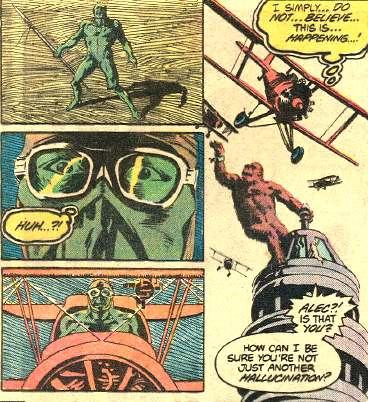
And now, for no good reason…Swamp Thing in a biplane:

from Saga of the Swamp Thing #8 (Dec. 1982) by Marty Pasko & Tom Yeates

Comics, not comics, and Half-Minute Mikester #1.


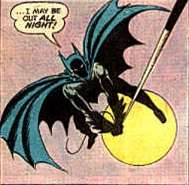
So a few folks were intrigued by the Steve Ditko Man-Bat comic advertised in that post of mine from yesterday. The most interesting thing about that very short-lived series (aside from an appearance of the Ten-Eyed Man, as my commenters noted) is that the first issue features a rare, if not solitary, example of Ditko drawing Batman.

I don’t own any of the Man-Bat funnybooks myself, and I was in kind of a rush to get out of the store last night (had to go buy drywall screw anchors — it was vital) so I forgot to grab a copy of #1 from the store stock for some choice scanning.

Luckily this fine fellow also found Man-Bat worthy of examination, and presents a couple pages from that issue. The above image was taken from one of those scans…makes me wish Ditko had drawn more Batman in his career. What an interesting presentation for the character.


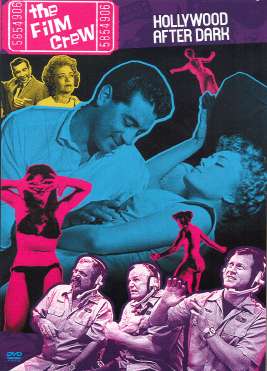
Nothing to do with comics, but as a longtime Mystery Science Theatre 3000 fan I wanted to point out this new DVD release of The Film Crew: Hollywood After Dark. The premise of this DVD series is that Kevin Murphy, Bill Corbett, and Mike Nelson (who played “Tom Servo,” “Crow T. Robot,” and “Mike Nelson” on MST3K) have been hired by an eccentric billionaire to provide commentary tracks for films that otherwise lack them…and, of course, the films are appallingly awful, giving the three guys plenty of opportunity to crack wise and/or groan in horror.

And, having watched it, I can tell you…when the movie is playing, and Kevin, Bill, and Mike are in full swing, it’s like MST3K (Sci-Fi Channel era, anyway) is alive again. There’s no visible silhouette of seats and the three guys watching the movie, but in an odd way that evokes the MST feeling a little more by not constantly presenting three guys instead of one guy and two robot puppets. The jokes are just as funny, if a little racier at times, and the sketches…well, there is a half-time “lunch break” where the guys leave the theatre and have a lunchtime meeting, and some bookending material, and if you didn’t like the out-of-the-theatre shenanigans from MST3K, you probably won’t like the sketches here either. I thought they were amusing, though it was a little disconcerting hearing Crow’s voice come out of Bill Corbett’s body. I can’t really match the two up, for some reason.

Also, at the end of the presentation there’s a 2005 copyright date, and if that’s not a mistake, then this particular Film Crew installment has sat on a shelf somewhere for a couple years. Huh.

But overall, a lot of fun, and a welcome return (of sorts) to the format of one of my favorite and much missed TV shows. If you buy the Film Crew: Hollywood After Dark DVD through this link, I think pal Dorian will get a little scratch from it, if I’ve got it set up right. I should set up an Amazon link for myself, someday, but in the meantime let Dor reap the benefits of my laziness.

Plus, my DVD came with a Film Crew patch:


Hey, neat!

(For the sake of completeness, I should note Rifftrax, where you can buy inexpensive and hilarious downloadable commentary tracks by Mike Nelson for big-budget Hollywood films and TV shows. Mike is often accompanied by the aforementioned Kevin, and Bill’s been known to put in an appearance or two. As has noted MSTie Neil Patrick Harris.)

(Sorry, went on a bit about this. Hey, we’re all fanboys about something.)


Because no one stopped me…Half-Minute Mikester #1:


Okay, a few things:

1. This is what I’m talking about, re: Justice Society.

2. That’s my laundry room, not the bathroom, wiseguy. But, that said, I think I know where the next Half-Minute Mikester is being shot.

3. Yeah, there’s a wee bit of an echo.

4. I sound a little tired and monotone-ish…I guess installing those drywall screw anchors took a lot out of me.

5. God, I missed Nexus.