Please don’t write in about the Starlog thing.

So the other day, on some streaming app or ‘nothing, I watched, for the first time in a very long time, two episodes of the late ’70s/early ’80s sitcom Mork and Mindy, starring Robin Williams and Pam Dawber. I think, actually, this may have been the first time I’d watched full episodes of the show since it originally aired. Oh, I’ve seen bits and pieces and clips and such since then, but watching one from beginning to end? It’d been a while.

But here’s the thing about Mork and Mindy. There was a particular magazine that I bought (or cajoled my parents into buying for me) early in the show’s airing that has stuck in my mind for decades after it was discarded in whatever cleaning incident took its life. You know the phrase “living rent-free in my head?” Well, it was this magazine, doing so for so many years. (I told my girlfriend about the “being stuck in my head” thing, and she responded “poor magazine,” which, well, yeah.)

Not sure why the memory of this specific mag was trapped in my RAM and not shunted away to the tape-drive back-up. The cover remained lodged there, and I could only recall one specific article.

Oh, the mag in questions: Cracked Collectors’ Edition #29 (May 1979):
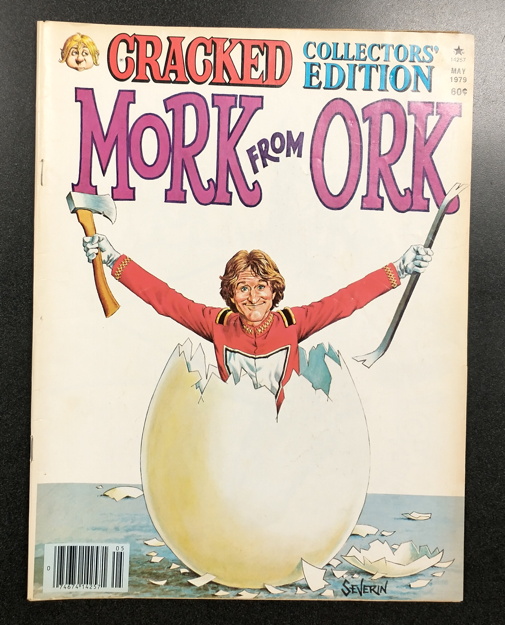

Inspired in part by the recent viewing of the television show, coupled with the fact the mag had been nagging at my mind for so long, I dipping into eBay’s waters and fished one out.

The cover is, of course, by John Severin. A master caricaturist, it seemed he could draw any real person from any angle, still have it look like them, make them “act” on the page, and it never once made you think “look at that photo reference.” Cracked may have been the mag you picked up if there wasn’t a new Mad out yet, but by God Cracked had John Severin and Mad didn’t, so big points in its favor there.

Which isn’t to say Cracked didn’t have other fine cartoonists in their stable, because of course they did. And plenty of hem worked on this very magazine. It’s just…well, where Cracked maybe fell down a bit, especially in this example, is forgetting the “parody/satire” part of the satirical genre of which the mag was supposedly a part.

Admittedly, it’s tricky, particularly with something like Mork and Mindy, a deliberately wild and silly show. Trying to come at it with a parodic or satirical take would require using some form of humorous perspective sufficiently transformative to be seen as a commentary on the source material, versus just as extension of it.

That is this issue of Cracked in a nutshell. It’s not satirical. It feels like an official fan magazine at times, an unauthorized tie-in to the TV show. So much so that I actually checked the copyright section to see if it had been actually commissioned by the folks behind the show. A lot of the humor is simply “here are some Mork-style jokes we’ve written,” such as having a “reader’s” letters page with answers in the Mork-voice:
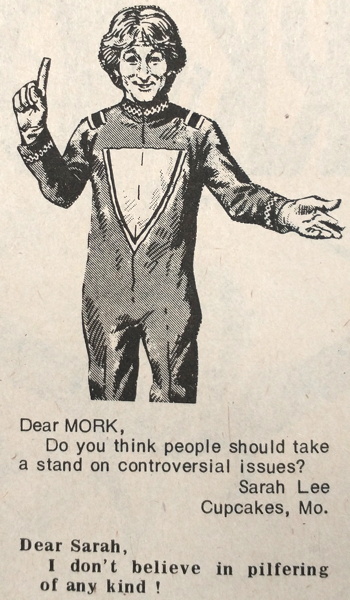

…surrounded with many of Severin’s illos of Mork and the cast to make sure you know who the mag’s about.

And then there’s this article defining words from Mork’s home planet:
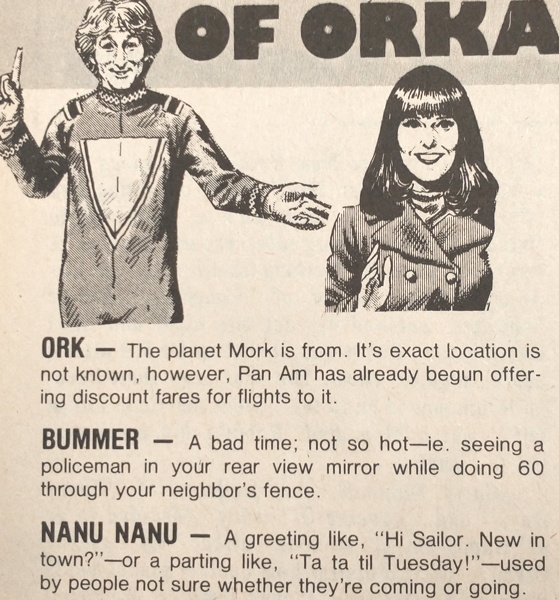
Plus some gag pages about life on the planet Ork, and a look at Mork’s boyhood:
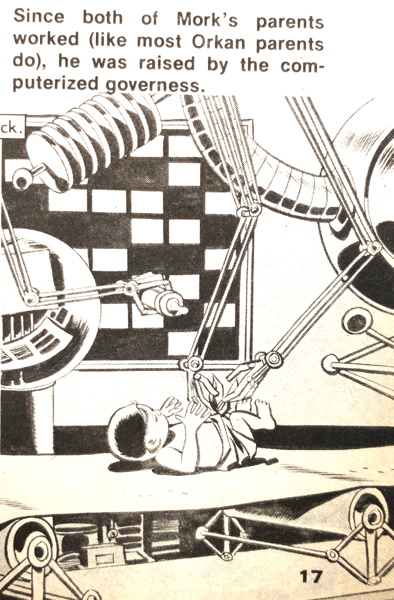

…which is strictly non-canon, of course, given the revelation in season 4 that Mork’s people are born old (in eggs) and age backwards. NON-CANON, DANG IT.

And really, none of this functions as any form of commentary on the show. It’s all either explanatory (like the glossary of terms) or Expanded Universe/fan-fiction-y (like Mork’s childhood). There’s a feature on “What If Other Actors Played Mork” with stills from movies and TV shows giving in-context Mork-style jokes. (Or “jokes” – one of which is a cowboy, just shot, being given the dialogue “that hurts, get me out of here, Orson! “which…what?) I suppose that’s…parody-ish, maybe?

Again, there’s nice art in this…Cracked never skimped on the funny drawings, at least back when I was reading. And that specific article I remembered all these years that I mentioned up front? “…All Seriousness Aside,” a text biography of Robin Williams (with a nice big photo of him accompanying it). Of everything inside the mag, the one that stayed with me was not comics. Go figure. I think part of it is that the title puzzled me, as a sometimes chowderheaded 10-year-old that I was. “‘All Seriousness Aside?’ Shouldn’t that mean that they put all the seriousness away and that this biography should be funny?” …As I said, chowderheaded.

I presume Cracked being recognized as part of the same school of satire as Mad Magazine is what kept any ceases-and-desists away in cases like this, where the “take-off” is barely distinguishable from licensed product. And frankly, Cracked rode that Mork and Mindy train hard. Just like they did Happy Days and the Fonz. And Star Wars. And Diff’rent Strokes. Boy, did they love Diff’rent Strokes. There was lots of Mork content in the regular mag, and there was even a second special like this one featuring all-Mork, all the time.

I don’t know if any of the other Mork articles in other issues were more along the lines of real satire. I know I had this issue as a kid, and I feel like maybe this might have made more of an attempt at poking humorous fun at the concept rather than write for it, y’know?

Mostly I think I was just surprised at how…low effort the humor was. I’d expected it to be more like Mad, but it was basically, I don’t know, Starlog.

At least it’s all nicely drawn. And overall…it’s not so bad if you take it for what it is: an exploitative fad-riding cash-grab, presenting a topic under the guise of satire but not really saying anything about it.

And before you say anything…I just noticed they used the same drawing of Mork in two of the pics posted above. Sigh.

In which I spend an overwrought paragraph explaining to readers of a comics blog how “comic collecting” works.

So I was processing a few books I acquired from a collection on Thursday, and one of them was New Teen Titans #36 from 1987:


It has an October cover date, but according to this page it was out late June, so I’d just graduated high school, was about to start college, and was still a year away from entering the world of comics retail in which I am still fully ensnared.

I’d bought a copy of this issue of the rack at the time, most likely from my future place of employment. I’d come somewhat late to the New Teen Titans, the first issue of which I’d bought being around #27 or so of the initial series, where they’re fighting Brother Blood. I continued to read it after that, going into the bins for back issues (again, from my then-future place of employment) and picking up the new ones as they were released. Even rode out the whole “hardcover/softcover” transition was the series was weaned away from newsstand sales and put firmly into the Direct Market of comical-book shops.

What I’m telling you is that I read New Teen Titans for a while. Big fan, thought it was great. Still think it’s great, even if, like mentioned in our discussion of Crisis on Infinite Earths, the art was usually beautiful (primarily by George Perez, but some of the other artists weren’t too shabby either), and the writing was…certainly of its time, but still readable. It was a Fun Book, essential reading if you were a DC fan (just as Uncanny X-Men was required if you were a Marvel fan). (Or hell, if you were just a comics fan, you probably read both.)

But when issue #36 came out…I mean, I bought it, I took it home, I read it. The more I thought about that cover, however, the more I came to believe it was, I don’t know, insulting my intelligence somehow. Like I saw the “IT FINALLY HAPPENS! STARFIRE KILLS” blurb for the somewhat tasteless pandering it was. I just plain didn’t like this cover, that blurb, and it put me off so much that I dropped the comic. (For a while, more on that in a second.)

I’m sure there was more to it than just a dumb cover blurb. While, as I said, many of the artists who came after Perez on the title were perfectly fine and enjoyable, they were usually in service to stories and scripts that just didn’t grab me. I don’t know if it was me, just having read enough Teen Titans for the time being, or if maybe without the magic partnership with Perez, Marv Wolfman’s storytelling was not quite as inspired, making the book no longer as compelling and vital as it once had been.

Ultimately, it was likely a combination of factors that caused me to drop New Teen Titans. It’s that blurb, though, that sticks with me, the marketing straw that broke this collector’s…long box? Sorry, the metaphor got away from me, but regardless, it’s just one example of how attrition occurs on longish-running titles, for on what the surface may be a nitpicky reason that serves as a blanket excuse covering the myriad of other issues involved in the decision.

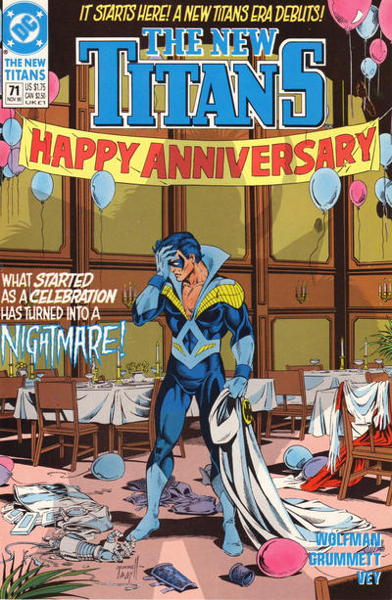
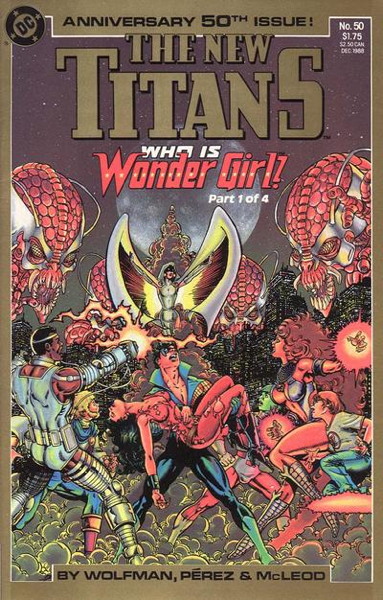
And what did I say above about coming back? Why, yes, I eventually did…I skipped that whole brouhaha between 37 and 49 and popped back in when Perez returned for the revised origin of Donna Troy beginning in #50:

…and looking at this pic reminds me of how the gold ink on this cover never looked shiny and clean, even new off the shelf. Just…”give me your most dingy gold ink, my good man” said DC at the printer, and they were happy to oblige. But cover coloring aside, the story was…fine, a new convoluted revision to the ever-revising Donna Troy origin. As soon as it was over, I was off the book ’til 1990 and the release of issue #71:


…because I’m a sucker for extree-sized anniversary issues, and also because I do like the Titans and wanted to give it another shot.

And I picked a good time to start up again because hoo boy it felt like Marv Wolfman found his second wind on the title. It was a leaner, more exciting ride, aided and abetted by some of Tom Grummett’s best artwork, and it just kinda steamrolled along for a while. Surprises in each issue, no character felt safe, cliffhangers galore…the book had a manic energy to it that was just carried you along. For a while there New Titans was one of my favorite series.

Eventually everything peaked and the book settled back down to a more normal pace…still good and perfectly enjoyable, and I hung on ’til #100 (another extra-sized anniversary issue) and that, as it turned out, was my Teen Titans saturation point. When the long-awaited graphic novel Games was finally released in…was it really 2011? That late? Anyway, when it came out, as intrigued as I was at reading another Wolfman/Perez comic, and I had the book in my hands, looking at the front and back covers and thinking about it hard, I ended up not delving back into that world.

I did give my Titans run a reread about a decade or so ago, enjoying what would turn out to be a final run through the book before I opened my own shop in 2014 and gave up all my copies to fill back issue stock. It was a Good Comic, fun and exciting and dopey and beautiful and melodramatic and compelling in all the right quantities and I’m glad I read it. Even if I’m occasionally reminded of why I didn’t like it sometimes, as per that cover at the top of the post.

Occasionally I think about getting one of the many reprints of at least the early Wolfman/Perez issues, to have them on nice paper for future perusal (especially since on my last reread I noticed the paper and printing in the original comics having not really aged well). Honestly, though, I don’t know if I’d make the time to go back to read them, particularly at the moment when I’m still catching up on a backlog of comics. But it’s good to know it’s being preserved, and not just forgotten in the dusty back issue bins of comic book stores.

Now the Teen Titans cartoons? Those are great, too, but that perhaps is for another post.

A correction and a couple o’comics.

So to add to my Superman: Birthright discussion on Monday, the writer of said book, Mark Waid himself, dropped on by to clarify/correct some of my assumptions. Primarily, that Birthright was indeed intended to be the new “official” Superman origin, but was eventually decided that yet another version, the Geoff Johns/Gary Frank Secret Origin mini, would be the new official origin instead. Least ’til, you know, they changed it again.

Anyway, here’s a period article with an interview with Mr. Waid about Birthright being the “official” origin, which was declared so late in the run due to the Super-books being “still somewhat in flux” when the series began. While I was correct in that the state of Superman’s history at that point was a bit mushy and open to revision, as I said in my last post, my assumption that Birthright was a planned out-of-continuity story that eventually ended up in continuity despite itself was incorrect.

So, when you reread that last post of mine, disregard my poor use of Birthright as an example for my thesis. I think my overall entry there is correct, in that if you leave any ambiguity to the canonicity of a story involving DC or Marvel characters in what appears to be their familiar milieus, the default position of a certain subset of fandom regarding that story is that it’s part of official continuity. And that the emphasis, especially by DC, on continually trying to establish what is their official continuity only encourages the behavior.

Not all fans do this, of course, but like I said, I’m still getting customers asking me if Three Jokers is, you know, Real Joker History and, well, what can you do. “It is if you want it to be!” I’ve answered more than once, and I don’t know if that helps, really.

Okay, let me say something about a couple of comics that came out this week:


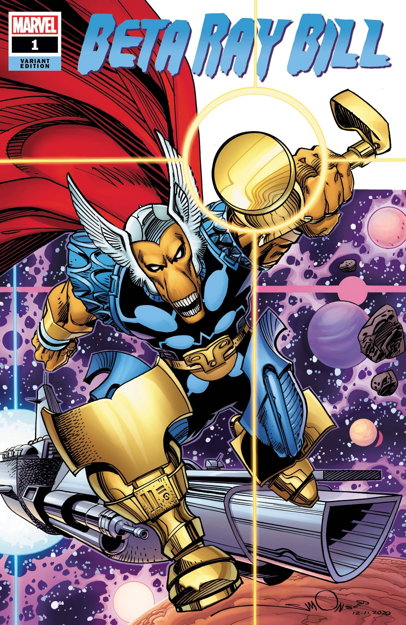
I didn’t keep the cover pictured above…this is one of those “retailer incentive variants” that I have to order a certain number of the regular covers in order to receive. But you think I’m gonna pass up posting a kickass Beta Ray Bill pic by his creator, Walt Simonson, on my site? Heck no.

Anyway, the entirety of my Thor reading is as follows: the Walt Simonson run from #337 to #382 (plus the couple of fill-in issues in that run, which were also great), whatever stories were in the Origins of Marvel Comics books, and the Lee/Kirby “Search for Galactus” issues that pal Cully let me borrow once. Nothing against Thor, and I know some later runs of Thor are very highly regarded, but my brain decided “That’s All The Thor I Need” and that was that, I guess.

When I opened my own shop a few years ago, I gave up my Thors (not Cully’s Thors, I returned ’em, honest) to the back issue bins, which was a good idea because boy did they sell well. As they should, because they’re beautiful and perfect, but “Fanboy Mike” is a tad annoyed at “Retailer Mike” as I kind of miss having those. But hey, I figured at the time I could always pick ’em up in reprints one way or another.

So basically I haven’t been involved in Thor comics for a while. Then why pick up Beta Ray Bill #1? Well, the work of Daniel Warren Johnson for one, who is writing and drawing this book and it looks fantastic. I’m not one for two-page spreads in comics nowaways, but Mr. Johnson throws in a couple of them in this issue and I know I really like a comic when that doesn’t bug me in the slightest. It all feels like a natural extension of Simonson’s rendition of the character without being an imitation of his style, in a way that previous efforts with the Beta Ray Bill have not.

As someone who, as I just told you, hasn’t been immersed in recent Thor comic shenanigans, there wasn’t a steep learning curve for getting caught up to speed on recent Asgardian events. Johnson does a good job naturally slipping in the necessary exposition to establish the world of the book and the premise for the series.

Yes, it is, nominally, a tie-in to the “King in Black” event currently happened at Marvel, but it barely counts, a “Red Skies” type of crossover where a Surprise Guest Monster shows up to wreak havoc in Asgard and oh, he’s all King in BLack-ized or whatever they call it. Could easily just have been Special Surprise Guest Monster all on his lonesome and the effect on the plot wouldn’t have been any different, really. But if it gets more eyeballs on the comic, then we shall let this pious fraud pass.

What I’m saying is that Beta Ray Bill is just as good as I’d hoped it would be, since seeing preview pages a while back. As someone actively not looking to pick up new series right now due to my immense funnybook backlog caused by eyeball issues, I snatched this one up with no regrets.


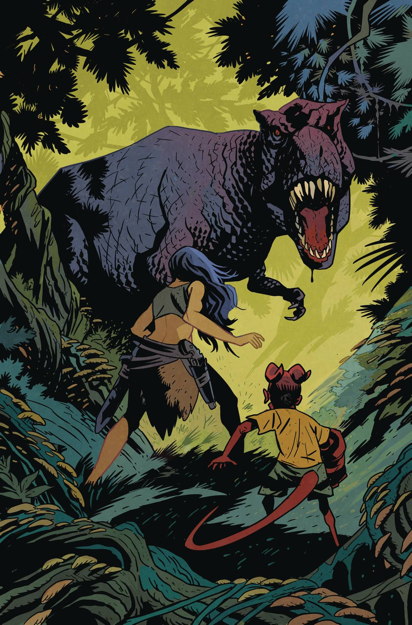
Young Hellboy is a fun, cute series, the second issue of which is out this week. Young Hellboy runs into a Golden Age-style jungle girl on a mysterious island, and seeing HB as an overly talkative, hyperactive child is always entertaining. With the forward motion on the “current” Hellboy timeline effectively ended with, um, the end of the world, it’s nice that we’re still getting “flashback” Hellboy stories. “Hellboy may be dead but his cash flow lives on,” as the Dead Milkmen said (slightly paraphrased). Even knowing the eventual end point for the Hellboy Universe, the sense of impending doom doesn’t weigh too heavily upon these stories…I mean, not that particular doom, anyway.

It’s a nice reminder of what Hellboy was, back before the plot overtook the premise and everything was pointing to The End, versus just the big red guy smacking monsters around and shooting (badly) at demonic foes. Or, as in this series, swinging on a vine and shouting with glee. As I said, fun and cute.

Daniel’s Progressive Ruin.

Unlike my hope at the end of the last post addressing Daniel’s comment about DC and the rebooting and the continuities, I do in fact have yet another early morning appointment waiting for me as I write this the night before it. I believe that’s the last of said appointments for a while, the timing of which is unfortunately a necessity when one has a seven-day-a-week job. So let me be quick like the bunny in these responses:

“For me, the DC characters are strongest when theyโ€™re in a perpetual state of reboot and/or Elseworlds variations. Seeing a young Batman meet the Joker for the first time in stylistically and narratively different ways each time is infinitely more interesting to me than seeing 80-year-continuity Batman meet the Joker for the 368th time in their ongoing history.”

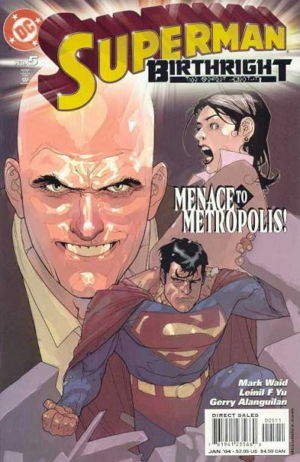
Nearly, urgh, 20 years ago, the mini-series Superman: Birthright by Mark Waid, Leinil Yu and Gerry Alanguilan was released, retelling the early years of Superman’s life. It wasn’t intended to be part of regular continuity; rather, just a fresh interpretation of Superman’s origin by a talented creative team, unburdened by the need to be tied to anything else DC was doing with the character.
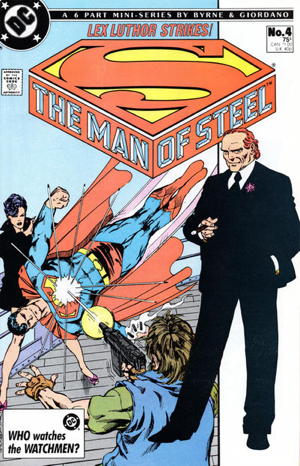
I suppose what happened was that the story told in Birthright wasn’t distinct enough from mainline continuity…not branded “Elseworlds” or whatever. Not the fault of the creative team, of course, but the Superman story post-Crisis and post-Zero Hour had perhaps become nebulous enough, and distant enough from the mid-1980s John Byrne reboot, that Birthright somehow came to be considered part of the “official” origin. I believe it was this story that reintroduced the Silver Age-y idea of Lex Luthor living in Smallville when he was young, effectively de-aging the Byrne version (who’d already been de-aged via clone/deal with Neron shenanigans that I’m not going into here) from being decades older than Clark Kent to maybe only being a few years, at most.

EDIT: Please check the comments for some clarification from Mr. Waid his own self.

Daniel, I think ideally, for the purposes of DC’s maintenance of a superhero universe, having the “in-continuity” stories is fine. And your idea of having varied tellings and retellings of stories featuring the characters that don’t have to be shoehorned into that continuity is great. Does Batman: Three Jokers fit into the official, current Batman history? Will it ever be referenced outside of a Three Jokers sequel? Probably not. I know I spent a couple of posts picking at the continuity details of this story, but, really, ultimately, it doesn’t matter. It’s a standalone story you can enjoy (or not enjoy, as the case may be) as in-continuity, if you’d like, or outside of it.

Part of the problem is that DC’s constant obsession with “fixing the universe” in most of their Big Events reemphasizes the idea that Continuity Matters, that all the pieces need to fit and be consistent. So when stuff like Birthright and Three Jokers come along, which (at least in the former, can’t say for sure about the latter) aren’t intended to be part of regular continuity but aren’t immediately identifiable as being separate from it, the readers can get it into their heads that they’re supposed to consider these stories are part of the Official Big Picture. I mean, if Batman’s not, like, a pirate in the story, or Superman’s rocket didn’t land in Norway, which is what DC has essentially trained its readership to look for when considering if a story is, biggest quotation marks ever, “real” or not.
Look, I know most people aren’t worried to this extent about their comic book stories. I read (and am still reading) the Superman comics from the Byrne reboot ’til today, and I can draw a more or less unbroken line from what happened then to what’s going on now. Is everything entirely consistent? No, of course not…it wasn’t even before the whole Flashpoint/New 52/Rebirth hoohar. Does that bother me? Nah, not really. I tend to go on about some of the inconsistencies here on this site, but more out of amusement than outrage. As a wise philosopher once almost said, “it’s just a [comic book], I should really just relax.”

In short, if I can ever be short, DC has its readership used to the idea that continuity is paramount, and therefore every story has to “count.” Thus, doing stories that aren’t necessarily in continuity can become difficult to distinguish as such unless they contain gimmicks that decidedly make them outside the main storylines. Thus, anyone really bothered by this sort of thing, which isn’t everybody, I know, but it ain’t zero people, can find things to be confusing.

“And I think that this is part of DCโ€™s brand management problem. I believe that there are just as many people like me who love the excitement and variation of reboots as there are people who prefer (and want to perpetuate) the never-ending 80-year soap opera. And any attempt to go in one direction or the other will inevitably alienate the other audience.”

I know DC has been messing with branding logos on their comics to identify which “family” their books are in, with a general “DC Universe” for those without specific categories. Maybe a general icon that means “YES, THIS IS IN WHATEVER OUR CONTINUITY IS NOW.” Which is its own problem, because then maybe people wouldn’t buy the one-offs and minis without the logo because they’re outside continuity? You see the difficulty. I think just ending the Big Event reboots, and changing things as necessary in the comics as time goes on, without making a big deal out of it, is the best solution. If DC stops making such a big deal out of continuity, maybe readers will too. Well, some readers, anyway. I’ve been at this too long, I know better.

I don’t know. I think folks should just read the stories they like and if they want to think some story is or is not part of the larger picture, then go to town, friend. In my personal head canon, those stories where Alec Holland’s brother “cures” Alec, followed by Swamp Thing teaming up with the Challengers of the Unknown and Deadman are all still part of the character’s history, and nobody’s gonna tell me different.

We interrupt this program with an important bulletin.

Well, hoo boy, more big news for the comics business as Marvel signs an exclusive deal with Penguin Random House to distribute their comics and books an’ stuff, beginning in October.

Diamond Comics, the distributor that’s had the exclusive distribution rights for nearly three decades, has announced that they’ll still be carrying Marvel product as before, if retailers prefer continuing to buy from them. However, Diamond would be essentially just be a large customer of Penguin Random House and reselling to stores, likely meaning an adjustment in discounts, and I’ve no idea what the timing will be like. Would Diamond get them early enough to redistribute the books to retailers in time for New Comics Day? Or will that point be moot if Marvel follows DC’s lead and picks another day of the week to be NCBD?

From what I’ve read, PRH, which I’m condensing it to because I’m already tired of typing it out, will offer a standard 50% discount to retailers on new product, which is less than what I’m getting from Diamond. However, PRH will also be offering free shipping, and no reorder fees, so that more or less balances out.

In addition, the ugly truth is that I expect shortages and damages to be reduced as well, which I’d gladly give up a percentage point or two in wholesale discount terms in exchange for product showing up on time and in sellable condition. My DC shipments from their new distributor, Lunar, have been virtually error-free…if I’ve reported more than a half-dozen problems total since receiving shipments from them last year, I’d be shocked. And it’s almost always “you sent me 49 instead of 50 copies,” that sort of thing. Only once did I have a significant issue (all my standard cover copies of Future State: Harley Quinn #1 got missed, but replaced right away).

By comparison, I’ve had problems with my Diamond shipments nearly every week. There are the minor mess-ups, like a book or two getting damaged in packing or in transit, which happens. But there are the times when books get missed entirely and I have to wait a week (usually) or two to three weeks (ugh, sometimes) for replacements. And more than once in the last few weeks, sometimes replacements can’t be found and I just get credit, meaning I’m off to eBay or other stores to beg for copies. Or buying directly from the publisher (like I had to with a recent issue of Taarna), which makes me wonder why I can do that and my distributor can’t. And God help you if that book you’re trying to replace on your own is The Random Hot Book of the Week As Decided by Speculators, like that Daredevil #26 I never got that was going for $20 a pop on eBay.

Now, I can only imagine the stress caused by the combination of massive amounts of product and whatever effects COVID has had on the processing/packing end of things. I need to be more understanding, but at the same time it’s a real pain to be invoiced for things you can’t sell. Maybe fewer Marvels passing through the system will ease the load and improve fulfillment? Or will the loss of that income keep us exactly where we’re at? I don’t know.

I know I can gripe about Diamond a bit, especially when something inexplicable (uh, just a single Comic Shop News instead of the full bundle?) or gross (is that a piece of chewed-up gum in this box?) happens. But honestly most of the time I’ve had a good relationship with them and they’ve treated me well, and on occasions when I’ve been especially screwed (like that time half my boxes disappeared in transit) they got replacements out to me within a couple of days.

Basically, I don’t want them to go away. But I am okay with having more competition in the distribution side of things, which, with any luck, will improve everyone’s service. Yes, that means more bills to keep track of, and more order forms to fill out, but it beats digging ditches (apologies to any ditch-diggers reading this who love their jobs). It also means learning a new online ordering portal, I’m sure (Lunar’s took a bit to get whipped into shape, and even still has a bit to go).

The competitive stakes are especially high on Diamond’s part, as some of their biggest remaining clients (like Dark Horse, IDW, and Archie) also have preexisting relationships with PRH. It probably wouldn’t take much for them to slide their product lines over from one company to another.

So we shall see what results from all this brouhaha. It’d be nice if PRH could somehow get Marvel to tamp down the #1 relaunches and variant covers. That’d get everyone celebrating.

“Let me expound on that for a moment” — the worst words you can ever hear from me.

So once again your pal Mike has an early morning meeting awaiting him, so I’m going to most just respond to Daniel’s comment from way-back-when today, as it is a very good commentary on continual rebootery vs. consistency’s hobgoblins.

Daniel thus spake

“Not sure if Iโ€™m in the minority or not, but I loved Crisis and (more importantly) the post-Crisis rebooted universe. I generally really liked a lot of the early New 52 reboot (until it became clear about six to eight months in that there really wasnโ€™t much of a central plan to the reboot and that they hadnโ€™t really learned anything from the mistakes of the post-Crisis universe). I like new beginnings. I like when things start over from ground zero.”

I honestly don’t think you’re in the minority at all in loving Crisis and the shenanigans that followed. I know there’s been a lot of knocking of Crisis in these here parts over the last week or so, but I started off saying that I unabashedly love the series, even as I’m aware of the storytelling shortcomings and the very much “ya hadda be there” requirement for the proper impact. I do love the series, I treasure that fancy slipcase edition from when it was first collected. Unlike most “important” event series, it actually Was Important, restructuring not only a publisher’s entire storytelling strategy but still influencing the industry in various ways several decades later.

And the New 52 was exciting, and maybe even a little frightening in a way…”what the hell is DC thinking,” that sort of thing. As you note, the excitement gave way to…what’s the right word? Dismay? Chagrin? Confusion, maybe? The apparently rushed nature of this restructuring became evident, and as the cancellations and the relaunches-of-the-relaunches started to hit and the flopsweat starting pouring from DC’s publishing plans, what was an immense hit became an progressing series of special events and an increasing reliance on variant covers to shore up sales.

I always feel like I have to note “but there were still good comics coming out from them” and there were, but the desperation of the gimmicky marketing was obvious.

“I like hard reboots. I like Elseworlds. I like the Burton-verse and the Nolan-verse and the Snyder-verse. I like getting into stories from the very beginning. I like variations on retelling the beginnings of these characters and seeing those retellings play out differently each time.

“The lesson of Crisis and the post-Crisis reboot is that these characters have finite potential. To my mind, attempting to perpetuate an ongoing, unending mega-continuity is doomed to fail. You can only have Joker escape from Arkham so many times before it becomes banal and loses narrative credibility.”

Different interpretations of your favorite characters by a wide range of creators is part of the charm of superhero comics and their spinoff media. There’s an appeal to getting in on the ground floor of things and trying to follow along and keep up with this fictional milieu as it builds up around you (though disappoint threatens when the publisher seems less devoted to the concept than you are — see again the New 52). I often get kids who pull a #3 of something off the shelf and immediately ask for #1 and #2, which…yes, of course, that’s a natural impulse. But let me expound on that for a moment.

When I was a kid, back in Ye Olden Tymes when dragons roamed the land, I didn’t think anything about getting issue number, what, 170 of the Fantastic Four. I might not have even been aware there was an issue number. I just knew that this was a thing (er, so to speak) that had been going on for a while, and the comic was clearly in the middle of a story so I obviously missed stuff that had happened previously…but I read and enjoyed it anyway. I had no access to back issues. And even if I did, it wasn’t like I was going to go buy issues 1 through 169, that’s too many. At most I would have gone one or two back.

Nowadays, a number one of anything isn’t too far away from the current issue. Even as Batman enters the early 100s, that still feels attainable, even if one has to resort to the paperback collections. It’s a combination of the perceived availability combined with the fact that many modern comics aren’t standalone enjoyable experiences in a way that even the serialized issues of decades past were, that the need to be there “at the beginning” has increasing among comics readership.

Is that a good thing or a bad thing? Short term is probably good, as first issues tend to get higher orders by retailers, though as more and more number ones flash by I imagine those orders are becoming increasingly conservative. But I know as a kid I liked the idea that I was dipping into a title with a long history, that was around long before I was born and would (theoretically) be around after I was gone. When Marvel did their “Legacy” numbering, when they returned numbers of various titles to where they would be if no relaunches had happened (generally in the hundreds), my sales on those actually went up. Probably not a universal happening, given that Marvel relaunched everything with new #1s anyway, but there may have been some people out there who liked seeing them big ol’ numbers.

But to your following point, Daniel, the need for companies (well, mostly DC, Marvel, despite the constant relaunches, hasn’t really rebooted their universe as such) to tie everything together stems from the difference in which comic books are consumed. Back again in Ye Olden Tymes, to my youth and decades earlier, the turnover in comics readership appeared to be reasonably high. Little Billy read Superman until he became Teen Billy and discovered girls or cars or both, giving up his readership spot to Little Johnny, coming up right behind him. There’s a reason why there’s only about a five year gap between DC retiring the Jay Garrick Flash and reintroducing the slick, new, For The Space Age Barry Allen Flash: enough time had passed that a new audience may cotton to an old concept with a fresh coat of paint.

That’s not true of every reader, of course…there were plenty who kept reading for years and years. But the common wisdom was that the turnover existed, and the need to maintain a consistent history and continuity was minimal. They were just kinda throwing stuff out there to entertain the kids…so long as the stories and characters remained relatively consistent within themselves, that was good enough, and nobody worried that (to use a popular example) the Atlantis Aquaman was from appeared to be different from the one Lori Lemaris lived in.

But as the average readership started sticking around longer and longer, and that turnover slowly dropped away, there was more demand for consistency. Plus, as the readers who didn’t give up on comics became creators themselves, a la Roy Thomas, additional emphasis was placed on remembering the older comics and having them influence, or directly impact, the new. Marvel’s advent in the ’60s and their attempts at actual world-building and crosscontinuity among their titles, not to mention their direct courting of older teen and collegiate readers, helped this transition along as well.

This is what fuels the need for DC to kitbash a consistent history for their superhero shared universe…reader expectations have grown to want this consistency. With DC’s incessant focus on undoing, redoing, or relitigating Crisis on Infinite Earths, the fans are encouraged to not stop worrying about whether this story fits with that story. They are kept constantly aware that DC’s shared universe is by its very nature a shambles, and that there is a never-ending need to fix it. That’s what Death Metal was about. So was Zero Hour. And Doomsday Clock. Some of the most successful comics DC has ever published have been on the topic of why DC Comics needs to be fixed.

When you say

“…DC should focus not on trying to stitch everything together, but rather on giving creators the freedom to tell as many variations on the basic mythology of each character as possible.”

…I 100% agree, and in fact I think DC tends to do…okay with that. But every year or three another Big Event Comic comes along to apply more patches to the DC Universe and all it really manages to do is remind us that supposedly It’s All One Big Thing and they’re gonna make it so by hook or by crook. If DC would stop doing that, maybe readers would stop worrying so much if events in the new Harley Quinn mesh up perfectly well with what’s going on in Teen Titans Academy.

You’ve got more comment to cover, Daniel, but I’ve got bedtime so it’ll have to continue another day, hopefully one without a morning appointment waiting for me the next day. Thanks for the comment, David, and thanks for reading, everyone else. See you Friday.

May the M.O.D.O.K. of Positivity brighten your outlook.


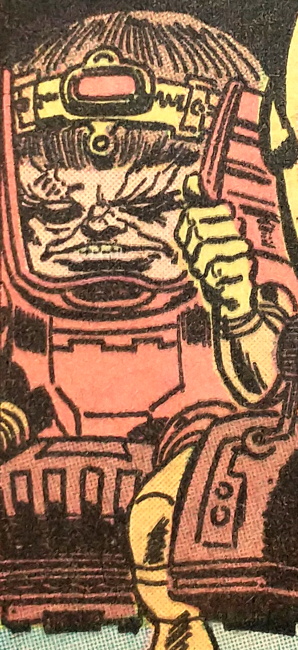
So your pal Mike has an early Monday appointment (not health-related for once, so don’t worry if you were inclined to do so!), and thus I won’t being staying up late Sunday to type another wall of words at you. Therefore, I present to you this image of M.O.D.O.K. giving us the approval we all need in this fallen world, from Sub-Mariner #48 (April 1972) by Gerry Conway, Gene Colan and Mike Esposito.

May it bring you the joy you require, and I’ll see you again in a couple of days.

This is post #5200…

…and you have no idea how much I kicked myself when I realized my birthday/New 52 post was #5197. Man, how perfect would that have been if I had that total convergence of 52s for that. Well, crud.

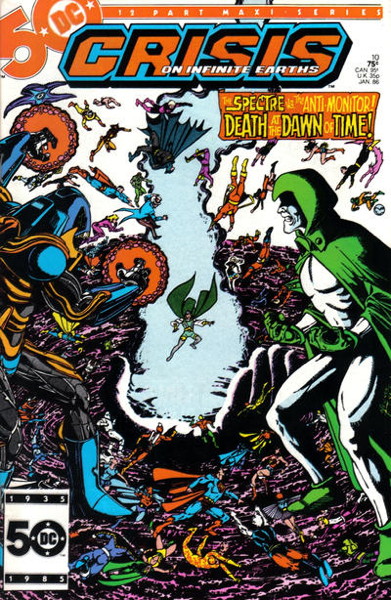
Anyway, I’ll likely continue the New 52/rebootery theme next week, but I did want to drop in one point I was sort of thinking about regarding Crisis on Infinite Earths. As can be inferred from some of your reactions, and my reaction, to DC’s continuity-sweeping series, it’s pretty clear the series loses much of its impact removed from context.

I wrote about how startling it was for Earth-3 to be wiped out in the opening pages of the series. It immediately raised the stakes and there was a sense of permanence. “Worlds will live, worlds will die, and nothing will ever be the same!” shouted the ads, and we had no reason to disbelieve them. We’d never seen anything quite like this, on this scale, knowing that big changes were coming. If you were a DC fan at all, you had to read it because this is where All The Shit Was Going Down. It was literally An Event that we, fans reading comics in the mid-1980s, were experiencing in real time.

Going back to look at it, years, decades, later, the immediacy of this story’s content is no longer a factor. The importance of the changes are no longer noteworthy, except maybe in a strictly historical/academic view. The shocking deaths are no longer so shocking…Barry Allen and Superman’s cousin both seem to be alive and well, nowadays. And like I said, the main conceit of the series, that the idea of a “multiverse” would be going away, has been undone with DC dragging the concept back into existence.

“Thou shalt not read Crisis for the prose,” as today it exists primarily as an artifact of publishing strategy, not as a standalone story with a coherent plot. (Though the George Perez art still is beautiful, of course.) None of that is Marv Wolfman’s fault…well, okay, maybe some of the weird plot holes are, but the series succeeded in what it was meant to do…grab the attention of fans and slap a new coat of paint on things. It doesn’t stand the test of time because it wasn’t meant to.

Again, not to say there isn’t good stuff in there…there are fun interactions here and there, exciting action sequences, tiny one-panel showcases for characters both major and forgotten. And as noted, it’s all wonderfully illustrated. But a big part of what made Crisis work was how vital it was to stuff going on in the now of the 1980s, diminished with the repetition of character “death” fakeouts and universal rejiggerings and generational transitions of super identities in succeeding event series. Plus, of course, with the subsequent undoing of everything that was “never the same.”

A commenter noted that these sort of events create reader excitement and interest in related and forthcoming books, and that’s definitely right. It’s good to shake things up and/or get all your properties together for a big super-party once in a while. It doesn’t always make for a tale to stand the test of time, and frankly, it doesn’t always need to. A lot of what drives my own love for the story of Crisis is pure nostalgia, a remembrance of how I felt encountering these events for the first time. That’s a tough feeling to translate over time to new readers to the book.

TL;DR “back in the olden days we had to walk miles uphill in the snow both ways to see Lady Quark fight the Anti-Monitor”

Okay, like I said, more on this stuff next week. In the meantime, a reminder that I’m putting up short audio posts on my Patreon, on a variety of comics-related subjects. Most are about 2 to 4 minutes long or so, and…well, I think I’m slowly getting better at it. I’m not…a natural public speaker, and thank goodness for editing tools to cut out the “uhs” and “aaaaand” and whatever else. Oh, and my issue-by-issue cover of Swamp Thing comics will be returning, too.

Thanks for reading, pals, and I’ll see you Monday.

Only eight issues of O.M.A.C. was a crime.

So the problem with saying “LEMME TELL YA WHAT COMICS I LIKED READING, OH, A DECADE AGO” is that now I have to depend on my dumb brain to dredge up specific memories from those books. What’s getting in the way is that most of these books I read once, as they came out, and only very rarely did I go back and read a whole run of issues in succession to more firmly lodge events in the ol’ mental file cabinet.

Thankfully, nearly-decade-younger-me, when I was sprightlier and full of hope, I did a three-part overview of the New 52 launch titles (one an’ a two an’ a three). Looking over these posts, they do seem to bolster some of my partially-retained thoughts on the titles, though I seemed to have been more faintly-positive about the Superman title than I thought I would have.

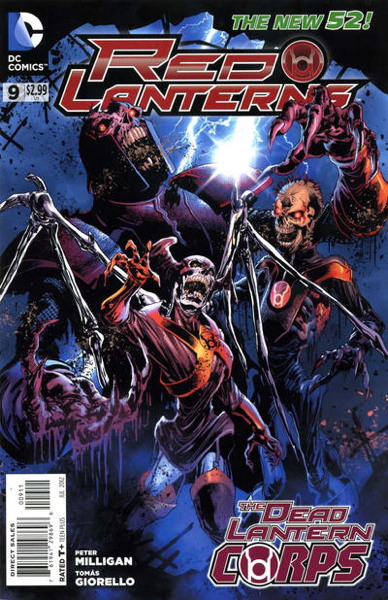
Interestingly, I noted in my discussion of the Green Lantern books that “four were too many, but it wouldn’t surprise me if they added a fifth” and, well, hello solo Sinestro series (which I kinda pushed for in those older posts of mine). In retrospect, I did enjoy the GL books from this period, which (coincidentally I’m sure) were among the least-affected by the New 52/Flashpoint changes of the Big Name DC titles. Plus, I’m in the bag for Green Lantern stuff already, and somehow too many GL titles didn’t burn me out. …Reading my old recaps did remind me 1) Red Lanterns was a far better series than it had any reason to be, and 2) I miss Larfleeze. He had a later-wave short-run New 52 title that I liked quite a bit.

Okay, to the Super-books…I thought then, and still do now, that the main Superman book by George Perez was cluttered and confused, though as we’ve learned in the years since Perez faced some editorial issues on that book so it’s not entirely on his shoulders. Plus, as I’ve said before, if Perez can’t make your costume look good, then the problem is with the costume. Anyway, remember when Lois had another love interest? That blonde guy? Whathsiname? That was weird.

Okay, I’m supposed to be focusing on the titles I liked here, but reminding myself how crummy Superman was makes me appreciate Action, with Grant Morrison writing “Young Superman,” all the more. I’m sure he faced as much editorial finagling as Perez did, but somehow Morrison managed to make it work, mostly, as I recall. After Morrison left, both books kinda fell into the doldrums ’til we got the “Superman’s Identity Revealed!” storyline, which was actually compelling and then eventually undone, of course, which I’m sure isn’t a precursor for anything happening in the Superman books now.

Also of note in my original analyses, I said that reading these Superman books was like reading an “Elseworlds” or parallel-Earth Superman book. Given how this version of the character was eventually replaced by the post-Crisis/pre-Flashpoint Superman, I guess the DC Continuity Gods agreed.

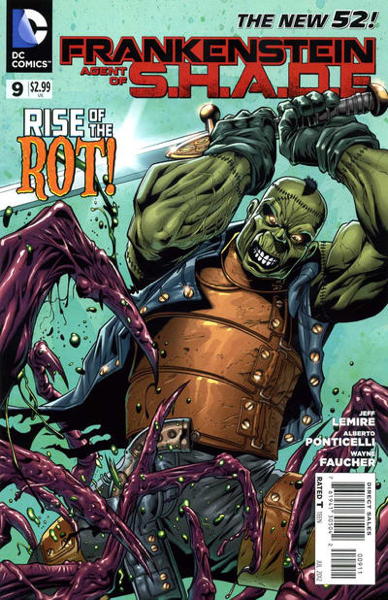
Some of the oddball books were fun as well…that O.M.A.C. series was definitely Kirby-Ahoy, as it should have been. It was too beautiful for this world, alas, and was amongst the first wave of cannings. Frankenstein, Agent of S.H.A.D.E. was also a blast of welcome weirdness, one that didn’t depend on any of the New 52 nonsense to just do what it did. In fact, neither did OMAC, really. It’s almost like the farther removed from the “event,” the better the books are.

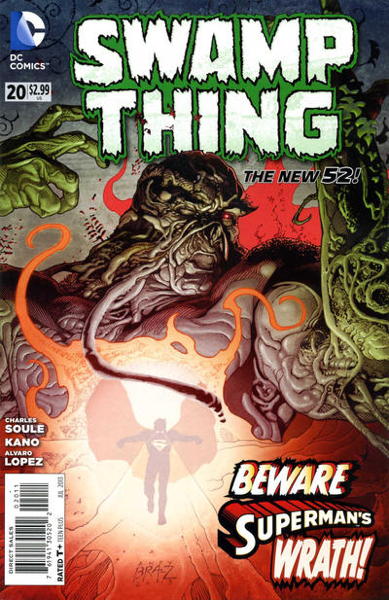
The obvious one you’re probably expecting me to mention is Swamp Thing, which, yes, I liked well enough. The main issue with these is a fanboy-ish one, that arbitrary changes were made to the character’s history and supporting characters (especially Arcane) that don’t really add anything except “it’s different now.” I’ve gone on about this before, and my own realization that they’re not writing these for people who’ve read every single comic with Swamp Thing in it, but for new-ish readers who may be vaguely familiar with ol’ Moss-Head. But overall I think I enjoyed the comic, once they got past the set-up and Swamp Thing was actually in the book.

It’s funny but Justice League Dark was a title I was lukewarm on at first, but it became a comic I enjoyed quite a bit and still follow now, even if it’s been relegated to a back-up in the main Justice League title. And no, not just because Swamp Thing is in it…I like seeing all the horror characters just sort of crammed in here together, plus Detective Chimp. What kind of soulless monster doesn’t like Detective Chimp?

All-Star Western I didn’t pick up ’til the time-travel stuff kicked in, because I do love Jonah Hex travellin’ through time. I know, I know, recent Jonah Hex comics were good the whole time, but it took the gimmick to get me in there. I’m shallow, what can I say. (Remember that time travel stuff started as part of DC’s planned “WTF?” cover stunt ’til someone realized “maybe having an implied ‘fuck’ on the cover isn’t the image we want to sell?” Oh, for those pre-Titans TV show days….)

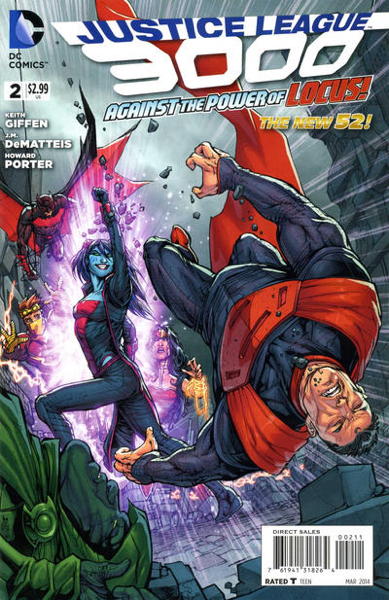
A couple later-wave New 52 books I really enjoyed, like Justice League 3000 (then 3001). I got a real “anythiing could happen/L.E.G.I.O.N. ’89 vibe from it, which 1) was helped along by being new characters removed from regular DC Universe happenings, and 2) L.E.G.I.O.N. writers Keith Giffen and J.M. DeMatteis wrote this too. I really kept hoping they’d bring this back someday, but given DC’s current publishing strategies, seems unlikely.

In addition: Constantine (fun seeing Johnny playing in a superhero universe again), Batwoman (stunning art), Animal Man (can’t think of a specific reason why I liked it, but I always like Animal Man), Secret Six (writer Gail Simone being evil, always a positive in my book), Batman Incorporated (continued over from pre-Flashpoint, which remained good but felt undermined by the relaunch).

So as you can see, I did like quite a few of the New 52 books. I mean, I couldn’t read everything, but what I kept up with I enjoyed (except maybe most of the Superman comics, which I sorta hung in there on out of inertia, which is a terrible way to read a comic but a lot of us have one of those in our reading lists). There were a couple of books I mentioned back then as ones that I liked, but afterward I’d drop (like Aquaman) or I just can’t remember anything about (like Firestorm). Maybe I’d still like them now? Once I find an eighth day in the week, I’ll do some rereading.

ADDENDUM: I am reading your comments, and thank you for them. Just wanted to let you know I’m not ignoring them just because I’m not addressing them in these posts yet. I’ll get to responding eventually!

Crisis of Mike’s Infinite Typing.

To clarify somewhat regarding my Saturday birthday post…I do find things to enjoy in the various reboots/relaunches/house cleanings that DC (and Marvel too) regularly employ. For example, the big one, Crisis on Infinite Earths…while that’s arguably Patient Zero for all the shenanigans at the Big Two today, it remains a beautifully fascinating comic.

Is it a good comic? I mean, look, if this was the first comic you ever read, well, God bless ya and God help ya too, as this clearly was a funnybook for those with regular admission to the clubhouse. As I said, in retrospect, it was very much solving a problem that perhaps didn’t need a solution (i.e. DC’s supposedly convoluted continuity) by trying to establish the groundwork for a consistency for which comic books, especially superhero comic books, have defiance built into their very DNA. Crisis hadn’t been done for months before creators started finding ways to push back against it, through in-jokes and knowing nods then eventually outright reestablishing what had been specifically done away with by the series. Supergirl and the Barry Allen Flash, done away with absolutely for sure, until they returned. And the ultimate expression of this was the recently -concluded Dark Nights: Death Metal, giving DC its limitless multiverse once again after Crisis had winnowed it down.

Now it remains to be seen what exactly is going to be done with that, after decades of DC releasing event comic after event comic trying to undo, or at least plaster over the cracks, what Crisis had done. But that’s hardly the fault of Marv Wolfman and George Perez, who tried to put out a comic with the nearly impossible task of telling a story while restructuring a fictional milieu pieced together by disparate hands for fifty years. It is, needless to say, beautiful to behold, with Perez absolutely in his element drawing everything and everyone in panels crammed with detail. Every character is essentially the Platonic ideal of itself in this comic.

But I don’t think anyone’s complaining about the art…it’s the story, and the editorial decisions evident therein, that’s the culprit for many. And I can’t blame anyone for thinking so…looking back, it seems wasteful to, say, open up the series by destroying Earth-3, the parallel Earth where the Justice League was an evil crime gang, a fun Silver Age-y idea that was so good that DC kept trying to reinvent it multiple ways over the following years until finally just saying “fine, okay, they’re from a parallel Earth again.”

That destruction had the intended effect at the time, however. It told everyone that nothing was safe, this Crisis series meant business. And boy, as this series was coming out you were on tenterhooks wondering what was going to happen next. The one-two punch of the deaths of Supergirl, immediately followed by the Flash, were appropriately shocking (even though Flash’s demise had been foreshadowed throughout the previous installments).

It is easy to let nostalgia color the memories of the series, admittedly, but there’s no real reason why it shouldn’t. In the context of the time, as the series was released, the perceived staggering importance of what was happening made each issue a must-read, to be absorbed if not outright studied. For someone who read it in real time back then, I can still look at the pages (in my slipcased hardcover edition, in which it was initially collected, natch) and recall that excitement I felt reading the series. I don’t think that’s a thing one should deny, but it should also be recognized as a problem when trying to approach the series critically.

Yes, I very much, emphatically and non-ironically, love Crisis on Infinite Earths. But it’s also very dense to the point of being cluttered, characters are given short shrift with that stilted dialogue in the Wild Wolfman Way, there are some editorial inconsistencies and shoehorning in tie-ins to other titles, and an ending that doesn’t quite stick the landing. Though in that latter case, the decision to allow characters to remember the DC Universe as it was, was generally ignored anyway so no big whoop, but it still felt like a cheat, a denial at least in part to the sweeping changes promised by the story.

There’s a lot of cover in this series, far more than can be really broached in a single blog post written by a later-middle age guy late at night who hasn’t been getting enough sleep lately in the first place. I did just want to let you know…I loved Crisis, still love Crisis, but yeah, it ain’t perfect. And despite knowing in my heart that the ripples it spread across DC, and Marvel too, that persist even today, weren’t intended consequences, it’s difficult to consider the series removed from its position as that epicenter.

Next time: to prove I’m not 100% a crankypants, I’m going to talk about the New 52 books that I liked. SPOILER: not Justice League so much.

Thanks for reading, pals, and for your thoughtful comments.