So in the mid-to-late 1940s, and just barely into the 1950s, the comic publisher Fox would put out this big ol’ funnybooks, running well over 100 pages in length:
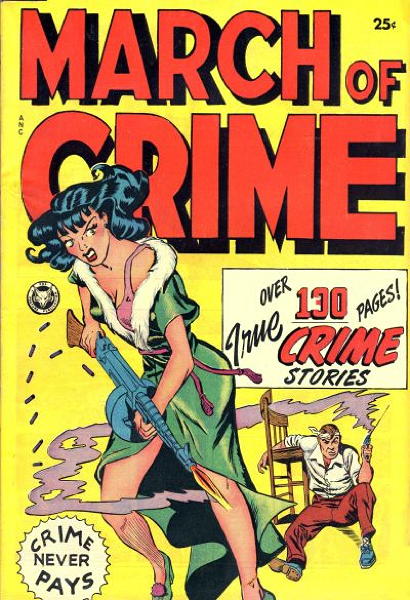
Back at the previous place of employment, we had a few of these come through, and they were impressively thick packages. And sometimes they had pretty great covers (like the one pictured above, which I’m pretty sure was one of the copies we had).
There were three or four dozen different Fox Giants released, with titles like Almanac of Crime, Romantic Thrills, Crimes Incorporated, and, yes, really, Throbbing Love, among other parent-pleasers. Each was comprised of four previously-published Fox comics, the covers stripped, and rebound under one cover. (Were the stapled together or glue-bound? I don’t recall, but watch this space!) As noted in Overstreet and in the various GCD entries, the first story in most Fox comics began on the inside from cover, which means, with the stripped covers, some of the stories would be incomplete.
And for the purposes of today’s discussion, the contents weren’t consistent. One copy of a Revealing Love Stories giant would not necessarily have the same issues bound within as another copy of that same giant. Overstreet also notes that if a giant were to have lucked into more desirable content (like a Phantom Lady story), that Fox Giant may be priced higher than the pricing given in the guide.
That, my friends, is Variant Interiors. I can’t say as to whether it was deliberately marketed that way at the time, to encourage kids to buy multiple copies of, say, All Real Confession Magazine so they can get lots of different stories while Fox unloads a bunch of remaindered/returned coverless comics that didn’t sell the first time.
A long time ago on this very online magazine weblog, I wrote about my copy of Adventures of Patoruzu, a weird book that featured the title character, a cartoonish Native American on the cover, while containing completely unrelated funny animal content inside. According to the GCD entry, copies of this comic have been found with contents other than what I discussed and what the GCD has indexed. They say that the covers were likely printed separately back in the ’40s, then repurposed in the ’50s for other coverless comics. Mostly, perhaps, a previously unpublished issue of Animal Comics, but a couple of others apparently got the Patoruzu treatment as well.
Now let’s jump to the ’90s, where instead of taking unsold stock and putting them into new packaging to clear them out, publishers were taking brand new comics and turning them into unsold stock! But I’m getting ahead of myself.
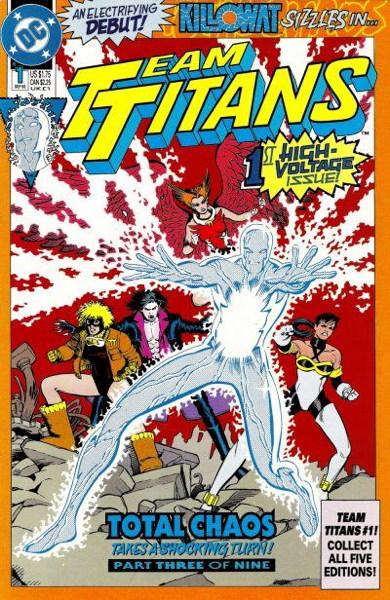
1992’s Team Titans was a spin-off series from the New (Teen) Titans, where Marv Wolfman was finding his second, or third…or whatever, he’d found a new wind that was creating excitement and buzz around the Titans that it hadn’t really had since George Perez left the book.
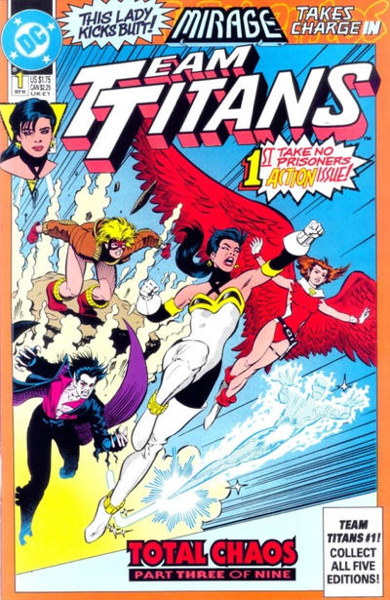
Between the exciting “Titans Hunt” storyline and the new and popular Deathstroke the Terminator ongoing series, there was seemingly plenty of demand for more Titans content. And in the true excessive style of ’90s comics, a wild gimmick was devised for the first issue.
There would be five different #1s each with a different cover…that’s pretty standard. But each variant cover would also contain a different story, five stories, each focused on one member of the team.
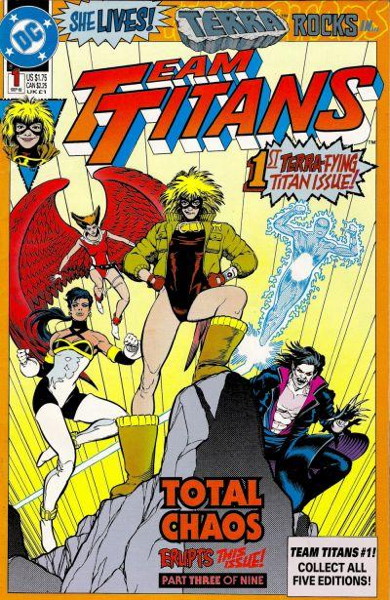
It has been a long time since I’ve actually looked at a copy of the first issue, beyond dumping ’em in the bargain bins. I do remember buying one (just one!) for myself at the time (I pretty sure I picked the Terra issue because I wanted to know what her deal was) but man, it’s been a while. Refreshing my memory at ye olde GCD yet again, I see that the “variant” story was the lead, running 18 pages, while the back-up story was the “main” story, part 3 of the “Total Chaos” crossover, the same across all three variants, and running 22 pages.
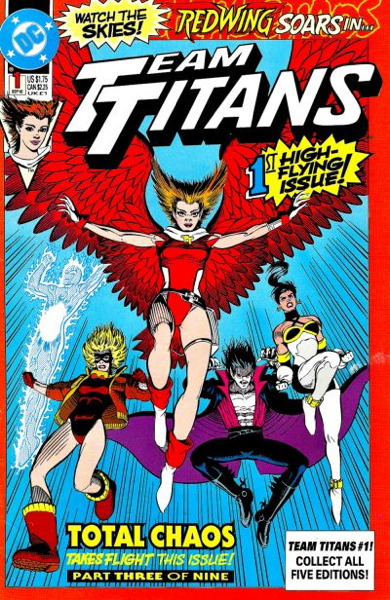
If all that sounds pretty wasteful and ridiculous…yeah, you’re right. I mean, I suppose it’s better than just a variant cover, in that you’re receiving actual new content, but…I don’t know, I’m trying to think of ways they could have done this without basically giving someone who bought all five half a book that’s the same? Maybe a five part Team Titans prologue series, half the size of the released #1s and at lower cost? One extra-sized issue with everything, including the “Total Chaos” “main” story?
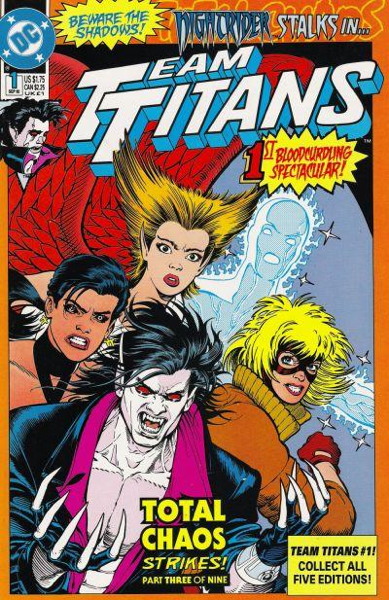
Those alternate stories were actually longer than I remembered, as I though the “Total Chaos” chapter was the first “main” story, and the different content was restricted to just a few pages. But given the significant length of the stories, this sort of variant is a little more…unfair, I guess, than just offering different covers. With variant covers, you can just pick up the copy with the image you like the most. Perhaps you like all the covers but can only pick up one…while you don’t get all the images, you are at least getting the entire story.
Whereas with Team Titans #1, if you want the whole story, you’re compelled to buy all the variants so you don’t miss anything. Granted, these are for all intents and porpoises five different comics with a shared back-up story. However, they were marketed as “the first issue” of Team Titans, it was presented as the debut of this new series, it was sold as “five different versions of #1, with alternate covers and interiors!” It says right on the cover “COLLECT ALL FIVE EDITIONS!” It was seen, psychologically, as the same comic.
Anyway, as it was the ’90s, we ordered high and it sold well-ish, though I recall having plenty left over afterwards. That was okay, we thought, as back issue sales were strong and we were sure to sell plenty of these as the years went on, presumably five at a time. But, as luck would have it, the push ‘n’ pull between what the creative team wanted to do and what DC wanted to do didn’t do the series any favors, and it came to a somewhat ignoble end just a couple of years later. Oh, and with the revelation that they were all just pawns of a bad guy anyway. You can read about the book’s travails here.
When it was new, we put together packages of the five number ones and sold them in a bundle for a small discount, though we needn’t had bothered. Most people weren’t weirdos like me and my one copy of the Terra issue and bought all five. As time went on and Team Titans went from “going concern” to “Teen Titans footnote,” back issue movement slowed down to nothing, thus beginning its migration from a slot in the bins under “T” to the purgatory of the quarter/50-cent/dollar boxes. And there they mostly remain, a forgotten artifact of that third or fourth time the New Teen Titans were red hot.
As I was putting together this post, I realized that if you’d asked me yesterday “who were the members of Team Titans,” there’s no way I would have gotten much past “Terra.” Maaaaaybe Redwing, if I dug deep. But, like, I couldn’t have come up with the hilariously-named Killowat if my life had depended on it. Even as I am typing this very sentence right now I can’t remember the names of the other two members, and I just looked a second ago to get “Killowat.”
Team Titans wasn’t the only modern comic to try the “variant interiors” thing, 1998’s Fathom did so, in its first issue:
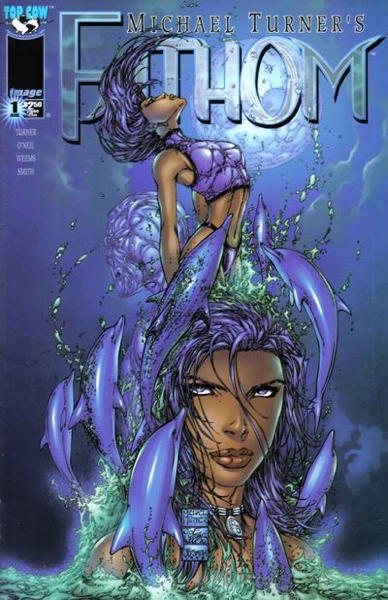
…which had three main variants available on the stands, not counting the “Wizard variant” or whatever. But each of the three variants had alternate story pages…not nearly to the extent of Team Titans, as I think it was only a couple at pages at most. I tried looking once, a long time ago, and alas Fathom makes zero impression on me, and whatever I was looking at just went in the eyes and out the ears and I retaining nothing of what I saw. Thus I’m just going on what I remember reading about it and hope that’s right.
Now these aren’t nearly all the “variant interior” comics that were marketed as such. There’s 1996’s Savage Dragon #31, where you can get a version with a dirty word in big letters on one page, and a version (with a variant cover featuring “God Is Good” printed in the Image logo) without said naughty word.
There was also Barry Blair’s Leather and Lace, which, at least for part of the series, was offered in “Adults Only” and “General Audiences” editions “for his younger fans” with all the Tab-A-Fitting-Into-Slot-B content removed. Frankly, the “General Audiences” edition wasn’t really fit for children anyway, as I recall.
All this leaves out the “printing error” variants, as those were accidents and not intentionally marketed as differing editions available to consumers. Like, I don’t imagine Marvel intentionally wanted a copy of Wolverine with an in-dialogue slur as an alternative version side by side with the one without on the shelf. But I will say I’m still looking for a copy of the All Star Batman and Robin the Boy Wonder #10 with the semi-visible dirty words that was recalled and reissued. Anyway, there are lots of examples of errors with corrected printings.
I’m sure I’m missing some other examples of intentional variant interiors. (And before anyone brings up 1990’s Exquisite Corpse, that’s a whole weird thing that’s sorta related to this, but not really. I’ll try to explain that eventually.) If you can think of any of the intentional variety that I didn’t mention, just drop ’em in the ol’ comments section.
Up next in the variant cover-age: maybe the 35-cent test market Marvel books? I’ll see what I can dig up on those. As always, thanks for reading, pals.
• • •
EDIT: Reader BobH has added some valuable information, including reminding me that the Team Titans first issues were all priced at a normal-sized comic’s price for the time. As he said, it still felt like a rip given the repeated content of the “main” story.
BobH also mentions Outsiders Alpha and Outsiders Omega from ’93, with separate mostly-different stories, with a handful of shared pages. I’d honestly forgotten about that. Reminds me a bit of this Fantastic Four Annual and the Avengers Annual from 1985 and their shared pages (though with different inkers).
Matthew also brings up Marvel’s Slingers, where there were four variants of the first issue, where part of the story would focus on a different one of the four main characters. Dating from 1998, clearly my long decades toiling in the comic field drove this from my memory. Not to mention the fact I can’t even remember the last time I handled a copy of Slingers.
As far as repurposed coverless comics rebound for newsstand sale, Andrew remembers this being fairly common in the UK during his childhood. And ArghSims notes that the old EC Annuals did the same thing.