The seal has been broken…

…your pal Mike has bought original comic art.

Oh, I do own a few original pieces from hither and/or yon, either drawings made specifically for, and gifted to, me, and I own at least one original page from an Archie comic published in the 1990s (which comic…who can say?) that was also given to me. I have purchased original drawings, like this Fred Hembeck rendition of Sluggo, but I’ve never laid out money for a piece of artwork that was used for mass reproduction.

UNTIL LAST WEEK.

So remember when pal Brook came by the shop with his copy of the obscure “Nobody Loves the Hulk” record, which of course immediately spurred me on to get one of my own?

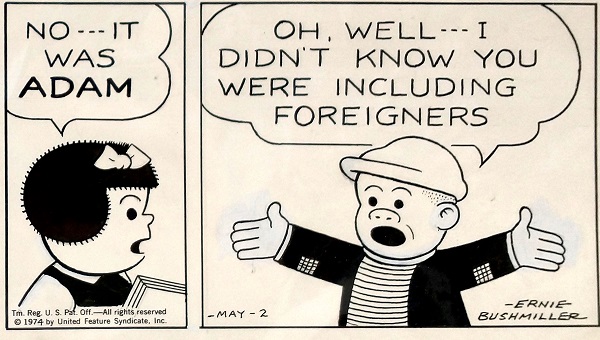
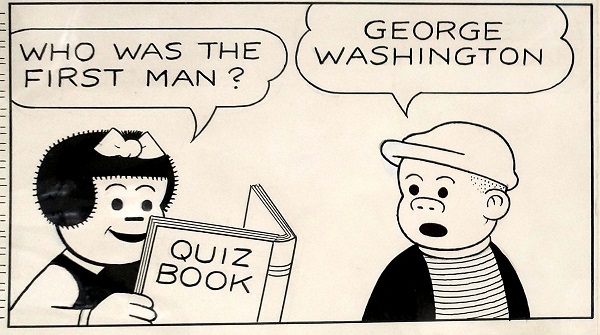
Well, that darn Brook did it to me again, by showing me his recently-obtained Ernie Bushmiller original Nancy daily strip from 1974, which he graciously allowed to be featured on this site.

Brook said “you should check out this seller, he’s got a few Bushmiller originals, and I thought “maybe I’ll look, but I’m not gonna buy anything.” And then I looked, and then I bought something, and what I bought was this original daily from June 26th, 1975 (click the pic for a larger view):
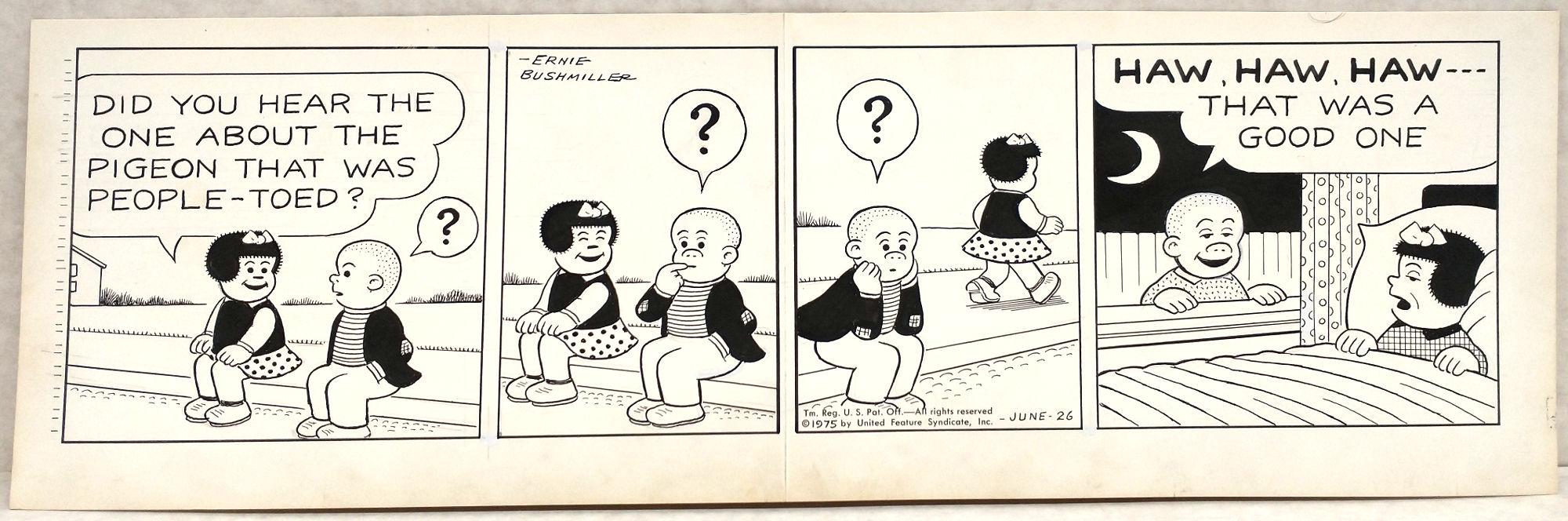

Now I’m aware Bushmiller frequently used assistants (which you can read about here), so I am not 100% sure how much of this is pure Bushmiller and how much is, say, Al Plastino (which would still be a good get) but that doesn’t make this any less of an original Nancy strip produced under the purview of their creator.

Plus, look at all that great Sluggo content. A SLUGGO IN EVERY PANEL. Bonus: “HAW HAW HAW” dialogue!

For those of you who are interested, the original measures about 20 inches wide and 7 inches high.

Not leaving well enough alone, I thought I’d take a peek to see what other original Nancy (esp. with Sluggo) art may be out there for sale. There was a particular strip that caught my eye, mostly for just how weird it was, for the peculiar cultural crossover artifact it represented. I saved a scan of it to my computer, thinking that would be enough…but it preyed on my mind. Nagging me, tormenting me, reminding me of that time I could’ve bought this Bob Marley/Yoda painting off eBay and forever regretting that I didn’t.

Plus, it was pretty cheap. Which is how I now own the Guy Gilchrist original for the September 18th, 2014 daily strip (again, click to enlarge):


Your eyes do not deceive you, that is indeed Sluggo dressed as a Teenage Mutant Ninja Turtle. Or, dare I say:
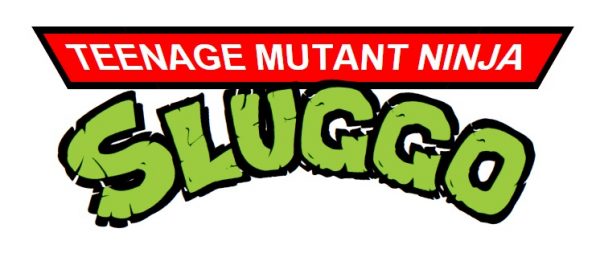

Okay, he’s not a teenager yet, but you get the idea. But what a bizarre thing this is. Just look at it. LOOK AT IT. Plus, there’s a bonus extra signature from Mr. Gilchrist at the top right there, dated 2016, where presumably he re-autographed it at a convention or something.

And again, if you’d like to know, the paper the strip is drawn upon is about 7 by 17 inches, though the strip itself is only about 13 inches wide.

There you have it…my first foray into buying original comics art. Not something I’m likely to do too often, though my mostly-working eyes are always on the lookout for that one Swamp Thing page that 1) I like and 2) can afford. But, you know, I bet Tumbleweeds originals are cheap. I could have all the Tumbleweeds! LET ME AT THOSE TUMBLEWEEDS
Does whatever a variant can.


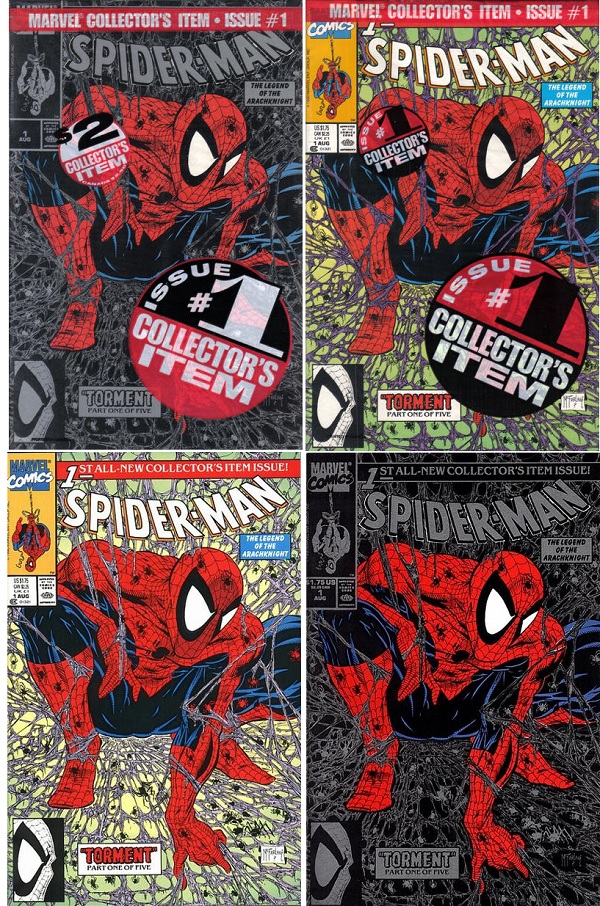
So in the summer of 1990, these came along: the first issue of what we referred to as the “adjectiveless Spider-Man, a new ongoing series drawn and written by the immensely-popular superstar artist Todd McFarlane. If you were a fan of McFarlane’s art, it was absolutely a visual tour de force, giving you the most McFarlane-est of McFarlane Spider-Man art. The writing was…well, I think in retrospect ol’ Todd got grief way out of proportion to his actual scripting skills. Perhaps he wasn’t the most talented wordsmith in the world, but for a goofy ol’ Spider-Man comic, it was fine. I’ve read plenty worse, I assure you. And while the opening captions to issue #1 took the brunt of the derision, it was turned into a wonderful piece of audio by my old pal Andrew and thus, how can I ever feel anything but love for it?

But look, we’re not here to talk about the contents of these Spidery-Sam books, we’ve come to poke sticks at the variant covers! Of the 1990s Big Variant Cover Hoohas, Spider-Man #1 was the first, with two differently colored covers (one printed with in green and black, the other black with silver ink), and then two additional versions with each cover sealed inside a polybag with “COLLECTOR’S ITEM!” printed all over it. Note the “Legend of the Arachknight” blurb, clearly referencing DC’s Legends of the Dark Knight #1 and its multiple covers.

Of note is the fact that the black bagged variant had no price printed on its cover, but instead had a $2 price tag on the bag. Gettin’ ya for an extra quarter there. The green bagged edition still appears to be the regular $1.75 price, though I could have sworn both were $2 at the time. Hey, it’s been thirty years, I forget things. However, for that extra quarter, you were buying a comic that was genuinely a variant in that the actual cover had a printing variation. But if it were removed from the bag, technically the collectible would be “incomplete,” so just being a variant in and of itself wouldn’t be enough, I’d thought. But just checked the eBays and someone there is trying to sell one of unbagged, cover-priceless versions of that black ‘n’ silver variant for $70, but I don’t know if that’s within reason or simply “high hopes.”

And yes, there’s also the bagged newsstand edition, with a UPC code on the cover instead of the Spidey face in its place. Can’t forget that. Plus there was the gold-inked 2nd printing, and the platinum edition and newsstand gold edition that you can read about here.

At any rate, we definitely sold a boatload of things…just stacks and stacks, with plenty of folks grabbing multiple copies. This was, of course, back in the day when you ordered heavily on a first issue, as, if successful, the series would go on for a long time and there would always be customers looking for that first issue in the future, because surely no publisher would be dumb enough to relaunch a series with a new #1 every year or two. In these days of direct market frugality, where everyone’s ordering as close to the bone as possible, it’s hard to imagine actually having that much stock on anything new, much less having speculators look at said stacks and view them as investible material. Compare to today, where speculation depends on pouncing on titles ordered at low-ish but reasonable numbers, creating and taking advantage of that additional scarcity in an already thinly-spread marketplace.

At the time, my previous place of employment had plenty on hand. Of the two regular covers, at least…my boss thought the polybagged-editions were “stupid” and refused to have anything to do with them after the sold out. Just wouldn’t buy them from collections, that sort of thing. Eventually we did get two that showed up in a collection that we just sort of ended up with, so out into the back issue bins they went. I think that was the one exception.

My personal thought on those bags back then was that they would eventually do damage to the comics inside, as they aged and broke down and decayed on the comics themselves. In recent years I’ve had my hands on those polybagged Spideys in my own shop, as well as other prebagged comics of that decade, and it doesn’t appear as it this has been the case. Whether that’ll change in the decades to come…well, of course it will, it’s cheap plastic, it’s gonna break down eventually. Whether that’ll happen soon enough for any of use to care, I don’t know.

I’d said the McFarlane Spider-Man #1, and the rest for that matter, were plentiful at the time. Not to beat that poor old dead horse some more, but after thirty years and shops vanishing and new shops cropping up and old back issue stock going away and all those copies purchased but then those were either not well cared for or simply thrown out…it’s very possible the available stock left in the world is at least somewhat lessened. Add to that the younger customers who weren’t around or too wee to be buying these off the racks, and are discovering them now. Regardless of the reason, these Spider-Man comics are currently in high demand, at least for me. I just can’t keep the darn things in stock.

And do those variants make any difference to buyers now? Not that I can tell. I haven’t had the quantities on hand to make a clear judgement as to whether there’s a consumer preference for the green cover or the black cover, but both (and the gold reprint) sell nearly as soon as I price them. This is, I think, one of those cases where cover variation is playing no real part in sales. It’s all “early McFarlane art,” or “it’s a #1 for one of the main Spider-Man series,” or “it’s a major Marvel #1,” period, all of it pushed along by a not-insignificant number of current speculators.

Next time: weekly X-Men variant covers…advantageous!

Now if we could be issued Fortnite codes to insert into old copies of Deathmate, we’d have somethin’.

I have a new post on variant covers in progress, but it’s getting late, it’s not done, and I’d like to avoid making any grievous errors like last time. And so, I’ll let the pot simmer an extra day or two before serving anything up, he metaphored, and we’ll continue next week.

In the meantime, more Batman/Fortnite news: yup, I’ve sold out…ran out sometime on Wednesday, and the calls keep coming in. I’ve been taking phone numbers and making reserve lists for folks for future issues and coming reprints, so it’s not all lost sales, thankfully. But, like I said the other day, while I ordered a pretty good number and was able to make plenty of kids (and parents and grandparents!) happy, boy I sure could have used a lot more than what I got in.

I did notice at least one retailer online somewhere griping about the demand for this Batman/Fortnite comic and wanting it to be overwith, which…well, I can sympathize a bit, anyway, especially if you don’t have any to sell. Every request feels like a jab in your side, reminding you that you fell down on the job by not ordering enough to meet demand. One really shouldn’t feel like that, if you did your best, because you never know for sure how these things will work out…could very well have had the result of “eh, don’t really want to buy a comic book to get a code” and nothing would have come of any of this.

That’s not how it happened, however, and even if demand outstripped whatever supply I had on hand, hoping those requests simply go away is a mistake. I’m taking preorders (some even paid in advance), so I’m making do best I can. Yeah, I hate saying “no” to folks when they call and ask, but I try to let ’em know “…I’ll have more soon!” And since these aren’t comic collectors, they don’t care if it’s a second, third, or ninth printing. They just want the comic…and yes, mostly for the game codes inside, the primary impetus for the rush, but these are still lots of new customers desperately wanting to exchange money for product, a circumstance some comic shops may not see very often.

Some other thoughts occurred to me: I don’t know what kind of deals are involved here, and whether or not other comic publishers can horn in on this action and also get Fortnite codes into their own comics. But if they can…look out. Everyone’s gonna want to boost sales on their books by baggin’ em up with those precious codes inside. At the very least, I expect DC to follow up with another series almost as soon as this one is over. Like I said about some retailers, comic publishers don’t often see this much money being waved at them by a whole new audience.

Also…issue #4 of Batman/Fortnite was the first issue on which retailers could adjust their orders after seeing how the first one sold (or would have sold had they had any). I think there’s a good chance the supply on the comic may go from the “totally not enough” status of right now to the panic-ordering/nigh-Deathmate levels pretty quickly. Yes, there’s a lot of demand for this comic, but it’s not infinite demand, so we may be seeing a flooded market in a couple of months. I’m sure we’ll all find out at about the same time.

Imagine a comic company being worried that orders were too high today.*

So for you Progressive Ruin Early Morning Crew, who catch the latest entries as they’re posted, either before you go to bed or as you have your breakfast and cup of coffee, or I guess pretty much any time of day depending on what part of the world you live in, you may wish to revisit the previous post. Look for the “EDIT:” dropped in there and read the rest of the paragraph that follows, which will be New to You.

Basically what happened is, while I was present in comics retail at the time, I had clearly forgotten the details around the release of Legends of the Dark Knight #1 and its variety of cover colors. I made assumptions about DC trying to boost order numbers up with variants, which is almost exactly what they didn’t do. They were actually worried that too many copies of LODK1 were ordered, and added the covers after the fact to improve sales. Go back to that post and its comments and you’ll see links and the helpful folks who nudged Old Man Mike and said “uh, hey, you got your facts a little off.” To them, I am grateful.

Ultimately, the overall point still stands, I think, that publishers realize the power of variant covers to encourage multiple purchases of essentially the same product to individuals. Even if, in the case of LODK1, this wasn’t the plan from the get-go.

Anyway, instead of just tacking on an addendum to the post saying “duh, I was wrong, here’s what happened” as I was normally do, I tossed out the offending passage and replaced it with corrected info. I feel a little funny about that, like I’m cheating or hiding my shame or something, but I do plan on continuing my series on variant covers and I don’t want the first installment to have a big ol’ screw up in it. But again, thanks to everyone for jumping in and pulling my foot out of my mouth…everyone please go and check out the comments section for that post for the usual wonderful contributions from my readers.

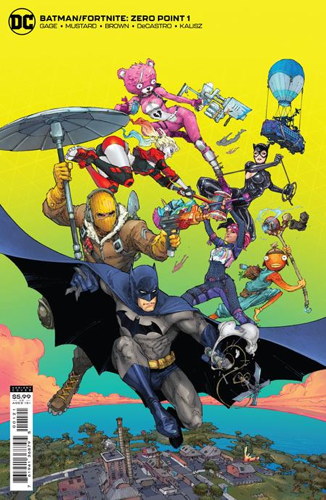
In actual comic book news, there’s this thing:


…which, surprise, turned out to the big hit of the week so far, and it’s only Tuesday. And it sounds like a lot of stores out there were caught by surprise, given a story or two I’ve seen online about retailers being upset about not being told this might sell well. …To be fair, in this market, one should never take a publisher’s word that a comic is going to sell well. Order what you’re comfortable with, order more if you need more, and if you need to get second printings, get those. Frankly, if publishers want a retailer to order extra piles of their comics on their word, they can make them returnable.

There are plenty of times when I wished I ordered more copies of something, but just as many, if not more, times when I wished I’d ordered less. With Batman/Fortnite: Zero Point #1…well, as someone who still thinks the original Nintendo is one of those “newfangled gaming systems,” even I am aware that Fortnite is a Big Deal. That doesn’t necessarily mean it’ll translate to comic sales…there have been plenty of properties that were Big Deals in the real world, but didn’t exactly drag that audience into comic book stores once their tie-in funnybooks showed up. Sometimes they do, sure (Firefly is still doing okay, um, y’know, considering), but a lot of times these licensed books can sell worse that other comics on the shelves.

This time, though, I took a chance and ordered a…reasonable number of copies for my store, and it worked out pretty well so far! Getting lots of calls for the book, plenty of new faces walking in the door to get copies, and at least for Tuesday’s traffic, I had enough to go around! Now once I open Wednesday, my remaining copies will likely fly out the door right quick.

All things considered I wish I’d ordered double the number of copies, and maybe if you ask me by the weekend I might say I wish I ordered four times the number. What is nice about all this is the fact that the customers coming in for copies of the Fortnite comic all seem to be genuinely interested in the game, and not just dudes looking to flip the book on eBay. And boy, it seems to be selling for a pretty penny on said eBays. …Which is another clue that the comic was desperately underordered. Not being in initial solicitations and being offered just in the Final Order Cutoff listings may not have helped.

I’m going to enjoy this while I can, as it’s always good to have a comic that will get new faces in the shop. I know that perhaps a lot of them just want the digital codes for the game sealed inside that polybag, but look, comics retailers can’t be choosers.


* I mean, aside from that business with Eniac #1.

Variants on a theme.


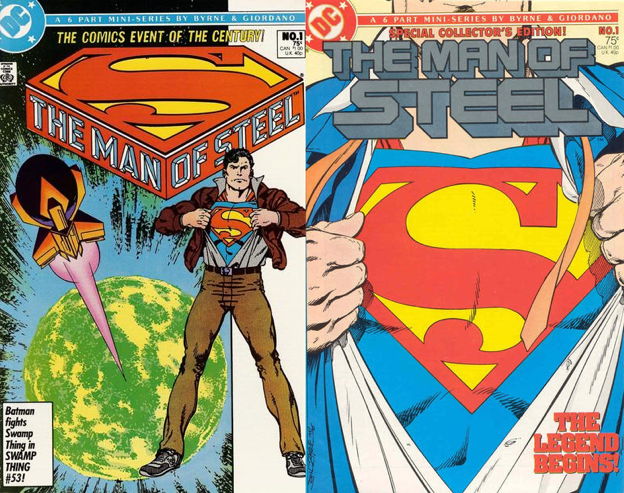
Man of Steel #1 in 1986 is generally considered to be Patient Zero for the variant cover marketing strategy in the comics marketplace. You had the standard cover on the left, with a cover layout duplicated by the other five issues in the series. Then on the right you had the fancypants cover with the metallic ink an’ such. Both were available in comic shops, but only the standard cover could be found on newsstands.

I mean, sure, it’s understandable that DC would want to go through the extra effort of slapping a second cover on the first issue of this series. This was, after all, a complete revamping — a “reboot,” if you will, perhaps you’ve heard that term — of their flagship character by a superstar creator. This comic was indeed A Big Deal, and doing somethin’ a little special to make it stand out was certainly warranted.

Now, did fans end up buying both covers? Not all, I’m sure (I myself just got the comic shop-only cover…I liked the design of the standard covers, but I thought Clark’s pants looked weird), but certainly a non-zero percentage of consumers couldn’t decide between one or the other and solved the dilemma by taking one of each home.

This is of course not including the sales to speculators, a market segment that would absolutely explode in the 1990s but certainly existed prior to that. (See also Shazam! #1 and Howard the Duck #1 from the 1970s.) I’ve experienced more than one acquisition of books from investment collections containing stacks of Man of Steel issues. But if I could hazard a guess…I think comic companies began to learn that not just speculators but your regular readership could be convinced to pick up more than one copy of the same book.

Look, some fans were doing that anyway. The “buy one to save, one to read” thought process had been there for years. Whether the idea is “I’ll have a back-up if my reader copy falls apart,” or “I’ll have a mint copy for resale” borne of either a genuine belief in a return on investment, or some kind of self-justification for still buying these things, it doesn’t matter. But those were purchasing decisions, both small scale extra copies here and there and the bulk investment procurement, were made independently of the publisher’s efforts. Sure, DC and Marvel and whoever else can throw “COLLECTOR’S EDITION!” blurbs across the covers but c’mon, no one falls for that any more.

But two covers? With two different images? That’s something a publisher could do to encourage duplicate purchasing. Granted, likely not a lot, but not nuthin’, either. Naturally the burden is on the retailers, particularly in the direct market, to try to determine order numbers on a comic with two different covers. Not just the “how many customers will buy both” question, but the more basic issue of “which cover will generate more demand?” What if one cover is preferred over the other? What if one cover is a complete dud nobody wants, and you’re stuck with that cover while selling out quickly of the other? Surely most customers wouldn’t have that binary a preference…yeah they’d like that one cover, but oh you only have the other, sure that’s fine.

If the variant cover on Man of Steel #1 didn’t help sales a least a little upon release, we probably wouldn’t have seen more of them shortly thereafter. Of course, we did, such as these specific parodies of Man of Steel and its two covers by Boris the Bear and the one-off parody comic Man of Rust.

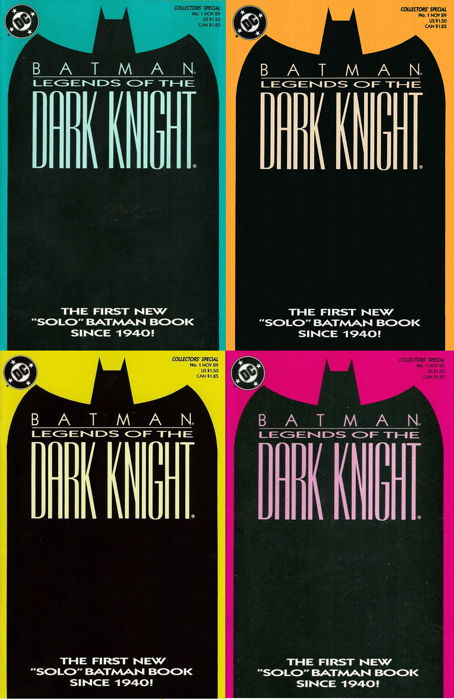
And DC itself had a big variant cover rollout again in 1989, when they published Legends of the Dark Knight #1, as part of the big movie-inspired Bat-push that year:


This time it appeared as if DC was testing the limit of what actually “counted” enough as a variant cover to generate multiple-copy purchases by consumers who wouldn’t ordinarily do so. These were just “extra” covers, attached over the comics regular cover, printed with four different colors. Now, I wasn’t involved in the retail end of the comic business when Man of Steel rolled out in ’86, but I was definitely behind the counter in ’89, and I do vaguely recall grumbling from both customers and retailers about this blatant marketing ploy.

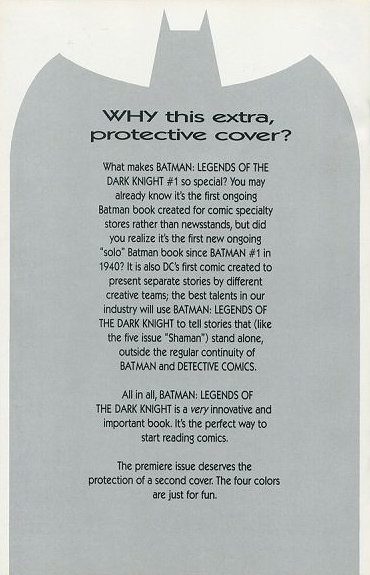
Actually printed on the inside of these extra covers was a message from the editor, explaining why the extra covers:


“The four colors are just for fun,” it says, but they’re also for goosing the collectors out there into buy more copies. EDIT: Now as it turned out, and I had forgotten about (but reminded my readers James and BobH), the reasoning behind these covers was that preorders were so high, again this being the time of the Batman movie-inspired craze, that it was feared it would be too many for retailers to sell and the market would be flooded. As such, these multi-colored additional covers were printed and affixed over the regular covers. And the reasoning for this was, clearly, to encourage collectors to buy more than the one copy.

And I promise you, as a fella working the register at a comic book store in 1989, I sold plenty of sets of all four covers gathered off the shelf by members of our clientele. And there have been plenty of these sets spotted in boxes of books brought back to me to sell over the ensuing decades.

If all it takes is just different colors to boost orders and sales, what other minimal perceived value-adds can be given to books to get folks’ wallets out? Maybe just prepacking a comic in a sealed polybag right out of the gate? Or having to buy every version of one issue, each packed with a different trading card, to get a full set? There can’t be any way those ideas would work.

More on variant covers coming next time, informed in part by your great responses to this post from last week. Thanks for reading, pals, and I’ll be back here in a couple of days.

Seeking your input on variant covers.

Look, I spent a long time putting together a post about the retail impact of variant covers, and it’s not quite coming together and it’s too late to keep polishing it and I know I’m leaving stuff out. SOOOOO…I’m gonna save it for Monday, and do a little consumer polling today.

Thus, my questions to you are:

  • What makes you buy a variant cover?
  • Do you buy multiple covers for the same comic? Regularly, or just on special occasions?
  • Do variant covers turn you off from buying a comic?
  • Do you mind paying more for a variant cover (whether it’s a buck more for DC’s cardstock covers, or higher premium prices for those incentive ratio — i.e. 1/10, 1/25, etc.– variants)?
  • Have you ever been tricked by a variant cover featuring a character or situation not in the comic itself? (Like, grabbing one of those Deadpool anniversary covers thinking Deadpool would be inside?)
  • Have you bought variants for comics you don’t regularly buy because of their “theme” (like, again, you’re a Deadpool fan and you wanted all those covers)?
  • Anything else about variant covers you’d like to say?

Please leave responses in the comments…you don’t have to answer all the questions, and you can be anonymous if you want (if you leave your email in the comment form, I won’t out you, I promise). You can even email me, too (at mike at progressiveruin dot com) if you’re more comfortable with that.

Thanks, pals!

“Art is any Swamp Thing you can get away with.” – Andy Warhol (paraphrased)

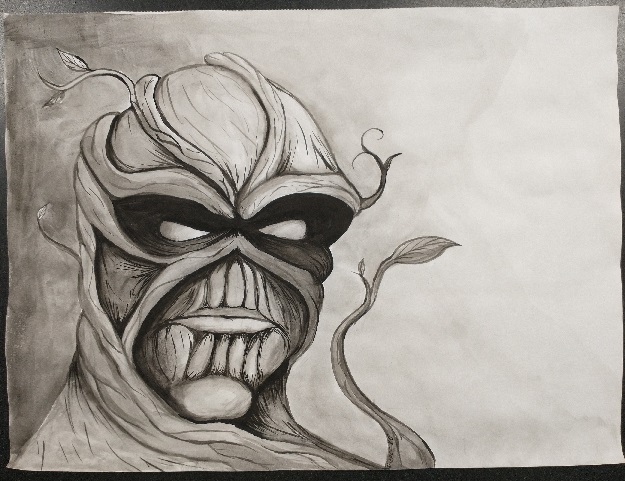
Look at these cool drawings customer Sarah gave me a little while back! The first is of that mossy gentleman Swamp Thing:


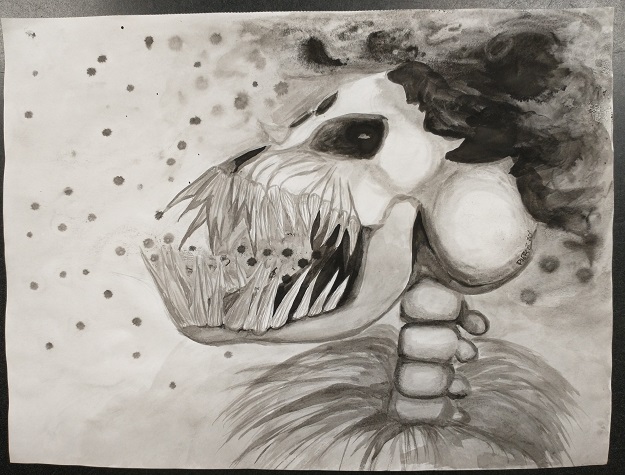
And the second is of a critter from the “Rotworld” storyline from the New 52 era…sorry if I don’t recall his/her/its name, as I haven’t committed that particular run to memory:


Pretty cool, right? Thanks to Sarah for gifting me with these fine pieces, and you can see more of her work at her Instagram thingie.

Yes, I know about the song from Avenue Q.

So a long time ago, your pal Mike was a student at the University of California, Santa Barbara, where he eventually graduated with a B.A. in English, thus essentially ensuring his eventual fate as a comic book store owner.

Now UCSB was gifted with a fine (and free — it was for college students, after all) daily newspaper, the Daily Nexus, which I would habitually grab out of one of the many on-campus racks when I arrived for the day. It was always informative and interesting and…well, fun.

One of the fun bits about it that appealed to me were, of course, the comic strips. Both the standard nationally-syndicated strips (like Bloom County, Doonsebury, and (as part of ad campaigns by local eateries) Calvin and Hobbes and The Far Side), as well as homegrown material.

A strip I regularly followed was Fresh-Man, for which I was lucky enough to pick up a collection from the school bookstore at the time. I wrote about that collection a decade back.

Fresh-Man ran in the Nexus during, appropriately enough, my freshman year. And there was another strip original to the paper that I followed and enjoyed that same year, but, lacking a reprint book that I’ve had for decades like the Fresh-Man one, I could not for the life of me recall the name. Even more aggravating was that a character or two from this strip have cameos in a Fresh-Man strip in that collection, but no indication of the name of the comic from which they were visiting.

A number of years ago it dawned on me that perhaps I could delve into the online archives of the Daily Nexus, which they must surely have, and I could finally resolve this admittedly minor issue in short order. At the time this first occurred to me, however, the archives that did exist only extended back, I don’t know, a decade or maybe two, and not nearly far enough to cover the middish-late-ish 1980s that I required.

Then a few weeks ago, I decided to check again, and lo, full archives for the Nexus (and its preceding publications) are now available for virtual perusal in PDF format, dating back to 1923! HOKEY SMOKES. And it’s text-searchable, even! (Yes, I looked up my own name…only hit was a police officer by the same name quoted in an article. I didn’t make much of an impression while I attended, I’m afraid.)

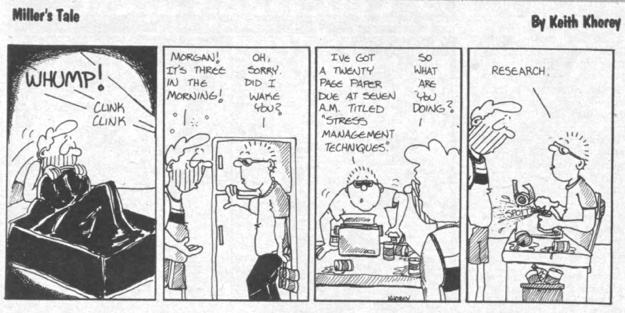
Anyway, FOUND THE STRIP:


Yes, it’s a little Bloom County/Doonesbury-esque in presentation, as were, um, many amateur strips that ran in, I’m sure, every college paper. But the personalities and situations that occupied this strip entertained me, dealing with college life and commenting on real world happenings, some light political satire, and so on. It was fun, and I’m glad to revisit it again. Maybe some of the gags, um, haven’t aged well (Jessica Hahn, anyone?) and perhaps aren’t the most politically correct from a modern perspective, but whaddaya want from a decades-old college strip? That’s, like, par for the course. (By the way, that’s the titular Miller who’s in bed in the first panel.)

I didn’t mention the cartoonist’s name in the text of this post because I didn’t want it Google-able, in case that would cause a problem for him (and I’m about 99% positive I did find him online). I failed to do the same for the artist of the Fresh-man strip way back when in my post about that, but I think the only result was that his wife found my post and commented on it. Anyway, don’t bother the fella on my behalf if you track him down…it’s enough that I can go through the Nexus archives and enjoy his strips again after all these years.

After Miller’s Tale and Fresh-Man left the pages of the Nexus, other strips came along to fill the void. I’m sure I enjoyed them well enough, and I poked my digital nose into some later editions of the paper to sample some. Nothing sticks out as being quite as memorable as these two strips, however…most are fine, a couple look like they’re gag strips but [JOKE NOT AVAILABLE], and none of them stuck in my brain for decades.

In addition to feeding my comics nostalgia, I also want to dig through the archives trying to find names of various local bands of the time and seeing if I can find any of their recordings now. If you follow my Twitter, you know, I’ve been digitizing some of the music I purchased during my college days from the music stores near the school, including nigh-forgotten bands like “Alice Fell” — the one reference for which I found online was someone who was a huge fan of theirs, and in fact one of their roommates, who claimed they never actually recorded anything! I emailed the fella and sent him a photo of my Alice Fell cassette (with the hand-painted J-card!) but never heard back.

Also looking up articles about my girlfriend and her twin sister from their time on the UCSB women’s volleyball team…least ’til my girlfriend transferred to Pepperdine to play for their team. …Hmm, wonder if Pepperdine has extensive archives for their school paper? That’s all I need, another rabbit hole to fall into.

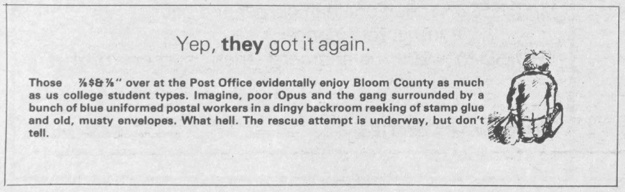
Okay, one more thing…while poking through the various Nexii, I found this notice the paper had put in place of that day’s Bloom County:


Anyway, thought that was amusing.

That author is Alan Moore, in case you didn’t know or couldn’t guess.

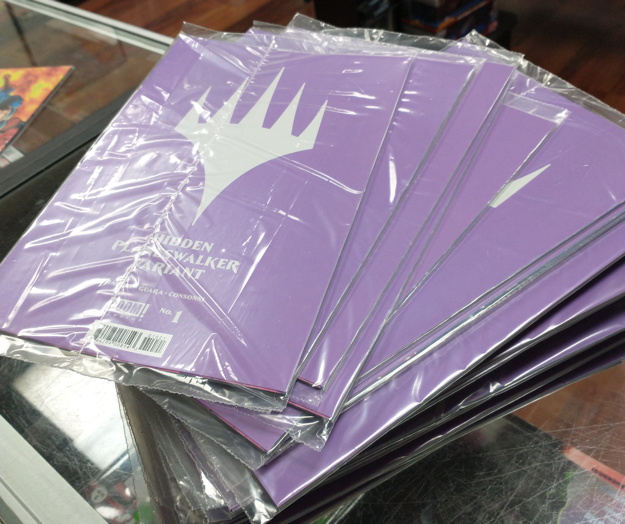
So when I crack open the shipping boxes from my distributor(s), it’s not often that I’m caught off guard by what I find inside. …Okay, wait, scratch that, I am frequently surprised by stuff like getting a single plastic Legion of Super-Heroes ring by itself in a full-sized box, or even this week, when I received 53 extra, unordered copies of a variant for the new Magic: The Gathering comic.

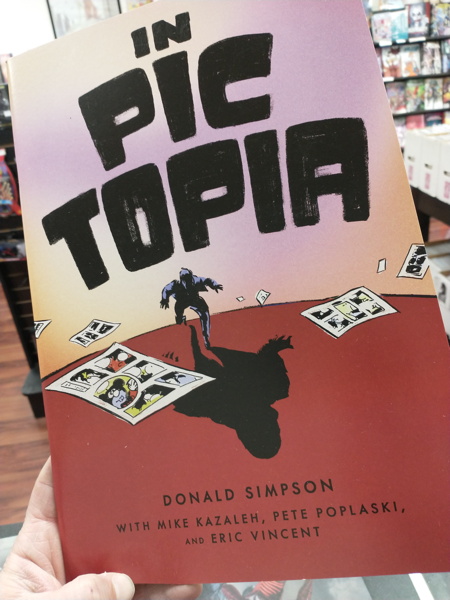
What I mean by “surprised” in this case is a good surprise, as I’d completely forgotten that I ordered copies of this for the shop:


This is a treasury-sized reprint of the classic story from issue #2 of the 1986 Anything Goes anthology. It was a surprise because I 100% forgot I’d ordered it and that it was coming.

The story itself is 13 pages, presented here in full color and looking possibly even more beautiful than it did in its original appearance. The rest of this 24-page publication is mostly text (with some illustrations), addressing the creation of the comic, what Anything Goes was for (raising legal costs for Fantagraphics), talking a bit about the fact The Author’s name isn’t on the cover, that sort of thing.

Now, to be fair, I haven’t read this yet. I mean, the original comic I read plenty of times since its initial publication, as I was one of those guys buying Anything Goes as it came out, and I was in the bag for anything The Author was writing (thanks to his Swamp Thing work, natch). But there are a couple of nice alternate covers for In Pictopia by the story’s primary artist, Don Simpson, in here, which apparently were art commissions or for a planned reprinting that didn’t happen.

I did catch somewhere in here where it said the story was “much anthologized,” which I wondered about. The only place I could come up with off the top of my head is the 1990 Fantagraphics collections Best Comics of the Decade (which I also own), and the Grand Comics Database entry I linked above mentions a 2016 collection. I don’t know of others, but honestly, it wouldn’t surprise me.

A quick Googling around seems to reveal at least some of the backmatter in this book had appeared on Simpsons’ own blog, but that’s fine. It’s nice to have a print copy in hand that I can still read long after the internet is destroyed for the good of humanity.

What’s funny is that I almost missed ordering this…it’s stuck in my head as being titled just “Pictopia,” and that extra preposition was enough to throw me off just a tad. Plus, not seeing The Author’s name in the credits also misled me to a degree…look, when I’m doing my orders, I have tons of different solicitations in the catalog all vying for my attention so sometimes even the most obvious things can take a moment to make it through my occasionally-working eyeballs and into my brain.

And then on top of that, once the hamsters started to turn the wheels in my head a little more quickly and I realized what “In Pictopia” was, not seeing The Author’s name made me think “wait, are they doing new Pictopia stories without him?” Yes, I actually thought that for half a second. Well, okay, maybe a full second. It just didn’t dawn on me that maybe Mr. The Author wanted his name off more than ancillary Watchmen products. (And actual Watchmen and other DC releases, too, but given the existence of Doomsday Clock it’s fair to say the “Keeping The Author Happy” boat has long sailed, at least for the comic books.)

Despite all that, this In Pictopia tabloid is a great looking package, presenting the comic in a good ‘n’ big size, with what looks like pretty dense discussion of it accompanying the story. The comic itself is an allegory for the comics medium and the crushing of the old in favor of the new…so on the nose that it barely counts as an allegory and is more an explicit description of what The Author thought was happening at the time. I suppose the follow-up I briefly imagined would involve a thinly-disguised Raina Telgemeier rushing in to save the day.

It still holds up a good, and melancholy, tale. If you haven’t read it yet, you should. It remains a concise, pointed masterpiece.

Should also note the contributions of Mike Kazaleh, Pete Poplaski and Eric Vincent, so that the guy who doesn’t want his name involved isn’t ironically the person I refer to the most here.