Oddly, no Amazing Spider-Man covers featuring photos of Steve Ditko.

So y’all had some good suggestions for nice photo covers in the comments for Wednesday’s post, which I appreciate. I especially appreciate Rob Staeger’s reminder that Sandman Mystery Theatre had photo covers for its entire long-ish run, certainly an unusual accomplishment in modern comics. Or this cover noted by BobH with Joe Simon and Jack Kirby.

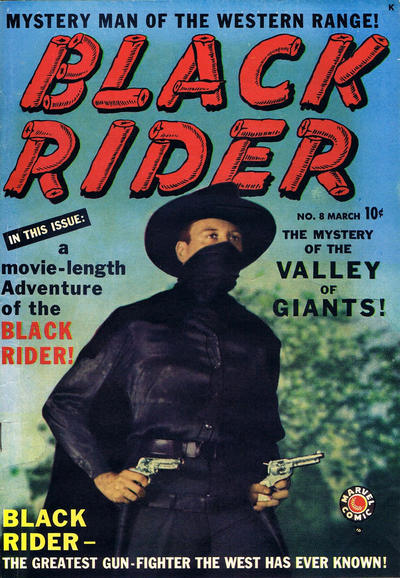
But here comes customer Sean with a comic I wasn’t aware of…Stan Lee cosplaying as the Black Rider on issue #8 of that title from 1950:


You can Read More About It here on this Stan Lee site.

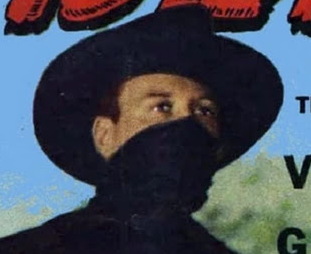
I mean, just gaze helplessly into the steely stare of Stan the Man, all masked up before it was cool:

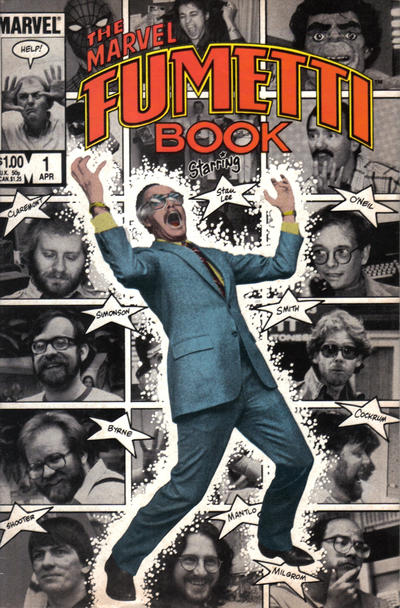
Speaking of ol’ Stan, Eric brings up the Marvel Fumetti Book from 1984 that has him on the cover:


Thanks to the Bullpen Bulletins in every Marvel mag, plus stuff like the in-house news/previews ‘zine Marvel Age, and just the general editorial shenanigans at Marvel since the get-go, the staff and creators at Marvel were more or less known personalities by the readers. Thus, a collection of photo gags starring the folks behind the comics was something they could probably pull off. I wonder if DC could have done something similar at the time? Maybe a bunch of photo-gags starring Wolfman and Perez, or Curt Swan hanging out with Superman (I mean, in “real life,” not in the story in that last panel here), or Alan Moore terrifying the suits around the DC offices…that sort of thing.

Of course prior to that was Fandom Confidential, a photo strip that ran in The Comic Reader and Comic Buyer’s Guide. But perhaps we’re going a little astray from the simple pleasures of just plain ol’ comic book photo covers. Like this one, which isn’t weird at all.

• • •

Also wanted to note the passing of David Anthony Kraft, publisher of the wonderful Comics Interview magazine, as well as the writer of several swell comics (including, very briefly, some of the original ’70s Swamp Thing). Mark Evanier has some nice words to say here. My condolences, of course, to his family, friends, and fans.

This is all somehow Nicéphore Niépce’s fault.

So in the comments section for my Gen 13 post, folks started talking about photo covers on comics. I don’t have anything in particular to say about photo covers, though I suppose I could note how of all the too-many variants for Dynamite Entertainment’s Vampirella, Bettie Page, and Red Sonja, it’s the “cosplay” photo covers that move the most for me. (And no, not just for prurient reasons, I promise.)

I can’t think of a whole lot of other photo covers of late, but I have the memory of a goldfish who has pretty bad memory even for a goldfish, so don’t depend on me. I can think of some of Marvel’s movie tie-ins and variants with movie stills.

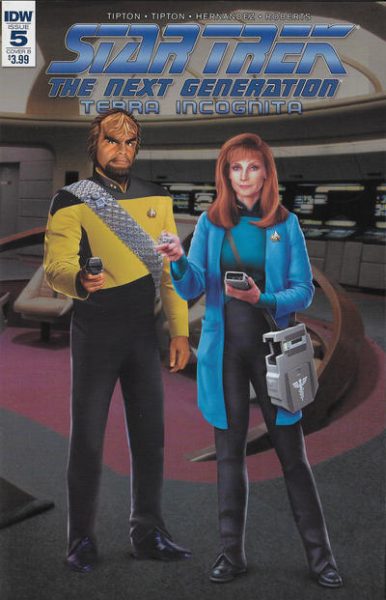
Oh, wait, I forgot about IDW, which uses photo covers all the time, especially for Doctor Who and Star Trek. Why, way back in 2007 I complained about making the photo cover the ratio variant instead of the regular cover. Why use a drawing of Young William Shatner when you can slap that handsome mug on all your covers and make a mint. Ah well, What Can You Do? In later years a lot of those photo covers from IDW have been freely orderable, some nice, some, um, a little awkward:

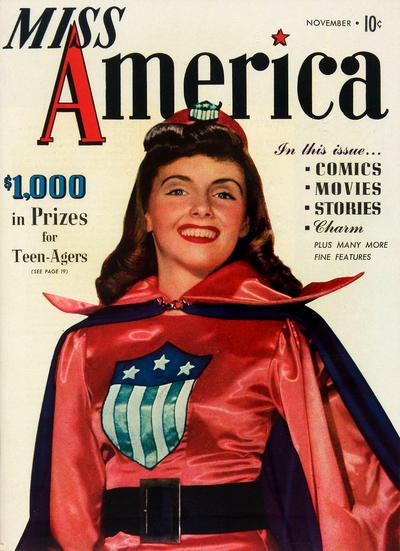
Now there’s no way I’m going to do a comprehensive history of photo covers just off the cuff right this moment…I mean, Turan says this is (maybe) the first superhero photo cover:


…and sure, I don’t doubt it. Looks like they did a good job on the costume. But I was trying to picture DC doing photo covers from, like, the Batman movie serial and how amazing that would’ve been.

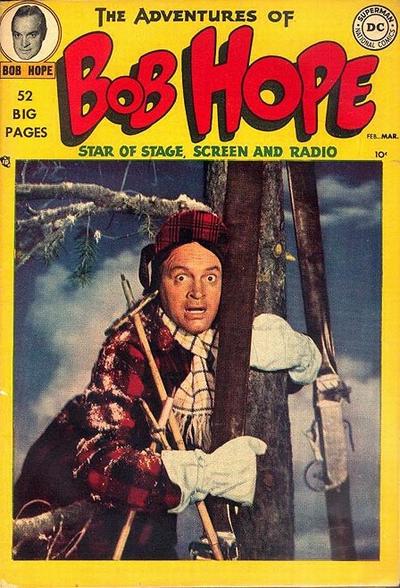
But there were plenty of photo covers to be had in the 1940s and 1950s,especially when celebrities were involved:


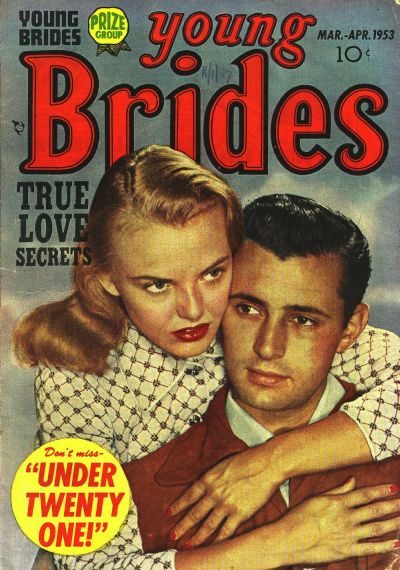
I think my favorites, though, and I don’t see enough of them passing through my store, are the romance comics with photo covers:


I would love (appropriately enough) to be able to put together a collection of these for myself. Especially Young Brides…there’s Jack Kirby in them there hills, friends!

I’m sure the photo covers (particularly for the romance comics) were there to make the comics look like their slightly more respectable magazine cousins. And the ones with celebrity photos would of course attract fans. Plus there’s the simple matter of photo covers just standing out on the rack…when you’re looking at that beautiful gory layout and see line drawing after line drawing, the sudden appearance of an actual picture of a real human is going to grab your eye. Photo covers were the foil/foldout/hologram gimmick variants of the mid-20th century. Why, if Death’s Head II & The Origin of Die-Cut came out in 1951, I’m sure the cover would featured models in some elaborate costuming!

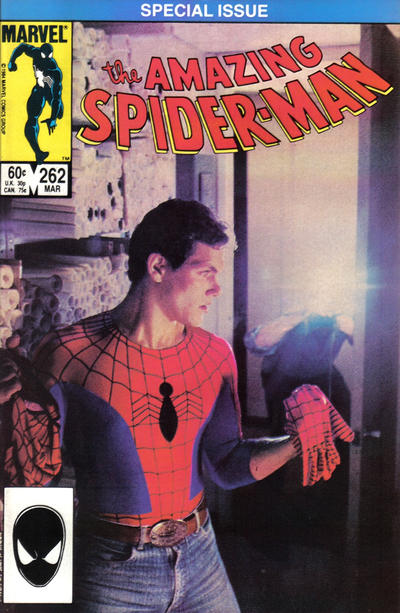
Anyway, I should note the one cover that seems to come up a lot, one that seems to be fairly common and that even some of you cited at me: 1985’s Amazing Spider-Man #262:


I always thought the cover design was funny, in that it’s got that “SPECIAL ISSUE” blurb across the top, and literally the only thing “special” about this comic was the cover itself. Not slamming the comic or anything (I mean, it’s Bob Layton, it’s fine), but as I recall (and yes, I bought this off the stands at the time because of that cover) it was just a typical Spider-Man story. Not like Aunt May joined with the Venom symbiote, or that Mary Jane pulled off her red wig and revealed she was Gwen Stacy. That cover did its job…it got you to pick up that comic. It sounds like it worked on a lot of you out there as well. Marvel did several photo covers in the ’70s and ’80s (the Dazzler and Spider-Woman are stand-outs, but I have a personal favorite).

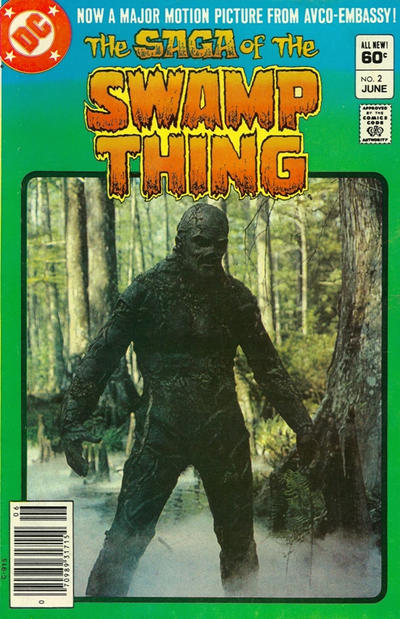
Let me wrap this up with possibly the greatest photo cover of all time:


Just your reminder that DC’s Vertigo imprint at least partially owes its existence to Wes Craven and that movie. Far as I’m concerned, that’s a celebrity photo cover for all us Dick Durock fans.

So let me ask you…what are your favorite photo covers?

Variant-active.

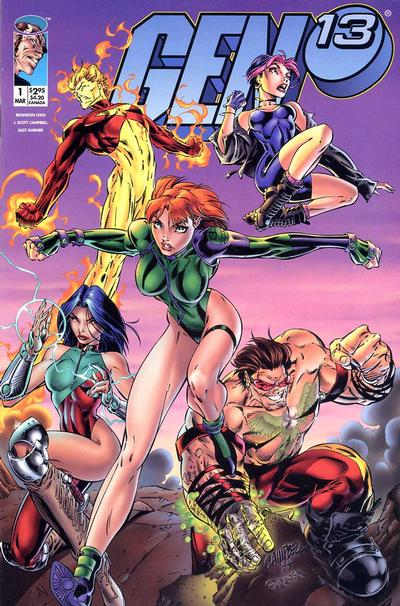
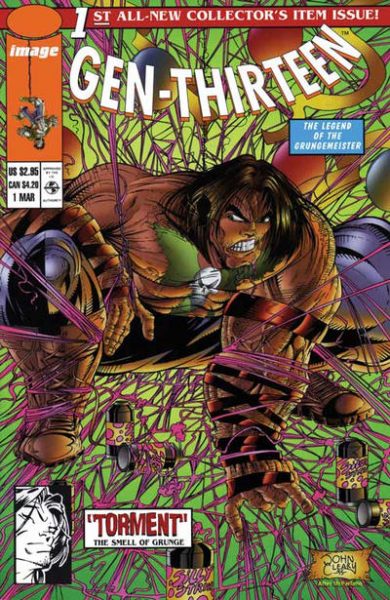
So Gen 13, when it made its debut in 1994, seemed like a younger, hipper take on the teen superteam formula that did so well for Marvel and DC. But Gen 13 was Young Comics by Young People for Young People, as compared to the relatively staid X-Men and New Teen Titans. That’s basically Image as a whole: “here are comics by the hep and with-it and not by those squares at the Big Two.”

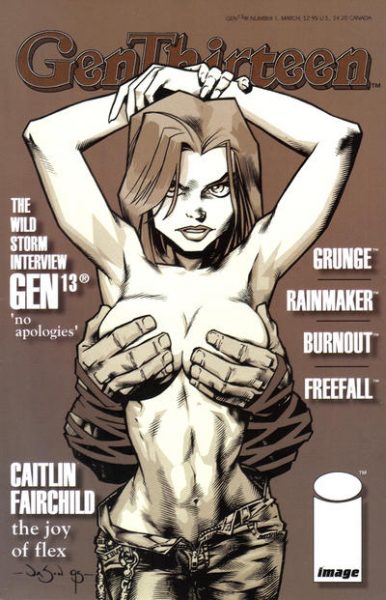
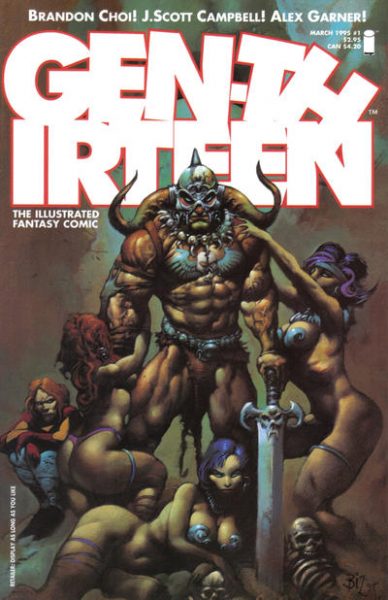
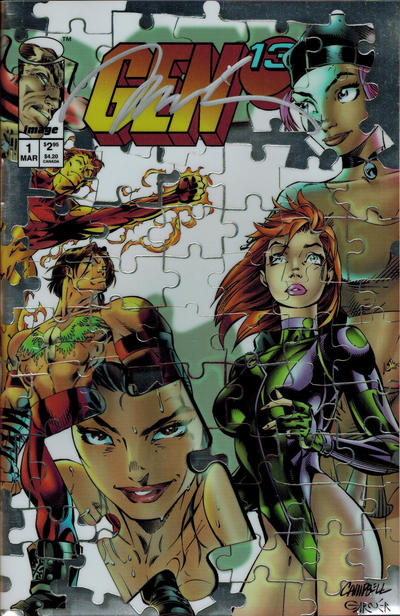
Anyway, that first mini did well, and so in 1995 an ongoing Gen 13 series was launched, and lo, if you thought the whole Robin II thing was too much, look out because here come thirteen variant covers!


Okay, it’s closer to, like, 14 different images (once you include the chromium cover, more on that in a second) and 15 different variants (when you count in the chromium cover and the “main” cover, pictured above, had a newsstand edition with a UPC code). I’m not putting every cover in this post, but you can see them all here.


I like how this cover references the Spider-Man #1 (which in turn referenced the Legends of the Dark Knight #1…it’s variants all the way down).

The one thing I’m wondering about, and just can’t remember for the life of me, was how the variants were ordered. Looking at this sales chart which just has “Gen 13 #1″ all lumped together as the #5 top seller. That implies to me that the comic was simply ordered as a single line item and the variants were distributed (more or less) equally. That is my vague recollection, and as I’ve said before, had I known I’d be writing a blog post about this a quarter of a century later, I’d have kept better notes. Also, I would have wondered what a “blog” was.


I also would have kept better notes as to which one sold better, though my gut instinct is that the “sexier” ones were preferred by the consumer. Like this take-off on the Janet Jackson Rolling Stone cover.

Many of the variants did quite well in the secondary back issue market for a time…the ones that were pop culture parodies attracted the most accrued value, and I recall having several of these in our glass cases. The main two covers (the one pictured above and a second one, both just featuring the team posing an’ such) were in somewhat lesser demand, and did not command as large a price. But, y’know, still sold fine.


Looking now, just peeking on the eBays, that there haven’t been a lot of sales of this issue in any variation over the last few months. Plus, the ones that do sell are for comparatively slighter prices. The Heavy Metal parody, pictured above, had sold for a significant amount (about $30), which have more to do with the Simon Bisley art and the cover’s Heavy Metal-ish subject matter. And I did find at least one copy of the Janet Jackson cover sold for $40 a couple of days ago.

Of course, the reason is that Gen 13 is currently a moribund property. Even during the run of this first ongoing the series took some hits, particularly after the popular artist J. Scott Campbell left the book early on. There were some attempted relaunches, but ultimately the last issue of a comic called Gen 13 came out a little over a decade ago. The characters themselves have popped up here and there since, including a cameo appearance of the team in the New 52’s Supergirl #33. And apparently some reissuing of old material is planned eventually.


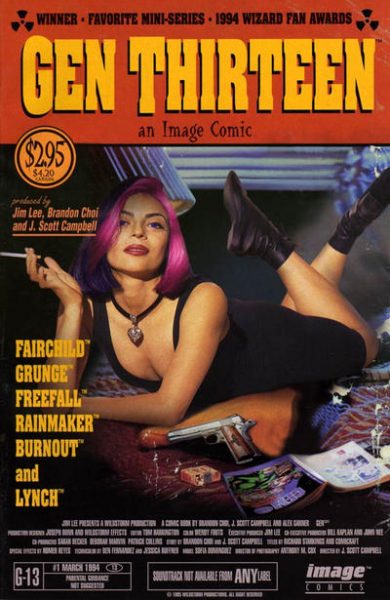
This cover, inspired by the film Pulp Fiction, was another of the more popular variants. Don’t have a lot to say about it, aside from that it’s the one cover to not feature hand-drawn artwork, but instead, a photo. I seem to remember that one not staying in stock long whenever we got it back in.


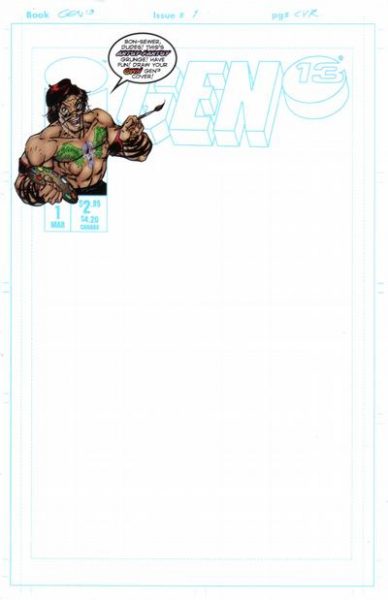
And I had several folks on the Twitters single out this comic as a precursor to the “blank sketch variants” that are so prevalent today. The big difference is that this is a standard slick cover, and not the “art board” covers of the later blanks that would seem to me be easier to draw on. I wonder if anyone actually did take a pen or pencil to this cover. Surely fans brought up copies of this to Campbell (or whoever) to draw upon at some convention.


Oh, and here’s that chromium cover. Not part of the regular distribution, but rather only found in a boxed set of all the variants, featuring a signature of one of the creative team. As you might imagine, it sold quite well when we could get our hand son one. Was it…$100, maybe? Again, too long ago, no notes, but that feels like the right price point.

So Gen 13…paving the way for Marvel to put out too many variant covers on too many of their books. (Hello like 30+ covers on Eternals #1)

Oh, and did I mention all the variants had cute names (like “GEN-et Jackson” and “Picto-Fiction”) Don’t recall anyone using these “official” names in the wild…but then, I heard someone ask for “copper age X-Men” the other day, so I guess anything’s possible.

Clearly I held the camera with my third hand.

A little follow-up on the Robin discussion from Monday…turns out I did have a copy of #2 floating around the shop, still sealed in its original bag. Wasn’t the greatest shape, so I performed the not-quite-ultimate sacrifice by popping the bag to present all the goodies within right here! I’M OUT LIKE A BUCK FIFTY FOR THIS POST, PEOPLE.

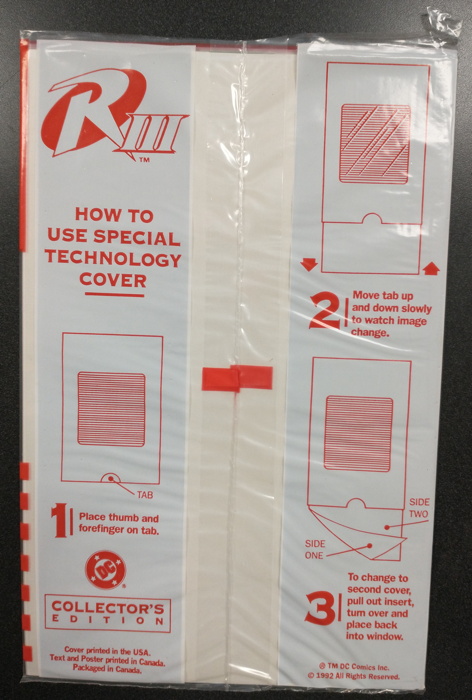
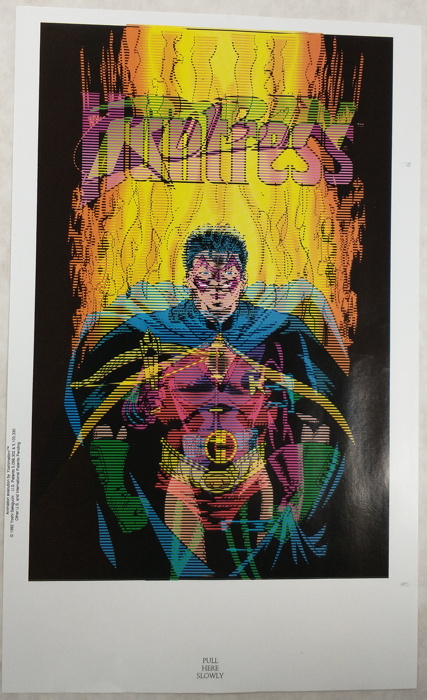
You saw what the front of the bag looked like last time, so here’s the back with all the poop on properly operating your Special Technology Cover™:

What they don’t tell you is that the insert you’re supposed to be pulling through the cover is…a bit flimsy and can be tricky to push back in after pulling it through. It’s definitely a two-hand operation.

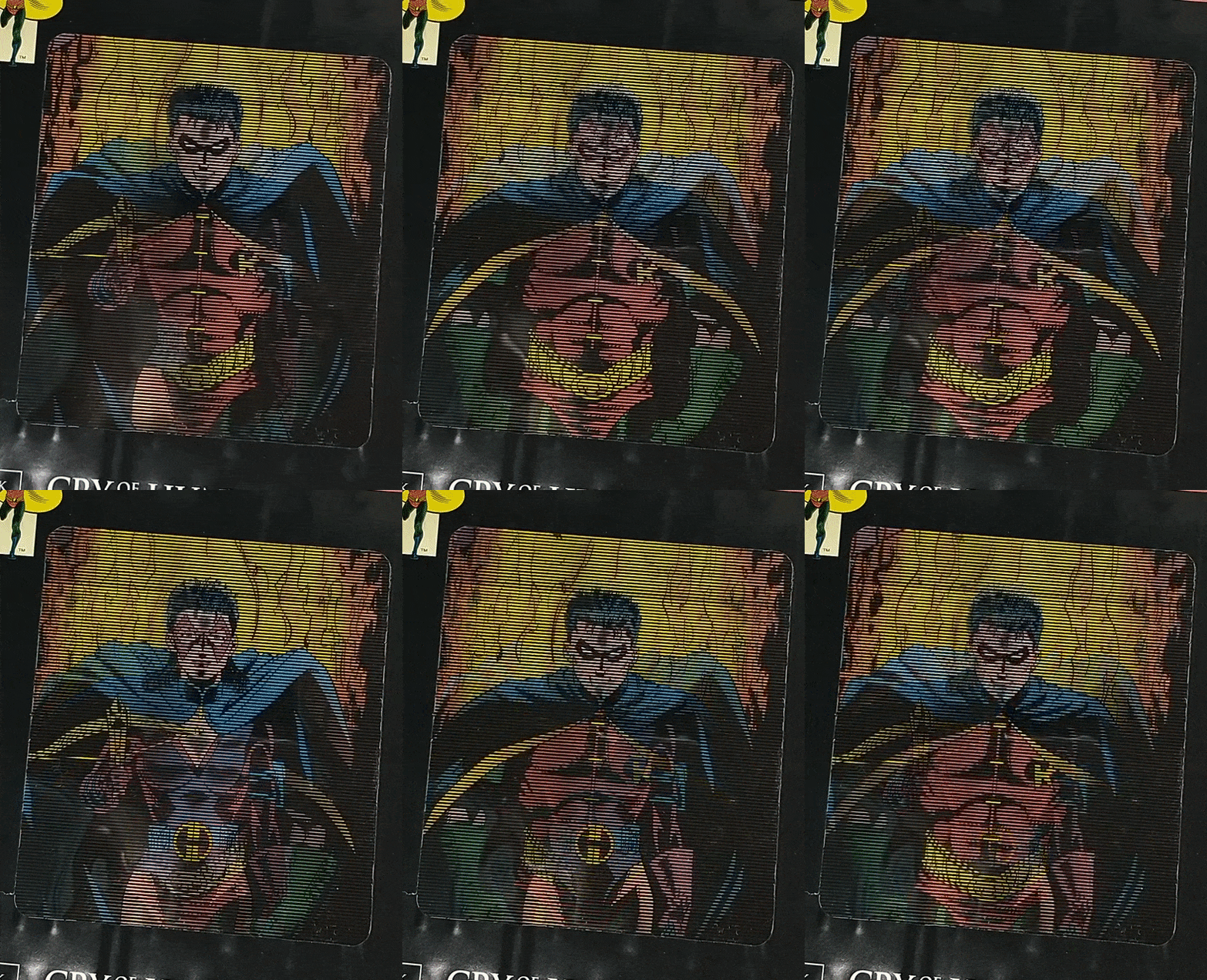
And once again, like last time, I made a GIF so you can get an idea of what’s going on here:

If it’s hard to tell, it’s a pic of Robin that changes into the Huntress, or vice versa.

This is what that insert looks like removed from the cover:

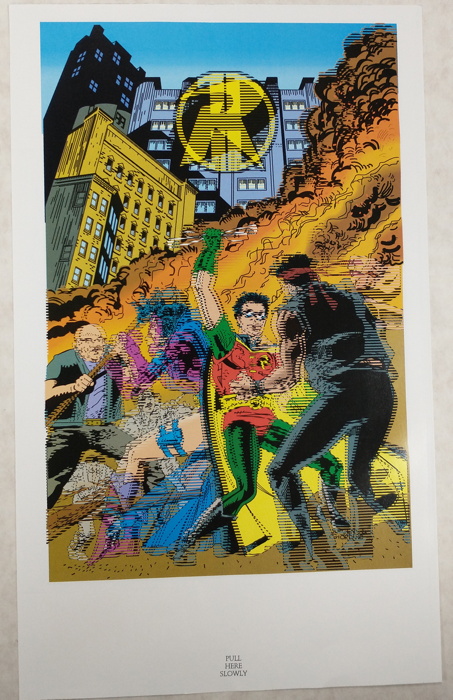
And here’s side two:

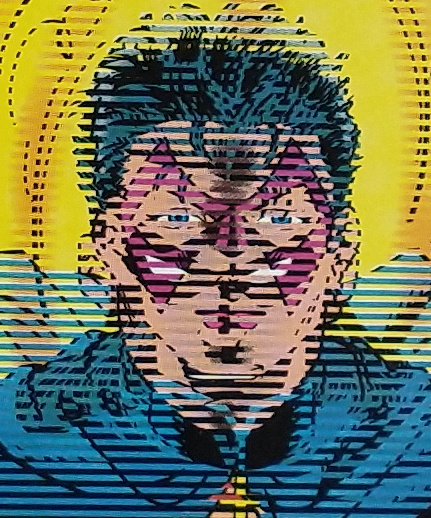
And BEHOLD, the jaggiest of Robins (with the Huntress Professor X-ing it out of his forehead):

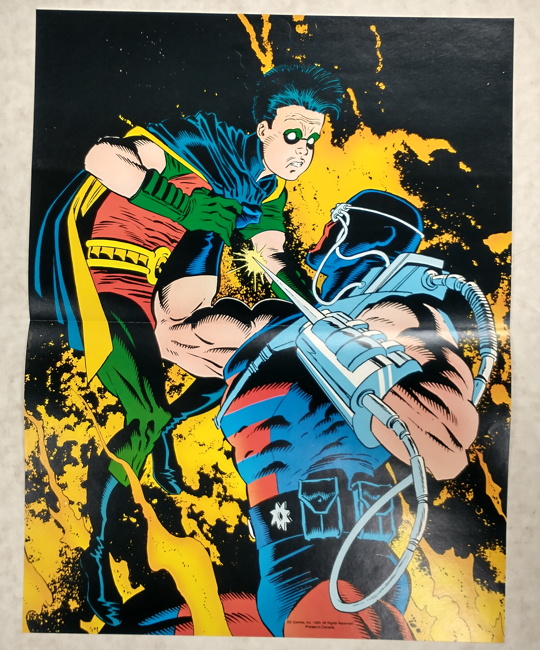
And just for the sake of completeness, here’s the included poster featuring the image from the “regular” version of this issue:

And there you go, friends…the 1990s. You never knew what wild cover gimmick was coming next, and this one was definitely in the upper echelon of “…what?”

More variant cover discussion coming Monday! And remember, if you have any suggestions as to where this terrible path should lead us, feel free to let me know!

“…With a kung-fu grip that don’t even work.”

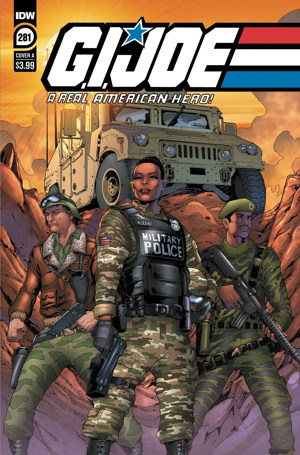
Monday I started getting emails and Facebook messages and stuff from folks asking for G.I. Joe #281, releasing this Wednesday from IDW. I sighed just a little, because by now I know what this means…some member of the elite comics-noscenti somewhere on an app or on the YouTubes has singled out this issue as “a hot collectible” and here we go again.

And sure enough…checking eBay right now, Tuesday evening as I type this, the “regular” covers (the freely-orderable A & B variants) are selling for between $10 and $20 or $30 or so, and someone has the 1-in-10 variant up for a C-note. When I checked on eBay Monday, when I first started receiving the requests, the regular covers were still at cover price, so things changed fast. (The 1/10 variant was listed for high prices then, too, to be fair.)

Why is it in demand? Well, it’s the typical trigger for speculation of late: the “first appearance,” this time of a new Joe named Sherlock. Haven’t seen a picture of him yet, and flipping quickly through the book didn’t reveal anything obvious. He might even be on one of these covers, I have no idea. I’m just hoping it’s a guy in your standard military fatigues but wearing a camouflage deerstalker cap.

So here’s the thing. This is issue 281 of a regular monthly series. It’s been going on for, like, a decade, picking up from the original numbering (and continuity) of Marvel’s G.I. Joe run. Most retailers have plenty of sales history on this book.

Meaning…I suspect most retailers didn’t order too far above what they actually sell. I know that, for years, I have sold essentially the same numbers on this title month-in, month-out, with maybe a one issue variance. After pulls, I’ll have one copy left on the rack. Most of the time it goes unsold and into the back issue bins. Once in a blue moon someone will buy it. Thus, at best, I’ll have one extra copy not spoken for.

Therefore, the second trigger for speculation is in place: scarcity. Probably the big mail order houses stored up some extra stock, but plain ol’ shops like me weren’t about to load up on it. Even if you told me months ahead of time “they’re gonna introduce a new Joe!” who would have thought “oh, yeah, issue #281 of this series, that’s the one that’s gonna attract all the attention!”

Sometimes you take chances on orders, but they have to be reasoned, educated guesses, based on what you know, not based on whether or not some random issue is going to attract the attention of investors. I actually ordered a bit higher on Batman/Fortnite than I would have of a Batman mini-series, or of a video game tie-in book. I’ve had customers over the years ask for Fortnite comics, and I knew that game was popular, so I gave it a shot. Turned out, this time, I was thinking in the right direction but not nearly enough…could’ve used a lot more copies. Apparently I was better off than a lot of stores, though.

At the previous place of employment I did the same with My Little Pony #1. I figured “this is a hot property, we have lots of kid customers…I’M GOING FOR IT.” I ordered a ton, and they all sold. Then again, I thought Superman Unchained would do better than it did…lots of great variants, Jim Lee art, the whole shebang. Now, as it turned out, we didn’t lose money on the comic, but we had plenty left over.

Those were decisions based on what I thought I could realistically sell, given the nature of the comics themselves, and what I thought would be our customer base’s response to them. It’s nearly impossible to anticipate fluke demand, that suddenly everyone’s going to decide they want the same single issue of a comic they’d never wanted before.

Even if you decide “a-HAH, I’ll just order more of every first appearance!” or “I’ll just order more of what these YouTubers/apps suggest!” that’s no guarantee those sales will materialize. In fact, quite the opposite…as I said, one of the triggers is scarcity. This speculative demand isn’t going to show up for a title sitting thick on your shelves. It’s going to show up for your G.I. Joe #281s, that you barely ordered to fill your pull lists and had one left over for the shelf in the off-chance someone else wanted it.

ADDENDUM: a while back one of my regulars dropped G.I. Joe from his pull list, after having it on there for many years, even dating back to when he was my customer at the previous place of employment. Figured I’d finally have to adjust my G.I. Joe orders for the first time in forever…’til about a day later someone started a new pull with me primarily so he could start getting that G.I. Joe series.

I called this the “Law of Conservation of G.I. Joe.” Please keep an eye out for my TED talk.

The Sensational Variant Find of the 1990s!

So, Robin #1. No, not the one that was released a week or so ago and had its speculation-fueled sell-out. I mean the now (urgh) 30+ year old mini-series that was absolutely red-hot. You know, this one:
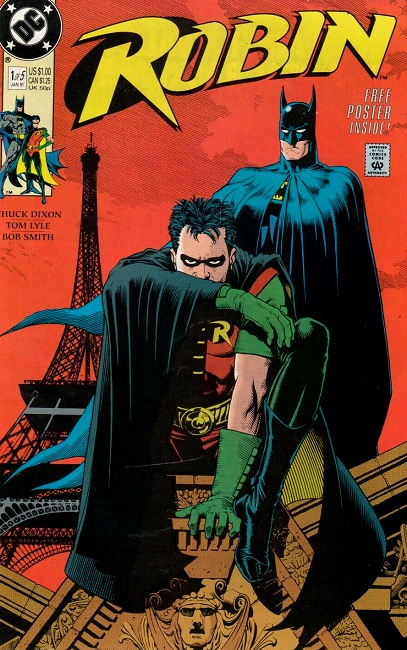

I can still remember trying to smooth out the creases in the door-sized promo poster they sent out for this thing while trying to display it in the shop. But anyway, as I was saying, this was a big seller, and demand was so high it went into second and even third printings. And they way you can tell these printings? By the little Roman numerals in the corner box there:
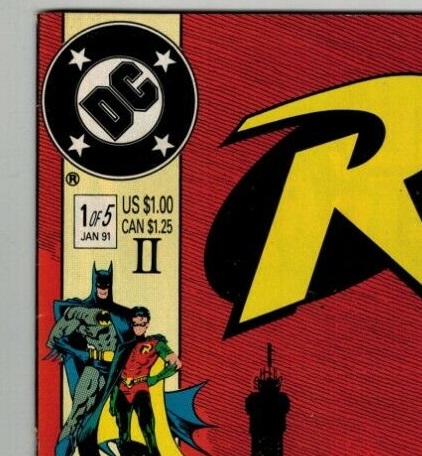

…which, I guess, makes those reprintings variants, thus fitting into the topic at hand. I kind of preferred this to DC’s later practice of changing cover colors or images to identify new printings, frankly, though I can understand the logic behind it. What’s gonna convince someone to double or triple dip on a comic they already bought? A little “III” or a whole new design? [EDIT: pal Nat reminds me that the contemporaneous Killing Joke also used colors to distinguish printings.]

At any rate, this is really as close as the first Robin series came to having variant covers. But don’t worry, dear reader, as they made up for it with 1991’s Robin II series.

This four issue mini-series had a decreasing number of variants as the series went on, starting with five variants for the first issue (not counting the “newsstand variant” with the UPC code, because c’mon), then four for the second, three for the third, and two for the fourth. Got that? Good.

For each issue there was one cover that was “normal,” and then the variant(s) would each feature different cover images and a hologram slapped on there, thusly:
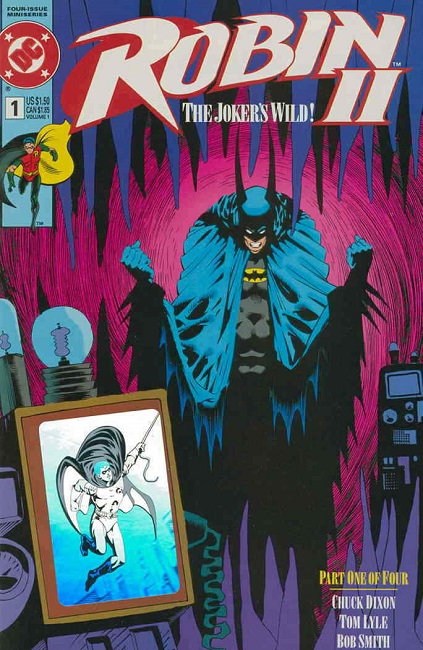

And look, here’s the hologram IN ACTION, as filmed-and-GIFfed by my own self:
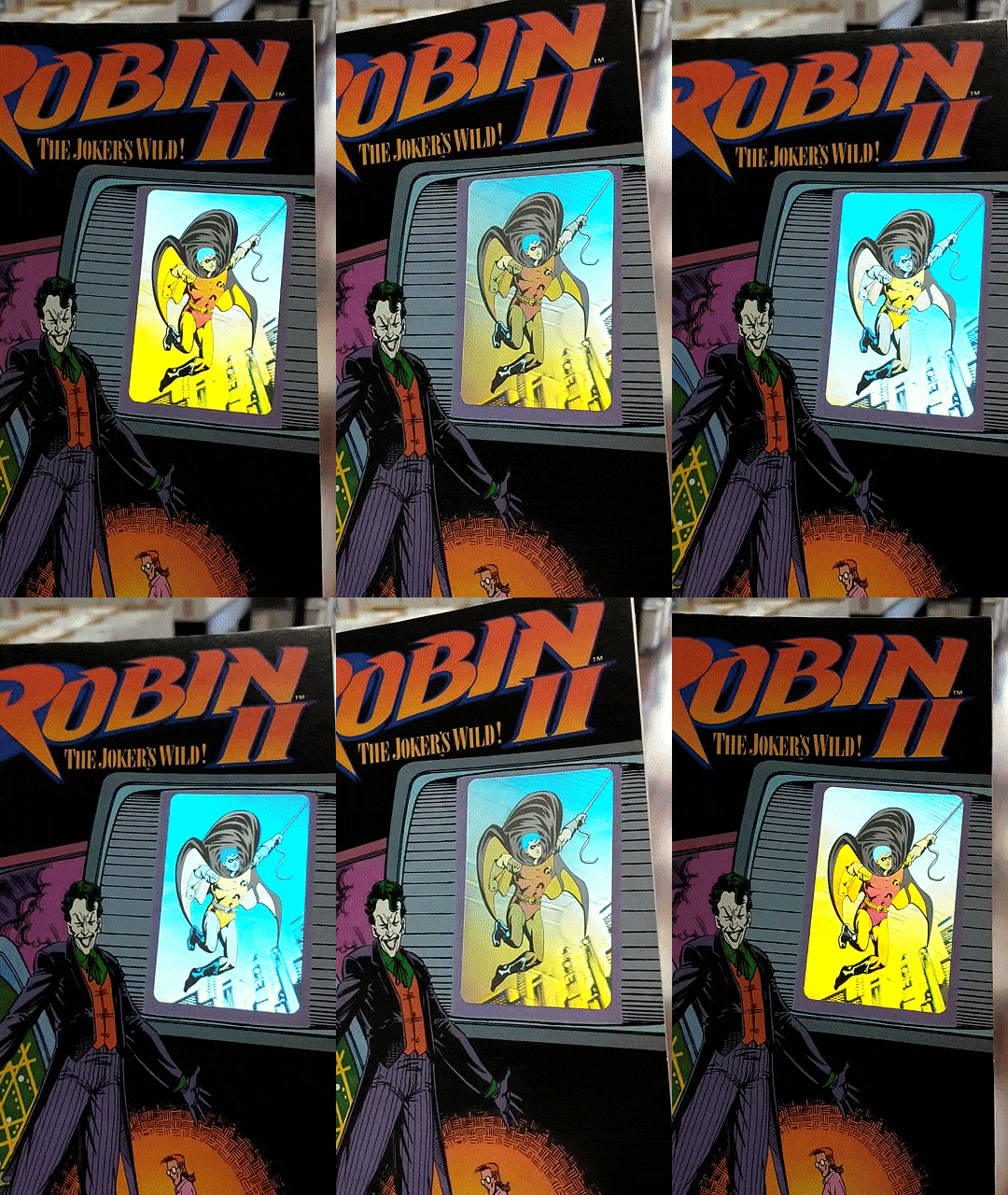

Exciting, right? How could you not want a full set of all those variant covers for each issue? Well, hang onto to your little green shorts, friend, because DC’s got you covered (get it?):
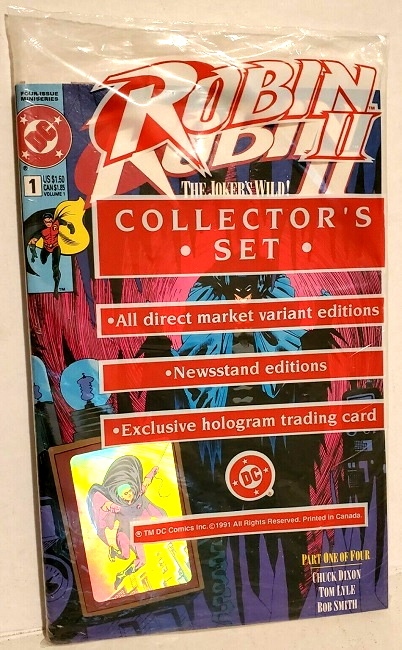

Yes, DC also marketed complete sets of all variants issue-by-issue in this polybagged packages, Plus a hologram trading card!

If this seems…somewhat excessive, you’re not wrong. It’s like Robin II somehow managed to take the multiple covers of X-Men #1 and the polybagged editions of Spider-Man #1 and formed them into this unholy collectible amalgam. By the way, when DC says “newsstand,” they just mean the regular non-hologram cover (which was offered both in a UPC-less direct sales version and a UPC-ed version you’d find at 7-11 or whathaveyou.)

Now, as far as the variants themselves…while not the first comic to have a hologram affixed to the cover (that would be Boffo Laffs #1 from 1986, I believe), the holograms do feature nicely iconic images of Robin, Batman, the Joker, and the Bat-signal on each succeeding installment (and the same hologram appears on all the variants for that particular ish). They’re also usually well-incorporated into the covers, though I kinda wonder about this Matt Wagner one:
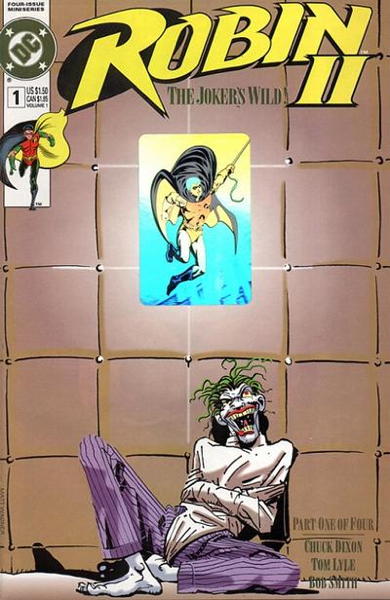

Is the Joker, like, thinking about Robin or something? Is that what that’s representing? Or did the asylum put up a framed hologram in his cell just to rub it in? Great drawing of the Joker, though.

Okay, in case DC wasn’t reaching into your pocket enough, they also had this $30 mega-collector’s slipcase set, for which I totally stole images from eBay auctions so I could illustrate it here:
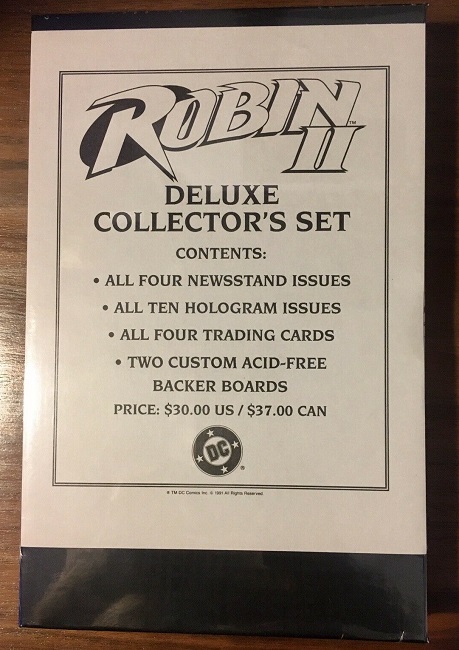

And in case you didn’t have enough holographic technology from the comics themselves, get ready for this thing on the slipcase:
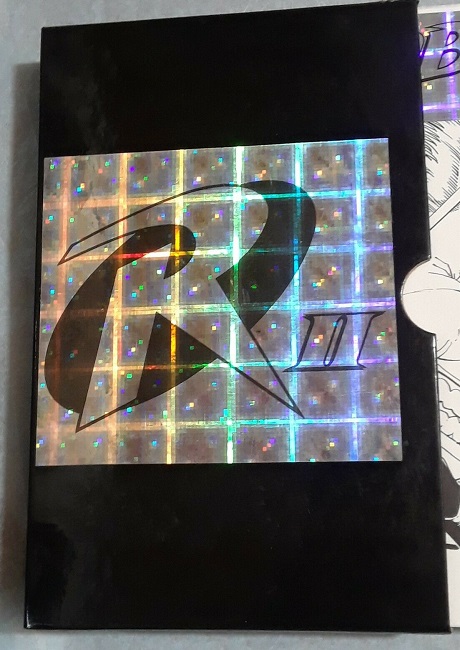

Now, it’s been a while since I handled one of these. I know at the previous place of employment we kind of had one kicking around the backroom for a while that I’d continually put on the eBays ’til it finally sold (I think). And the contents are…just what they say there on the label. I seem to remember the “two custom backing boards” being not really anything you’d want to use in your comic bags…kinda flimsy, and I’m pretty sure they had holographic stickers on those, too, because why not.

Speaking of holograms, since “hologram” was pretty much every other word in the last paragraph, if I recall correctly one of the promo items for this series was a little holographic sticker with Robin’s “R” printed on it. I can literally still see the small bundles of these we got from DC, unless of course I’m imagining these and they never existed. Which, you know, I wouldn’t put past my brain at this point.

So that series sells well, as you might have imagined, and you know what that means. That’s right, Robin III in 1993, which scaled back the variant-ism to just two covers per each issue of this six-issue run. You had your standard, regular, boring static image cover printed on regular paper that Grandma prefers, and then you had…SPECIAL MOTION COVERS:
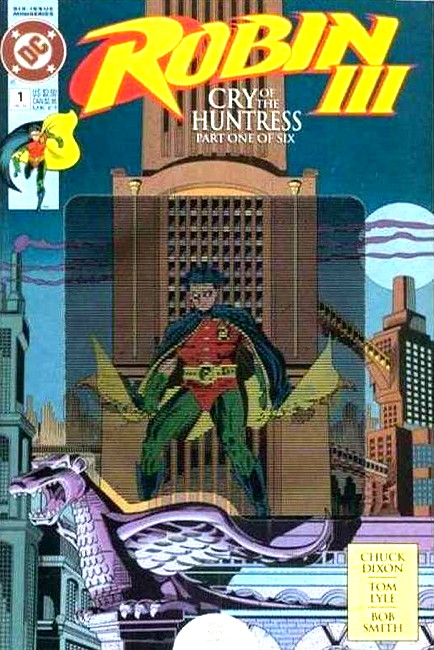

Alas, I didn’t have any of these in the shop right right now, otherwise I would have made an awesome GIF of this too. But trust me, you pulled the little tab on that cover and you cold make that image change. And it was a two-sided thingie too, so you could pull that insert entirely out, flip it over, and have a brand new image moving back-and-forth on that cover. I’m pretty sure that’s what they mean by “reversible cover” on the polybag that each of these “special moving covers” came in:
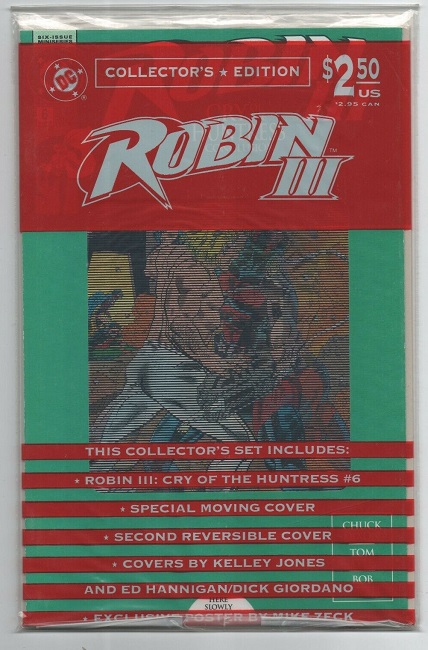

The poster noted at the bottom, kinda obscured by the folding of the bag’s bottom, was a poster of the comic’s regular cover. I thought that was a good touch and a solid bonus for fans.

One of my favorite things about the Robin III mini-series was that a demonstration copy of the special cover was sent to retailers. It looked like just another copy of the comic, but the pages inside were all blank. Honestly, I wish publishers would offer “blank” versions of some of those more speculated comics coming out now…would save them some money and they’re just gonna end up unreadable in CGC slabs anyway so they might as well be blank. Anyway, we had a lot of fun showing that Advanced Cover Technology to the customers, and that certainly moved some copies for us.

Following that in 1993 was the first issue of the ongoing Robin series, which ran quite a while and, oh yes, had variant covers for the first issue. You had your standard flat cover, and then you had this embossed beauty:
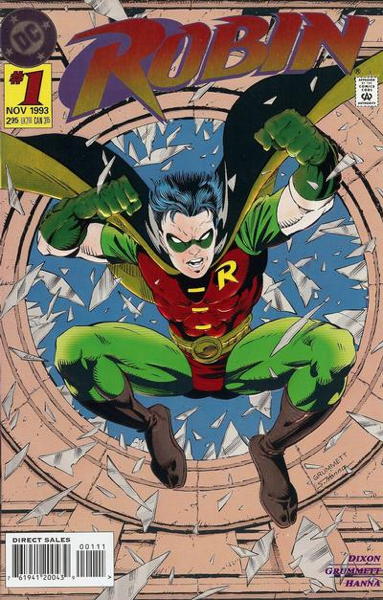

…with the figure featuring raised “3-D” puffy bits so you could examine Robin’s contours with your fingertips to your heart’s content.

Now, that aftermarket for these is a little hard to judge personally, in that I have copies of the first mini, one or two of the second, and none of the third currently in stock. I know while that original Robin ongoing was, well, going, the back issue sales on the various minis were very strong…especially for that original #1. I know at the previous place of employment we had a couple of those Robin II polybagged bundles still kicking around, and I noted how hard it was for me to move that slipcased set. A look at eBay shows at least the slipcased books are doing well now, so I guess I was just a decade or so early in trying to list the thing.

In collections I’d take in at my own shop, the most common of the Robin #1s I’d find would be that embossed cover for the ongoing series. I suppose a lot of people wanted to feel their Robins.

What’s next? I don’t know! The thirteen Gen13 covers? The trend of retailer-exclusive “platinum” editions for certain Big Comics? Or something else entirely? If you have a preference, you know how to tell me!
[taps the “Doing this for 33 years” sign again]

Whenever I extol the virtues of Free Comic Book Day, I am frequently asked questions lke “what good does it do?” “Does it really help your business?” “Do you ever get regular customers out of it, or do the new faces just show up to load up on freebies?”

In the simpler, easier-to-quantify short-term benefit, a Free Comic Book Day event makes my store a great deal of money. While the “free” comics I give away cost very little per individual unit, en masse, particularly in the quantities I traditionally purpose…well, it ain’t cheap. However, it’s always a worthwhile investment in that it attracts a lot of people to my shop for that day, most of whom take advantage of the store-wide discounts on products I’m actually selling. Along with the handfuls of free comics, many also walk out with stacks of graphic novels or back issues that they’ve also purchased. As I often say, I have never lost money on a Free Comic Book Day.

Aside from the financial considerations, there are the emotional ones. Free Comic Book Day makes people happy. Yes, happy that they’re getting free stuff…but they’re happy to be getting comics, they’re happy to be at the shop, it’s a big event that’s very exciting and cheerful.

And now we get into the long-term benefits. People will remember that happiness. That there was this cool shop in town that gave away a bunch of free stuff. That the Free Comic Book Day promotion itself caused them to find out if there was a comic book store in their area, who then sought out and visited my store for the first time. And now, those first-timers now know where to go for comics should they ever need any again. Plus, they’ve got friends they can tell about their experience…a little good word-of-mouth advertising is always welcome.

I don’t think anybody expects Free Comic Book Day events to create new weekly New Comics Day regulars, snapping up a dozen or so books every Tuesday/Wednesday. That habit is…kind of a lifestyle choice more than anything. But it does generate returning customers. I have had people specifically cite Free Comic Book Day to me as their reason for returning to the store to pick up something or ‘nother. I’ve had them tell me “I was going to buy this on Amazon, but I remembered getting free comics from you, so I’d rather spend my money here.” Yes, really.

So no, Free Comic Book Day doesn’t immediately convert all new faces into weekly visitors. But it does positively promote the store, either informs or reminds people that a comic shop lurks waiting in their midst, and that my shop is a nice, clean, and friendly place to go if comics are needed. It is a long term gain.

And thus it is the same with Batman/Fortnite.

The big problem is supply. Even I, who ordered much higher numbers on this than I would have on a typical Batman mini-series, still sold out quickly. So, unlike Free Comic Book Day, where everyone who came to the store left with what they wanted — free comics and discounted goods — many B/F seekers left without the item for which they were hunting.

In that circumstance, it may seem like it’d be difficult to put a positive spin on the shop for the disappointed customer. However, friendly service, an offer to hold future issues, and just generally offering as good an experience as possible, all things considered. I can tell you I didn’t have one angry, or even all that disappointed, customer after learning I was out of B/F. Well, okay, I had a couple of folks grumble at me because I wouldn’t let them buy a half-dozen copies of it for flipping on eBay, but that’s not the sort of customer I’m worried about here. Even if I didn’t have the product, I want new customers to know that it’s a nice store with a fella behind the counter what’s trying to be as helpful as he can manage.

On the other hand, what of the people who were lucky enough to get a copy at my shop? They were certainly happy to get a copy, at cover price, and like the new faces at Free Comic Book Day, they’ve learned there’s an inviting comic book store in town.

Again, no, they’re not likely to suddenly become regular visitors to the shop outside the B/F context…but you treat them well anyway, and, whether they were able to immediately fill that B/F need or not, they are more likely to remember you when they need something comic book-y for whatever reason. Even if it just another Fortnite tie-in comic book.

And rest assured, Batman/Fortnite is essentially like printing money for DC. There will be more of this sort of thing. And when the time comes, and, I don’t know, that Superboy and the Ravers/Fortnite crossover comic is finally released, where will the customers for that be more inclined to go? The comic shop that screwed them over by jacking the price up to $30 or whatever the last time a Fortnite comic came out, taking advantage of an excited kid or a desperate parent? Or the shop that sold ’em for cover price when they had it, and offered to save future issues and reprints of issues they missed? The shop that made you feel bad about buying a comic, or the shop that made you feel good?

I don’t buy the excuse that the inflated prices on Batman/Fortnite are no big deal given the money gamers usually spend on their game-related products. So what? Just because you can get away with something doesn’t mean you should. There’s no legal reason to not charge whatever you want on a comic book…otherwise, the back issue market would be markedly different, wouldn’t it? But a brand new comic, literally the day of release…for me, that’s an ethical consideration. It’s…well, it’s scummy, is what it is.

Robin #1 and Star Wars: War of the Bounty Hunters are a couple of recent hot comics that got the speculators all hot and bothered lately. What if on the day of release I bagged ‘n’ tagged them with $25 price tags? You know what that would make me? An asshole with unsold copies of Robin #1 and Star Wars: War of the Bounty Hunters on my shelf, that’s what. Would some people still buy them? Probably…$25 is probably a small investment after getting their copies in those CGC coffins and up on eBay for $200 or what have you. But the folks who just wanted to read the comic, and maybe don’t have the budget for those obviously smartly market-valued collector’s items? Well, fuck ’em, right? Gotta grab that cash while the grabbing is good!

Sorry, I want to sleep peacefully at night. And I want people who come into my store to leave with happy thoughts about their experience, making them more inclined to return, or recommend me to others. That is the long-term gain from treating people well, and not taking advantage of them when their need is great and you hold all the cards. As reader John said, “Don’t Be A Dick,” because folks will remember if you are one.

I look forward to seeing at least some of these new customers back in my store in the future, after this Fortnite comic thing is done. Because experience tells me that I will.

Only been doing this for 33 years, what do I know.

Well, I was going to answer a question about variants someone left in the comments to Monday’s post that I thought would be simple, but it started turning into a book and I’m not even sure I was close to being done, so…let’s put that on hold ’til Friday, after I’ve thought about it for a bit.

As for your latest Batman/Fortnite comic book news: yes, #2 is out this week, Yes it’s still in demand. Yes, still don’t have enough to go around, though from the sounds of it I was one of the few stores around here to actually have any kind of significant quantity of them ordered. Not nearly as many as it turns out I could have used, but I guess I was better off than most. Adding more customers to preorder lists, and will need to start calling a few folks to remind them that, yes, I am holding copies of #2 for them and they should come pick them up.

What’s nice is that at least a few of the Fortnite customers are buying other comics, so it’s not just kids ripping open their copies to get the codes and then setting fire to what remains. I mean, sure, most of them are doing that, which, y’know, fine, but if even a couple of new readers result, I ain’t gonna say “no.”

I was recently turned off of a podcast from a noted professional sporadic comics generator, which I’d been enjoying despite (or maybe because of) the not-always-justified self-aggrandizement and some…glossing over of certain points of the ’90s comics industry. But his enthusiasm was entertaining, and hearing his side of what was happening was educational…and, y’know, fans have been shitting on the guy for decades, if he wants to put out a podcast talking about how great he is, hey, more power to him.

But a recent episode discussing the Batman/Fortnite phenomenon and how some of his retailer buddies were dealing with it really left an unpleasant taste. While talking about all the new customers coming in the doors, he’s also saying how these retailers are charging $20, $30 or whatever a pop and essentially giving his approval of this.

I get that everyone was caught short on this comic, and that sellers are making a killing on eBay with these, but…the one thing the industry has desperately wanted is kids putting down Those Darn Vidya Gabes and buying comics again, and when they do…we start gouging them for as much cash as we can grab? Or, rather, their parents? What’s that going to leave them thinking about comic stores? Or with the comics industry in general? It’s…well, it’s gross, is what it is. I know, “supply and demand” an’ all that, but maybe a little long term planning over short term profits would be the preferable strategy.

I limited copies to one per customer, and took down lots of names for future issues. Or for reprints of already released issues if the first prints weren’t available, because the best part about all the Fortnite kids is that they don’t care what printing they get. The codes are the same in all of them. And I will sell them all these issues at cover price. End result: happy customers who’ll come back. Haven’t had a single person mad at me about the whole Fortnite situation. Maybe I’m just in a laid-back part of the country, but talking to folks who come in looking for the comic, explaining the situation, and offering to save issues as they come in seems to have a mollifying effect.

Anyway, I know this has all turned into something of a mess, but starting within an issue or two, once we start getting in the installments we were able to order once we realized how much demand existed for the book, there should be plenty to go around. In fact, I’m expecting a glut, as retailers probably went to far in the other direction ordering more than they could possibly sell. In addition, the buyers who are picking copies up out of pure speculation right now will drop off then, as only the relative scarcity drove those purchases.

So I always hear about it when I criticize retailer behavior (remember “not buy?” Sheesh, that was stupid) but since nobody reads blogs anymore, I guess, maybe I can get away with it this time. But honestly, the next time we get a huge influx of new potential customers, hopefully we can all put our best foot forward, y’know?

To me, my variants!

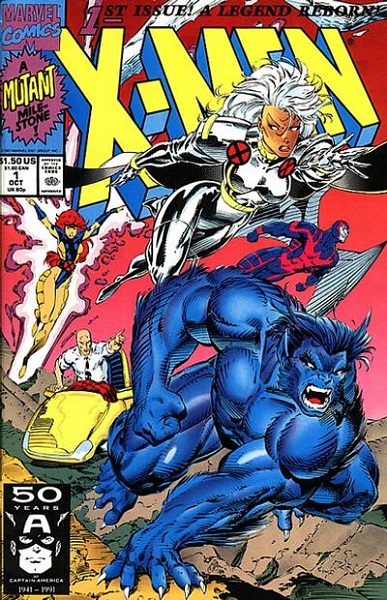
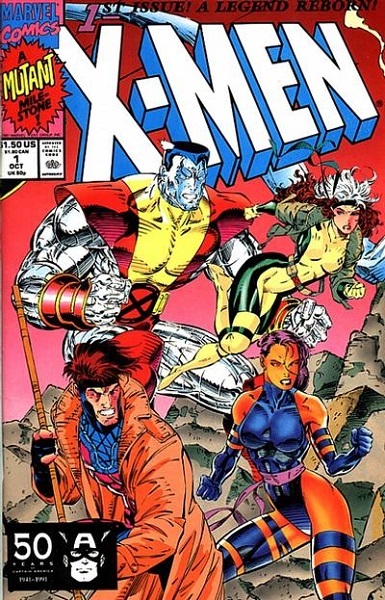
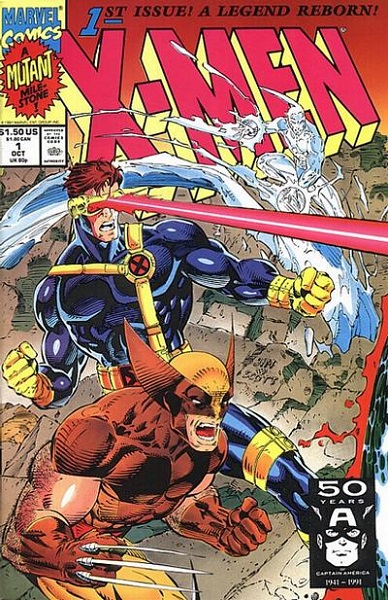
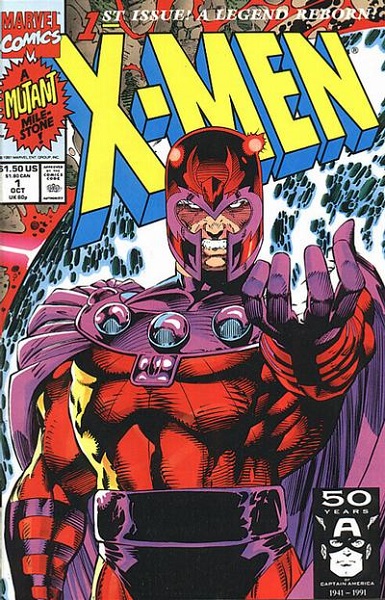
If you’re trying to decide “what’s the most famous example of variant comic covers of all time” — first, c’mon, what’re you doing with your life, and second, I think just through the sheer magnitude of copies that were unleashed upon an unsuspecting public, it’s gotta be 1991’s X-Men #1:

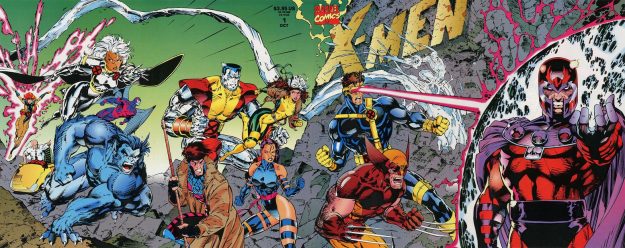
There were four different covers produced, the first three featuring a different mix of members of the team, with the final cover presenting their arch-nemesis Magneto. The four covers formed a single image when connected together, but if you didn’t trust your hand-eye coordination to assemble so complex a puzzle, Marvel had your back with the fifth variant: a gatefold cover that opened up to present the full image.

Unlike Spider-Man #1, the covers weren’t released all at once. Instead, Marvel decided to dominate comic sales for over a month by releasing each cover one per week, starting with the A, B, C and D covers (as they are usually referred to), culminating in the gatefold cover in the final week.

Orders were gargantuan. In total, over 8 million copies were produced, though as has been noted by multiple observers, and just through my own personal observation, a good chunk of those remained in retailers’ hands.

Speaking of personal observations, I’ve written in the past about how once impossibly-common comics from the ’90s marketplace are becoming slightly less easy to find in the wild, simply due to the attrition of stores that were active then having shut down in the intervening decades and taking their backstock with them. I’ve also written about how many of the people buying comics at the time either had no idea how to take care of their comics at the time (despite the wide variety of comic storage supplies being offered, and purchased, in sizeable amounts), or simply neglected their collections and let them fall to disuse and ruin over the years.

The point being…a comic that was once so commonplace and contemptuously familiar that copies were given away free with purchases is now, kinda sorta, becoming “collectible” again. Not to keep referring to things I’ve said in the past, but I’ve said in the past that even without actively buying copies of X-Men #1 in collections, I’m accumulating a backlog of it. And I’d say only abut a third of the copies I’ve seen have been in Near Mint or better, and when you actually have a copy in Near Mint (and not, say, VF- which you’re calling “Near Mint”) it can sell for a pretty good price nowadays.

Again, this all depends on local supply. There are probably still plenty of areas of High X-Men #1 Concentrations where they flow like water, and you merely need to dip your hand in a stream to retrieve a copy or three. And they’re all over eBay, natch. But, in areas populated primarily by newer stores, where even the bespectacled old men who have direct memories of those times and will gladly share them with you (ahem), they may not be as in deep a stock as they historically had been.

It was a large confluence of causes that resulting in this massive amount of orders:

  • The ’90s were a boom time for collectible comics, with a huge influx of new customers driven to comic shops primarily by the 1989 Batman movie, with earlier successes like Dark Knight, Watchmen and Teenage Mutant Ninja Turtles helping to push the expanding market as well.

  • It was the time of The Hot Artists, and Jim Lee may have been the hottest artist of the time. Launching an expansion of Marvel’s popular franchise with Lee on art chores couldn’t help but grab market attention.

  • The investors were out in force. The aforementioned Teenage Mutant Ninja Turtles arguably kicked off a new wave of folks looking to make their fortune trading in “rare” comic books, and what could be rarer than eight million copies of X-Men #1? Okay, nobody knew it was going to sell that many copies, but it was a pretty easy guess that it was going to move some large numbers. That didn’t stop people from buying boatloads of copies in the hopes that they’d be able to turn them into houses or kids’ college funds down the road.

  • This may be hard to imagine, but there was a time in comics publishing that when a new series was launched, the expectation was that the series would continue so long as sales held out, and maybe if sales dipped a little, the publisher would try things like “new directions” or “fresh creative teams” or more promotion to support the book. The idea that new #1s for titles would flash by like strobe lights was not one that was considered. As such, retailers would order plenty of first issues of titles, as that would likely be the most sought-after number in the back issue bins over the years, and hopefully decades, of the title’s life.

  • And yes, the multiple covers. Outside of investors, just plain ol’ folk who bought comics and weren’t necessarily looking to turn a buck. As I brought up early on this ongoing series of “variant covers” posts, having different cover images was a way to encourage the regular reader to pick up more than one copy of a particular item. Plus, having the additional twist of making all the covers connect into a larger picture…it’s a cunningly evil plan that, I can tell you at least from my memories of selling the things at the time, worked quite well indeed.

Some have pointed to this as being one of the causes of the ’90s market crash, and…I don’t know, I think there may be worse offenders (I won’t say any names, but the initials stand for Deathmate) since, all things considered, X-Men #1 actually sold (though again, not nearly as many as were ordered). There were bigger stinkers out there, at least to the point that X-Men wasn’t seen as a flop, whereas something like Turok: Dinosaur Hunter was. That said, I’m sure enough people got burned on their investments on ’90s comics, including X-Men #1, that they, and their money, fled the marketplace, reducing cash flow and feeding the crash.

So wither X-Men #1? It remains a popular seller, as do assorted issues from the 1991 series as a whole. There’s a whole new audience of comic book buyers and X-Men fans who weren’t around thirty years ago when this series launched. And there are plenty of customers who were around but misplaced, sold, or damaged their copies in the meantime and want replacements. And, of course, there’s the current wave of speculation mania driving sales on any “key” and/or first issues.

I don’t always have every cover in stock, but I usually have at least two or three different ones on hand. The cover I see the least? The gatefold cover. The one I see the most? Surprisingly, the fourth cover with Magneto, given that, according to this article, it was the poorest selling of the first four. And that gatefold cover was the highest selling. Huh, go figure. (Again, it all depends on how many copies actually got into people’s hands, and didn’t disappear with the retailers who ordered them.) It’s my memory that, as each cover was released every week, sales dropped a little with each one, with a boost on that final fold-out issue. But I could be wrong…it’s been 30 years, after all.

And which cover did I buy, since as a 1990s comics buyer you were legally required to buy at least one copy of X-Men #1? Why, the gatefold edition, of course…I wasn’t going to miss out on any of that artwork!

Next time in my variant cover-age, even though John kinda beat me to the punch: Robin comics! A whole lot of ’em! Holy gimmick covers, Batman!

In my headcanon, Beanish is somewhere in Dark Nights: Death Metal too.

So you may remember from (cough) nearly a year ago when I was writing a series of posts on intercompany crossovers (as linked here: 1 2 3). My intention was to write one more post on the topic which I never got around to doing, mostly because I feel like I hit bit of a stumbling block. I had in the back of my mind that the fourth post was going to be about the Eclipse Comics series Total Eclipse from 1988 and the First Comics series Crossroads, also from 1988. Must’ve been something in the air that year.

Anyway, when I actually thought about it for a second, I remembered “oh yeah, those aren’t intercompany crossovers, they’re intracompany” featuring characters they alone publish, more in line with, say Marvel Super Heroes Secret Wars or Crisis on Infinite Earths. Why I had these two series linked in my brain with the others, I wasn’t sure at the time. But, y’know, I think I have more of an idea why now. I’ll get to that in a moment.

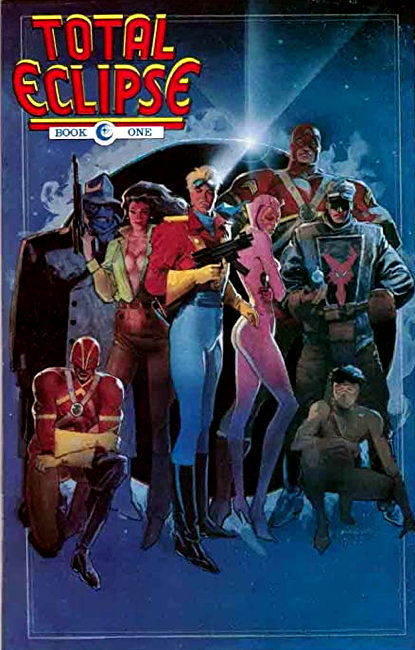
So let’s talk about this Total Eclipse mini-series:


Gotta be honest, haven’t read it in a while, so I have no idea how well it all holds together. I do have a vague sense that, um, it wasn’t the most readable thing in the world, though you had some top talent working on this book. Gorgeous Bill Sienkiewicz covers, Marv Wolfman and Bo Hampton on the main story inside…the book had a solid pedigree.

My personal primary interest in picking up this series was the involvement of Miracleman, whose part in the story eludes me at this late date, even after flipping through my copies pulled from the What’s Left After Putting Everything Else in The Store Mikester Comic Archives. He’s here and there participating in the action and hanging out with the other superhero-type characters and probably giving us a preview for how strange it’s gonna look when Marvel finally starts using the character in the Avengers or whatever.

Of note is a back-up Miracleman story in Total Eclipse #4 by Neil Gaiman and Mark Buckingham, who were the follow-up creators on the main Miracleman title after Alan Moore and John Totleben departed. This was the issue that continued to have back issue sales life long after the series was over, at least while Miracleman was still an ongoing thing and before it vanished into history, never to be seen again except for that brief blip at Marvel a few years back, and whatever the hell it was Todd McFarlane was doing with him in his Spawn comics. It used to have something of a premium price attached to it, though it was hardly in short supply (at least at the time), but that doesn’t seem to be much the case any more. I mean, on eBay someone’s had some luck selling them for $9 a pop, but using the keyword “Gaiman,” no “Miracleman” in sight.

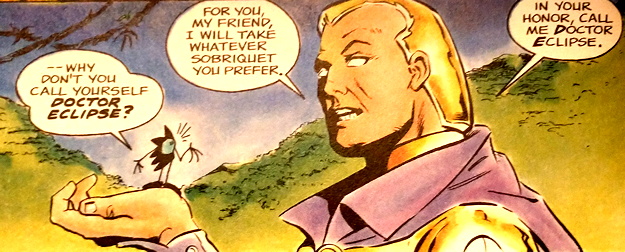
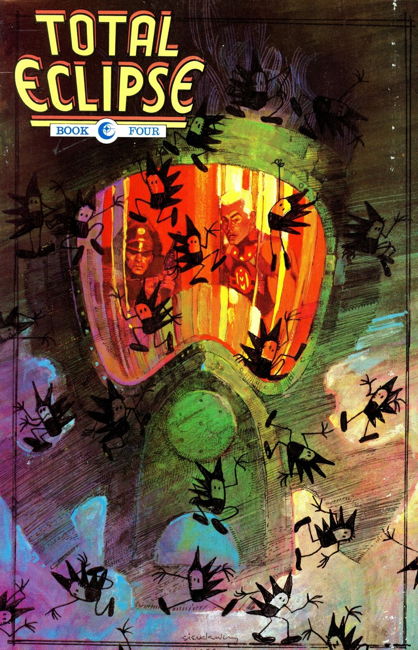
The other major reason I picked up this series was the character Beanish from Tales of the Beanworld, who plays a surprisingly heroic part in the story:


His involvement springs from a direct tie-in in the main Beanworld comic itself, where Beanish, the artist, goes on a near-spiritual journey outside of his home of Beanworld into the greater universe. Beanworld creator Larry Marder (who actually drew Beanish in Total Eclipse) explains the bean’s involvement here. There is a cute moment when Beanish is back in his own comic and he’s trying to explain where he’s been and all he can say is “yeah, it’s pretty complicated,” with a Beanworld-style illustration of a superhero representing his thoughts on everything.

Beanish (or at least, multiples of him) is featured on the cover of Total Eclipse #4 in glorious Sienkiewicz-vision:


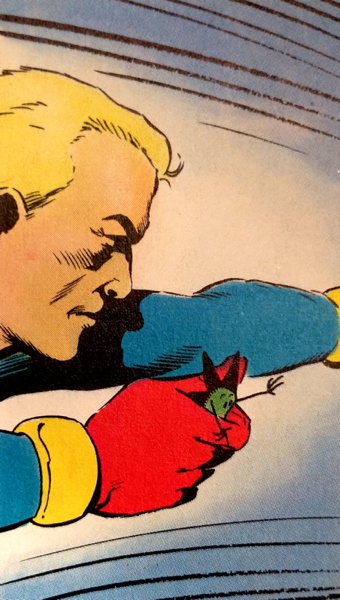
…and even better, he partners up with Miracleman, making them the World’s Finest team…sorry, Bats and Supes!


(You can find other outside-their-book appearances of Beanworld characters listed here.)

Kinda paging through the comics here again after so many years, I find that the only things grabbing my attention are the appearances of MM and the Bean (coming this summer to CBS), as I don’t have any particular attachment to most of the other characters. Well, except Destroyer Duck, he’s in here too. Oh, and Mr. Monster shows up. And the Heap. And Ms. Tree. But otherwise…I don’t know, man, I just read it for the characters I liked, which is how these crossover events getcha.

Speaking of which, why did I link this in my mind with intercompany crossovers, which clearly this isn’t? The most obvious reason is that none of these characters were really intended to team up with each other…they were mostly all in their own separate “universes,” for the lack of a better word, with their own genres and storytelling styles and such. They might as well had been published by multiple companies. At least, that’s my story and I’m sticking to it.

The interesting effect of a crossover is the intermingling and, well, “smoothing out” of all the characters involved. In other words, regardless of how they’re portrayed, scriptwise or artwise, in their books, by being pulled together into one story by another creative team they are all essentially unified in look and voice. Curt Swan Superman, Don Heck Wonder Woman, and Rick Hoberg Batman all become George Perez Superman, Wonder Woman and Batman in Crisis. Their disparate characterizations and dialogue all get filtered through one writer’s voice. At Marvel and DC, that’s one thing, where, at least in the superhero universes, everyone’s working in the same milieu.

But with a company like Eclipse, where the point is the variety of creators and genres and styles…cramming it all together into one book, with one artist providing most of the art (I mean, good art by Bo Hampton, with various assistants (with a few presumably working on their own characters like Marder did). The wide variety of art and personality is minimized to a specific vision. Which is fine, but what made some of those characters readable were their creators, and outside that context they can lose a little something.

(I believe the still-unfinished Image United tried to address this issue by having respective creators all do their own characters, but, um, I think there may be a reason why the series is unfinished.)

At least Beanish still shines through in all his weird little bean perfection. Okay, it’s not Marder’s lettering in his word balloons, but I can let that slide.

…So I was going to look at Crossroads from First Comics today, too, but surprise surprise, I went on a bit. I’ll tackle that event next time…promise I won’t take a year to get to it!