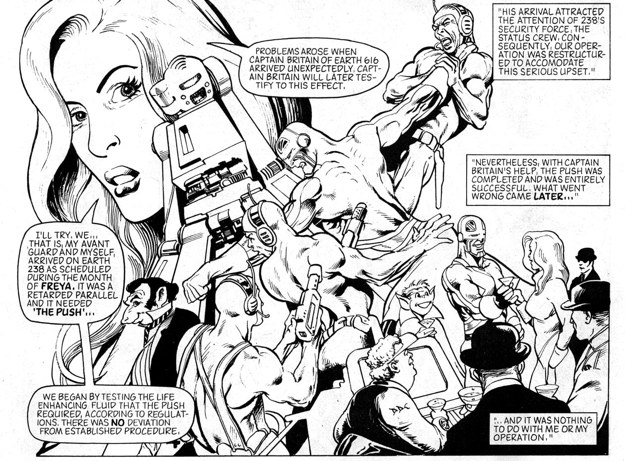
I’m trying to put together this whole thing re: DC’s multiverse and it’s requiring me digging up scans left and right and frankly, I’m not the young, energetic blogger I used to be, staying up well past the witching hour with the hum of a scanner my only company. I’m still working on it, but in the meantime, let’s get back to your comments and questions and such:
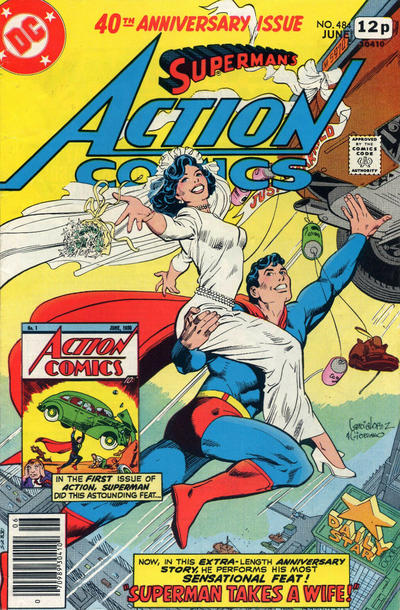
Matthew Murray points out, in regards to the semi-fake out of Action #484 and the marriage of Earth-2 Lois and Supes
“The other tip off for that Action Comics cover is that it features the Daily Star newspaper.”
That’s fair enough, and it’s a fairly prominent background detail featured in the corner of the cover there. But — and this is a big but, I cannot lie about liking those — your average person not mired in DC’s parallel-Earth shenanigans isn’t going to recognize that as meaning anything. They might think, if they even notice it, “shouldn’t it be Daily Planet?” and if they think that represents any kind of in-story problem, there’s no natural way for them to expect the resolution to be “Superman from another universe, y’all.”
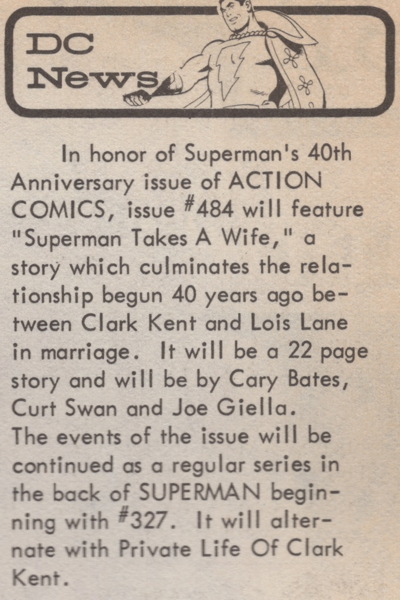
So my judgement remains “dick move,” at least as it stands in regards to the general public. And just slightly less of a dick move to folks more familiar with the milieu and observant enough to catch that detail. Plus, I don’t think DC itself ever emphasized that this was going to be not regular Superman taking a bride. Anyway, take that, 44-year-old Superman comic!
Hal Shipman sails in with
“The parallel universes were never confusing to me and my friends – they were explained in one, maybe two panels. I never got the references in COIE stories about them being a problem.”
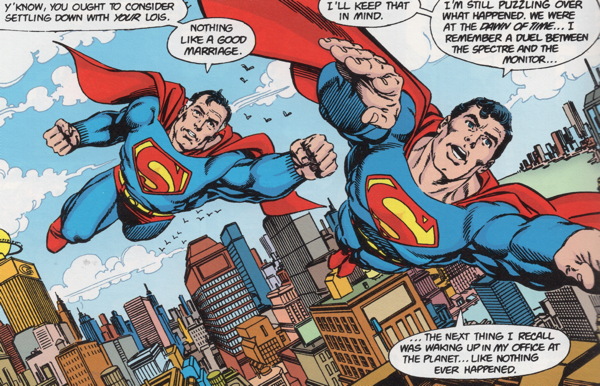
Yes, exactly…it was solving a problem that, at least internally, in comic book fandom, didn’t really exist. It didn’t take much to explain, like in this panel from Justice League of America #219 (1983) by Gerry Conway, Roy Thomas, Chuck Patton, and Romeo Tanghal:
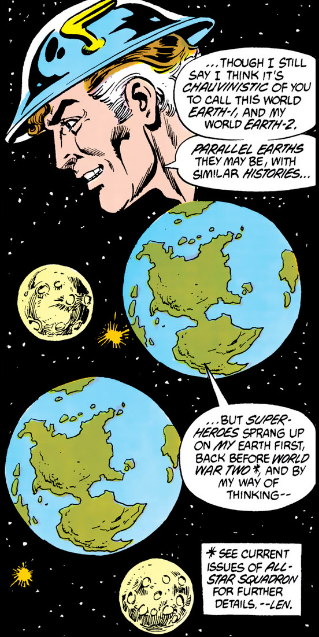
…and it was just off to the races. But I think it was a problem of public perception and confusion, as per that Action #484, that egged along a desire to streamline and get rid of potentially confusing elements such as “two Wonder Women” and the like. (Oh, and that specific letter published in New Teen Titans that inspired Marv Wolfman, but that’s a whole ‘nother thing.)
Or as you say:
“The ONE thing I kind of liked about the consolidated world was that it did make it easier to team up or make groups like the Giffen JL. But the constant retelling of pre-Crisis stories (especially in the Superman titles) to basically reintroduce elements was tiring.”
It did spare DC having to jump through hoops (or, you know, run a panel like the one above) in order to have the original Captain Marvel on a team with Guy Gardner without having to explain that he has to commute from Earth-S via the Rock of Eternity so he can help the Justice League fight the Gray Man. (No, not that Gray Man.)
The problem DC ran into with this sudden overhauling of their multiverse into one universe is that the readership from one era carried over into a new era. It wasn’t like the gap between the Golden Age and the Silver Age, where DC could introduce a new version of Hawkman as a space cop, and a new version of Green Lantern as…er, a space cop, and there was enough readership turnover in the meantime that they didn’t have a bunch of fans writing in demanding this new Hawkman and GL be reconciled with the previous versions of the characters. I mean, I’m sure some did, but a lot of those eight year old kids who rode out the end of the initial Golden Age superhero era probably didn’t come back at 16, pick up that issue of Showcase and suddenly go on a tear on 1940s Twitter with #notmyflash.
Or maybe they did. I don’t know, I wasn’t there, but I suspect that publishing gap gave DC enough of a clean break that they could essentially start over again with a minimum of reader confusion. The Crisis on Infinite Earths rejiggering had no such gap, and the folks reading before were told “forget everything you knew” and were along for the ride as DC tried to figure out in real time how this new fictional set-up was going to work.
The original plan of just restarting everything from scratch at the conclusion of Crisis might have been sufficient enough of a firebreak between What Came Before and What We’ve Got Now (well, Then-Now, you know what I mean), since DC putting everything on hold for five or six years obviously isn’t practical. ‘Course, they chickened out on that, and now (real now, not Then-Now) we’ve got what we’ve got. They did eventually sort of try that out with their New 52 publishing initiative, but even, like, Green Lantern comics just kinda carried on as usual, so the break wasn’t as clean as it should have been.
Crisis on Infinite Earths (like New 52 later) did serve its purpose, which was “get more eyeballs on DC Comics,” at least for a while. People have said in my comments and elsewhere that Crisis goosed them into trying out DC’s other titles, which is the ultimate goal of any superhero universe crossover event, even more so than DC’s annual attempts at redefining what “DC Universe” actually means.
Next time: more question response or that parallel Earth post I’m gathering panels for. We’ll see!