Entirely separate except for the bust killing distributors and shuttering stores.

There’s a lot of Comics Ages talk in the comments to this post — well, a lot of talk in general, hi Sean! — especially about the term “Bronze Age.”

Now that’s something I’ve poked at a few times in the past on this blog, like way back in 2008 and then relatively recently in 2019, and I’m sure one or two more times but you get the point. I’m not a huge fan of the term “Bronze Age,” and as I point out in one of those old entries, even the Overstreet Price Guide was all “yeah, that’s not an official Age of Comics” until suddenly it was an official age of comics.

Also as I’ve said, those are all just marketing terms to help sell old comics, whether it’s a publisher trying to make their reprints of 1940s books sound like a Big Deal instead of just filling some space in a World’s Finest 100-pager, or it’s someone trying to make their old issues of Arak Son of Thunder seem fancier by slapping a “COPPER AGE CLASSIC!” sign on their box.

Bronze Age eventually made the Comic Ages cut after enough people started using it to describe their books…and after getting enough distance from the period to be able to say “yes, this period of comics does look distinct enough from what came before and what came after to make it its own thing.” But that said…I feel like 1984 is too late a cutoff date for the period. Crisis on Infinite Earths I think is what’s being used as the break between ages, given its massive (and continuing) impact on DC Comics and how other publishers handled big events with their title. I’d say New Teen Titans #1 in 1980 would make a better separation point, given its new style and direction for the team and how it energized DC to an extent, and it’s what lead Marv Wolfman and George Perez to Crisis. I’d say it’s as much as a demarcation point as Showcase #4 in terms of “this is what superhero comics are now.”

(Yes, New Teen Titans is walking in X-Men‘s footsteps, but that would really disrupt the whole “what is Silver/Bronze/Copper” thing and I’m too tired to deal with that right this second.)

Daniel T notes that he’s not a fan of “Bronze Age” including stuff like Love and Rockets and Nexus, and that’s fair enough, as Comic Ages tend to be DC/Marvel/superhero-centric anyway. I mean, I don’t know that I’ve ever seen the underground comic God Nose described as a “Silver Age book.” There’s a case to be made that undergrounds/small press/indies are their own thing, outside the main “comic ages” universe. A parallel universe of comics history, if you will. One that contains the “Black and White Boom/Bust,” a phenomenon almost entire separete from the color superhero funnybooks.

I mean, people will use those terms for “Cerebus #1 Bronze Age Key!!!” or “Bone #1 Copper Age Key!!!” but…I don’t know. I don’t have an answer. And the rise of indie titles was a big part of the comics industry…pushing the Bronze Age back to 1980 to include a lot more of them would be nice.

Anyway, not going to solve this issue right here and right now, and yes we still need to come up with divisions to split up that “Modern Comics” age. I came up with a good’un in one of my old posts linked above.
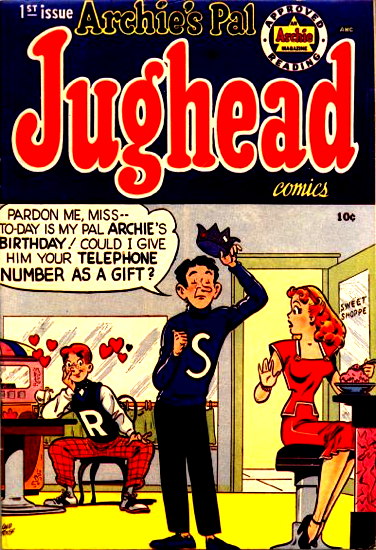
Don’t send me emails about the Jughead joke.

So Hal Shipman sailed in with

“IIRC, ‘X’ was an allusion to what they really wanted to call that Earth: Earth-Swastika, i.e. where the Nazis won.

“Kind of like (but not really) where he Fawcett world was Earth-5, rather than Earth-S because a) they were already were using numbers, mostly, and b) someone thought everyone would think the ‘S’ was a ‘5’ anyway.”

To which the I’m sure entirely-coincidentally-named S responded

“Wait, I’m confused – wasn’t the Fawcett world Earth-S?”

The answer is, yes at first, when DC Comics started publishing the Marvel Family, they were relegated to another parallel Earth, eventually dubbed “Earth-S.” The “S” of course stands for the same thing as the S on Jughead’s top:

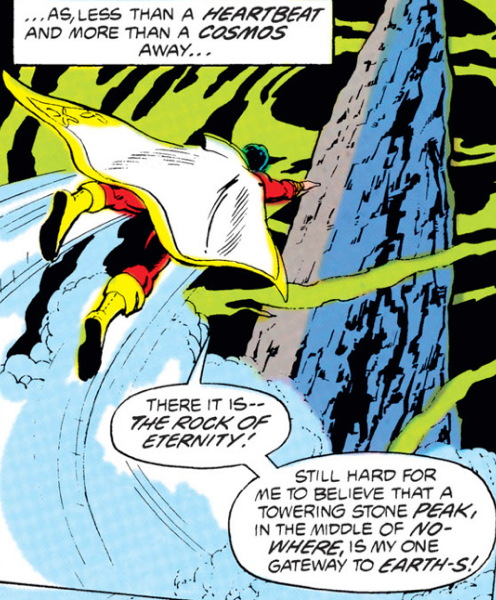
Anyway, it was cited as such whenever multiversal shenanigans cropped up involving the Big Red Cheese, such as this example from DC Comics Presents #33 (1981):


(That’s Superman in the panel, by the way…long story.)

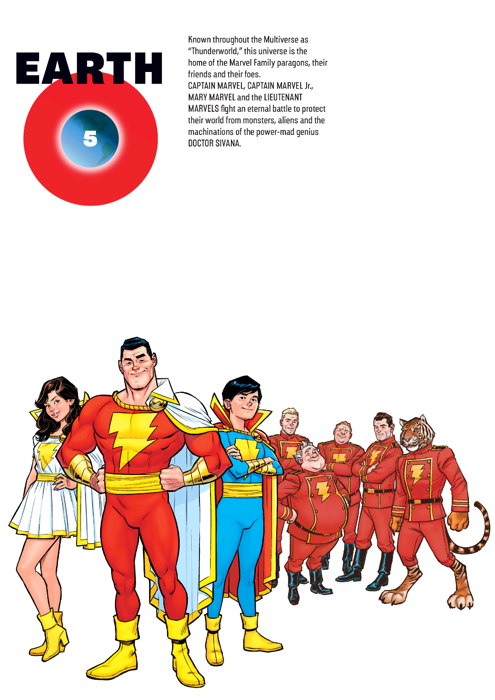
I presume that changed to Earth-5, with the numerical designation, at around the time they were rejiggering the DC Multiverse a few years back, as per this entry in the Multiversity Guidbook from 2015:


Please note it’s still the “Marvel Family” here, with all their proper names, as opposed to Main DC Earth’s continuity where they’re all named “Shazam” istead. YUCK, PHOOEY

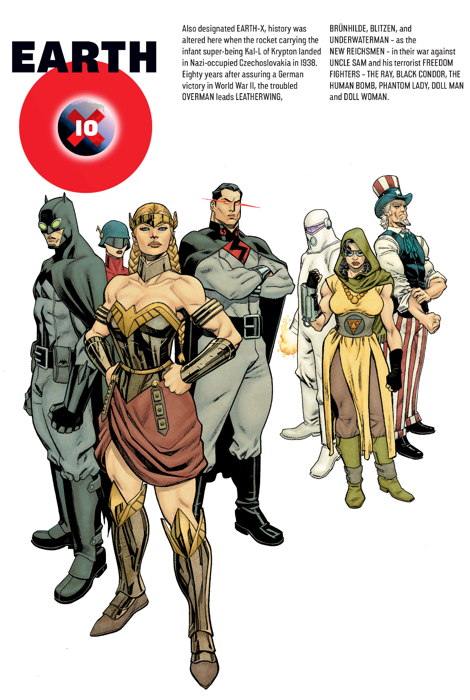
By the way, the Multiversity-era version of the pre-Crisis Earth-X is called “Earth-10” but retains the “X” in its guidebook listing:


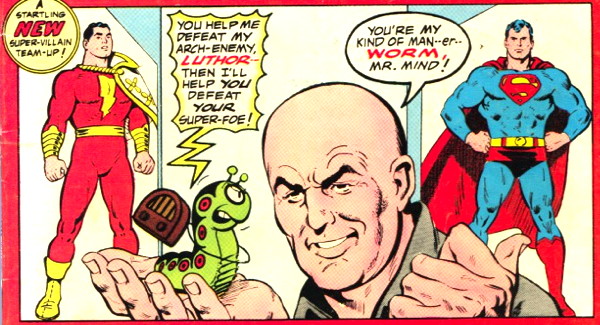
Back to Earth-5, or -S, or whatever…I’m not 100% sure of the first usage of the Earth-S designation. I thought for sure it would have been used in this story where Lex Luthor is mystically transported to the Marvel Family’s world in Shazam! #15 (1974):


…but there’s not really any of the usual talk of “parallel Earths” or nuthin’ in the course of the story, and at the end Luthor wonders if it was all just a dream. I presume the editorial decision at the time was to keep Captain Marvel and his pals separate from the tonally-different DC Universe at large, save for a story like this where it could be kept at least somewhat ambiguous as to what actually happened, at least from the perspective of the characters.

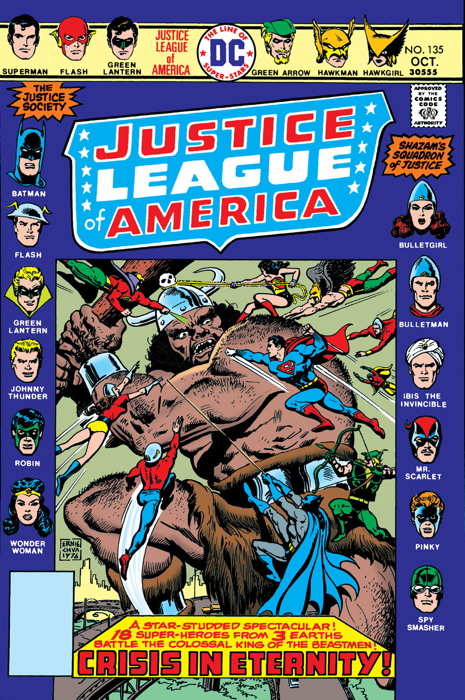
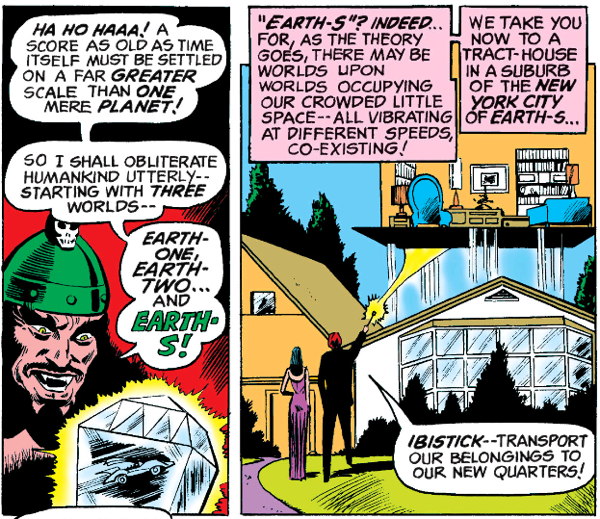
Well, that escalated quickly, as I believe this brings us to Justice League of America #135 in 1976. That comic starts off a big multi-issue hoohar between Earth-1’s Justice League, Earth-2’s Justice Society, and the characters originally from Fawcett Comics, which of course brings in the Shazamers in later chapters:


It’s inside this issue that we get what I believe is the first time the Marvel Family’s Earth is dubbed “Earth-S.” At least, its presentation here makes it look that way:


So ultimately, the answer to whether it was “Earth-5” or “Earth-S” is of course “yes.”

I mean, seriously, the age is given right there in the text.

[um, SPOILERS AHEAD for Dark Knight Returns, I guess]

Joe Gualtieri has a question that should’ve occurred to me during my Old Joker discussion:

“I expect this kind of thing from these apps, but in the specific instance, how did they not think of Dark Knight Returns, never mind any of the stuff you named, Mike?”

Welllll…I forgot, and who knows about the people running the Hot Comics App…something like Dark Knight Returns is probably ancient history to them. But lemme defend myself just a tad here.

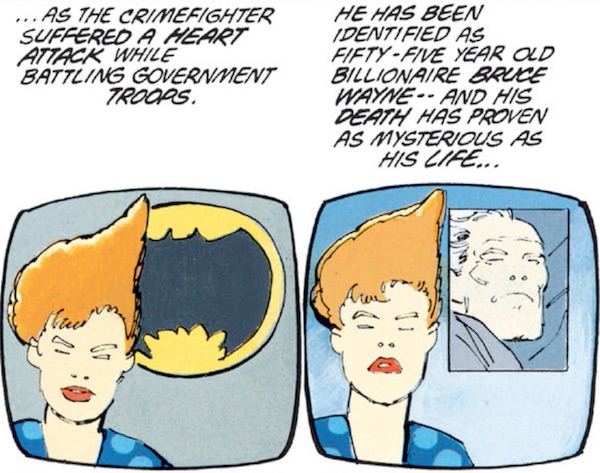
The Dark Knight Returns by Frank Miller, as most of us know, is about an older Bruce Wayne who returns to being Batman (hence the title) after having given up the costume a decade earlier. In issue #4 of Dark Knight (or “Chapter 4 of Dark Knight Returns” for you newfangled trade paperback readers) Bruce’s age is specifically stated as being 55:


(Oddly, I found this article that goes through a lot of trouble figuring out Batman’s age in Dark Knight Returns and other related works by Miller…which ignores the explicit statement of 55 and comes to the conclusion that he was 48 in that series.)

Continuing the assumption from my previous post that Joker is likely of a similar age (the symmetry of Batman and Joker being “two sides of the same coin” and whatnot would, at least in my interpretation, possibly preclude too much of an age difference between the two), he would be about 55 as well. When we first see him in Dark Knight, he’s sitting quietly in the asylum watching TV when he sees the news of Batman’s titular returning:


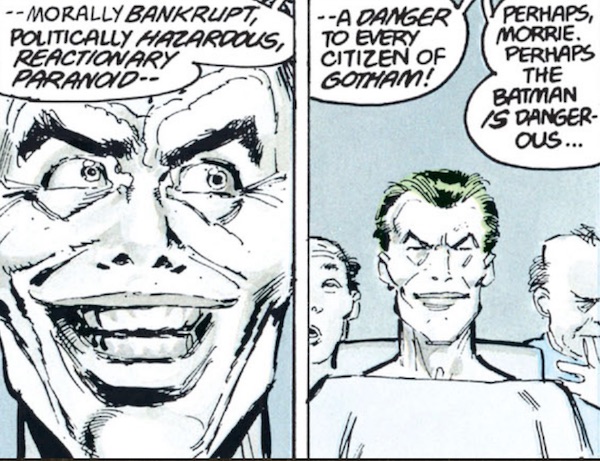
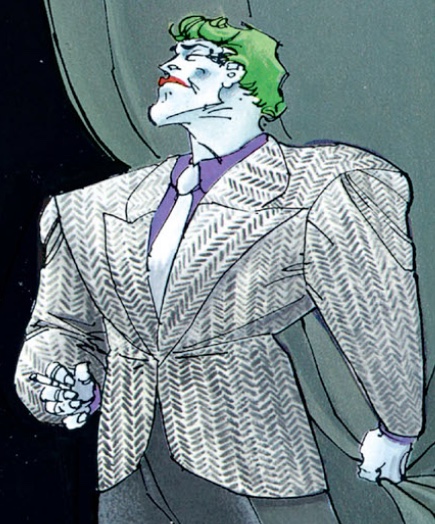
And then he cleans up pretty well for this TV appearance later in the story:


Now, to the Frank Miller who wasn’t yet 30 when writing and drawing Dark Knight Returns, 55 probably seemed terribly ancient to him. It would be inherently ridiculous for someone to still be running around dressed as a bat at that age. You know, instead of just running around dressed as a bat in his twenties, like a normal person.

But we can say neither Batman and the Joker are necessarily old-old in this series. I mean, the working premise of the story is that Bruce Wayne is too old to be doing Batman stuff, which isn’t necessarily the same as being elderly. Heck, even the 70-ish age we’d pinned Joker’s age at in some of his appearances listed in my previous post doesn’t seem as old as it used to. It all comes down to just what you think the world “old” entails. That Justice Society Annual entry in the Hot Comics App could simply be understood as “first appearance of a Joker that’s older that what we’re used to seeing.” They’d still be wrong, of course.

I think what I’m trying to say here, Joe, is that, as a person who as of this writing is 53 years old, I’m not going to think of 55-year-old Joker as old. Nope, no way, I REFUSE.

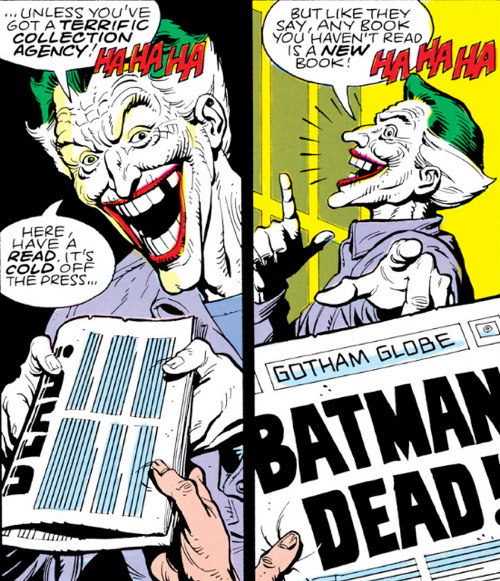
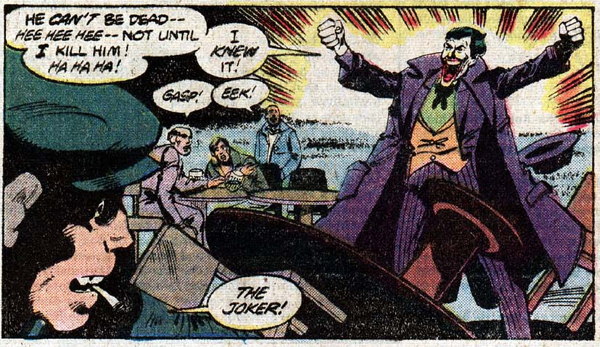
I do like the Joker in 1983 is still carrying around a 1979 newspaper headlining Batman’s death .

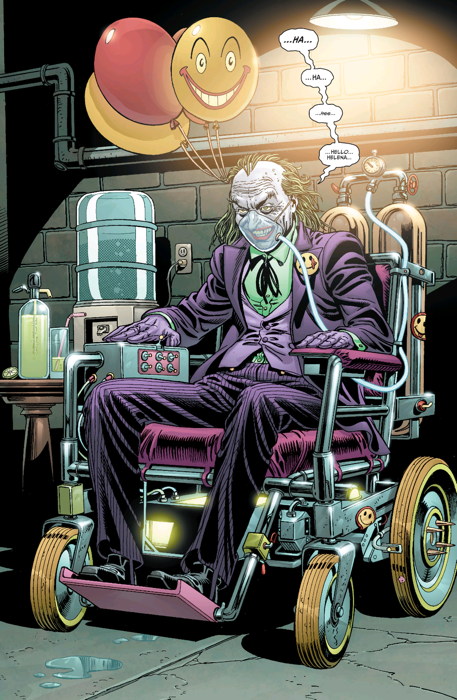
So I was looking up some pricing info on one of those “Hot Comics Apps,” as I occasionally have to do out of self-defense, when I came across this note on the 2008 Justice Society of America Annual:

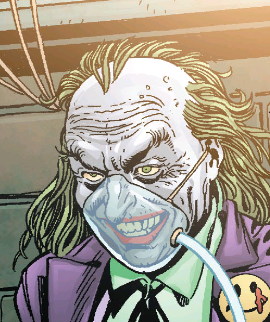
And here is said Old Joker of this newer version of Earth-2, as he appears courtesy Geoff Johns, Jerry Ordway and Bob Wiacek:


SMILE FOR YOUR CLOSE-UP

Anyhoo, seeing that particular notation in the app made me say “Whoa, hold on, I know that ain’t true.” Yes, I totally said that out loud in the shop, how dare you doubt me. But the first thing I thought of after seeing it was Brave and the Bold #200 from July 1983, in which we also see an Old Joker, also from Earth-2 (the real one, not the “make Crisis on Infinite Earths never not so” version we got post…Infinite Crisis?). Here he is, via the talents of Mike W. Barr and Dave Gibbons:


All I can say is this Earth-2 version of the Joker aged a lot in two years, as in August 1981’s Wonder Woman #281 through #283, the Huntress back-up stories by Paul Levitz, Joe Staton and Steve Mitchell feature…you guessed it, the Earth-2 Joker, looking as hale and hearty as he ever did:


Now, trying to pin down exact ages for comic book characters can be tricky, but it’s my assumption that the Earth-2 characters, at least the ones introduced in the actual real-life Golden Age, more or less aged in real time (and yes, I know Roy Thomas retconned a little “energy boost” for all o’them in All-Star Squadron Annual…#2, wasn’t it?) which let us have 90-or-more-year-old JSAers runnin’ around well into the 2000s.

As such, assuming the Earth-2 Batman appeared in the fictional universe at the same time as in the real world, 1939, and a presumption that the Joker would be of a similar age, theoretically Joker could be somewhere around 70 years old in that Brave and the Bold issue. Kind of a rough seventy, to be honest, but being a super-villain probably isn’t the easiest of lifestyles, what with getting punched in the face all the time by the good guys.

I don’t think the B&B200 appearance necessarily contradicts his still relatively-youthful looks in those Huntress stories from a couple of years earlier. If he’d been in hiding and out of the clutches of the law, as per that storyline’s premise, and given the Joker’s own vanity, he probably had plenty of opportunity to wash that grey right out of his hair, apply the wrinkle cream, do his nails (I mean, honestly, look at the nails in those B&B panels), that sort of thing. You know, stuff he wouldn’t be allowed to do, most likely, during his 1983 imprisonment.

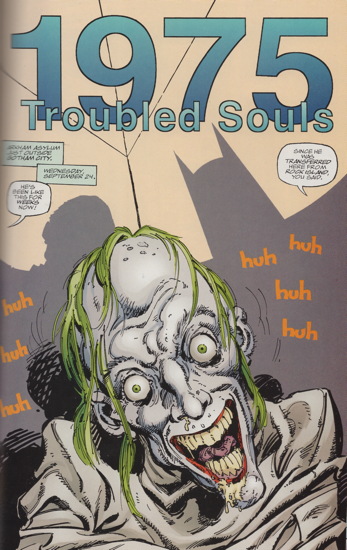
For comparison, here’s Old Joker from issue two of John Byrne’s alternate history series Superman/Batman: Generations II #2 (2001):


Looking a little more rough around the edges that the other versions shown here, I think. It appears this Byrne continuity starts about ten years earlier than the traditional Earth-2 superhero universe, which would put this Joker in 1975 at about the same age as our Joker appearances in Brave and the Bold and the Huntress stories.

I know, I know, all this talk about the Joker’s supposed age. I’d assumed he’s around Batman’s age, but honestly, who knows. That Joker movie would have him at, what, a couple of decades older at least? Anyway, the actual age of the Joker isn’t the point of this post, so much as “take information on Hot Comics Apps with a grain of salt” because, as shown here, they ain’t always right. And I’m sure these aren’t the only examples of Old Jokers predating that Justice Society Annual to boot.


Special thanks to the Crown Prince of Cookies, Bully the Little Stuffed Bull, for production assistance.

That’s really power, Power Girl.

Back to your multiversal comments!

Buck Ripsnort gallops in with

“I think what blew the Multiverse out of my mind was the origin of Powergirl. Instead of making her a new character, or even just Earth-2’s Supergirl, they made her into something so convoluted that my mind refuses to recall it.”

When it was just Earth-1 and Earth-2 and such, Power Girl’s deal was a lot simpler. She’s the cousin of Earth-2 Superman. That’s it, done deal. But then that pesky Crisis on Infinite Earths happened along and all that Earth-2 business was flushed away, so now what?

I gotta be honest, most of my Power Girl reading from anywhere close to that time was when she was in…Justice League Europe, I’m going to say? But I do know they tried to tie her in somehow to Arion, Lord of Atlantis, but I’m unfamiliar with any of that nonsense and I think it was undone relatively quickly anyway. As it stands now she’s once again from Earth-2 (not the same Earth-2 as the Pre-Crisis Earth-2, but a new Earth-2) and, well, that’s where we stand now. I suppose I could Wikipedia it and see what the official deal is, but frankly I already have a headache, and


…no, I said I wasn’t going to go look at Wikipedia. And that’s final.


AUGH okay, fine, I’ll go look.

…

So here’s what the ol’ Wiki, right and true in all things, has to say:

“Power Girl’s origin has gone through revisions, but over time has reverted to her original conception as the Supergirl of Earth-Two. The 1985 limited series Crisis on Infinite Earths eliminated Earth-Two from history, causing her to be retconned as the granddaughter of an Atlantean sorcerer known as Arion. This was an unpopular change and writers depicted the revised Power Girl inconsistently. The 2005–2006 Infinite Crisis limited series then restored her status as a refugee from the Krypton of the destroyed Pre-Crisis Earth-Two universe. Following DC’s 2011 ‘Flashpoint’ storyline and New 52 reboot, Power Girl’s origin was retold as the Supergirl of ‘Earth 2,’ cousin and adopted daughter of Superman, who during evil Fourth World New God Darkseid’s invasion of Earth 2 becomes stranded in the main continuity of Earth 0, subsequently adopting the name Power Girl to hide her true identity. She returned to her source Earth in the story Earth 2: World’s End (2014–2015).”

So there you go. About as clear as we can manage, I think. Though in one of the animated series some years back Power Girl was just a clone of Supergirl, kinda sorta. It’s a little amusing that the origin is “she’s from Earth-2,” and has more or less remained that way even as what “Earth-2” means in DC continuity changes.

• • •

CP Bananas’s comment has appeal

“I remember that the thing I most missed in the post-Crisis DC universe was the idea (prevalent in the late ’70s, I believe) that, on both Earth-1 and Earth-2 (maybe more?) Superman was the first superhero. It made him special in-universe and mirrored his role in the real world. One debuted in 1938, the other in some indeterminate recent–ish year. I just kept expecting them, once that year got too far back, to roll the odometer over into a new earth. Still makes sense to me.”

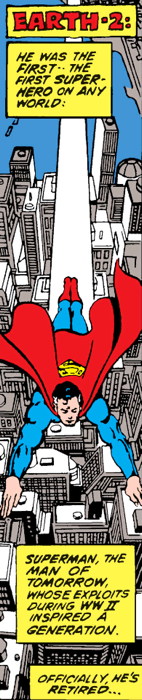
I always like that particular conceit, even if, as I’m about to go into, Superman’s status as “the first dude” may not strictly be true.

This panel is probably my favorite statement on the matter, coming from the way great 1981 JLA/JSA crossover by Gerry Conway and George Perez:


But the thing that always comes to mind is “aren’t…aren’t there other heroes that popped up before him,” like Miss Liberty, active during the Revolutionary War; the 15th-century Super-Chief; and depending on who you ask, sometimes the Crimson Avenger is cited as being first out the door; and I’m sure there are others I’m missing, too. Oh, like Immortal Man. Or the Shining Knight. Do they even count?

I always worked this out in my head as “the first hero of the Modern superhero age” and that was good enough for me.

So the second time he changed history, that Earth should have been Earth-AA.

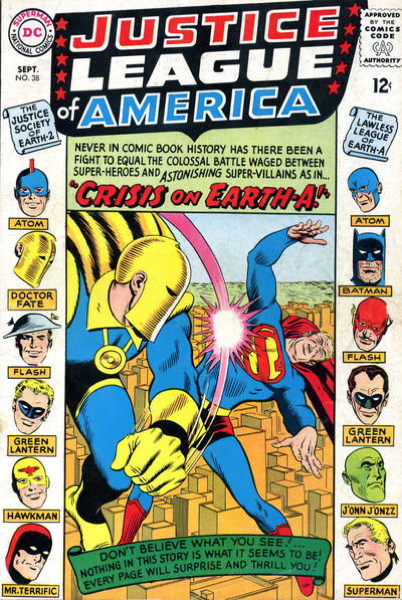
So a comic that’s sorta half-intrigued me for years (and I last mentioned here) is this one, Justice League of America #38 (1965), featuring Coming-to-Theaters-Near-You Dr. Fate giving a blonde-haired Superman a mystical knuckle sandwich:


The cover mentions “Earth A,” which wasn’t one of the many parallel-universe Earths with which I was mainly familiar, and didn’t recall it ever popping up in any later multi-Earth adventures in those wild and carefree pre-Crisis days.

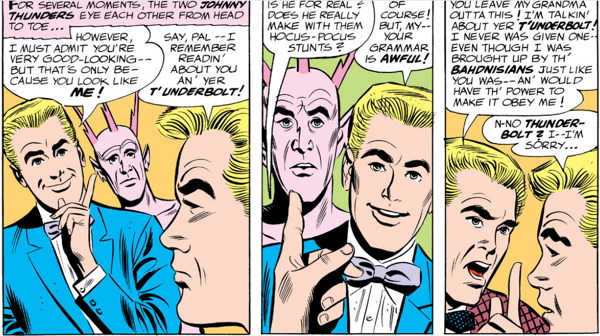
Well, this is actually a two-parter, beginning in issue #37, where Earth-2’s Johnny Thunder idly asks his magical Thunderbolt to bring him to Earh-1’s Johnny Thunder for a little meet ‘n’ greet. And as it turns out, this other Johnny is…not quite as dignified as Earth-2 Johnny:


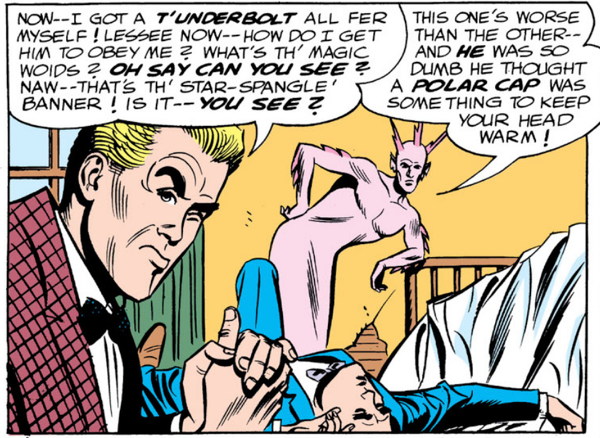
…and eventually Earth-1 Johnny realizes, since he’s basically the same guy as Earth-2 Johnny, he can just take over commanding the Thunderbolt, after, you know, trying to figure out what the magic word is (with some commentary from the T-bolt about his high opinion of both Johnnys):

…and then he proceeds to go on his merry way to cause menace and mayhem.

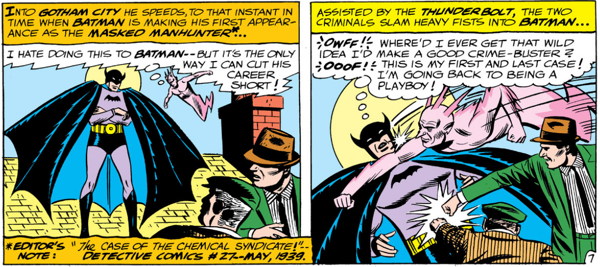
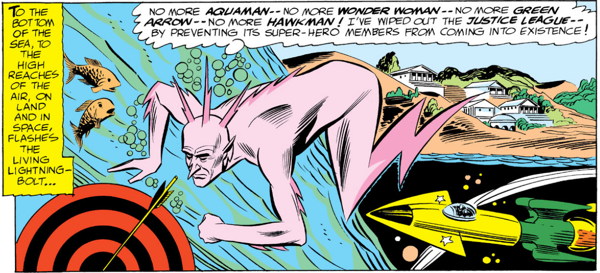
Long story short (and this story is long and a tad convoluted), Johnny’s Evil Twin Johnny decides that his attempted crime spree on Earth-1 being halted by the Justice League was a pain, so he commanded the thunderbolt to go back in time and prevent all the Justice Leaguers from ever becoming superheroes. Like so:

Eventually, the Thunderbolt’s sad tasks are completed, some off-panel:

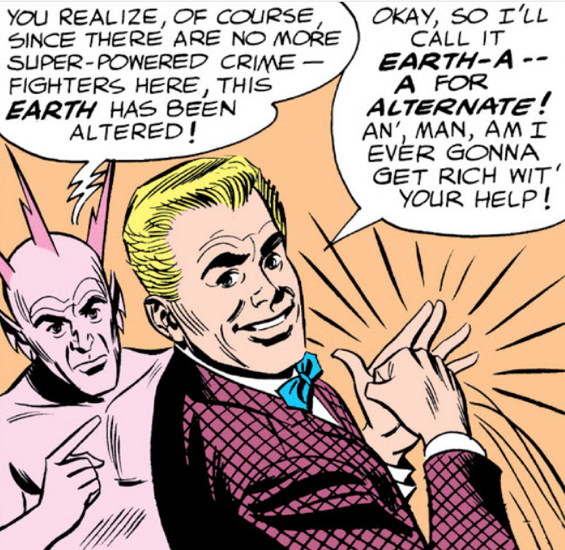
As a result, we get a modern Earth with a changed history in which the Justice League never existed and I’m going to guess never got in the way of Evil Johnny’s crime plans in the first place thus never requiring him to send the Thunderbolt back in time…but anyway, comic book magic, everyone! Regardless of any implicit paradoxes, Evil Johnny dubs the resultant Earth-1 as “Earth-A,” with A standing for…

So, as Brad noted in his comment last week with NO SPOILER WARNING WHATSOEVER for this 60-year-old comical book, this ain’t your garden-variety parallel Earth as suggested by the familiar nomenclature. It’s just Earth-1 with a magical coat of paint slapped on it, which addresses my previous wonderings as to why it was never revisited in future multi-Earth events at DC. I mean, one could make the argument that an alternate timeline by its very nature creates a parallel reality, and some might even exclaim “Hypertime!” before they’re escorted out of the auditorium, but things are already complicated enough, I think.

So now that mystery is solved for yours truly, the fella what never read this story prior to this past week. But still remains the question: what’s up with that blonde Superman and the rest of that scraggly new JLA?

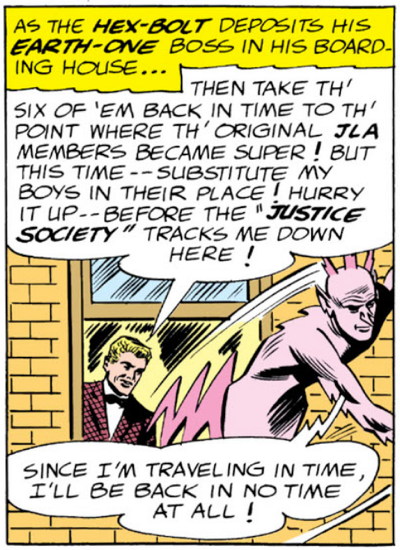
Well, as it turns out, Earth-2’s Justice Society eventually twigs onto what’s going on, since this is, after all, one of the annual team-ups between Earths 1 and 2. To protect himself, Evil Johnny commands the T-bolt to take some of his gang of thugs, go back in time, and insert them into the moments in which they would have their “origins” or otherwise get their powers. Look, see, here’s Thundie taking off to do the deed right now:

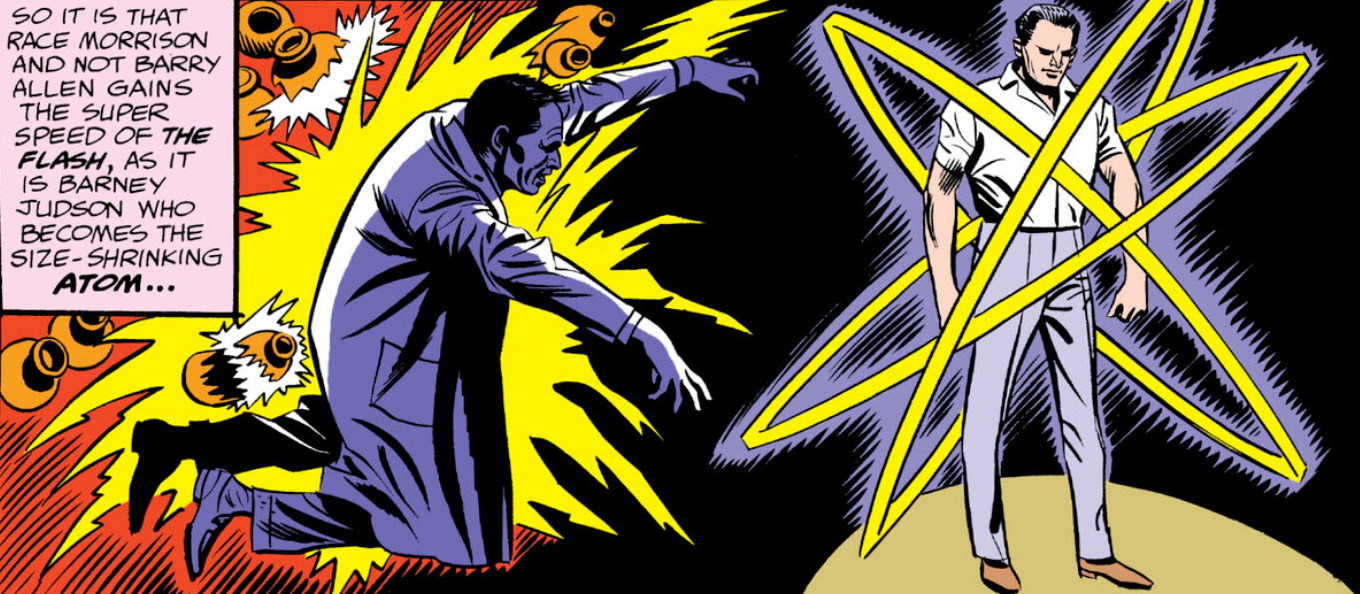
For example, we see one of the gang take the place of Ray Palmer in his origin as the Atom:


…and I hope you enjoyed that example, because that’s all the book’s giving you since in the very next panel, the deed is done:


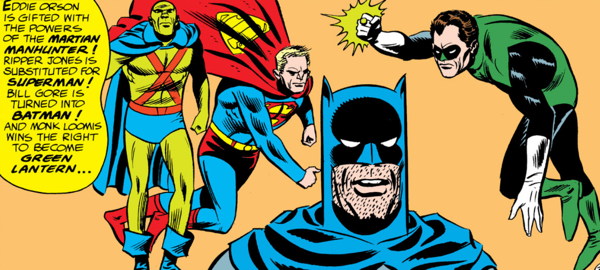
Not sure what exactly T-bolt did to get that one blonde guy to replace Superman in his origin, aside from 1) turning him into a baby, 2) putting him on Krypton, 3) literally making him Kryptonian, and 4) ensuring that Jor-El would send Ugly-El to Earth, eventually. Or else that guy was just magically given Superman’s powers. At any rate, don’t get me started on that Martian Manhunter substitute and however that worked.

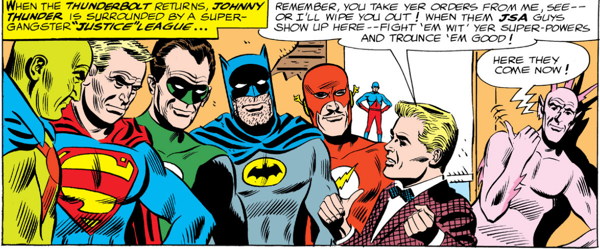
Anyway, here’s another look at ’em:

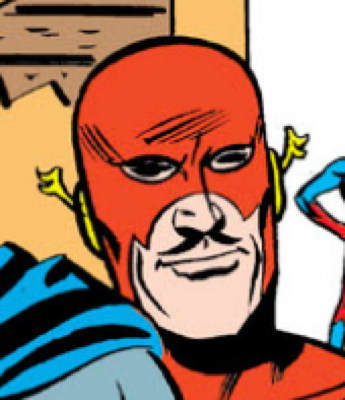
Please sign my petition to make the Flash look like this from now on:

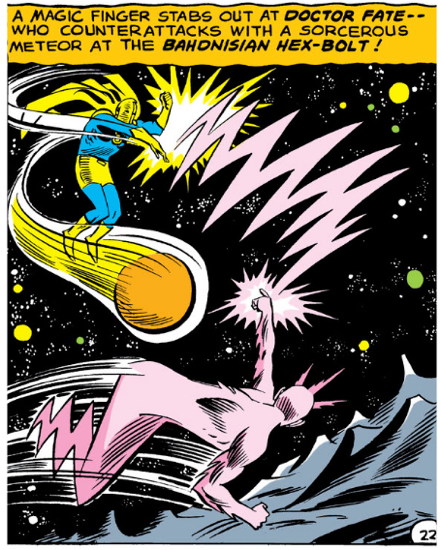
To wrap this up quickly, the Lawless League is defeated, the regular Justice League returns, Evil Johnny commands the Thunderbolt to fight Doctor Fate:


…and he’s overwhelmed by the results of this mighty battle, of which we only really see the one panel, the rest being devoted to Evil Johnny being smacked around by the terrible magic forces thus unleashed. In the end, there’s a wish that “none of this ever happened,” and one magical reset button later, the proper JLA/JSA meeting can commence.

And that’s it for the Johnny Thunder of Earth-1 until 1983, when he shows up in the next-to-last of the long-standing JLA/JSA team-up traditions. But I can always cover that later if needs warrant. And I hope they don’t because this turns into kind of a regrettable Black Canary story what we can just kind of pretend didn’t happen.

So that’s The Horrifying Secret of Earth-A, my friends. Not a parallel Earth, maybe, but close enough for our purposes here, I guess. Thanks to all your interaction and support on this recent series of posts, and I’ll be reacting to more of your comments soon…usually with outright fear.

“I saw a bank that said ’24-Hour Banking,’ but I don’t have that much time.” — Steven Wright

Okay, I do have another Multiverse post about ready to go, but I just didn’t have the energy to finish it last night. And besides, I should give you a brief update on my bank thing.

First, I’ve got a new account opened, and while not everything is transferred over there yet (since eBay’s verification system for adding a new bank account is taking its sweet time) I’m well on my way. And one of the unauthorized withdrawals has already been returned.

Second, my call to Diamond went well, and they are totally understanding. My bank was informed to honor that check whenever it goes through, and hopefully they’ll do so. Regardless, the money guy at Diamond knows the situation so either way I’m covered.

Some of you mentioned having similar problems with debit/credit cards, as have I, and those are relatively simple to handle…just get a new card. And also stop using cards at outside gas pump terminals, which I did after having a card number stolen twice in four months and haven’t had it taken since. At least, that I know of.

In this case they were somehow getting money right out of the bank account, which is a slightly different, and far more complicated matter. Thus, here’s hoping I don’t have to do that again for a while. And you bet I’m keeping a very close eye on my bank stuff right now.

Okay, that should be enough about that for a while. Next time, back to the important stuff: parallel Earths at DC Comics!

No post today. Except for this post.

So anyway, if you follow my Twitter account, and you probably shouldn’t, it’s terrible, you’ve likely seen my latest set of travails. In this case, someone gained unauthorized access to my store’s bank account and withdrew some cash via an online payment somewhere or ‘nother.

As such, that has occupied my days since I discovered the perfidy on Friday evening, especially since at every turn I seem to get the runaround for a bit before finally acquiring the assistance I need.

For example: I go to the local branch of my bank. They tell me they can’t help, I have to call the customer service line. I go back to the store, call said line. They tell me no, I have to call the fraud department’s number on the back of my store credit card. I call that number, get told “why are you calling me? You need to report this at your branch.” So I go back to the branch, and then they figure out what paperwork I need to fill out, etc. etc. So, you know, in case anyone was wondering why I opened the shop an hour late on Friday.

The solution to this issue is “close the old account, open a new one,” which is seemingly fine…the old account is frozen to withdrawals, but I can receive deposits, which is good in this heavily credit-card focused economy. And I thought I was good, with no pending payments out in the wild that would try to draw on that account, except I totally forgot about the payment I mailed to Diamond Friday morning for the weekly comic shipment, which they will attempt to deposit by Wednesday or Thursday. Therefore, I have an early call to Diamond to make Monday, warning them about this little problem. I can theoretically tell the bank “look out for that check, make sure it gets paid from wherever my money is,” but being told it “should” work, and “maybe” there’s not a problem doesn’t instill me with confidence.

In short, it’s been a huge aggravation, getting in the way of anything I wanted to do at the shop for the last couple of days. Part of it is my fault, in that one piece of paper I really needed to file with the bank, the one I was sure I put in a safe place, wasn’t where it was supposed to be, so I tore up the store looking for the stupid thing for quite a while.

But at this point, aside from some paperwork I need to finish up tonight, I’m pretty much ready to head back to the bank and finally get that new account opened. And then spend my Monday updating that info at the various locations that need it. And hoping that Diamond check gets clearly properly. All in all, I hope that few hundred dollars this person got away with made them happy enough so that it was worth all the aggravation I had to go through.

With any luck, things will be back to relative normalcy shortly, and I can go back to posting about DC’s multiverse and whatnot. Thanks for your patience, pals, and I’ll be back at it soon.

“And don’t call me Leslie.”

Sorry, wasn’t able to put together a real post last night, so please accept this fill-in, in which I follow up on this post from last year about my small press days.

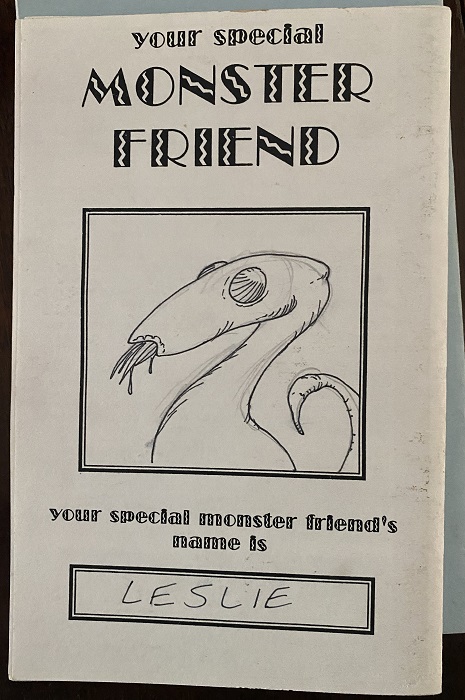
Specifically, that post was about the blank “Your Special Monster Friend” box on the back cover of my comic, the inspiration-for-this-site’s-name Mike Sterling’s Progressive Ruin. I had lamented the lack of records of the handdrawn monsters I’d done for these covers, until my old pal William sent me a picture of his copy (which you can see on that linked post).

Well, this week I heard from another old friend, Ben, who noted he still had his own copy of said comic, and I cajoled, wheedled and whined until he sent me this pic:


So, one more Special Monster Friend added to the catalog: everyone, meet Leslie! Not named after anyone specific, far as I recall, so let’s say it’s named after beloved performer and noted enjoyer of flatulence jokes, the late and lamented Leslie Nielsen.

Thanks for reading, pals, and I’ll see you next week.

I wonder if the same Bat-Mite visits all of them.

Tim noted

“My first real introduction to alternate universes was reading the classic ‘To Kill A Legend’ in a collection I had as a lad. The idea of Batman going to another universe with the chance to save the lives of his parents BLEW MY LITTLE BOY MIND.”

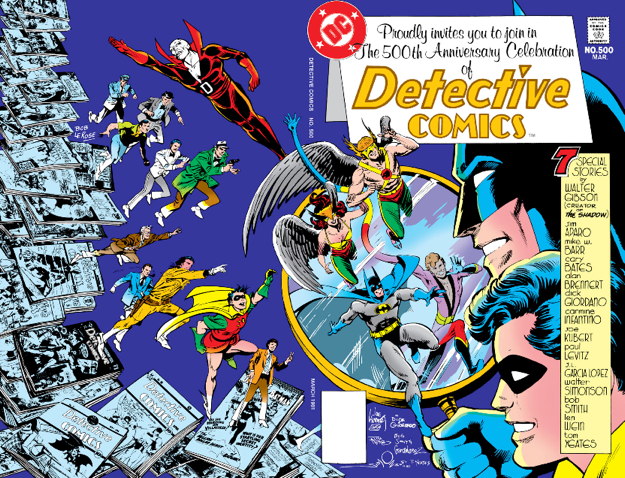
The comic that story originally appeared in was Detective Comics #500, released in late 1980/early 1981 when I was about 11 years old. Here’s the great jam cover that wrapped around this extra-sized funnybook:


Very early on here on this site, I did a series of posts about anniversary issues, including an entry on this very issue giving an overview of all the contents.

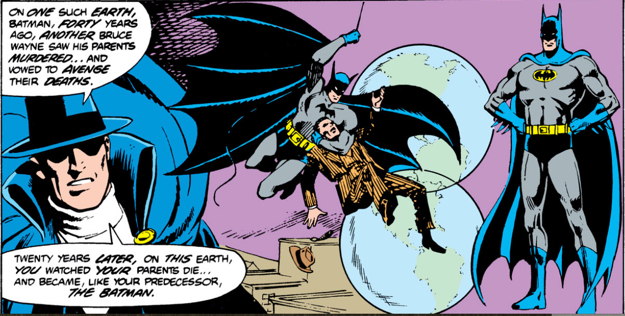
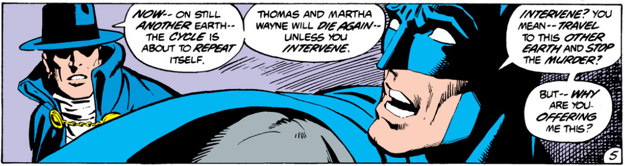
In “To Kill A Legend” by Alan Brennert and Dick Giordano, the Phantom Stranger shows up to lay all this on the Caped Crusader:


He’s obviously referring to the Earth-2 Batman as the Bruce Wayne whose parents were murdered 40 years ago (at then-press time), pictured there with an image evoking Batman’s first appearance on the cover of Detective Comics #27 back in 1939. The Bruce Wayne of “twenty years later” is Earth-1 Batman, the star of this particular show. (As an interesting side-note, assuming Bruce was somewhere between 5 to 10 years old at the time of the Waynes’ murders, that would put Earth-2 Batman at about 45-50 years old, and Earth-1 Bats at 25-30.)

The interesting implication of this story is not only that there is a new, apparently unnumbered parallel Earth in the DC Universe that may or may not have a Batman (not spoiling the story, you should read it!), but that there is a 20-year-cycle to these events duplicating in alternate universes. Going by that, we should’ve had another couple o’Batmans since then…and in a way, maybe we have, what with all the Crises and Rebirtheries, if perhaps not on a strict 20-year timeline.

It is a very good story, and one of the rare multiversal excursions in the DC Universe that doesn’t involve travel to one of the recognized Earths in the company’s established cosmology. To my knowledge this is the one and only trip to this particular Earth. There’s another parallel Earth that I think was only visisted once, in Justice League of America #38 where they go to…Earth-A? I haven’t read that yet, but I suspect I’ll be reporting on it here very soon.

Overall, this comic is excellent, so, Tim, and everyone else reading this, if you get a chance, give it a gander. I hope DC eventually releases a nice hardcover edition…there’s too much good material in this book as a whole for it to languish in back issue bins or be partially reprinted across trade paperbacks. But then, there are a lot of DC Comics of the past I wish they’d do that to.