PRESTO!

Reader Paul, longtime member of the Progressive Ruin Elite Support Team Operatives, has concocted this much-needed follow-up to my troll-less lamentations from Monday’s post:


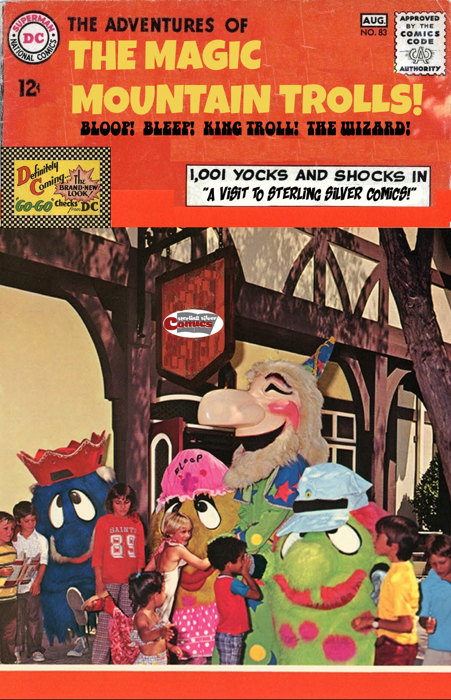
This is, by the way, exactly what my storefront looks like. Yes, even with the trolls.

• • •

Due to a handful of very early morning errands and doctor’s office visits, my late-night blogging routine has been curtailed slightly, hence the shorter posts. I should be back to speed for Friday. Thanks for your patience, pals!

It’s beyond me.

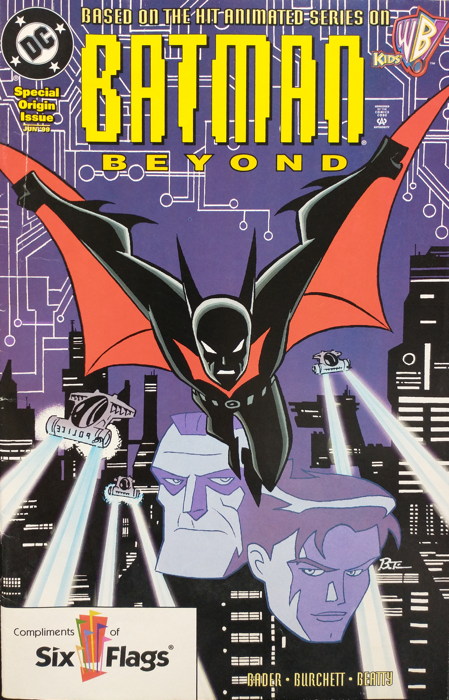
So here’s just a quickie “variant cover-age” post today, featuring a comic I came across in a collection recently. It’s a reprint of the first issue of the Batman Beyond mini-series:
aa

…with “FREE” replacing the price, and a Six Flags logo printed in the corner:

Not to be confused with the other version of this promo comic with just the blank box, of course.

Not much to say about it aside from “hey, look, it exists,” an jhd a good reason to return to this series of posts on my site.

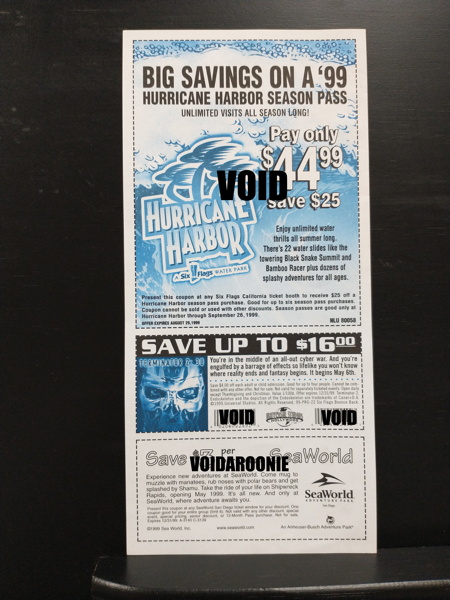
I presume this was given away at the amusement parks under the Six Flags banner. This copy I had in my possession still had a coupon flyer inside for other attractions:

Before you ask: already sold and gone. The going price on the item was higher than I expected, though I suppose I shouldn’t be surprised. If this was a park giveaway, I suspect most copies ended up dumped on the ground, tossed in the trash, or just plain mishandled while carrying it around and transporting it home. As such, not a whole lot of mint copies out there, I think.

I don’t know (and can’t seem to look up anywhere) if this was a specific tie-in to a Batman-themed ride. I mean, the last time I was at the nearest Six Flags attraction, Magic Mountain, it was well before the Six Flags acquisition and the park’s mascots were trolls. I mean, there were plenty of Batman-themed rides, but I don’t think any of them were Beyond-related (aside from being temporarily “skinned,” maybe, like the Nightmare Before Christmas reworkings of Disney’s Haunted Mansion).

Anyway, it’s a neat little item, thought it has me wishing for a comic based on those trolls.

In which I explain a couple of words with about 500 of them.

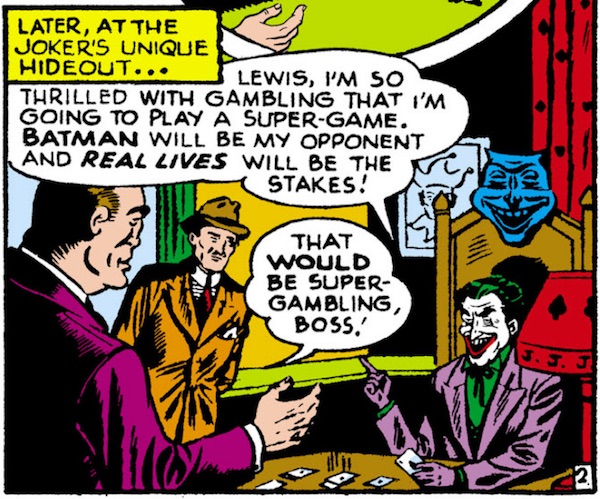
So I got a soupçon of disagreement over my reducing the the Joker’s motivation to “causing chaos.” And…okay, none of you are wrong, and there’s a lot of discussion in the comments there about just what is the Joker’s deal, anyway, but I think my initial generalization is fairly on target still.

And it is a generalization. I was speaking to the opposing forces that Batman and the Joker generally represent in their stories. Batman is a (usually) dour chap dressed in grays, blues, and blacks (and a smattering of yellow) who fights to bring justice and order to a world. Joker is a dude dressed in bright, garish colors who is trying to do…well, more or less the exact opposite of what Batman’s doing. I mean, dropping the resolution even more we have “Batman is a good guy” and “Joker is a bad guy,” a big gray dot bumping up against a big green dot, but that lacks the nuance that makes stories interesting. But as we zoom in and the Joker resolves into view, what exactly makes him tick isn’t so clear cut.

We’ve had various iterations of the Joker over the years, ranging from a merry crime prankster pulling boners, to a homicidal maniac who beats kid sidekicks to death with a crowbar. And we’ve had explanations along the way as to why that is, with Grant Morrison’s interesting suggestion that the Joker undergoes occasional dramatic personality shifts, to Geoff Johns’ simultaneously literal and nonsensical approach of “there were actually multiple Jokers.”

Regardless , their ascribed motivations and plot purposes are always, naturally, to oppose Batman. That’s why the character exists. And there have been so many people writing and drawing and editing the character over the decades that the methods and reasons to that opposition are inconsistent, so much so that attempts have been made, as stated in the previous paragraph, to internalize that inconsistency into the character. And it works with the Joker more so than with another character in the book who’s been inconsistently portrayed over the years — Batman himself — in that the Joker is this “wild and crazy guy” who can be defined by contradictory depictions. Well, sure, Batman can, too, in that Morrison’s idea was that all Batman stories were basically “in continuity,” and the cheery Bat-swashbuckler existed in a continuum with “the Dark Knight,” even maybe near-simultaneously, but that feels more the exception than than the rule.

What I was trying to say with “Joker creates chaos” is that he’s simply the opposite of Batman. That he represents the “contrasts with the hero” type of villain, like “strongest man” Superman versus “smartest man” Luthor. As the Joker’s origin in The Killing Joke becomes increasingly official canon, even the shared element introduced there between Batman and the Joker, in that they were both formed by trauma, leads into their inverse relationship in how they each dealt with it. I wanted to say something other than “Joker is bad because Batman is good” and “creating chaos” seemed like the simplest way of describing our favorite Clown Prince of Crime. Feel free to insert whatever purpose or motivation you’d like instead…given the Joker’s history, it’d probably fit just as well.

In which I write a bit about comics I’ve not read in a while.

Going back to mid-August, David Conner relates

“Supergirl’s JL animated origin (actually from the Superman show IIRC) was substantially lifted from the underrated Superman vs. Aliens comic. Which was published during the period when DC didn’t have a Supergirl in continuity.”

Okay, it’s been a while since I’ve 1) read Superman/Aliens, and 2) watched the relevant episodes of Superman: The Animated Series. However, a peek at the Wikipediatron does show [SPOILERS AHEAD]:

1. Neither Supergirl (or rather “Kara” in the Aliens book) is actually supposed to be the Kara Zor-El, Superman’s cousin.

2. Both are survivors from a dead planet that is not Krypton, though there is some connection to Kryptonians in both their backgrounds.

As I’ve stated before multiple times before, DC put a whole lot of effort into, if not outright undoing Crisis on Infinite Earths, then at least referencing those elements of the DC Universe done away with by that series. I mean, not that either of these were part of the DC Universe…the animated series was, well, the animated series (though the white top/blue skirt costume would pop up briefly on the other Supergirl I’ll mention in a moment); and Superman/Aliens wasn’t technically an Elseworlds, as it didn’t directly contradict any then-established continuity (I think), but the use of the licensed Aliens property probably separates it out from the DC Universe mainstream.

[An aside: I mean, the story could still be referenced — “remember that time we fought a bunch of crazy extraterrestrial beings” with a flashback panel hiding the Aliens in shadow or something. I know there were some changes to the Wildstorm Universe superhero stuff in their Aliens crossovers. But to my knowledge the story was never referenced again, except possibly in Superman/Aliens II, the New Gods one, even though both kinda/sorta left open threads for follow-ups.]

Thom H. reminds us

“So much better than ‘protoplasmic blob from a pocket dimension that got fused with an angel(?).’ I know that Peter David series was popular, but I never did understand it.

“If writers at DC wanted Supergirl back, they should have just brought Supergirl back instead of jumping through so many weird hoops.”

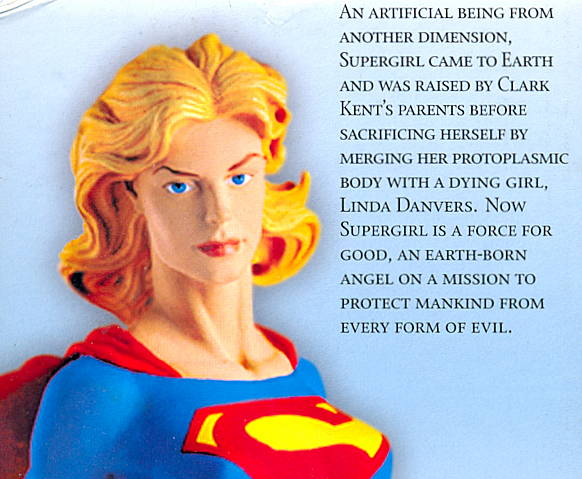
Hmmm…I was trying to come up with a short explanation, but it was getting too long, so let’s just say that protoplasmic being was created by an alternate universe Lex Luthor where, in the form of Supergirl, attempted to protect that Earth from that dimension’s evil Kryptonian villains. She was eventually brought to Main DC Universe Earth where she (mostly) remained in the form of Supergirl until…well, you know what, this detail from the box of a Supergirl statue sums it up:


And while I did like Peter David’s Supergirl run (which did last 80 issues, which is almost like an eternity in modern comic book terms, so folks did seem to enjoy it) it wasn’t the easiest premise to explain. Even the ultimate ending of this version of Supergirl wasn’t entirely cut ‘n’ dried. There was some very heavy implying in the Fallen Angel series David later did for DC that the title character was in fact the lead from his Supergirl series. And when the series moved to another company, the eventual reveal was that it was not Supergirl/Linda Danvers, but in a hopefully non-copyright-infringing way, Supergirl/Linda was involved in Fallen Angel‘s backstory. (And then Linda Danvers makes a brief appearance in DC’s Reign in Hell series, so she was still in the DC Universe in one way or ‘nother.)

Of course, with all the New 52/Rebirth/Whatever Else shenanigans the DC Universe has gone through, it’s probably likely that the events that lead to the introduction of Pocket Universe Protoplasmic Supergirl did not happen in current continuity as shown. I mean, I think we’re still dealing with the post-Crisis/pre-New 52 Superman who somehow crossed over into modern continuity, so maybe that all happened to him, but not to DC’s continuity at large. If you’re not following any of this, don’t worry, I’m barely following it myself.

It’s all kind of moot anyway, as DC stopped screwin’ around and finally said “OKAY FINE, HERE’S SUPERGIRL, SHE’S FROM KRYPTON, SHE’S SUPERMAN’S COUSIN AGAIN” and reintroduced her in 2004’s Superman/Batman #8. This comic is…well, not good, but it finally got a new version of the Classic Supergirl back into comics, and later creators did some fun things with her (especially around — 2019, I think? — when some Omega Men and other pals and gals showed up). And that’s the Supergirl we have floatin’ around today, assuming I haven’t missed a revamp or reboot somewhere along the line.

And don’t get me started on Flaming Carrot.

With the impending return/continuation of Miracleman by Neil Gaiman and Mark Buckingham, which, you know, I’ll see that when I believe it*, I was thinking back to some other old favorites that I haven’t seen in a while, or at least wonder if they will continue and/or conclude in some fashion prior to the creators’ — um, inability to do more, shall we say.

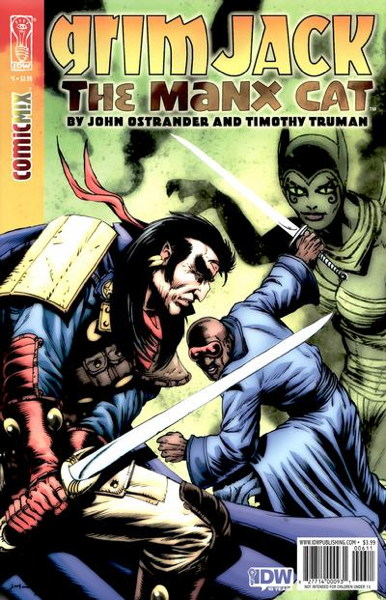
The first series that comes to mind is grimjack:


…and shown above is the last issue released featuring the character, shipped to stores on January 6th, 2010. This…is kind of a convoluted situation, which I discussed on this site before. In essence, the original Grimjack series ended with a particular situation/circumstance/milieu change, but further mini-series (of which the above pictured comic was one) went backwards into the title’s history to essentially tell new stories of Classic Grimjack.

Which I guess is fine an’ all, since Classic Grimjack doesn’t take much explanation and Going-Past-Where-We-Left-Off Grimjack…um, would. And unfortunately it’s been so long that continuing the story now would, while not impossible, probably would find difficulty gaining much traction since the general perception of Grimjack, as much as it exists in today’s comics marketplace, is pretty much the version you see on the cover above. It’s disappointing, especially since future events for the character were teased and sounded intriguing, but seem unlikely to happen now (outside perhaps Kickstarter-type intervention). Supposedly an animated series is being developed, but whether that would be enough to get comics that pick up the story threads from where they ended…man, I don’t know. But it’d be nice.


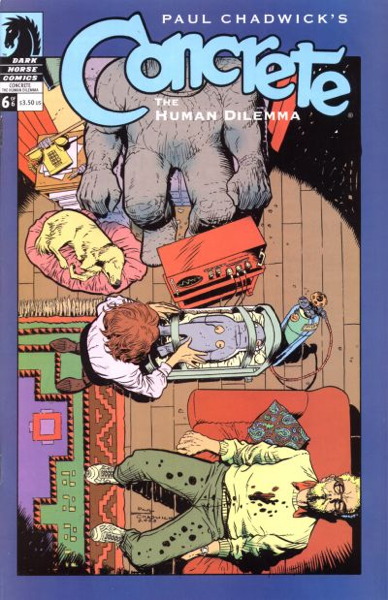
So pictured above is the final issue of the most recent Concrete mini-series, released June 1st, 2005. Now, that’s not the most recent new stories with Concrete, as this comic, released July 18th, 2012, does feature three new stories from the Dark Horse Presents anthology. However, the forward motion of the character’s continuity has been on hold since 2005. This 2010 article announces a follow-up mini Stars Over Sand, which is as yet unreleased. Chadwick mentions this project again in a 2017 blog post on his site. Plus, here’s a 2018 Twitter post where you can actually see (from a distance) pages from the story!

I adore the Concrete comics, and miss the days when we seemed to have new material on a relatively regular basis. It’s a different, and more difficult, market now. And I know Chadwick has other stuff on his plate, so I’m being patient, but I can’t wait to read it.


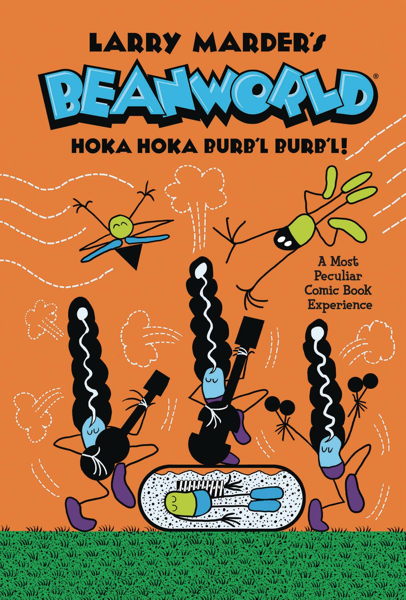
Released on July 5th, 2017, this original graphic novel (released in the same format as that publisher’s hardcover reprints of the entirety of Beanworld) isn’t that long ago, so the idea that more will come out doesn’t seem like that distant a hope. The problem is that it feels like there is a lot of story yet to tell, so many more questions that need to be answered, and at this rate…well, I don’t know just how many more original graphic novels in the series we can realistically expect. I don’t know, maybe there’s a Giant Final Book being worked on even as I type this. I sincerely hope this ends up a completed masterpiece and not a tragically unfinished curiosity. It would seem there is a planned ending to this decades-long saga, and I hope we get to see it.

I’m sure there are more, but that’s enough for now. All beloved comics, all gone too long from the racks. Like I said above, it’s a more difficult marketplace in which to publish, so I’ll appreciate what I can get, when I can get it.

• • •

Don’t worry, I’m gettin’ back to Multiverse Talk shortly. Thank you for all your comments and, most importantly, keeping it civil!


* Phrased like that on purpose, because I know someone would say something otherwise. Quoting something, but I can’t recall what.

The original Twilight Zone, not the other one. Or the other other one. Or the other other other one. Or the movie.

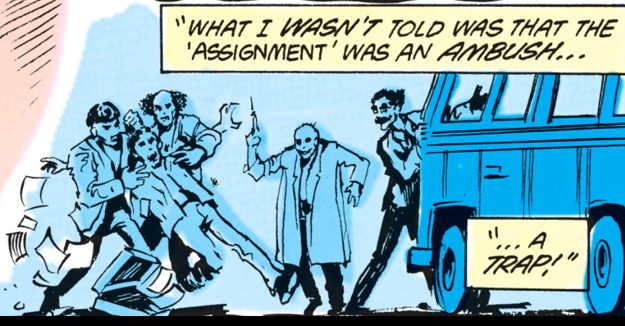
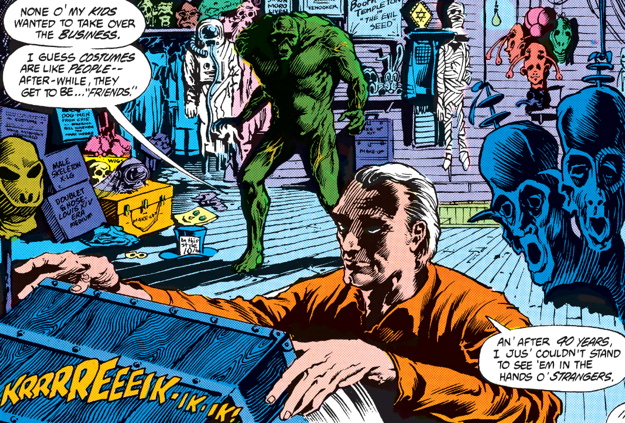
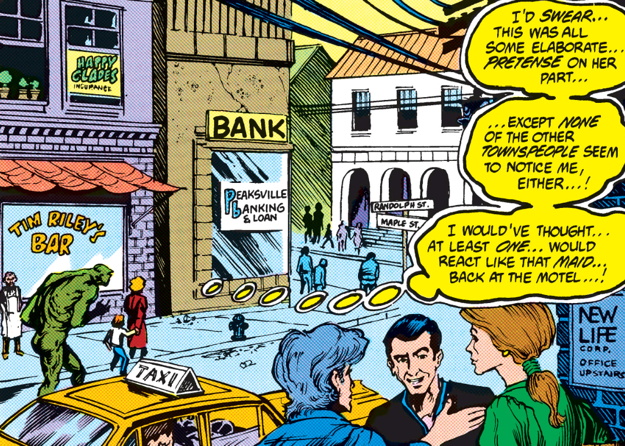
So I’d been using the DC Comics digital comics app to revisit the 1980s Saga of the Swamp Thing series…not like I haven’t read them a million times before, but it’s been a while. Plus, it’s nice being able to blow up panels good ‘n’ big on the iPad in order to enjoy a clear view of the linework and the details.

Like, for example, this panel from #19, taken from a flashback being related by Matt Cable and his abduction at the hands of a government agency. I suppose Shemp could’ve made a good fourth figure, but ol’ Julius is perfectly fine:

And from issue #16, a whole slew of Twilight Zone references throughout the issue (appropriate for the very TZ-ish tone of this story), including these two panels crammed full of them:


And a good cameo of Mr. Rod Serling himself in that second illo.

Speaking of the DC app and Swamp Thing, the problems noted in this post of mine from just over four years ago (the missing last line from #24, the dropped “color hold” from #21) are still there. Regardless, I enjoyed re-perusing those nearly 40-year-old friends of mine.

• • •

Been short on evening blogging time, so posts are a little light in content, so sorry about that. Should be back to normal Friday. Thanks for reading, pals.


images from Saga of the Swamp Thing #16 (August 1983) and #19 (December 1983) by Marty Pasko, Steve Bissette and John Totleben

“To give away the secret would really spoil the fun.”

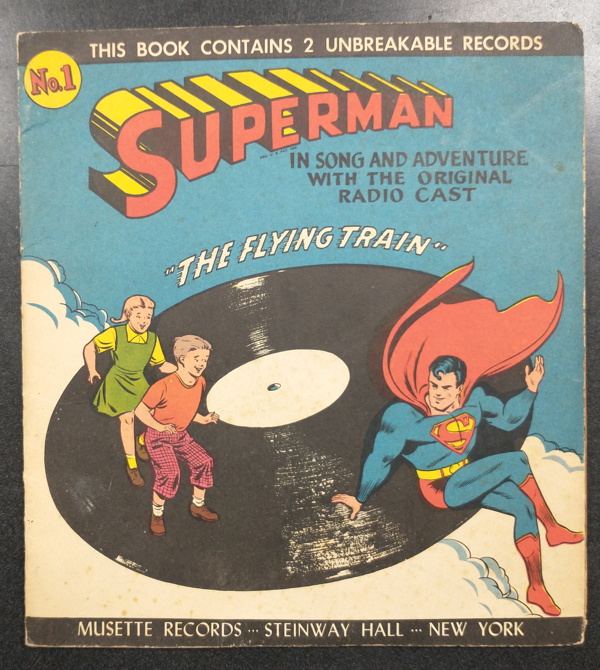
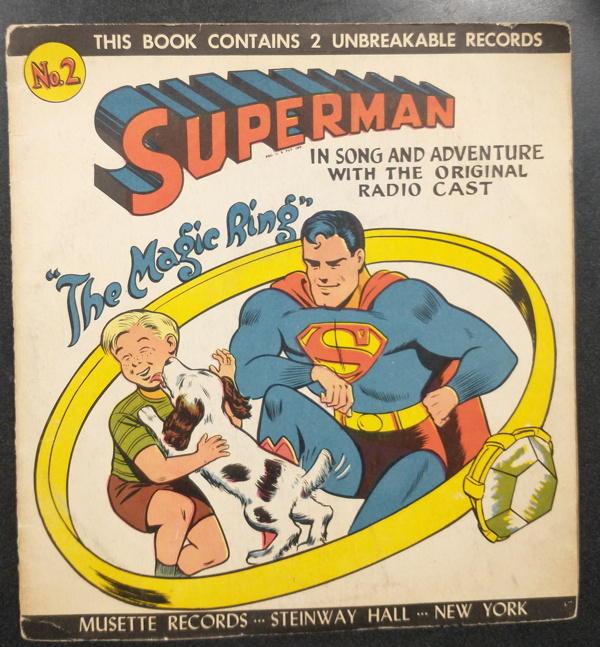
So one of my regular customers popped into the store the other to show off a couple of his goodies from his collection. He wasn’t interested in selling, despite my generous offer of a nickel apiece, or even after I doubled it to a dime apiece. However, he did allow me to shoot some pics so that I may share them with you, the dozen or so people who still look at comical blogs.

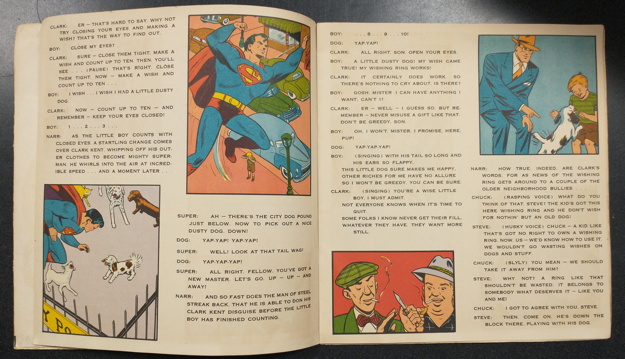
What he’s brought in were two 1947 Superman record sets, each featuring stories “in song and adventure with the original radio cast!” Here’s the first one:

Followed by, naturally, the second one:

Inside the book was the story in radio play format so that the young’uns could read along (or even perform the story themselves in their unauthorized underground guerrilla theaters), accompanies by illustrations that I think were taken from the comics and not original to the booklet, but I could be wrong:

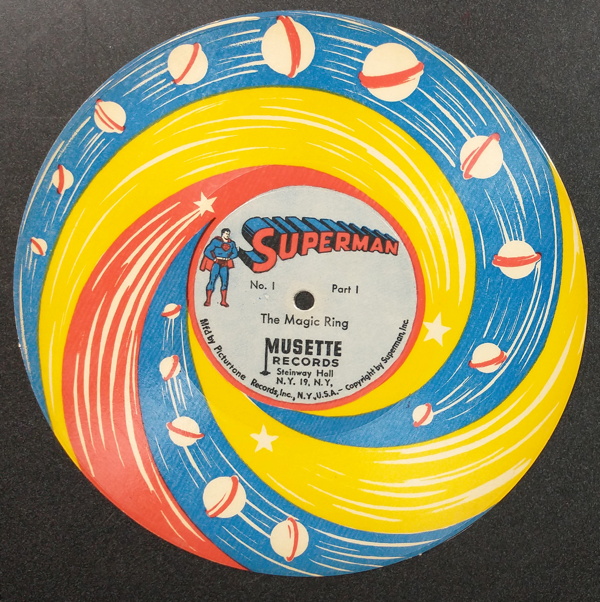
Each set came with two 7-inch records, that were remarkably colorful (and had the same design for both releases):

Now the cover ballyhoos these records as “unbreakable,” and I did give ’em the slightest bit of a flex to check their give, but I wasn’t about to put someone else’s 75-year-old discs through a full stress test. I believe the records were either a very thin vinyl, or each side was even thinner vinyl, like flexidiscs, glued to maybe a cardboard insert sandwiched between the two? I can’t say for certain. But it was certainly lighter than your standard vinyl disc of about the same size.

No, I didn’t play them on the store record player (again, someone else’s 75-year-old records) but thanks to YouTube, the Land Where Copyright Goes to Die, I can give you a sample of one of these recordings in action:

By the way, they’re not kidding about “in song” – characters do straight up break out into that very thing. Maybe you won’t listen to the whole thing, but at least check out the opening theme. And also maybe stick around to hear the voices of the bad guys “Frog” and Snicker.” Holy cow.

Still technically a “Multiverse Talk” post.

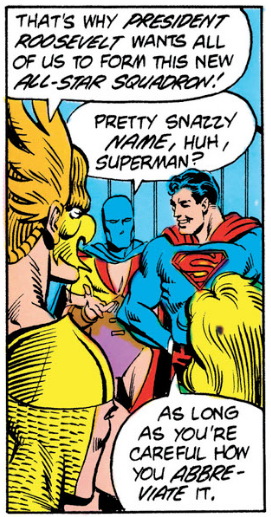
So this panel has been, as they say, living rent-free in my head ever since I first read it in All-Star Squadron #3 way back in 1981:


As a 12-year-old, I thought that was pretty much the height of wit, and even now as a slightly-more-than-12-year-old it amuses me a bit. Yes, “All-Star Squadron” is a good, catchy title, but how do you shorten it without showing your whole…well, you know?

Now here’s the thing: while I read the first dozen or so issues of the series at the time (and then dipped back in on occasion on and off ’til its eventual cancellation), I can’t for the life of me recall just how they got around it in the editorial/letters pages? This just wasn’t a joke for a comic book, it was probably a small concern behind the scenes as well, as titles were regularly shortened for convenience (like JLA, DET, ADV, LSH, A&A, B&HB, ADVDMJL, etc.).

This will be a question I might be able to answer for myself once I get back to the shop and poke through the stock, but does anyone recall what they did? My suspicion is that they eschews abbreviations entirely, or just called it ALL-STAR or something. I feel like ASQ would be the ideal solution, but I don’t know what they did, or at least I won’t for a few hours.

Anyway, it’s funny that it’s Superman that gets to the off-color gag first. Though, it’s fine because this is the Earth-2 Superman and he always seemed to be a little more rough ‘n’ tumble given his Golden Age origins. Also, that panel gives you a bonus look at Hawkman’s weirdo fullface mask. Like, what is up with that tongue, dude?

There you go, a silly sorta-throwaway joke from Roy Thomas, Rich Buckler and Jerry Ordway. And only “sorta” because I’m sure what Superman was saying was exactly what Rascally Roy and the DC editors were thinking.

Bring on the bad guys.

I’m going to jump ahead and address a comment from Monday’s post — DK’s, to be specific, in which he talks about the relative lack of motivation for DC’s various villains.

It’s funny, this topic had sort of crossed my mind the other day, but along the lines of “what makes a villain an arch-nemesis.” Superman is easy, as it’s Lex Luthor: world’s strongest man versus the world’s smartest man. Batman, it’s the Joker: a man trying to impose order on a chaotic world versus a man who creates chaos. Wonder Woman is a little more difficult, as while thematically it’s Ares (a woman representing peace versus the God of War), I don’t know that this pairing showed up a whole lot until the latter half of Princess Diana’s existence.

I mentioned the word “thematically,” and that’s what these match-ups are, battles of opposites. It doesn’t say much in terms of characterization so much as plot considerations. Why (aside from the hair thing) does Luthor hate Superman? What compels the Joker to spread chaos? …Wonder Woman and Ares I’m willing to give a pass on possible internal motivations, as, well, Ares is the God of War, there’s no real subtlety here.

I tried to spread this out to Marvel characters, like Spider-Man, but that’s harder to nail down. Like, why would it be the Green Goblin? Is an octopus the natural enemy of a spider? And so on. I came to the conclusion the Spider-Man’s arch-nemesis is the irresponsible use of power, especially that gained through scientific mishap. Yes, the ol’ “intangible quality” trick. But I think it fits…Peter Parker got his powers from science gone awry. and used them for good. Green Goblin, Doctor Octopus, the Lizard gained theirs the same way and used them for eeeeeevil. Granted, not sure Venom fits into this entirely neatly, but I was just pondering, not laying down law here.

But again, like I said, this doesn’t dive into specific character motivations as opposed to the thematic/plot-oriented purposes to which these characters are utilized.

That said, let’s go through DK’s list:

“Luthor: He’s basically Trump, but actually rich.”

I am not even sure what Luthor’s exact deal is right now. Post-Crisis, he’s a power-hungry dude pissed that there’s someone more powerful around, who has also continually got the better of him. As time wore on, he became more of a mix of the Silver Age Luthor and the Byrne/Wolfman-era Luthor, a rich businessman who just freely uses advanced science to do…I don’t know, whatever. Join the Justice League, that sort of thing.

His modern motivation is still his hatred of Superman’s apparent superiority, but he couches it (as he does in this week’s Action, in fact) in his desire to remove “alien influence” on Earth. And that it would get rid of the guy who always makes him look bad, well, that’s just a happy coincidence.

“Joker: Murder clown, haven’t even given him a real name for 75+ years.”

I sort of go into it above…the Joker doesn’t really need a specific motivation beyond wanted to wreak a little havoc, and it just so happens it’s usually Batman there to stop him. As to a specific motivation as to why he would do that…well, I guess The Killing Joke is now just straight-up officially the origin of the Joker, all that built-in ambiguity in the original story just jettisoned for the purposes of current comic-booking.

As such, I suppose the Joker’s motivation is…well, basically what I said above, causing chaos And with Killing Joke now canon, the death of his wife, among other things, is what drove him to this point, lashing out at a world that destroyed his life.

Oh, and I did write a bit about DC finally, weirdly, giving the Joker an official real name, but frankly I won’t believe it ’til I see it in black and white in whatever the next iteration of Who’s Who in the DC Universe will be.

“Sinestro: Power corrupts (just this one dude, not the 10,000 others with rings)”

I mean, that’s good enough I think. Sinestro fell out with the Guardians like (here we go) Lucifer rebelling against God and being cast out of Heaven. Sinestro hates his former bosses and their Green Lantern force, and especially the face of that authority, their arguably greatest member after Ch’p, Hal Jordan. I know that (I think) Gerard Jones added emphasis to the whole “Sinestro is obsessed with maintaining order” element, which I think is still a part of the character’s drive.

“Reverse Flash: Admit it, lazy AF concept. Can’t even be bothered to give him a real supervillain name.”

Ah yes, the “bigger, badder version of the hero” trope we all know so well from most of the Marvel movies. But to be fair, his full moniker was “Professor Zoom, the Reverse-Flash,” which, c’mon, that’s pretty cool. Now I’m just talkin’ the original dude here, don’t get me started on all these other Reverse-Flashes that turned up.

What I do like about Reverse-Flash is that his deal was that he was a dude in the future who thought the 20th century Flash was awesome, replicated the accident that gave the Flash his powers, and then discovered he was going to come the Flash’s enemy, which drove him mad, turning him into the Flash’s enemy. It’s this weird, sci-fi time loop thing that I happen to like.

During Waid’s run on the Flash comic, he altered the origin slightly by having RF (sorry, tired of typing that out), still a big fan, go back in time and discover that not only was he going to be a villain, but that the Flash would kill him. Anyway, that’s a whole thing that I won’t get into here, but I think this provides a nice, unusual motivation for the character. Yes, it’s “he hates him because he hates him,” but the background is interesting enough to support it.

“Gorilla Grodd: Kill All Humans, as I am not a human and I am better than them.”

Look, evil telepathic superpowered intelligent gorilla has got to be motivation enough, right? I’m going entirely from memory here, but Grodd was trying to take over Gorilla City from its leader, Solovar, and Flash interfered, and now the Flash is also on Grodd’s shit list? I’m pretty sure that’s right. Anyway, c’mon, he’s a gorilla villain, let’s cut him some slack.

“Deathstroke: I get paid to be Evil. I have no idea why Bruce Wayne doesn’t just pay me to be good.”

I mean, assassin-for-hire who goes after superheroes, that’s good, I think. Admittedly he’s not very successful against them, which makes me wonder how he makes any money (“okay, sure, you haven’t killed any of the Titans yet, but maybe the 20th time’s the charm, do you take personal checks?”). I suppose in the Teen Titans’ case, it’s more “personal vendetta” as time went on, but I think being a hired gun who keeps getting hired despite being almost entirely ineffectual by necessity kinda works.

“Per Degaton: This secret dies with Roy Thomas.”

Ah, Per Degaton. The would-be dictator who used his boss’s time machine to rampage through history, screwing around with time, and also bother the Justice Society of America, all in his attempts to become, as I said, a dictator.

When he was reintroduced into DC Comics in the 1980s, DC also reprinted his (I believe) first appearance from the Golden Age in one of their reprint digests, so anyone new to the character (like I was) could get his deal. And his deal is that whenever his plans get undone, he’s thrown back into the normal timeline as a lab assistant:
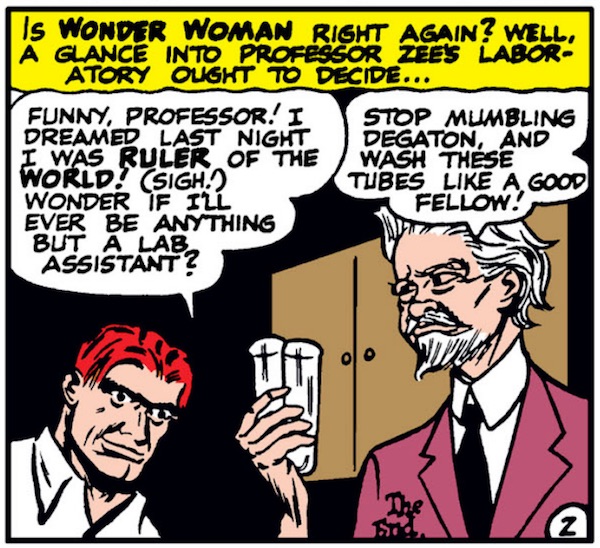

I love that this seems to be his eternal fate (with one or two exceptions over the years)…just sent back to where he was, frustrated by the memory of what was undone.

“Brainiac: I am the smartest being in the universe but I want City Funko Pops for some reason.”

He collects cities either to study, to preserve them, to put on his own planet so he could rule them…he had a few reasons for doing what he did. End result of any of these reasons: he came to your planet to grab a city and take off. Kinda like Galactus, only he just stole a city instead of eating a planet.

I do like the animated series origin, where he’s an embodiment of Krypton’s artificial intelligence network that survives the planet’s explosion, and he goes on collecting data (i.e. planets) which puts him in conflict with Krypton’s last son. Whatever version seems to come down to “Brainiac does evil science stuff and Superman tries to stop him.” Plus, it’s nice to have a regular (and powerful) alien nemesis for Supes, in contrast to his vast array of Earthbound bad guys.

Anyway, those were my thoughts on those particular DC villains. Again, just some off-the-top-of-my-head ideas, so I’m sure I got a fact wrong here and there. You know where to correct me!
Hair today, gone tomorrow.

Yup, I’m still addressing comments left on this site from nearly two months ago. What can I tell you?

So Daniel sez

“Byrne’s first meeting of Superman and Luthor in Mos #4 was soooo much more interesting than the pre-Crisis Superboy-causes-Lex-to-lose-his-hair-in-a-lab-accident”

Now let me just step in here for just a sec and defend the “Superman makes Lex lose his hair” thing. I’m not going to say you’re wrong for your position, for reasons I’ll get into, but I think Superboy being at least partially responsible is good actually, and fits tonally with the kind of stories being told in Super-comics of the time.

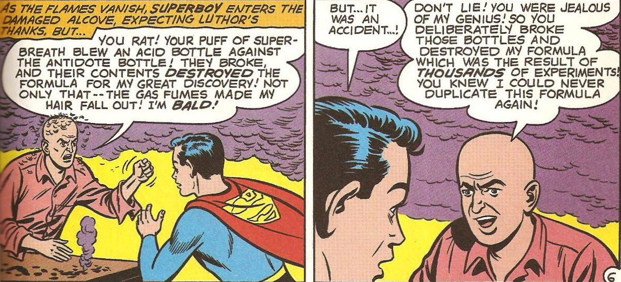
We’ve all probably seen this sequence, or something like it, from Adventure Comics #271 (1960) by Jerry Siegel and Al Plastino. Lex, the local boy genius who had been fast friends with Superboy, was working in his lab (built by Superboy, in fact) to create a cure for Kryptonite for his super-pal. Suddenly Science Goes Awry and the Boy of Steel blows out the flames and smoke in the exploded lab, only to discover:


This works in the Superman books of the day in that is fits the general low rent level of almost dreamlike myth-making in the stories. Motivations and broad and simplistic, intended to be easy for children to understand. (I’m put in the mind of an early ’60s Green Lantern story where the impetus for Sinestro’s actions was that he losing out in some popularity contest with another villain and he wanted to regain the top position.)

“You did something bad to me” (well, sort of) “and now I hate you forever!” is a plain enough explanation. Plus, it was probably a surprising twist for readers to discover that adult Luthor’s baldness was tied to the actions of a young Superman. It’s all very “closed-circle” kind of stuff. And this doesn’t get into the mythological/Samson-esque implications of a loss of hair equating a loss of strength and virility.

In other words, It Was Good Enough, at least for the time. As the actual stories of Lex vs. Supes played out, it was not so much about “my beautiful curls!” but just Luthor trying to find ways to commit crimes and outwit and/or destroy Superman. So the hair thing didn’t really play that much into the enmity between the two, aside from the occasional flashback. Now, had Luthor spent all his time trying to cause Superman to lose his hair, well, that’d be another story entirely. I think there were one or two stories like that, but it wasn’t, like, Lex’s thing.

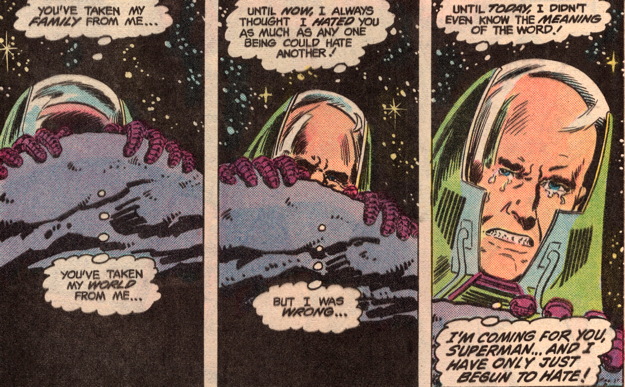
When the Superman comics entered the ’80s, it was decided to change things up just a little bit. Not Crisis on Infinite Earths-levels of changing up, that would be a couple years hence, but for Superman’s 45th anniversary in 1983, here in Action Comics #544 by Cary Bates, Curt Swan and Murphy Anderson, Luthor was given all-new reasons to hate the Man of Steel.

Long story short, Lex was living on the planet Lexor, where everyone loved him, and he and Superman were fighting, Lex fired an energy beam at him with his fancy new armor, the beam bounced off Superman and hit a big doodad that was keeping Lexor’s core stable, and everything went kablooie. Lex of course blames Superman entirely, resulting in:


A more brutal origin for an age when comics were, just very slightly, beginning to get a little edgier with their storytelling…not that Superman was going to suddenly become, I don’t know, Frank Miller’s Daredevil or anything. But we were getting to the point where the more fantasy-ish “loss of hair” origin wasn’t enough in comics, where a little more grounding in reality (relatively speaking) was becoming more in vogue.

As it turned out, this New Unleashed More Dangerous Than Ever Luthor only popped up a handful of times before the aforementioned Crisis came along, and frankly things weren’t much different than before except for Luthor having his new space armor suit.

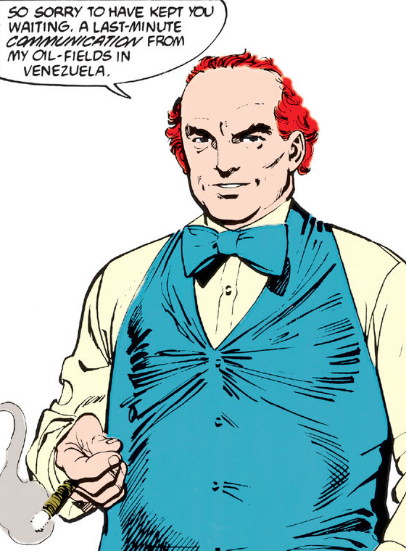
With Crisis and the accompanying sweeping 1986 reboot of the Superman line by John Byrne, all that previous Luthor stuff was cast aside, and a new relationship between the two was forged. “Introduced” in Man of Steel #4, our new Luthor is now a wealthy businessman whose successfully hides his shady side from the public (causing a lot of comparisons to Marvel’s Kingpin in the process):


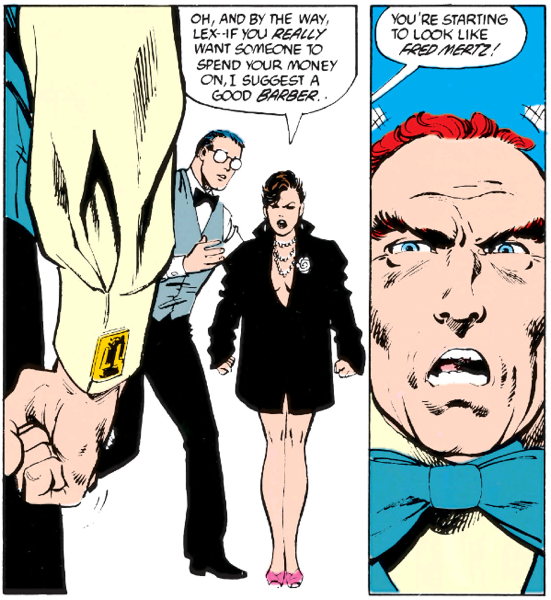
And yes, he has hair. At least until Lois slings this parting shot at him after an eventful evening:


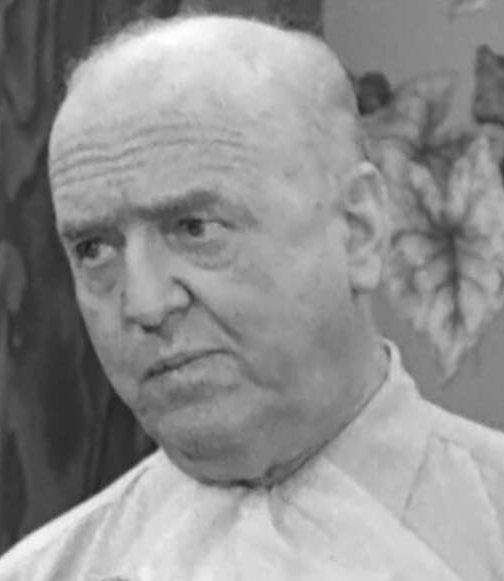
…which, hey, I don’t know, don’t be hairline-shaming my man William Frawley:


But this being the motivation for Lex to start shaving his head clean (as he appears sans hair in EDIT: his very next appearance Superman #1 – was reminded in the comments he didn’t go Full Yul ’til after the Man of Steel mini was over) is frankly just as silly as Superboy blowing Kid Lex’s hair away after a lab fire. BUT TO BE CLEAR I know this isn’t the argument at hand. Hair is removed as a motivation for Luthor’s behavior…now it’s just a small point being made about his vanity.

Luthor’s hatred of Superman comes from the Man of Tomorrow’s replacing Lex as the most powerful man in Metropolis. This is a more modern, a more…well, using the word “subtle” for anything Byrne works on is bit of a misnomer, but it is a more nuanced take on his hatred for Supes than “I lost my hair.” It rises out of the character’s personality, a change that comes from the increasing demand for the approximation of “realism” and storytelling sophistication in comics.

In a way, though, it still hearkens back to the childlike simplicity of comic character motivations of decades past: “I was the biggest guy, now someone else is bigger, and I hate him.” It probably just comes down to being more relatable…everyone’s been jealous of someone else, but very few people have experienced a friend causing their immediate and total hair loss. Unless, you know, their arch-nemesis is an evil barber or something.

As a small addendum, one of the elements of the Smallville TV show I appreciated is the fact that the meteor swarm that stuck the town, the one in which baby Kal-El’s rocket was enmeshed, was responsible for a young Lex’s baldness. Bringing back the “Superboy was kinda responsible for that” which had been missing from the other live-action adaptations…nicely played.