The only article you’ll see today mentioning both Lobo and The Scarlet Letter.

[This post contains SPOILERS for the endings of Supergirl: Woman of Tomorrow, the Supergirl movie, and also one chapter of The Ballad of Halo Jones.]

So one of my favorite incomplete works from Alan Moore is the science fiction strip The Ballad of Halo Jones, drawn by Ian Gibson, in which we follow the life and times of the titular character. Alas, a disagreement between Moore and the publisher truncated the comics’ run, and all we got is what we got.

I bring it up here because I wanted to point out this sequence (scanned from Quality Comics’ 1988 reprint of the story, in which the art was “stretched” to fit a standard comic book page). In this sequence, Halo Jones is a member of the military, and while on patrol on this planet, they shoot and kill an enemy sniper, to which the team has this response:


The obvious point here is that they can’t believe they just shot a child, and attempt to justify the incident by talking themselves into the idea that this wasn’t just a little girl, but an of-age adult. And as things progress, they talk themselves into thinking she’s progressively older and older until, as the caption says, “she’d practically died of old age.”

Now, it’s clear what’s going on here. The girl isn’t literally aging, it’s a psychological response by the squad to having killed a child and trying to rationalize it. The art shows what happened, the dialogue and captions tell a different story.

In a 1987 issue of The Comics Journal, in a review of an earlier reprint of Halo Jones from Titan Books, the otherwise insightful and informative article has this to say about that same sequence:


I mean, the person who wrote this article is a smart person, so I’m just chalking this up to a brain fart. “Whomst amongst us…” and all that. Who knows how he missed this? Was he reading just too many comics he had to write about, rushing through the volume and not allowing the implication to sink in? I don’t know. Regardless, what was written in that review is not what was happening in the comic.

Again, it happens. Look, even Roger Ebert didn’t quite get the “multiple choice origins” for the Joker in The Dark Knight, so none of us are infallible before God.

Which brings me to Supergirl: Woman of Tomorrow by Tom King and Bilquis Evely.

This 2021 comic book series was the primary inspiration for the new Supergirl movie, which heavily borrowed characters and plot elements from it, but not every detail. And the movie also included folks who did not appear in the comic, like, oh, say, Lobo. One of the frequent complaints I’ve seen about the translation of the comic to film is that the book’s ending had been altered, or drastically misinterpreted.

I hadn’t read the comic before I watched the movie, as I noted in my look at the film. However, I’ve since perused the source material, as well as did some searching online for more reactions.

And what I found was interesting: there is a portion of the comics’ readers who are confused by its ending. Which…I find puzzling.

Here is the last page of the book, more or less (I cropped the panels for increased legibility, where I could). At this point, the bad guy, Krem, has been released from the Phantom Zone, aged and repentant, begging Ruthye for forgiveness for what he’s done. Ruthye had been talked out of killing Krem as vengeance for her father’s death, and Supergirl stands by her here.

In panel one, we see Ruthye smack the kneeling Krem with her walking stick:


In panel two, we see Krem on the ground with his hands apparenly flailing in the air, as Ruthye walks away.


Then we see Supergirl and Krypto walk away in the opposite direction, as Krem reaches for his head.


And here, is Krem, alone, just remaining on the ground.


What Ruthye does to Krem here is slightly open to interpretation. Does she kill Krem, despite the point of entire book being about eschewing vengeance, giving the story a darkly ironic ending? Or does she simply bop him on the head, indicating that despite whatever personal growth he underwent while imprisoned, she still hates his guts?

Well, it’s the latter, Tom King his own self said so. Krem is still alive, just with a likely bleeding and sore crack on his noggin.

While there is admittedly some ambiguity there, there is no ambiguity about what’s going on in the captions. An additional note about what’s going on here: it’s been 300 years since the events earlier in the book. Ruthye is elderly. Supergirl and Krypto are, it seems, immortal. In that time that’s passed, Ruthye wrote a book about the events in this story, about which she’s said


Ruthye straight up tells Supergirl, and the reader, what she wrote is a whole lotta bullshit. As such, those excerpts, describing Supergirl’s dispatching of Krem with a sword, is a fictional rewriting of the actual end of the adventure. That book had been written as some point in the past, and since Krem is still alive now under the captions presenting those excerpts, clearly Supergirl ain’t killed nobody with no sword. (Apparently it was a ruse by Ruthye to keep Krem’s comrades from seeking their own vengeance on her.)

That all seeems pretty clear. And yet, when researching responses online, I found people confused by the ending. Okay, yes, I’ll give a pass to those who thought Old Ruthye killed Krem at the end. It’s contrary to the spirit of the book, and shouldn’t be interpreted as such, and c’mon Supergirl was standing right there, but you can’t put it past that wily Tom King to give such a dark punchline to a story that tried so hard to avoid it.

But there were folks confused by those captions. They were saying one thing, we were seeing something else in the artwork. Even though it should be understood that Supergirl hasn’t killed anyone, some readers were apparently still confused by what they were being told. It’s not what’s shown, the timing doesn’t work out (the book relating a death that happened in the past, though the person killed is still alive in the present), but the old Unreliable Narrator trick can still muddy the waters, it seems.

Interestingly, Ana Nogueira, the screenwriter for the Supergirl film, also didn’t quite grasp the book’s ending. She straight up says in this Variety article

“[Krem] essentially has changed, and she kills him anyway, because she still just has this anger, and you understand there’s this element of deserve, right?”

Now, again, I’m not going to fault someone entirely for not getting that, for all the reasons I stated previously, while also saying that same someone probably shouldn’t have thought that, also for previously-given reasons.

What that seemingly leads to, though, is that Krem’s death still has to happen in the film, and the responsibility is transferred to Supergirl.

“So, we wanted to craft a villain who would deserve this, but we also wanted Kara to really care about preserving Ruthye’s innocence, and to feel like she could take on [killing him], that she could be the one to bring justice to this man, and do it without burdening this child.”

This change to the story’s ending took on a more deliberate stategy, despite seemingly being based on a misunderstanding. In this article on Comic Book Resources, director Craig Gillespie related

“I met with James [Gunn, head of DC Studios], and we talked about it, and James was adamant about it. I think it’s an amazing thing. To lean into – knowing the kind of movie that we’re making, and where her character is heading, that she has to go through this emotional journey. There’s no other logical conclusion to what she would do.”

Realistically, I don’t know how this more brutal interpretation of Supergirl will play into future DC films, as frankly, how many more will feature the character? She’s on deck for the next Superman movie, but it certainly doesn’t seem likely we’re getting any more standalone Supergirl films. To whatever end this choice was made, to have Supergirl capable of taking a life, they probably just have the one shot for it to play out. Whatever arc they intended will likely never see a conclusion.

These are a couple of extreme examples of misinterpreting the text. One is a simple misunderstanding of a description of a mental state in an otherwise solid print article. The other dictated the course of a multi-million dollar franchise, for good or ill. (Possibly “ill,” given how the film’s doing.)

Does the change in the Supergirl ending ultimately matter? No, not really. Whatever story is there for the films to work out will either work out or it’ll just dry up into nothingness, awaiting the next attempt at getting DC superheroes onscreen. It’s probably disappointing to fans of the original comics, but hey, if they could fiddle with the ending of Watchmen, or even The Scarlet Letter, nothing is sacrosanct.

I still think Supergirl is a pretty good film. I also think Supergirl: Woman of Tomorrow is a pretty good comic. That one is different from the other is…nothing new, given the Hollywood of it all.

Of course, that hopefully still-upcoming Swamp Thing movie had better be 100% faithful to the comics or I’m writing letters. Letters, I tell you.

Supergirl (2026).


So ahead of seeing the new Supergirl movie, I believed I was in bit of a quandary. As you may have noticed, the film had already attracted some negative chatter, primarily from The Usual Suspects. You know, the folks that regularly dogpile upon any superhero-or-related-genre mass media that focuses on a character or characters that aren’t straight, while males. Or, to borrow phrasing from my review of the 2025 Superman movie, “the usual parade of grifters out for your attention and your wallet” griping about things being “WOKE,” whatever they think that means.

As the movie appears to have, shall we say, faltered at the box office, it’s those very folks out in force right now crowing about some imagined “victory” in the culture war they’re fighting in their heads. And, going back to that quandary I mentioned, it puts someone like me, Just Some Dude on the Internet, in the position of fearing to critique the movie and being lumped in with Those Folks. (AKA “The Last Jedi Syndrome.”)

Prior to seeing the movie, I had heard some real, actual critique of the movie from people who are presumably Not Insane, ranging from a simple “I liked it!” to actual concerns about the film’s structure/direction/scripting, etc. Nearly all noted that Milly Alcock, the titular Supergirl, was excellent, regardless of their opinion of the project in its entirety. As such, I had those thoughts with me as I entered the theater that evening.

And…I liked it!

Alcock does a wonderful job giving us a troubled Supergirl, submerging her trauma and her (literal) alienation in partying and alcohol, and her struggle to emerge from that emotional burden. I know, I know, that sounds like a bummer, but it really isn’t. Alcock is absolutely a riveting presence onscreen, and you can’t help but feel sympathy for her character.

There is a layer of melancholy laid over the story, regarding Supergirl’s personal history and flashbacks to her life on Argo City (which survied the destruction of Krypton). But there is a sense of fun, too, as we’re given some exciting action set pieces, especially when Supergirl lets loose at full power (which she isn’t always at, due to story demands). Jason Momoa as Lobo is an entertaining addition to the proceedings as well, and is involved far more than I was led to believe, since a number of people said he had no more than a cameo. Oh, no, he’s in there quite a bit.

I thought the storyline was clear and straightforward, and plot points like the color of various suns and their effects on Supergirl as they travel from star system to star system were handled well. The action scenes were clearly directed, which is a typical complaint I have about these sorts of movies, but here I could tell who was doing what and where. And overall, the pacing was good and the story kept my interest from beginning to end.

If I had any quibbles, it would be maybe not having a major established villain at the core…forgive me, but I didn’t read the Tom King/Bilquis Evely Supergirl: Woman of Tomorrow mini that apparently provied some inspiration for the film, so I don’t know if the bad guys are a transplant from that story. But on the other hand, a departure from formula probably didn’t hurt (or maybe it did, given the film’s performance, but more on that in a moment). I mean, it’s true enough that the Supergirl Rogues Gallery isn’t exactly overflowing with villains distinct from Superman’s own enemies (I mean, Lesla-Lar, sure, but I don’t think I would have wanted a “me, but evil” adversary. Again.)

The other qualm I have is (and here we enter some SPOILER territory, which I’ve tried to avoid so far, but really can’t for this point) how the main bad guy is ultimately…dealt with by Supergirl. I get this establishes her as a different person with different standards than her cousin Superman, but it seems contrary to the message of “being good” instilled in her by her mother, and brought up several times during the film. But then, her mother also added that “being good” isn’t the same as “being nice,” so that plays into her decision, as well.

I know this could upset the purists, of which I’m usually one, but in this case it makes for a morally complex character, and that could have been further developed in future Supergirl films, of which, it seems, there will be none. Maybe it’ll get touched on in other upcoming DC films, assuming Warner Bros. doesn’t pull the plug on the whole thing.

And why did this film do so poorly right out of the gate? Look, as the internet’s only champion of Frank Miller’s The Spririt, I’m used to having the outlying opinion on a piece of media, but surely other people thought this movie was good, too. But maybe the tone of the film was a downer to most folks, not the Big, Flashy adventure that people want from their superhero films. Maybe not having that big name villain reduced interest. Maybe it’s just the now-typical “Superhero Fatique,” where audiences already had one Super-movie last year, that was enough for the time being.

Or maybe the Usual Suspects, the ones I mentioned at the beginning of this wall of text, succeeded in poisoning the discourse, convincing John and Jane Q. Public that the Supergirl movie was Bad, Actually. Which, may I say again, that would be wrong — it’s Good, Actually.

But maybe being good isn’t enough (ironic, given the advice from Supergirl’s mom). In this new post-COVID superhero film economic ecosystem, one of these types of films has to be an event. And it has to be something that at least appears new. Last year’s Superman was an event, the beginning of the new DC Cinematic Universe. This year’s Supergirl didn’t reach that perceived status, and, like I said, it came out on top of a another movie that had a hero with a big “S” on the chest. Superman turned into a must-see, Supergirl got the “wait for streaming” treatment.

And I hope the people who avoided it in theaters do discover it on streaming. By that point, it’ll be too late…Supergirl will be dubbed, by every metric important to the studio beancounters, a “failure,” even if everyone who catches it on MAX or whatever other service Warner Bros. sells the film to decides “hey, I like this!”

I say, give it a shot on the big screen. I was glad I did.

Also, Krypto the Superdog is in the film. Surely you want to see more Krypto.

That’s the first appearance of Mogo, friends, a Hot Key Investable Issue!


So I done dood it…I got myself a copy of the nigh-legendary Time Beavers graphic novel by Tim Truman, published by First Comics in 1985. Now I haven’t had the time to read it yet, but read it I shall, oh yes. I’m just a tiny bit miffed with myself in that copies of this were just all over the place at my previous place of employment. I mean, I could have bought one of these from there on the day of release, but alas, I thumbed my nose at Time Beavers and headed straight to the rack to grab Green Lantern #188 with its Alan Moore/Dave Gibbons back-up instead. Thus, I have to resort to the eBays and other nefarious means instead.

Anyhoo, there were plenty of comics I had easy access to back then, but didn’t think about acquiring until, oh, say, ten-something years after I stopped working there and three years after that shop closed. Ah, well, What Can You Do™? I’ve got my Time Beavers now, so my decades-old oversight has been corrected. I’ll get it read soon and let you Dingbats of ProgRuin Street know what I think.

• • •

Some interesting news from DC Comics over at the 2025 Comicspro event, such as:

  • Krypto: The Last Dog of Krypton by Ryan North and artist Mike Norton, which sounds amazing. No thought balloons here, North promises, but if you’ve ever seen Norton’s artwork, I suspect there’ll be expression enough from the Dog of Steel.

  • Supergirl written and drawn by Sophie Campbell…good, there should always be a solid and accessible Supergirl title on the stands.

  • Action Comics, which isn’t a new ongoing, obviously, but the new regular team of Mark Waid and Skylar Patridge will be effectively making it into a new Superboy series with a young Clark Kent. After years and years of DC either not having “Superboy” in Clark’s history after the Byrne reboot, and then kinda sorta waffling about it over the last decade of in-flux continuity, it’ll be interesting to see a modern take on the “Adventures of Superman When He Was a Boy.”

  • Batman by Matt Fraction and Jorge Jiménez – YAY! Restarting the main Batman series with a new #1 – BOO! I saw a news site state that “this is only the fourth time the Batman series has been renumbered,” and c’mon, that’s like five times too many. Batman will sell just fine without renumbering. Yes, we’ll get a boost in sales for the first few issues, which is the reason they do this, but then it’ll be back to its normal sales level soon enough. …I mean, the comic sounds good, I’ll definitely be reading it, I’ll just sigh heavily every time I look at the issue number.

I didn’t see any new Swamp Thing comic news, so all this Super/Bat stuff will have to do.

“EEEYAAAHHHH!”

So I talked about the “Supergirl’s Husband” story last time, about how it wasn’t as bad as I’d recalled it being. I mean, it’s not the greatest Superman story ever told but as a weirdo hybrid of modern storytelling demands and the Bronze/Silver Age milieu in which the Super-books still existed, it remains a fascinating example of where this particular franchise stood in those about-to-be-rebooted-away days.

The previous issue, however…


…well, it’s not awful throughout, but it ends on a really sour note that affects my opinion of the whole thing.

The most notable happening in this comic is the elaborate-if-easily-foiled-by-opening-a-door computerized contraption that uses its mid-1980s A.I. to generate believable Clark dialog while occasionally telling you it’s totally fine to eat fugu liver:


This is what I mean by the Superman books still being under the long shadow of the Silver Age. The wild elements and behaviors from that period continue on, even as the genre “matures,” with plot points like “Superman’s out-there ways of protecting his secret I.D. from Lois” sitting side-by-side with attempts at more modern storytelling sensibilities.

(I recently noted online that Superman media adaptations have increasingly done away with the idea of Superman trying to withhold his secret from Lois, possibly a reflection of the fact this is no longer a thing in the comics, or more likely just out of the feeling that aspect of the relationship is outdated.)

Another element of “modernization” bringing Superman comics in parity with 1960s Marvel is some of the overly-chummy captions, that “greetings fellow kids” really, really hard:


A total slam on Bulgaria completely out of nowhere, C’mon Julie.

And I just have to bring this up, as one of the alien antagonists for this story has an annoying speech pattern, one not shared by his fellow alien from the same species that’s his partner in crime. So the dude deliberately choose to talk like this:


“I have it with me…in this file I do have it!” “As we planned! Planned it we did!” AUGH SHUT UP ALREADY

Speaking of those guys, the story generally revolves around them (representatives of the Superman Revenge Squad) invading New Krypton (the planet upon which the formerly shrunken Bottle City of Kandor was expanded) and causing some havoc. But the early parts of the issue are more explicit tie-ins to Crisis on Infinite Earths, opening with Superman’s grief over the death of his cousin Supergirl, and proceeding to fly around a bit with the Superboy of Earth Prime:


Wait, that comes later. This story features the character in more innocent times:


…before he’s whisked away yet again by a mysterious cosmic vortex that…was there an explanation for that? I seem to remember it happening in the series and folks were all “where did that come from?” and it’s been so long since I last reread it I can’t remember if there is a reason for those. If you can enlighten me, feel free.


This comic concludes with Superman bringing Supergirl’s body to her parents on New Krypton, wrapped up in her cape. And I suppose Superman did a good job of wrapping, or Zor-El is in complete denial, because he says, well….


And we close ther issue with a nice, tasteful scream of anguish…


…accompanied by the almost certainly deliberately Vonnegutian “So it goes….!” which, I mean, c’mon, there’s a reason it’s used in Slaughterhouse-Five, I don’t think that’s quite earned here. Unless it’s some form of metacommentary on Crisis‘s then-ongoing slaughter of parallel universes and the countless lives therein, in which case, Elliot S! Maggin, I salute you.

But despite that, that final panel is…urgh. Kinda gross, to be honest, with that terrible cry across the top of the image. Better to have just shown the exterior in silence, I think, but forty years on may be a bit too late to do a little armchair editing.

The whole comic very much feels like “we’d better address what’s happening in the DC Universe at large” in a book that had largely charted its own course without many interactions outside its specific character franchise. That, of course, was a common element across most of DC’s superhero line, one that I think was hoped to change with the New, Fresh Start afforded by Crisis.

Following the Crisis tie-ins the Superman line mostly went back to business as usual, until the conclusions afforded to the main ongoing titles written by Alan Moore and Steve Gerber. Then along came the Byrne reboot, which I’ll be getting back to here shortly.

The verdict’s in!

I did get around to rereading this “Supergirl’s Secret Husband” issue of Superman, which I remembered as bad…


…but it turned out to be…okay-ish? Not as bad as I’d remembered, given I probably haven’t read it since around the time it was released. I still have my copy of it, bought new off the stands, and still in nice shape, which sort of surprised me, but then again I only read it once or twice so it’s not like it experienced a lot of wear.

This is marked on the cover as Crisis on Infinite Earths crossover, and…well, it’s more of one than some other similarly-marked books from the time. In this ish, we find out that, during a bout of amnesia and being stranding on an alien world, Supergirl met and fell in love with a resident there, Salkor. You can see Salkor below:

I’m not going into every detail here, but in short Supergirl regains her memories and returns to Earth, and…well, I’ll let here tell it via post-death hologram message:


So anyway, this “Hokku” she’s talking about is a device that she’d kept with her, one that retained her memories and such and Salkor wanted it back. But Superman was all “she’s my cousin, I’m keeping it” and thus the conflict proceeded until a giant robot thing shows up and they must unite to…well, you know.

Then at the end the Hokku displays a hologram of Supergirl as per the above scan and sets everything right, except the fact that she didn’t try to get back to Salkor after regaining her memory or even asking Supes “hey, turns out I’m married, help me contact my husband, right?”

But as egregious additions to the Superman mythos go, it’s not as bad as some things. Given the proximity to the eventual slate-cleaning by John Byrne ‘n’ pals with the Superman reboot, there’s not much opportunity to refer to this marriage or to even bring back Salkor for a guest spot (“Appearing in this issue: Supergirl’s Widower!”), so the impact is relatively nil. It’s almost…Silver Age-y in its presentation, outside the more modern Big Event Tie-in elements, which is sort of fitting given that Crisis, and the Byrne reboot, put a pretty solid cap on that era’s influence on Superman. Not that Silver Age stuff doesn’t get reinserted into newer stories, but it’s usually more a nostalgic reworking than just a natural expression of Superman comics’ DNA.

So this comic is fine, when all is said and done. Not a prime example of Superman comicking, but certainly a passable example of the end-of-days weirdness for the Super-books prior to their relaunch.

But the previous issue, #414, which is another Crisis tie-in…well, I may have been remembering the wrong Superman comic as the “bad” one all these years. But I’ll get to that next time.

In which I write a bit about comics I’ve not read in a while.

Going back to mid-August, David Conner relates

“Supergirl’s JL animated origin (actually from the Superman show IIRC) was substantially lifted from the underrated Superman vs. Aliens comic. Which was published during the period when DC didn’t have a Supergirl in continuity.”

Okay, it’s been a while since I’ve 1) read Superman/Aliens, and 2) watched the relevant episodes of Superman: The Animated Series. However, a peek at the Wikipediatron does show [SPOILERS AHEAD]:

1. Neither Supergirl (or rather “Kara” in the Aliens book) is actually supposed to be the Kara Zor-El, Superman’s cousin.

2. Both are survivors from a dead planet that is not Krypton, though there is some connection to Kryptonians in both their backgrounds.

As I’ve stated before multiple times before, DC put a whole lot of effort into, if not outright undoing Crisis on Infinite Earths, then at least referencing those elements of the DC Universe done away with by that series. I mean, not that either of these were part of the DC Universe…the animated series was, well, the animated series (though the white top/blue skirt costume would pop up briefly on the other Supergirl I’ll mention in a moment); and Superman/Aliens wasn’t technically an Elseworlds, as it didn’t directly contradict any then-established continuity (I think), but the use of the licensed Aliens property probably separates it out from the DC Universe mainstream.

[An aside: I mean, the story could still be referenced — “remember that time we fought a bunch of crazy extraterrestrial beings” with a flashback panel hiding the Aliens in shadow or something. I know there were some changes to the Wildstorm Universe superhero stuff in their Aliens crossovers. But to my knowledge the story was never referenced again, except possibly in Superman/Aliens II, the New Gods one, even though both kinda/sorta left open threads for follow-ups.]

Thom H. reminds us

“So much better than ‘protoplasmic blob from a pocket dimension that got fused with an angel(?).’ I know that Peter David series was popular, but I never did understand it.

“If writers at DC wanted Supergirl back, they should have just brought Supergirl back instead of jumping through so many weird hoops.”

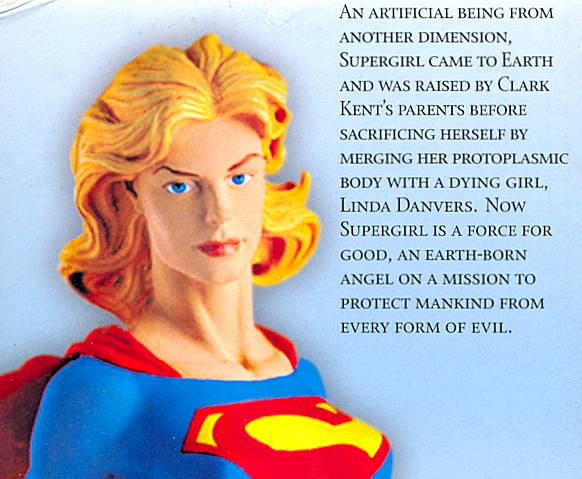
Hmmm…I was trying to come up with a short explanation, but it was getting too long, so let’s just say that protoplasmic being was created by an alternate universe Lex Luthor where, in the form of Supergirl, attempted to protect that Earth from that dimension’s evil Kryptonian villains. She was eventually brought to Main DC Universe Earth where she (mostly) remained in the form of Supergirl until…well, you know what, this detail from the box of a Supergirl statue sums it up:


And while I did like Peter David’s Supergirl run (which did last 80 issues, which is almost like an eternity in modern comic book terms, so folks did seem to enjoy it) it wasn’t the easiest premise to explain. Even the ultimate ending of this version of Supergirl wasn’t entirely cut ‘n’ dried. There was some very heavy implying in the Fallen Angel series David later did for DC that the title character was in fact the lead from his Supergirl series. And when the series moved to another company, the eventual reveal was that it was not Supergirl/Linda Danvers, but in a hopefully non-copyright-infringing way, Supergirl/Linda was involved in Fallen Angel‘s backstory. (And then Linda Danvers makes a brief appearance in DC’s Reign in Hell series, so she was still in the DC Universe in one way or ‘nother.)

Of course, with all the New 52/Rebirth/Whatever Else shenanigans the DC Universe has gone through, it’s probably likely that the events that lead to the introduction of Pocket Universe Protoplasmic Supergirl did not happen in current continuity as shown. I mean, I think we’re still dealing with the post-Crisis/pre-New 52 Superman who somehow crossed over into modern continuity, so maybe that all happened to him, but not to DC’s continuity at large. If you’re not following any of this, don’t worry, I’m barely following it myself.

It’s all kind of moot anyway, as DC stopped screwin’ around and finally said “OKAY FINE, HERE’S SUPERGIRL, SHE’S FROM KRYPTON, SHE’S SUPERMAN’S COUSIN AGAIN” and reintroduced her in 2004’s Superman/Batman #8. This comic is…well, not good, but it finally got a new version of the Classic Supergirl back into comics, and later creators did some fun things with her (especially around — 2019, I think? — when some Omega Men and other pals and gals showed up). And that’s the Supergirl we have floatin’ around today, assuming I haven’t missed a revamp or reboot somewhere along the line.

In which Mike just rambles on, making baseless and crazy assumptions.

Just following up on a couple of comments from my most recent post:

Andrew responds with

“I want to read those comics NOW (well maybe not the Fox and Crow, since my pocket money is finite).”

Fox and the Crow is actually pretty good, though I understand not having the scratch to throw down on everything. The particular issue being plugged in that ad is issue #95, which was the first appearance of “Stanley and His Monster.” Now, the lead stories were based on what I assume is a now-obscure series of animated shorts…at least, nobody seems to be trying to market or “reboot” the characters at the moment, so I’m pretty sure they’re mostly forgotten. But the comic lasted a good long time, with new Fox and the Crow stories illustrated by Not That Jim Davis, squeezing out endless variations on the Crow pulling some kind of scam on the Fox.

But, with the introduction of Stanley and His Monster in the mid-1960s, at a time when lighthearted monster-based entertainment was really taking a foothold, Mssrs. Fox & Crow began to lose their starring position in their own comic. Eventually, with issue #109 of the series, Fox and the Crow were discarded entirely as the title of the book changed to Stanley and His Monster. The previous stars likely seemed too old-fashioned, particularly in a comics marketplace that was focusing more on weird concepts and wacky “modern” humor, where Stanley and friend seemed to fit right in. Too little, too late, however, and the series ended with #112, though S.A.H.M. would be revived years later in a Phil Foglio mini-series and as supporting characters in a Green Arrow storyline, of all things.

Fox and the Crow, however, have mostly vanished, though it looks like they’ve made cameo appearances, or where at least mentioned in dialogue, here and there. I think technically they were licensed characters, so I don’t even know if DC has the rights to them now. I keep thinking about all the licensed books DC published over the years, and how it would be great to have a collection of, say, The Adventures of Bob Hope, despite the fact that the potential audience for such a thing ain’t exactly expanding of late. I’d love to have a Fox and the Crow collection, but given it took years of consumer demand to get even one reprint book of old Sugar & Spike comics out the door, I suspect the forgotten obscurities, especially ones that would cost extra licensing fees, will continue to languish.

But honestly, DC had two chances to get a Stanley and His Monster trade out to an audience that may have been interested by the characters’ revivals. Ah, well.

Andrew also adds

“It looks like those issues of B&B before Batman took over have been passed over for reprints.”

Well, if this series went to a volume 2, they would have reprinted this Supergirl/Wonder Woman team-up. Alas, ’twas not to be.

• • •

Wes Wescovich writes

“I think this may be the first time that Supergirl logo was used on a cover?”

I’m not 100% sure, but I think you may be right. My first instinct was that the logo showed up on one of the 80 Page Giants, and it sure did…a few months later. I don’t see the logo on previous issues of Action, where Supergirl primarily appeared, so it could very well be that the logo made its cover debut on that very issue of Brave and the Bold. If someone knows otherwise, hopefully they’ll let me know.

Once thing I noticed while looking at the Action covers on the Grand Comics Database is there’s about a three year gap between Supergirl’s introduction in #252 and her “going public” to the people of DC Comics Earth in #285. In the meantime she was “Superman’s secret weapon,” privately training and keeping the existence of Supergirl a secret. Three years probably seemed like an eternity to keep a plotline like this going in the late 1950s/early 1960s, though it’s not like this was the grand scheme planned from the get-go. I’m sure it was more like “okay, this is how Supergirl fits into the Superman family of books” at the start, and eventually “hoo boy, this ‘Supergirl’s a Secret’ thing is a drag, let’s put an end to that.” But I’m just imagining a bunch of kids who read the Supergirl stories at the start, grew out of reading comics a few months later, and went the rest of their lives thinking that Supergirl went on continuing her superheroic deeds in hiding from the general public. You know, watching the new Supergirl TV show and thinking “this is all wrong! She’s superhero-ing out in the open!”

I do wonder if anyone at the time made it all the way from Supergirl’s first appearance to her eventual introduction to the world. I’m sure someone did, even with the huge turnover readership likely had at the time. Like I said, three years was a long time in comics then, even if now it can be a not-unheard-of gap between issues in high-profile series. Or, more commonly nowadays, that’s not too far from how long it takes for some event stuff to pay off (like the whole Watchmen in the DCU thingie). Funny how we went from long-running titles with a high turnover in readership to a huge turnover in restarted/rebooted titles trying to get the attention of folks who’ve been reading comics forever. …Well, maybe not so funny.

Spoilers for a DC Comics Christmas story from the late 1980s.

christmaskaraSo Roel asked, regarding my link to last week’s Question over at Trouble with Comics, just why that particular Alan Brennert Christmas story with Supergirl and Deadman was referred to as “infamous.”

To be honest, I didn’t think much about that particular description…I just figured it had something to do with the pre-Crisis Supergirl appearing in the post-Crisis universe and someone somewhere, either a pro or a fan, got bent out of shape over it or something. And, it appears, after being pointed in the direction of this article by my fellow Troublemakers, that there more hoohar swirling about this particular comic than I realized.

The article itself focuses on the (basically confirmed) idea that folks in charge of the Superman comics weren’t terribly enthused about the pre-Crisis, totally-wiped-from-continuity Supergirl all of the sudden being brought back for a Very Special Story that was not under the purview of the Super-editorial offices. And if one were to look to the comments on said article, rumors aplenty are to be had about what may or may not have happened in regards to the release of this particular story…rumors that I’ll thank my kind readers not to reproduce in my comments section here, please. But anyway, there’s the “infamous” bit of business about it, I suppose.

I also saw elsewhere (in a post on a comic news site that has since been deleted, it seems) some commentary inspired by the Trouble with Comics Question column, wondering just why this specific Supergirl/Deadman story is held in such high regard. I personally think it’s a good, strong story (in a comic filled with some top-notch funnybookin’), in which Deadman learns a Very Important Lesson that just because no one knows about the effort and sacrifice one makes to do the right thing, doesn’t mean that doing the right thing isn’t important or unappreciated. For Deadman, who is literally an invisible spirit that the living world can’t know about, it’s an idea he needs to learn to accept, that he isn’t any less a hero just because his heroism is unrecognized.

For the reader, who is presumably aware that this is the Supergirl who was written out of the DC Universe due to the events of Crisis on Infinite Earths, we are reminded that just because the characters don’t “exist” in “current continuity” anymore doesn’t mean those stories suddenly stopped meaning anything to us, now. It’s hard not to read a sort of implied criticism in this story about how stories and characters “count” or “don’t count” in terms of where they fall vis-à-vis universe-wide continuity-changing events. This comic is copyrighted 1988 (with a cover date of 1989), so this was only a year or two past DC’s kinda/sorta linewide reboot in Crisis, which would make Supergirl’s appearance here one of, if not the, earliest return of a pre-Crisis character that specifically references the pre-Crisis universe. Kind of a surprise kick in the pants to folks still getting used to the New DC of the “there’s-no-stopping-us-now” variety.

I don’t know that really explains why this is as highly regarded as it is, beyond it being a well-written comic with great art by Dick Giordano. It could be seen the sort of fan-targeted deeply-referenced insular story that isn’t good for the long-term health of the medium, with a punchline that only makes sense if you were there for Crisis and can understand just who that blond gal is talking to Deadman. But it is a nice Christmas gift to those fans, a quiet metatextual reminder after the bombast of the crossover event, that those characters and stories may be in the past, but they’re not forgotten.

Plus, who doesn’t love a good Deadman story? C’mon, let’s get serious here.

Also, according to the in-show dialogue, Smallville has a comic shop.

So I finally wrapped up my watching of the Superman: The Animated Series DVDs, and in the third season episode “Unity,” Supergirl (in her civilian get-up) is given some comic books by a friend. First up, a probable precursor to Garth Ennis’s Jennifer Blood:


Here’s a slightly larger image of said funnybook:


In a way, I sort of admire the purity of it. Though I kinda hope it’s actually about a woman who turns into a gun. Who also carries a a gun.

Here’s another comic that shows up a bit later:


Again, a better look:


This one is an object of a brief gag in the episode where Supergirl reacts in disgust at the very idea of a spider-based superhero, a direct slam, of course, on Marvel Comics’ Incredible Hulk.*

The hero of this one looks slightly like a pro-wrestler — appropriately enough, given the original Spider-Man’s initial brush with rasslin’ during his origin. But I could see this guy rising up and bellowing “SPIDER POWER!” just before whipping out his finishing move, or whatever it’s called. I’m unfamiliar with the proper parlance. Also, it looks a bit like this character borrowed a helmet and gloves from Japan’s Ultraman.

Anyway, now the Superman series is down…time to move on to Justice League! Bring ’em on, Netflix!

* Yes, I know it’s Spider-Man. I’m goofing on the obviousness of the cartoon’s reference. This footnote only exists to avoid the inevitable “um, actually” corrections in the comments.

Sometime I just feel like posting a panel with Supergirl in a crazy outfit.

from Adventure Comics #415 (Feb 1972) by John Albano, Win Mortimer & Bob Oksner


There are two Supergirl stories in this “52 BIG PAGES – DON’T TAKE LESS! ONLY 25¢” issue…the second one, written by Len Wein and illustrated by Bob Oksner, isn’t tied plotwise to the previous story at all, aside from this bit of probably editorially-mandated bit of dialogue seen here in this detail from the title panel:


I thought that was a nice bit of intra-issue continuity, connecting two otherwise unconnected stories together and explaining why Supergirl is suddenly in a different costume (a costume that’s a little closer to what she wore through most of the 1970s and the early 1980s, and at least had the virtue of not being accessorized with a headband).

…

It seems I’ve now written a post about Supergirl’s costumes. So it’s come to this.