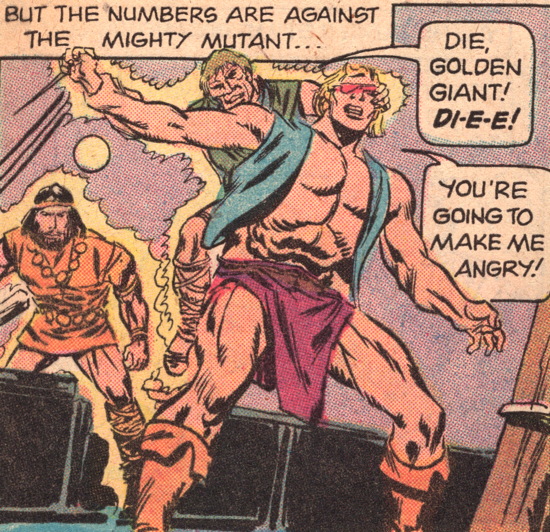
And yes, Mighty Samson #32 was released in a three-pack, I didn’t mention that in the body of the post.

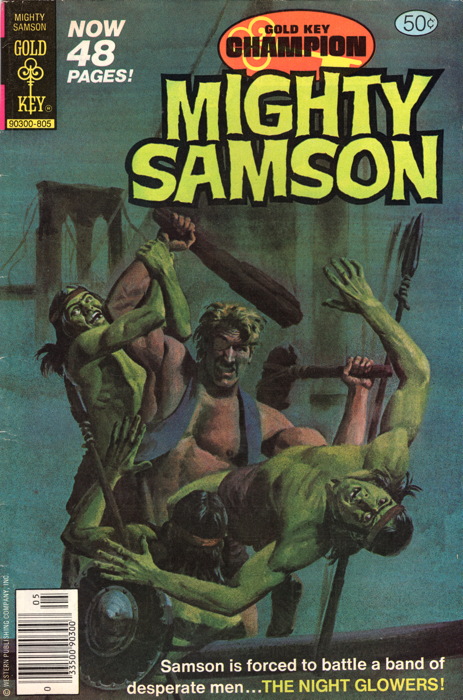
So one of the funnybooks I acquired in that recently-purchased collection was this:


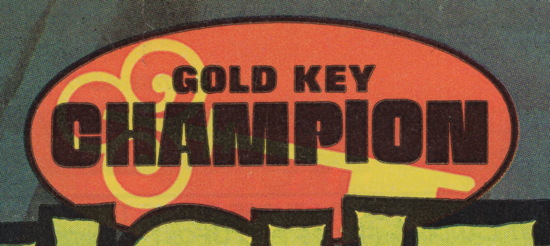
I didn’t pay it much mind at the time, because “oh hey it’s another Mighty Samson comic, no biggie.” But taking a closer look it has this blurb at the top of the front cover:


…my initial thought was “is this a comment on the fact that Mighty Samson was, against all odds, still running?” But no, this is in fact a series called Gold Key Champion, one that I really can’t recall seeing before (or I did see before, at some point at the previous place of employment, and just don’t remember).

Well, sort of a series, anyway, as it ran two whole issues, of which the Might Samson installment was the second. And as I was pricing it up, I saw the note in the Overstreet Price Guide that it was “half-reprint,” which intrigued me. A look at the Grand Comic Database entry shows that the cover story “The Night Glowers,” illustrated by Don Heck, is new to this publication. Said cover appears to be new to this comic as well.

This comic was released in 1978, between issue #31 in 1976 (which has new material) and #32 in 1982 (reprinting issue #3 from 1965, but with a new cover by Dan Spiegle). I am presuming this new Don Heck-illustrated story was maybe…unused inventory that was put in this Gold Key Champion comic, published to see if there was still a market for these Samson comics? He wasn’t the artist when the series left off, so I don’t know if he’d drawn the story for publication in 1976, or was hired to draw either a new or inventory script for the ’78 release. I’ve no idea, but I can imagine those Mighty Samson completists suddenly alarmed that there’s this other comic outside the main series with new work.

Issue #1 of Gold Key Champion, by the way, features Lost in Space (the Space Family Robinson original-to-comics version, not the “Danger Will Robinson!” TV one – here’s an explanation). Again, it’s half-reprint, with a new story by Gaylord Du Bois and Dan Spiegle, and I also don’t know if this was produced specifically for this book or if it was leftover inventory. Du Bois and Spiegle were the creative team when Space Family Robinson Lost in Space ended with #37 in 1973, so was Du Bois’s story in GKC1 sitting in a file cabinet somewhere for Spiegle to come back and draw five years later? Did they both come back to do a new story? Or was the whole thing ready to go in ’73 and not published ’til 1978? I’m guessing the last.

Anyway, wasn’t that all interesting? …Okay, I know, but I thought it was neat and wanted to ponder a bit about this comic here.

• • •

Don’t forget, I’m still taking your 2023 comic industry predictions! Where are we headed? What’s going to happen? OH MY GOD WHY IS EVERYTHING ON FIRE? Feel free to leave them in the comments to this entry and I’ll cover ’em in January 2024! (And I’ll start going over your 2022 predictions in just a few short weeks!) Thanks, pals!

Size does matter, maybe a little.

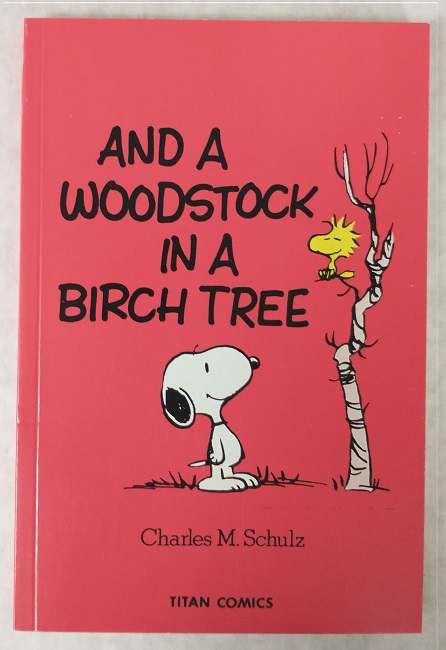
Was surprised slightly when opening up my Diamond Comics shipment this week (though I shouldn’t be too surprised since I’m the person ordering all this stuff) by the arrival of And A Woodstock in a Birch Tree from Titan Books:

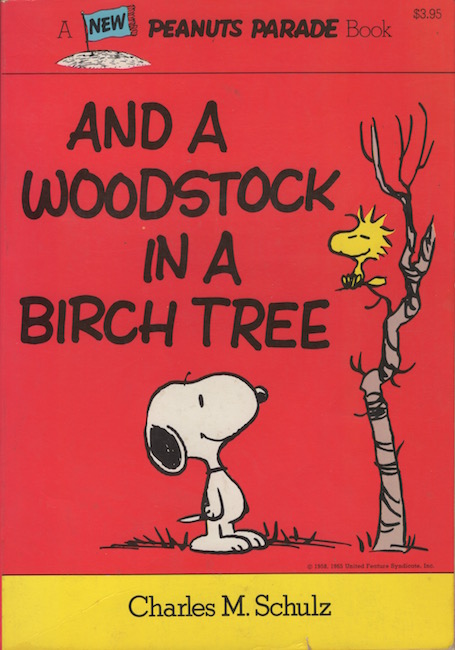
This is, in fact, a facsimile reprint of the original Peanuts Parade book from 1979. Which, by the way, I just happened to have bought back then, having somehow scraped together the necessary $3.95 to acquire it. And as I still have it, here is a pic of that very book purchased by Grade School Mike in the rapidly-receding past:


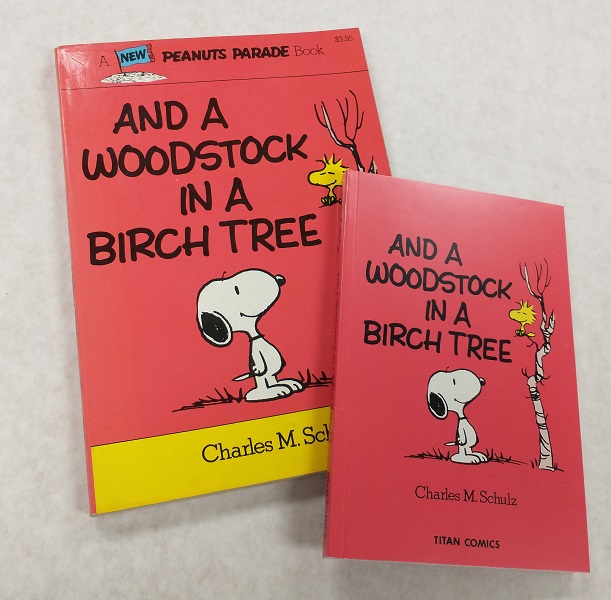
Now I loved these Peanuts Parade books. I checked every available one out of the school library and the public library, often multiple times. I can still picture these well-worn volumes being held in my hands. I liked these much better than the standard Peanuts paperbacks because 1) they were thicker and had a lot more strips in them, and 2) they were physically bigger, measuring 7 by 10 inches in size.

Hence my surprise when I cracked open that Diamond box and saw the new edition, and its much smaller stature of 5 1/2 by 8 inches. I know you can’t really tell by looking at the scans above, so point your peepers at this pic I took especially for you comparing and contrasting the two editions:

(The back cover of the original features a Sunday strip in color, whereas the back cover of the Titan edition is mostly solid red with a publisher note about this being a facsimile and what strips are reprinted therein.)

Now I realize this, and similar volumes of Peanuts strips, are possibly made redundant by the Fantagraphics Complete Peanuts series. Those are extremely nice, don’t get me wrong, and I’m so glad to have ’em all, but there is a nostalgic value to simply holding a book like this in your hand, original or facsimile. The look and feel, the very format of the volumes, makes them distinct pleasures above and beyond the value of “completeness” that you could otherwise obtain. I have a handful of old oddball hardcover Peanuts strip reprints that I would never get rid of, simply because they’re aesthetically pleasing to me, even if the strips are better curated elsewhere.

But it’s hard to top having my old original and beat-up copy of Peanuts Parade in my hands, connecting me to the ten-year-old I used to be.

Or “Mxyztplk,” if they’re writing about the Golden Age version.

Okay, let’s see if I can run through a couple of more comments left back in Ye Olden Tymes (i.e. last August):

Wayne sallies…um, in a forward-moving direction with

“Mike, I will send you five dollars in cash if you write a post on the Heckler.”

I AM NOT ABOVE BRIBERY. However, I don’t think I’d read the Heckler since…well, probably when that series was released in the early ’90s. But I did buy every issue, though I’m reasonably certain I gave up my copies to my shop‘s back issue bins when I opened up in 2014. and I just checked, and The Heckler isn’t on the DC Universe app.

But never fear, as I think those comics may yet still linger in the bins awaiting my retrieval. Therefore, Wayne, I will attempt to read the series and see if I have anything to say here about it. A quick look at the Wiki entry reveals…nothing I can recall from the comic, save for his nemesis “John Doe,” but I might only remember him because he’s on one of the covers. Ah well, I guess it’ll be like reading brand new comics to me.

• • •

David Conner continues with

“The mention of Peter David’s Supergirl and Aquaman got me thinking, is there any other writer from the last 40-odd years who feels more ‘of his time’ than Peter David?

“I *loved* his stuff in the ’80s and ’90s, but looking back at it today, it’s more often than not cringe-inducing (using that term which I generally hate advisedly.)”

First off, let me just say it’s high time my browser’s spellchecker stops flagging words like “Supergirl” and “Aquaman.” I mean, I suppose I can add them to the dictionary myself, but whoever programs these things might as well just dump all the superhero names they can into whatever file they go into. Help the world spell “Mxyzptlk” correctly!
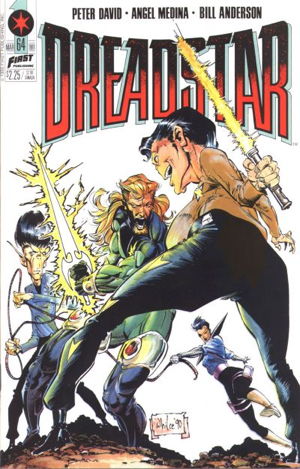
But to David’s actual point…yeah, I see where you’re getting at. I have to admit, I’m a bit more charitably inclined towards Mr. David’s writings than the opinions of some of my fellow comics-noscenti. I think his Hulk work still stands up, for example, and his Dreadstar was fun (save for that two-issue bit where he was parodying Trek…oof). And there is other stuff he’s written here and there that I’ve liked, such as Fallen Angel and, yes, Aquaman. Supergirl was a weirdie, mostly because of the premise, but I’d read and liked the whole run. His Star Trek was genuinely great, something of a miracle considering the editorial interference he often faced.

When I think of a certain comic creator being “of his time,” the one that comes to mind for me is Don McGregor, a writer who came to prominence in the ’70s and his very text-heavy work is what I picture when I think of “1970s comics.” Now that’s just a matter of my particular perception, as the man’s still working today, but I think of 1970s comics, in comparison to modern books, as having a lot more captions and dialogue, and I associate McGregor with that particular style.

Now David’s work…I think a primary criticism aimed at his comics is the level of self-aware, and of a certain measure self-satisfied, “cleverness” to his writing. Sometimes it can be subtle-ish (the “brush with Death” in Incredible Hulk), sometimes it can be laid on a bit thick (that Trek parody in Dreadstar I’d mentioned) and as with most humorous and/or clever writing, Your Mileage May Vary. It may be that this sort of thing didn’t age well, with it seeming New and Fresh at the time, but as the years have passed and writing styles and trends and tastes have changed in comics, looking back reveals the some of the obviousness of the artifice. Much in the same way we look back at Alan Moore’s early work and kinda wince a little at some of those scene transitions (which, to be fair, folks were kinda gripin’ about even back then — like in Killing Joke where we see a “Fat Lady” poster at the circus, and then we move to the Joker’s memory of his pregnant wife. Hoo boy).

I would say something like your reaction to David’s writing, David [Conner], is different from something like Stan Lee’s writing in the 1960s. That is Very Much of Its Time, but it may be more that Lee’s style defined that time and is considered perfectly acceptable, versus people trying to write “for the hip kids” back then whose writing did not age quite as well (cough cough 1960s Teen Titans cough). Before The World’s Biggest 1960s Teen Titans Fan gets mad at me, those are fine, the art’s beautiful, but you have to admit that DC’s “hello, fellow kids” scripting house style was clunky as all get out, rarely reaching the masterful level of smarm Lee was able to churn out.
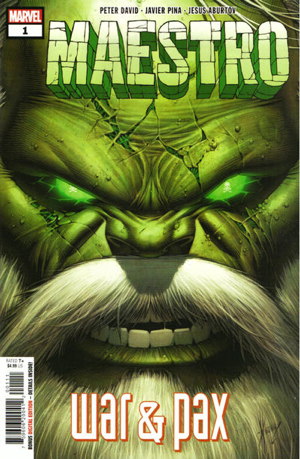
David’s work of late, revising the Maestro character from the Hulk, and Genis from his run of Captain Marvel, seem to have been reasonably well received. I didn’t read the Genis title, despite having read and enjoyed those CMs, only because I’m so backlogged with comics I try not to add more titles unless I absolutely have to. That said, having been a Hulk reader for decades, I of course picked up the Maestro titles, and I think they’re a perfectly fine extension of the character’s story. Nothing in there struck me as being overly…Peter David-y, in the sense of what people who don’t care for his previous work don’t care for.

Now New Fantastic Four maaay be a bit much for those same people, with the banter amongst the main characters and a particular gag involving another character’s name. I picked up this series too (what with the Hulk being in there, and the FF tie-in as well) but I’m only a couple of issues in, since it hasn’t felt quite as compelling a read as the Maestro books have been. Eh, what can you do.

I do still think David’s Hulk run remains a high point in that character’s history, and I still have fond memories of much of his other work. However, I do realize if I go back and reread some of it, I may find myself in a similar position of being more aware of the seams now that some time has passed. Or I may enjoy it just fine for what it is, even if it is an artifact of the period in which it was produced. (Remember “wilding?”)

But you know what? Peter David got this dirty joke into a Popeye comic and I can’t hate him for it.
If I’m going to use a cover from this series, let it be the one with kangas.

Cassandra presents

“Mike, the main reason Wonder Woman survived into the 50s has to do with the terms of the original contract between AA/National and Marston. If there came a period where she didn’t appear in a comic published for a certain length of time (I’ve heard two months), the rights would revert to the Marston estate. So, Wonder Woman might be the first comic that continued to be published solely for a rights issue!”

If I recall correctly, it was Kurt Busiek who first unleashed this knowledge onto the world…some kind of deal where he mentioned “oh yeah that post-Crisis, pre-Perez series mini I wrote was done else DC lose the Wonder Woman rights” and the rest of the funnybook resident was all “…wait, run that by me again?”

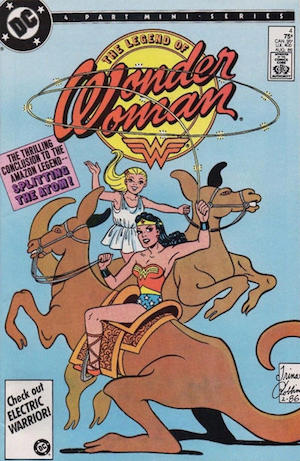
Now that’s entirely paraphrasing, but it was something along those lines. The Legend of Wonder Woman, scripted by Busiek and illustrated by Trina Robbins, was released in the year-long interim between the cancellation of the original Wonder Woman series and the George Perez/Greg Potter relaunch. Apparently, without that mini being rushed into production and released, that publishing gap would indeed have been enough to trigger whatever contractual clause existed to revert all Wonder Woman rights to the Marston estate. Last month’s issue of Back Issue, the ’80s DC Mini-Series issue, features a good interview with Busiek and Robbins about the series.
One of the details I believe I learned from that interview was that it had to be specifically a title starring Wonder Woman. Guest-appearances in other comics, or even just being a member of the Justice League, wasn’t enough to keep the shepherd’s crook at bay and yanking her offstage.

Now I’d assumed after that close call, as the series was rushed into production after someone realized that contractual issue, that DC/Warners went to the Marston estate, pulled out the checkbook, sighed and asked “…okay, how much?” I presume that was the situation when DC nailed down the Shazam!/Captain Marvel rights a couple/three decades back instead of just continuing to license the characters from Fawcett. Anyway, in that Back Issue interview Busiek said he wasn’t sure what the situation was regarding the Wonder Woman contract, and whether that clause was still in effect. If there’s been clarification on this since then, I’d like to know.

As I noted in the post upon which Cassandra was commenting, in that otherwise superhero-less gap between the Golden and Silver Ages, Batman, Superman and Wonder Woman continued to be published because they were still money-makers. In Wonder Woman’s case, yes, that title was still making money via all the toys and such DC was able to license, which certainly gave them incentive to keep the title going. Not just to encourage more licensing, but to keep their mitts on the property so they could continue making that toy-and-costume scratch.

Now as to whether or not any other titles continued on solely to retain the rights…well, technically, that’s the deal with pretty much any licensed property, but I know what you mean, Cassandra! There was that aforementioned licensing arrangement DC had with Fawcett over usage of the Shazam! family of characters, but I don’t believe that would’ve been a “use it or lose it” kind of deal. I don’t think there were too many long gaps with DC’s usage of Captain Marvel anyway, so I don’t believe that to be entirely analogous. But I can’t think of anything else that’s quite the same. Something to look into, perhaps!

Also, I should note that I’m filing this under the “Multiverse Talk” category not just to continue the conintuity of converssation, but also because the Legend of Wonder Woman mini includes a nicely appropriate send-off to the Earth-2 Wonder Woman!

Entirely separate except for the bust killing distributors and shuttering stores.

There’s a lot of Comics Ages talk in the comments to this post — well, a lot of talk in general, hi Sean! — especially about the term “Bronze Age.”

Now that’s something I’ve poked at a few times in the past on this blog, like way back in 2008 and then relatively recently in 2019, and I’m sure one or two more times but you get the point. I’m not a huge fan of the term “Bronze Age,” and as I point out in one of those old entries, even the Overstreet Price Guide was all “yeah, that’s not an official Age of Comics” until suddenly it was an official age of comics.

Also as I’ve said, those are all just marketing terms to help sell old comics, whether it’s a publisher trying to make their reprints of 1940s books sound like a Big Deal instead of just filling some space in a World’s Finest 100-pager, or it’s someone trying to make their old issues of Arak Son of Thunder seem fancier by slapping a “COPPER AGE CLASSIC!” sign on their box.

Bronze Age eventually made the Comic Ages cut after enough people started using it to describe their books…and after getting enough distance from the period to be able to say “yes, this period of comics does look distinct enough from what came before and what came after to make it its own thing.” But that said…I feel like 1984 is too late a cutoff date for the period. Crisis on Infinite Earths I think is what’s being used as the break between ages, given its massive (and continuing) impact on DC Comics and how other publishers handled big events with their title. I’d say New Teen Titans #1 in 1980 would make a better separation point, given its new style and direction for the team and how it energized DC to an extent, and it’s what lead Marv Wolfman and George Perez to Crisis. I’d say it’s as much as a demarcation point as Showcase #4 in terms of “this is what superhero comics are now.”

(Yes, New Teen Titans is walking in X-Men‘s footsteps, but that would really disrupt the whole “what is Silver/Bronze/Copper” thing and I’m too tired to deal with that right this second.)

Daniel T notes that he’s not a fan of “Bronze Age” including stuff like Love and Rockets and Nexus, and that’s fair enough, as Comic Ages tend to be DC/Marvel/superhero-centric anyway. I mean, I don’t know that I’ve ever seen the underground comic God Nose described as a “Silver Age book.” There’s a case to be made that undergrounds/small press/indies are their own thing, outside the main “comic ages” universe. A parallel universe of comics history, if you will. One that contains the “Black and White Boom/Bust,” a phenomenon almost entire separete from the color superhero funnybooks.

I mean, people will use those terms for “Cerebus #1 Bronze Age Key!!!” or “Bone #1 Copper Age Key!!!” but…I don’t know. I don’t have an answer. And the rise of indie titles was a big part of the comics industry…pushing the Bronze Age back to 1980 to include a lot more of them would be nice.

Anyway, not going to solve this issue right here and right now, and yes we still need to come up with divisions to split up that “Modern Comics” age. I came up with a good’un in one of my old posts linked above.

And was Prison Jumpsuit Luthor even areound at the same time as this? I can’t even remember now.

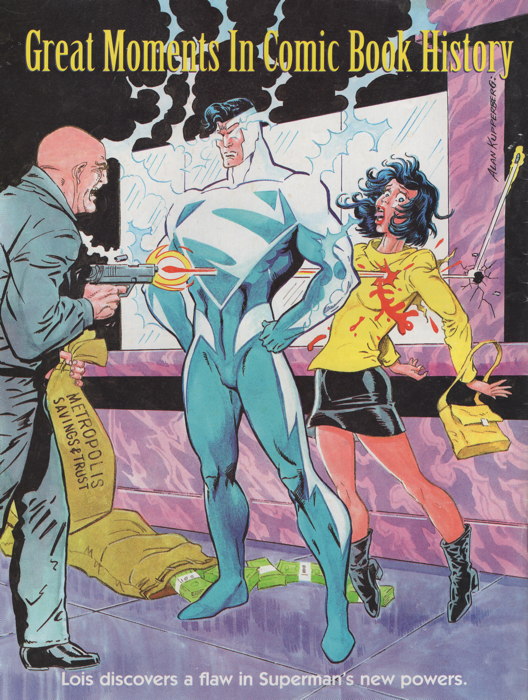
So I was processing some new acquisitions at the shop (said shop being Sterling Silver Comics in lovely midtown Camarillo, CA — shop early, shop often) when I peeped my peepers at the back cover of Cracked #317 (July 1997):


I don’t know why this struck me as oddly as it did. It feels awfully…insular a gag to put in a nationally-distributed magazine, maybe? The whole “Electric Superman” thing (featured in this long-ago post of mine with the possibly increasingly-inaccurate title) got some real world coverage at the time, as I recall, but I don’t feel like it was a lot. Remember, by 1997 non-comics-initiated folks were still coming into the shop, seeing Superman titles on the stands, and asking “hold on, isn’t he dead?” That feels like it was the primary public perception of Superman at the time. Not to mention comics were still in, or crawling out of, a market crash, so they didn’t have the huge cultural cache they did only a few years prior.

But of course, not every gag needs to, over even can, hit with everybody, and this one (drawn by Alan Kupperberg) may have received a brief flicker of amusement from those Cracked readers who also had a foot in the door of the comics hobby and were aware of Superman’s then-current status.

I know, I know, I’m overthinking it. Maybe the gag was conceived during that very brief window the new costume was getting some publicity and everyone thought “oh, yeah, this’ll still be a thing everyone will be talking about in three or four months.” Or maybe Cracked was increasingly being sold through the direct comics market and thus more likely to find readers who’d appreciate this joke.

Anyway, I just thought it was odd. Also, “person getting shot is funny” doesn’t, um, play quite as well at this current moment, needless to say.

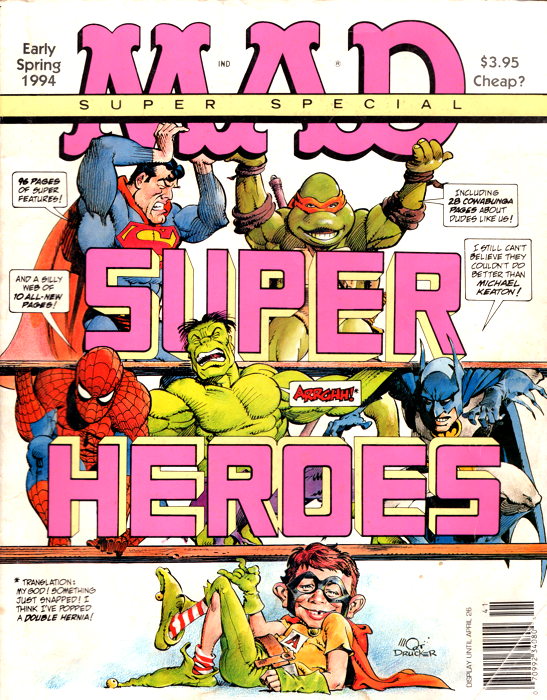
Coincidentally, I also received in the same collection a copy of Mad Super Special #96 (1994):


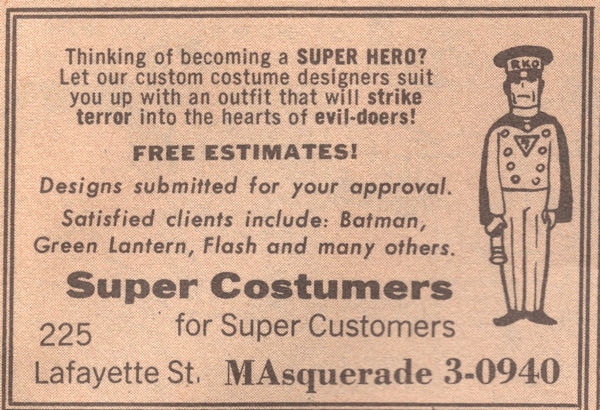
…which, as you can see, was their big Super Hero issue. The gags are a little broader, either playing off characters’ more general perception or placing them in jokes that require no special comics knowledge (man complains about a fly in his soup, which is promptly webbed out of there and eaten by Spider-Man), or parodying specific events that anyone reading the mag would know (like the 1989 Batman film), or making jokes about things that are eternal and forever embedded in our culture, like, er…Yellow Pages ads:


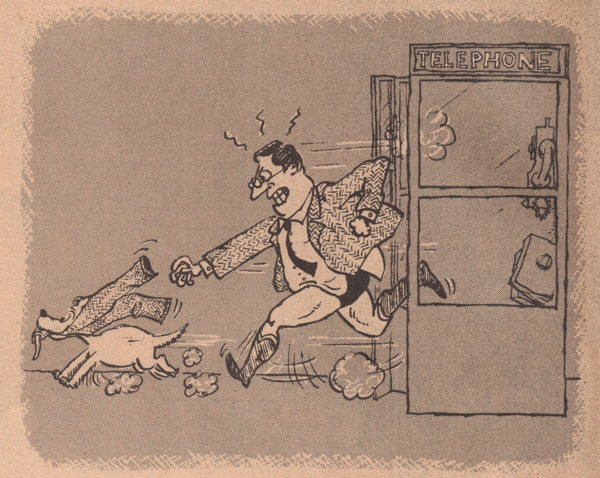
…or, um, phone booths:


Okay, admittedly that’s mixing two different things here, the eventual aging of once-current gags versus a gag that kinda hit the ground limping in the first place. But it seemed to me an interesting contrast between humor that, though near archaic, is still amusing, versus a joke attached to an event that’s irrelevant now and was barely relevant to its potential audience then.

And also carry stacks and stacks of All-Star Batman and Robin the Boy Wonder.

Twitter pal jd asks the following not-easy-to-answer question:

“…Why do some comic shops succeed and some fail? What are the major factors that go into longevity?”

Egads. Where do I start? Where do I end? Where do I go in-between?

The barest minimum answer I can give to “why some succeed and some fail” is “the businesses that make enough money to pay expenses and provide a living for the owner/employees succeed, and the ones that don’t fail” which, of course, applies to pretty much any retail business you can think of. But what is it specific to comics that feeds the rise and/or falls of those stores?

In slightly less general terms, I think a long-standing store should have

1. Knowledgeable, friendly employees

2. A wide and relatively deep range of stock

3. Some measure of cleanliness

…which again isn’t exactly comic-specific, but I think these are the positive qualities for a comic store to be around more than a year or two.

Those are just the things within the control of the store itself. That doesn’t take into account things like your potential customer base, the quality and proximity of competition, the overall health of the comics business, etc.

This is immensely simplified. Factors such as “expanding too much just as the market downturns” can take out a shop. “Being in a bad location,” or “being a good store but being outcompeted,” or “having the building you’re in get bought by a new owner who promptly prices you out by raising the rent too high,” “the partners who own the store got into a fistfight and now that store’s shut down,” “owner dropped dead” — could be anything, really.

I know during the ’90s boom a lot of shops opened up and I’m sure many of the proprietors smelled some easy funnybook money and dealt heavily in “hot” books. Once the fad died and the market crashed, all those “hot” comic customers dried up and without any longterm committed clientele, many of those shops vanished.

And this isn’t even touching really on distributors suddenly going under, taking retailer money and product with them, leaving stores in the lurch. Which is what has me wondering if we’ll see a return of that particular problem in this new no-longer-beholden-to-Diamond-Comics direct market world.

Ultimately, all I can do is control my store and do what I can to keep it vital. I’m not the biggest store around, or the fanciest, or the most monied, but it’s operating at a level I’m comfortable with, one that pays the bills and affords me a living and the occasional eye injection, and is (usually) stress-free, despite my distributors’ best efforts. But I try to be helpful and friendly, try to stock what I can (and am willing to reorder what I don’t have), and have fair pricing on my back issues.

Now if someone were to open a big ol’ comics emporium right across the street from me, I might take a hit, but I’d like to think I’d engendered enough loyalty to keep at least some of my customer base. I mean, I’ve been doing comics retail for three and a half decades now…it’s too late to go find a real job.

Oh oh oh, I forgot one…a store should have some kind of internet presence. Without going into too much detail, there was a shop I knew about that, when I went to look ’em up online, the only thing I found was a mention of their shop on someone else’s Instagram. Anyway, that shop wasn’t around too long.

• • •

As long as I’m taking Twitter queries, here’s one from a couple of weeks back from Joseph Z:

“What is the most reprinted comics story of all time? Story, not issue. My guess would be Spidey’s first appearance from [Amazing Fantasy] #15.”

That’s certainly a contender, and I’m presuming we’re not talking print runs but rather “most individual reprints of the same story in different comics or trade paperbacks.” I feel like the first Batman from Detective Comics #27 may be a small contender, though the look of the story hasn’t aged well and likely wouldn’t appeal to most modern audiences.

Now a while back I listed off the various House of Secrets #92s I had. I admittedly had too many and have more on the way. Thus, that was 8 reprints of the original Swamp Thing story…with more acquired since this, and more about to arrive. So…a dozen or so now, 15 maybe?

I’m hard pressed to think of an individual story that comes close (and also it’s super past my bedtime right now)..if you’ve got an idea, throw it into the comments and we can do a little digging. It’s probably going to end up being something at Disney or Dell, isn’t it.

“His shadow — advantageous!”

Going to jump around a bit addressing some of your recent questions left in my comments sections, starting with this one that Thom H. though nobody would notice. I SEE ALL, THOMATHAN:

“Not sure if anyone will actually see this, but I just realized my copy of Miracleman #23 has a printing error. Some of the art is cut off at the top and some is cut off at the bottom, depending on the page. Does that make it worth a lot more money now?”

I took a look at my own copy of this comic, and it doesn’t appear to have any printing issues like that, and I don’t recall hearing about any widespread printing problems with this issue, so it could be you have a relatively unique item. The big question, though, is “does anybody care?” when it comes to additional collectibility.

The answer is usually “who the hell can tell” particularly in today’s market, where just about anything and everything can become a reason to inflate a price.

I would say one of the most famous of the printing-error books is Venom: Lethal Protector #1, where mistakes make in the application (or lack thereof) of the foil enhancements resulted in the “black” variant and at least one white variant (which I hadn’t heard of ’til looking up this link for the post you’re reading now).

In this Venom comic’s case, those variants do admittedly look very striking, and one can see how they would attract extra demand. As per the links a couple of paragraphs above, a small miscolored patch on an Amazing Spider-Man cover is…a tad more inexplicable as to why anyone would give a poop, but a miscolored Galactus in only part of the print-run is more understandable.

But a trimming error in the interior pages? The wide net cast by collectors trawling for any reason to create an investable item has yet to dredge that up, far as I can tell. Though things change fast, and for all I know “OCCUPY AVENGERS #4, CENTER PAGES MISCUT IN HALF, RARE H@T” will turn up on eBay at any moment.

• • •

Roel Torres asked in response to my Solson post earlier in the week (see, told you I’d be jumping around):

“Mike, are Quadro Gang and Shadow of the Groundhog the worst comics you’ve ever encountered?”

Okay. I try to be as charitable as I can be when it comes to comics. “It’s not for me” is, I think, a fair response to any book that I don’t happen to care for. Admittedly, I’ve come down hard on comics that are very not for me, but it’s been more of a sarcastic or silly disdain than any real hatred (I’ve used Purgatori as a punchline once or twice, for example).

In the case of Quadro Gang (which gets a full evisceration here — thanks to MisterJayEm for the link), I would say in its defense that it at least seems sincere. The cartoonist had characters she created, and stories she wanted to tell, and by golly that’s what she did. She printed up comics, and they were distributed to stores.

I realize that intention doesn’t make a comic good, and this comic was…not your typical professionally polished comic book. But there is at least an attempt at making content, at telling stories, and for that alone I would put Quadro Gang above something like Shadow of the Groundhog.

It’s been a very long time since I’ve looked in a copy of Shadow of the Groundhog, so it’s very possible a fresh reread would alter my opinion. But until then, my opinion is that it was a cynical attempt at riding the Teenage Mutant Ninja Turtles coattails, getting stores to put their money into another new small-press black and white comic in case that Turtle lightning would strike twice. And that the artwork and writing inside only existed because shipping a collectible item only intended for investment and not for reading with blank pages was, as yet, a bridge too far.

Again, just my opinion. Maybe this was just as apparently-sincere an attempt at comic book making as Quadro Gang. The black and white boom inspired a lot of people to get into the business of making comic books, for different reasons — being able to tell the stories they wanted to tell, or making a quick buck from a volatile marketplace. I happen to think Groundhog was more the latter than the former, but I’m willing to be told I”m wrong.

These were both obviously amateurly-produced comics, and, despite whatever motivation brought about their existence, I think it’s safe to say on an objective level, they’re not very good. But when you get right down to it, are they The Worst?

In the early 1990s, Kitchen Sink put out a two-part series called the World’s Worst Comics Awards, which went through a bunch of professionally-published comics from Major Comic Book Publishing Companies and dunked on how dumb some of them were. Basically this comic was the forefather of comics blogs, which I think my blogging brother Andrew once pointed out. And frankly, I think buying a comic from what is supposedly a Real Publisher that knows what it’s doing and ending up with a real stinker is worse than some vanity-press book by amateurs.

And by “stinker,” I don’t mean “oh, that story wasn’t very good.” I mean, “this shouldn’t have made it past an editor” kind of stuff. Specifically, I’m thinking of an issue of Avengers that looked like it was drawn by a child. Or many comics in the ’90s that only seemed to be released because pages needed to be filled and they just ran what they got. And even Charlton Comics should have been better than this.

So I don’t know if that entirely answers your question, Roel. Small press books by amateurs are one thing, but outright junk from companies that supposedly apply some quality control is another.

I’d like to see Marvel Vs. DC get reprinted someday as well.


So as I’m sure you’re aware, JLA/Avengers is finally getting a new printing via the comics industry charity Hero Initiative, with all profits going to it. That is, all profits from direct distribution to retailers, but more on that in a second.

What’s putting folks out about this particular minor miracle, which saw Marvel and DC work together for the first time in years in order to allow this republication to happen, is that so few copies, relatively speaking, are going to be available. There’s a printing cap of 7,000 copies, for reasons I’ve seen here and there on the internet ranging from “that’s all we can get printed with the time and resources available” to “lawyers, man, whatcha gonna do?” No idea what the actual answer is, beyond the fact that Hero Initiative probably didn’t sign on to keep the book in print forever, so a max print run had to be set somewhere.

And as you also know, the legendary Mr. Pérez recently announced that he’s stricken with a terminal condition, with only months to live, hence the rush to get this book out while he can still see it. It’s nice that Marvel and DC were able to come to terms to allow a charity reprinting of this series, for which I presume “neither of us are getting the money from this so we’ve got nothing to fight about” helped things along.

But like I said, only 7,000 copies are going to make it out to the world with this printing, minus however many copies get damaged during distribution to retailers. One would hope that DC and Marvel are currently looking at the frenzy this limited availability is causing and are reconsidering any future publishing plans regarding this title. I know there’s some hoohar over profit-sharing on this book, to the point where not publishing it at all and making no money on it is somehow preferable to getting it out there and making at least a little money on it. I’ve said in the past that my solution is just let each publisher release their own trade paperback of JLA/Avengers (or Avengers/JLA for the Marvel book) and keep all profits from their own publication. But I’m sure there are legal/financial reasons from even that being able to happen.

Anyway, all I know is that I’ve been deluged with requests for this book, and I’ve started a first-come/first-served waiting list. For once, the people who actually want the book to read and enjoy were in reasonably early, while the Usual Suspects with the eBay auction listings all ready to go are a day late and a Bitcoin short. But make no mistake, this book is going to be flogged at some sky-high prices the second it’s out. Way to honor George Pérez, guys.

But because there is a limited quantity, and order allocations are almost certain to occur, it is very possible the only person on the list I’ll be able to provide for is the first one who got his name on the list. It is actually very possible, depending on how other stores place their orders, that I get zero copies. If enough bastards out there type “7000” into the order slot on the distributor website to get max allocations, maybe there won’t be enough left over for anyone else.

I’m guessing I’ll get at least the one copy, though. I am ordering a larger number of total copies under the assumption it’s going to be reduced. I was guessing that I’d likely only get about 10% of what I ordered and placed numbers accordingly, but I’m beginning to think 10% is highly optimistic. I also don’t want to order too high, then hear “oh, we’ve upped the print run, everyone’s getting every copy they ordered!” and then I’m stuck with all 7,000 copies. Er, I mean, someone is stuck with that many, I certainly didn’t order 7,000.

Ultimately I hope Marvel and DC do see that people want a nice collected edition of this beautifully-illustrated goofy mess of a comic. The amount of love Pérez put into this comic shouldn’t be forgotten by history or kept out of the hands of fans new to the hobby. I mean, right now the Justice League and the Avengers are at what may very well be their height of cultural awareness (admittedly for drastically different, and not always good, reasons). Strike while that iron (man) is hot.

I am glad it’s back, even for as small a print run as it is, but I’m hoping this leads the way to more copies of it from Marvel and/or DC.

P.S. I always wonder how much negotiation when into things like that cover above. “Superman has to be taller than Captain America.” “Okay, fine, but Cap is standing in front.” “We’ll give you that, but the Atom has to be standing on his shield.”

P.P.S. When reading a few online articles about this, came across one site giving a brief history of Marvel/DC team-ups and saying

“…Doomsday Clock noted a future Marvel and DC crossover called Secret Crisis, but it’s not certain if this is actually in the works.”

NO, IT’S NOT IN THE WORKS, it’s just something Geoff Johns threw in there while making his point about Big Crossover Events. Not saying it can’t happen, especially after Disney buys Warner Bros., but I’m pretty sure it wasn’t intended as an Actual Thing in the Works.

P.P.P.S. Variant cover-age Monday posts are returning, they’re just resting for a moment.

Trying to scratch that itch.

So I was processing a stack of Tick comics acquired from my previous place of employment — stack pictured here:

…and boy, there sure were a lot of Tick comics released in the 1999-2002 period. (Of course, the one on top of that stack is from a few years earlier, but I assure you, those are mostly 1999-2001 Tick books.)

I mean, there was Tick: Heroes of the City and Tick Color and Tick and Arthur and Tick & Artie (not to be confused with Tick and Arthur) and The Tick’s Big Cruise Vacation Special and multiple Big Yule Log Specials and The Tick: Circus Maximus and The Tick’s Golden Age Comic and The Tick: The Pseudo Edition (supposedly #13 of creator Ben Edlund’s original Tick series, but not by Edlund) and The Tick’s Incredible Internet Comic and a couple Big Halloween Specials, one of which is inexplicably pricey in the secondary market, and well you get the idea. Perhaps not a patch on the number of Batman books published during the same period, but certainly a lot for a black and white indie title being published during one of the comic industry’s leaner periods.

Now I suppose the popularity of the mid-1990s Tick cartoon spurred the release of all these Tick funnybooks, as well as the then-impending, and then almost immediately cancelled, 2011 live-action TV show. And yes, Tick comics were still relatively popular with readers during this period, so a market definitely existed for all these different publications.

Currently, there are no Tick comics currently being released. Aside from giveaways for Free Comic Book Day and Halloweenfest events, the most recent Tick comic is Tick 2017, released specifically to capitalize on then-new now-defunct Amazon Prime series. I mean, I went back and looked at the original order solicitations, and they specifically cite that TV show, so I’m reasonably sure that was the impetus for this iteration of the comic.

I was a big fan of Ben Edlund’s original 12 issue Tick series. A college buddy of mine had talked about the first issue and it sounded funny, and given I’d just started work at a comic book store, I was in the perfect position to check it out for myself. And I happily stuck with the series through its very erratically-published run.

As it turned out, while I really liked the Tick, I think I only really specifically liked Ben Edlund‘s Tick. I tried other Tick comics, especially after it became obvious Edlund wasn’t going to be producing very many on his own and I wanted more of the character. I sampled many of the spin-offs (I think that Karma Tornado was one of the first) and…they didn’t really do anything for me. They didn’t feel right…like the balance of jokes was off, or the tone wasn’t right, or something.

It’s like reading Plastic Man comics not by Jack Cole, or Peanuts comics not by Charles Schulz, or Howard the Duck stories not written by Steve Gerber. There’s an ineffable quality imparted upon these creations by their creators that other writers/artists can’t really duplicate, and the Tick, at least for me, is no exception. (At least in comic book form, as all the different TV shows are great.)

This is not me being down on all these comics. They have fans, people love ’em, that’s great. They just Weren’t For Me, and not every comic has to be. But I really would like a new, ongoing Tick series of some kind, even if Edlund isn’t around to do it. The Tick is still a popular character people have a lot of affection for, and its absence from the stands is felt. Something new, with a strong creative team, published on a regular basis — that’s what I’d like. Of course, in this weird marketplace we find ourselves in, even building it is no guarantee they’ll come, if I may paraphrase that one movie.