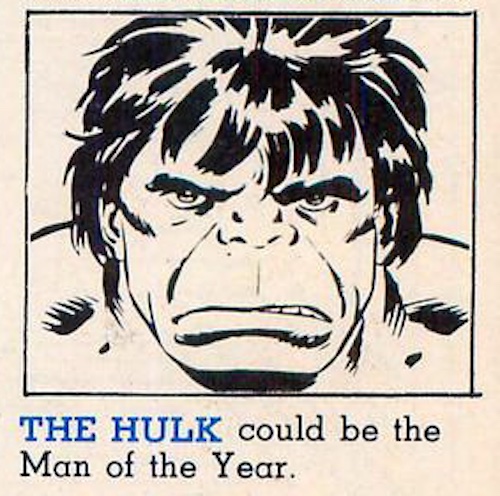
Was otherwise occupied Thursday evening, so all I have for you today is this excerpt from the “Pizzazz Poop” celebrity gossip column from Pizzazz #12 (September 1978):
Mike Sterling's Progressive Ruin
Putting the bomp in the bomp-bah-bomp-bah-bomp since 1969
 Mikester
 Was otherwise occupied Thursday evening, so all I have for you today is this excerpt from the “Pizzazz Poop” celebrity gossip column from Pizzazz #12 (September 1978):
At long last, here is the next installment of our little ’80s indie overview here, as voted upon by YOU, the people what still read the blogs and also a few people I cajoled into voting on Twitter.
And speaking of the Twitter, a couple of you have wondered what happened to my Twitter feed that used to be in the sidebar on this site. Well, I mean, it’s still there, it’s just not working anymore aside from a link that won’t do you any good unless you’re on Twitter, too. For reasons too stupid to go into, Twitter’s new owner Elon Musk decided to no longer 1) feed out tweets through embedded widgets like the thingie I had in the sidebar, and 2) prevent anyone not logged into Twitter from being able to see anyone’s tweets.
So for those of you following my feed there, I’m sorry, it wasn’t my decision to cut you off. With luck Bluesky will open up to the public sometime soon and you can find me there (under mikester.bsky.social), and I’m also on Mastodon, and if you absolutely have to, I’m “mikesterlingjr” on Threads. I really don’t like Threads. Don’t forget you can usually find what I’m up to at mikesterling.com.
Enough of that nonsense, let’s talk some comical books:
Usagi Yojimbo (Fantagraphics 1987-1993)
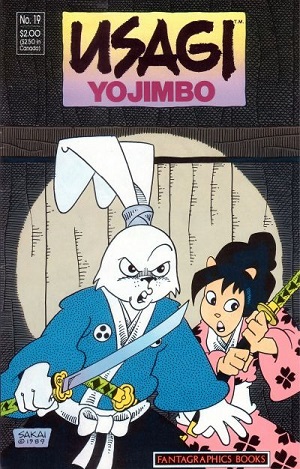 Hoo boy, where do I even start. Stan Sakai’s samurai rabbit has been going strong since debuting in Albedo Anthropomorphics #2 in 1984. After some appearances in that anthology, Usagi moved over to Fantagraphics, first in the anthology Critters, then a one-shot special, and then a 38-issue run of his own series (the one noted in the header above). From there the character moved to Mirage (the original publisher of Teenage Mutant Ninja Turtles) for a short run, then it was off to Dark Horse Comics for its longest numbered run from ’96 to 2018. Since then new Usagi has been coming from IDW, in both an ongoing series and various minis.
That’s just a barebones overview of its publishing history, not mentioning stuff like the Space Usagi mini-series (leaving the usual setting of Japan from centuries ago and presenting the adventures of Usagi’s descendant in a sci-fi future), or the various crossovers with the aforementioned Mutant Turtles (one series going on even as I type). There are literally thousands of pages of story produced over the last few decades, and nearly all of it has been reprinted; I direct you to this part of the Wikipedia entry to find what comics show up where.
“Yes yes, but is it any good, Mike?” The answer is “yes, it is excellent.” I missed out on buying it from the start (though I have on very rare occasions held that Albedo #2 in my hands), but I tend to drop in on the character from time to time, at one point several years ago sitting down and reading, like, sixty in-sequence issues that showed up in a collection. Sakai’s storytelling, from his scripts to his art to even his lettering (the last of which very familiar to Groo the Wanderer fans), is flawless. Sakai populates his book with a cast of anthropomorphized animals (including the lead: “Usagi” is Japanese for “rabbit”), and tells a straight, serious (but not without its moment of humor) tale of his lead’s relationships, adventures, and travails.
The character has appeared in various animated adaptions, perhaps most famously in the original 1980s Teenage Mutant Ninja Turtles cartoon, and then later in the 2012 TMNT series. Most recently a CGI cartoon has been appearing on Netflix, which, like Space Usagi, is set in the future. Haven’t seen it, but I feel like not putting it in the Japan of the past was a lost opportunity. I don’t know, like I said, I haven’t seen it, maybe someone can tell me if it’s any good.
But what is good is Usagi Yojimbo comics. Well worth your time. I know there’s a lot of material out there, but Sakai’s master storytelling will draw you right in and tell you everything you need to know to enjoy what you’re reading. Easily one of the best comic books ever produced.
Xenozoic Tales (Kitchen Sink 1987-1996)
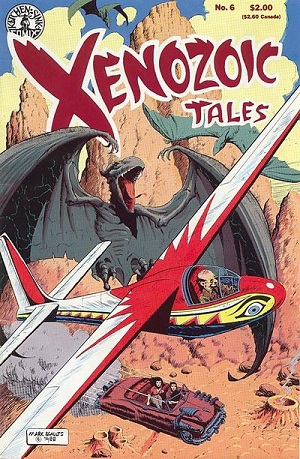 But Xenozoic Tales ain’t no slouch either. Mark Shultz’s very EC Comics-inspired series is set in a post-apocalyptic future where prehistoric beasts once again roam the Earth. The concept was introduced in a short story in the Kitchen Sink legacy underground title Death Rattle in ’86, before getting its own series in ’87. 14 issues were produced in a ten year span afterwards, taking a while due to the meticulous art, but probably also due…
…to the advent of Cadillacs and Dinosaurs, an animated adaptation of the comic that debuted in 1993 and ran for one season. I imagine the development of the show took up some of Mr. Schultz’s time.
The Cadillacs and Dinosaurs name had appeared previously, when Marvel acquired reprint rights and reprinted the first six issues in color. That title was used again on a handful of series published by Topps Comics in the mid-1990s, which were new stories written and drawn by hands other than Schultz.
There have been multiple reprints over the years, but none appear currently available from Diamond. Dark Horse had a two-volume series that reprints all of Schultz’s work from book. There has also been a hardcover edition from Flesk that puts everything under one cover. If you want to go for the original comics, they shouldn’t be expensive, but may be a little harder to find now. But it’s well worth the search…these are some beautiful-looking funnybooks.
Sorry about the lack of content, as I’ve been otherwise occupied at home and not having time to generate any posts here. I thought about having A.I. do it but then you might get some hideous mash-up of Sluggo/Swamp Thing/All-Star Batman and Robin the Boy Wonder/Frank Miller’s The Spirit, and sure, that may sound awesome, I don’t want to be responsible for it breaking free and wreaking havoc upon the townspeople.
I do have the next part of the Final ’80s Countdown underway, and hope to have it posted this week.
IN the meantime, here’s a TikTok video from Luisa Colón, the daughter of comics legend Ernie Colón, talking about the greatest Green Lantern cover of all time. Is there a cameo from a certain comics blog that’s been around too long in this video? You bet there is!
Thanks, pals, and I’ll be back with more of that Hot Content™ shortly.
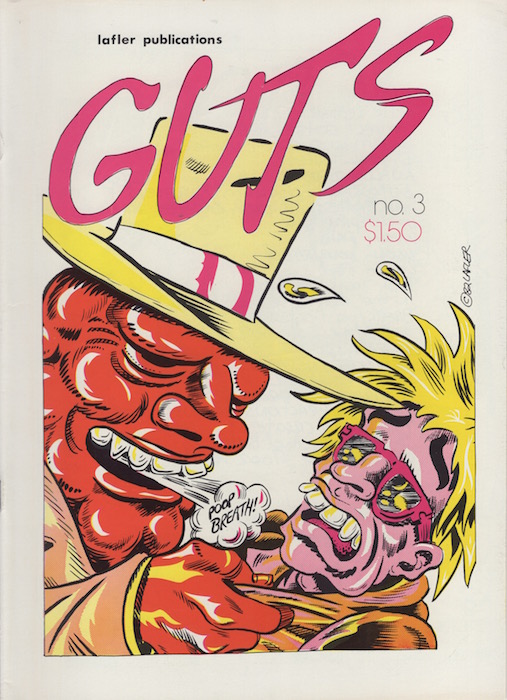
So a long time ago I related the story of a collection obtained at the previous place of employment that contained two rare-ish Steve Lafler comic magazines…a copy of Guts #3 and a copy of Mean Cat. As both coworker Rob and I were big Lafter fans, we split the find, with Rob taking Guts and me acquiring Mean Cat.
Over the years, I’ve thought about that Guts #3, particularly since finding out it was the first appearance of the beloved Dog Boy (not to be confused with Dog Man or, um, Dog Boy — ACCEPT NO SUBSTITUTES). I even wondered, as I said in that post about Mean Cat, if former coworker Rob still had it and was willing to give it up.
Now, I didn’t really need a Guts #3, as that Dog Boy story (along with every other then-extant DB story) was in this Kickstartered hardcover I got (egads) almost exactly 10 years ago. But I’ve been in this weird urge to pick up original copies of comics I already had in reprint form, like the first 25 Cerebus or the first couple of the black and white Nexus magazines.
And as it turned out, I discovered when placing some orders from Last Gasp that they had Guts #3 in stock. For cheap. Very cheap. And plenty of them, because I just got a second order of them in on Tuesday. And needless to say, I now have a Guts #3 in my possession. Turns out I made the right choice way back when picking Mean Cat to take, since as far as I know that has never been reprinted anywhere.
(By the way, I mention in those older linked posts that I’m still missing a couple of the Fantagraphics Dog Boy issues…I have those now too.)
Now my Dog Boy collection is, more or less, I’m pretty sure, complete. But my Guts collection is not complete, as there remains a #1 and a #2 to track down. Not to mention this Benb & Gerald book, there’s gotta be one out there somewhere.
Okay, you were probably expecting the next installment in the ’80s Indies Countdown thing today. Sorry, didn’t have enough time to do a proper job on it, so check later in the week.
Speaking of which, I just obtained what looks like full runs of both series of Elementals (with the trade paperback in lieu of the first few issues). Maybe I can finally read the darned thing and see what all the fuss was about.
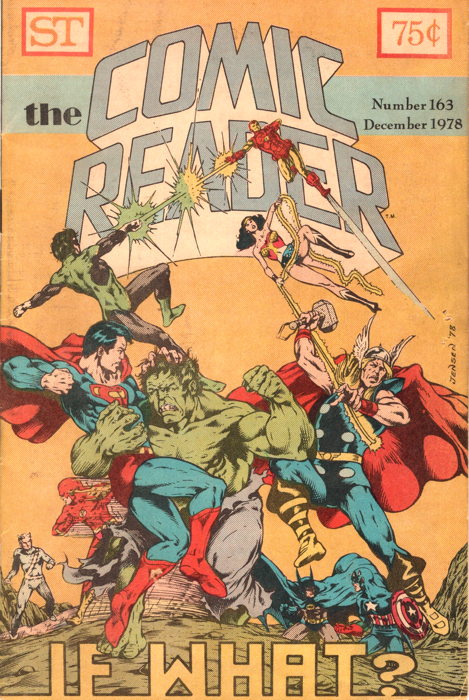
And I did want to say a thing or two regarding the Comic Reader post on Friday. As ‘zines go, Comic Reader was a fairly reputable one, probably undeserving of my cherry-picking a news-reporting misstep of theirs from one issue. Like Snark Shark says in the comments, it may have just been “rumor mill” stuff, word on the street, however that rumor mill would have been formed in 1978. Other ‘zines, convention talk, someone in the Marvel office spilling the beans, whatever.
It is very possible all three items were, in fact, true at one point, or close enough. Marvel could have signed an agreement with the Rolling Stones to do a comic…and then the project was canned for some reason. (Or maybe the contract was about to be signed, and someone who thought it was a done real slipped the news to the fan press, but then it never happened.)
It’s also very possible that Marvel was circling around the idea of doing something with the Amityville Horror property. Sure, it was all bullshit, but it was hot bullshit at the time, and if Marvel thought it could make a buck off of it, well, why not? Patrick Joseph brings up the point that Marvel didn’t seem to be in the business of doing horror movie adaptations at the time, which may be why it ultimately didn’t happen. (Not that they were necessarily after the movie per se, but who knows?) I mean, there’s not much info in that single sentence about the possibility. “Negotiations” may not have been much more than “hey, how much will it cost us for the rights? …Will you take half of that? Okay, thanks anyway.”
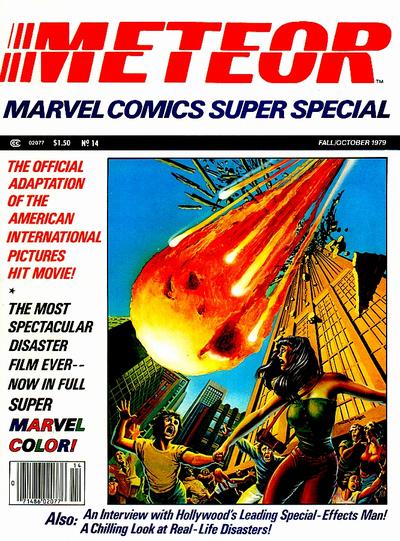
As for “Schrödinger’s Meteor Adaptation,” well…the ‘zine this was reported in was cover-dated December 1978. The release date of the comic was October of 1979. A lot can happen in that span of months. That early on Marvel’s rights to adapt the movie may still have been in question, perhaps a definite “no” at the ‘zine’s press time before it became a “yes.” I don’t know how much lead time was necessary to slap that Meteor mag together, but I’d guess about eight months was probably pushing it.
Anyway, I just thought these three stories in such close proximity to each other was amusing and worth noting. And I don’t believe they were just conjured up out of nowhere…at worst, they were just running unconfirmed rumors. Best case scenario was, as I said, it may all have been true at one point, ’til it wasn’t. It’s still fun to see what folks were talking about at the time, and what projects (real or imagined) may have been planned for release. That’s why I enjoy collecting old fanzines, for stuff just like this.
From The Comic Reader #163 (December 1978):
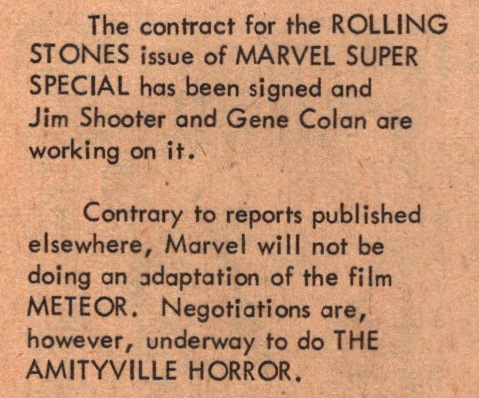
Not released: that specific Rolling Stones project and any Marvel-branded Amityville Horror book.
Definitely released: the Meteor adaptation in Marvel Comics Super Special:
Now Marvel did eventually release a Rolling Stone comic, Voodoo Lounge by Dave McKean(!) so there’s that. And the band also shows up in an issue of What If.
But Amityville Horror, best to my knowledge, went nowhere at Marvel, except maybe providing some inspiration for other horror stories. But honestly, if Gene Colan was going to draw any of these things, it should have been this one. His nice moody, spooky art could’ve made something out of that haunted house tale.
So every once in a while I take a look on the eBay for 1996’s Flex Mentallo #3:
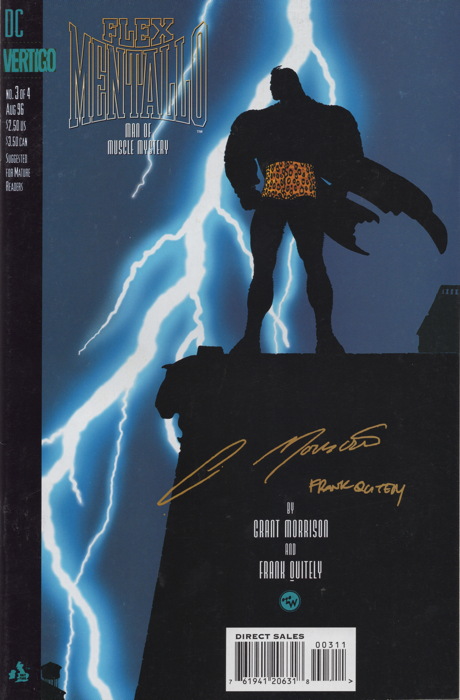
…not because I need a copy (I bought mine way back when it was new), but out of perverse fascination with how the book gets listed. Specifically because of this cover detail:
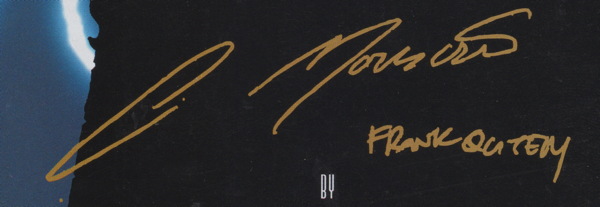
…featuring the signatures of the book’s writer and artist, Grant Morrison and Frank Quitely. Not actual signatures, mind you, but part of the actual cover image. If you look closely, you can see the comic book coloring details in the “penlines” of the signatures:

But if you only ever see the one copy of this comic, and didn’t, say, unbundle a giant pile of them after arrival from Diamond to put them on the shelf and seeing the dozens of copies with identical autographs on each one, then at first glance maybe, just maybe, you might thing you had some genuine hand-scribblings.
Such as the person who listed this item for sale:

Currently it’s just the one listing, which is unusual given that in the past I could usually find four or five at any given time. Maybe folks are learning, maybe I just caught eBay at a good/bad time, maybe enough buyers have complained in the past, I don’t know.
Which does have me thinking about buyers who did purchase one of these off eBay as a “signed” item, believing to this day that they have a rare collector’s item. Ah, well. I don’t remember anyone thinking this when they were buying the item new off the rack (because they could see with their own eyes that every copy had identical “inscriptions”). I do recall having to explain once or twice over the years when buying collections that these weren’t actually hand-signed.
To be fair, this isn’t a common cover design element, so I can’t blame people for being momentarily fooled. And I wouldn’t put it past Morrision and/or Quitely if that wasn’t a planed prank on their part, still playing out all these years later.
So here we are, finally up to the two-vote getters in my little survey from a while back re: Your Favorite ’80s Indies That Aren’t Actually Comics Like Elfquest and Cerebus That Started in the ’70s.
And today’s entry features a couple of heavy-hitters from the period, so this post may get a little more attention than normal. As such, let me point out to anyone new that the dates presented represent the length of the initial run of the subject’s first primary series, so it may skip earlier appearances as back-ups or anthology entries an’ such. (I fudge this a little in the Nexus entry.) Admittedly, I should have just noted “year of first appearance” or something, but no,I had to be more difficult about it. Anyway, I do at least try to mention those earlier appearances.
Got it? Good! Confused? Probably also good! So here we go….
Elementals (Comico 1984-1988)
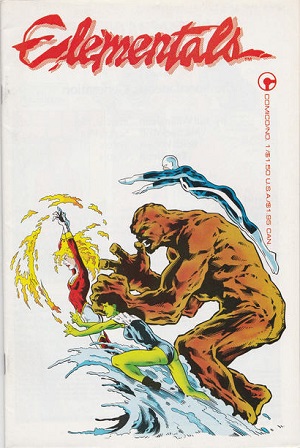 I recently had…not a full set of all the Elementals (at least, the “good” ones, more on that in a moment), but pretty close, and a friend who had an interest in reading those but missed ’em the first time around asked after them. After taking them home and reading them, he reported back “…um, yeah, not for me.”
Here’s the thing, I’m still interested in reading these all in sequence someday. I’ve read scattered issues here and there, I’ve glanced through them at the shop, I generally like Bill Willingham’s work from this period (fresh from the TSR ads). Thus, I have at least a passing familiarity with the books.
First appearing in Texas Comics’ Justice Machine Annual #1 in 1983, they got their first ongoing series from Comico the following year when the previous company went other. The comic, about four people who had died but were revived with power over the element that caused their demise (the woman who drowned getting water-based powers, for example) ran 29 issues. Willingham wrote and drew most issues through 23, with occasional guest stints from other artists. Jill Thompson is probably the most notable, and she draws the remainder of the series through to 29 after Willingham’s departure. There was also an Elementals Special published in ’86, drawn by Willingham and written by Jack Herman.
Willingham returns to script the second series, and provide covers, which starts in 1989. Mike Leeke is the main artist for this run, aside from the occasional assist from guest-artists like Chuck Austen and Adam Hughes. With #23 Willingham is gone again, and other hands bring this series to its conclusion in 1993 with #26. (Willingham did write and draw a second special in 1989.)
There was also the Elementals Sex Special, an adults-only series that ran 4 issues from 1991-3, with Willingham involved only in #1. Another two-issue run under this title was issued in 1997. If that’s not enough, there was the Sexy Lingerie Special, a 1996 Swimsuit Special, and well, you can see what the new owners of this property, having acquired it from Willingham, think of the whole thing. There were a couple of attempts at actual narrative for these characters in the mid-late-ish ’90s but that was pretty much that. And Willingham’s out so he’s not going to revive the property (but he was credited on something called Ghost of a Chance as writer, Tony Akins on art, in 1995 that I thought was reprints but is maybe new? If someone out there knows for sure, please drop me a line (or a comment)).
Oh, and I should note the early crossover mini Justice Machine featuring the Elementals from 1986, script by Willingham.
So, that’s a lot of stuff, and aside from maybe a trade paperback or two, there’s never been a comprehensive reprinting of this material, nor is there likely to be one. Fortunately, the once relatively sky-high prices on that Justice Machine Annual and the first Comico issue have come way, way down, and everything else should be cheap cheap cheap. You can probably get by without anything published after the end of the second series (except maybe that Ghost of a Chance book, depending if it’s new stuff by Willingham or not). I like the concept of the series, and it’s a shame it got out of the control of its creator.
Nexus (Capital/First 1981-1991)
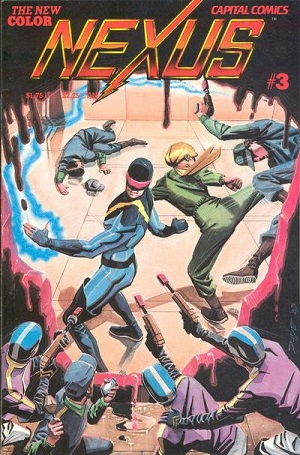 I wrote about Nexus a few months back, on the occasion of a new (and, um, pretty overpriced for what you got) graphic novel. Despite that, the series has featured some remarkable and memorable work over the decades, primarily the the comic’s creators Mike Baron and Steve Rude.
Beginning with a three-issue run of a black and white magazine in 1981-2, Nexus continued as a color comic (with a new #1) in ’83. This was under the Capital Comics banner, but the series ended with #6 in 1984, moving to First Comics in ’85 and running ’til issue 80 in 1991. Mike Baron wrote pretty much everything, Rude drew primarily in the first half of the series, with an array of usually top-flight artists (like Paul Smith!) doing the rest of the work. Given the premise of the series (Nexus is compelled by dreams to find and execute mass-murderers) it seems like it would just wallow in darkness, but it remains energetic and fun and inventive pretty much through its entire existence.
Following First’s demise, Dark Horse picked up the property and issued a whole slew of mini-series, several by Baron and Rude, some by other creators (like 1992’s Nexus the Liberator). The ’90s also brought us intercompany crossovers teaming Nexus with Madman (and The Jam) and Magnus Robot Fighter.
There were also plenty of tie-in minis and one-shots featuring Nexus’s pals and gals, both from First and Dark Horse. Most notable were Next Nexus from First, the handful of Hammer of God minis from both companies (starring best pal Judah), Mezz: Galactic Tour 2494, and, of course, the Clonezone Special (issued by Dark Horse whilst Nexus was still at First, curiously enough — one can only presume First was too chicken to publish it).
Post-Dark Horse, there was a short run in the mid-2000s from “Rude Dude Productions,” reteaming Baron and Rude on the character. Also released was a collection of “Newspaper Strips” (which I think were a Kickstarter or subscription thing?). The 2010s version of Dark Horse Presents had some serialized stories. And then there was that recent graphic novel I linked to above.
If you’re trying to catch up on Nexus now, well, good luck friend as I think a lot of the books are out of print, but Wikipedia has a list of what’s been reprinted and how. Looks like the Omnibii are the way to go, all you have to do is find the darned things.
The first three magazine-sized issues were reprinted in a nice trade by First (sans the flexidisc from the third issue) at their original size, so I think that likely looks better than being shrunk down to comic-sized pages in the Archives/Omnibus books. But that’s just me, the guy with crummy eyes who wants larger pages to look at. There was also a standalone trade of Next Nexus, and there was a reprint series called Nexus Legends that presented the early color issues.
This was a good series, with a fleshed-out universe and interesting and unusual characters (and the occasional guest-appearance of that other Mike Baron character the Badger), and I sorta miss having a new issue of this to look forward to every month. Rude apparently has a new Nexus graphic novel on the way, and supposedly he’s also split with Baron, so…we’ll have two competing Nexus continuities, I guess? Well, I guess we’ll see what actually comes out.
If I were to recommend any Nexus, I’d say “start with the early stuff” and so long as Rude is drawing, you’re in for a good time. The first dozen or so color issues are, like, Peak Nexus, but there’s lots of good stuff elsewhere in the run. Ah heck, just read ’em all. Get those ominuses as you can!
Hi pals…sorry for the short post today, was just too tired last night to get anything together.
I’m just going to leave a brief note about the current Social Media Shuffle…I’m still on Twitter, while the duct tape is still holding everything together. And I have a Mastodon account, which is fine but is just mildly complicated enough for it to not quite feel “Twitter-like.”
The current point of exodus appears to be Bluesky, where you can find me under “mikester.bsky.social.” It’s invite only at the moment, but my account there should be publicly accessible eventually, along with everyone else’s. Here’s hoping…it looks like it may be the site of choice, but I thought that about another place until policy decisions an’ such caused folks to bail.
Anyway, we’ll see what happens. Everything could change again in a few weeks. But mikesterling.com will still have links to wherever I’m at, though I need to update it again (and probably drop off the social media accounts I don’t intend to keep around).
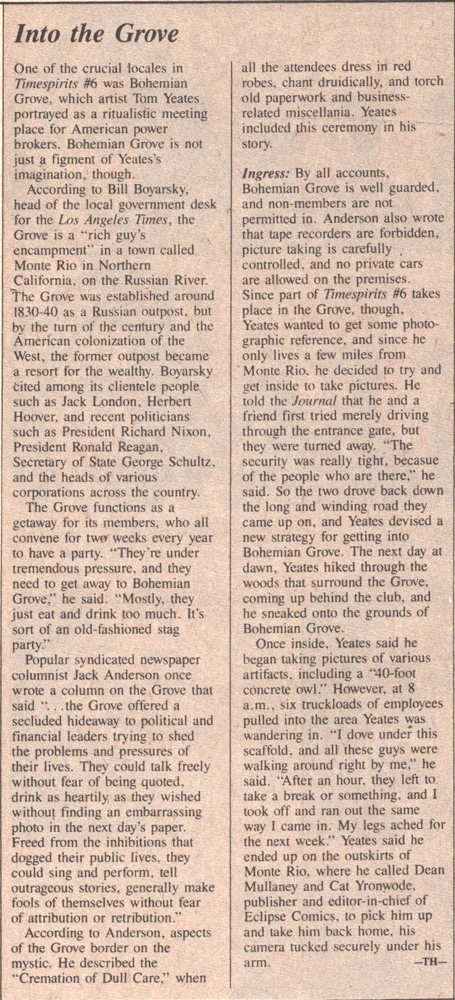
Okay, when I was talking about Tom Yeates, cocreator and artist of Timespirits, and how he sneaked into someplace or ‘nother for research on a story for the book.
Well, I dug through my archive of The Comics Journal issues from around the period the comic was being released, and lo, in Comics Journal #102 (September 1985), there was the article. It was a sidebar to the main article about the differences between writer Steve Perry and Yeates (discussed in detail on this site), and had I been thinking, I would have started my dive into my Journals with that issue, but nooooo.
But here’s the bit from the issue, talking about how Yeates found his way into this retreat for the rich and the political to get reference for his comic. Still a completely wild thing:
Also from that issue of Comics Journal, similar to what they ran regarding editorial changes in Sisterhood of Steel, there was a page of changes made to that issue of Timespirits #6. Yeates was pushing the more political aspects of the story, but Perry rewrote to ease up on that particular tone:
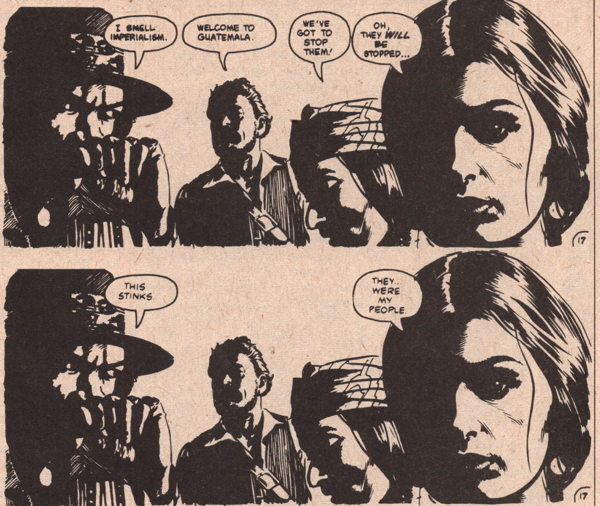
I’d be interested in seeing a full deluxe collection of this series, maybe somehow presenting both versions of these rewritten pages. At any rate, I’d love to have a nice reprinting of Yeates’s beautiful art.
Also, I’m surprised this bit of business regarding Yeates’ infiltration of the retreat has stuck in my head all these years. Especially since I wasn’t a Timespirits reader at the time, but I was a voracious Comics Journal reader. And the stories behind the making of this comic were interesting in and of themselves.