I’m just about ready to move on from John Byrne’s 1981-1986 run on the Fantastic Four, but I wanted to touch upon this particular storyline because, among other things, it sets up a character that will return again and again in future creative teams’ efforts on the title.
I remember picking up issue #271 and being quite taken with the throwback cover to the 1950s/early ’60s Marvel monster comics, before Stan Lee, Jack Kirby and friends dived back into the superhero genre:

I’m not sure where I’d been exposed to that era of Marvel monster books initially…perhaps some of the reprints that popped up as filler material in some of the Giant-Sizes I’d collected, or a friend whose uncle had a handful of original copies of these books (before being all destroyed in a rainstorm, having left his box of them outside. But I was certainly familiar with them, and found them amusing and charming enough that I would eventually draw out my own spoof splash page of such a story (“FONDUU, THE CHEESE DISH THAT WALKED LIKE A MAN!”).
Byrne’s pastiche of the Marvel monster period (this time involving a pre-superpowered Reed and Sue as the intrepid humans against the alien menace) takes up the majority of this issue. It certainly succeeds in evoking the essence of that era, even if it suffers a little in retrospect as the bad guy is coincidentally defeated in pretty much the exact same way the bad guy is defeated in Avengers #250, released shortly afterward.
But of interest is the plot element that turns up in the “present day” section of the book…the fact that Reed is suffering memory loss, introduced in this dramatically effective panel:
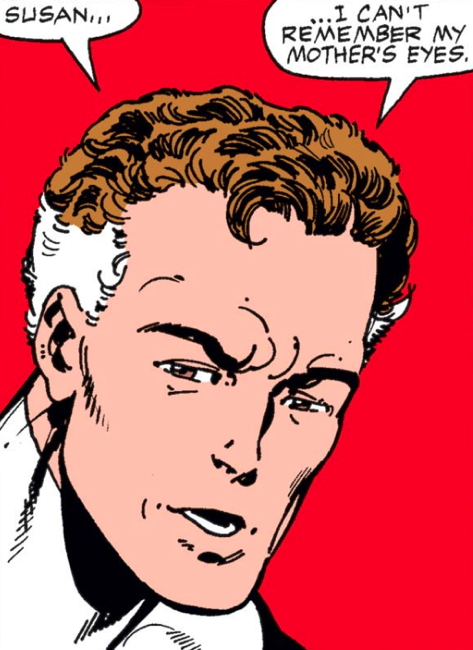
He continues to say that other memories of his younger years are lost, and attributes this to their recent adventures in the Negative Zone, where Reed’s brain was drained and blah blah I’m not going to get into it, but some alien critter messed with his head and left it Swiss-cheesed.
So it’s decided for some reason that escapes me even though I just reread these three issues right before reading this to go back to Reed’s father’s mansion in California…and I just reread that section of the story and I’m still not clear why they did. Anyway, we learn that Reed’s father, a scientist, had disappeared about ten years ago (“three years” before the team got their powers, leaning into Byrne’s “seven year” span that he assumes the FF had been active).
Eventually Reed discovered that his father had created a time machine that shunted him into an alternate timeline, and in #272:
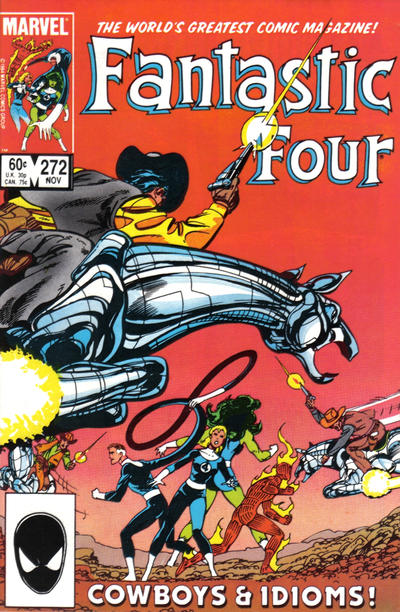
…the FF use Pops’ machine to follow him into the parallel universe. Look, okay, there are cowboys on flying horses on the cover, and we get some neat bits with a sci-fi tinged Old West in this other timeline, but the big story is that Reed’s father is apparently the hated Warlord, who rules over this world:

And that brings us to Part Three, #273:
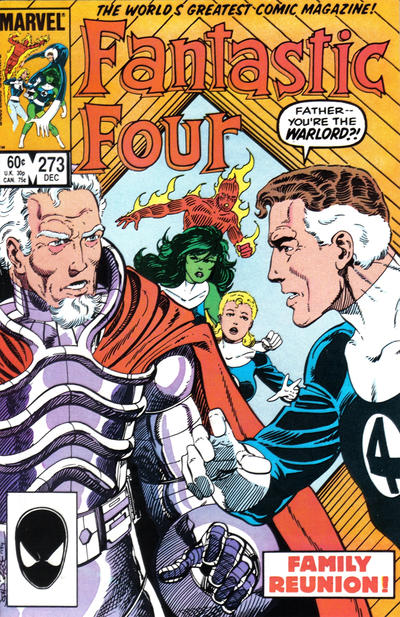
…where you can see on the cover there that Reed and his dad finally meet face to face, which is a neat moment, but boy, this issue is undermined by the fact that Byrne decided to not only write and draw this issue, as he had been on the FF for the previous few years, but letter it as well, and, um:

…the man’s no Gaspar Saladino. I think when I first read this issue, even then I was all “what’s up with the lettering” when I noticed that there was no lettering credit on the issue. Eventually I figured out Byrne did it his own self, which kinda blew my mind just a little. I mean, artists lettering their own work was not a new idea to me, as comic strip artists did it all the time, natuarlly. But in Marvel and DC Comic Books, it was always a separate job that you got someone specifically to do.
I should have realized it wasn’t unprecedented, but I don’t think I realized Jim Aparo often lettered his own work, and it was around this time that Todd Klein was lettering his own scripts on Omega Men. Of course in many independent books, this was often the case…the Hernandez Brothers lettered their own work, Dave Sim did some wild lettering in Cerebus, but that seemed different from the usual assembly-line nature of the Big Two.
Regardless, it did seem like A Step Too Far when Byrne picked up the lettering gig for this issue. He was already perceived as being stretched too thin writing and drawing the multiple books he worked on per month, and adding the not-insignificant task of lettering an entire issue felt like one burden too many. Especially when the result was aggressively Not Good. It looked awkward, the lettering was inconsistent, lines of text looked crooked, and even the word balloons themselves were pretty janky. Lettering can’t be distracting when reading a comic book, and this job was nothing but distracting.
Despite all that, the story continues, with Reed pleading his case to the Warlord (only it turned out (SPOILER) to be Reed’s stepmom, who was acting as the Warlord without Pops’ knowledge).
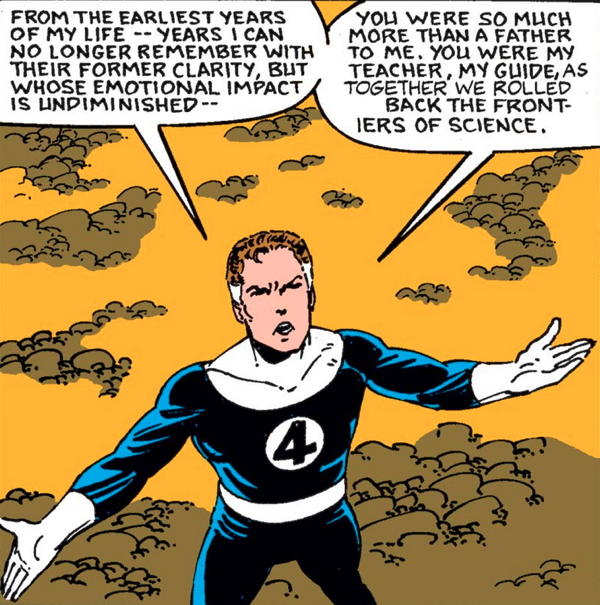
Note that we are here in the third and final part of this story, and Reed is still emphasizing his loss of memory. Which is interesting because ultimately, when the story is resolved and Reed and his dad have their peaceful reunion…the whole “lost memory” subplot is completely forgotten. The problem that launched this storyline remains unresolved. Far as I know, to this very day Reed still lacks all those memories, because at no point over these three issues does he ever get them back.
I remember noticing this at the etime, and wondering what exactly happened to let that plot element go astray. They didn’t forget it was such, and it was brought up in the concluding issue. Just when everything was said and done, the instigating action to drive the characters into this other world exists only as that: an instigating action. It is not a problem to be solved, but a…is Macguffin the right word here? I feel like that’s not exactly it but my English is failing me here.
But it’s ultimately pointless and I think that made me really wonder how such a gaffe could be made in a professionally published comic book. Yes, I knew about Marvel’s “No-Prizes” sent out for folks spotting (and explaining away!) continuity mistakes, but this seemed like a much bigger problem than that. A problem of a creator getting Too Big for an editor to successfully edit? I didn’t know then, and I’m certainly not sure now.
The lasting legacy of the introduction of Reed’s father in this storyline (beyond the “surprise twist ending” of the story connecting him to the time-traveling villain(s) Rama-Tut/Kang) is that Reed’s dad will return in Avengers: Doomsday in future FF storylines, with alternating personalities. While a seemingly benevolent and kind man at the end of Byrne’s issues, he returns in the Tom DeFalco/Paul Ryan issues as a untrustworthy and manipulative figure, then returns again as a somewhat more positive character. But, as I like to say when talking about future FF events, I’ll say more when I get there.
The other note I wanted to add is something I noticed on my most recent rereading…the attempts at pinning down Reed’s exact age. In this panel from #271, Johnny Storm congratulates Reed on hitting “The Big One” for this year’s birthday:
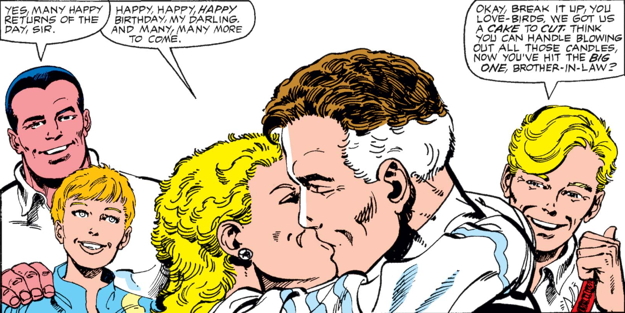
I interpret that as either 40s (most likely) or 50s (still plausible, given Reed’s slightly older status compared to the other 20/30-something superheros at Marvel.
Then Reed says this in #273:

…which still leaves things open a little bit. Reed’s dad vanished about a decade prior, but it’s very possible Reed hadn’t seen him for many years prior to said disappearance. However, if you look closely at the lettering in the second word balloon, the word “twenties” was obviously lettered in after the fact. Apparently someone didn’t want to accidentally “age up” the character by even implying Reed was in his 30s, or older, “10 years ago.”
This run of issues grabbed my attention way back when in good ways (Byrne’s generally fun art and storytelling) and bad (oy, that lettering, and the unresolved plot) that, had I had a blog back then, I almost certainly would have commented upon. It was an experience to get a story with a strong beginning and a clunker ending, leaving me wondering what fell down to allow this to happen. It was just another piece in the puzzle reminding me this comics were made by Human Beings, and sometimes we Human Beings drop the ball, even with the best of intentions.
Next time: the big transition from Byrne to Post-Byrne!






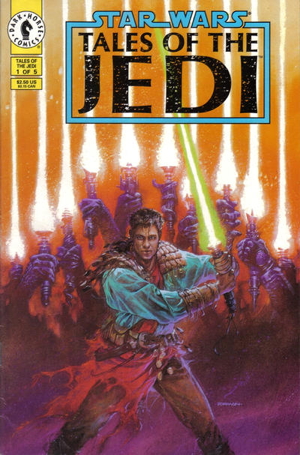 The first thing that surprised me when I started doing my research on this title was just how few of them there were, and how short of a run they had. The first mini-series, Tales of the Jedi but later referred to as Knights of the Old Republic, ran five issues from ’93 to ’94. Then there were another half dozen or so mini-series, ending with Tales of the Jedi: Redemption in 1998. In my memory, it always felt like there was so much more than that, probably because I’m recalling the many times at the old job having to sift through the section and restock missing issues.