So in our last installment, I wrote about some of the new villains John Byrne created during his Fantastic Four run that never really seemed to go much of anywhere. Someone responded in the comments that Malice, AKA “Dark Invisible Woman,” was one that Byrne came up with and popped up again and again over the decades. Granted, I probably should have mentioned her in that particular post, but I did discuss Malice, and mention her current usage, in Part Three of “My Fantastic Four-ay,” so I didn’t forget her completely!
And to really get right down to it, strictly speaking it’s more a remixing of a character created by someone else, in this case Stan Lee and Jack Kirby their own selves, rather than a whole new person. But that’s splitting hairs a bit…I mean, who created Nightwing? Marv Wolfman and George Pérez, who in the 1980s put Dick Grayson into that outfit and gave him that name, or whoever it was Bob Kane took the credit from when Dick Grayson was introduced way back in Detective Comics #38?
Regardless, it’s a new take on a preexisting character, and I suppose that’s close enough for horseshoes, as nobody younger than me says.
But anyway, in that same vein, let’s talk about Frankie Raye.
Frankie Raye was a supporting character in the Fantastic Four title starting with issue #164, by Roy Thomas and George Pérez, published in 1975 and several years before I started reading the book on a regular basis. Frankie becomes Johnny “Human Torch” Storm’s girlfriend, despite her apparent fear of fire. Natch, they broke up, but she was reintroduced into the book early in Byrne’s run, making her one of the few non-Lee/Kirby FF elements to return in his “Back to Basics” run (along with Terrax, discussed in Part One).
Like those early Terrax stories, I never read any of Frankie’s appearances in the title prior to this Byrne run. She was just another story element that emphasized to me that the Marvel Universe was an ever-growing, ever-self-referential thing, and that while I was tempted to go back and pick up those prior appearances so that these stories I was reading were “complete,” I think even then I realized the futility of doing so. The soap opera and subplot-ridden storylines would make it impossible to ever pick out a completely clean “starting point,” unless I was willing to buy all the way back to Fantastic Four #1, which maybe I would have been but my pocketbook would likely have argued against that course of action.
So that was likely an early lesson taught to me by Byrne’s run on this book…just let his first issue (#232) suffice as close to a clean break as may be possible from what has gone before, and let any previous elements worked back in be explained as they need explaining.
And that’s what we got here. Frankie Raye shows back up, reconnects with Johnny, we’re told enough about the two’s backstory, but then Mr. Byrne pulls one of these on us in issue #237:
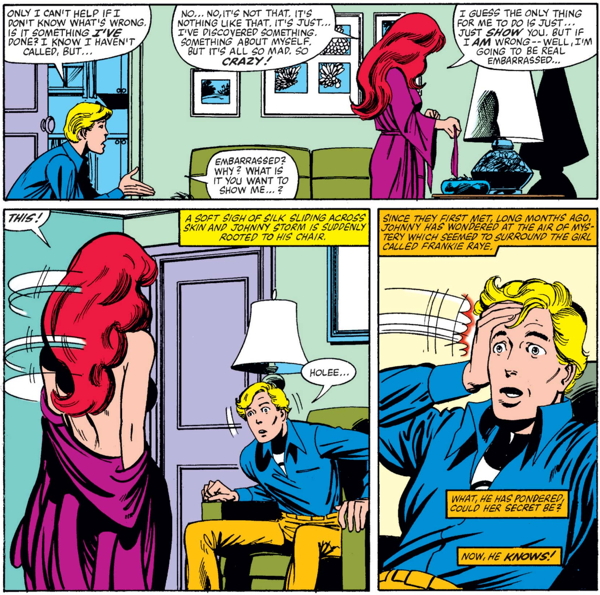
What’s this? Frankie Raye — completely in the altogether? Look, we’ve all read Byrne comics, we know that could totally have happened, but instead we have to wait a month and in issue #238, we see what’s really going on:

She goes on to explain that this costume only appears when she’s otherwise naked, for you “this is a fetish for someone” fans, and she reveals some suddenly awakened memories of her past. Like, for example, helping her stepdad move some barrels of dangerous chemicals:

…and after the accident, she finds herself alive, but burning:
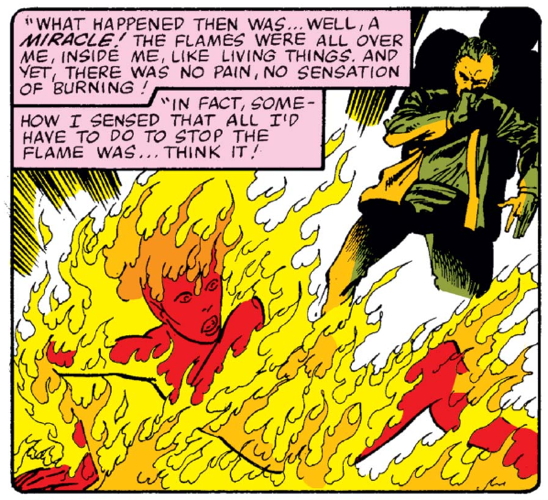
…and in response steppop hypnotizes her into forgetting the whole incident and the fact that she apparently has superpowers, out of guilt or whatever:
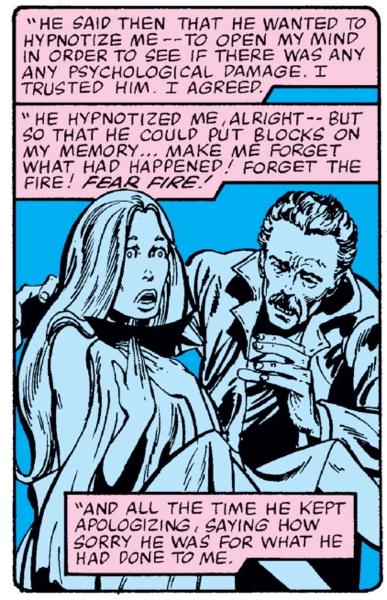
Hence that previously mentioned fear-of-flame, you know.
Now as it turns out, her stepdad was Professor Phineas Horton, creator of the original android Human Torch during World War II, and the chemicals he and Frankie were moving around were like those that gave the android its flame powers. Strikes me as a plot contrivance they couldn’t get away with now, given WWII is 40+ more years in the past than when this comic was originally published. Horton being a teen girl’s 100-year-old stepfather now seems unlikely…or even an 85-year-old one, if you want to work it into a flashback timeframe. Just sayin’ Frankie Raye’s backstory is probably one they’d have to adjust if they ever referred to it again.
So anyway, Horton mailed her this costume some years later to help her contain her powers, though via post-hypnotic suggestion or something via a cassette tape included with the costume, she was made to immediately forget that she put it on and to destroy the tape and forget that too. Okay, that cassette would be an MP3 file now, but let’s not quibble.
Regardless of all this backstory, the upshot is Frankie Raye is also a Human Torch-type character now, and she goes on adventures and such with the Fantastic Four and everything is hunky-dory.
Except…a couple of times she used excessive force in her superheroing, showing little to no consideration for what she’s done. And that’s foreshadowing for what happens in issue #244, the conclusion of Byrne’s first major Galactus storyline.
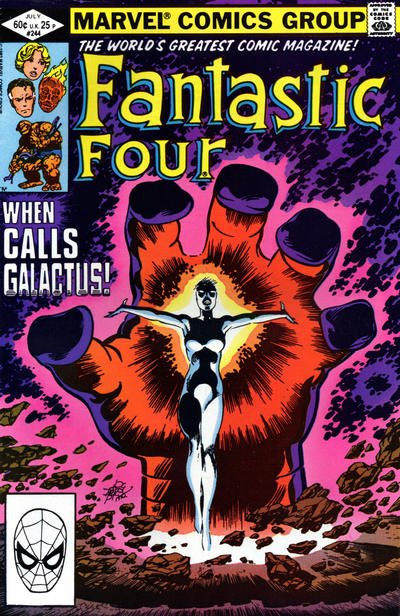
As you can see by that cover there, something drastic is about to go down, and given the subject of today’s post, it’s probably not a shock to discover that’s Frankie depicted on the cover there.
Near the conclusion of this storyline, for assorted reasons Frankie makes the offer to Galactus to be his new herald, à la his former servant the Silver Surfer.
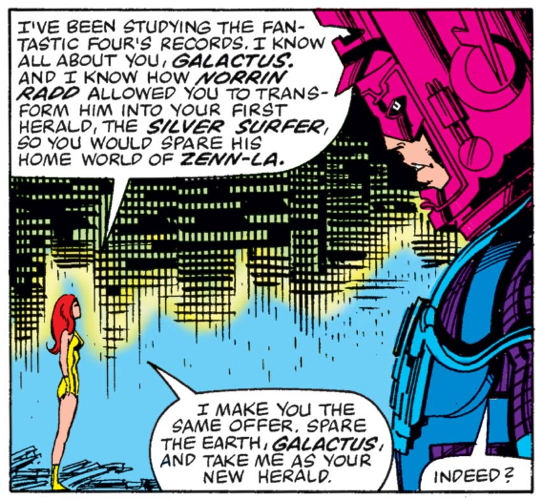
Reed of course tries to talk her out of it, telling her what she’d have to do in this role, and her response is surprising:
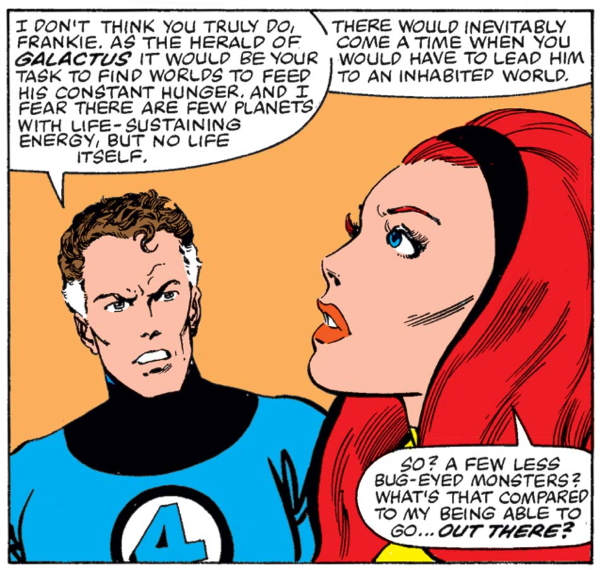
…though maybe not so surprising, given her attitude on display during those foreshadowing events I mentioned earlier.
Galactus, for his part, has a pragmatic reaction:
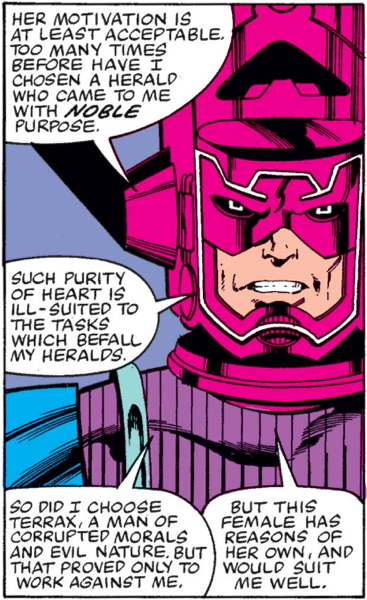
And the deed is done: she’s transformed by Galactus (see the cover above), and leaps into the new role, forsaking everything earthly for her new job:
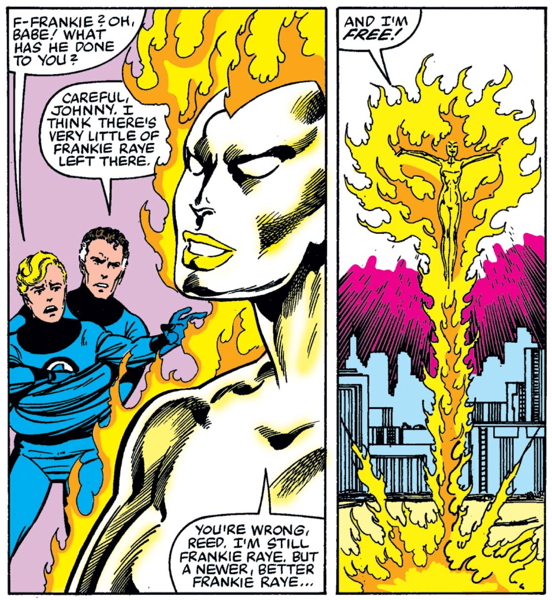
Johnny clearly has no impact on her anymore, even after being a couple again for a bit, and his reaction is genuinely affecting in the face of Frankie’s (or rather, Nova’s, to use her new name) faded humanity.
And that’s that. Frankie turns up once or twice more during Byrne’s run, notably leading Galactus to the Skrull Homeworld. But also notably, we get the beginnings of a long-running subplot in future Marvel comics that Nova may be developing feelings for Galactus.
By “future comics” I mean mostly Silver Surfer, where that aspect of her relationship with Galactus is touched upon, and she also has some romance with the Surfer himself. We do get a follow-up to Nova’s disregard to the lives of “bug-eyed monsters,” and we also learn that Galactus himself may have had…something approaching stronger feelings for Nova than he let on, especially in the wake of her death.
Yes, I said “death,” the character dies in Silver Surfer, though she came back in some form, in the Mighty Marvel Manner, in the Heralds mini, but I hadn’t read it so I don’t know what she was up to there, or lately.
I didn’t even get into her appearance in the alternaute future “The Last Galactus Story” that was serialized, but never completed, in Epic Illustrated. But I think it’s safe to say, like Malice, Frankie “Nova” Raye was one of his reworkings of an established character that did have legs, did continue to have an impact, not just on the Fantastic Four title, but on the Marvel Universe at large.
And farther still, as the “Frankie becomes Nova” story make it, in condensed form, into an episode of a 1990s Fantastic Four cartoon. The character makes other animated and live action appearances as well.
What really struck me most about Frankie Raye is her amoral stance in regards to non-terrestrial life, as presented in #244. That surprised me as a reader still relatively new to the Marvel Universe, presenting a complexity in a character that we identify as “hero,” did heroic things, and had the readers’ sympathy. But she had that one flaw, one that would basically put her in the “villain” category, that made us question any specific attachment we may have had to her. And on top of that, throwing away her humanity, discarding her relationships in exchange for power…that would also be marked as villain behavior in a more black-and-white milieu, but reads as hopelessly tragic in Marvel’s longstanding “characters with problems” foundation. It’s a move that impressed me then, and still, all these years later, even after everything that’s been done with the character since, impresses me now.





 Man oh man, where do I even start.


