So in our last installment, I wrote about some of the new villains John Byrne created during his Fantastic Four run that never really seemed to go much of anywhere. Someone responded in the comments that Malice, AKA “Dark Invisible Woman,” was one that Byrne came up with and popped up again and again over the decades. Granted, I probably should have mentioned her in that particular post, but I did discuss Malice, and mention her current usage, in Part Three of “My Fantastic Four-ay,” so I didn’t forget her completely!
And to really get right down to it, strictly speaking it’s more a remixing of a character created by someone else, in this case Stan Lee and Jack Kirby their own selves, rather than a whole new person. But that’s splitting hairs a bit…I mean, who created Nightwing? Marv Wolfman and George Pérez, who in the 1980s put Dick Grayson into that outfit and gave him that name, or whoever it was Bob Kane took the credit from when Dick Grayson was introduced way back in Detective Comics #38?
Regardless, it’s a new take on a preexisting character, and I suppose that’s close enough for horseshoes, as nobody younger than me says.
But anyway, in that same vein, let’s talk about Frankie Raye.
Frankie Raye was a supporting character in the Fantastic Four title starting with issue #164, by Roy Thomas and George Pérez, published in 1975 and several years before I started reading the book on a regular basis. Frankie becomes Johnny “Human Torch” Storm’s girlfriend, despite her apparent fear of fire. Natch, they broke up, but she was reintroduced into the book early in Byrne’s run, making her one of the few non-Lee/Kirby FF elements to return in his “Back to Basics” run (along with Terrax, discussed in Part One).
Like those early Terrax stories, I never read any of Frankie’s appearances in the title prior to this Byrne run. She was just another story element that emphasized to me that the Marvel Universe was an ever-growing, ever-self-referential thing, and that while I was tempted to go back and pick up those prior appearances so that these stories I was reading were “complete,” I think even then I realized the futility of doing so. The soap opera and subplot-ridden storylines would make it impossible to ever pick out a completely clean “starting point,” unless I was willing to buy all the way back to Fantastic Four #1, which maybe I would have been but my pocketbook would likely have argued against that course of action.
So that was likely an early lesson taught to me by Byrne’s run on this book…just let his first issue (#232) suffice as close to a clean break as may be possible from what has gone before, and let any previous elements worked back in be explained as they need explaining.
And that’s what we got here. Frankie Raye shows back up, reconnects with Johnny, we’re told enough about the two’s backstory, but then Mr. Byrne pulls one of these on us in issue #237:
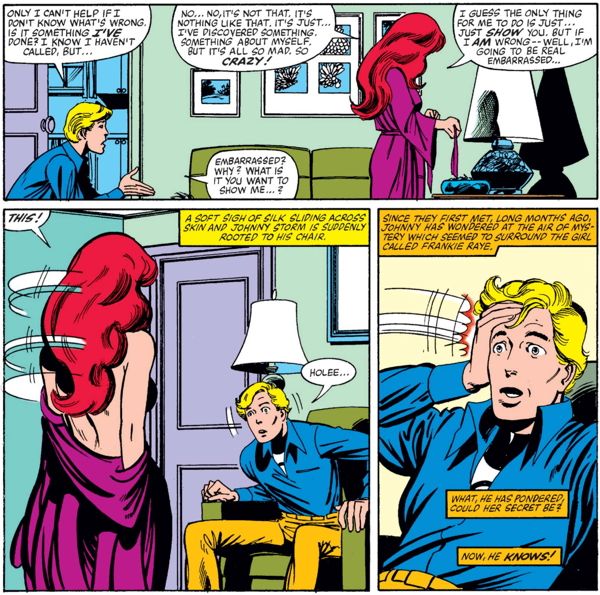
What’s this? Frankie Raye — completely in the altogether? Look, we’ve all read Byrne comics, we know that could totally have happened, but instead we have to wait a month and in issue #238, we see what’s really going on:

She goes on to explain that this costume only appears when she’s otherwise naked, for you “this is a fetish for someone” fans, and she reveals some suddenly awakened memories of her past. Like, for example, helping her stepdad move some barrels of dangerous chemicals:

…and after the accident, she finds herself alive, but burning:
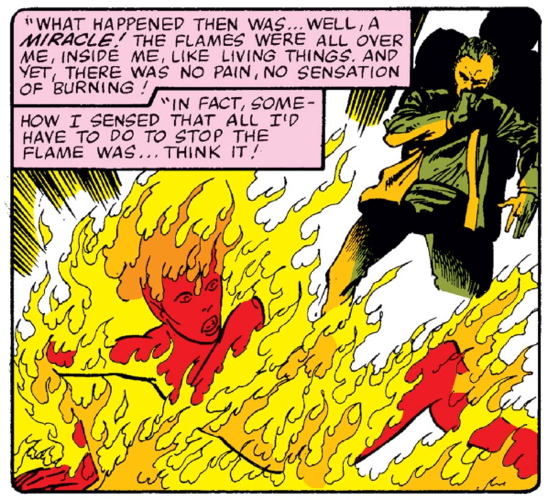
…and in response steppop hypnotizes her into forgetting the whole incident and the fact that she apparently has superpowers, out of guilt or whatever:
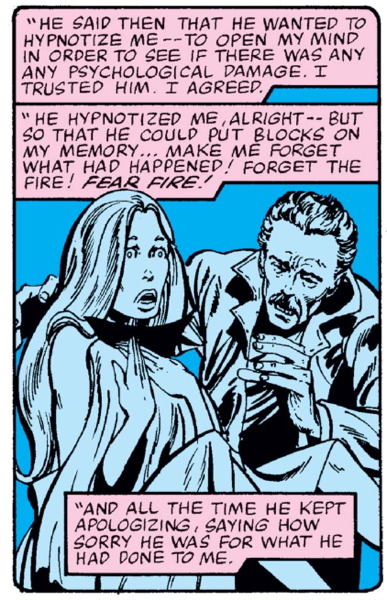
Hence that previously mentioned fear-of-flame, you know.
Now as it turns out, her stepdad was Professor Phineas Horton, creator of the original android Human Torch during World War II, and the chemicals he and Frankie were moving around were like those that gave the android its flame powers. Strikes me as a plot contrivance they couldn’t get away with now, given WWII is 40+ more years in the past than when this comic was originally published. Horton being a teen girl’s 100-year-old stepfather now seems unlikely…or even an 85-year-old one, if you want to work it into a flashback timeframe. Just sayin’ Frankie Raye’s backstory is probably one they’d have to adjust if they ever referred to it again.
So anyway, Horton mailed her this costume some years later to help her contain her powers, though via post-hypnotic suggestion or something via a cassette tape included with the costume, she was made to immediately forget that she put it on and to destroy the tape and forget that too. Okay, that cassette would be an MP3 file now, but let’s not quibble.
Regardless of all this backstory, the upshot is Frankie Raye is also a Human Torch-type character now, and she goes on adventures and such with the Fantastic Four and everything is hunky-dory.
Except…a couple of times she used excessive force in her superheroing, showing little to no consideration for what she’s done. And that’s foreshadowing for what happens in issue #244, the conclusion of Byrne’s first major Galactus storyline.
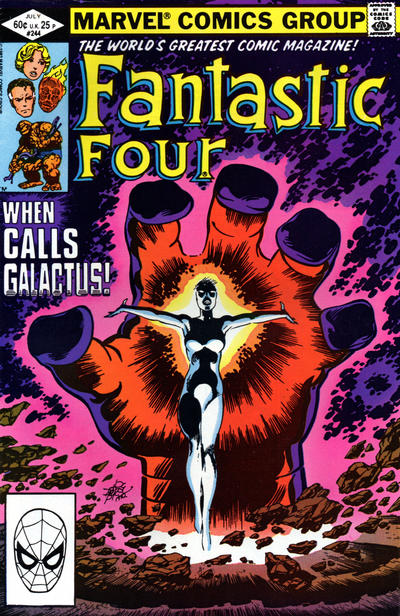
As you can see by that cover there, something drastic is about to go down, and given the subject of today’s post, it’s probably not a shock to discover that’s Frankie depicted on the cover there.
Near the conclusion of this storyline, for assorted reasons Frankie makes the offer to Galactus to be his new herald, à la his former servant the Silver Surfer.
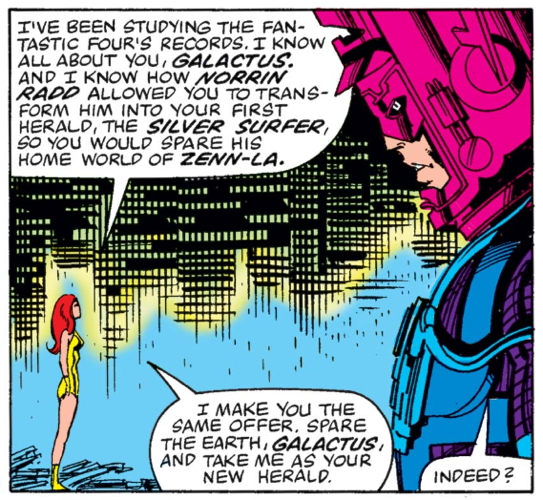
Reed of course tries to talk her out of it, telling her what she’d have to do in this role, and her response is surprising:
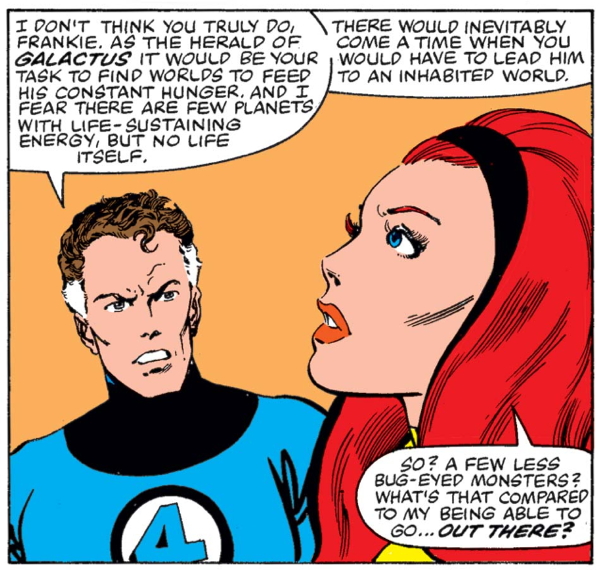
…though maybe not so surprising, given her attitude on display during those foreshadowing events I mentioned earlier.
Galactus, for his part, has a pragmatic reaction:
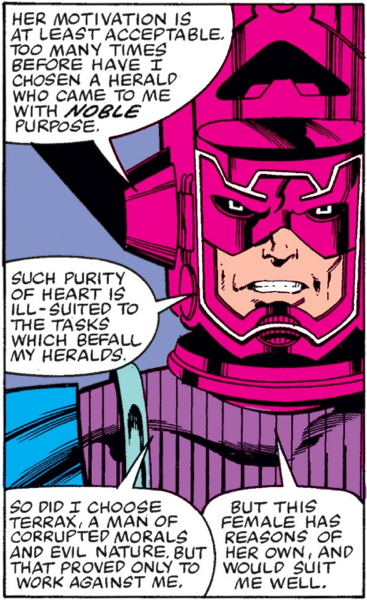
And the deed is done: she’s transformed by Galactus (see the cover above), and leaps into the new role, forsaking everything earthly for her new job:
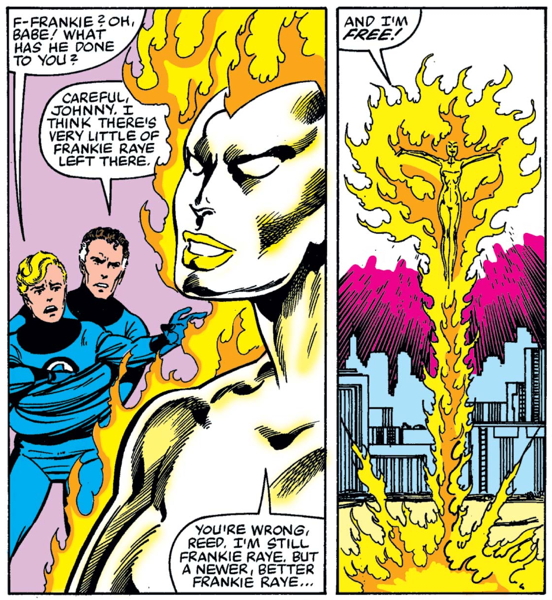
Johnny clearly has no impact on her anymore, even after being a couple again for a bit, and his reaction is genuinely affecting in the face of Frankie’s (or rather, Nova’s, to use her new name) faded humanity.
And that’s that. Frankie turns up once or twice more during Byrne’s run, notably leading Galactus to the Skrull Homeworld. But also notably, we get the beginnings of a long-running subplot in future Marvel comics that Nova may be developing feelings for Galactus.
By “future comics” I mean mostly Silver Surfer, where that aspect of her relationship with Galactus is touched upon, and she also has some romance with the Surfer himself. We do get a follow-up to Nova’s disregard to the lives of “bug-eyed monsters,” and we also learn that Galactus himself may have had…something approaching stronger feelings for Nova than he let on, especially in the wake of her death.
Yes, I said “death,” the character dies in Silver Surfer, though she came back in some form, in the Mighty Marvel Manner, in the Heralds mini, but I hadn’t read it so I don’t know what she was up to there, or lately.
I didn’t even get into her appearance in the alternaute future “The Last Galactus Story” that was serialized, but never completed, in Epic Illustrated. But I think it’s safe to say, like Malice, Frankie “Nova” Raye was one of his reworkings of an established character that did have legs, did continue to have an impact, not just on the Fantastic Four title, but on the Marvel Universe at large.
And farther still, as the “Frankie becomes Nova” story make it, in condensed form, into an episode of a 1990s Fantastic Four cartoon. The character makes other animated and live action appearances as well.
What really struck me most about Frankie Raye is her amoral stance in regards to non-terrestrial life, as presented in #244. That surprised me as a reader still relatively new to the Marvel Universe, presenting a complexity in a character that we identify as “hero,” did heroic things, and had the readers’ sympathy. But she had that one flaw, one that would basically put her in the “villain” category, that made us question any specific attachment we may have had to her. And on top of that, throwing away her humanity, discarding her relationships in exchange for power…that would also be marked as villain behavior in a more black-and-white milieu, but reads as hopelessly tragic in Marvel’s longstanding “characters with problems” foundation. It’s a move that impressed me then, and still, all these years later, even after everything that’s been done with the character since, impresses me now.
It’s mentioned often that Byrne really brought out the best in Sue in his run, making her more powerful, renaming her Invisible Woman, making her a capable and independent member of her FF. I don’t think enough credit is given to Byrne for his treatment of Johnny. Most writers treat him as a self centred, immature, head strong pain in he ‘you know what’ but Byrne really matured him and gave him a complexity I don’t think has been matched. He was genuinely devastated at the rejection by Frankie. There’s also that story about what his powers might have on an impressionable child, only spoiled by the necessity of inserting a Secret Wars 2 tie-in. Byrne also made Reed much less intolerable as well, put him in situations that he just couldn’t use his brilliant intellect to get out of – Sue losing her child being the perfect example of this. It may be controversial, but I think the one member he had the least handle on was actually Ben.
When you put Frankie’s whole story together like this, it reads as remarkably sensitive and nuanced. She has a lot of unresolved trauma: accidentally gaining frightening powers, being forced to forget them, being given a phobia by a controlling parent. All of that seems connected to her lack of regard for other peoples’/aliens’ welfare. If her life can so easily be played with, then how much value does life actually have?
Not to mention her attraction to a violent force of nature/father figure like Galactus. Even making Horton her stepfather, as opposed to her biological one, is pretty inspired. She’s got some major daddy issues.
But her choice to become Galactus’ herald is her own, and it shows growth on her part. She’s picking a life for herself instead of having it thrust upon her (having powers and amnesia) or just falling into it (becoming the de facto fifth member of the FF). In the context of a superhero comic, it’s a questionable choice, but it works as a sort of triumph for Frankie as well as a tragedy for the team.
I’m not sure how many of these connections were intentional on Byrne’s part. If they were, some of them were buried pretty deep in the text. Or maybe I’m just discovering something that everyone else realized a long time ago. But Frankie has a classicly Marvel, tragic origin story that she never quite turns into something inspiring or heroic. She makes a great foil for the FF (and Johnny in particular), who did turn lemons into lemonade.
—
On a completely different note, Byrne carrying Frankie over into his run reminds me of Grant Morrison doing the same thing for Rhea Jones in Doom Patrol. She was kind of a throwaway “kid with powers” in the previous incarnation of the team, but she wakes up in Morrison’s version as something much more powerful and cosmic. She even has red hair. Coincidence…or something more?
The rare Marvel issue with a title that is a reference to a Margaret Thatcher line.
In fact, The Lady’s Not For Burning is the original reference that Thatcher’s speechwriter changed. It’s a play by Christopher Fry that enjoyed considerable success in its time, with John Gielgud bringing it from London to Broadway, and which Byrne had presumably heard of. Though nowadays we only know the phrase for Thatcher.
Well I’ll be darned. TIL.
I like Frankie as Nova, herald of Galactus. Her backstory, however, is too illogical and convoluted. I remember reading 237 and 238 and groaning about how many dumb concepts were pushed onto one character. I’m glad she became more than her backstory, but those issues are a point in my “Byrne’s run as a whole is overrated” column.
Your comment about Professor Horton’s age makes me think of how Aunt May has got younger over time. From the frail old lady one nasty shock away from death to something more reasonable for the sibling of the parent of a twentysomething.
A memory I have of the comic when Byrne reintroduced Frankie Raye was some level of outrage in the letters column due to Byrne’s limited repertoire of faces. Since Frankie had red hair she was basically the then newly dead Jean Grey but in yellow.
“Since Frankie had red hair she was basically the then newly dead Jean Grey but in yellow.”
It’s funny you should say that, because reading these panels here for the first time just now, Frankie becoming someone who has no qualms about finding and destroying a planet with living inhabitants reads to me like Byrne transporting the Phoenix that killed an entire planet with no hesitation, which lead to Jim Shooter demanding that she be punished (and ultimately killed), to the FF so he could have the character he wanted out of spite.
I don’t remember where I read it, but apparently Roy Thomas’ original plan with Frankie was for her to be Toro’s daughter (Raymond = Raye). Which makes a bit more sense than the convoluted Phineas T. Horton thing.
Agreed! THe Phineas T. Horton angle always struck me as a bit odd.
I get that plot contrivances are necessary but I’ve always found the “hey Step-Daughter help me move these extremely volatile chemicals that have the potential to turn you into another Human Torch” a bit odd. Surely there’s a better way to tell that origin, but then again I’m not the one writing, drawing, AND inking a monthly comic book.
Horton makes the Puppet Master look like step-father of the year!
MIKE: go back in time and fix this. Talk to Shooter or Byrne about Roy Thomas’s idea. Have dinner with the at a Blimpie’s. Then buy a bunch of right off THE NAKED CITY spinner rack (only 12 years later then that one episode) and you’ll be rich and your store would be bigger than Camarillo and seen from space by Artemis.
Look, I can dream a bit. Nightmarishly, of late.
Bill Finger and Jerry Robinson created Robin/Dick Grayson.
Legally speaking, Malice and the Invisible Woman and Robin and Nightwing are distinct characters (as Superman and Superboy are).
“Bill Finger and Jerry Robinson created Robin/Dick Grayson.”
Makes sense. Those guy shoulda got a LOT more credit.
“but I’ve always found the “hey Step-Daughter help me move these extremely volatile chemicals that have the potential to turn you into another Human Torch” a bit odd.”
It IS contrived, but in its 80’s Marvel context, I don’t mind it!
I had meant to join the conversation about a week ago, but life just got too busy.
Anyway, for what it’s worth, here are my thoughts and observations.
I find it interesting just how much John Byrne’s art had changed by the time he took over FF with no. 232, compared to his prior stint on the title. During his first foray he was more or less drawing in a similar style to Rich Buckler, George Perez, and Keith Pollard, which, in turn, was somewhat based on the ’70s Marvel “House Style” as established by John Buscema in the post-Kirby era. But by 1981, Byrne was popular enough and had evolved into his own distinctive style (which I see as primarily an amalgamation of the styles and influences of Neal Adams, Steve Ditko, and Joe Staton), that I guess Jim Shooter just let him do what he wanted.
Already, in FF no. 232, Byrne changed the depictions of Reed Richards and Johnny Storm quite a bit by rendering them very spindly, whereas throughout the late ’60s and ’70s they had both been drawn solidly with athletic builds. I wonder why he chose to skinny them down?
And, going back to Joe Staton for a minute, considering that Byrne and Staton both worked at Charlton Comics at the beginning of their careers in the early ’70s, and considering that Byrne’s Rog-2000 appeared as a back up story character in a few issues of E-Man, I wonder if Byrne took the character name and elements of the costume for Frankie Raye from E-Man’s similarly garbed and similarly named superheroine girlfriend, Nova Kane?
Also, it seems like a golden opportunity was missed to have Frankie’s superheroine name be “Torchy.” And why was she named “Nova,” considering that the other Nova (and the Nova Corps) was already an established part of the Marvel Universe?
I do think it would have been cooler to have Frankie be Toro’s daughter, or niece or cousin, instead of Phineas T. Horton’s step-daughter. But it could also be fun to have a retro-80s untold FF story where Johnny and Frankie time travel to the ’40s and team up with the Golden Age Human Torch and Toro. The precedent is there, as the FF met The Invaders at least one time.
And, I guess this was touched upon already, but was the whole Nova saga basically Phoenix redux on Byrne’s part? And what was up with the whole Dark Phoenix, Nova, and Malice story arcs anyway? I mean, sure the Dark Phoenix saga is a certified classic, but after that wasn’t it all a bit repetitive? Was the early ’80s that much of a reactionary time period in culture in general and in Marvel Comics in particular towards the societal advances women had made that all of these characters needed to happen?
Also, here’s a link to information about Byrne’s “X-Men: Elsewhen” fanfic project, the first volume of which has been published in full color by Abrams and will be released in June, 2026.
https://youtu.be/oqkhos-ud9I?si=X5Law3ujvfYCVcwl