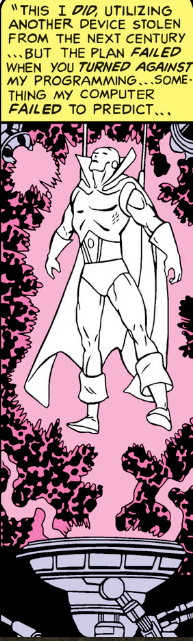
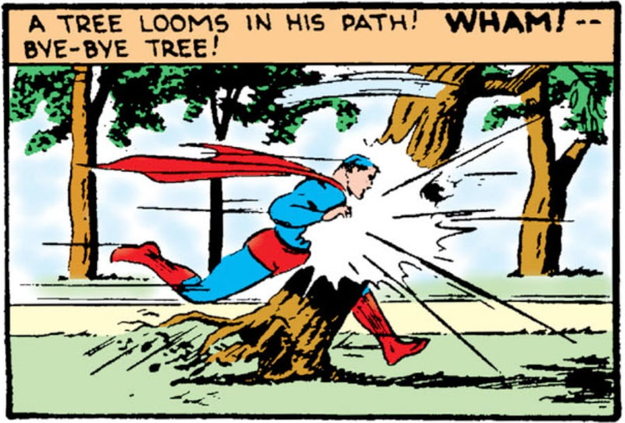
Presumably this counts as “Man vs. Nature.”


Found this panel while reading some Golden Age Superman books on the DC Universe Infinite app, and the casualness of the caption box made me laugh. Written by Jerry Siegel, art credited to Joe Shuster but actually drawn by Paul Cassidy, the story featured Superman taking on a hypnotist who, at one point, puts the whammy on the Man of Steel. Hence, his awkward charging through a tree…not on purpose, I promise you. (From Action Comics #25, June 1940.)

• • •

Just an additional note letting you know that today is the 7th anniversary of the opening of my comic book store Sterling Silver Comics. Since I’ve been in the comics retail business for 33 years, that means I’ve done around 21% of it on my own. Here’s to seeing that percentage grow. And thanks to all of you for your years of support. It’s much appreciated.

Here’s the post where I first announced my plans. And here’s the post where I reported on my opening day! (Boy, my store is a lot more full now than it was then.)

Strong to the finich.

You probably thought I forgot about your questions! Let’s jump back into a couple of them!

King of the Moon declares

“How often does Olive Oyl slip some spinach into a dish on date night?”

First, how very dare you. Second, given all documented evidence, Popeye’s strength and stamina are increased by the swallowing (if not the digestion, since there’s barely time) of spinach, As such, I suspect the temptation on Olive’s part is not insignificant. However, one should refer to Larry Niven’s famous essay about Superman’s theoretical existence as a sexual being, “Man of Steel, Woman of Kleenex,” for the potential danger to Ms. Oyl, despite the astounding amount of resilience she’s shown over the decades.

• • •

Walaka of Earth 2 crosses the dimensional barrier to ask

“Mike, what’s the best way for someone who is a wait-for-the-trade type to work with their retailer to get the books they want? Sometimes I see a first issue, and know I am not going to buy the monthlies, but really want to get the trade when it comes out. Is there a way to do a not-published-yet pull slist or something?”

Well, the way it’s always worked with me is…just ask! If it’s something that’s eventually coming in the not too distant future, or even the not-not too distant future, let me know and I’ll put it in my pull list file. And if I need to, I’ll make sure to make a note to order the thing in case it’s not already in whatever distributor’s system from which I need to obtain it.

Now that’s just me, and I’m very simplistic in my technological solutions…some stores have more elaborate systems in place that probably make the process even easier. But the upshot is…there should be literally no problem.

• • •

JohnJ jingleheimers the following schmidt

“Mike, Do you have a wish-list of a few titles from the 50s-60s that you’d like to see reprinted but don’t think either of the Big Two will ever actually publish?”

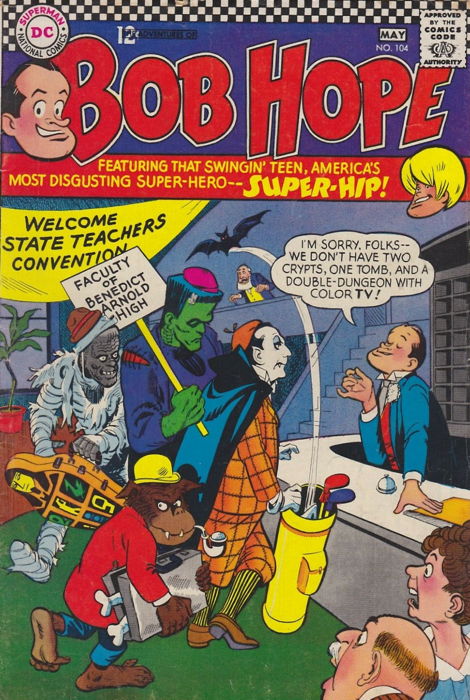
Since you specify the Big Two, Marbles and Duh-C, I’ll stick to titles from them, and friend, number one with a bullet on my list is this comic book series right here:


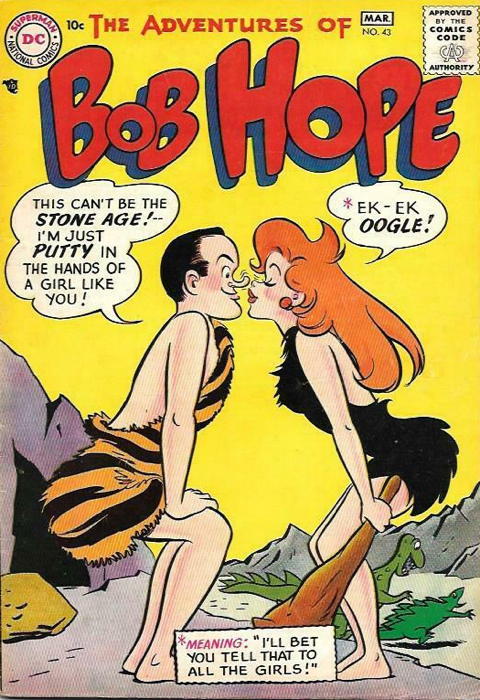
Okay, that’s a little later in the run, where things went…off the rails a bit, but still absolutely wonderful. The earlier issues were a little more what you’d expect from a comic starring Ol’ Ski Nose:


I want them all. In freshly-scanned and recolored oversized hardcover volumes. I know due to licensing reasons and, well, potential audience (are there enough weirdos like me out there to justify the cost of any reprinting, much less a refurbished one like I’m asking?) I don’t think we’re ever seeing it again. And to think…at the previous place of employment we actually had an Adventures of Bob Hope #1 just sittin’ in the case forever. I coulda started my collection there! Anyway, it’d be great to have these and the Dean Martin/Jerry Lewis book in print somehow as well.

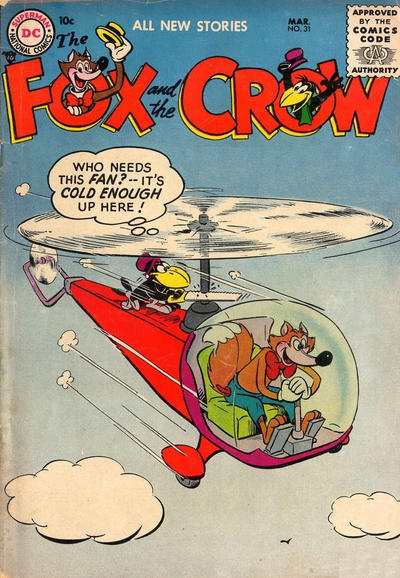
Another book I’d like see and is also hindered by having been a licensed property, were the Fox and the Crow comics:


…based on a pretty much forgotten series of animated shorts that stopped being produced in 1950. The characters went on a while longer in the funnybook biz, appearing in other anthology titles at DC as well as having their own self-titled series as shown above.

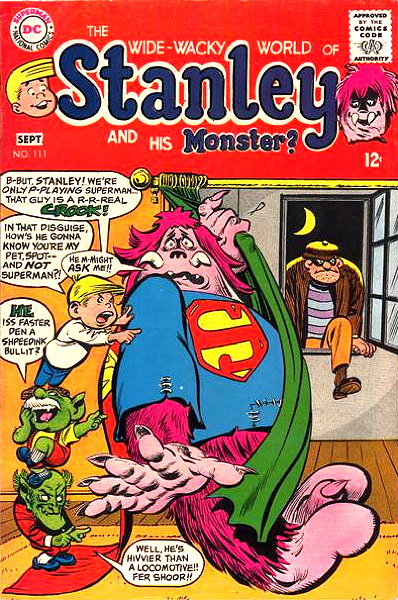
Running as a back-up in later issues of Fox and the Crow were “Stanley and His Monster,” which eventually took over Fox and the Crow as the title characters for the last four issues of the series:


There’s no licensing agreement keeping this from reprinting, as far as I know, but again, demand probably isn’t there. When they had that Phil Foglio mini a couple of decades back, or where they showed up in those Kevin Smith issues of Green Arrow, that would’ve been the time for reprinting. But alas, that window has likely passed.

In addition, I’d like to see reprints of all the Sheldon Mayer stuff…we got that one Sugar and Spike Archives and that was it. But I’d also like to see Three Mouseketeers, Scribbly, all the short funny animal features that popped up here and there.

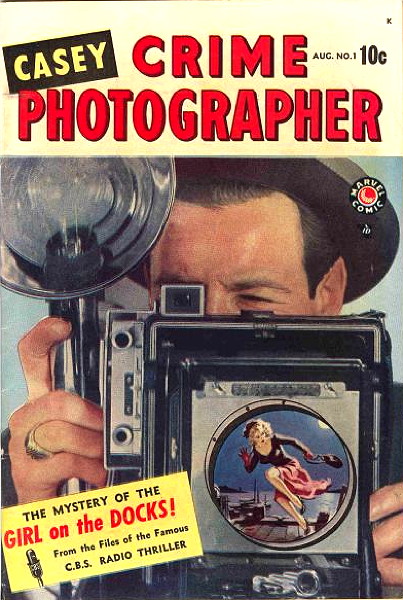
Okay, that was all DC stuff. I couldn’t really think of an Marvel book I’d like to see collected. Maybe Casey Crime Photographer?


I mean, sure, why not. I mean, aside from also being licensed.

What’s black and white and variant all over?


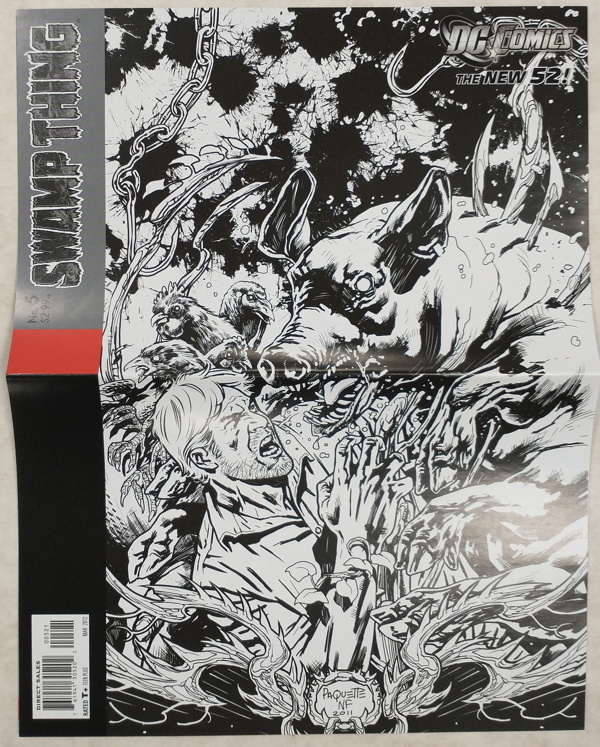
So it dawned on me that I might be opening up bit of a can of worms here, as DC’s New 52 publishing initiative was rife with variant covers. Initially, I was just going to talk about these black and white variants DC offered early on in the initial months of New 52. Like, for example that Swamp Thing one above, which I removed from the formerly vast Mikester Comic Archives to photograph. (Er, pardon the glare.)

As I recalled, several DC titles around this time had this particular style of variant, taking the regular cover, flipping it on its side and stripping it of its coloring. This Swamp Thing issue (#5, March 2012) was offered in a 1:25 ratio, meaning a retailer would have to buy 25 copies of the main cover to order one of these. …Look, I know most of you know how ratio variants work, but someone reading this might not.

In looking at other DC titles, it appears Batman #5 also had a similar variant, but it was a 1:200 ratio book…which makes sense, since Batman is nearly always a top seller for DC. Aquaman #5’s variant, another 1:25. Same with Superman #5. Even Detective Comics #5 was only 1 in 25.

I’m not going to look up every 5th issue of the initial New 52 series to check the ordering plateaus for these black and white wraparounds (and not all of them had ’em…sorry, Blackhawks #5), but I’m going to hazard a guess and say the main Batman title was the one series with the highest “ask” to get that variant. If I’m wrong, I’m sure I’ll hear about it.

These black and white variants are kinda neat. It’s like you’re getting your own reproduction of the original art, in varying stages of development: fully inked, like on the Swamp Thing cover, or just the pencils, like on that Aquaman cover. Which is nothing particularly new or innovative, as black and white “sketch” covers had been a thing already, but by turning it on its side, wrapping the image around the front and back covers, now it more closely approximates the size of what we generally think of original art pages. (Yes, not exactly, hence my use of the word “approximates.”)

I don’t have specific retail stories about these black and white variants, beyond me unsurprisingly glomming onto the Swamp Thing one as soon as I cracked open the Diamond delivery boxes. But what I do want to talk about is DC’s increasing reliance on variant covers over the history of the New 52’s lifespan, as alternate and gimmick covers were prodcuced to shore up the orders after the initial excitement over the relaunch started to fade away.

Variant covers were there from the very beginning of the New 52, with some titles (like Batman and Superman offering other covers based on your lowest DC order for the week. For example, if your lowest order for a DC title coinciding with Batman‘s release was only 20 copies, then you were limited to 20 copies of that one Batman variant. Thus from the get-go, they weren’t even waiting for numbers to drop. They were trying to get you to order more of a comic in which you didn’t have as much faith so you could get yer mitts on more of that Batman variant. Very sneaky.

And there were more variants than that from launch, especially for Batman, not even counting the variations on the several reprintings for this and other New 52 titles (which, as I said last time, is a little outside the range of this overview). I intend to cover more the DC New 52 variants, making this a bit of a series inside the variant cover-age series already in progress, as it’s clear I’m never going to squeeze all these into one post. I mean, I suppose I could, but I don’t really want to be up ’til 4 AM writing a blog post, like I used to do when I was a young and spritely 34 years of age when I started this site nearly two decades ago.

So hang onto your butts, as this variant ride is going to be taking on the New 52 variants over the next few weeks. I of course reserve the right to interrupt the run with breaking variant news, but we’ll see how it goes.

In which I finally reach some measure of self-awareness at the end, there.

So I’ve been using the DC Universe Infinite digital comics service mostly to try to catch up on many of the comics I picked up but couldn’t read during the earlier and particularly bad months of my eyeball issues, when I wasn’t really able to read anything. I’ve also been using to dip a little farther back into DC’s publishing history, reading some Golden Age books, a lot of the earlier Silver Age Green Lantern (boy, does Hal call Tom that name a lot), and finally reading the entirety of Ostrander’s Suicide Squad run (which I missed during its initial publication). And I keep hoping they’ll add more late ’70s/early ’80s Superman comics to the catalog.

Anther purpose to which I’ve put DC Universe is revisiting some old favorites from my youth, my own copies either buried deep in the remainder of the Vast Mikester Comic Archives, or long since tattered into unreadability and discarded. One of those stories was the “Secret Origin of Red Tornado” two-parter that ran in Justice League of America #192 and #193 in 1981, when I was 12 years old.

I pointed out one short sequence in my last post, where I discussed the occasional brief focus of a team book on developing characters that had no other home on that stands. Now granted pretty much the entire focus of this story was on Red Tornado, but you know what I mean. Getting a little character development in for Reddy’s supporting cast because, you know, where else is that going to happen. (At least not until his own mini-series a few years later.)

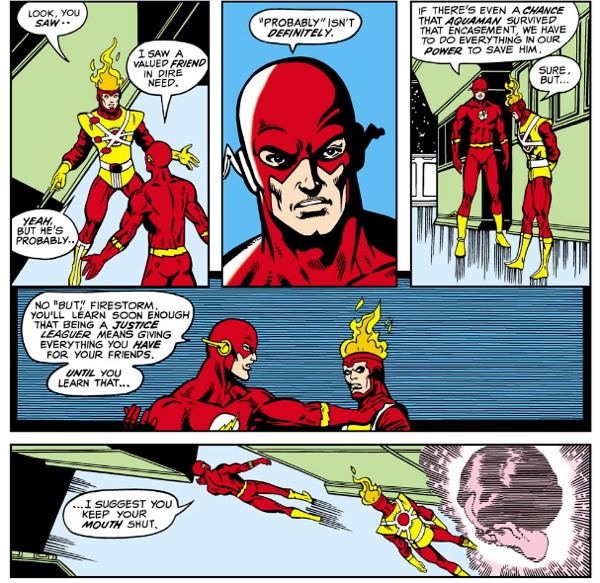
Another bit of character development for someone who didn’t have his own title (but was featured in a back-up series in another comic at the time) was this, where the Flash admonishes Firestorm for prematurely (and loudly) giving up on a teammate for dead:

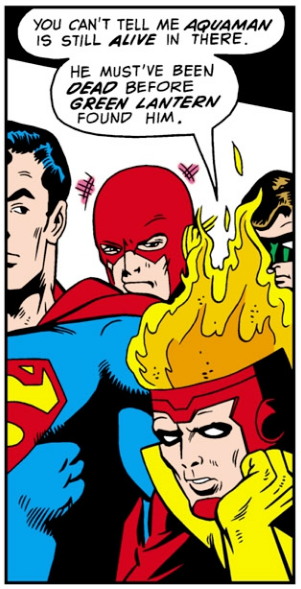
That sequence has stuck with me for a long, long time. Particularly this panel just before it, with Superman giving ol’ Flamehead the super side-eye:


You could just feel that burn of shame on Firestorm’s behalf. And in retrospect, it isn’t necessarily some tossed-away sequence to fill pages and create conflict between members of the team…this was written by Firestorm’s creator, who was also writing those back-ups over in The Flash. As such, it feels like an important part of the character’s development and not just something you could ignore because it didn’t happen in one of his “real” (i.e. solo) stories. I don’t think I appreciated this at the time, but now that I’m older (definitely) and wiser (jury’s still out) I certainly appreciate it now.

Another thing I appreciated about this comic, then and now, is just how much backstory got crammed into this comic. Well, “crammed,” relatively speaking, since this stories did run 52 pages over two issues (at only 50 cents a pop, even) so there felt like there was plenty of space. But there was a good chunk of the narrative given over to expository info needed for the reader to realize the importance of just what’s going on around here.

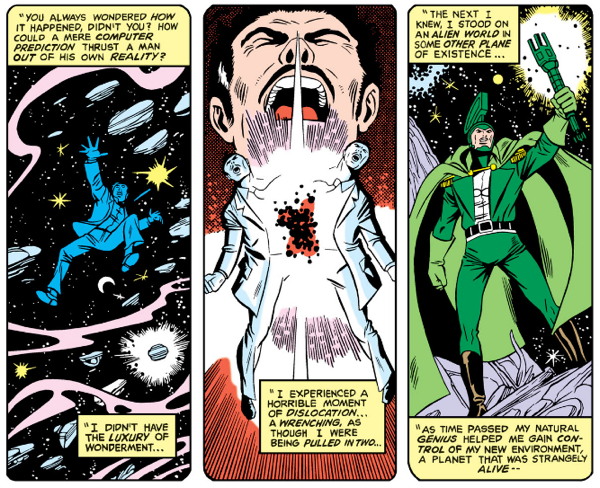
I mean, we get a retelling of Red Tornado’s beginnings:

We learn about the villain T.O. Morrow, his origin, and what he’s been up to since his last appearances:

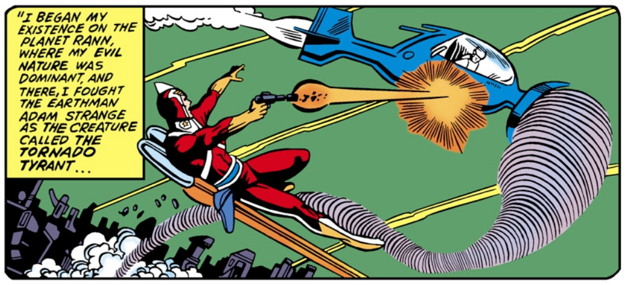
There’s some bonus Adam Strange stuff, tying into the current story:


…and that’s not even all of what’s being shown and explained in this book. And it all reads very smoothly. As I said, I was 12 when this came out. I’d been reading comics for a bit, but I didn’t know much about characters like Firestorm and Red Tornado at the time, I certainly didn’t know T.O. Morrow, and while I knew Adam Strange mostly from being featured on the early Nickelodeon program Video Comics, I didn’t really know from the Tornado Tyrant.

It would seem like this is a lot to hit a kid relatively new to comics and some of these characters/concepts, but I do recall finding it absolutely fascinating. Finding out there was a history to these characters, still being referenced, still mattering, that happened long before I entered these worlds, gave the proceedings a depth that they would not have had otherwise. It’s a style of presentation that would shortly have me doing deep dives into Roy Thomas’s DC work, and its reverence for Golden Age tales.

I wasn’t put off…I was attracted by the idea that there was more to learn about all these characters and the worlds they lived in. I know, and I knew even then, that the shared universe at DC (and Marvel too) was built by Many Hands and inconsistencies abounded, but part of the fun was seeing what fit and what didn’t. It’s a feature, not a bug.

I’ve spoken about Crisis on Infinite Eaths before, and how its attempt at codifying and streamlining the DC Universe was compelling reading at the time…perhaps one of the very few times a comic book series had you genuinely concerned for the fate of those involved. It wasn’t until after patch after patch after patch was applied to that firmware upgrade that it began to sink in that the trip Wolfman and Perez took us on was, maybe, not really necessary. Reboots and relaunches began to pile on, and that long history for these characters began to evaporate.

The repeated relaunches of Legion of Super-Heroes threw away all their history in exchange for brief high bursts of first issue sales and slow declines. X-Men, a comic once read by, you know, everyone, splintered into endless spinoffs and relaunches, with no one easily able to follow the thread of stories and characters.

I know there are attempts to redress the shallowness of their fictional worlds. Nearly every crossover event at DC is about trying to make Crisis never-was, with the latest iteration being “every story matters,” however that’s going to work.

This whole post reads like “why aren’t comics like they were when I was a kid,” which comes awfully close to lumping me in with those “comics were never political!” people, and nobody wants that. Comics are always evolving and changing and trying to find their place in a world where they’ve been largely supplanted by, ironically enough, their own enormously popular TV and movie adaptations. There is still lots of good work being done with them, and I still love reading (and selling!) them.

But I do miss the feeling I had of dipping into some comic I hadn’t read before and realizing there’s a whole world here that I’m only barely experiencing in this one issue. Maybe I’ve read comics for too long to have that happen now. Or maybe I’m assuming too much, and that kids do have that same wonder, just not with the same types of comics I read. There’s someone out there whose first volume of Naruto is number 81 and being intrigued by what they’ve discovered, the same way I was 40 years ago, when I decided to pick a comic off the rack that promised secrets to be revealed about Red Tornado.


images from Justice League of America #192-193 (July & Augst 1981) by Gerry Conway, George Perez, and John Beatty

The best shrug in comics.

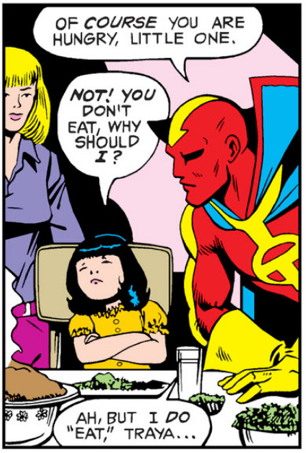
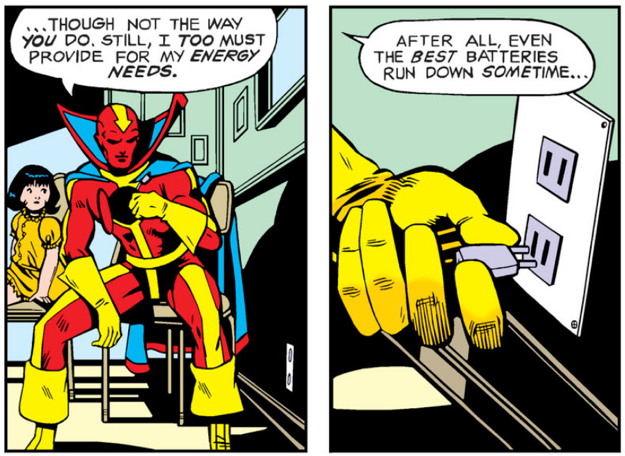
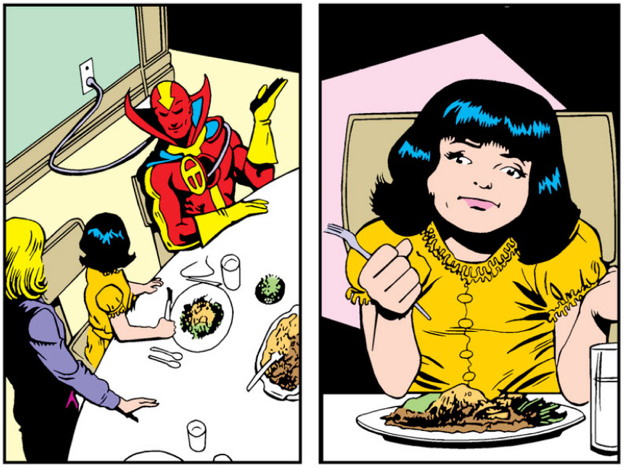
I actually have a lot more to say about the Justice League of America story this sequence comes from, which I will get to next time. But, for today let’s just enjoy this small bit of domestic humor featuring the android superhero the Red Tornado, his partner Kathy, and their adopted daughter Traya as they deal with the little girl’s recalcitrance at mealtime:


That’s one of the best parts of superhero team books, particularly when it’s done well as in the above excerpt. They allow some brief moments with characters that otherwise have no other outlet. There was no Red Tornado ongoing series…if you were Reddy’s biggest fan, this is what you got. A few panels every month, if you were lucky.

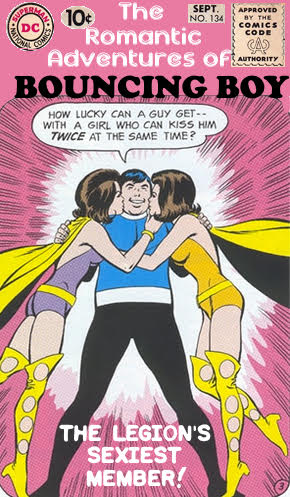
Imagine being a big Wolverine fan at a time when his primary print endeavors were in a book he shared with other characters who also only appeared in that book. You waited a month between issues to get a few pages with the character. And that’s with one of the more popular members of the X-Men. Imagine being a big Bouncing Boy fan and waiting month-to-month for him to be featured in Legion of Super-Heroes. Sometimes all you got was a panel, and not even a speaking part.

The way comics publishing has been of late, things haven’t been quite so dire…lots of third/fourth/fifth/more-string characters eventually do get their own titles, even if just briefly. So, if you’re a fan of a member of a team book who just gets a small amount of attention there, eventually you’ll receive at least a little more quality time with your fave. Red Tornado got his own series. Wolverine certainly did. No Bouncing Boy solo title yet, but I still hold out hope.


images from Justice League of America #192 (July 1981) by Gerry Conway, George Perez, and John Beatty

To variant or not to variant, that is the question.

Turan said, in response to my Saturday post about my old mini-comic with the various monster drawings on the back:

“You let pass an opportunity to tie this post in with your recent theme, by calling all of those copies with the personalized monsters ‘variants.'”

I did briefly consider making this explicitly one of my variant cover-age posts, but had opted to not cross the streams, as it were. But, well, the seal has been broken, the connection between the two has been noticed, so I might as well touch on this briefly. Or “briefly,” as the case usually is.

Now, what exactly am I talking about when I say “variant comics?” Okay, fair enough, I’d imagine that’s a question that should have been addressed when I started this series of posts, oh, six months ago. Anyway, when I’m talking about variants, I specifically mean “different versions of the same book offered for sale at the same time, giving consumers a choice.” I’ve more or less followed that here, maybe not strictly exclusively (like the international comics purposefully not offered to the same customers), but that was sort of my overall goal.

Mostly that was to differentiate simultaneously-offered variants from reprint variants, where a sold-out comic would be reissued with a new image or altered coloring on the cover. Like, for example, Identity Crisis #1, where the first print looked like this:
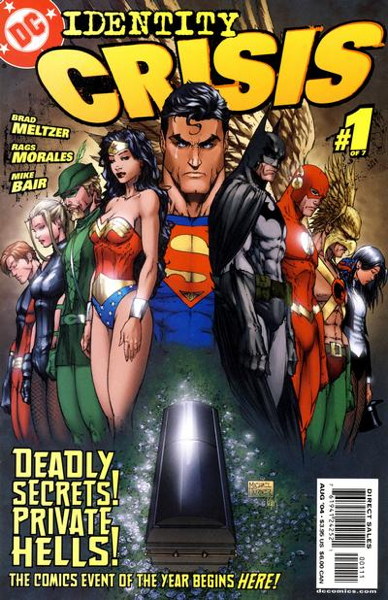
And then the later pressings had changed covers, like this fourth printing:
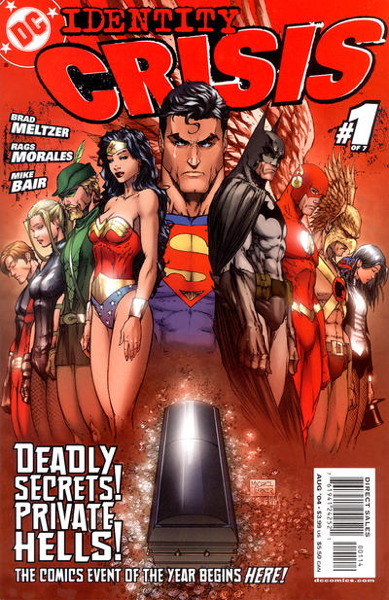

Again, I’ve brought up changes in reprints before here, like for the Robin mini-series. Overall, though, I feel like that’s a somewhat different topic than what I’m covering here. Splitting hairs, I know (and I realize it’s not like the reprints weren’t often offered on the shelves side-by-side with the comics they’re reprinting) but they just weren’t my focus.

Going back to Turan’s comment, where he continues:

“…There was one illustrator who did just that with an issue of BATMAN released with a blank cover–he bought a batch of copies, drew a quick sketch of Batman on each one, and then put them up for sale on eBay as ‘super-rare variant editions,’ priced at thirty dollars apiece. I wonder still how many people fell for this.”

Now “sketch” covers are variant covers, an alternate cover offered at the same time as other covers for the same comic, just with a blank covering made of somewhat-more-amenable-to-drawing-upon paper stock. J. Scott Campbell’s joke “do-it-yourself cover” for Gen13 has become reality, with regular offerings like this:
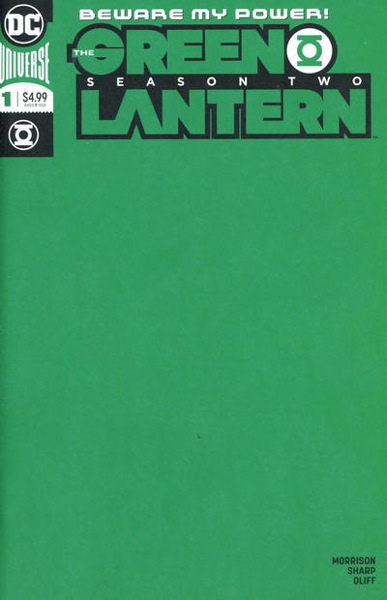

Usually the paper is white, but sometimes the publishers go for a little novelty.

Thus, while blank sketch covers are themselves “variants” for the purposes of my discussion, I am agreeing with Turan (as I think most people would) that the drawn-upon sketch covers being offered on eBay are not “variants” in the same sense. Yes, technically they are additional versions of the cover, but they are not variations simultaneously marketed by the publisher, but rather made after the fact.

Before you logjam my comments section with “what if” and “actually” and “how ’bout” responses, yes, I know there varying circumstances that could allow for a sketched-upon blank cover to be simultaneously offered with the other variants. “Remarked” books with drawings an’ such are frequently available from official sources…I’m just saying, for the purposes of discussion here, at the moment that doesn’t fit the topic I’m interested in discussing. It’s not Law Engraved in Stone, it’s just drawing a line (ahem, so to speak) on “what is a variant” and “what is not a variant” for my purposes. In this instance, “sketched-upon covers” are basically “autographed comics” — yes, they’re all different, but when I’m talking about actual variant comics, you know what I mean.

Now the reason I did all that typing above is to state that my mini-comic with the different monsters drawn on the back…those do count as variant covers. Only one copy of that comic exists with no handdrawn monster, and that’s the one in my collection. As the fella what created, printed, assembled, stapled, and drew upon a few hundred copies of this comic, I can guarantee every one that went out for sale had a different monster on it. Not done after the fact, where they were sold blank and you had to ask me for a monster. You flipped though the rack, found the monster you liked, and you bought a copy. It was offered by the publisher, Full Frontal Harvey, and the creator, me, only with original drawings on the back cover.

If I may be so bold, I suppose it’s like that issue of RAW Magazine with the torn-off corner (and the corners were then switched around so you got a corner of a different copy taped inside):
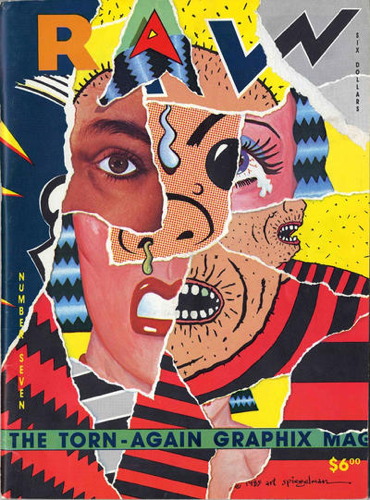
Now you could buy a copy of, say, issue #136 of America’s favorite romance comic Unicycle Tragedy, the extra-sized 17th anniversary issue, off the stand, tear off the cover, and declare it a “variant cover” but nobody’s gonna buy into that. But if the publisher did it and offered ’em up for sale as such, like them wacky RAW folks, then yes, I think that counts as a variant in the sense I’ve been using it here.

That’s a lot of words basically discussing “publisher’s intent” versus “after-market fiddlin’ around. As I said, I’m not the Dictator of Comics (yet) laying down edicts. Just trying to define what “counts” and what doesn’t in my little discussions here.

And speaking of variants: the other day I was going through some stock at the store, and in researching a particular comic I found, I discovered the Grand Comics Database didn’t have an image of it in their system. Well, thanks to me, now they do! …The irony of attaching that bit of business to this post is that the comic may have been a later reprint of the issue for sale in other markets (like the Superman Wedding issue I talked about here). So, possibly closer to Identity Crisis above than to, say, X-Men #1. Oh well, you know where to send the complaints.
Small Press Saturday #1.

So as I’ve mentioned several times in the past, the name of this website comes from a mini-comics digest I published in 1998 (under the “Full Frontal Harvey” banner, a shared local comics ‘zine thing that former coworker Rob started up…name explained in my first anniversary post).


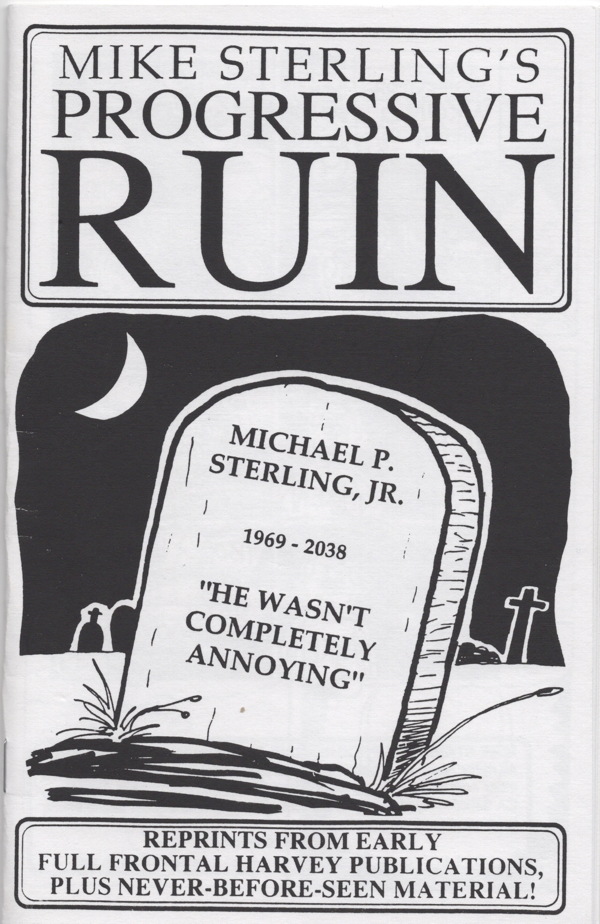
And come to think of it, my date of “death” on the tombstone becomes increasingly less humorous as the years dart by. But anyway, this was a collection of comics ‘n’ stuff I drew for the FFH flagship anthology title Wood-Eye, a scattering of pages from my solo mini-comic Lookit! along with some new material. (Here’s a sample.)

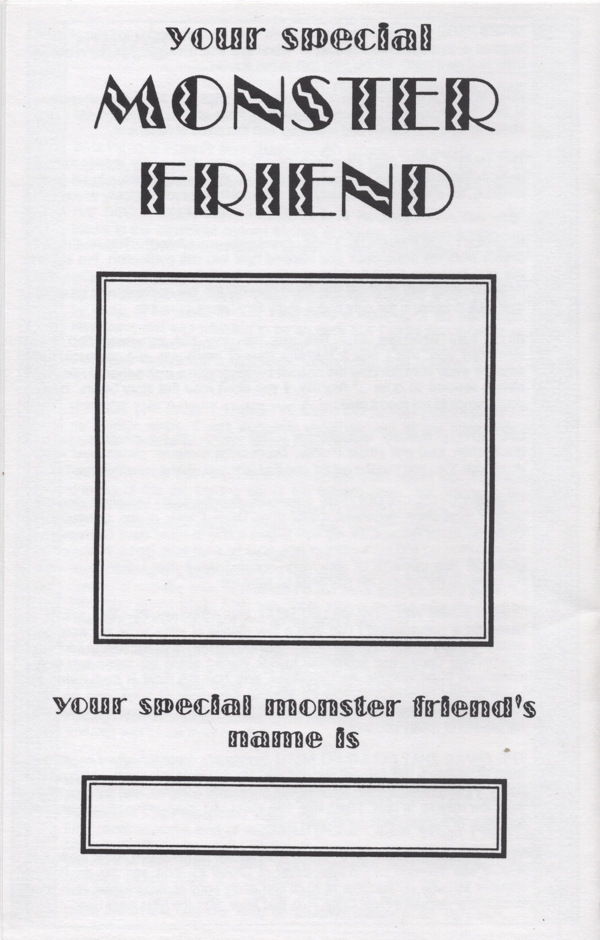
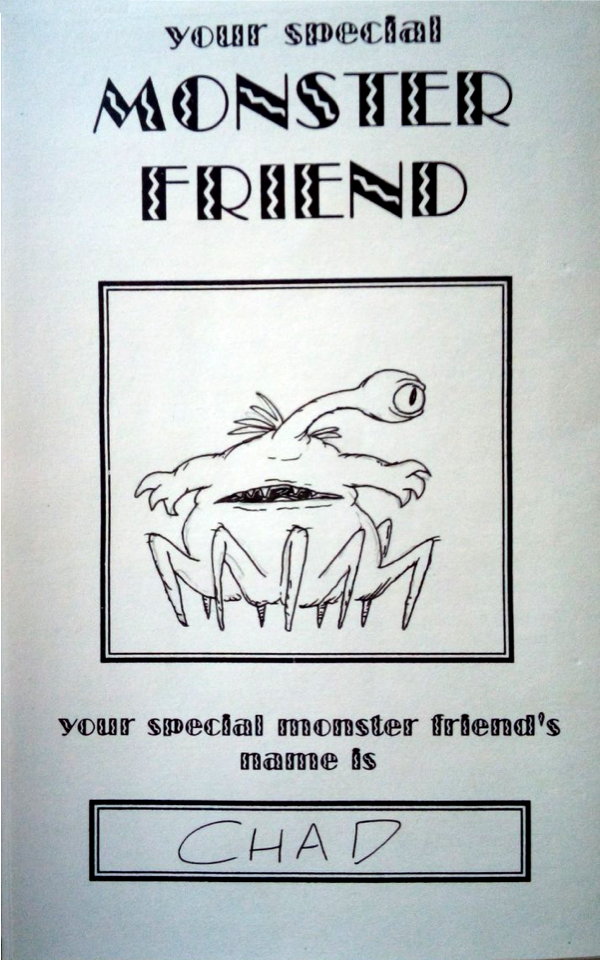
Some of what counted, I think, as new material, and what counted for sure as extra work for me, was the “Your Special Monster Friend” back cover, where I would draw and name an original monster on each and every distributed copy of Mike Sterling’s Progressive Ruin the printed-on-dead-trees comical book.


However, this being 1998 and not having regular access to a scanner or even a digital camera, I did not document the many, many monsters I drew on these back covers. I do remember that there were monsters named after me, former coworker Rob, our pal and FFH member Fred, and other friends, but I retain no memory of what any of them look like. The monsters, not my friends and me.

But in swoops old pal William (who probably also had a monster named after him) to the rescue, as he dug out his copy and sent me a pic of the monster I drew thereupon. BEHOLD…CHAD:


Thus, at long last, I have at least one catalogued example of a Special Monster Friend in my records, 23 years after the fact.

John Goodman’s finest role.

So in Monday’s post, where I was talking about variant covers in the “real” non-comics world, I brought up the multiple foil covers used for the Raiders of the Lost Ark novelization. I did say at the end of the post I didn’t think many people were actually buying all the different covers to be completists, but I’m sure it’s not nobody.

Well, Turan swooped in with some bookstore-sellin’ experience, to inform that book publishers weren’t producing multiple covers for their titles as a means of encouraging multiple sales. It was more for encouraging displays from sellers, or for offering more options possibly to attract different demographics by using different cover images/designs.

When you have a hammer, everything looks like a nail, and my comics retailing hammer may have been aimed at those old Raiders books. To be fair to me, I didn’t necessarily say that book publishers were doing multiple covers for the same reasons comic publishers seem to do so…at least, maybe not back then. But discussing those books in close proximity to comics probably implied as such, for which I apologize. But I’m sure there are still book collectors out there snapping up all variations of a new book’s release. C’mon, have you met book collectors?

Anyway, back to the comics…while I’ve been hitting the “variants are there to get multiple sales from the same customer” nail fairly hard around these parts, Turan does bring up other possibilities that I haven’t really considered. There is always the possibility of a comic publisher trying to attract a buyer that may not care for one cover, but definitely like another. I have over the years had customers walk up to the counter buying a comic they wouldn’t normally because of a specific image used on one of the many variants. In fact, a certain still-extant comics blogger of some note may have bought a variant cover or two simply because it had an unnamed swampy gentleman thereupon. So, basically, I should’ve pointed out this reason for variants long ago.

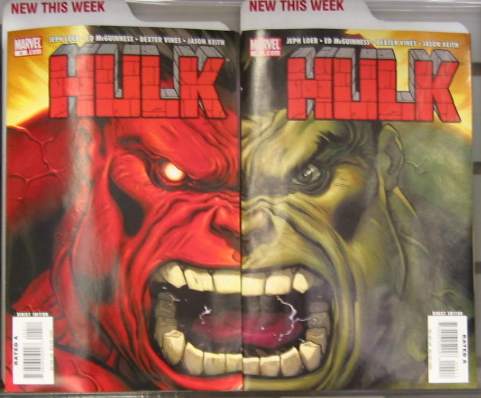
As for variants being issued to inspire creation of in-store displays…well, sure, comic stores could do, and have done, that. I don’t know if that was the explicit intent of comic publishers, but more a natural extrapolation by more clever shops to take advantage of the material offered. I mean, who knows. And again, this is something I’ve sort of done in the past…I mean, I try to display all covers on my racks anyway, but I haven’t gone out of the way to make a specific separate display of just variants in a long time (we did way back when with the 1990s X-Men and Spider-Man #1s). I don’t know if my racking these books like this counts:


…but boy, it almost got me to buy both covers. I do have to admit I was very tempted to display these covers on opposite sides just to annoy everyone, but cooler heads prevailed.

• • •

To follow up on some other previous posts, I received my newest shipment of weekly Marvel comics from their new distributor Penguin Random House. As I’d expected from how some replacement damages were shipped to me last week, PRH has responded to widespread criticism of their piss-poor packaging and the excessive damages of comics that resulted.

Like Lunar (DC’s distributor) PRH is now packaging their books inside a cardboard box, surrounded by bubble wrap inside another cardboard box. Frankly, the outer box isn’t quite sturdy enough (or large enough to allow for more wrap) to my tastes, but it’s definitely a step up from the last couple of weeks. I did experience some damages, but they were fairly minor dings on six comics, and to be honest I don’t know if these came from their time in transit or before (or as) they were packed in the boxes.

Also, replacements for all of my damages from last week (and there were a lot) arrived early this week. (I initially thought I was missing one, but that’s only because I didn’t recognize the variant cover as being a certain title. AGAIN WITH THE VARIANT COVERS.)

Here’s hoping things continue to improve, and that a certain other distributor who shall go unnamed here will begin to feel at least some pressure to step up their own game. To be fair, I only received two damaged books from them this week, but in the past that just meant I was due for a real problem the following week. We’ll see.

Now I hadn’t heard about this, but on this week’s episode of the Longbox Heroes podcast (being listened to even as I type this), apparently there have been other odd problems with PRH…such as filling an entire order of a book, not with the regular cover, but with the 1/25 or 1/100 ratio variants, which is pretty wild (and possibly quite the windfall for the less scrupulous retailers). I haven’t experienced that particular problem yet, thankfully.

• • •

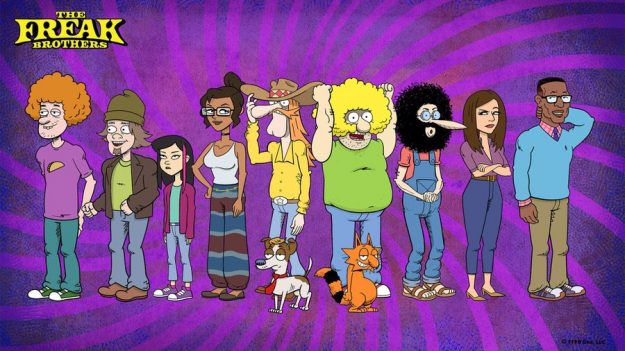
And now, some good news…the Fabulous Furry Freak Brothers is finally going to series, airing on the free TV app Tubi:


As has been noted, the styles of “Characters Created by Gilbert Shelton” and “Characters Not Created by Gilbert Shelton” do, um, clash quite a bit, but given the premise of the series (the Freak Bros. are spirited away from their ’60s/’70s stomping grounds into the world of today) that seems only fitting. I’ve seen a few of the shorts they did with this voice cast (which is great, by the way) on YouTube, so I’m looking forward to some full-length episodes.

No tights, no flights, some variants.

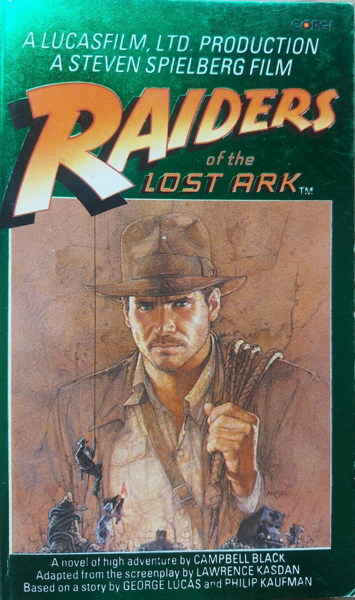
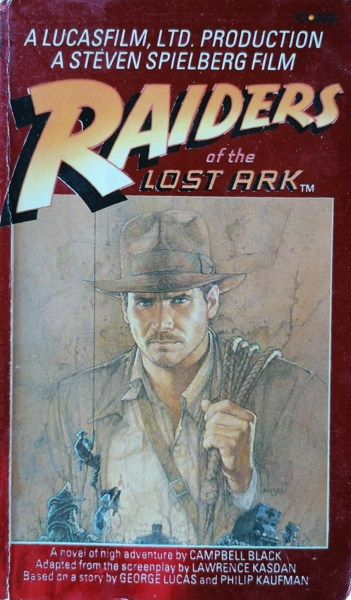
The very first variant cover I remember being confronted with a young’un, where I had to choose “which one do I buy and have to look at for the rest of my life” was the novelization of Raiders of the Lost Ark released in 1981. I can remember the rack at the local Waldenbooks (or was it B. Dalton?) that had multiple copies of this book in a variety of shiny foil coverings. Here are a couple of samples stolen from eBay listings (like, ahem, pretty much every illustration in today’s post):

Not pictured is the variation I did buy, which had a silver cover. You know, like “Sterling Silver.” Say, that’d be a good name for a store.

Anyway, it’s weird to see how prevalent variant covers for publications has become, and not just in the funnybook biz. TV Guide had gone fairly hogwild with the variants over the last decade or two, perhaps (like comic books themselves) trying to shore up some dropping circulation numbers by encouraging multiple purchases of the same issue by collectors. (EDIT: Turan explains the reason for variant covers for actual books…more for encouraging in-store displays and appealing to different audiences, not so much for collectors.)

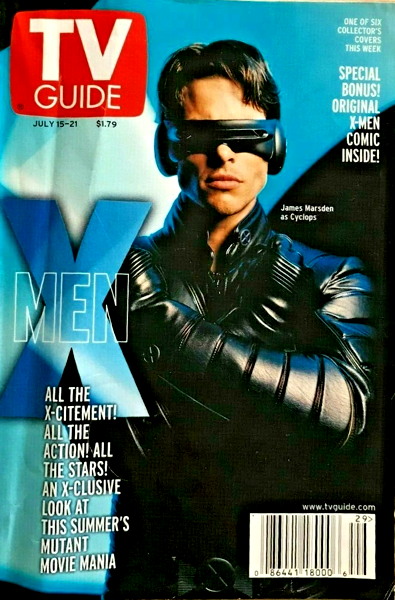
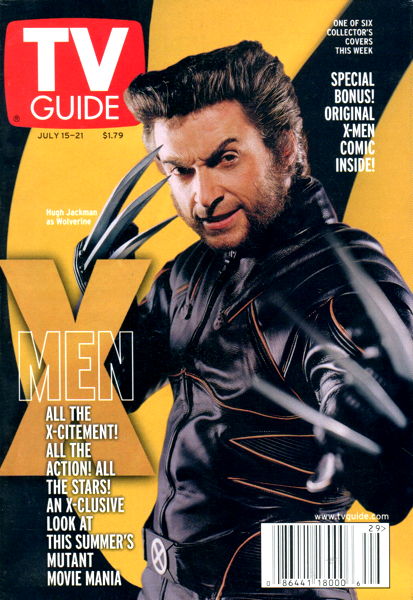
While TV Guide did this for a variety of shows, I’m going to focus on a couple of instances where its variants crossed over with our particular focus here at Progressively Ruinated. I mentioned in my previous post, there was some attempt at outreach by Marvel by including a short comic in a 2000 TV Guide promoting the…well, movie, not a TV show, but whatever. The sample cover I showed you was this:


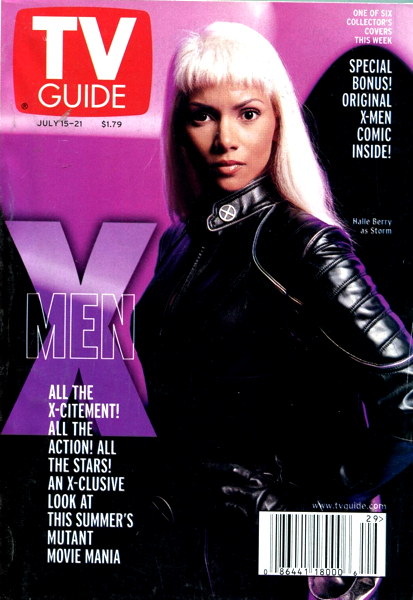
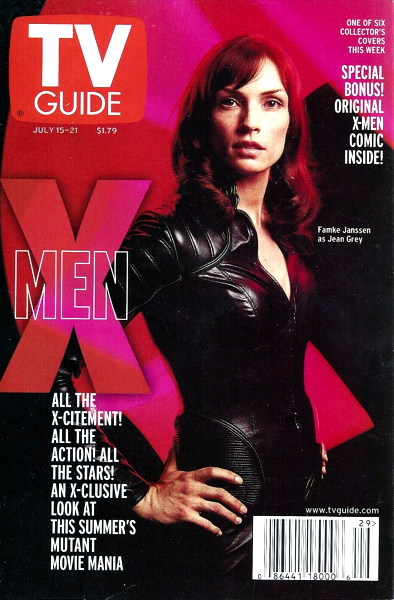
…but there were five additional covers, each featuring one of your favorite X-Men, and also Cyclops.

Like I said, I had to hunt down these pics on eBay, where active listings seemed to have a lot of “apple pie in the sky” hopes in their pricing, but looking at the sold listings, they mostly sold for only a few dollars each at most.

The only one that seemed to command any kind of higher price was the Storm cover, and even then it was only about $15. Which doesn’t come as too much of a a surprise…though I’m sure circulation wasn’t what it was, there were still plenty of these printed. And with the comic book tie-in, I wonder how many comic fans squirreled away one (or all six!) of these into their collections.

By the way, I did see at least one of these X-Men issues sealed in a graded slab, and it was the Jean Grey cover:

And all I have to say about the Wolverine cover is “just look at that cherubic face.”

Now the comic inside was intended to get people interested in the X-Men comics, and while it certainly put comics in front of a lot of faces, I have no idea how effective it was. I know at the time, like I said in the previous post, comic folks weren’t terribly impressed with the included story and its potential to attract new readers. I barely remember it myself, so I can’t speak personally as to how good or…less good it may have been. I do know I never had a single person (or even a married one) come into the shop and say to me “wow, I loved that X-Men story in TV Guide, gimme more of that!”

If you were a person who was turned onto the X-Men by the comic in this issue, and statistically speaking I feel like there must be someone…and you’re reading this blog, which is statistically unlikely, let me know! That X-Men comic was a lot of people’s first X-Men comic, and it was probably almost as many people’s only X-Men comic. I want to know who continued from there.

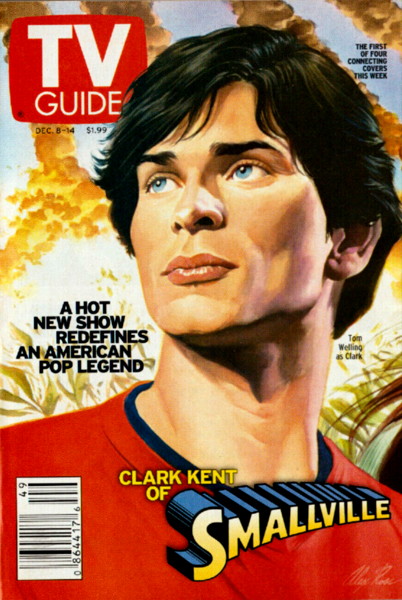
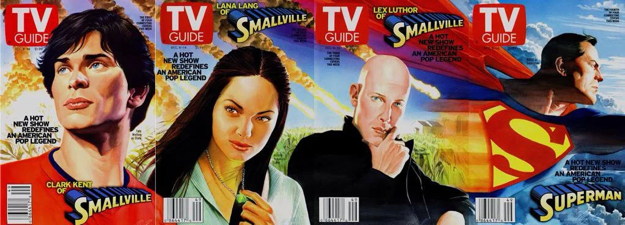
Another TV Guide comic book tie-in with variant covers was 2001’s Smallville issues, featuring four (connecting) covers by Alex Ross. And inside was a short Smallville comic story. Here’s the first cover, featuring Tom Welling as Clark Kent:

…and here’s a pic of all four covers together (this one grabbed from Reddit, I think):

I do recall a small amount of chatter at the time from Superman fans picking up copies of this issue, and trying to get a complete set. I even grabbed a copy, longtime Superman fan that I am, opting for the fourth cover with the Man of Steel himself. Perhaps inadvertently wisely prescient: no Chloe cover.

It’s the Smallville issues I’ve seen more often turning up in collections (though it’s been a while). I can’t ever recall seeing an X-Men cover show up in someone’s hands, looking to sell. A look on eBay shows, again, some high hopes for active listing pricing, but virtually no completed sales. Either they’re all priced too high or nobody wants them. And given that the show is long off the air, and basically supplanted by other superhero shows, maybe that’s not a surprise. Or maybe all the Smallville fans got theirs already and ain’t giving them up. I mean, I still have mine.

It’s be a long time since I’ve paid any attention to TV Guide, and with the increasing emphasis on streaming on-demand television, I’m sure its relevance is hurting a bit. A look at this archive of TV Guide covers shows they did variant covers as last year (not for any comic book related properties that I see), but none for this year as of yet. I was also semi-surprised to see the mag is biweekly now.

It is interesting to see how other media have latched onto the variant gimmick to get increased sales…possibly inspired by comics, but, like that Raiders of the Lost Ark book, not necessarily. But magazines, books, CDs and records…all going for that collector dollar by feeding on completist impulses. Even though I have a hard time picturing someone grabbing one of each of those Raiders books…but I bet someone did.