Twisted variant theatre.

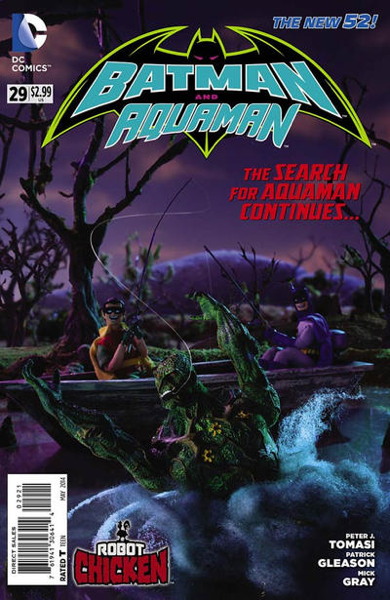
So I remembered the just the one action figure cover variant from when DC did ’em a while back, the Batman and Robin #29 from 2014:


…which I kept because of the Swamp Thing appearance, natch. And while I knew there were more, as part of DC’s attempts to boost orders on their New 52 line, I could not for the life of me remember any of the others. I mean, I know I ordered them and carried them at the previous place of employment, but this was during the lead-up to me opening my own shop, so, you know, maybe I had my mind occupied with other things.

Looking at the cover again reminded me this was a tie-in to the Robot Chicken TV show, which animated action figures in humorously irreverent sketches. (Worth noting that the show itself was inspired by similar “photo-funnies” content featuring action figures in Wizard magazine publications…in fact, writers on the feature went on to create the TV show.)

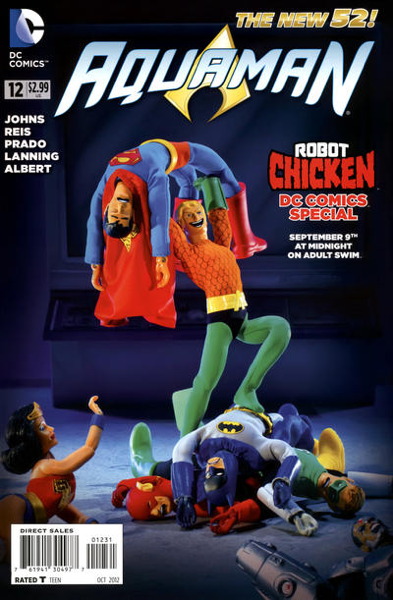
Specifically, the 2014 covers (of which there were 22(!)) were created to tie into a DC Comics-centric Robot Chicken TV special. And in all this Googling about, I discovered this was the second TV special, with the first in 2012 being advertised by DC then on, far as I can tell, one sole variant cover:


Why just Aquaman? Well, he’s apparently the most hilarious of superheroes, an easy punchline for hack writers.

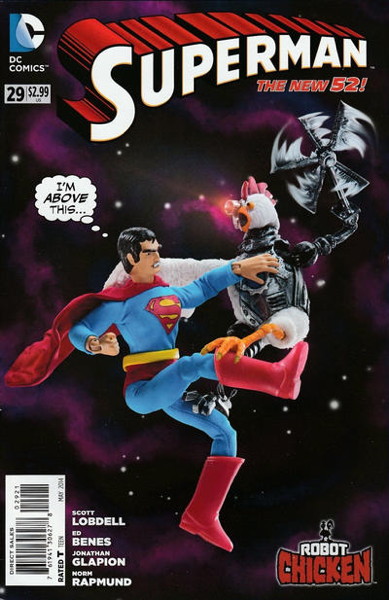
Anyway, like the MAD variants discussed last time, they got a second run with the aforementioned 22(exclamation mark!) variants in 2014, featuring gags like this:


Hm. Well, your mileage may vary I guess, depending on how funny you find the show itself. I’ve never seen it, beyond, I think, some Star Wars gag years ago, and maybe some incidental advertising…but I looked at a few clips on YouTube and it’s fine. And looking at the Wiki entry there’s certainly some impressive voice talent puttin’ in some time there.

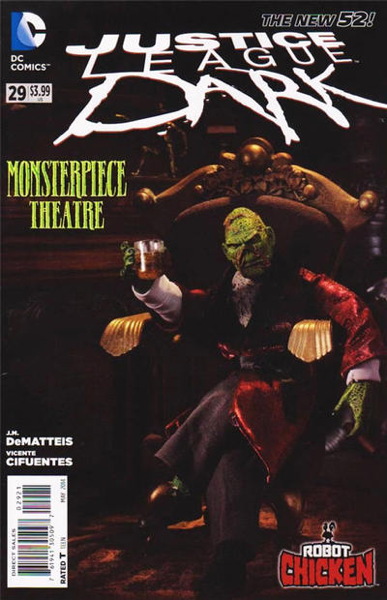
But back to the covers: honestly, looking at that gallery I linked above (and will link here again so you don’t have to go searching) I have no recollection of any of these save that Batman and Robin I mentioned. I don’t even remember this Justice League Dark variant:

…even though I surely must have kept one for myself. No way that would have slipped past me.

The 2014 books were 1 in 25 ratio variants…again, a silly thing to do, as making these freely orderable may have resulted in fewer inflated orders for comics that may not sell just to get the special cover, and more copies moved to customers who were amused by the variants. But that does explain the low estimated print runs you saw on that gallery page I’m not going to link to for a third time. Some random eBay checking revealed prices in the $10 range, mostly, but some optimistic chap has the Wonder Woman variant at $85.

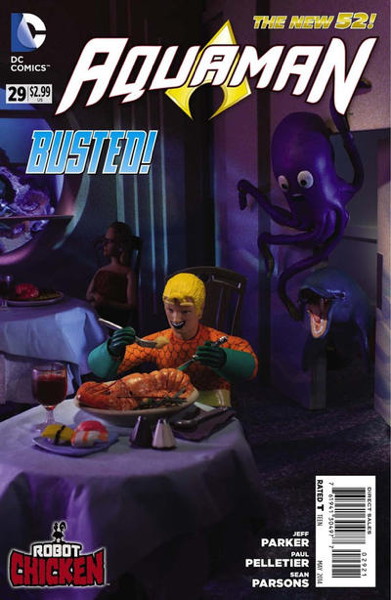
I think, though, my favorite gag on all these covers was the one used for Aquaman #29:


Okay, I admit it, Aquaman is hilarious!

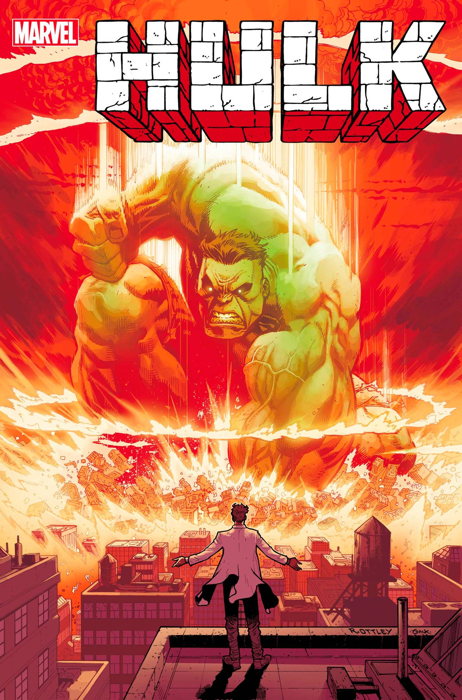
By which I mean the current Hulk #1, not the previous three or four Hulk #1s.

[spoilers for Hulk #1]


So my first Hulk comic was Incredible Hulk #293, cover-dated March 1984 but released in late 1983. I’d been mostly a DC Comics kid, but I’d been sampling various Marvels here and there for a while, enjoying just how different they felt from their crosstown rivals.

I was of course familiar with the Hulk…I’d seen the TV show, I read the Origins of Marvel Comics paperback featuring his origin, and I’m pretty sure I’d encountered funnybooks of his before. I certainly read the 1981 Batman/Hulk crossover. I just wasn’t picking up his own monthly title on a regular basis.

Well, for whatever reason I picked up that #293 off the stands, probably because of that image of him whaling on the Fantastic Four and wondering what was going on (SPOILER: dream sequence). I was also in for another surprise, in that the Hulk with which I was the most familiar, the one that in fact is the dominant version of Hulk just about the entire world knows, is the “Hulk Smash!”/”Madder Hulk Gets, Stronger Hulk Gets” character. Not very bright, speaks like a child (or not at all, as per the TV show), alter ego Bruce Banner wandering from town to town in his purple pants…that’s Hulk.

I started reading Incredible Hulk with that #293, and once a month (or two or three times a month, given Marvel’s bonkers release schedules of late) I’ve been getting a Hulk comic ever since. And for the majority of that time, that prevailing popular perception of the Hulk had not been the basis for the stories.

In that first issue I’d read, Bruce Banner had been in control of the Hulk’s body for quite some time. However, gears were beginning to slip a bit as we pushed forward to #300, with Banner losing more and more control until finally, we ended up with a Hulk that was entirely savage with no trace of Bruce Banner at all. Plus, there began to be a heavier focus on the psychology of Banner/Hulk, introduced by Bill Mantlo and picked up by Peter David during his long run.

Over the ensuing decades, we saw lots of permutations of the Hulk, with Ol’ Jadejaws “Smash Puny Humans” edition only appearing incidentally. And the focus was heavily on the psychology of the Hulk and Banner and how they related to each other. And after this latest iteration, Immortal Hulk, which dove deep, deep, deep into the workings of the Hulk — or rather, multiple Hulks — it was hard to see where else they could go with the concept. Especially since the series was so highly regarded, and for good reason (though ultimately going down in history with an asterisk next to its name due to some issues with the primary artist).

For one thing, I’m kinda surprised/kinda not surprised that Marvel immediately jumped back on the Hulk train so soon after wrapping up such a high profile series. Surprised in that the quality of the series casts a long shadow that any new series is going to have to try to escape in order to get its own thing going. Not surprised because it’s Marvel, restarting series with new #1s over and over again is kinda their brand.

But here it is, a new Hulk #1 for me to read after almost 40 years of reading the darn things. And yes, they seem to have found yet another permutation of the Hulk/Banner relationship…one that seems to present a more antagonistic Banner, literally pictured as piloting the Hulk’s physical body from whatever mental seating he has within. The Hulk has been outfitted with rocket-ship-y doodads and thingamajigs, apparently for Banner/Hulk to depart the Earth, fueled by the caged-in-mental-realm Interior Hulk’s rage.

I gotta say, didn’t see that coming. While I do appreciate that it retains the bones of the classic “madder Hulk gets etc.” idea, I especially like the idea of Banner being more explicitly a menace, as opposed to the “puny” “milksop” victim he’s usually portrayed as. The thesis statement of the book appears to be “the Hulk is there to protect us from Banner,” so I expect to see variations on that theme over the course of series. It reminds me a little of that bit at the end of Peter David’s (first) run, where a darker, yet more put together Banner surprised Rick Jones in his room at night, and as he leaves, he turns and Rick sees a glint of gamma green in Banner’s eye. Just the slightest hint of danger that’s now fully in Banner’s grasp.

So, yes, this comic’s got my attention. I don’t know about “Hulk as spaceship,” but I do like a more motivated-by-self-interest Banner portrayed as being possibly more of a problem than the Hulk himself. It’s still going to be compared, favorably or disfavorably, to the Immortal Hulk that wrapped up just before it, but hopefully it’ll be good enough for fans to approach as Its Own Thing.

Anyway, look, after all this time…it’s not like I wasn’t going to read it, right?

Humor in a variant vein.


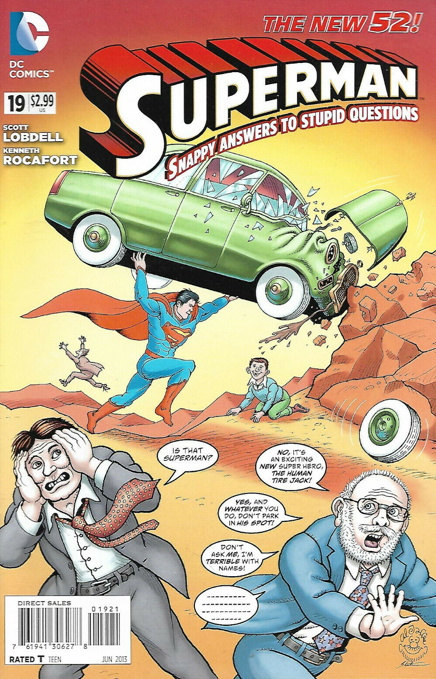
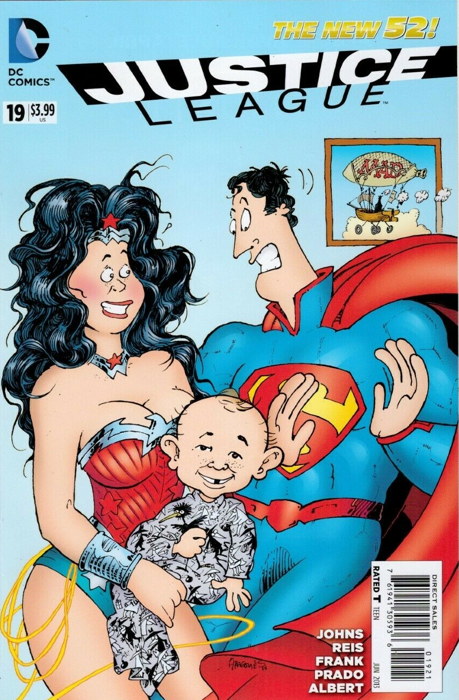
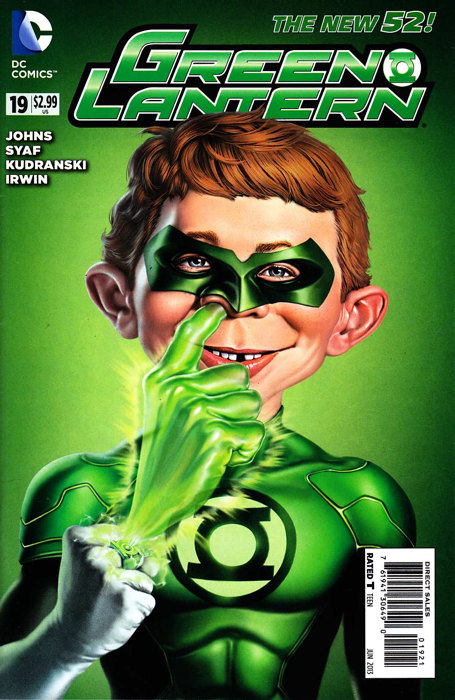
So I think I said at the time, in 2013 when DC Comics was producing MAD Magazine variants for their New 52 line in celebration of April Fool’s Day, that this cover bothered me. I mean, it should have delighted me…it is technically a great drawing, as one would expect from the legendary (and then in his 90s!) Al Jaffee. It’s nicely colored, it certainly stands out on the shelf….

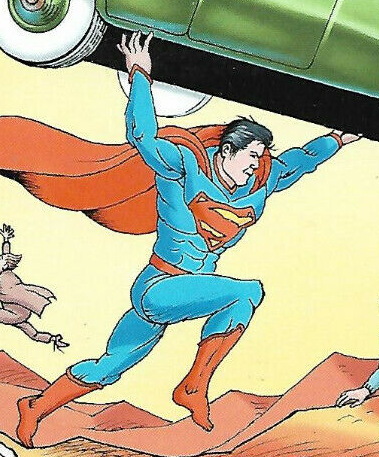
…But what really bugged me is that this wonderful opportunity is marred by burdening Mr. Jaffee with that awful, awful design for Superman’s costume. I know, I know, I’ve gone on about it before, but it baffled man and God as to who actually thought this was a good idea. (As a wise man, me, once said, “if even George Perez can’t make it work….”)

Anyway, Mr. Jaffee did his best, but the costume still looks awkward, unless of course Jaffee himself thought “this costume’s terrible” and played up how terrible the costume was. Though, I have to admit, when I first saw it, I wondered if he’d been given the instruction “draw a funny Superman cover” and drew Classic Superman, only adding the New 52 outfit’s details later an editor got a look and returned it for regrooving. I mean, I have no idea…the fact that Superman was drawn with obvious trunks, or that the collar seemed a little…off, like it was added after the fact. Or that the body of the costume and even the boots look more like the traditional togs versus the inexplicable armor Supes was saddled with:

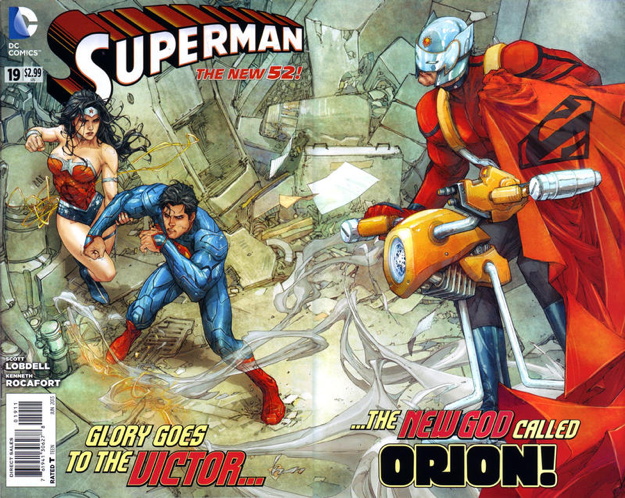
That cover just above, by the way, is the “standard” cover for this issue. However, not satisfied with a MAD variant, DC was running gimmick covers as the “non-variant” edition. In this case, it was the thing DC had branded as their “WTF Certified” covers, a gatefold cover where the front would pose some situation, and then you’d fold out the cover and presumably shout “WHAT THE F–” as you saw the amazing surprise that was revealed. Anyway, more on that when I start my “Gimmick Cover” series, after I’m done (if ever) with Variant Cover-age.

Similarly, poor Sergio Aragones had to do his best with that costume for the Justice League variant:

This actually turned out to be the MAD variant for which we had the most requests, and it’s a good thing this was the MAD variant for which we were able to get the most copies, if I recall correctly. A spot check on a number of the MAD variants released that month showed that the majority of them were offered as ratio variants…for every ten copies of the regular cover ordered, a retailer could order one of the special covers.

This always seemed so short-sighted to me. Given that the Justice League variant was offered to retailers…hmm, lemme see how to put this. Retailers were able to order as many copies of that Justice League variant up to their numbers on the lowest ordered New 52 comic for that week. As such, shops ordered as many of that Aragones variant as they did of Sword of Sorcery #7, maybe even raised their orders on the latter to get more of the former, and got a variant that, at least in our case, sold great, even despite that Superman costume. If they’d made the same deal with all the MAD variants, we could have had lots of these to sell:

…and believe me, we would have sold plenty.

Now, these MAD variants must have done well, as DC Comics did it again the following year. Alas, not so much since, though when I was tracking down some images on the eBays I noticed that several of these variants have been going for premium prices. Whether that’s a usual thing or just another example of the current collectible-inventing market boosting prices, I don’t know. I did see someone call that Justice League variant a “1 in 10” cover, which is of course wrong. What, on eBay, what a shock.

I do wish something like this was attempted earlier, with some of the MAD artists that I remember from my early days of reading the mag. Not that there was anything wrong with what we got, but imagine a Don Martin Swamp Thing cover, or a Dave Berg Harley Quinn. I tear up just a little thinking of those wonderful possibilities.

(Here’s a gallery of the 2013 MAD variants, and here are 2014’s offerings.)

Time, time, time, is on my side, yes it is.

Back to doin’ the Question Mash as I take on another of your queries!

Daniel T bones up on

“How much extra time does having three main distributors cost you? If dealing with Diamond took (x) amount of time, how much does Diamond, Lunar and Penguin Random House take?”

Well, yes, as you’d expect having the number of primary comic distributors suddenly treble does impact my workday, primarily when it comes to entering the monthly comic order. Diamond takes less time than normal, naturally, as I’m no longer ordering several product lines from them (DC, Marvel, Ahoy, Scout, a couple of other publishers). Ordering those now missing products (save Marvel) from Lunar doesn’t take any longer from them than it did from Diamond. And doing the final order cutoffs for Diamond/Lunar (where I can adjust my initial orders just prior to items going to print) hasn’t really been impacted timewise either. Just doing the same thing, only on two websites instead of one.

But Marvel over at Penguin Random House. Hoo boy.

The retailer website isn’t quite as streamlined as Diamond’s or Lunar’s. Placing initial orders takes forever…I can pretty much forget about doing anything else with my day if I’ve decided to enter the monthly Marvel numbers. Things work very slow there with order entry, and that’s not even talking about the seemingly random “log out due to inactivity” no matter if you’ve been typing numbers into the damned thing for the past hour. We’ve been promised ease-of-use changes for a while, but it’s got a long way to go before it works as smoothly as the other two distributors.

And the final order cutoffs…Diamond and Lunar present your order numbers on every item eligible for alteration right in front of you, and you can enter new lower or higher amounts for each item as you wish. PRH doesn’t give you your numbers, meaning repeatedly referencing past paperwork. And you can only add to orders on your own…if you want to drop any numbers you have to email a sales rep with a list of item codes and your adjustments and have them do it. So, yes, it takes quite a bit longer to do those for Marvel, too.

The other big change is in taking in the orders, breaking them down, and then doing the weekly comic pulls. When I used to get everything from Diamond on Tuesday (assuming no delays and no missing boxes), breaking down the pulling the order was often an all-day job, possibly lasting way past closing time. Going home at 10:30 or 11 at night wasn’t unheard of. Opening up the Diamond boxes, getting everything into some kind of order, checking it all off the invoice (if they remembered to pack one into my shipment), noting all the damages and shortages (of which there always were), then doing the pulls…it made for a full day.

When Diamond and DC split up, I started getting DC a little earlier in the week to accommodate their new Tuesday on-sales dates. Which meant having to break them down earlier and getting the pulls done…and since Lunar’s shipments, with very very rare exceptions shows up with no damages or shortages, and almost always already sorted to some extent, it takes a lot less time to process the DCs (and the other publishers once they started to add them to the distributor’s roster).

As such, I’ll do the DC pulls on Monday, then do the Diamond breakdown/pulls on Tuesday…with Diamond taking a little less time now that the DCs have already been handled.

And now that Marvel has also been separated out from Diamond, it also takes less time to process. They now show up, also mostly presorted and, at least for me, only with very rare shortages and damages (neither of which I’ve had for the past three or four weeks, after the pretty awful first couple of weeks). Like the DCs, I check them off the (slightly less readable) invoice and get ’em pulled for for the comic savers in relatively short order.

Thus, when the Diamond shipment comes in on Tuesday, the Marvels and DCs for the week have already been done. The leaves me with a much simpler task that day, getting everything sorted out and having more time to deal with damages and shortages. Overall, despite doing pulls three times a week instead of just once, it takes less time. One, it’s kinda easier to do pulls a company at a time for me. Two, a lot of the work before was untangling the mess of books that were packed with no discernible rhyme or reason in Diamond’s boxes, meaning more time to straighten everything out and putting them in an order where I can easily check them off the invoice. With Marvels and DCs now separate and mostly sorted, that means less set-up time. And few damages/shortages means less time spent sending in those reports (and making notes for the comic pulls on comics they have have missed due to those errors).

So overall…yes, probably more time spent once you add in the extra work dealing with PRH, but the perceived workload is lessened due to being able to split the burden of new comic shipments over a couple of days. Trying to do it all in one day was a real bear, but now it’s a lot less stressful. You know, so long as everything shows up on time and very little is missing or damaged.

More pictures next time, I promise.

So this week’s installment of variant cover-age is going to be just a little different. I know I said I was going to take a look at the various New 52 variant covers DC started using to shore up sales once the initial excitement for the new publishing strategy ebbed away.

But more on that later. What I want to touch upon here is the recent report that direct market comic sales in the U.S. are on their way up. A friend (who now has a suspended account there due to stupid reasons involving Twitter’s algorithms) responded on the Twitter thread there asking about the impact of variant covers on that increase, and the response was that the inflated prices on variant covers were not considered, only cover prices on all releases.

Which is fine, of course, those shouldn’t be considered. But there is something to be said about variant covers boosting the amount of money retailers spend on new comic product. I tried to argue the point in that thread, but Twitter’s not a platform for nuance, and things kept getting off track, so let me try again here.

As I’ve mentioned many a time in this ongoing series of variant cover posts (running three-quarters of the year now!), variants exist to improve sales. On the retail end, they offer varying images to appeal to a wider range of customers…if they don’t like one cover, maybe they’ll find the other appealling. Or, more cynically, it’s a way to get a customer to double/triple/quattuorvigintuple-dip and buy more than one cover of the same comic. Or, of course, if it’s a “rare”-ish variant, you can charge a premium price.

What the main focus here, though, is what retailers are buying, and how variant covers can affect those purchasing decisions.

As you may have noticed, or at least noticed me taking about, the collector/speculator demand increasing over the last couple of years. I won’t try to go into the reasons why here (aside from noting that it’s seemingly connected to everyone being stuck at home during peak pandemic times). Demand for anything that even smells of eBay flipability just shot through the roof (which I don’t need as frankly my shop’s had enough roof problems lately). Mostly it’s focused on ’60s Marvel, which is red hot, and the mercurial demand for comics that have even the slightest, and occasionally even spurious, tie-ins to events in the many Marvel TV shows and movies. And don’t even get me started about everyone looking for this comic featuring a character named “Corona.”

Anyway, increased demand from consumers will trigger increased ordering from retailers…and when a portion of that demand is coming from speculators, the temptation is there to go after the manufactured rarity of the ratio variants. You know, where for every 25, or 50, or 200 of something you order, you can order one copy of a special cover.

The argument I was making in the Twitter thread was solely this: an increased incidence of retailers bumping up orders to get ratio variants is a contributor to the overall increase in the direct market. How many times have I been near one of the ratio plateaus when ordering a book, and decided “ah, I’ll get the [x] number of extra copies to get that variant.” And I’m sure I’m not the only one. And with the increase in speculation, the temptation to bump those orders up only increases. Instead of only bumping up, say, three or four copies to get that variant, maybe you’re getting an extra ten since you’re sure whatever you charge on it and sell it for will more than make up for the additional copies.

The specific example I used in that thread was King Spawn #1. Now, I’m just a little ol’ rinky-dink shop. I don’t sell a lot of Spawn normally. I did order a larger-than-normal amount of King Spawn #1 (and the other new Spawn books) because interest seemed to be high in them. But there’s no way, under normal circumstances, I would sell anywhere close to 250 copies, which is what you had to order to get the 1/250 variant cover signed by Todd McFarlane his own self.

As it turned out, I had a customer who really wanted that signed King Spawn, so the amount he prepaid for it essentially covered the the extra expenditure I had to make ordering additional copies of that #1 to get that comic for him. The end result is that I have a boatload of regular King Spawn #1s that I can afford to sell at a special discounted price of a whole 99 cents, to the delight and occasional alarm of my customers.

But that’s neither here nor there. The point is that I ordered waaaay above and beyond what I normally would have ordered of King Spawn #1, for the sake of a variant. That is absolutely, 100% a case of a variant impacting the direct market’s increase in money spent on product. And certainly more retailers ordered 250, or multiples of 250, of that comic in order to get the autograph, even if expected rack sales where nowhere close to what they received.

And yes, that King Spawn stuff all happened this year, and thus not part of the market report, but it simply writ large the sort of impact variants can have on overall sales. It’s easier to see the effect with King Spawn, versus trying to determine how many retailers added a couple of copies here and there to reach much lower ratio variant order plateaus.

On top of that, there are of course the “free-to-order” variants, where you’re second guessing demand on specific covers. Which is hard to do, as Artist [A]’s variant may have been the Hot One on a book last month, but may no longer be the in thing when Artist [A]’s cover for the next book shows up. Plus when there are a lot of variants, you don’t want to miss out on the one people are looking for, so sometimes you perhaps order more than you would have if there was just the one cover. There were cases in the last year or two where Marvel put out comics with literally more variant covers than copies I expected to sell at the shop (cough Eternals #1 cough). For titles like that I certainly didn’t order every cover…but I probably ordered more than I ordinarily would have anyway.

Also there’s ordering extra copies of each variant to accommodate the customers who want more than one cover for the same comic. Another case of the variant boosting sales…especially in the current marketplace, where some customers want every version of each new hot book that comes along.

And really, that’s the only point I was trying to make. The increase in the comics market was contributed to by the presence of variant covers. As I admit in that Twitter thread, I don’t know how much of an impact variants had, but it definitely wasn’t “none.” Again, not talking premium pricing or what have you, just literally sheer numbers of units shipped from distributors to retailers. Seems self evident, but didn’t stop me from going on about it for over 1100 words, did it?

Okay, next time, back to just plain ol’ “lookit dese variant covers.” Thanks for reading, pals.
What? Throw something away? BITE YOUR TONGUE.

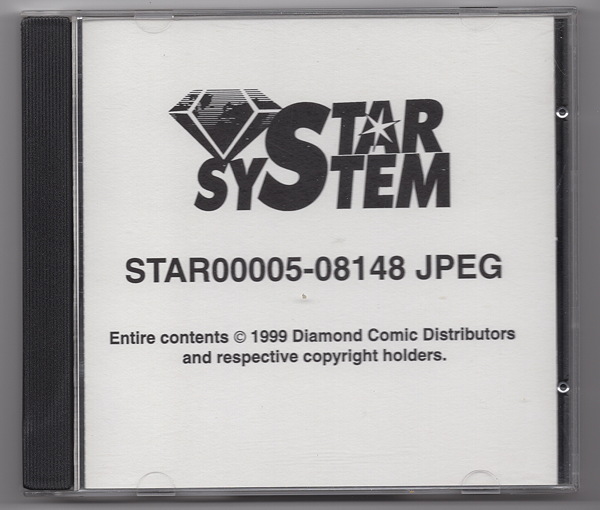
So I’ll hopefully be back to business as usual on the site next week, when I will have a new variant cover-age post and get back to answering more of your questions. In the meantime, though, lookit this thing I found in my stack of old CD-ROMs:


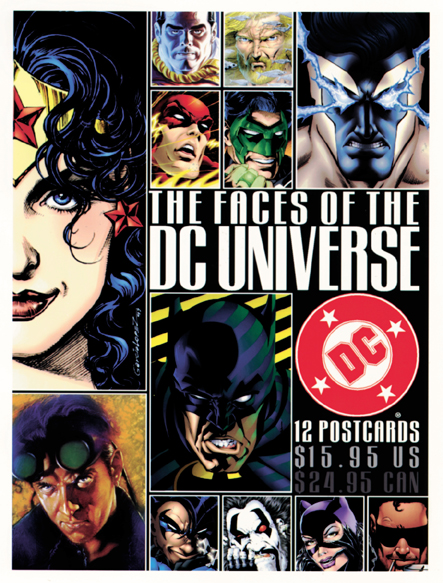
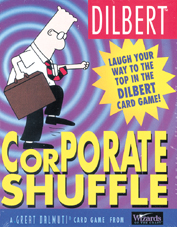
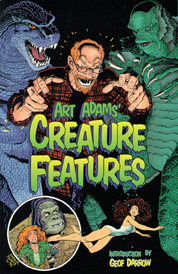
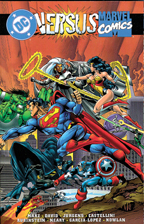
This is a disc, provided by Diamond Comic Distributors in 1999, featuring thousands of images of products then in their Star System reorder catalog.

I don’t recall why I have it in my evil clutches specifically, other than perhaps to use some of the pics on the website for my previous place of employment. Which is, I think, one of the reasons why the disc was made in the first place. Also, I think it was to provide easy reference to the items available back in those pre-broadband days for anyone not wanting to dial up their internets and wait for the pixels to gradually load.

Some of the files are pretty good size…this is the actual size of the largest file on the disc (324kb):

And this is the smallest-sized file of an actual product, at 14kb (there is one smaller file at 13kb, but it’s for retailer cycle sheets):

While probably fine for whatever purposes they were put to at the time, most of the images on the disc are too small for modern purposes, beyond perhaps just providing tiny thumbnail pics for an online catalogue or some such.

It is kinda neat just to open some of the images at random to see what products they reveal. I remember most of what I’ve found, even some of the old gaming and anime stuff, but I’ll occasionally come across some item forgotten in the mists of time:

Or some book I wish was still in print:

Or some book I really wish was still in print:

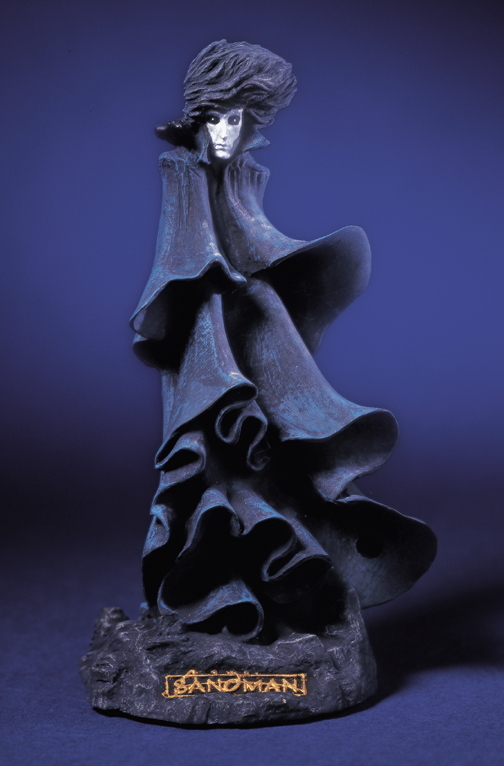
Anyway, I’ll poke through it some more and see if I can find any surprises. Like this Sandman statue:


Boy, I bet I could still sell those.

You know what the Diamond Comics BBS needed? “Tradewars 2002.”

As you probably heard, the computer system for Diamond Comic Distributors was taken down by a ransomware attack over the weekend. Diamond’s various online presences started popping back up in various levels of capacity Sunday and Monday, though I was having a problem accessing the retailer site.

Basically, after I heard it was supposed back up, I’d click my menu bar bookmark for the retailer site, only to have the browser think for a bit before sending back this message:

I’d confer with other retailers, in state and out, asking them if the website was coming up for them. “Oh sure,” they said. Confounding me further was that I could call up the site on my phone, which is how I ended up doing the weekly final order adjustments before the deadline. And believe me, filling out the online order forms on the phone was no fun…and with the monthly order due in a couple of weeks, there’s no way I wanted to have to repeat the process with that.

So I tried multiple browsers, clearing caches again and again. I tried multiple operating systems, Windows at work, Mac at home. No dice. I fiddled with DNS settings, and no go. I was beginning to wonder if my internet provided (the same in both locations) had noticed something fishy was going on at Diamond and just shut off access to them completely as a safety measure.

It wasn’t until Monday morning, when I called the Diamond service number to find out if there was any way to fix my lack of access, when I heard something the recorded message said. It told me their retailer website “retailerservices.diamondcomics.com” was back up.

Wait, hold on. “Retailerservices?”

For…well, I don’t know how long it’s been, a couple of decades at least. Sometime after we stopped calling into the Diamond Comics BBS to download order forms and stuff. (Remember the Diamond BBS? You do? Hello fellow olds.) The address I always accessed was “retailer.diamondcomics.com.” That was the address I’d been trying to log into for a couple of days now. Always getting that message in the pic I posted above.

Well, Diamond’s phone message said the “retailerservices” site…and lo and behold, I logged in there just fine. And when I double-checked my phone…yes, sure enough, that was the site I was accessing there.

In conclusion, I felt pretty stupid. Apparently Diamond set up “retailerservices.etc” somewhere along the line, but still supported the “retailer.etc” domain. At least, until this ransomware attack hit, and “retailerservices” was restored and the other wasn’t. Sigh.

Poking around the retailer site…some functionality has been restored. I was able to do my final order adjustments as I’d said, and the damge/shortage report form was working as well (y’know, good thing, considering). I placed a reorder, which seemed to have been confirmed (though may take a little longer to ship, more on that in a second). I saw that UPS tracking numbers for shipments hadn’t been updated, and that some data files were unavailable, like the list of the week’s new releases.

But, that’s better than nothing. Plus, Diamond’s “back up” website is up, specifically for news about their operations post-computer disaster. Noted there is that delays have struck shipping to a number of areas due to the hack…my area was not one of them, so all my boxes showed up on time.

I am expecting, though, that without computers and access to invoices and such, next week’s shipment may be an entirely different issue. Since I get my Marvels and DCs from other distributors now, I’ll at least have them on time, but I expect everything else to be late. I wouldn’t be entirely surprised if Diamond just skipped a week to get everything back in order. Says on that backup site we’ll find out “later in the week,” so I’ll keep my eyes peeled. I’m also sort of wondering if the invoices for next week will be automatically generated sometime thjs Wednesday morning…probably not is my guess.

It’s a good thing we have multiple distributors now, as this could have easily taken down the industry for a while if everyone’s eggs were in the same basket. We’ll just see how things go next week…may just have to settle for a new DC Tuesday, new Marvel Wednesday, and a new Everything Else…whenever they can get it to me.

My apologies…

…but due to circumstances beyond my control, I didn’t have time to produce a proper post for today. I do have more variant cover-age Monday posts to come, don’t worry about that. I’ll pick the series up again next Monday, and I should have normal posting here the rest of the week. In the meantime, please enjoy this video footage from the 1976 Marvel Con, featuring some prime Stan Lee, along with appearances by John Buscema, Roy Thomas and Archie Goodwin, plus other fun stuff: