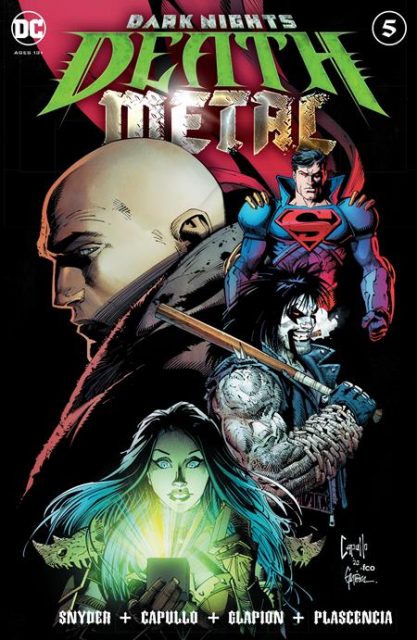
[Some minor SPOILERS, particularly for the end of Death Metal, below.]
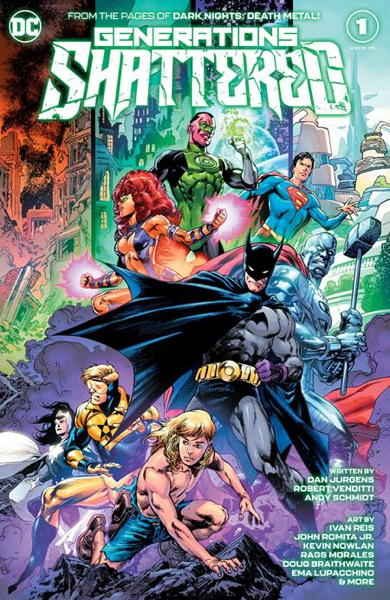
So Generations: Shattered is the Dan Jurgens-est of comics, fitting as Mr. Jurgens is one of the writers and surprise, Booster Gold is also prominently featured. As is a return to some “Death of Superman” stuff, which, as I’m sure anyone who’s read this site for any length of time will realize, is always welcomed by me.
Anyway, this is all very…I don’t want to say “old fashioned,” or “retrograde,” or anything like that, because that maybe feels a little dismissive at best, insulting at worst. Let’s say it’s more “traditional” in tone when compared to other recent-ish crossover events, which tend toward the edgier and more self-aware (like, oh, say, Dark Nights: Death Metal, which I’ll address in a moment.) It’s a basic “we must gather heroes to fight the menace” story, with the twist being that the heroes come from alternate and seemingly incompatible time streams (versus “from across the multiverse,” as in the obviously-inspirational Crisis on Infinite Earths).
Again, not a bad thing. Not a bug, but a feature that this comic feels like a plain ol’ dopey comic from the ’80s or ’90s, uncomplicated and plainly told without a drop of irony or the previously mentioned self-awareness. Well, maybe a tad of the latter, as I believe the stated purpose of the Generations event, prior to its being pushed back for some apparent retooling, was to pin down a definitive timeline for the DC Universe. As such, as I’ve said before about many DC crossovers, the event is about the DC Universe itself, and I’m guessing the larger purpose of redefining parameters for this fictional world is informed what would otherwise be a good guy vs. bad guy punch ’em up.
But it’s easy to ignore the metatextualness of it all and just enjoy it for what it is. I mean, I wish it wasn’t $9.99, but that’s the way of the world now, I suppose.
Speaking of lots of money, I haven’t sat down and figured out what it would cost you to have collected every installment of the latest Dark Nights series and tie-ins, but given they were all $4.99 to $8.99 apiece (except for the $3.99 Justice League issues), I suspect the answer isn’t one anybody’s going to want to hear. Now, most of them were good, which eases the burden at least a tad, but as someone pointed out to me, well, somewhere online, this is only going to encourage Dark Nights 3, This Time Everything’s $9.99 A Pop.
The upshot of all these Dark Night shenanigans is, once again, more multiverse to play with, which is fine, I mean we’ve been there before, DC’s always tryin’ to roll back that old devil Crisis on Infinite Earths, but it doesn’t hurt to kinda reestablish that again. Oh, and that all the characters “remember everything” and I can’t wait to see the implications of that, if there are any. Sounds maybe a little Hypertime-ish, and probably like Hypertime it’ll be misused or ignored. Will this mean that Superman will remember hangin’ out with Hocus and Pocus and their cynical rabbit? I hope so.
This “Future State” event, which is replacing DC’s regular titles for the next couple of months, feels maybe like a bit of bad timing? The industry, and the economy in general, are not in positions to give people reasons to not spend money. Interrupting your ongoing comic book series with apparently unrelated sidestories smacks of that Convergence event from a couple of years back to me, and boy did people actively skip most of those.
Now “Future State” seems like maybe it’s a little better thought out this time, in that plot elements introduced in these minis may feed back into the regular monthlies (which seems to be the case with this Swamp Thing series, from what I’ve read in interviews). I initially had a negative reaction to these comics, in that I had a number of customers explicitly tell me they weren’t interested, but then, in the last week or so, I started getting folks stated that they were, and thus maybe things will work out anyway. Price points are a put-off ($5.99 on Superman of Metropolis, $7.99(!) on The Next Batman), but one of my previous naysayers did backslide a bit on the $3.99 Wonder Woman one, so there’s hope. Particularly if the regular ongoings do reference these Future State books, which could mean some back issue sales down the road.
You know, in case you ever wondered why the hair of comic shop owners goes grey.
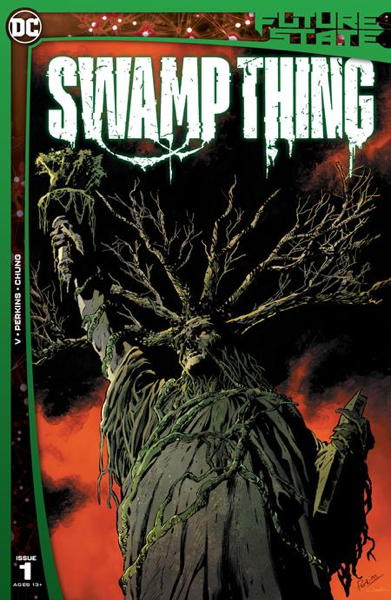
Oh, the comic itself…it’s fine, interesting. Extrapolates from earlier comics where Swamp Thing builds additional, sometimes almost human-like, bodies, which has me wondering if the other swampy people we see in this comic are all ultimately just aspects of his mind or their own autonomous beings. There is a line of dialogue in which Swampy notes that their emotional knowledge is “borrowed” from him, but I think it’s ambiguous if that knowledge is copied from him or literally his brain entended into their beings. Or maybe I’m reading too much into it. Wouldn’t be the first time. Find out next Swamp Time, same Swamp Channel, I suppose.
It’s interesting how DC can’t seem to get away from their shared-universe navel-gazing in their events, where everything is a Crisis and the very nature of the universe in which they exist is at stake. I’ve gone on before about how DC has, time and time again, tried to make that Crisis on Infinite Earths “never not was” as they try to put all the pieces back to the way they were, or at least find viable workarounds (like “hypertime”).
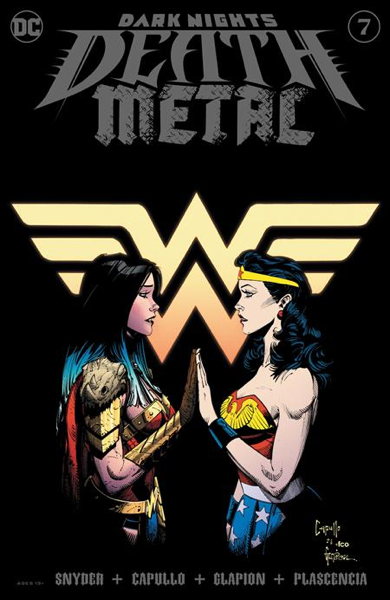
Not to say Death Metal isn’t entertaining, because it is. Tossing all the pieces of the DCU into the air, and printing however it falls to ground. Okay, there’s a little more planning to it than that, but if we’re going to have constant explorations of how the DC Universe works, at least let it be entertaining like this.
I would like to thank whoever decided to change the Batman Who Laughs’ dialogue from red-on-black to white-on-black, so that my beleaguered eyeballs may more easily read them. And while I get DC’s glad to have a hit on their hands, maybe for their next Dark Nights series (and there will be one, surely), maybe have fewer $5.99 one-shot tie-ins? While, again, they’ve all been entertaining, the constant onslaught of them is beginning to bum people out. I mean, find a way to squeeze all this into the main series, somehow, honestly.
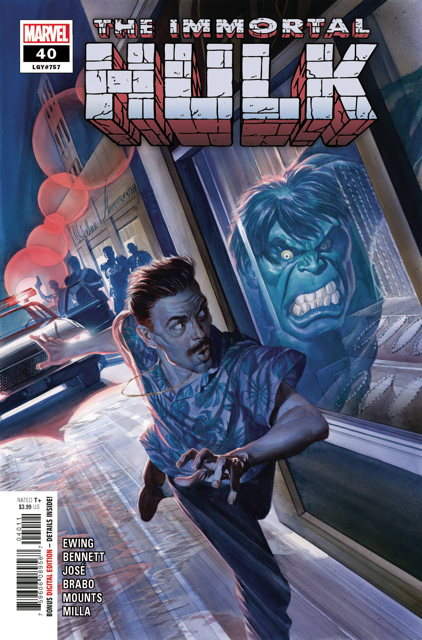
Apparently the Al Ewing/Joe Bennett run is ending at issue #50, so we only, what, seven, eight months to go? Well, plus tie-ins to events like “King in Black” and whatever other one-shots they’re gonna get in before the end. And I can’t help but wonder how Marvel is going to follow this series with a new Hulk #1. Well, okay, we know they will, but this series has been such a bull-in-a-china-shop when it comes to the character’s premise, its twisting about of the Hulk’s multiple personas in a horror context, that’s been so excellently done that’s it hard to imagine where one would go after that. I mean, they have to, Hulk’s not going away, but as good as this run is, I am sort of excited to see what comes next. I’m pushing for some sort of domestic comedy.
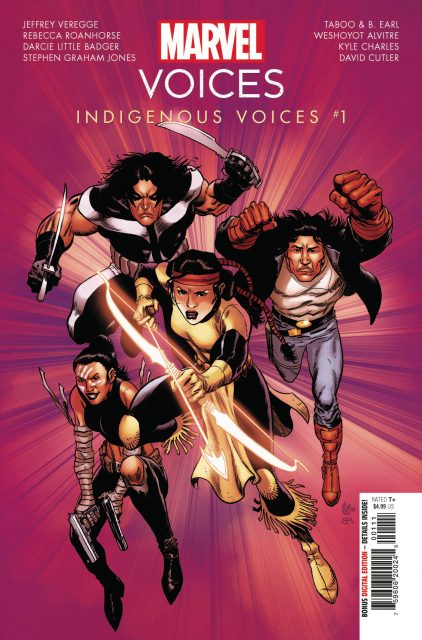
Look, my pal Weshoyot drew a story in this, so you should pick it up. I’ve known her since she was a kid coming into my previous place of employment, and over the ensuring years she’s become a wonderfully talented artist. So glad to see how much success she’s achieved, and look forward to seeing what she does next.
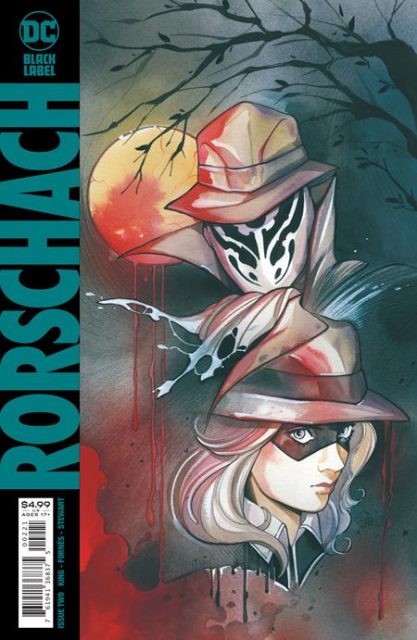
Boy, this is a weird comic. I mean, aside from the fact that there are ads in this book and one moment, you’re in someone’s idea of the Watchmen universe, and the next you’re nose-deep in a Snickers ad. Previous Watchmen knock-offs have had ads in them, I realize, but it seems somewhat more egregious in this title. Particularly that Snickers ad, I swear to God it gets me every time I’m reading a DC.
Anyway, the comic is basically about “What If Steve Ditko Actually Became Mr. A?” and I was amused at first but…I can’t exactly say it’s mean-spirited, but the inspiration it takes from Ditko’s actual life feels just a tad disrespectful. Part of me finds it oddly interesting, part of me is like “yes, we get it, Ditko was kind of an oddball, quit piling on.” Also, this doesn’t really feel like something that should be a twelve-issue series, but who knows, maybe “Kack Jirby” will show up to punch Nazis or something.
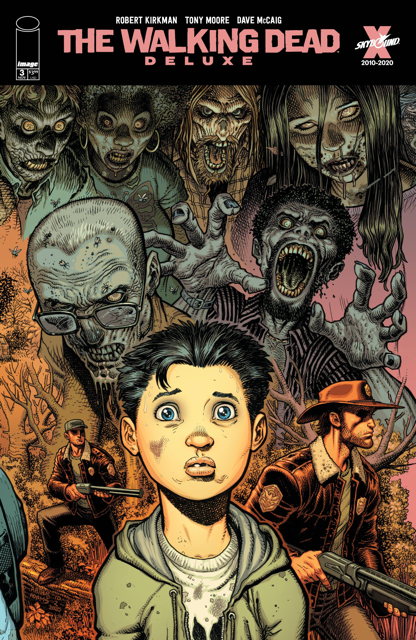
Well, what can I tell you, I missed out the first time, so I’m jumping on now. Whether they’ll actually manage complete reprinting of the entire series issue-by-issue is something of a longshot, but hopefully there are enough 1) people like me who missed out and didn’t get trades for whatever reason, and 2) completists who are buying every variant cover for every issue, I suspect there’s a non-zero chance of reaching the end.
That said, I think this is a good package, with plenty of backmatter notes on the making of the issue before you. It is also kinda weird to be reading this in serialized form when, while not having read it as such, I have flipped through enough of the comics as I unpacked them out of the shipping boxes to have at least a mild appreciation of what had been going on, so actually reading the comic now gives me, to say the least, a little more understanding of the nuances of storytelling. You know, like that splash page of Rick shouting “We ARE the walking dead!” which, if there is any justice in this fallen world, will have every letter in that balloon a different color once the reprints reach that point.
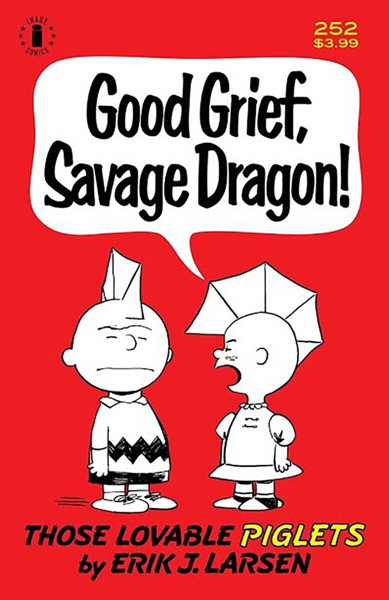
So I read the original Savage Dragon mini-series back in ye ancient tymes, in my samplings of the early Image Comics releases. (For the record: read Spawn ’til about issue 20 or so, wasn’t interested in Youngblood (sorry, Rob!), found WildC.A.T.s incomprehensible, Shadowhawk was…well, it wasn’t normalman.) I thought Savage Dragon was probably the best of the bunch, but I didn’t follow it past those initial installments, for reasons more to do with my personal budget than anything about the book itself.
Now as it turned out, of all the Image books, it was ol’ SD’s creator Erik Larsen who the the greatest staying power, writing and drawing all 252 issues, and counting, of the title…evening including doing an extra issue to kinda/sorta “replace” an issue of the run done by a guest team. (Details here.) It’s a incredibly impressive run by a single creator, who’s maintained his personal vision on this book, and isn’t afraid to really changes things up on a regular basis.
All of which makes me wish I’d kept reading from the beginning, but What Can You Do? I’m glad it exists, I’m glad Larsen’s able to do this on his own terms, and I hope he’s able to do it for as long as he wants.
Now since that initial mini (and I think the first issue of the monthly series), I haven’t picked up very many of the series. There were one or two specials along the way, where Mr. Dragon would occasionally cross over with characters of interest (like Megaton Man, Destroyer Duck, or Marshal Law), and I think I glommed onto a Free Comic Book Day issue or two, however many there were.
At long last, I’ve had another reason to pick up an issue, this time an actual issue of the series rather than a spin-off, as it intersected with a couple of my interests. Pictured above is the second printing of Savage Dragon #252, released this week, with a cover image of what should be obvious inspiration. Now, I may not as big a Peanuts fan as some of my friends, I still do love them enough to be properly amused by this cover and want to have a copy for myself.
the other interest of mine this comic tickled is “comic strip parody,” which fills this publication. Dick Tracy, Calvin and Hobbes, Little Nemo…even Tumbleweeds. Tumbleweeds. Who parodies Tumbleweeds in this, the Never-Ending Year of Our Lord 2020? Well, Erik Larsen dood it, right here in this funnybook. That’s all I need, friends, and this book is at home, waiting for my full perusal. Looks like it’s stand-alone enough so I hopefully won’t be too lost with any specific references to regular continuity. But the cover alone is fun bit of parody and, as they say, worth the price of admission.
• • •
Now you folks had a lot to say in response to Monday’s post, and I do want to address more of what you all said soon, which I have a little more time and energy. But let me at least say something in regards to this question from Thelonius_Nick:
“You’ve mentioned ‘local market conditions’ several times on your site in the past. Are there really back issues that might be systematically more common in one part of the country than another? Not just a random issue here and there for whatever reason, but something structural, like maybe Flash is all over stores in Oregon because they like track there?”
I have to admit, “local market conditions” is more of a caveat, an acknowledgement that my own personal experiences in terms of comics retail and such are not necessarily universal, or perhaps unique, or semi-unique, to whatever it is I’m doing. It’s not really exact knowledge of what’s going on here, there or anywhere, but it’s my assumption that there are countless variables involved in retail than can affect sales or demand for certain products in one place that may not be duplicated elsewhere.
Now admittedly, there can be a sameness across the retailing board regarding certain trends…ask your local funnybook slinger if he has plenty of copies of Teenage Mutant Ninja Turtles: The Last Ronin #1 floating around, and watch him/her/them sigh deeply. Or maybe there’s a shop that is just swimming in copies of Last Ronin somewhere, wishing he could get rid of them. That would be a difference in local market conditions!
I remember talking to a shop owner in the Los Angeles area sometime around…1990, I guess, where he mentioned he couldn’t move any copies of Legion of Super-Heroes. I was like “whoa, we sell lots of those!” which 1) probably shouldn’t have rubbed the poor guy’s nose in it quite like that, and 2) clued me in to the idea that not everything sells equally everywhere.
Another thing is that I’ve taken to pricing first issues on certain comics maybe a buck or three above the guide value. I can put a full run of U.S. 1 in the new arrivals boxes, someone will come along and snap up that #1, leaving me with the rest to languish. If I’m going to sell one and not the rest, I’d better get better value for the one I do sell. I’m sure not everyone does that, and I’m also sure some folks price ’em up even higher than I do. More of them local market conditions.
Or some days, maybe it’s just raining. A local weather condition that affects the local market condition.
Okay, that’s just me being silly. But you provide several other examples in your question, Mr. T. Nick, and all of those are just as valid. You never know what can mess up or bolster sales. That’s what makes this business so fun! Or “fun,” as it were.
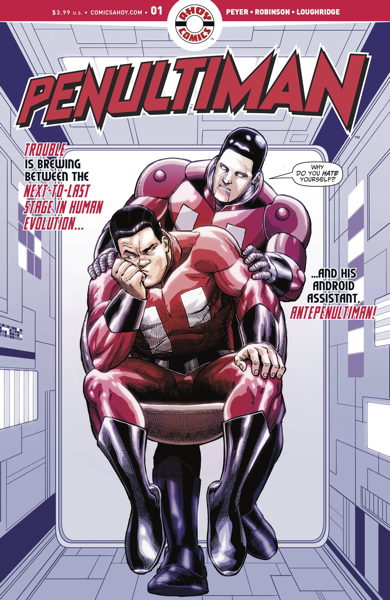
Let’s see if I can get through another one of your questions today, but first let me recommend the new comic book from Ahoy called Penultiman by Tom Peyer and Alan Robinson:
Now, I’m still way behind on many comics from the last couple of years, as I touched upon last time, and in fact spent a good part of last night reading about 15 issues of the current Daredevil series by Chip Zdarsky and Marco Checchetto and their pals (verdict: it’s good). So basically I’m not looking to add anything more to the teetering “to read” stacks. Buuuuut I’ll always take a peek at a new Ahoy Comics release, and I like writer Tom Peyer, so ah what the heck, throw it on the pile.
And read it I did, as anything new I take home I’m not behind on I am trying to read right away. It’s very good, drawn in a nicely clearly and appropriate Silver Age-y style by Robinson, which my poor ol’ eyes appreciated. It’s primarily about the relationship between A Superhero and his robot duplicate assistant, and I don’t really want to get into it any more than that because I don’t want to spoil anything. You get a tiny hint on that cover I posted above, but there’s more to the story that definitely plays on the very basics of, well, let’s face it, Superman, for whom Penultiman is a definite analog.
Speaking of which, the first page is a nod of sorts to Grant Morrison and Frank Quitely’s All-Star Superman, introducing the title character in a similar fashion. So just buy it already…it’s great. Two thumbs up from Mike’s eyeballs!
• • •
AND NOW, A QUESTION:
Rich (who had a brief cameo in Monday’s post) coughs up the following
“Do you think the real-world pandemic, the need for social distancing and masks, and the blunders on the part of multiple national governments in dealing with this crisis will soon be commonly depicted in comics, as well as in TV shows and movies based on same? In other words, do you predict we will see characters OTHER than superheroes and supervillains wearing masks in comics and onscreen for the foreseeable future–and, if so, how profoundly will this change the storytelling landscape?”
I suspect we’ll get comics specifically about COVID-19…I mean, know we are already, via webcomics and small press stuff and the like. But I presume you are asking about the major comic publishers, and whether we’ll see, like, Jimmy Olsen wearing a mask and whatnot, or Iris’s dad Joe wearing a mask in the FLash TV series. (Is Joe even still around? I’m about three seasons behind on that show, too.) And, like, Image or somebody from the front of Previews probably has a “Live in the Time of COVID” semi-autobiographical mini in the hopper.
But as far as other regular titles referencing the pandemic? I…generally don’t think so. I mean, I think recent issues of Savage Dragon have, but I don’t believe we’ll be seeing incidental civilians in, like, The Avengers in PPE. Except, of course, if they decide to do a Very Special Episode of Your Favorite Superhero Comic where they talk about the pandemic or at least some kind of symbolic representation of same. So no, while I’m sure the virus is inspiring plenty of small press/indie work, the ongoing fictional milieus of superhero comics will likely not incorporate it as any part of “the world outside your door!” type of storytelling.
Unless this goes on for another, oh, say, year or two, in which case, all bets are off. But with superhero comics in particular, the pandemic’s inclusion would raise the “World War II” question…if the world’s at war, and the Justice Society of America exists, why don’t they just go capture Hitler? Like, America’s got Superman, Green Lantern, the Spectre, and Johnny Thunder’s Thunderbolt…they’d have WWII wrapped up in a hot minute. And that requires a lot of in-story handwaving and explanations why our super-pals didn’t put an end to things (like Hitler having the magical Spear of Destiny, which kept the JSA from getting their mitts on him…can’t recall if that’s a Golden Age thing or something Roy Thomas or someone cooked decades after the fact).
In essence, if you had the pandemic as a presence in the Marvel Universe, for example, why wouldn’t Reed Richards have, if not a cure, at least some invention that would stall infections until a cure is found? You’d have to do more handwaving to explain why Reed or some other Marvel U. smartypants couldn’t help, and frankly given the offense it could cause, especially after so many folks have died already, it’s probably best that DC and Marvel and whoever else don’t put themselves in that position.
I could totally see one of the companies doing a one-shot out-of-continuity special to raise awareness…well, okay, sure, we’re all pretty aware of this disease already, I know. But some kind of charity book, featuring heroes addressing the coronavirus, maybe packaged with a specialty mask…that’d be somethin’, I think.
So Rich, I think my answer is “they won’t, unless they do, and I think Savage Dragon already did.” Glad I was able to nail that down definitively for you!
So in Monday’s post, I linked back to an ancient entry on my site regarding the insertion of flexidiscs into comic books. I warned this particular entry was rife with dead links, but I should probably have noted there was some dead information there as well.
2004 Me stated “we can pretty much forget about seeing comics with flexidisc inserts ever again” given that record players were on the way out. Well, 2020 Me knows that actual vinyl records have made a resurgence…and never really went away in the first place, though it feels like they’re more of a “thing” now. Could be I’m just more aware of it, after inheriting a large-ish collection of LPs from my grandparents and purchasing a brand new record player. And buying new records. And haunting local thrift stores for any album donations. And maybe taking in some Nipsey Russell records at the shop for store credit.
At any rate, Records Ain’t Dead, and neither are flexidiscs being distributed in funnybooks, and I had claimed. Reader Matthew was first in the comments to note
“Post York #1 (published by Uncivilized Books) in 2012 and Hip Hop Family Tree #12 in 2016”
and I do remember taking preordeers on that Hip Hop Family Tree specifically for the inserted flexidisc.
I guess there’s still some life in the ol’ flexi just yet. Now if we can get paper/cardboard discs on comic book back covers that we’d have to cut out, like we older folks used to do as kids with cereal boxes, that’d be great. There’s a gimmick I coiuld get behind. GET ON IT, um, I don’t know, VAULT COMICS I guess.
• • •
Okay, I didn’t read a lot of new comics this week (been watching I, Claudius on DVD and streaming the final season of The Good Place now that it’s finally made its way to Netflix) but boy howdy did I read Batman: Three Jokers #2. I won’t go all into it like I did with the first issue, but suffice to say that the art by Jason Fabok (both interiors and all those covers) is still spot on. The story…welllll, this is one of those comics that feels like a ten pound load in a fifty pound sack. A lot of this probably could’ve been taken care of in a single 48-page special or, you know, a two-parter at most.
The majority of this issue is concerned with the ramifications of events from the last issue, so there’s lots of interpersonal drama and a set-up for either a big reveal next issue (placing this firmly in out-of-continuity territory) or a big reset button (making it in continuity or whatever passes for it now). I mean, whatever, it’s fine…not as important as it wants to be, and it’s kind of sweet that it’s trying so hard to tie itself to the look ‘n[‘ feel of The Killing Joke. I know some online hay was made out of a shot of a couple of manilla folders, one marked “missing criminals,” and the other marked “missing clowns,” and c’mon, there’s kind of a weird ridiculous beauty to that.
• • •
Still taking comic artform/business/whathaveyou questions to answer here in the coming weeks, so just drop one into the comments at that post if you can!
§ July 15th, 2020§ Filed under this week's comicsComments Off on At two comics a week I should be caught up decades after I’m dead.
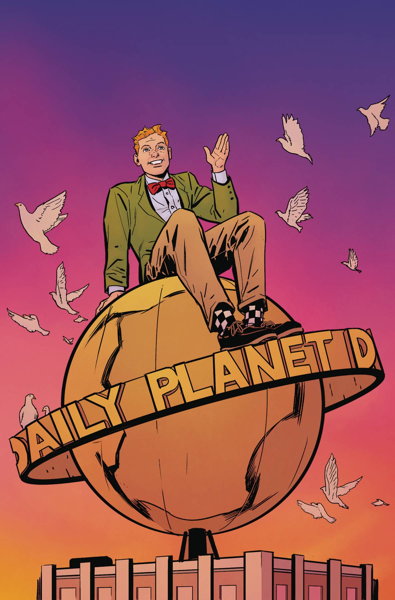
So the thing about the Superman’s Pal Jimmy Olsen series by Matt Fraction and Steve Lieber is that it seamlessly merges the 1960s “anything goes” sensibility from Jimmy Olsen stories from that period, with a more modern storytelling style that’s more palatable to current tastes. Nonlinear presentation of chapters, a surprisingly dense amount of plotlines, and an excellent punchline (not to mention a huge change to the relationship of Jimmy to another character, which I hope sticks) all make for a very satisfying reader.
Speaking of the denseness/Nonlinearity…due to my eyeball health issues, I had to put off reading most comics for…well, many months. So when it came time to start reading again, I had a pretty good stack of Jimmy Olsne to read, so all the weird twists and turns of the plot remained fresh in my mind as I went from issue to issue, in a way that they may have not had I been reading this once a month as it came out. The bite-sized chapters into which each issue was split made it easily consumable, but I’m sure this is going to make one satisfying lump of funnybookin’ once it gets all collected together under one cover.
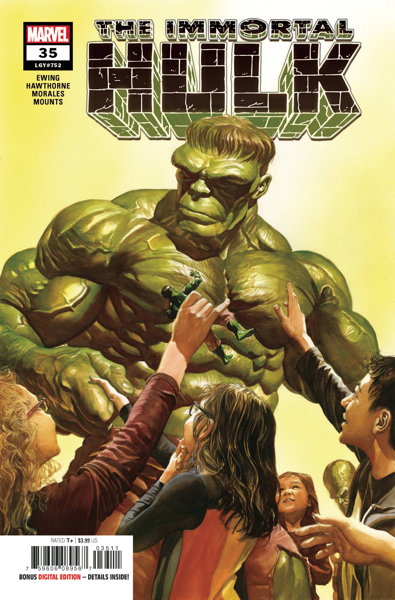
Another book that evoked a prior era for me was Immortal Hulk #35 by Al Ewing and guest-artist Mike Hawthorne. I mean, yes, we’re still in the “Hulk as Horror Comic” phase of the character, but it feels very ’70s/’80s to me, especially with the classic Savage Hulk making a personal appearance to be thanked by a community he saved. Plus we get a bit of business where Banner and said Savage Hulk have a “face to face” discussion in Banner’s…well, their…mind about trying to coexist. It’s a thing we’ve seen before in Hulk comics, and the point is even made in dialogue that it’s been done before, but something about the way it’s done in this story. More emotionally adult, less melodramatic…a resigned Banner conceding to an angry and upset Hulk that they do need to work together…it’s affecting in a way that it hadn’t been before.
The horror aspect of the book is downplayed slightly, but the suspense is definitely there, especially in that aforementioned sequence with Hulk visiting that town to receive thanks from the populace. You keep waiting for the other shoe to drop, especially in the context of this series where a really awful thing can happen at any time. I said this reminded me of older style Hulk stories, but in those if a situation like this went bad, Hulk would just shout “BAH!” and jump away, not really hurting anyone. But now, in these modern stories, you just know something terrible is about to happen. And…does it? Look, I’ve already said too much, but I’m sure you can probably figure it out.
One thing I liked was the first page, text with illustrations catching you up what was up with Banner and IDing some of the other Hulks you’re likely to come across. I’ve been keeping up with Immortal Hulk best I can during the eye-enning, but having a little primer to jumpstart the memories is quite welcome, particularly in a story that can have its own set of twists.
So a couple of days ago I asked you all for a little help regarding my eyeball-related medical treatments and associated bills via a GoFundMe campaign. I was thinking at best I’d reach the goal amount, which would cover some outstanding bills, a couple laser treatments to hopefully, finally stem the constant bleeding in my eyes, and a few follow-up visits (likely requiring more injections).
Well, you really came through for me. The goal was reached within twelve ours, and folks are still contributing. Any extra money I receive will continue to go to medical bills and debt. If, with any luck, I finally get through this eye stuff and money is left over, I’ll find a worthy charity to give it to.
I said this on the GoFundMe page, and I’ve been blathering about it on Twitter…but I have been very moved by this enormous outpouring of help from everyone. I just couldn’t believe so many people care about some dude who sells comics and also types too much about them on the internet. I can’t possibly thank you all enough for what you’ve done.
• • •
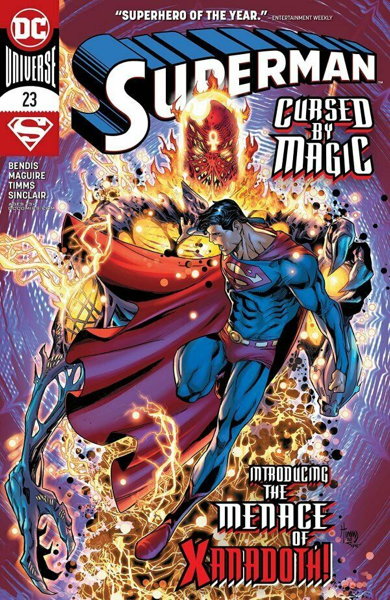
Okay, so this week’s new issue of Superman reminded me a lot of the Giffen/DeMatteis Justice League series from the ’80s, and I’m sure having that series’ artist Kevin Maguire on this new book helped a lot.
It was mostly a light, funny read except, of course, when it wasn’t, as Superman and Dr. Fate try to work out whatever problems Supes is having. More something that’s essentially talking heads (what, in a Bendis book, who would’ve guessed) it remains compelling reading as Superman works through his feelings on recent events in his comics. It’s not often you see your mainstream superhero books tackle the emotional impact of whatever super-shenanigans they were responsible for. And here you do, and somehow it’s interesting.
Plus I forgot we had a new Dr. Fate, which is from…I don’t know, two or three reboots ago, right? So I didn’t know if that new Fate was still around or if we were back to the original dude. If the new guy’s turned up in other stuff recently, I don’t know, since I’m still behind on just about everything. I’m catching up, though, one comic at a time!
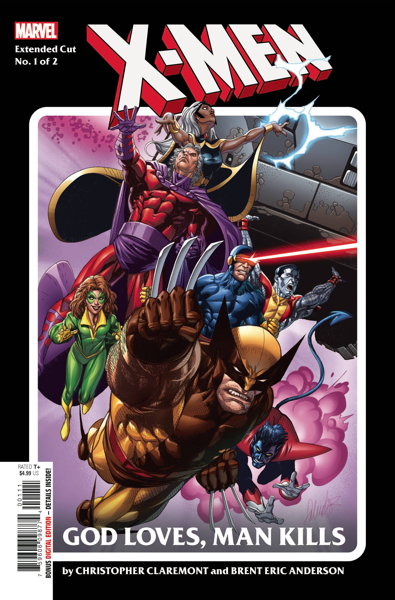
Now this one I was interested in, as, hold onto your hats, I’ve never actually read the original graphic novel! In fact, my primary memory of God Loves, Man Kills is when I somehow managed to catch some religious TV show in the early 1980s looking at some then-recent comic books, including that very volume. I can’t remember many specifics about what the panel on this show had to say, except they weren’t entirely thrilled with the imagery of Professor X being crucified, and that the ended the discussion with “this cost $5.95? I remember when they were ten cents!” (Also, they talked a little about Thor, and his being the “God of Thunder” which was also apparently a problem.)
Anyway, I finally have my mitts on at least half the story, and since this is the “extended cut,” there are a few new introductory pages of what I’m presuming to be a framing sequence (with the other part of the frame in #2), featuring Kitty Pryde. Oh, and it’s by Chris (excuse me, “Christopher”) Claremont and Brent Anderson, the folks what did the original book. You know, that’s kinda neat. And there’s some back matter, too, interviews and such about the making of this story.
The story is pretty much Peak X-Men, with all the characters you’d expect, hanging out in the mansion, getting persecuted for being mutants, all that sort of thing. I mean, when I think “X-Men Comics,” this is what I think of, down to being written by Mr. Claremont, back before the 1990s arrived and the X-franchise was splintered and more-or-less destroyed. Well, okay, maybe the endless array of never-ending subplots aren’t as involved, but you can’t have everything.
And it turns out, it’s a good story, in case you hadn’t heard about this here graphical novel. A Falwell-type religious leader has it in for them mutants, successfully taking them on in the media, and meanwhile, some bad people are going around killing mutants, and The X-Men Are There to put a stop to all this. A nice point that’s made is that in a televised debate between said religious leader (Stryker) and leader of the X-Men, Professer Charles Xavier, it’s Stryker who comes out the clear winner, being charismatic and convincing and knowing ahow to play to the cameras, while our Professor X, who doesn’t know how to deal with the media, comes out a bit off-putting. A nice comment on how “truth” and “facts” can get easily steamrolled.
Another interesting bit in this half of the story involves Kitty, and the aftermath of her fight with a fellow dance class student who thinks Stryker’s got the right idea about getting rid of mutants. Kitty, a mutant herself, clearly objects to this, and her classmate refers to her as a “mutie-lover.” Following a brief scuffle, the instructor of the class, Stevie Hunter, a Black woman, tries to calm Kitty down, to which Kitty responds how Ms. Hunter would have responded if the other student had said “n*****-lover” instead.
The N-word is not censored in the comic, which I wanted to address, if only because not that long ago, in Marvel’s Miracleman reprints, the same word was censored, when it wasn’t in the original. I suspect the difference is context, in which the X-Men usage is simply making explicit the X-Men’s allegorical themes regarding racism and bigotry, while in Miracleman it’s a Black man using the word to describe himself in a derisive manner. Both uses are about the racist treatment of Black people, but the X-Men example is a little more obvious in its purpose. …Or, you know, just different editors making different decisions, and I’m just reading too much into it, which, you know, I never do. Regardless, it was still a bit of a shock to see, particularly in the current questioning of whether white people should even be using that slur in any context, no matter the point being made. Look, I don’t even like typing the censored version here.
I am glad I finally read this, or at least half of it, after all these years. It’s definitely a product of its time, with evil folks using religious as a weapon against the oppressed. Whew, thank goodness that doesn’t happen anymore. Anyway, maybe I’ll get around to reading that New Mutants graphic novel next. Nobody spoil it for me.
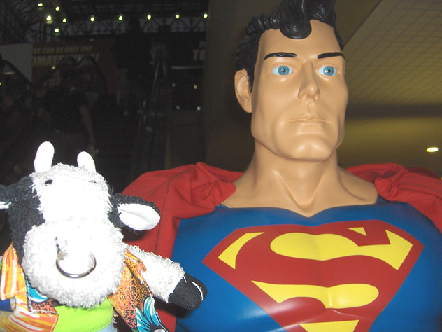
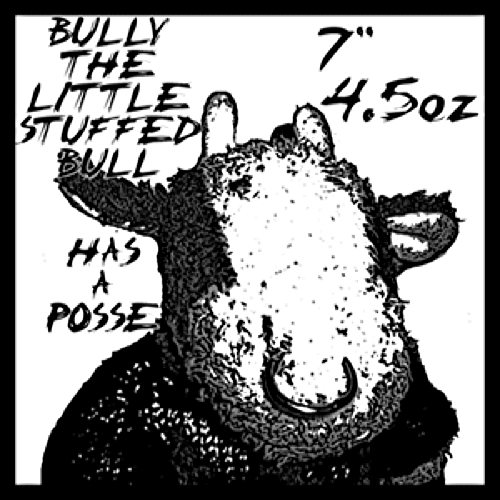
Alas, it has come to pass on this, the occasion of his seventh birthday, that Bully the Little Bull Stuffed with Love, is bringing his website Comics Oughta Be Fun to a close after fifteen years.
Bully (with the assistance of his pal John, who helps Bully type since he’s too small to reach the keyboard) has been one of the purest delights of the comics internet, with an endless library of comics and a staggering knowledge of the artform. Always presented with good cheer, enthusiasm, and delightful humor, Bully was a dependable break from the sarcasm and cynicism that too many others (including myself) often utilized. To read Bully was to read joy, to remember why it is we all love comic books…and we all do remember why, even if it’s buried beneath layers of accumulated mental crud caused by industry shenanigans and less-than-great publications.
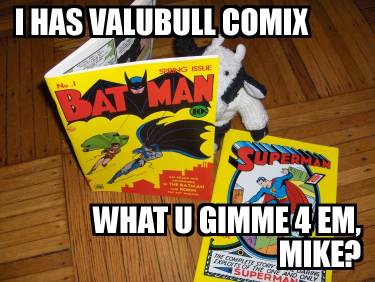
Bully was also a good friend to me, personally, and I’m glad to have known him…oh, and his friend John too. More than a handful of times have I asked Bully for production assistance on some post I was trying to put together, and he always came through, bless his little fuzzy heart. And of course he occasionally found time to razz me a little:
DARN YOU BULLY
Anyway, I am sorry to see Bully wrap up his blog, but am glad we were able to enjoy it for so many years. And of course, despite me continually talking about Bully in the past tense here, he’s still around on Twitter as one of the very few good things on that platform. And, if I know Bully, I’m sure he’ll find even more ways to continue reminding us that comics oughta be fun.
Here’s to you, Bully and John, and please, always remember:
• • •
So, in a minor tribute to Bully’s long internet efforts, let me talk about a couple of fun comics right now! It’s the stunning return of the “This Week’s Comics” category, after being years behind on purt’near everything due to my ongoing eyeball situation. Well, while I still have eyeball issues to contend with, I have been able to get actual prescription glasses, thus allowing me to finally start trying to catch up on my funnybook reading. Oh, and also work and drive and stuff, I guess.
I’m not entirely behind…I did attempt to at least keep up on a couple of titles during those brief periods I could see well enough to struggle through a comic armed with a pair of dollar store reading glasses. And one of those titles was Immortal Hulk, a new issue of which comes out this week:
This continues to be the best comic Marvel is current publishing. Hulk-as-horror-comic is a natural interpretation of the character, one that’s been touched upon many times in the past but not for the extended examination that this series has provided. Psychological and body horror mixed together with nightmarish interpretations of Hulk’s enemies and allies, combined with the overarching existential dread that always lurks behind every plot twist and character moment in this book. It’s lotsa fun, honest!
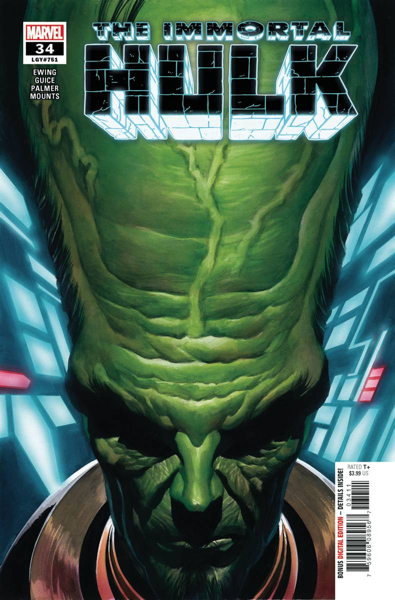
Ol’ Sam Sterns, The Leader, the fella what got super-strong brains from gamma radiation instead of the muscles the Hulk received, is the focus of this issue, though perhaps you guessed that from the cover. We see the history of the character, from his beginnings to present day, and if you’ve read Hulk comics for way too long like I have, you definitely recognize some of the stops the narrative makes along the way. Certain events are recontextualized for the overall themes the book explores, particularly those of life and death and resurrection, and it’s all endlessly fascinating.
It was recently announced that the series is wrapping up with issue #50, and while it’s disappointing to have one less good comic to read, it is good that the creative team will be given the option to conclude the story on their own terms. Of course, we’re all gonna feel sorry for whoever takes over the Hulk next.
Should note that this is the work of regular series writer Al Ewing, while quest-artists Butch Guice and Tom Palmer fit right in. I hardly noticed the difference.
A confession: aside from Action Comics #1000, I haven’t read any of the recent 80th Anniversary specials DC has released. I want to read ’em, I have a copy of each of them, but, well, I refer you a couple of paragraphs back where I complain about my eyes yet again.
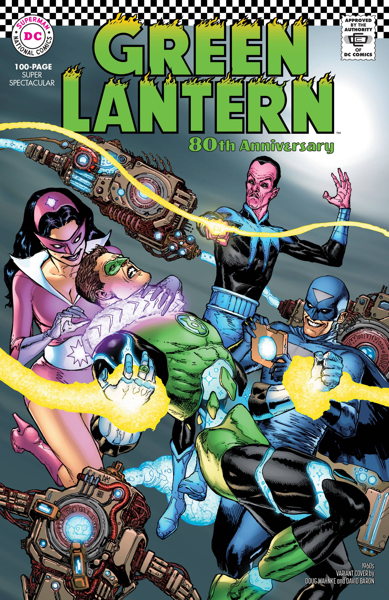
But gosh darn it the Green Lantern anniversary special came out today, and while I have working eyes and good glasses I was going to read the darn thing. And read it I did.
First, of course I was going to go for the ’60s cover variant, with the go-go checks and the swell art by Doug Mahnke and David Baron. I think they did a good job differentiating the different decades represented on the covers…I didn’t even have to look at the small print in the corners to figure out which one was which. (Unlike the Joker anniversary covers from a couple of weeks ago, where…maybe the ’40s one looked like it was trying to evoke the 1940s?)
The contents are a good read as well, starting off with a pleasantly done Alan Scott story that addresses the origin of a particular aspect of that version of Green Lantern. (Will note that seeing Doiby Dickles, the Golden Age GL’s sidekick, being called “Derby” feels so terribly weird to me.) And I know y’all like to kick Geoff Johns around, but his contribution is a simple character piece with an amusing payoff. The rest of the book is enjoyable as well, with nice bits featuring Jessica Cruz, Simon Baz, Sinestro and Kilowog, plus a story where the other GLs talk about Guy Gardner…it’s a good piece, but a tiny bit distressing, which you’ll see when you read it.
The book is filled out with several pin-ups, including a great image of Guy Gardner by Joe Staton, the very fella who helped usher him back into the DC Universe back in those long-ago 1980s. The back pages are a mini-who’s who of the various Green Lanterns, human and otherwise.
Anyway, both of these are fun comics. As they oughta be.
So the other day I noticed on pal Brook’s Instagram that he posted a picture of his latest rare vinyl acquisition. I of course immediately asked him if I could feature it on this here comic book weblog, and he said that was fine…and also since he was going to be dropping by the store Wednesday for new comics anyway, he’d bring it in for me to see in person.
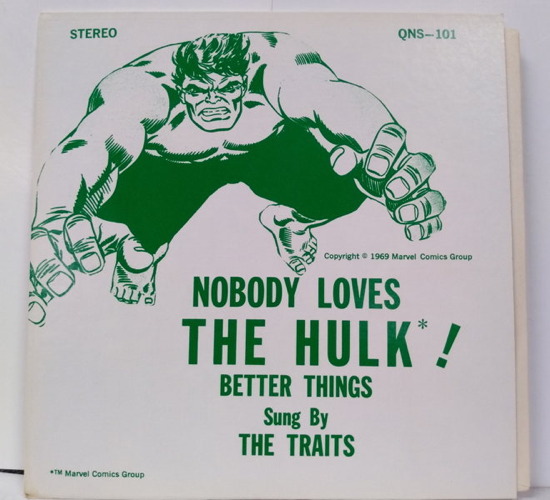
And here it is, with some new photos I took at the store once I had that record in my ungainly mitts, an original 45 RPM single of “Nobody Loves the Hulk” by the Traits, released in 1969:
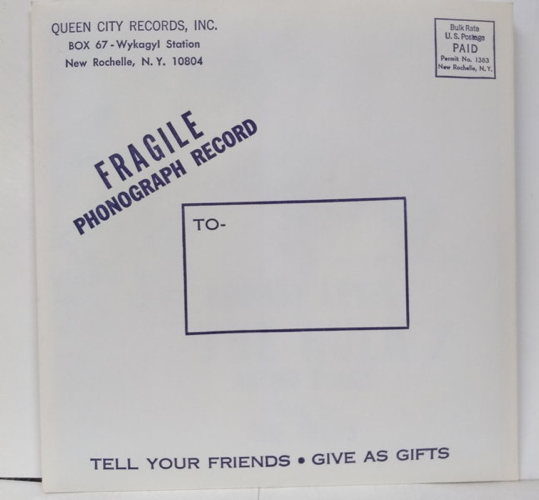
This is a pristine copy, only removed from its original mailer by the seller to check its condition prior to selling. And speaking of the mailer, here it is:
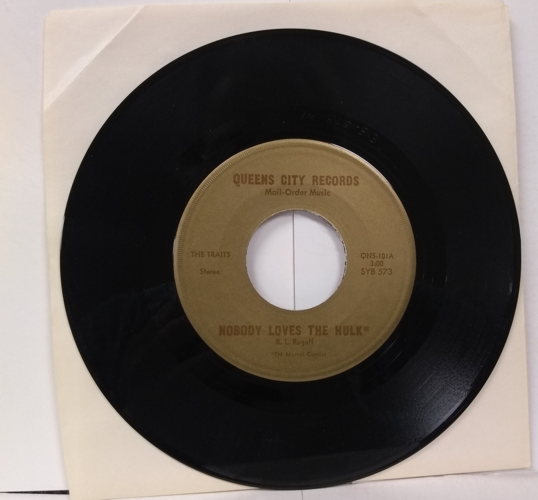
And why not, here’s a pic of this classic piece of vinyl itself:
And did I play it on the in-store turntable? I wasn’t going to, as a’feared as I was to do damage to this artifact, but Brook insisted that I did, so I dood it. If you weren’t lucky enough to be there when I did, you’ll just have to replicate the experience best you can by listening to this:
Brook also forwarded this link to an interview with one of the people behind this recording. Apparently it was originally sold only through mail order ads in comic books, with only some of the 2,000 copy print run selling that way, the rest being dumped off in various places. Given the condition of Brook’s copy, this seems likely to be some kind of warehouse find, probably sitting in a box somewhere for decades after being discarded by the original owner. Who knows? But Brook got one and, um, perhaps I may have my own copy on its way now too.
Big thanks to pal Brook for bringing that in.
In other news:
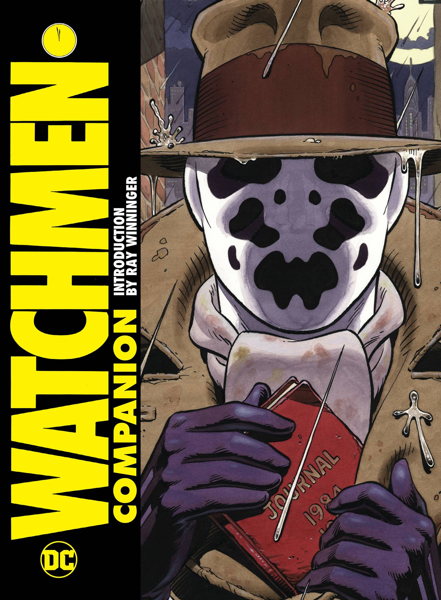
This thing came out this week, which made for a nice addition to my personal collection given that the majority of the reprint material inside is taken from the Watchmen supplements for the DC Heroes Role Playing Game, the originals of which I’d sold off long ago. Thus, it’s nice to have them again.
Also reprinted therein are the entries for the Watchmen and related from Who’s Who in the DC Universe (and given the publication of Doomsday Clock, they really are in the DC Universe!), plus the covers for said Who’s Who issues, as well as material from Amazing Heroes and a Dave Gibbons cover for The Comics Journal.
Most hilariously, it includes that bonkers Rorschach appearance in The Question #17. I mean, sure, why not.
Turns out, when asking longtime customer and fellow Swamp Thing afficionado, andWatchmen and Planet of the Apes expert Rich Handley if he needed a copy…turns out, he was actually consulted regarding content for this book! He was asked what extra Watchmen stuff should be included that hadn’t already been offered in reprint form elsewhere…and I’m presuming whoever it was at DC asking this already knew about Question #17 so I won’t blame Rich for that. Anyway, due to changes in editors and whatnot, Rich didn’t seem to get a credit or even a “thank you” inside (at least, I couldn’t find one in the tiny print, given my ailing eyeballs) so just mentally add his name in there when you’re reading it. Okay? Okay!
Also, in other other news:
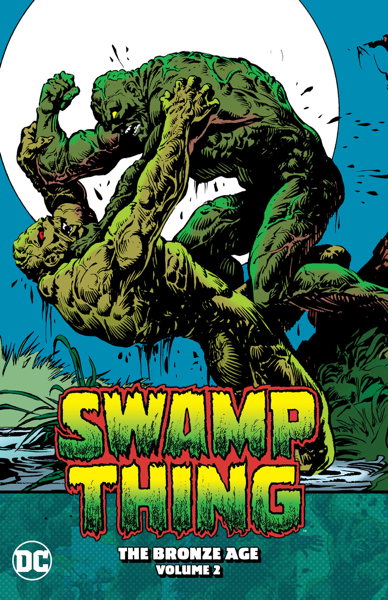
Also out this week is Swamp Thing The Bronze Age Vol. 2:
I didn’t really pay much attention to the original solicitation for this book. I just figured “ah, it’s just reprinting that big ol’ Swamp Thing omnibus I already bought, I don’t need this,” but reader, How Wrong I Was. It includes a lot of material not in the big ol’ hardcover…enough material that I probably should have passed on it and just waited for the paperbacks. It has the Challengers of the Unknown issues with Swampy and Deadman, it has the DC Comics Presents and Brave and the Bold team-ups.
Most importantly, it has all extant material related to the unpublished #25 from the original series! Now, I already had copies of the pencil and inked interior pages included here, but this volume also contains pencil roughs for other pages, the script, a paste-up of the letters page for that issue(!), and even the inked-and-logoed cover! Pretty amazing. I’d kinda hoped they had enough of this issue done that they could have released it as one of DC’s currently “facsimile” reprint line, a “reprint” of a #25 that never was, but looks like it wasn’t as finished as I’d thought. Ah, well. But this is great to have, finally.
Now, if we can get DC to reprint the finished pages ‘n’ script from that pulled “Swamp Thing Meets Jesus” story should they ever get around to collecting the stories from that immediate era…that’d be somethin’.
When we last met, I was about to go under the knife for another eye surgery. Well, I’m happy to report things went swimmingly, I was in and out of the operating room in a flash (not so much the waiting room, which we sat in for quite a while) and my eye seems to be healing up nicely. The end result is that I now need glasses for pretty much any close-up lookin’, as the replacement lens in my left eye is meant for distance vision, but that’s okay…at least it leaves me able to drive.
Anyway, I’m fine, and once my other current eye issues settle down to the point of being able to get real glasses, versus the array of dollar-store cheaters I’ve been depending on, everything will be just dandy. Or at least as dandy as my eyeballs will allow.
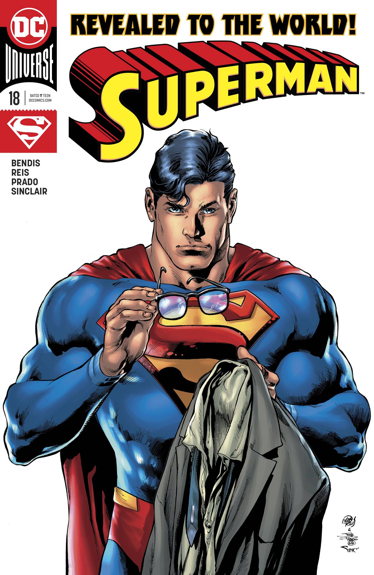
And it turns out I can still read comical books, which I tested by getting caught up on the last several months’ worth of Superman, culminating in this issue:
[SPOILERS for said issue ahead]
…Okay. I’m fine with this turn of events, just as I was the last time this was done with Superman, near the end of the New 52 run just a few years back. I thought then that the public revelation of Superman’s dual life as Clark Kent made for an interesting twist in the ongoing comics, one we hadn’t really seen before in the mainline continuity as an extended storyline. That was kinda the last hurrah for that particular version of Superman before he was replaced by the return of the post-Crisis/John Byrne reboot/married to Lois/has a son version that had been the main Superman for the 30 years prior to the New 52. (Look, I know that’s a lot to absorb if you’re not familiar with Superman’s publishing travails over the past decades, so take a moment if you need one.)
My feeling about the New 52 version of the public revealing of the secret ID is pretty much summed up by my post about a story just prior to that, when Superman revealed his ID to just Jimmy Olsen. In short, it was fun to read, scratches bit of an itch, but these twists to the Super-formula don’t have the impact they should have had because it’s still this weird not-quite-Superman version of Superman DC was foisting off on us as part of their rushed-into-existence New 52 line-wide relaunch.
But now, we have…well, as close to the “real” Superman back in comics as we’re going to get, without Siegel/Shuster/Swan/Schaffengberger/Boring/Plastino etc. coming back from the dead to do more stories. I think Bendis has been doing a relatively decent job writing a recognizable Superman that falls in line with the Superman comics of the past, while still feeling like a “modern” comic. I mean, there’s the occasional rough edge, or some Bendis-istic quirk, but by and large they’ve been fine.
Thus, the repeat of the plot of “Superman Reveals Himself!” (ahem) so soon after the last time they did it still feels somewhat…new and fresh and interesting, because now it’s “really” happening to the “real” Superman, and not some What If — er, excuse me, “Elsewords” — version. It reminds me a little of [hold on…SPOILER ALERT for Batman: Hush, of all things] that time when it looked like Jason Todd had come back from the dead, but it turned out to be Clayface, which kind of honked everyone off, so Jason Todd really came back later on and though the shock of the return was just slightly muted by the previous fake-out, it was still a surprising twist that grabbed attention. Okay, that’s not a 1:1 analogy, but I think you get the idea.
Back to the current comic, here…yes, I think this will make for some interesting stories. And yes, I’m sure this will eventually result in some reset-button putting of the worms back in the can of restoring the secret ID (and hopefully not yet another reboot). But I’m willing to see where this goes, especially with the idea stated in this issue that Superman will continue living and working as Clark Kent. If that doesn’t result in someone shouting at him “WHY ARE YOU SITTING AT A KEYBOARD…PEOPLE ARE DYING IN ACCIDENTS ALL OVER THE CITY” in every issue…well, I don’t know what to tell you.
I also have a vague memory of one of the Elliot S! Maggin prose novels from decades ago — Miracle Monday, maybe? — where Superman’s ID is revealed, and someone discusses how weird it would be if he continued as Clark Kent, that it would be kind of perverse for him to continue acting like a normal human when everyone knew that he was an alien superbeing. I’m getting details wrong, I know, it’s been many years since I’ve read the book, but it’s something like that. But that message still colors my perceptions of what Superman still hangin’ out as Clark post-revelation in the comics would be like. It’d just be…uncomfortable, if realistically depicted.
On the other hand, the more modern interpretation of the Clark/Superman dynamic, as Byrne tried to firmly establish in his reboot, was that Clark was the “real” persona, whereas Superman was the “disguise.” That’s a difficult thing to do, given that the star of the comics, the guy that puts butts in seats, is Superman, so by default he’s the “main” identity. However, if one does keep in mind that Clark is the real person, then him continuing his life as Clark should feel less peculiar than how that long-ago Maggin book would have it. The end goal is probably something along the lines of “Hey, it’s Tony Stark! That’s the guy who occasionally does stuff as Iron Man!” instead of “Hey, it’s Superman pretending to be one of us, just a slob like one of us!”
This is all based on one single issue of the storyline, by the way. Bendis could very well be planning to address some or all of this in his comics, so I’ll just read it and see. …I did want to point out a couple things about this issue that…didn’t ring true for me. A couple of those quirks I may have mentioned earlier in the post.
First, Clark tells Perry White he’s Superman, and Perry gives him a hug. Okay, I can buy that, because they’ve been friends for years, but it’s not followed by Perry immediately firing him from the Daily Planet for years of journalistic fraud. Okay, it’s comics, suspension of disbelief and all that, but it’s a bit tough to swallow. Again, future storylines may address this, but just in this issue as a standalone story, it still felt wrong.
Next, Superman gives his press conference (a well done sequence for the most part, I thought), and after telling everyone “hey I’m Clark Kent, I’m married to Lois Lane, okay see ya” he flies off, basically leaving Lois to fend for herself. Maybe it’s not as bad as all that, but it felt odd to me that Superman would just bail on his wife and pals in the wake of this revelation. Or maybe off-panel he told ’em “meet you at Big Belly Burgers after the speech” and they all had some fast food after the issue was over. Hey, why not.
Before I shut off the computer for the night, I’ll add that I really did love the scene of Jimmy Olsen messing with Superman as he tries to convince his longtime pal that he’s really Clark Kent. Genuinely funny.
Okay, that’s that. Thanks for sticking around after my brief hiatus, pals, and I’ll be back soon.
 Okay, I didn’t read a lot of new comics this week (been watching I, Claudius on DVD and streaming the final season of The Good Place now that it’s finally made its way to Netflix) but boy howdy did I read Batman: Three Jokers #2. I won’t go all into it like I did with the