Not to get all Inception on you, but I’m going to address some comments made to a post where I was addressing your comments from a previous post, before returning to responding to more comments from the initial post. Got it? Good.
Anyway, I wanted to say just a few words about Marvel’s (or editor-in-chief Jim Shooter’s) “New Universe” publishing initiative, in which on the event of Marvel’s 25th anniversary (counting from the publication of Fantastic Four #1) they were going to introduce a whole “new universe” (hence the name) of superheroes completely unrelated to the shared world with Spider-Man, the Hulk, etc. The tagline was that this would be “the world outside your window,” with a somewhat more realistic take on what supeheroes would be like and what impact they would have on the society and people around them. Even the time scale in which the comics operated was “real time,” with a month passing in story time between each monthly issue. (Not sure how long that was kept up, to be honest.)
This dovetails nicely with a post I made recently about “realism in superhero comics, and I’m sure much of New Universe’s inspiration was informed by the success of Watchmen and Squadron Supreme. Star Brand, the one NU title I followed all the way through, had several examples of this sort of thing, such as pointing out a superhero costume wouldn’t really hide one’s identity very well, or the main character getting lost while flying around…little things, but details that commented on that nature of the genre.
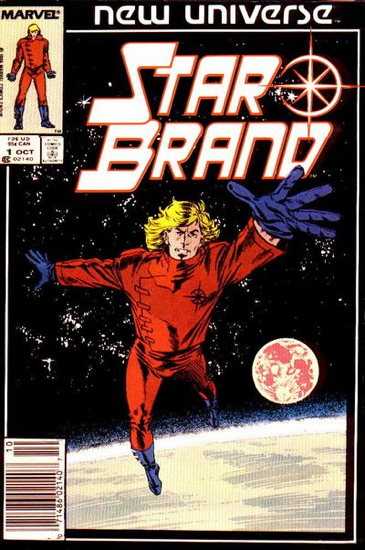
Like I said, Star Brand was the one I kept on with, though I liked early issues of D.P. 7 (a superhero team) and tried out an issue of Merc or two. Star Brand, being the work of the NU creator Jim Shooter, would probably be the title that most exemplified what the whole imprint was about…at least in my opinionl, since as noted I didn’t really read too many of these titles. But it did try to tell a superhero story in a different and unconventional way. The hero’s “costume,” as such, was kinda drab, the hero himself wasn’t exactly the sharpest knife in the drawer, as I recall…at the very least, he was a flawed human and no paragon of perfection. He even flew funny, in an upright, “standing” position instead of the usual “one fist forward” Superman pose. Even when John Byrne took over the book for the final few issues, and it began to look like a somewhat more conventional superhero comic, it still underminded the genre here and there, even if seemingly biting a particular plot point from Miracleman.
Even the trade dress of the comics was unusual, at least for the initial couple of years, with each cover framed in a black border, like they were in mourning for something. It gave everything a sheen of solemnity, that this wasn’t some flashy comic with dudes punching each other. It was something different, something somber, with dudes punching each other realistically. Or perhaps the more obvious interpretation was that black frame was a window frame, tying back into the “world outside your window” concept…you’re lookiing through your “window” at the New Universe that’s outside it.
The imprint was shaken up a bit with The Pitt (not to be confused with, well, you know) in which “the world outside your window” was distanced from the New Universe with the destruction of Pittsburgh. And then that was follwed by The Draft™ and then The War™ and my sense was that emphasis was less on keeping the New Universe “realistic” and more “something customers might keep buying.”
Anyway, the imprint eventually came to an end, with the last issues of the series reading “# [x} of a [x]-Part Limited Series,” which was sort of clever. And that was that, ’til elements of the New Universe started to creep into the regular Marvel Universe (a crossover that was once verboten). It started with some stuff in Spider-Man 2099 and in Quasar early on, and continues even today, with reboot series and character appearances and such.
I don’t think the original New Universe was a bad idea…kinda beat the big rush to everyone starting up their own “new universes” a few years later during the Big Comics Boom/Crash. And I think, in a way, the “Ultimate Universe” was a continuatino of the idea with marginally more realistic/deconstructive takes on the standard Marvel heroes. Of course, it ended the same way, eventually petering out with shake-ups to the premise and then getting folded into regular Marvel Universe continuity. But what probably did the New Universe in wasn’t necessarily the execution, but the rejection of Marvel fans to buying new Marvel comics that weren’t part of the regular Marvel universe they’d been following. I mean, sure, the Ultimate Universe books did fine at first, but those featured the familiar characters…this was a whole new batch of weirdos and unless they were going to fight Wolverine at some point, why bother reading them?
Or maybe it was the execution. A couple of them were pretty bad.
Now this all started prior to my entering the world of comics retail in 1988, so I don’t know what initial sales/customer reaction was like at the shop. I’ll have to ask former boss Ralph when next I see hiim…or maybe I can finally start going through these stacks of ancient invoices he passed along to me for research purposes, now that my eyes are a little more up to the task.
In the meantime, you should at least read John’s comment explaining his Spitfire #1 collection.