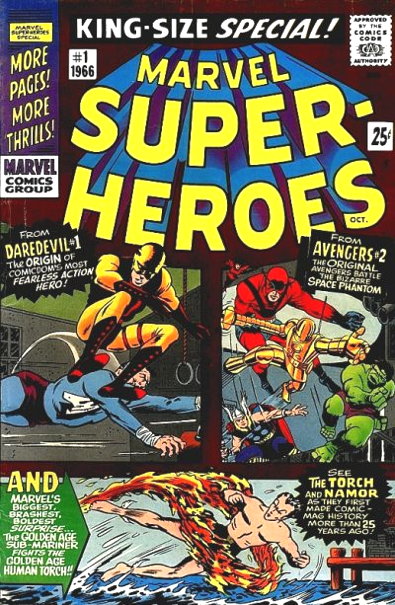
Not too long ago I purchased a copy of the above comic for my shop…Marvel Super-Heroes #1, from 1966, reprinting what was then a few relatively recent-ish comics from the publisher.
But of course, in 1966, most fans didn’t have the option of strolling on over to ye local comic book emporium to peruse the stacks and fill in gaps in their collections. Not to say there weren’t avenues to find old comics…there were stores here and there that had some, and you could always try mail order, but for the average comic book reader the newsstand was their source, which meant just the latest releases. So, if you had an interest in a particular character and title, and came to the property a tad late, these reprints held a lot of appeal.
Both Marvel and DC cranked out the reprint books throughout the 1960s and 1970s…the work was already paid for, and just sitting around in the archives, why not get it out there again? And it was, perhaps, easier to sell to an audience that tended to refresh every few years, meaning this old stuff was hitting new eyes.
I feel like Marvel’s reprints may have had more of a hook, however. DC’s stories were, by and large, standalone items, where, outside of their out-of-continuity “Imaginary Stories,” all the toys were put back in place by the tale’s conclusion, no matter how scattered or destroyed they may have been during the course of the plot. There were exceptions at DC, of course…the Legion of Super-Heroes springs to mind, and the status quo of Supergirl changing from “Superman’s Secret Weapon” to “Supergirl Reveals Herself” (ahem) is a fairly significant alteration to the premise. But a Superman story is a Superman story is a Superman story…if you read one Superman adventure, you don’t feel like you’ve missed any backstory, any twists or turns or surprising revelations.
In Marvel’s case, their superhero comics had adopted a more soap-operatic strategy. Stan Lee often ballyhooed Marvel’s “illusion of change” in their comics, but the subplots and relationships felt like they built on what came before, that there was forward progress being made with each character as they lived what seemed like, well, not “realistic” lives, but at least suspension-of-believable existences. This made you want to know what had come before, as coming in on issue 34 of, say, Amazing Spider-Man, will make you want to know what happened in the previous 33. You feel like you’ve skipped ahead to the 34th chapter in a book with 33 previous chapters (oh, and a prologue in Amazing Fantasy #15), and who knows how many chapters left to come. (Answer: this is one hell of a long book.)
Thus, the great appeal of Marvel’s reprint lines. You get those early chapters, maybe not in precise order, and not always in the same reprint title, but with some perseverance one could piece together earlier storylines. You could see beginnings of character relationships, early clashes with recurring villains, where those subplots had traveled prior to the more recent installments. Plus, in the 1960s, with Marvel’s new superhero line having only started a few years earlier, filling the gaps back to the beginning and getting the whole story probably seemed somewhat within reach.
The interesting thing is, in the modern marketplace, a lot of those early reprint books remain affordable, especially in lesser conditions. The copy of Marvel Super-Heroes #1 sold for $15, and I had several copies of Marvel Collectors’ Item Classics (don’t forget that apostrophe!) that sold from $1.50 to four or five dollars. Still have fans today trying to fill in those early stories, looking for the foundations on which the Marvel Universe was built. And doing it the old fashioned way…hunting and collecting and piecing it together. Sure, you can buy trades with the stories in order and on nice paper (assuming they’re in print), or even (gasp) digitally…but what’s the fun in that?