My Fantastic Four-Ay: Part Two.

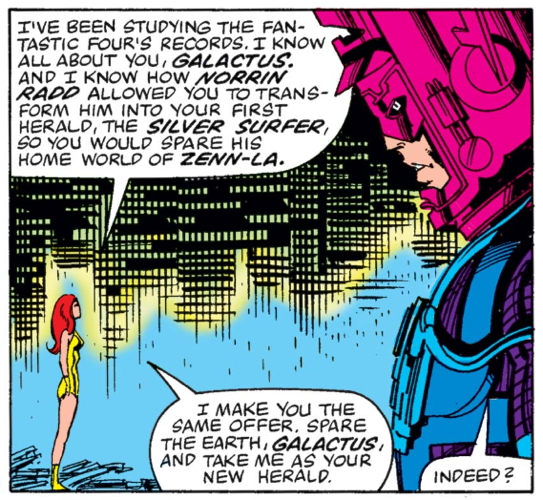
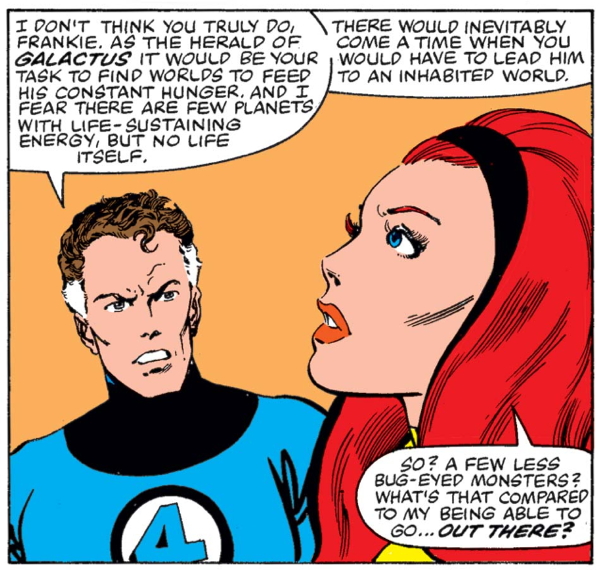
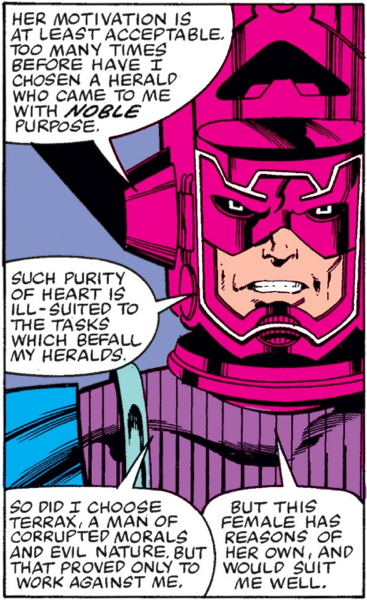
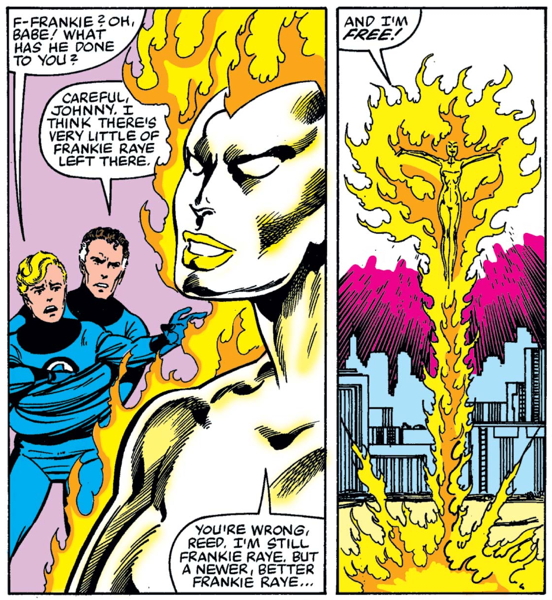
While the Thing quickly became one of my favorite Marvel superheroes, thanks in part to John Byrne’s portrayal in the (probably) first issue of Fantastic Four I purchased off the stands, I very quickly latched onto my favorite Marvel supervillain:


If #259 was my first purchased new issue of Fantastic Four, then #257 (cover date August 1983) was likely one my earliest back issue acquisitions of the series. And what a cover that was, with Galactus’ visage split with that of Death, which I probably thought was largely symbolic when I pulled the comic out of the bins, but surprise, it’s actually a literal representation of the story inside. But more on that in a moment.

I’ve read stories with Galactus, or referencing him, before, primarily in the Fantastic Four and Silver Surfer stories reprinted in the Origins of Marvel Comics and Son of Origins of Marvel Comics 1970s paperbacks that I checked out several times from the library as a young’un. Those books were a primary source of my knowledge of Marvel characters, along with Stan Lee’s semi-apocryphal text pieces therein, which is something I somehow neglected to mention in the previous installments of this series of posts.

The Galactus I encounted in those stories, the 1960s era rendition of the character, were likely more in line with the bombastic, cosmic storytelling of Lee ‘n’ Kirby, or fitting into the more quixotic Silver Surfer stories by Lee and John Buscema. What Byrne gave me in this comic was a combination of both, starting with this issue’s splash page that I remember being quite taken with:


I mean, what? That’s how you start a comic, throwing what may be the most powerful being in the Marvel Universe at you and having him make this quiet, tragic-seeming admission. Plus, that’s a hell of a drawing.

Then Byrne hits us with this two-page spread, that really lays into the cosmic bombast while still giving Galactus his somber soliloquy as he ponders his existence:


I know at least a couple of you out there winced when I referred to Galactus as a “supervillain” earlier in this post. A lot of hay has been made over the fact that Galactus is not a villain, as such, as he is “beyond such concepts as good and evil.” It’s established early on that he does what he does (tools around the universe eating planets) because it’s what he must do to survive. Not out of malice, just out of necessity.

I suppose if you’re on the planet being eating, that’s a splitting of hairs you really don’t have the time for. But this issue, getting into Galactus’s head, as he goes into his motivations and his doubts, goes a long way to fleshing out a being that could have just been a giant monster that our heroes fight occasionally, and let that be that. Giving him this level of…dignity goes a long way to establishing just who and what he is, and while Byrne may not have been the first to do this with the character, this was the first time I’ve seen it done with him. And it just fascinated me.

What especially grabbed me is Byrne further indicating Galactus’s importance to the universe at large, by having him literally have a conversation with Marvel’s embodiment of Death:


Death straight up says that she and Galactus as “two corners of the great triangle which is the universe” (the third corner being, of course, this fella). I ate all this up, buying into the mystery and the cosmic significance of Galactus, and wanting to Read More About It.

Now, later in the issue, Galactus gets his mojo back and decides to eat a planet, this time just happening to be the homeworld of some old pests of the Fantastic Four, the Skrulls:


…and while the Big G usually sets up machinery and such to more effectly absorb the planet’s energies, sometimes you just wanna dive right into the pie and not bother with the fork, right?

And, luckily for me, this would lead into more delving into the nature of Galactus some issues later, as Reed Richards is forced into a space-trial, accused of being responsible for the destruction of the Skrulls’ planet.


Reed’s responsible, you see, because in a previous story, he took the steps to revive a fallen and really dying Galactus, because he wasn’t just going to stand by and watch someone die. Even a someone who’s taller than buildings and likes to eat planets.

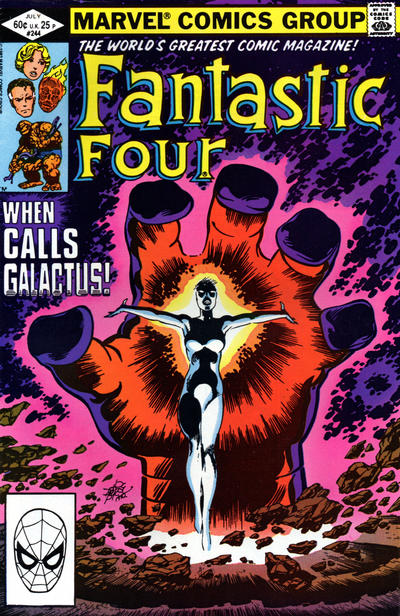
And having learned that, I of course, in my Fantastic Four back issue buying, decided to pick up that particular storyline, three issues running from #242 to #245 (May-July 1982). Here’s the middle issue, with a great cover image that, eventually, was turned into a statue or toy of some kind:


It was also in this issue that I learned of the origin of Galactus’s new herald, Nova, who had been in the newer issues I read. It was weird, working my way backwards in time, filling in the holes in the newer stories I’d read. It’s a sensation I don’t really experience much of anymore, piecing together long runs and slowly having the full story come together, like getting chapters of a book out of order and reading them as they come. The old comics I collect now (like Popeye and Turok are episodic, and don’t have continuing subplots and such.

Regardless of the order in which I encounted his comics, Galactus continued to fascinate me and I would pick up his appearances as I saw them. And pal Cully (whom you’ve seen in my comments from time to time) would lend me his run of Lee/Kirby Thor that centered around Galactus and Ego the Living Planet, and that was almost too much cosmic shenaniganery for me to handle. Eventually I would get my hands on Supervillain Classics:


…which would fill in the holes on his backstory for me, using literal panels extracted from previously published comics and tied together with short bits of explanatory text.

Of course we’d eventually see Hatless Galactus, but maybe we’re getting a little off track here.

I still have a fondness for Galactus, particularly when creators have new and unusual takes on the character (like Mark Waid and Mike Wieringo having a depowered Galactus trying to exist as a “normal” person). I also enjoyed getting an actual Big Guy in a Wild Helmet version of Galactus in the recent Fantastic Four film.

Galactus pops up in a lot of places, but whenever he shows up in the Fantastic Four comic, I’m pleased to be seeing my old pal, the one who introduced me to the whole Cosmic-Ness of it all in the Marvel Universe.

My Fantastic Four-ay: Part One.


I am reasonably sure Fantastic Four #259 (cover date October 1983, released June 1983) was the first issue of the series I purchased off the stands. While The Thing #5 that kicked off my still-ongoing dive into the world of Marvel Comics was technically a November ’83 (relased in July) issue, it was still close enough to that Fantastic Four‘s release that I could still find copies on the stands.

This was far further along into John Byrne’s tenure on the series than I imagined. Byrne, of course, had been a hot commodity since his time on the X-Men title with Chris Claremont, which came to an end in late ’80 (#144, cover date March 1981). Picking up Fantastic Four with #232 (July 1981 cover, released circa March), Byrne took what is popularly called a “Back to Basics” approach that he favored, stripping away all the excess subplots and characters and oddball permutations of the book and the team within, scaling it all back to just the family and their adventures. In essence, trying to bring it back to the Stan Lee/Jack Kirby days of the comic’s inception.

Byrne had actually worked on the book before, in the late 1970s/very early ’80s, from 209 to 221 (with a couple of fill-ins from other creators). He worked over Marv Wolfman scripts, and was inked by Joe Sinnott, but Byrne wrote the last couple of issues himself. I feel like this short precursor to his main run on the book is often overlooked, though its adherence to the slightly more overwrought tone of the title may separate it from the aforementioned “Back to Basics” approach from the later run. However, elements from the earlier books would be brought back…

…in particular, Terrax the Tamer, the fella what the FF is squaring off against on the cover of #259 up there. Here’s a better look at him from inside the comic, going by a slightly different moniker that didn’t stick around long:


Anyway, when I picked up this issue, I didn’t know nuthin’ about nuthin’ about any of the backstory, either given the comic’s story or what the history was with the artist behind the scenes. I mean, I knew who the FF were, I knew who Dr. Doom was, I had no idea who this Terrax, or Tyros, guy was, but he was clearly the bad guy. Look, I was 14, I’d read comics before, I knew how these things work and how to pick up what backstory I needed to catch up with what was going on.

But I think overall I was more taken with the overall…grounded (relatively speaking) tone of Marvel I was experiencing here. My superhero fandom, since I started picking up comics on the regular basis, rather than just piecemeal as I could cajole my parents into picking one up for me on an occasional basis, was mostly DC Comics. They had a lighter, more fantasy-oriented tone to most of the titles I was reading, but this Fantastic Four comic went a long way to establishing that these characters existed in a more representative world. That they had complex inner lives and relatable problems aside from whatever that issue’s particular plot contrivances inspired.

Just…just look at this panel of the Thing in the back seat of a cab. Just a dude sittin’ and thinkin’ and Byrne spent a good amount of page space giving us character:


Not that DC wasn’t approaching storytelling in a similar way, but it just didn’t have the frisson that one panel of Ben Grimm in a cab did.

Fantastic Four #259 turned out to be my gateway into the series, and into John Byrne’s work as a whole. But before I expanded too far into his other endeavors, I had what amounted to a couple of years’ worth of back issues I had to acquire in order to catch myself up on what would quickly become one of my favorite new comics. How that went, and what new-to-me character I found there and became obsessed about, I’ll discuss in the next installment of this series.

My Fantastic Four-ay: Prologue.

I’m not sure what my actual first issue of Fantastic Four was. I know I certainly encountered it as a younger child, having the vague memory of reading a 1970s-era issue at my cousin’s house. I know I definitely read (and owned) a copy of Marvel Two-in-One #18 when it was new, or close to, so that was very likely my introduction to the delicate sensibilities of a certain Mr. Grimm.

Eventually I would encounter the Origins of Marvel Comics paperback in the local library, possibly in the late-ish ’70s, which not only gave me my crash course on what the FF were about, but got me up to speed on several other Marvel characters to boot.

When I was reading comics in the ’70s, while I did get a superhero comic from time to time (like the aforementioned lightly-terrifying issue of Marvel Two-in-One), I mostly gravitated towards other topics. I read Disney comics, I enjoyed Pink Panther, I’d get the occasional sci-fi or horror comic somehow (like this comic with a worrisome sci-fi story from Denny O’Neil and Tom Sutton), that sort of thing. When I did get superhero comics, I primarily angled myself at DC’s characters.

Obviously, if you’ve been following my site for any period of time, you can guess that an early DC fave was Swamp Thing. I also got the occasional Superman or Green Lantern comic, or that one Superboy giant with the Legion of Super-Heroes. Oh, and all the digest reprints, and so on and so forth.

I would get the occasional Marvel superhero book, and even had a brief subscription to Amazing Spider-Man around issue #200, to fill out the rest of my subscription to Pizazz, which had been cancelled shortly after I started getting them in the mail. But I wasn’t a regular follower of any of them…mostly it would just be one issue here and there, if I had a particular need to read a new comic and I already had all the DCs I wanted from the latest shipments to the newsstands.

It was sometime in ’83 when I started making a more concentrated effort to follow certain Marvel titles, like Incredible Hulk, or Uncanny X-Men. But I remembered liking the Thing from those long-ago comics I read in the ’70s, and picked up a copy of this:


Given that my first issue of Incredible Hulk also featured the title character fighting other superheroes, maybe there was a specific attraction about such an event that attracted me to those issues. Regardless, I enjoyed this comic quite a bit, having a definitely different look ‘n’ feel from the DCs I’d been buying, and kept on buying more Marvels.

It’s not like Marvel replaced DC in my comic buying habits. I still predominately bought DC superhero comics. But I made room in my budget for more Marvel titles, including, eventually, Fantastic Four.

It was also about this time I started to discover that most peculiar of retail outlets, the “comic book store.” My first visit to one was well out of town, a place called Comic Book Nook in Simi Valley, which I’d found out about via a newspaper ad with a couple for so-and-so off the price of a back issue. However, a schoolmate of mine clued me into a place by the name of “Ralph’s Comic Corner” in the much closer city of Ventura, which is where, in short order, the greater percentage of my comics custom would be applied. (And I would also get a job there a few years later, leading to where I’m at now, but that’s another story.)

It was at Ralph’s where I could not only get the new comics usually a week or two ahead of the newsstands, but I could also delve deep into the back issues and fill in holes in my reading, picking up comics I long ago missed on the newsstands, or filling in runs of newer comics I’d just started. Like, you know, a lot of those Marvel comics that I just started picking up, which, unlike many of their DC counterparts, were a little more continuity-focused with more ongoing subplots and such. Reading the past history could often enhance the experience future stories, versus a Superman story that would exist in a vacuum separate from other Superman stories, and certainly other DC comics.

So I don’t recall where I started, exactly, with John Byrne’s run on the Fantastic Four from this period, but I absolutely used my access to the comic shop’s back issue bins to work my way back to the beginning of his stint on the title. That may very well be the first time I did such a thing with a comic book series I was following…not just going back a couple of issues to get the start of the current storyline, or working my way back to an actual #1, but liking a creator’s work on a specific title enough to get all the issues that creator did.

And reading that run of Fantastic Four started me on an on-again/off-again journey of reading that title, one that continues to even now and the great work being done by Ryan North and Humberto Ramos. But before I get to there, I’m going to start back here, and talk about what it was that grabbed my attention about Byrne’s tenure on Fantastic Four. And after that, what did and did not keep me following Marvel’s First Family over the succeeding decades.

This will be an intermittent series of entries on this site, probably at least one a week. I certainly hope you follow along, and I look forward to your comments on your favorite FF stories and why you read, or maybe didn’t read, the title.

Using the “FF” abbreviation is going to be confusing if I keep talking about these comics.


I thought I’d mention the fact that I’ve been reading/rereading over the last several weeks Fantastic Four of the last few…decades, as it turns out. My project started with reading, for the first time, the Tom DeFalco/Paul Ryan run of the early ’90s.

I’d read the Byrne run, stuck around a bit during the Englehart run (but dropped the book before the “John Harkness” stuff started), came back for Simonson, then dropped it again ’til the Waid/Wieringo run and skipping to the Millar run, then I think I was off ’til Hickman came on, and I’ve been following the book ever since.

Boy, that’s confusing to figure out. Especially since, given Marvel’s recent publishing shenanigans, Fantastic Four gets relaunched over and over again with new #1s. But anyway, like I was saying, I started off by reading the DeFalco/Ryan books, which I hadn’t read but was always intrigued by the “what the hell is going on in this book?” feeling I’d get whenever processing these issues at the shop:


It is overall a fun run of comics, just a solid superhero book that, as I saw someone observe, tried to an FF that wasn’t necessarily duplicative of the classic Stan Lee/Jack Kirby run. And overall I think it was successful, bringing in Reed’s father as bit of a potstirrer, introducing Lyja the Skrull as Johnny’s sorta love interest (that’s a long story I won’t be getting into here), plenty of parallel universe happenings, lots of warnings of impending doom (like that cover above), and so on.

And for all the different directions the stories go during this run, by the time this iteration of the Fantastic Four comes to an end in issue #416 (the “last” of the original series), all the various subplots are pretty much tied up (aside, I think, from a lead-in to a then-ongoing X-Men “Onslaught” crossover, but close enough).

After reading that run, I decided to keep going and reading FFs that I either hadn’t read yet or hadn’t read in a while. I wasn’t being a completist about it, as I did skip the “Heroes Reborn” business and then the Chris Claremont-written relaunch that followed. I also jumped over the Waid/Wieringo run since I had reread that not terribly long ago.

I don’t know that you need to hear every thought about every run on the book I either revisited or visited for the first time. I may address these in further posts, but I wanted to note a couple of things.

One, reading (most of) thirty years of Fantastic Four over a relatively short period of time makes you realize just how much is crammed into a fictional history of a book like this. As you read these one issue per month over the decades, you don’t question just how much was supposed to have happened in their lives over an in-universe span of, maybe, a decade or so. Like, how many times has the Baxter Building blown up? Every few weeks, maybe? Or when Johnny was “dead” for two years, but the kids hadn’t seemed to age two years in the meantime? This is stuff you really shouldn’t try to think about.

Two, speaking of ages, Reed and Sue’s daughter Valeria is kind of all over the map. She starts off as a toddler, gets revealed to be super-intelligent, and then once she’s running around with the team her age seems to begin to flucuate. It’s during the Hickman run, I believe, that her age is specifically pinned down as “three years old.” Though, as additional creative. teams come and go, she seems to be aged up to about…7 or 8, maybe? I think she’s older still in the current run. I know, trying to get children’s ages consistent in endless narratives like this is a quick way to madness, and besides, they’ve been going through this with their son Franklin for decades now. Just thought I’d mention that.

Three, I posted that specific Fantastic Four comic at the top of the post because I had totally forgotten that James Robinson had written the book for a time, around 2014-5. Got his own #1 and everything. And I even read it at the time. I suppose I can be excused for this, as I was opening my shop around then, but still, this book had been lost to my memory.

I’ll see if I can cook up any more observations about the FFs I’ve read in future posts. I will point out that I didn’t read the “Heroes Reborn” stuff, or the Claremont-written relaunch, so I’ll take suggestions as to whether or not I should tackle those.

I went out of my way to not use the phrase “here’s the Thing.”

[SPOILERS for Fantastic Four: First Steps ahead]

There are a couple of very specific details I appreciated about the newest Fantastic Four movie.

First, the film avoided the usual character tropes of having Ben Grimm mope over being a huge rocky monster, or Johnny Storm being immature and irresponsible. He’s still impulsive, but never seemingly in a way that makes the rest of the family kinda roll their eyes and think “not again.”

That the movie starts with the FF having been around for four years, we can assume a lot of this behavior may have already run its course. Not that Ben is any happier about being the Thing, but he’s clearly dealing with it a little more easily now.

Second, that the idea (pushed hard by John Byrne during his legendary FF run) that the Invisible Woman is the most powerful member of the team. Not just in terms of literal superpowers (though single-handedly pushing back Galactus is certainly an expression of that), but in terms of leadership ability (defending herself against an angry crowd, negotiating peace with the Mole Man).

Third — speaking of Galactus, I think they pretty much nailed the character, after being disappointed the first time they almost had him in a movie. We wanted a giant dude in Kirby gear, we got a giant guy in Kirby gear, stomping his way through New York.

Fourth, the whole portion of the film where the FF were all, “well, better hop into the spaceship and travel through hyperspace to where all these planets are disappearing.” Not something I was expecting, a full-on sci-fi epic with the team wandering through a giant, unknowable landscape to meet a menacing demigod. It’s a weird, strangely modern/futuristic setting in the midst of all this ’60s-esque aesthetic.

Okay, I can’t count any higher than four, so I’ll mention a couple of other things, like how early on in the film we only saw quick snippets/clips of Reed Richards stretching, so I figured the stretching effects tech hadn’t yet advanced so far beyond where it was for the previous movies. But then we get plenty of it later on in the film, and the stretchiness looks fine.

I think what I liked most of all was the overall look ‘n’ feel of the film, which of course I’m sure wasn’t missed by anyone. More than just the previously stated ’60s-style aesthetic, it just seemed like a…gentler film, not so loud or abrasive as other Marvel movies could be. It was simply fun, a comic book movie that didn’t shy away from its origins, name-checked several of the FF’s bad guys, and straight up showed us at least one of the Red Ghost’s Super-Apes.

The one concession to the Marvel Cinematic Universe at large (which you don’t need to watch as homework for this film) is the opening caption telling you this is “Earth-883” or whatever the number was in the Multiverse. (EDIT: I am reminded in the comments that it is Earth-828, AKA 8/28 as in Jack Kirby’s birthday!) (The main Marvel Earth in the films is 616, same as the main Earth in the Marvel comics, though if I recall correctly the Cinematic Earth in the Marvel Comics Multiverse is given a different number, while its inhabitants still call it 616…anyway, I have a nosebleed now.)

It shall come as no surprise that eventually the twain shall meet and the FF will cross over to the main Marvel Movie-verse…we’ve seen something pointing to this already as a post-credits scene in ThunderboltsAsterisk. Trying to merge the FF’s storytelling sensibilities with the somewhat sharper-edged primary MCU would be a shame…it feels like the former would have to fit the latter, costing some of the appeal.

I don’t know, we’ll see what eventually happens, since we’re promised as the end of the film that the FF will return in Avengers: Doomsday (you know, the one where Superman dies) due out in 2026, maybe. I hope that doesn’t preclude the possibility of more standalone FF movies in the future…I think we as a people are owed an Impossible Man adventure.

What sound does the Swamp Thing Signal Watch make?

So I received a nice surprise in the mail on Tuesday…a postcard from Steve Lieber advertising the forthcoming hardcover collection of the Jimmy Olsen series he with with Matt Fraction:


If that cover seems familiar, here’s why.

On the back of the postcard is info about the book, plus a special handdrawn message from Mr. Lieber his own self:


A closer look:


Very nice. Made my day getting this card. And, if y’all haven’t read that Jimmy Olsen series yet, this is as good a way as any to check it out. It’s a great run, very funny and imaginative, and one of my favorites.

• • •

In other surprises-shipped-to-the-store news, I received last Friday an envelope from Marvel marked “DO NOT OPEN UNTIL 6/16” so I went ahead and opened it up immediately because c’mon guys, I don’t have time for this “do not open until Christmas” nonsense. (And it’s “616 Day” for reasons discussed in the links I put in this post the other day.)

Anyway, inside was a note from Marvel saying they’re trying to get 6/16 to be “Marvel Day” or whatever, and they’re kicking it off with some new, branded variant covers for recent Marvels, like this one for X-Men #15:


So anyway, I put those out for sale on Monday, but not put out for sale was this item, a set of Fantastic Four pins:


Pretty cool, thinks me. And as someone who likes pins, I’m just gonna hang onto these, thank you very much.

I think future 616 Days may be better served by some kind of freebie comic instead of just “collectibles” to be marked up. (And if they’re going to ship pins like these with comics in the future, they might want to do a better job making sure the clasps on the back don’t get crushed into the covers of those special variants when the envelope containing everything is at the bottom of a box with piles of books on top of it.)

• • •

Okay, we kinda lost the thread a tiny bit with the Final ’90s Countdown, in which the intention was to only cover titles that began in 1990 or later.

However, this have resulted in a lot of hair-splitting and questionable decision-making and whathaveyou and sometimes something slips through the cracks, like 1989’s The Mask.

So, there will be some sidebars to the Final ’90s Countdown with some “Honorary ’90s Comics” — titles like Eightball and From Hell, all technically beginning in the very late ’80s but are very associated with the ’90s. Look, I’m flying by the seat of my pants here, but these comics should be discussed, even if they were disqualified from the initial vote.

It’s a little bit of a mess, but at least we get to talk about a bunch of good comics!

Doomsday +2.


Yes, I know it’s the second post in a row this week leading off with a big ol’ pic of the Red Hulk, but given this is the first Red Hulk comic on the stands since, I think, Red She-Hulk ended back in 2013, I think I’m justified. It’s a tie-in to the “One World Under Doom” crossover, which is one of the few Marvel events I’m actually reading and not just kinda inferring what’s happening in the larger Marvelverse when these things creep into series I follow (like when “Blood Hunt” poked into my series).

Of course the reason this series exists is that said crimson behemoth is currently appearing on a slowly diminishing number of movie screens near you in Captain America: Brave New World. I’m very curious how the comic is going to do, given I haven’t had a whole lot of advance demand in this at the store, and I don’t know if the film is generating enough interest amongst the Wednesday regulars to get them to grab it off the shelf.

I’ve red…er, read the comic, it’s fine, it’s very obviously Part One of the story, with not as much Red Hulk action as I’d have expected. But it sets up the character’s involvement in Doctor Doom’s plans, and we get a few surprising cameos, and I’m happy to stick around and see where it’s going. The Doom event has attracted some good sales on the released tie-ins so on, so that may be what gets people trying out the title more than the Hulk his own self.

Side note: when the Red Hulk was originally introduced, the big mystery was “just who is the Red Hulk?” and my somewhat bonkers guess was that it was Bruce Banner’s paramour Betty Ross. Who it turned out actually to be was mildly disappointing, but I suppose it was no surprise. Still haven’t seen the film, but it’s pretty clear that nobody’s going in wondering who becomes Red Hulk. …Still think my idea was better.


Continues to be a complete delight, as Al Ewing channels his inner Bob Haney and makes this the most groovily-script comic on the stands. I had a good grin on my face through the entire issue, and even released a Sensible Chuckle on more than one occasion. Artist Steve Lieber ain’t no slouch either. This issue is a good focus on the relationship between Metamorpho and his boss Simon Stagg’s unfrozen caveman assistant Java, between whom no love is usually lost but find themselves just kinda stuck with each other anyway. Anyway, the book’s a blast, you should read it.


Another “One World Under Doom” event book, in which we get a look at life under Doom’s thumb, and it is very, very hard not to read the descriptions of that life, the discussions between characters about it, and so on, as an allegory for Trump, which can only be intentional. Politics, in my comics? Why, yes, as they’ve pretty much always have been since the beginning of time, but if you’re worried that it’s heavy-handed, nah, take it easy. No explicit references, but if you read this, you won’t be able to help but connect the dots.

But anyway, what I’m enjoying a lot about Ryan North’s run of scripting these books is the various grouping of characters that he does with the relatively small-ish main cast. This issue we get the Thing, Dr. Sue Storm (and I do love that North is very big of reminding us of that “Dr.”), and former member She-Hulk in a very satisfying done-in-one story that doesn’t let the crossover get in the way.


As always, whichever of the Absolute books I’ve read most recently becomes my favorite of the imprint, as the initial storyline of this title comes to its conclusion. While the main plot seems relatively simplistic (Wonder Woman helphs Man’s World fight off a giant monster), there’s a lot of solid backstory and characterization and just plain pretty art and entertaining dialogue that you get your buck’s worth with each issue. In fact, every issue of these Absolute series is dense on art and story and giving you good value. I hope this continues on in the new Absolute titles coming in the next few months.

Speaking of which, I’m hoping DC doesn’t go into overkill with the additional spin-offs for this imprint, chasing those strong and continuing sales the first three series have experienced. The fear of course is The New Thing replacing The Old Thing, and I recall one writer of a Marvel book wondering why he’s doing a regular Marvel Universe title when the “Ultimate” version was being published concurrently. The original Ultimate titles I’m speaking of, by the way, not the current iteration. Now we know what happened with the original Ultimate books, so I don’t think there’s any real danger of one supplanting the other. That said, I still don’t want too many and have them biting into each other’s sales, or into the sales of the main line.

As in “editorial edict,” not “the model of car.”

So Matthew brings up another option I’d totally forgotten aboiut in the Thing eyebrow/no eyebrow raging debate: TWO eyebrows, as per Fantasic Four #502 (art by Casey Jones):


Now I was all ready to not like this, based on the description. This issue, though, was one I had read, probably a couple of times, given this particular run of the book was a favorite of mine, and I don’t recall being put off by the appearance of Aunt Petunia’s favorite nephew at any point.

Pulling up that above image and giving the dual-brow look a once-over, I find…I don’t hate it. (And to be fair, I don’t really hate any of the Thing’s various visual permutations, despite some interpretations of his “pineapple Thing” days proving…challenging.) I can picture Benjy waggling his eyebrows up and down, individually, Groucho-style, stogie in his better-be-toothless mouth if he were still allowed to have his stogies (banned long ago via editorial).

The aforementioned “raging debate” in the comments of Wednesday’s post is described as such in the Mighty Mike’s Facetious Manner, as folks from both sides of the conflict, the no-eyebrow people and the wrong people, have cheerfully piped up with their love for the character no matter the state of his forehead. As I said then, either interpretation of the Thing is perfectly fine, and though my personal preference is no-eyebrow, the charm of the expressive separate eyebrow is certainly not lost on me.

One thing (cough) we can all agree on, as brought up a couple of times in my comments, is “Woe Betide You If You Give the Thing Teeth,” as so:


Look, God bless Neal Adams, that man did a lot for our beloved funnybooks, at his peak his art was unmatchable, he gave us Superman Vs. Muhammad Ali, he was instrumental in Superman’s creators Jerry Siegel and Joe Shuster getting their due. And maybe he had some…odd ideas about science, and maybe his latter-day comics were…idiosyncratic, but he was a legend and absolutely rightfully so.

But when I turned the page and saw the above image in his Fantastic Four: Antithesis series, it was like a jump scare in a horror film. I mean, wow, that is not a Thing I am used to. It was an entertaining series, and the art was nice overall, but the Toothsome Mr. Grimm took some getting used to, not that I really ever did.

The Thing is one of those characters that is open to a wide amount of variation and still being “The Thing,” but there are certain elements that to his look that can just look wrong if pushed too far or simply not done correctly.

John Byrne’s “How to Draw the Thing” from the early ’80s is oft-cited:


…and my early exposure to it, and internalization thereof, has definitely influenced my opinions on the Thing’s appearance. I notice when someone gives him a neck, for instance, and it always reads as “wrong” to me. Despite this, I am up for versions of the character that don’t necessarily follow Byrne’s fiat.

However, with increasing talk about the forthcoming Fantastic Four movie, and Marvel’s predilection for letting the tail wag the dog, one wonders how much a live-action/CGI Hollywood Thing design will alter the character in the comics. I got to wondering about this after seeing a post on…probably Xwitter, lamenting the fact that whatever is done with the FF in the movies will be reflected by the comics for the following few years.

This doesn’t take into account that Marvel movies may very well be entering a period of decline, as moviegoers appear to be becoming pickier about the movies they see, and films budgeted with near-billion box office takes in mind are barely breaking even, if at all. Lots of reasons for this, and it’s less the ever-threatened “Marvel burnout” and more “COVID has changed movie-going patterns” and “people have turned increasingly to streaming options” and “it’s just easier to wait a month or two and watch at home instead of going to a theater.”

And maybe it is a little bit about “Marvel burnout,” as I saw an article recently ask, nonironically, “why did The Marvels, the 33rd film in the franchise, fail?” Well, maybe after 2 1/2 dozen films, the novelty’s worn off, and folks just won’t go to see any movie with a Marvel logo in front of it. The movies might be perfectly fine (I myself would like to see The Marvels, but I haven’t been to a theater since the pandemic started and have no plans to return) but unless it’s something special, it’s not going to pull people in. (Compare to Barbie, which was new and different and had a point of view and an individualistic style and made that coveted billion bucks.)

And I’m not picking on Marvel movies specifically. DC’s last few movies underperformed, and I don’t see that trend changing even under James Gunn’s purview. That last Indiana Jones film made $300 million in the box office, an impressive take under normal circumstances, but its production costs were about that much, and that’s not even counting the advertising. It had to become a phenomenon to turn a profit, and there just wasn’t enough of an audience that excited for the last installment of a decades-old franchise. Which is why I think forthcoming Star Wars movies may also see the same fate.

Anyway, what all this means is that maybe we don’t need to worry too much about an FF movie having undue influence on its poor print cousin. Even if they make the Thing purple with eight arms and teeth for days, there’s every possibility the film will come and go without making a ripple and ol’ Bashful Benjy will be safe. Except if there’s too many flops Marvel The Comic Publishing Company may outlive its usefulness to Disney and be scrapped so they can spend that money on cleaning the Star Tours queue area instead.

Not that I expect that to happen. Marvel movies will more likely slow down in production, maybe one a year if that, making them more “events” again and giving them a better chance at bringing in viewers. Like, Spider-Man movies will always make money. This new Deadpool film will do fine. If Marvel ever gets around to doing a new X-Men movie, that should also do well, assuming they don’t screw it up. But I just don’t see the Fantastic Four capturing audience excitement in the way it needs to in order to justify that likely $250+ million budget. Which would be disappointing because I love the FF.

Well, that’s not where I expected this post to go. Please take a lot of the above with all the authority that I, a dude that sells comic books for a living and doesn’t make Hollywood movies, bring to it. I hope I’m wrong about the movie end of things, since I enjoy superhero films and want them to continue, even as I’m part of the problem by no longer attending theaters. It’s a trickier marketplace than ever, and I’m glad I’m just working at the nickel-and-dime level I’m at rather than having millions upon millions of dollars on the line.

Honestly, I think he’s a grown-up Herbie Popnecker (and that he’s teamed up with Herbie does nothing to dissuade me).


This issue of Marel Two-in-One was the first Fantastic Four-related comic I remember reading. Sometime after that I remember looking at some random issue of Fantastic Four my cousin had, which one I can’t remember, but I do know it was in the middle of some ongoing story and it was weird and strangely fascinating to someone mostly used to DCs and the occasional Charlton.

It wasn’t until the early ’80s that I began my full-on dive in Marvel Comics readin’, and my gateway was…an issue of The Thing, which brought me to John Byrne’s run on Fantastic Four (starting with the then-current issue and picking up the previous ones as I could) and then on to just about everything else Marvel-ish.

Fantastic Four, though, was one of the main two I stuck with (the other being Incredible Hulk and all its later permutations). I would occasionally not follow the title (there’s a big chunk of ’90s FF I skipped) but I have all those Byrne issues, the Waid run, the Millar run (which I still think is actually pretty good), Fraction and Hickman, Simonson, and now Slott…all readable, enjoyable and imaginative. I’ve also since read all the original Lee/Kirby stuff, with all its primal energy, laying the foundation for a fictional universe that is essentially dominating all popular culture today (even if its mostly been without the FF’s direct interaction, though not for lack of trying a couple of times).

None of this really says anything about the comic, so let me just say it’s a fun tribute to the team’s long history, with cute “chapter break” images that really drive home the time the team has spanned. You will not be surprised at all by one of the story’s “twists,” but really, it’s a wild trip though the FF’s history and that’s entertainment enough. It’s mostly a standalone book (though one major subplot does carry through from the previous issues, but the exposition train pulls into the station long enough to catch you up) so if you haven’t read FF in a while, it’s a good sampler of the title’s current status, and worth checking out.

• • •

On a copmpletely different topic, I was looking at my old Flaming Carrot action figure the other day. It has a feature where if you twist the little plastic plume of “flame” that sticks out of the top of his head, it will light up. Or would light up if the battery wasn’t long dead, I thought as I twisted the doodad, but lo and behold:


…LET THERE BE CARROT LIGHT. I wondered just how old this figure was, as I couldn’t recall exactly when I picked it up from the previous place of employment. A peek into Diamond’s database revealed 1) it was still listed in said database, and 2) it came out in December of 1998. Nearly 23 years later, that little light is still working. Amazing. Now if we can only fnd out what the Carrot’s actual secret identity really is, and where that speaker in his chest came from.

The official Dark Horse Comics site still has a page devoted to the figure (which gives a release day of November ’98). A closer look is in this pic I “borrowed” from an online source:

All that does is make me wish I hadn’t discarded the packaging for my figure.

“Leaps and bounds” — I see what you did there.

From Marvel Comics Retailer Spotlight #16 (August 1990), here is the hype for the Walt Simonson/Art Adams “New FF” run on Fantastic Four #347 through #350:


In case you’ve forgotten, here’s what the first issue looked like:


Now, it’s been a long time, and I think in 1990 I was still in the “huh-yuk, I’m a’sellin’ comic books!” starry-eyed haze and not worried overly much with the behind-the-scenes ordering hoohar that the boss concerned himself with, so I probably didn’t know at the time that this first issue was in fact returnable. (Returnability is only occasionally afforded to retailers on certain books today, but it was a real rarity back then.)

As it turned it, it sold extremely well, eventually going to a second printing (also not a very common occurence in those long-ago Young Mike days). I know we didn’t have much backstock on it, and we’d buy back copies as they came in collections. This was quite the popular item for some time after its release, and even still today gets an inquiry from curious fans here and there.

It’s an interesting look at the cross-promotion and sales strategies used for a comic that one would think would almost sell itself anyway. This was during the big 1990s comics boom, so something like this seemed like it was almost guaranteed to outsell the Bible anyway, but even in those times when the gold poured out of the rivers and the oil flowed freely, no one was going to take any chances. Even dragging in ol’ Fin Fang Foom and referencing the rest of the Marvel Monsters to get that crowd (you know, “them”) shows the extent of hype for this book.

The listing of each guest star and why he’s of import is certainly a sign of the times, when any of these characters popping into any book usually meant at least something of a bump upward, if not necessarily in rack sales, but at least in retailer order numbers. It may still sorta be true today, but not nearly to the extent it once was, a combination of readers being a little choosier with their comics money and the fact that “Special Guest Appearances” of “hot” characters are no longer the huge sales pull due to overuse and overexposure. Wolverine’s “sales power,” once taken for granted as shown here, is no longer the sure thing.

I think most interesting to me is the characterization of this storyline as a “fill-in,” which I think maybe surprises me a little. It never felt like a fill-in, like some inventory story or reprint pulled out of storage thanks to the Dreaded Deadline Doom. I mean, it was the same regular writer and a special guest artist…it may have interrupted the main storyline, but it didn’t feel intrusive (like a fill-in in the Simonson run a couple of issues later, which was…okay, but it was a real case of “well, I guess this’ll do ’til Simonson’s back”).

Anyway, this is one of those few cases where the publisher was all “better order lots of these!” and being correct. It was quite the item, and stil is today, thanks to fans with long memories or a deep interest in comics past. Also a rare encouragement to stock up for later back issue sales, which you don’t see too much of anymore. (I think Crossgen was the last company to really push the “better have back issues for new fans!” thing.)

But as far as that advice to place copies of this comic “all over [our] comic racks” — yeah, I know one of Marvel’s publishing strategies was (and maybe still is) to make a retailer fill up his/her shelf space with all the Marvel product they could possibly carry, and crowd off everyone else. I mean, I get it, they wanted copies of this next to Ghost Rider, etc. However, I’m pretty sure we just had them up on the rack under “Fantastic Four,” and it seemed to do fine.

One last note…as to this being the Punisher’s “most unique” role…yeah, I think there’s a challenger.