Mike Sterling's Progressive Ruin
Sparing you the worst since 1969
 Mikester
 Among other announcements at last weekend’s Wondercon, DC is apparently going to reveal the Joker’s real name in the forthcoming Justice League #50. They hinted at its reveal before, earlier in the storyline, and you can see those specific panels at that link where Batman learns the name, but we, the readers, are kept in the dark.
Now, assuming it’s not a big ol’ fake-out, it still seems kind of weird. As Twitter pal nicknewt newted…er, noted, “There’s two possible outcomes of revealing the Joker’s real name: 1: Someone we never heard of, thus anticlimactic / And 2) an existing character, which is dumb as [fudge].” My response was that it could be some heretofore unrevealed relative of Bruce Wayne, which, if I may opine briefly, would also be a dumb as [fudge] option. Given Batman’s reaction to the revelation of the name, it’s clearly got to mean something, but…well, I don’t know. We’ll see in two or three months, whenever Justice League #50 actually does show up.
And that’s the weird bit…the reason it feels like some kind of fake-out or doomed-for-the-reset-button reveal is because it is happening in Justice League, and not one of the main Batman books. Unless, as I also mentioned on the Twitterers, this is some kind of “Wolverine’s Origin” deal where the movie studios were going to reveal their own version of the formerly-secret information and it was in the comic company’s best interest to do it themselves in whatever title was convenient before it was done for them. I mean, I’m not sure what film or TV project could theoretically have done this. Maybe some throwaway line in Suicide Squad? Something they’re leading up to in Gotham?
The one time they almost got a real name to stick to the Joker was in the first Tim Burton Batman film, where he was given the name Jack Napier (a play, I think, on “jackanapes,” which is clever). The name ended up being used in the animated series (where I believe it was eventually revealed as an alias), and eventually faded away, finally unable to counter the decades of inertia of a nameless Joker. I noted, ugh, 11 years ago that the one remnant of that particular bit of the character’s history is that “Jack” (or something similar) is now sort-of the go-to name whenever the Joker’s past starts getting thrown around. (Interestingly, if a bit awkwardly, Alan Moore in The Killing Joke avoids mentioning his real name at all in the flashback scenes.)
Like I said, I’m still convinced this is a fake-out of some kind, but it got folks talking about their comics, so, hey, a win for DC. I personally think that would undermine the Joker’s power as a character, by nailing down this agent of chaos to a specific history, when he’s more effective as just this wild monster that came from nowhere to counter Batman’s need for order. It doesn’t matter who he was, just what he is, and (presumably) making a Shocking Reveal out of his true history may bump up sales and interest in the short run, but won’t really add anything in the long run. Then again, if DC really is sticking with it and (almost more importantly) if the tie-in media runs with it, the Joker’s real name could be with us for while…at least, until that previously-mentioned decades of inertia wipes it away once more.
The Trouble with Comics Question of the Week, focused on the state of newspaper strips and featuring my typical overlong response, is now live for your perusal. Enjoy, won’t you?
Taking the week off from the site, and I’ll be back next Monday. Thanks for understanding.
In the meantime, you can hear Gerry Conway answer my silly question on the latest episode of War Rocket Ajax, and the new Question of the Week featuring my response should be posted at Trouble with Comics any time now. (I’ll update this post when it does.)
And, of course, you’ll likely see me popping off on the Twitterers.
See you soon.
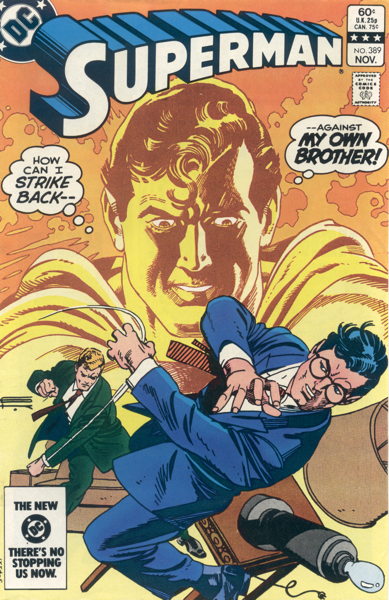
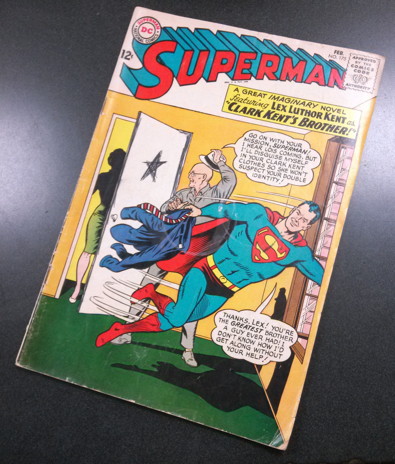
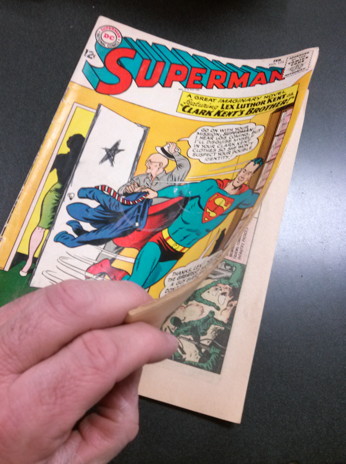
So here’s a Superman comic that I bought off the stands way back in 1983. That’s a scan of the actual comic, straight out of my collection, up there. There’s nothing particularly of-note about it, as individual issues go. It’s not a key issue, no first appearances (aside from Superman’s “brother,” whom I believe is never seen again), not particularly scarce by any means. Just your plain ol’ Superman comic, with a dime-a-dozen Gil Kane cover, and yet another art job, the latest in a string of hundreds of assignments on the character, from Curt Swan. Another story by Cary Bates (plot only this time, scripted by Paul Kupperberg).
So, you know, nothing special…
…we thought at the time.
What I wouldn’t give to be able to wander into a local newsstand (or even my own store, though that dispels the nostalgia somewhat) and be able to pick up a new Superman comic, with another wonderful Gil Kane cover like the one above, with more beautiful Curt Swan art, written by either Cary Bates or Paul Kupperberg…or, you know, both. Or with Kurt Schaffenberger art. Or with Elliot S! Maggin scripts.
Or…well, you get the idea. The Superman comics were always just sort of there, but looking back at them today, knowing that exact style of Superman comic will likely never return…well, they all seem a little more special now.
Even the ones where Superman meets a brother he didn’t know he had. No, really. And his brother’s a secret agent! It’s all pretty awesome.
EDIT: See the comments for more comic book appearances of Superman’s brother.
From Captain America #237 (December 1979) by Chris Claremont, Roger McKenzie, Sal Buscema, and Don Perlin…here’s a great panel transition aided by some timely (heh) and gratuitous logo insertion:
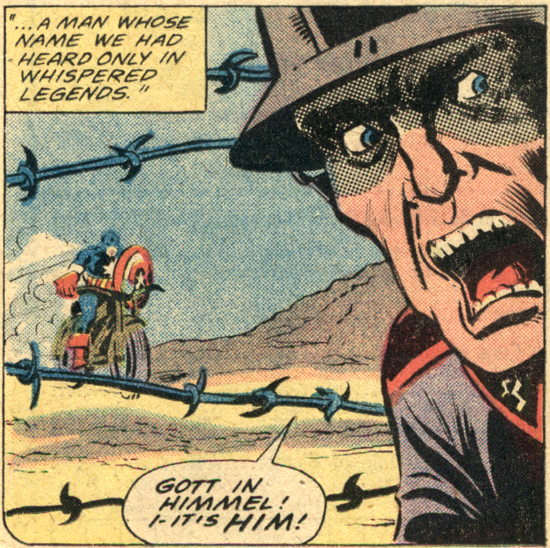
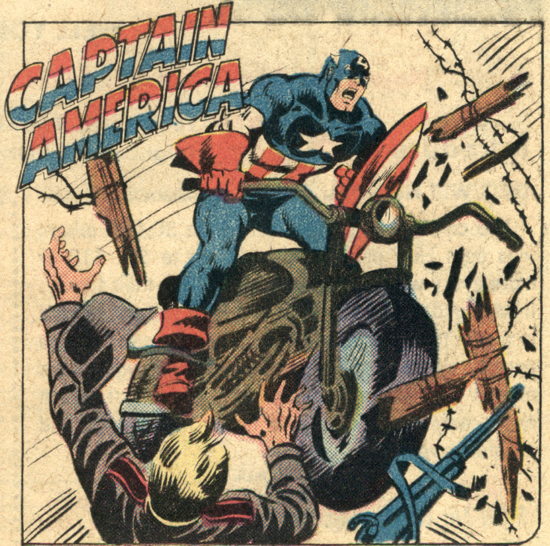
Nazis…YOU’VE JUST BEEN CAPTAIN AMERICA-ED.
Seems like we don’t see the ol’ “character logo inserted into dialogue/captions” as much as we used to. Yeah, the recent issue of Action has the Superman “S” as a graphic element in Clark’s caption boxes, but that’s not the same as him shouting “THIS IS A JOB FOR SUPERMAN” and the “Superman” in the word balloon is represented by the actual Superman logo.
Then again, maybe I’m just not reading the right comics. Anyone else spotted any in-dialogue use of superhero logo iconography lately? …There’s a question you probably don’t get asked often enough.
(Additional data may be located here.)
So the other day I acquired a number of mid-1960s Gold Key comics, including a couple issues of the long-running Bugs Bunny series. Now, for years, it seems as if the Bugs Bunny comics, and the other Warner Bros. animated family of comics from Dell and Gold Key, have been forgotten by God and man and been shown no love in the back issue marketplace. I think, in the nearly three decades I’ve been at this, I’ve had requests for Warner Bros. back issues only a handful of times.
(Wait, I should add a caveat here…there were
Part of the problem is, unlike the Disney books which had Carl Barks and a few other “name” artists, I don’t believe the Warner Bros. comics ever had their own “Good Rabbit Artist” spurring on collectors to acquire their titles (though it should be noted Barks did draw a Porky Pig story that includes Bugs). As such, I remember having at the previous place of employment issues of Bugs Bunny going back to the ’40s for as cheap as four or five bucks, or even less. I’d often use them as an example as “no, just because a comic book is old doesn’t mean it’s expensive.”
“Then why would you even buy any Bugs Bunny comics for your shop?” you may be wondering. Well, frankly, they were more or less thrown in with the other comics…as I was totaling up the books, I noted to the buyer I wasn’t going to pay much of anything for the BBs as I would likely never sell them, and as he was just looking to unload the whole lot, he was fine with that.
Thus, that is how I ended up with issue #108 from November 1966, featuring the premiere appearance of Honey Bunny:
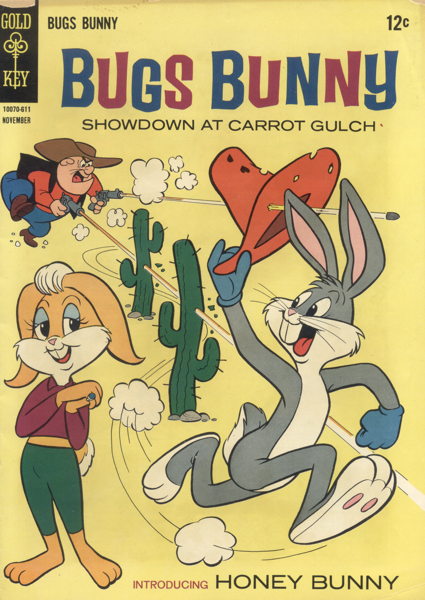
“Who?” you ask? Well, “Who?” I also asked, and I figured it was just a one-shot character that was never seen again. Here’s another shot of her from inside the book:
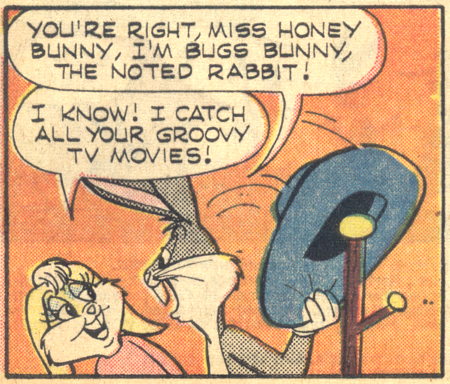
I went to that inerrant font of all human knowledge, Wikipedia, and sure enough, there’s an entry on her which has informed me that she actually stuck around in one form or another until the ’90s. Not starring in cartoons (aside from perhaps a cameo here and there), but primarily in the comics and some merchandising, only to be replaced with the arrival of Lola Bunny in the film Space Jam.
And that’s how I found out about an obscure outlier in the Warner Bros. cartoon family, one that had actually seen a bit of use over the course of a few decades without ever significantly crossing over into wider animated visibility and into the general public’s consciousness. I mean, even Gabby Goat only made it into a couple old cartoons, and we all remember Gabby Goat, right?
So this week’s Question over at Trouble with Comics is about “enhanced” covers (versus the variant cover topic we covered last week), and what we thought about ’em, and whether there were any we liked, et cetera, et cetera. I threw an answer or two into my response, including one cover I discussed on this site, lo, a decade ago now so I supposed enough time had passed to revisit it.
Fellow Troublemaker Logan had this to say in his own response:
“With the possible exception of the poly-bagged Deadpool card, can any retailer still move their copies of X-Force #1 at even face value? Yet it still gets mentioned in conversations regarding how many copies were sold, how popular the book was, and so on. The only gimmick to it was that there were different trading cards bagged with each issue,* and I don’t recall there being a shortage on any particular card, Mike Sterling would have a better memory of that though.”
The asterisk there was to an editorial footnote reminding us of the “reverse image UPC boxes” which I’d somehow driven out of my mind, though apparently that was a big deal in regards to how “collectible” and “rare” any particular variant of X-Force #1 happened to be. And by “collectible” and “rare” I mean “just slightly more copies of X-Force #1 out there than, say, grains of sand.”
Now, as I do recall, the cards themselves were available in equal numbers. It’s been a couple of decades, but that’s my recollection. But as I noted in this post from a few years ago (where I note the then-decline of Deadpool’s recent popularity and the lack of any kind of promised Deadpool movie…boy, that’s almost “political pundit” levels of foretelling, there), those comics sold like crazy, and even sells once in a while to this day. Yes, even at more than face value. Why, one can get upwards of $3 to $5 bucks per copy, even! Not very often, no, but it does happen.
There is still no shortage of these in the direct market, especially at stores that were open at the time, and even in new stores like mine where they just kinda turn up whether you’re trying to buy ’em from collections or not. And I think it’s because of that proliferation that, even now, even after an actual Deadpool movie is in honest-to-God real-life movie theaters and viewed by presumably willing audiences, there is, like I noted in that old post, still negligible interest in the Deadpool appearances in those early X-Force comics. I mean, people still want those New Mutants #98s with his first appearance, sure (I even had one in my shop for about five minutes last week before it was claimed), but that Deadpool trading card edition of X-Force #1, or that story with Mr. ‘Pool in #2…nope, no one’s biting yet, movie or no.
Swamp Mark noted
“i don’t think you’ve said a word about the new Swampy series. which is a shame because Wein and Jones are knocking it out of the park!”
I thought I mentioned it at some point…probably it was on the Twitterers, where I said, after reading the first issue, that it didn’t really do anything for me until the antagonist shows up in the back half of the issue. The series as a whole so far, now that we’re at the half-way point, is…well, it’s okay, I think.
I have no beef with the art. If we can’t have Bernie Wrightson back, Kelley Jones is just dandy, giving us weird, goopy, and creepy illustrations as is befitting a Swamp Thing title. Jones, of course, has drawn Swamp Thing many times over the years, and he’s always welcome.
Swampy’s other creator, Len Wein, is back on writing chores, however, and…well, I don’t know. It’s fine, but…okay, this is mostly on me, I suppose, in that the original ’70s Swamp Thing comics still have a strong appeal, so expecting this new series to compete with my own nostalgic feelings for the older work is very unfair. You Can’t Go Home Again, is what I believe I’d said on Twitter, and that’s probably more aimed at me than it is at Wein. The tone of the scripting just doesn’t feel the same…and why should it, I guess. There is this thing with Swampy’s dialogue that seems out of character, with his talking about kicking something’s ass here, and this bit of business there:
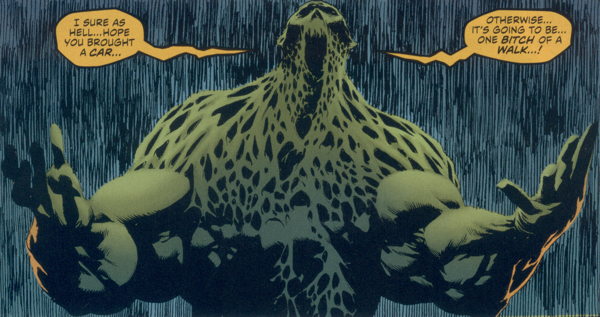
…which doesn’t sound right to me.
I just paged through the most recent issue, #3, again since it happened to be sitting here, and like that first issue, the story didn’t really grab my attention until the latter part of the comic, which leaves on a cliffhanger that genuinely left me looking forward to its resolution.
But even that brought up an issue with me, which is one that’s probably out of Wein’s hands, and that’s the New 52 continuity. Again, this is an issue that bugs me, The Guy Who’s Read Swamp Thing Comics for Nearly Four Decades, and may not be a problem for someone coming to the character fresh, but there’s the big disconnect between what has come before, and the New 52 version of events. Given that we were reintroduced to the “plant that thought it was Alec Holland” version of Swamp Thing post-New 52, I was able to imagine that the adventures we read of that version of Swampy still existed, more or less, even with the changes to Arcane. But, with the return of a certain old supporting character in this issue, unless there’s a lot of weird backstory to be revealed, one of the classic Alan Moore stories from early in his run now appears to Never Have Happened. (It also futzes up a small bit of Neil Gaiman’s Sandman, for that matter.)
I can sort of understand the decision…why remain committed to a piece of continuity from decades ago when you’re trying to do new comics for hopefully new readers who may, at best, only know the most basic information about the character’s concept? Not to mention the fact that, referring to those old events involving said supporting character, none of them were experienced by this version of Swamp Thing anyway, if you follow me. It’s not like the Alec Holland-version of Swamp Thing is suddenly going to shout “B-b-but you’re DEAD!” when as far as he knew, that character was just fine and dandy when he last saw him.
Ignore all that if there’s a big reveal in the next issue that this was all a trick and it isn’t really that supporting character but some old enemy in disguise or something.
Anyway, wrapping up…I like the series. The art’s great, and the writing’s tone is taking me a while to warm up to but it’s fine. The continuity issues are a thing, which undermines the proceedings a bit, but that’s because I’m old and read all that stuff so it’s still in my mind when I read this new stuff. But to paraphrase those brilliant philosophers, “it’s just a comic book, I should really just relax.”
EVEN SHORTER CONCLUSION: Mike, you got a new and reasonably good Swamp Thing comic written by its creator and drawn by a great artist — shut up, already.