Every time I mention Mark Russell, I think of the piano-playing political satirist.

So the interesting thing about these Hanna-Barbera/DC superhero team-up books is how in most cases, some attempt is made at making them…well, if not in continuity with the regular DC universe (such as its continuity is right now), at least not directly contradictory. Well, to be fair, I don’t know if that’s the case in the Suicide Squad/Banana Splits book since I haven’t read it yet, as 1) I’m not a Suicide Squad guy, and 2) my only real experience with the Banana Splits is enjoying the cover of their theme song by the Dickies. But Green Lantern and Adam Strange cross over into alternate universes to meet Space Ghost and the Future Quest gang, respectively…and even Top Cat falls through some interdimensional portal to meet a cowled crusader of some note (setting up what seems to be a very Howard the Duck-ian premise for the forthcoming series). It’s sort of the difference between the early Marvel/DC crossovers where Spider-Man and Superman have just always existed in the same world and they didn’t get around to meeting each other until 1976, versus the Marvel/DC crossovers from a couple of decades later where the Marvel and DC continuities were explicitly described as “different universes,” with even a jointly-owned character who could facilitate said meetings.

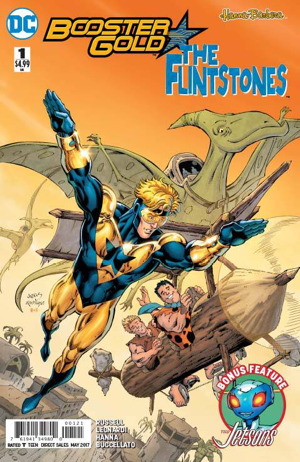
The exception seems to be Booster Gold/The Flintstones, which just throws Booster back in time to the Flintstones’ version of the Stone Age, without worrying about, you know, how Anthro fits in, or whatever. This was written by Mark Russell, who writes the regular Flintstones series, and as such this particular crossover fits right in the darkly satirical tone of that book. Russell also scripts the Snagglepuss back-up in the aforementioned Suicide Squad/Banana Splits comic…and of course I read at least that part of the book immediately. Yes, Snagglepuss is, as the writer describes him, a “gay Southern Gothic playwright” in the 1950s, and how he deals with officious types who don’t approve of him and his work. The brief sample we get is a tad more serious than Flintstones, but Snagglepuss’ dialogue is fun to read, and I look forward to hearing more of what that ol’ mountain lion has to say in his upcoming series.

As for the others: Adam Strange/Future Quest is right in line with the Future Quest series, fitting right in with the tone of that comic…I mean, what’s one more weird adventure character like Adam Strange in a book already full of them? Lots of fun, and, oddly enough, semi-connected to Strange’s appearances in the recently-completed Death of Hawkman mini. Green Lantern/Space Ghost has some nice art by Ariel Olivetti (making it match quite nicely with the Olivetti-illustrated Space Ghost mini from a few years back). Maybe a little wordy, with maybe too many small-ish panels, but you definitely get plenty of story for your buck that way. And while I’m generally surprised at just how much Hanna-Barbera has let DC get away with so far, Howard Chaykin’s “Ruff ‘n’ Reddy” is…well, Chaykin-y. Not for kids, though frankly the number of kids who are currently Ruff ‘n’ Reddy fans can probably be counted on one anthropomorphic paw.

Anyway, they’re all weird, and I enjoyed what I’ve read so far, and I expect I’ll enjoy the Banana Splits one, too. Hopefully they’ll do more Hanna-Barbera team-ups, because quite frankly once I thought of the Killer Croc/Wally Gator pairing, I’d had great need to actually see it.

• • •

In other news:

  • Blogging pal Tegan is writing for Medium, and her recent column on the passing of Bernie Wrighson is a must-read.
  • I have a few favorite artists who’ve drawn the Thing…Jack Kirby, of course, and John Byrne, and Barry Windsor-Smith…and RON FREAKIN’ WILSON.
  • And don’t forget…if you’ve got comics questions for me to answer, or topics for me to discuss, drop ’em in the comments to this post!
“You people bring questions for Mikey?”

Well, I was planning on doing some comic reviews, but ran myself out of time and energy, so I’m gonna put those off ’til tomorrow. But, in the meantime, since I’ve been thinking about doing this lately, I’ll go ahead and do it right now: let’s do Question Time again, where I welcome (hopefully comic book industry-related) inquiries from you, the people who haven’t realized you’re not supposed to be reading blogs anymore, and I answer them to the best of my ability. Or you can just suggest a topic you’d like me to discuss…at any rate, please just one question/suggestion per customer, deposited right here in the ol’ comments section.

Like the last time I did this, I won’t be answering your questions all at once in a week-long series of too-long entries here. Instead, I’ll probably address one or two topics per post, interspersed amongst the regular content and features of Progressivelyruinated.edu, such as “It’s the End of Civilization Already Again” and “Your Weekly Moment from Frank Miller’s The Spirit,” over the next few weeks or months or possibly eons…we’ll see.

Anyway, you guys ‘n’ gals usually cook up some good Qs for me to A every time I do one of these, so I’m looking forward to what you have to say. What, a website actually looking forward to comments? What decade is this? Again, please, one question or suggestion per person, gently placed in this welcoming receptacle. Thanks!

No, not actual horses.

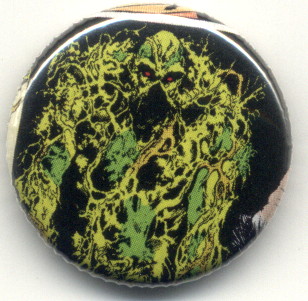
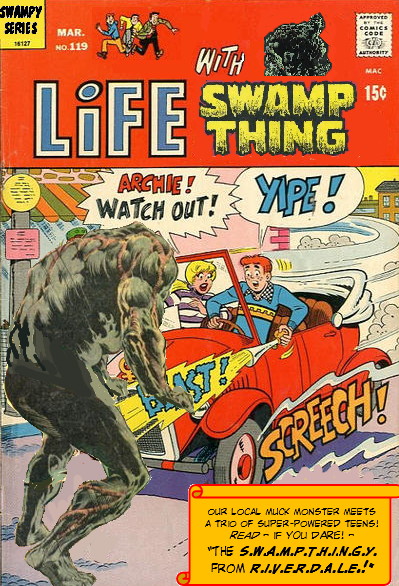
So Former Employee Aaron (in that he’s no longer doing my cruel, heartless bidding…he’s still at my former place of employment) has a buttonmaker, and I’d featured some of his creations on the site before. Well, the last time I saw him, when I stopped by the old shop to do a little horse-tradin’, he had a surprise for me. Another handmade Swamp Thing pin:


Why yes, that is Swamp Thing as drawn by Steve Bissette and John Totleben from Saga of the Swamp Thing #21 (1984). Now to await a formal occasion for which I may use said pin as the perfect complement to my coat and tails.

In other news:

  • So Brian Cronin over at Comic Book Resources put up an article discussing the old Nickelodeon TV show Video Comics, which I talked about myself, due to the Swamp Thing connection, about four years ago. Brian was good enough to link back to my old post, since I had a few additional memories about the show not covered in his article. Thanks, Brian!
  • Hey, Matt Wilson is running a Kickstarter to fund his next comics project, Everything Will be Okay, done in conjunction with Joe Hunter, Rodrio Vargas, and Josh Krach. Looks like it would be fun, and they have a little ways to go yet on reaching their goals, so pitch in if you can!
  • Bully, the Little Punching Bull presents…Daredevil versus Hitler! (No, not that Daredevil.)

The DC Comics Hardcover/Softcover Plan: The End of the Thrillogy.

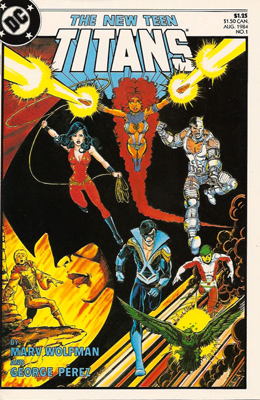
Okay, it’s the third post regarding this particular publishing plan of DC’s from waaaay back in the ancient times of the 1980s. If you’re just joining us, you can read just exactly what the hardcover/softcover thing is in these two posts. If you’ve been here for the whole exciting saga, you’ll be glad to know that, as promised, I did ask my old boss Ralph about sales on the New Teen Titans and Legion of Super-Heroes comics during that period.
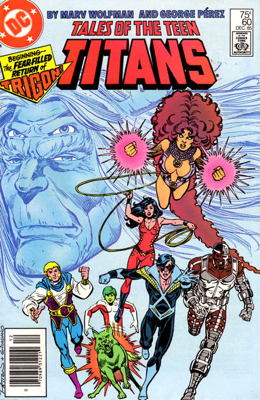
As it turns out, sales in Ralph’s shop were pretty much as you’d expect. The new printing-on-fancy-Baxter-paper direct sales only series sold great, and their newsstand counterparts still sold quite well as long as they continued presenting new stories. Once the newsstand versions started to reprint the stories from the new direct-sales series, sales on the newsstand series plummeted. They did still sell a handful of copies, so either someone was still following the series in the cheaper format, or just completing the run, or it was simply random, non-consistent purchases from walk-ins not necessarily following the comics but just wanted something to read.

Ralph didn’t recall if there were any holdouts who didn’t want to spring for the extra cost of the newer series, but instead waited for those stories to be reprinted in the less-expensive partner series. However, some readers left comments saying they did just that, based on wanting to get the maximum comics bang for their bucks with the limited amount of financial resources at hand. So, you know, I would guess that this particular buying strategy was a tad more common than I assumed.

I also asked Ralph if there was any grumbling from his regulars about now having to buy two series of, say, New Teen Titans a month, instead of the normal one. He didn’t really recall any, as it seemed to him at the time customers were excited about the new higher-quality Baxter-format comics, even at the higher price. Plus, DC picked a couple of series with strong enough fanbases that the prospect of more material available each month was generally welcome. …Man, that was a long time ago.

Personally, I dutifully bought both versions of New Teen Titans and Legion of Super-Heroes, up until the newsstand books went into reprints (except for the initial Titans one, since that reprinted the first appearance, which I didn’t have at the time, and a story from a DC digest which I did already have, but didn’t mind having in the full-sized format). I suspect, for readers who had the scratch and were within hopping, skipping and/or jumping distance of a devoted funnybook store, that was usually, but not always, the case.
Reader Michael likened this to Marvel’s 1990s experiment with direct sales/newsstand editions of some of their books, like X-Men and Wolverine. However, the wait time between releases was only a couple of weeks or so, and the pricier, fancier version came out first, with the less expensive version on the less fancy paper coming afterwards. As I recall, the plan was to see which format would sell better in the direct market, and, as Michael notes, of course the fancier one sold better because people didn’t want to wait even that short of a time to keep up with these particular titles. My main memory of these was, when restocking the back issue bins, having to keep track which issue numbers of which titles had the two different formats, and making sure both were represented in the old comics boxes.

…This all seems so quaint, compared to the modern practice of “here’s a new number #1 for a character/franchise that’s already had multiple new #1s in recent memory, some of which are still going.” I often thought at the time that future price guides and collectors would have a hard time puzzling out the different permutations Titans, Legion and Outsiders went through trying to satisfy two different retail markets. Little did I know what was coming.

Bernie Wrightson (1948 – 2017).

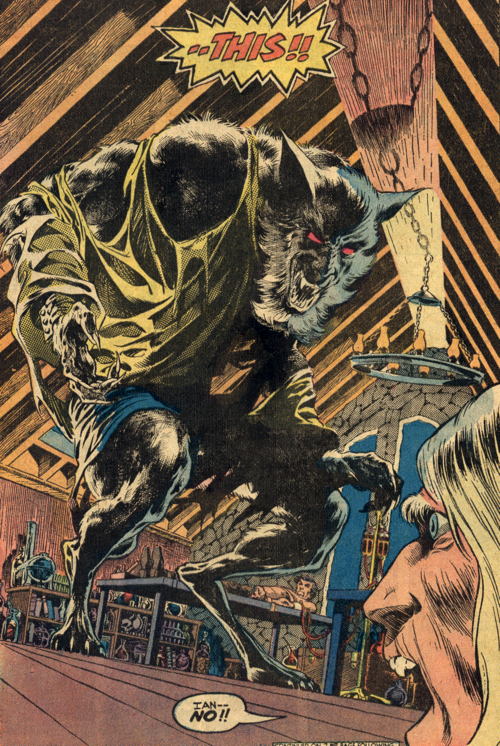
There are a lot of fantastic illustrations by Bernie Wrightson in those early Swamp Things, but this is the one I keep coming back to:


The strange perspective, the incredible detail, the full page reveal coming late in the story after we’d already seen the werewolf a couple of times…all combining to make this an image that impressed itself into my brain for all time. Funny that it’s a pic from this series that doesn’t even feature the title character, but this splash from #1 does take a close second in the “Bernie Wrightson Drawings I Think of When I Think of Swamp Thing” category.

But flip through pretty much any issue of Wrightson’s Swamp Thing and you’ll see no end of intricately-detailed illustrations, their impact diminished not at all by the cheap printing and yellowing paper. If anything, the impact is enhanced, the drawings made even more moody and mysterious by the decaying pulp on which they are presented.

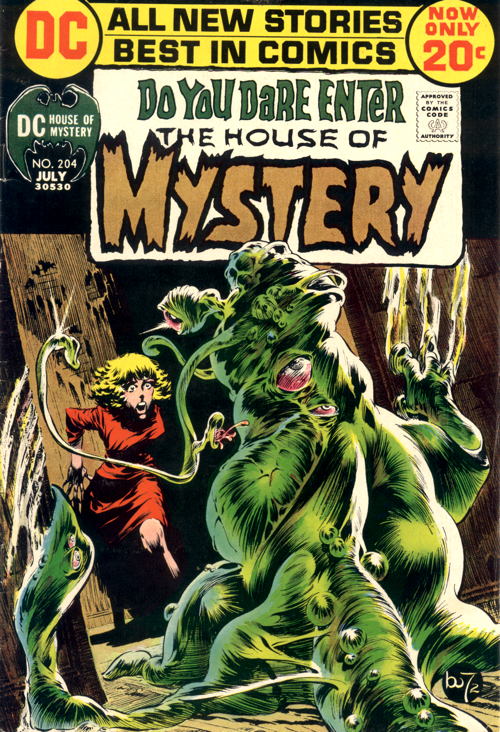
Wrighton’s covers from the period are eye-grabbers as well, looking like nothing else on the shelves. This Lovecraftian critter on this House of Mystery clearly represents something that should be unnatural and repellent, but Wrightson’s linework makes it endlessly fascinating. You want to pick this comic off the rack and see just what’s going on here:


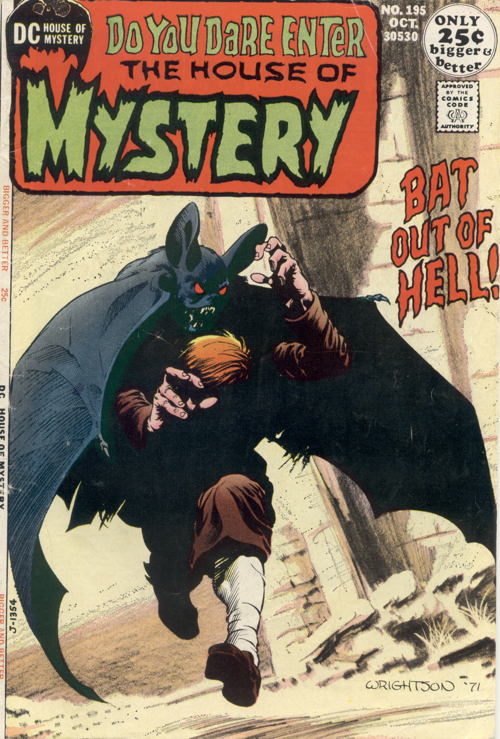
…And this cover here…where do you even begin? This was 1971, and Wrightson, in his early 20s, had only been in the comics business for a couple of years. And here he is, already creating images as perfect as this:


And this doesn’t even scratch the surface of the man’s work. These drawings are all from the early years of his career…his impossibly-detailed Frankenstein work was still ahead of him. His “Captain Sternn” stories, both the short in Heavy Metal and the later mini-series (plus the related back-ups in Dreadstar. The Weird. Batman: The Cult. National Lampoon strips and illustrations. Tons of horror shorts for Warren magazines. The Hulk/Thing graphic novel. Batman/Aliens. The “Howard the Duck for President” button. The Spider-Man: Hooky graphic novel. The comics adaptation of Stephen King’s Creepshow, plus all the other illustrations he provided for King’s novels. Even Punisher comics…and much more, besides.

Saying “he was a great talent and he will be missed” doesn’t seem like enough. He embodied a particular aesthetic that took inspiration from horror comic artists and fantasy illustrators that preceded him, and formed it into something unique, something so his own that the term “Wrightson-esque” easily conveys its meaning. He didn’t just redefine the horror genre. He was his own genre.

So long, Bernie. Thanks for letting us see, for so many years, what your wonderful imagination created.

And you didn’t think I was going to let this go without at least one picture of Swamp Thing, did you?


images from Swamp Thing #4 (April-May 1973); House of Mystery #204 (July 1972); House of Mystery #195 (October 1971); Swamp Thing #6 (September-October 1973)

Also it appears to leave out Swamp Thing’s appearance in Super Friends #28.

There were some good comments regarding DC’s “hardcover/softcover” publishing move for their comics in the 1980s. I plan on returning to the topic soon, but, like I said in that post, I still want to ask my old boss Ralph a question or two about how they sold for him/what customer reaction was like to this program, since that was just before my comics retailin’ time. What I’m really curious about is if anyone pooh-poohed that newfangled New Teen Titans comic on the fancy Baxter paper and just stuck with the regular Tales of the Teen Titans series, figuring the stories will get reprinted there eventually anyway, for a cheaper cover price. Anyway, I’ll see if I can get any more info about customer buying patterns on these books from Ralph, and I don’t see why I wouldn’t, since it’s only been a little over 30 years and surely still fresh on his mind.

In other publishing news, I’ve been emailed and tweeted at regarding the Swamp Thing Bronze Age Omnibus, with plenty of details as to what said omnibus would contain at that link. Now, I’ve discussed this forthcoming volume before, about a year ago, at which point its Amazon listing described it (and still describes it) only as containing House of Secrets #92 and Swamp Thing (first series) #1 through the unpublished #25 (which was likely a typo).

The newer content listing contains a boatload of Swampy comics, much more than that older listing. It almost seems like it’s too much for one volume, but a quick comparison to what’s in my Man-Thing Omnibus shows it’d be about the same size. I forget how huge these volumes can be. Also, given what’s in the book means there won’t be a Swamp Thing: The Bronze Age Vol. 2 since we’ll be well into the 1980s with any follow-up material, which is the Copper Age or whatever name people are trying to saddle that particular period of comics with in order to make them sound more marketable.

Anyway, this will be the first time the majority of the post-Wrightson issues of the original series will be reprinted, I believe (after getting #11 – #13 reprinted a few years back in a hardcover), and the first comprehensive reprinting of the pre-Alan Moore Saga of the Swamp Thing, though leaving out #19, the conclusion of Marty Pasko’s run on the book. Maybe it’s seen as a…transitional issue, between Pasko’s run and the beginning of Moore’s run, though traditionally Moore’s first issue on the series, #20, has been seen as the transitional issue, left out of early trade paperback reprintings of his initial storyline. And #18 seems like a weird issue to stop on, as it was a reprint of #10 from the original series, with 4 pages of new wraparound by the then-current creative team, and something of a cliffhanger-y issue to boot. Does this mean Original Series #10 will appear twice in this book? Again, like the inclusion of issue #25 in the initial Amazon listing, maybe this too is just a typo and Saga of the Swamp Thing #19 will be in here. We’ll find out soon enough, I guess.

Was going to joke about newsstand reprintings of Watchmen with Dr. Manhattan having little bikini briefs edited in, but that’s probably what’ll happen in Rebirth.

BobH has a few things on his mind, in reaction to my oddball analogy in a recent post:

“I wonder if, in retrospect, the direct/newsstand plan DC did was considered a success or a failure? The reprints lasted about 30 issues, which isn’t too bad, but they only added one other book to the plan, OUTSIDERS, and that one only lasted 8 issues into the reprints.”

Without going back and check exact dates on various titles (well, okay, I double-checked Omega Men) DC was experimenting quite a bit with “direct sales only” (i.e. only available in comic shops and your slightly more comprehensive newsstands*) titles in the early-to-mid 1980s. This was slightly before I entered into my lifetime of comics retailing, so I don’t have specifics on sales numbers and customer reactions and what have you to this turn of events, beyond anecdotes like BobH’s own. The “hardcover/softcover” plan, which, as previously described, was DC publishing stories in the direct market first, then reprinting them in their newsstand titles a year later, was a way for DC to establish a greater foothold in comic shops, using their biggest title (New Teen Titans) and the comic with a then still-strong fandom (Legion of Super-Heroes) while hopefully not abandoning their newsstand-only fans.

Now, was it a success? In the short term, if my memory of the sales charts in the Amazing Heroes magazine was correct, the direct-only NTT and LSH did sell quite well, and each series did last a long time (over 100 issues each, back in those “we don’t have to reboot a title every dozen issues” days), and the newsstand reprintings lasted about 3 years for the Titans, a little less for the Legion. I guess that’s not too bad on the newsstand reprints, though I suspect print runs were pretty low on those later issues. I wonder how many fans of either property bought both versions, just to keep their runs going? Even so, there must have been, at least for a time, enough people just buying the newsstand versions to keep them going even that long.

Also, was reminded of one of Marvel’s attempts (or only attempt? I’m drawing a blank) to duplicate the hardcover/softcover plan, the short-lived Dreadstar and Co.. That was a weird choice (an oddball creator-owned sci-fi book, though Marvel distributed other creator-owned books to newsstands, like Groo and Elfquest) though I don’t know that Marvel had enough big name direct-sales-only titles that would really fit this particular type of publishing/reprinting program.

“I always get the feeling that it ended up disrupting the momentum of TITANS and (especially) LSH, taking them from DC’s flagships to more fringe books. But I’m not sure how much of that was the publishing plan and how much was the quick change in artists (Perez only lasting two issues as full artist, three more as penciller and then gone, Giffen only two as penciller, three more co-plotting and then gone).”

At the very least, this seemed to be the beginning, or the middle-ing, of the abandonment of newsstands, by splintering the fandoms these titles in this way (in addition to the many direct-sales-only titles both Marvel and DC were producing). The newsstand reprints, though holding on for a while, were probably doomed to eventual cancellation as sales shifted toward comic shops and the folks who could only buy comics at newsstands were left behind. Widespread casual sales and awareness of these particular characters gave way to the “preaching to the converted” sales in the specialty comic shop, where people who were already comic fans were going anyway. …That’s a huge simplification (yes, of course there were some new people going to shops and discovering titles) but I think I’m reasonably on target.

Creative team changes probably didn’t help a whole lot in the direct market end of the equation, but New Teen Titans and Legion of Super-Heroes still had some solid artwork even after the departure of the artists most associated with each title. I’m sure some people were disappointed and stopped reading, but these comics still remained quality titles for quite some time. Again, I wasn’t there at the time except as a reader/buyer of funnybooks, but my sense is that sales probably were still doing fine after losing part of the creative teams that started ’em all off.

My own memories of the time are a little hazy, what with being 48 years old now an’ all, but I suspect I can ask former boss Ralph how sales were going on these comics at the time. Lemme get back to you.


* A local newsstand I used to go to seemed to have a lot more comics than your usual supermarket and convenience store racks…I don’t know what distributor they used, but they’d often get comics earlier than your traditional outlets, and even carried ‘zines like The Comic Reader and various indie publishers, like Fantagraphics and PC Comics.

48.

+

+

=


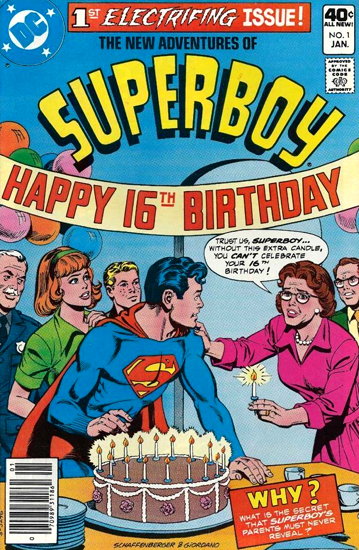
Yes, that’s supposed to be a cake with 48 flaming candles. Also, best wishes to my blogging-and-birthday brother, pal Andrew, whose own cake is almost certainly illuminated by tiny mushroom clouds.