Yes, I know he doesn’t really turn into Mr. A.


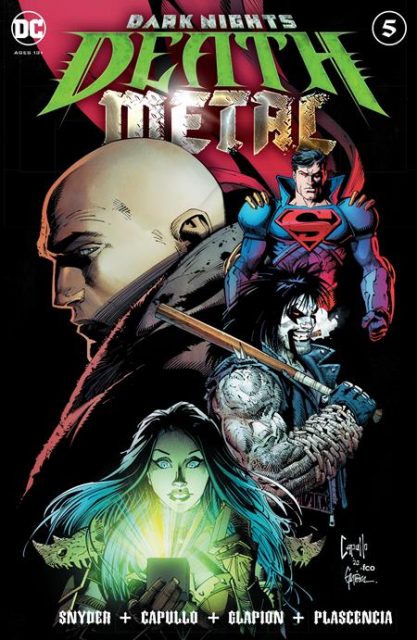
It’s interesting how DC can’t seem to get away from their shared-universe navel-gazing in their events, where everything is a Crisis and the very nature of the universe in which they exist is at stake. I’ve gone on before about how DC has, time and time again, tried to make that Crisis on Infinite Earths “never not was” as they try to put all the pieces back to the way they were, or at least find viable workarounds (like “hypertime”).

Not to say Death Metal isn’t entertaining, because it is. Tossing all the pieces of the DCU into the air, and printing however it falls to ground. Okay, there’s a little more planning to it than that, but if we’re going to have constant explorations of how the DC Universe works, at least let it be entertaining like this.

I would like to thank whoever decided to change the Batman Who Laughs’ dialogue from red-on-black to white-on-black, so that my beleaguered eyeballs may more easily read them. And while I get DC’s glad to have a hit on their hands, maybe for their next Dark Nights series (and there will be one, surely), maybe have fewer $5.99 one-shot tie-ins? While, again, they’ve all been entertaining, the constant onslaught of them is beginning to bum people out. I mean, find a way to squeeze all this into the main series, somehow, honestly.
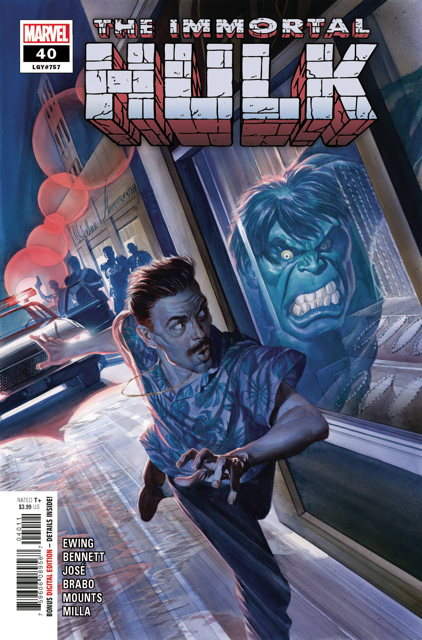

Apparently the Al Ewing/Joe Bennett run is ending at issue #50, so we only, what, seven, eight months to go? Well, plus tie-ins to events like “King in Black” and whatever other one-shots they’re gonna get in before the end. And I can’t help but wonder how Marvel is going to follow this series with a new Hulk #1. Well, okay, we know they will, but this series has been such a bull-in-a-china-shop when it comes to the character’s premise, its twisting about of the Hulk’s multiple personas in a horror context, that’s been so excellently done that’s it hard to imagine where one would go after that. I mean, they have to, Hulk’s not going away, but as good as this run is, I am sort of excited to see what comes next. I’m pushing for some sort of domestic comedy.
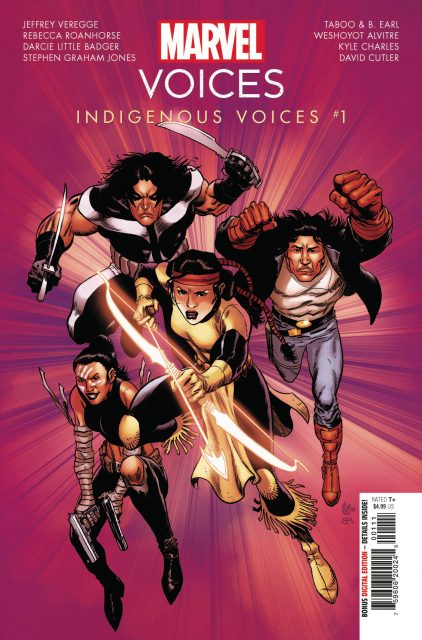

Look, my pal Weshoyot drew a story in this, so you should pick it up. I’ve known her since she was a kid coming into my previous place of employment, and over the ensuring years she’s become a wonderfully talented artist. So glad to see how much success she’s achieved, and look forward to seeing what she does next.
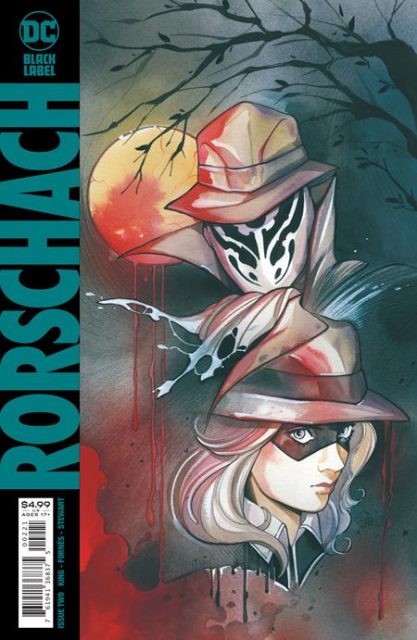

Boy, this is a weird comic. I mean, aside from the fact that there are ads in this book and one moment, you’re in someone’s idea of the Watchmen universe, and the next you’re nose-deep in a Snickers ad. Previous Watchmen knock-offs have had ads in them, I realize, but it seems somewhat more egregious in this title. Particularly that Snickers ad, I swear to God it gets me every time I’m reading a DC.

Anyway, the comic is basically about “What If Steve Ditko Actually Became Mr. A?” and I was amused at first but…I can’t exactly say it’s mean-spirited, but the inspiration it takes from Ditko’s actual life feels just a tad disrespectful. Part of me finds it oddly interesting, part of me is like “yes, we get it, Ditko was kind of an oddball, quit piling on.” Also, this doesn’t really feel like something that should be a twelve-issue series, but who knows, maybe “Kack Jirby” will show up to punch Nazis or something.
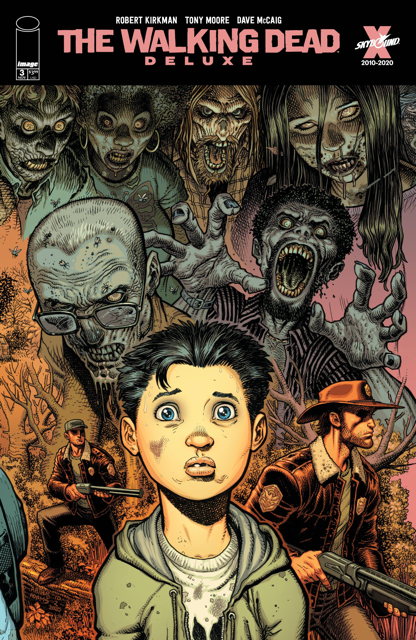

Well, what can I tell you, I missed out the first time, so I’m jumping on now. Whether they’ll actually manage complete reprinting of the entire series issue-by-issue is something of a longshot, but hopefully there are enough 1) people like me who missed out and didn’t get trades for whatever reason, and 2) completists who are buying every variant cover for every issue, I suspect there’s a non-zero chance of reaching the end.

That said, I think this is a good package, with plenty of backmatter notes on the making of the issue before you. It is also kinda weird to be reading this in serialized form when, while not having read it as such, I have flipped through enough of the comics as I unpacked them out of the shipping boxes to have at least a mild appreciation of what had been going on, so actually reading the comic now gives me, to say the least, a little more understanding of the nuances of storytelling. You know, like that splash page of Rick shouting “We ARE the walking dead!” which, if there is any justice in this fallen world, will have every letter in that balloon a different color once the reprints reach that point.
Yes, I misspelled “Palisades.”

My blogging time is going to be somewhat curtailed over the next couple of days, so don’t expect to the typical Progressive Ruin Wall O’Text™ at least ’til Friday, thanks to some too-early morning appointments over the next couple of days.

So let me answer Wayne’s question very briefly here, where he asks if anyone’s seen the Palisades Park coupons you used to see in Silver Age DCs ever clipped out.

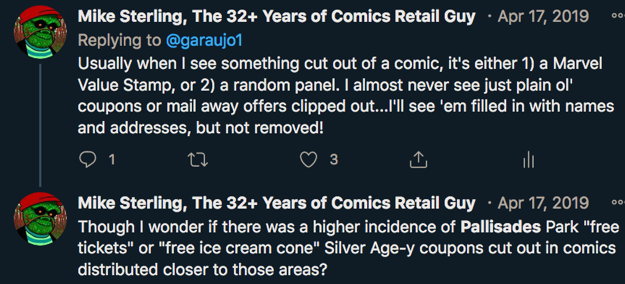
I actually wondered about this myself about a year and a half ago on the Twitters, on the slightly broader topic of finding clipped coupons in comics:


And as you see there, the answer is “nope,” presuming that most of the comics I’ve come across were not from the general area of said park, thus presenting a reduced incidence of clipped coupons. Or kids didn’t want to cut up their comics, which is also possible given the number of surprisingly not-cut-up comics I’ve encountered in collections over the decades. Not saying there were none, but not nearly as many as you’d think, especially with the puzzles and dioramas and whatnot you’d see in Dell Comics, which practically begged kids to ask their parents for permission to use the scissors.

Okay, the primary exception to this is Incredible Hulk #181, which, like, 90% of the time is missing the Marvel Value Stamp. DARN YOU SHANNA THE SHE-DEVIL FANS! …Actually, my theory as to why we see H181 missing the stamp so often where other comics with stamps usually still retain them is because H181 still has significant value and remains sought after even without the stamp. Most other Marvel books with the stamp cut out get tossed in the dollar box or just tossed out…okay, maybe not “tossed out” but boy they don’t go for much, usually.

Anyway, off track, and I want this short. Any of you notice Palisades Park coupons missing from your books? Just curious if anyone’s noticed this.

Well, technically, I’m Silver Age.

So Matthew asked last week sometime

“Speaking of the ‘copper age,’ What years and terms do you use to define different eras of comics?”

Which, you know, fair enough, since I’m very vocally not a huge fan of that very term “copper age,” which still to my ear smacks very much of a marketing term generated to make back issues of Nomad sound rare and collectible.

I’ve gone into detail on this before, actually also in response to a query from the very selfsame Matthew, in this post from last year. Actually, I’m glad for the chance to revisit that post becuase just the briefest of glances revealed some pretty awful typos (which I’ve since fixed), and more to be found, I’m sure. I’m guessing this was written during one of my “cloudy vision” periods, of which there have been too many. But I presume most of you got the gist of my typical too-long foray into the nomenclature of comic ages then, despite my obfuscated spelling and word use.

But to defy tradition and provide a more succinct answer to this most recent query, let me say to you, Matthew, that I use “Golden” and “Silver” frequently, and “Bronze” less so. However, as we get farther away from the period supposedly defined by “Bronze,” i.e. circa 1970 through 1984, I find my incidences of usage increasing, perhaps identifying a psychological barrier against acceptance. “Why, there can’t be an ancient sounding ‘age’ for that period…that’s my time frame!”

A naming of ages is, almost by definition, a matter of historical definition, and one tends not to think of a time lived through as being “historical,” no matter how long ago, in truth, that time may be. However, I suppose, 35 to 50 years on, I must bite that bullet and accept that the range of years is thusly dubbed.

As has been pointed out by some, including me in that very post from last year I linked above, some distance is needed to fully appreciate the characteristics of the industry’s behavior before one can really begin to divvy up specific eras into “ages.” I go into a little detail at the end of that post about what I think the current “age” might be called [attention Allen M, who brought this up last week], but we’re still way, way too close. So long as it isn’t “the Final Age,” a joke I’ve made at some point in the past here or on Twitter, though truth be told I’m only about half-joking.

Okay, I clearly didn’t defy any ProgRuin traditions with that answer, so let me move on to another response to last week’s post.

• • •

Tenzil Kem, Esq., bites off more than I can chew with

“I get the argument about the ‘rarity’ of newsstand comics vs. direct market, although I’m not sure if newsstand copies from the 70’s/80’s are truly that much rarer (since, as you know, print runs were hundreds of thousands of copies and available widely back then). I think the argument is stronger for comics from this century, such as DC New 52 newsstand issues with the higher cover prices, but I still don’t know that it should translate into higher valuations.”

Oh, sure, I’m not sure I was clear on that, but yeah, with comics from when newsstand distribution was still a major thing, there really shouldn’t be much of a difference, if any, in secondary market pricing. It should be restricted to more modern releases, though, as I noted in that post, I’m not a fan of that sort of pricing behavior anyway. I understand the impulse, but it still feels like making a collector’s item out of nothing for no really solid reason. (Like, as you say, the price differences on those DCs, but even then that’s bit of a stretch).

Now look, when it comes to collector’s markets, it’s the money that talks, not me, and history will side with whatever makes some people’s wallets fatter while I walk the streets with my sandwich board filled with tiny scrawled handwriting. I’m sure eventually I’ll fall into line if the back issue market leans in that direction, but rest assured I’ll be making passive-aggressive complaints about it on whatever Nazi-free microblogging platform eventually replaces Twitter.

“For that matter, I don’t like the inflated back issue pricing on comics with Mark’s Jewelers ads, and I have several of those that my grandparents bought me from the Fort McClellan PX near Anniston, AL.”

Yeah, that’s been a thing for years, but I think tradition has won over any objections we might have had. To be fair, if a comic came with some kind of insert, and that insert is removed, then that comic is not “as new” and should be graded accordingly. While I think advertisements should be treated differently from inserts more directly related to the comic book, or comics in general (like, say, trading card inserts that Marvel would occasionally include in their books throughout the ’90s), the problem of “where is the line drawn” does begin to creep in.

The imperfect analogy that immediately comes to mind is the usual comic grading policy of “age is not an issue.” A comic from the 1940s is held to the same grading standards as a comic that came out last Wednesday (or Tuesday, if it’s a DC). Otherwise you have to create sliding scales for what is considered “mint” or whatever for multiple time periods, and frankly, that sounds like an enormous pain the All-Star Squadron. With that as precedent, one can perhaps see where trying to distinguish between the kinds of inserts would eventually turn problematic, and it’s simply easier to apply the same pricing/grading rules to any comic with any insert.

As a side note, you’d think having the stiff-paper trading card inserts or jeweler ads would create a wider prevalence of these comics being in higher conditions with less spine creasing. Let me tell you, friends, that this is not the case.

“I’ll go full grumpy old man and complain about Canadian price variants and British price variants because I feel those are just “rare” here in the USA.”

An issue I recently experienced when I acquired a large number of 1960s Marvels and DCs from a lady who’d spent her youth in England. The DCs were all stamped with ink impressions featuring the price in, I don’t know, ha’pennies or whatever was goin’ on there, but were otherwise as distributed in the U.S. with the American prices printed thereon.

The Marvels, however, were printed with British pricing replacing the U.S. pricing on their covers (for the most part…there were one or two that also had to be stamped). I wasn’t quite sure what to do with these in regards to back issue pricing…especially as some of them were quite the in-demand books (such as the first appearance of Black Panther).

Did a little research, consulted with former boss Ralph, and eventually decided to just price ’em up as normal. I mean, these weren’t new, different foreign editions produced specifically for their markets. It’s the exact same contents, exact same covers and ads, the only difference is that the U.S. price was swapped out with another price at some point during the printing process. This minor cosmetic change might increase demand as “a variant,” might decrease demand as “a repint” (which I don’t think it is), so I just split the difference.

“With all of these examples, I think sellers are just trying to justify why someone should pay more for their specific copy, but the market seems to be looking for rarity wherever it can find it.”

As I’d noted…or rather, as a customer brought to my attention and I shared here, as older comics become less available folks are looking for reasons to make newer, more common comics into collector’s items. Even with brand new comics, as almost any “first appearance” that turns up in a recent release inspires the purchase of multiple copies, even when more often than not any increased value that accrues is more of a self-fulfilling prophecy than any indication of organic widespread demand. Investors create the scarcity that increase the demand from those who need the issue and couldn’t get it because investors bought them all. Artificial rarity…those who forget the ’80s are doomed to repeat them.

A tale of two DC Comics Presents.

So one of the series I’m reading on the DC Universe app is DC Comics Presents, the Superman team-up series that ran for 97 issues plus four annuals, from the ’70s into the ’80s. I read, probably, about a third of the run just buying it off the stands. The earliest issue I owned was a Whitman edition of #3, either out of a bagged three pack of comics, or perhaps in one of those batches of comics my grandmother purchased for me from a second-hand store. I’m pretty sure the first issue I actually bought fresh off a newsstand was #29, wrapping up the Mongul trilogy, the first two parts of which I wouldn’t read ’til I started going to comic shops with back issue bins on a regular basis. I would then proceed to pick up further issues of the series, on and off, for the rest of its run.

Like I said, I read about a third of the series that way. I probably read another third, more or less (look, don’t press me on my math skills) via back issue purchases or by reading stories reprinted in digests. And now, with the aforementioned DC app, I am slowly working my way through the issues I hadn’t read yet via either method.

I’m two issues closer to having read the full run as of last weekend, as I decided to peruse DC Comics Presents #48 from 1982 (Superman and Aquaman), and DC Comics Presents #51, also from 1982, with Superman and the Atom. And I found I had a very different response to the two stories.

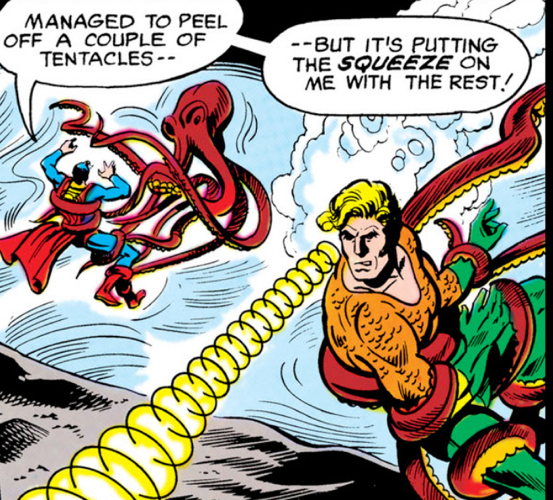
In the Aquaman team-up the King of the Seven Seas and the Fella in the Red Cape must join forces to defeat super-intelligent octopuses, which, sure, okay:


Of note, Aquaman uses his telepathic ability to control his unconscious body, citing the evolutionary connection to ancient sea life humans (and also, luckily for ol’ Arthur, Kryptonians) have. Pretty sure this is something Grant Morrison eventually picked up on decades later in JLA, if I recall correctly.

Anyway, point is, it was a perfectly fine, if odd, Superman story where he teams up with Aquaman. Superman does his thing, Aquaman does his watery stuff, the menace is defeated, and there, we’ve got a comic book. All very surface level (er, so to speak), basically shaking action figures at each other, but sometimes that’s what you need from a superhero comic to kill a few minutes.

Now the Atom team-up is just about as outlandish…the Atom, while visiting the past of 100 years ago, sees Superman there gettin’ killed by some alien invaders, and then he, Supes, and Professor Hyatt (who owns the time travel device the Atom had been using) return and try to solve the mystery. This also ties into an ongoing subplot from a previous issue I had read as new, involving the mystery of Superman’s ancestor Var-El.

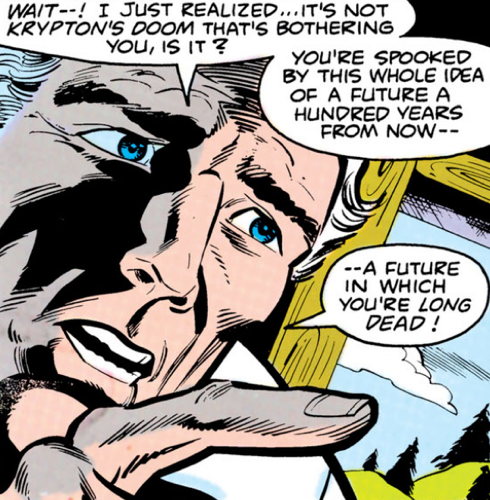
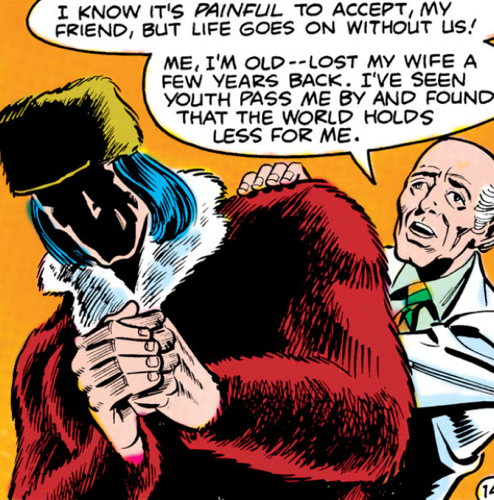
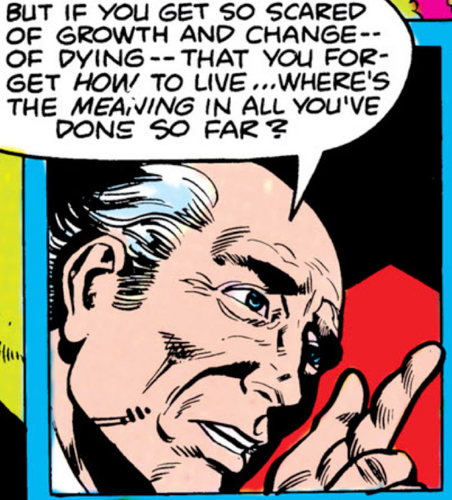
Stuff happens, the professor gets separated from the heroes, and he runs into Var-El his own self, living as a mountain man in this time period (hence the get-up you’ll see). The professor tries to get Var-El to speak to his descendant (after spilling the beans about, oh, his home planet exploding), but Var-El is reluctant. Which leads to this exchange:


And that…was a bit of unexpected depth that caught me by surprise in what I thought was going to be solely another “how does this combination of super powers solve this situation?” plot. Some thoughtful comments on dealing with age and the knowledge that the world doesn’t stop when you do? There’s a conflict you don’t often see in the pages of a superhero comic.

It’s not much, just a few panels, but it gives the proceedings a little extra emotional depth, some weight behind the time travel and aliens and all that hoohar. And that made all the difference. The Aquaman team-up was fine…silly and weird and enjoyable with nice Irv Novick art, but ultimately empty calories. The Atom team-up, with just that slightest pensive touch, is a story that sticks with you maybe a little longer than simply dissipating as soon as you closed the covers.

Just so we’re clear, I’m not saying the Aquaman story is “bad” or “inferior” — there is absolutely a place for a plain ol’ all-plot, shallow-as-a-sidewalk-puddle story with a big gimmick (Aquaman “controlling” Superman’s boy telepathically) to sell it. But it’s nice when that emotional content gets in there, too. And I wonder, if I’d read this at the age of 13 when it was originally released, if that bit in the Atom book would have hit me as strongly, as opposed to reading it for the first time now as I approach 52. I suppose I may know the answer to that already.

Oh, and by the way, the Var-El storyline gets wrapped up in issue #74 of this series, which I also hadn’t read yet. Guess that’s next up!


DC Comics Presents #48 (August 1982) by Dan Mishkin, Gary Cohn, Irv Novick and Frank McLaughlin

DC Comics Preens #51 (November 1982) by Dan Mishkin, Alex Saviuk and Frank McLaughlin

Yes, I know “semi-unique” doesn’t really mean much of anything.


So I read the original Savage Dragon mini-series back in ye ancient tymes, in my samplings of the early Image Comics releases. (For the record: read Spawn ’til about issue 20 or so, wasn’t interested in Youngblood (sorry, Rob!), found WildC.A.T.s incomprehensible, Shadowhawk was…well, it wasn’t normalman.) I thought Savage Dragon was probably the best of the bunch, but I didn’t follow it past those initial installments, for reasons more to do with my personal budget than anything about the book itself.

Now as it turned out, of all the Image books, it was ol’ SD’s creator Erik Larsen who the the greatest staying power, writing and drawing all 252 issues, and counting, of the title…evening including doing an extra issue to kinda/sorta “replace” an issue of the run done by a guest team. (Details here.) It’s a incredibly impressive run by a single creator, who’s maintained his personal vision on this book, and isn’t afraid to really changes things up on a regular basis.

All of which makes me wish I’d kept reading from the beginning, but What Can You Do? I’m glad it exists, I’m glad Larsen’s able to do this on his own terms, and I hope he’s able to do it for as long as he wants.

Now since that initial mini (and I think the first issue of the monthly series), I haven’t picked up very many of the series. There were one or two specials along the way, where Mr. Dragon would occasionally cross over with characters of interest (like Megaton Man, Destroyer Duck, or Marshal Law), and I think I glommed onto a Free Comic Book Day issue or two, however many there were.

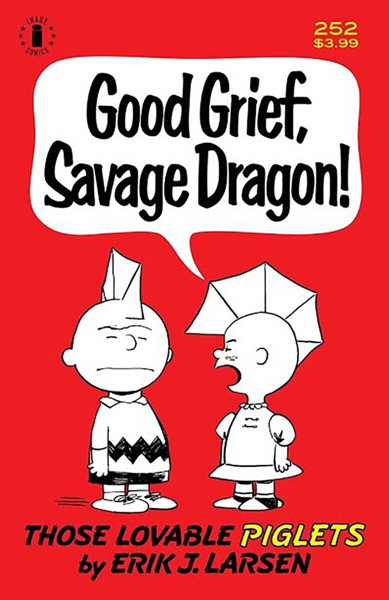
At long last, I’ve had another reason to pick up an issue, this time an actual issue of the series rather than a spin-off, as it intersected with a couple of my interests. Pictured above is the second printing of Savage Dragon #252, released this week, with a cover image of what should be obvious inspiration. Now, I may not as big a Peanuts fan as some of my friends, I still do love them enough to be properly amused by this cover and want to have a copy for myself.

the other interest of mine this comic tickled is “comic strip parody,” which fills this publication. Dick Tracy, Calvin and Hobbes, Little Nemo…even Tumbleweeds. Tumbleweeds. Who parodies Tumbleweeds in this, the Never-Ending Year of Our Lord 2020? Well, Erik Larsen dood it, right here in this funnybook. That’s all I need, friends, and this book is at home, waiting for my full perusal. Looks like it’s stand-alone enough so I hopefully won’t be too lost with any specific references to regular continuity. But the cover alone is fun bit of parody and, as they say, worth the price of admission.

• • •

Now you folks had a lot to say in response to Monday’s post, and I do want to address more of what you all said soon, which I have a little more time and energy. But let me at least say something in regards to this question from Thelonius_Nick:

“You’ve mentioned ‘local market conditions’ several times on your site in the past. Are there really back issues that might be systematically more common in one part of the country than another? Not just a random issue here and there for whatever reason, but something structural, like maybe Flash is all over stores in Oregon because they like track there?”

I have to admit, “local market conditions” is more of a caveat, an acknowledgement that my own personal experiences in terms of comics retail and such are not necessarily universal, or perhaps unique, or semi-unique, to whatever it is I’m doing. It’s not really exact knowledge of what’s going on here, there or anywhere, but it’s my assumption that there are countless variables involved in retail than can affect sales or demand for certain products in one place that may not be duplicated elsewhere.

Now admittedly, there can be a sameness across the retailing board regarding certain trends…ask your local funnybook slinger if he has plenty of copies of Teenage Mutant Ninja Turtles: The Last Ronin #1 floating around, and watch him/her/them sigh deeply. Or maybe there’s a shop that is just swimming in copies of Last Ronin somewhere, wishing he could get rid of them. That would be a difference in local market conditions!

I remember talking to a shop owner in the Los Angeles area sometime around…1990, I guess, where he mentioned he couldn’t move any copies of Legion of Super-Heroes. I was like “whoa, we sell lots of those!” which 1) probably shouldn’t have rubbed the poor guy’s nose in it quite like that, and 2) clued me in to the idea that not everything sells equally everywhere.

Another thing is that I’ve taken to pricing first issues on certain comics maybe a buck or three above the guide value. I can put a full run of U.S. 1 in the new arrivals boxes, someone will come along and snap up that #1, leaving me with the rest to languish. If I’m going to sell one and not the rest, I’d better get better value for the one I do sell. I’m sure not everyone does that, and I’m also sure some folks price ’em up even higher than I do. More of them local market conditions.

Or some days, maybe it’s just raining. A local weather condition that affects the local market condition.

Okay, that’s just me being silly. But you provide several other examples in your question, Mr. T. Nick, and all of those are just as valid. You never know what can mess up or bolster sales. That’s what makes this business so fun! Or “fun,” as it were.

Happy Anniversary, Happy Anniversary, Happy Anniversary, HAAAAAPY Anniversary!

I’ll be back to regular posting tomorrow, but did want to pop in now to let folks know that today is the sixth anniversary of my opening up Sterling Silver Comics for business. Thanks to all of you who’ve expressed your support over the years, starting with my initial announcement here all the way ’til today. It means a lot to me that I’ve had so many of you wishing for my success. It has its ups and downs (especially this year!) but running my own business has been rewarding and fun, and I’m sorry it took so long to finally make the jump.

Again, thanks to all of you, and I’ll be back tomorrow with your regular dose of industry talk mixed with silliness.

Yes, I’m complaining about that again.

So I had one of my longtime customers ask me the other day what my thoughts were on the collector focus and increased pricing on newstand editions of certain comics versus those that were sold through comic shops. By and large, the only difference between the two are the UPC codes, where the one that went through traditional outlets like newsstands, convenience stores and the like would have ’em, and comics sold in the direct market either didn’t have UPC codes or had the UPC marked “Direct Sales” to differentiate from the other.

Now, my personal feeling is that pricing on the two variations of a comic, newsstand or comic shop, should be the same so long as the only difference between the two is the UPC code. If there are other variants, like different cover images (like Amazing Spider-Man Annual #21) or other changes in details about the comic (like the “9 cent” Fantastic Four having the regular cover price for newsstands), then maybe, sure, there may be some variations in pricing.

I did briefly posit that this newsstand/direct disparity in back issue pricing felt like it was a trend of forcing something into collectibility, but the customer noted something about that I hadn’t considered. That said forcing of collectibility was coming about because actual older collectible comics are in much shorter supply than they used to be. Golden Age, and even a lot of Silver (particularly Marvel) don’t just drop out of the sky every day like they used to. Maybe, he theorized, collectors are trying to make some silk purses out of their boxes full of sow’s ears by claiming some of the comics they do have access to now have some extra value accrued to them.

Now technically, I suppose newsstand editions are “variants,” particularly in latter days when newsstand distribution of comics dropped and new comics were primarily available through comic book stores. As my customer suggested, in earlier years, newsstand distribution was, of course, much higher, but as soon as UPC codes started being affixed to periodicals in the late-ish 1970s, we were at the beginning of the end for that form of distribution as comic shops took over.

As a result, newsstand editions were in less supply (and also more likely to end up in the hands of non-collectors, who were apt to destroy or damage the comic beyond collectibility, effectively removing it from the secondary market ecosystem). Even in cases like Alf, which apparently sold extremely well on newsstands versus its fairly moribund movement in comic stores, seems in short supply for these reasons. I mean, I’m just making some assumptions here, based on my observation of local market conditions…for all I know the state of Vermont is flush in Alf comics, the streets of Burlington just swimming with copies of the Alf Holiday Special.

I’ve seen this sort of forced collectibility before…in fact, I see it a lot now, as I get phone calls and walk-ins requesting copies of whatever the Hot Book of the Week is, usually featuring the first appearance of whomever, which is already listed for get-rich-quick prices on eBay. Remember when folks were all frantic about the first appearance of the Gold Lantern in Legion of Super-Heroes? …Yeah, I know, “who?” Anything that even feels like a first appearance of somebody is an investment potential…but not every first appearance, so don’t bother trying to order lots of copies ahead of time, because you won’t know for sure you’ll need them ’til the day of release which is when everyone will start asking.

And it all depends on “supply,” too. I could order extra numbers of all the later appearances of Gold Lantern…but so could everyone else, and now that it’s readily available, no one’s interested. Or that recent “X of Swords” event for Marvel…early issues were in high demand, because orders on it were generally low. That same demand hasn’t turned up for newer installments, ordered in numbers based on all the folks clamoring to for first installments, a lot of whom didn’t come back for the rest. Even restocks of those “hot” first installments have barely moved, now that anyone can get them.

I’m getting a little off track here, ranting about things I’ve already ranted about, as per usual. Back to the increased pricing on newsstand books…look, I can see why, particularly in cases where newsstand sales were less than the same book’s direct market circulation. It’s just after years where the conventional wisdom was that the two versions were priced the same, and now they’re not. As an old person, I hate change, but I suppose I need to get used to this new paradigm sooner rather than later.

Hey, I eventually got used to using “Bronze Age” (once described in Overstreet’s glossary as “widely unaccepted”). I use it fairly freely now…but I’m still drawing the line at Copper Age. I mean, c’mon, honestly.

You’d think at some point in the ’60s they’d have published Jughead’s Freak-Out, but no.

As noted by the folks in the comments to my wishing for reprints of Jughead’s Folly and Jughead’s Fantasy…lo, they were indeed reprinted. Folly was reprinted, apparently in its entirety (as there were more stories than the “Jughead becomes a rock star” lead) in the Best of Archie Comics #3 digest/book from 2013, and again in the Archie 75th Anniversary digest from 2017. Likewise, the three issues ofJughead’s Fantasy have been reprinted multiple times from the 1960s into the 2010s (and I’ll let you look at the individual entries for that info).

So my hasty supposition that Jughead’s Folly not being reprinted, and my inference that Fantasy also had not, was completely incorrect. Look, not everyone has the time to put in the whole 10 seconds of research it would have taken me to find this info out in the first place.

I suppose I could probably seek these reissued forms of the original stories…comic book sized preferred, as my aged and long-distressed eyes are no longer up to the challenge of digest-sized comics. I realize there’s no real difference in reading the story in a more recent comic versus reading it in its original release, but I just plain like the look of Archie covers from that period. I’m gonna be one of those guys who’s got to have the originals for their look ‘n’ feel.

A second choice would be “facsimile editions,” like what Marvel and DC have been doing of late. Just more or less exact reprints of the original comics, except on better paper and a higher price. I’ve picked up a handful of those over the last couple of years…they’re fun to have, and that way I can get a copy of the comic without taking something out of the shop I might actually be able to sell for money.

Third choice would be a some kind of handsome hardcover or softcover, which would hopefully include full-color and full-sized reproductions of the covers (and not just little thumbnails on the back cover).

I suppose a fourth choice would be digital editions, but frankly I’d rather have a physical edition. Even if, er, a digital version would be slightly easier for me to read now.

I don’t know…maybe I’ll get luckly and someone will bring all these Jughead comics into the shop for me to buy. I figure if my store is open long enough, every comic I want will eventually pass through! That’s my fantasy…or, more likely, my folly.

Spoilers for Batman: Three Jokers #3 herein.

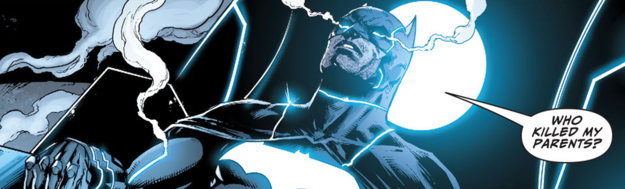
So in Justice League #42 (cover date September 2015, released July 2015), the following happens. Batman, gets a hold of Metron’s Mobius Chair, a repository of nearly every bit of information from across the universe that it was possible to obtain, gathered by the chair’s (former) owner.

Once he plants his Bat-butt into the seat, Batman decides to test the chair’s accuracy by asking it a question:


The chair makes some pinging sounds (pinging panels omitted from this brief recap) and delivers the answer:


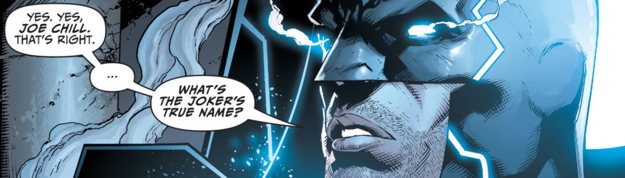
As you see there, Batman acknowledges that the answer was correct, pauses for a moment as he ponders his next move, then asks for the Joker’s “true name.”

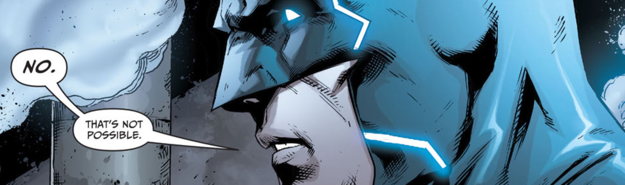
The chair beeps and boops further, before delivering a tantalizingly unseen answer to Batman, who responds thusly:


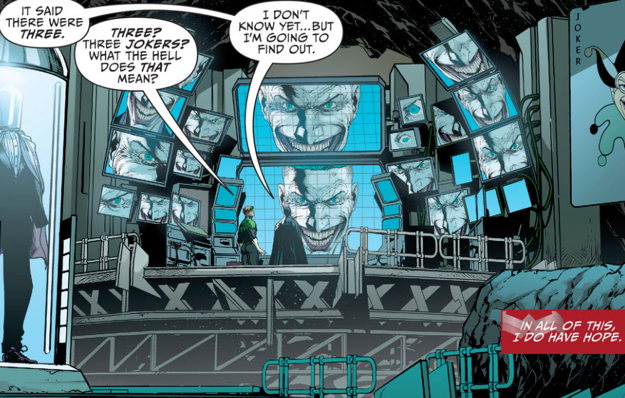
And how do you keep a sucker in suspense? We’ll tell you what Batman heard several months later in Justice League #50, cover date July 2016, released May 2016:


Now, cut to Fall 2020, where this Three Jokers business is finally being addressed in a prestige mini-series titled, what else, Batman: Three Jokers. I’ve gone on about the first two installments in the series, at length on the first issue here and I managed to restrain myself a bit for #2 here. The conclusion to the series is out now, and like I said in the title way up above there, there’s gonna be SPOILERS, so don’t come crying to me.

At first glance, the conclusion of Three Jokers appears inconsistent with the set-up in Justice League #42 shown above. Batman asks the Mobius Chair for the Joker’s real name. One of the big reveals in Three Jokers #3 is that Batman’s known the Joker’s real name all this time. If he knew, why’d he ask?

Well, looking back at the Justice League comics, I suppose there’s kind of an out. Batman tested the chair with a question he already knew the answer to (that Joe Chill was the murderer of his parents). Maaaaaybe, if you squint a little, one could claim that his next question about the Joker’s real name was also a test, to see if the chair would spit out the right name. The twist in that story is, of course, as we eventually find out, the whole triad of the Clown Prince of Crime thing.

The problem with that interpretation is that the comics do not read that way. In context it feels that Batman’s question about the Joker’s real name was made as a sincere inquiry, not a further test of the system. It’s…that pause before he asks, and the intensity with which he asks it. It doesn’t feel like a question being asked by a man who already knows the answer. It reads like someone excited by the chance at gaining knowledge he’s desperately sought and now finally has a chance to have.

That said, there is enough ambiguity to where both the Justice League stories and Three Jokers can remain consistent. When Green Lantern is prodding Batman in JL #50, trying to find out what the chair said, Batman evades the issue at first. He’s being deliberately cagey in relation to any questions about the Joker’s true identity, perhaps because of what we know now from the ending of #3. He doesn’t want to discuss the subject in order to protect….

…Well, yes, protect whom? So way back when, Alan Moore and Brian Bolland’s Batman: The Killing Joke gives us a backstory for the Joker, told in flashback and implied heavily to be the Joker’s own memories. We see a failed stand-up comedian who has agreed to participate in a crime to gain money to care for his wife and his as-yet unborn child. However, policemen find him sitting in a bar to inform him that his pregnant wife was killed in an accident…one of the tragedies leading to this comedian’s coming transformation. However, the text of that comic tells us the backstory as shown isn’t necessarily the backstory for the Joker, as his own memories are likely unreliable. But it’s the Joker saying this and he’s the very definition of unreliable, his narration saying one thing with the truth being another.

It’s left ambiguous in The Killing Joke, but that ambiguity is stripped away as, in no uncertain terms, it’s revealed that was very much the Joker’s backstory. That the pregnant wife in fact faked her death to get away from the now-revealed-to-be abusive comedian husband to raise her child, and that the Batman keeps the Joker’s name to himself to keep the media from tracking her down somehow.

Now…I’m okay with this conclusion, actually. I like the idea of Batman being smart enough to actually know who the Joker’s been all this time, and that he has good reason to keep it a secret based on information revealed in previous stories. Like I said, it does remove the uncertainty from Killing Joke, but, you know, eh.

Of course, that begs the question “if Batman was smart enough to know that, how was he not smart enough to know he was dealing with three different people saying they’re the Joker?” Especially since at least one of them looks like he’s drawn visibly older than the others. Whatever process they’re using to make more Jokers is making them physically identical, I guess? I don’t know, Batman’s being bamboozled by this ruse doesn’t seem to follow.

Also, as discussed in my look at the first issue, it’s said in-story that the Joker first appeared, quote, “decades ago.” But #3 has Bruce Wayne looking in on the Joker’s wife and son wherever they’re living out their lives…and the son appears to be, well, still a kid. Not 20 years old or so, as the “decades ago” comment would imply. I am presuming this is a flashback, but nothing seems to indicate as such, aside from the child’s age. Those panels aren’t colored differently, like the other flashback panels involving the Joker’s family. I mean, it has to be some kind of flashback to Batman looking in on them just a few years after they started their new lives. But that’s not what it feels like when you hit that point of the story.

It is snowing in that particular sequence, and I don’t recall if the current time of year was established for this mini-series, and that the snow was to imply a change in time frame (like sometime in the past). I just figured they were in Alaska, hiding out with Jesse Pinkman. (Um, spoilers for El Camino, too, I guess.)

Overall…I enjoyed this series for what it was, though whether there is any longterm impact on Batman comics from here on out remains to be seen, if it’s not just outright ignored. Jason Fabok’s art is gorgeous throughout, and I do think the thematic interweaving of Batgirl’s trauma from The Killing Joke and the Red Hood’s trauma from “A Death in the Family” was interesting. I like the symmetry of Batman and the Joker keeping each other’s identities secret for their own reasons. And as I said above, I think the big reveals at the end of #3 were fine. It’s just that the set-up, that there were multiple Jokers running around, requires Batman to be dumb, and nobody likes a dumb Batman.

Ah, well, I suppose we can look forward to the major work years later by some other creative team, reaching back to repurpose Geoff Johns’s story for the eventual “The Joker’s Son” special event. Turnabout is fair play, I guess. Maybe they can team up the Joker’s Son with the weird Clark Kent/Dr. Manhattan amalgam kid from the end of Doomsday Clock. Run with that, Future Hot Writer and Artist!

Actually, only ’til 1 in the morning this time.

Once again, getting a late start on the ol’ question thingie, plus I have plans for a Tuesday post here (WHAT!?!? GASP!) so let’s take a look at a couple of easier (i.e. “Mike won’t be typing ’til 2 in the morning”) inquiries here:

William Burns is on fire with the following

“Now that Big Bang Theory is receding into the mist of yesteryear, do people still do that “Where’s Sheldon” routine in your store?”

Come to think of it…it has been a while. And it’s not like 1) it’s been all that long since the series wrapped, and 2) it’s not like there’s not some cable channel that seems to be Big Bang 24/7, so it shouldn’t be out of our collective memory (no matter how hard some of you are trying to forget it, I know). I suppose it can at least be partially attributed to fewer casual passerby dropping in just to say their BBT remark that I’ve never, ever heard before and move on without, you know, buying anything, due to the whole Captain Trips bug currently ravaging the globe.

You might be inclined to believe that this is something of a relief to me, and to a certain extent, it is, as part of me was getting a little tired of hearing it. But on the other hand, as I’d said before and probably bears repeating, these folks weren’t coming in to say these things in a disparaging manner…they were actually amused, or happy, to see that such a thing as “a comic book store” actually existed, like the one on the television show they enjoyed so much. And as far as I’m concerned, anything that makes The General Public associate “comic book store” with positive feelings is just fine and dandy with me. Believe me, I spent plenty of years dealing with people who’d rather be doing the backstroke through the sewers than crossing the threshold of a comic shop, so I welcomed this shift in perception.

• • •

Daniel T tees up this one

“What back issue would you most like to own but know you never will? (And I don’t mean, like, a 9.0 Action #1. Something that is theoretically attainable but unlikely due to JUST being out of your price range or because it’s just hard to find one.)”

Please, a 10.0 Action #1! DREAM BIG, MY FRIEND.

Okay, seriously…I wrote on this site a long time ago (and frankly, I’ve been doing this site long enough that it’d probably be easier to note things I haven’t written about) about how lucky I was that I started reading comics when I did, which meant I got in on things on the ground floor that would later be harder to piece together (like Eclipse’s Miracleman. Or, something that occurred to me just the other day in fact, how lucky I was that I got into comics before the current wave of rebooting and relaunching beginning with Crisis on Infinite Earths, that I had a better sense of what had come before, and what changed after, as it was happening rather than trying to figure out what the hell happened decades after the fact.

As such, pretty much anything I was interested in reading over, say, the last thirty years, I bought new off the shelf. Anything earlier than that I was interested in, I was able to pick up at generally reasonable prices. For example, I’m glad I completed my run of all the original issues of Doom Patrol when I did, back in the early ’90s, paying what was probably only a fraction of the price I’d have to dole out today. Or getting most of Turok Son of Stone, including the earliest Four Color issues. Or buying all those Comic Reader fanzines at a dime a dozen.

So, a lot of the back issues I was seriously interested in picking up, I picked up. Which isn’t to say there aren’t a few white whales out there I wouldn’t mind getting my mitts on. Now, luckily, being in a comic shop most of my time, there is a non-zero chance something I’m actively interested in obtaining will float on in…for example, this Showcase issue introducing Dolphin. I’d been wanting one of those for years, and, whaddaya know, there it is. And stuff like that has happened then and again…an issue of Yummy Fur I’d been missing forever finally turned up, and that Virginian one-shot from 1963 came into my store not all that long ago. Oh, and I was gifted a new-conditioned copy of the original “black and white” Love and Rockets #1 as a store-warming present from Jaime Hernandez his own self, so I was able to scratch that off the list!

But there’s the stuff I would like, but expect will never make it into my hands. I mean, it’s not impossible, but not terribly likely. I’d sure like an authentic Cerebus #1 for my run of that series, but I’m going to have to be satisfied with this recent reissue, I imagine.

I actually had a chance at Four Color #178, the first appearance of Uncle Scrooge McDuck, when my former boss had one at my former place of employment, waaaay early on in my comics retailing “career.” I just couldn’t spring the, what, $175 or whatever it was at the time, and I’m sure I couldn’t spring the thousands of dollars that same copy would bring now. Well, not spending that kind of money and expecting to keep it, at any rate.

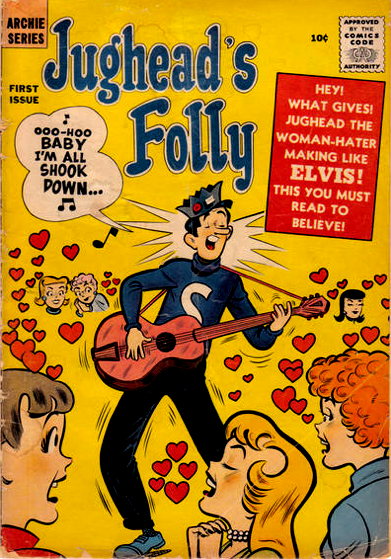
But I think the big one I would like to have, which, unlike those other two, I don’t think has ever been reprinted, is Jughead’s Folly, a single issue released in 1957:


I’ve actually read a copy of this that someone brought into the other shop long ago, but it’s been such a while that I don’t recall that much of it. But it’s basically Jughead (perhaps my favorite Archie character) as Elvis Style Rock Star, and it’s pretty amazing. And hard to find. If one came into the shop, I would totally throw money at the person selling it until it was mine, all mine, yes, my precious.

Though I wouldn’t thumb my nose at a run of Jughead’s Fantasy, either.