Mars attracts.

Chris crossed over with

“Here’s the thing I’ve found with Nexus, I’m a longtime fan, but if Steve Rude isn’t drawing it, it’s pretty much unreadable for me – same with American Flagg with Chaykin. Zot! Is probably one of my all time favourite series, love the colour and bw series.”

Steve Rude is, of course and will always be, Optimal Nexus. But I’m a little more forgiving of he guest-artists, I think…the character and setting designs laid down by Rude were so strong, that so long as you followed his lead to some extent, the visuals were passable. Like, that recent graphic novel release I was talkin’ about, Richard Bonk’s artwork was just fine. No, it wasn’t Rude, but it mostly did the job (the one confusing storytelling point I hit may have been just as much a scrip problem as anything else).

A couple of names I mentioned that had been guest-artists on the title include Paul Smith, whose tight, smooth lines were well-suited for the project, and Rick Veitch, whose penchant for strangeness accentuated the weirder side of the series. I know the artist who ultimately wrapped up the First Comics ongoing was…not a favorite, but even still I thought he did a passable job.

But the real lesson learned from this series is that, even if the guest-artists were talented, it was Steve Rude’s work that made the book sing. Most (but not all) of the post-First Nexii have been Baron/Rude collabs, which is why this most recent book with Bonk’s art came as bit of a surprise.

I will say Les Dorscheid, who colored many issues of Nexus, did a good job illustrating those painted covers on the regular series near the end there.

As to American Flagg! with or without Chaykin…I stated in a later post that I liked Staton’s work on the title, even if maybe it seemed a little too…”innocent,” I guess, in the face of all the shenanigans and goings-on in this book? Mike Vosburg worked perfectly well for me on the title as well, since, I mean, if you can’t get Chaykin, get Vosburg. The only artist on the book that put me off was Mark Badger, which, no offense, I liked him on other stuff, just didn’t care for him here.

“While we’re throwing out great 80s Indy series, let’s add Mars from First to the mix….”
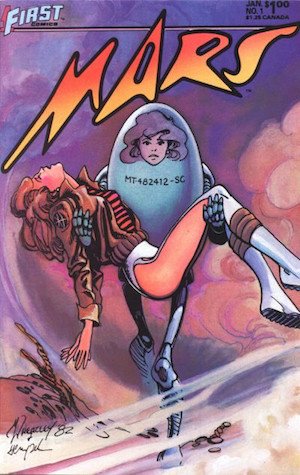
Ah, yes, Mars, by Mark Wheatley and Marc Hempel, released for 12 issue sin the mid-1980s. This was a favorite series of mine, marred only by occasional back-up features I didn’t much care about beyond wondering why they were eating up 8 perfectly good pages that could have been devoted more to Morgana, Dawn, and the mystery of Mars. That cover pictured here grabbed my attention (“why is that lady’s face also on the robot?”) and only set the stage for the more serious weirdness to come.

Back issues should be cheap if you can find them. There was a trade (and signed hardcover) goin’ on nearly 20 years ago from IDW, but that’s long out of print. It could stand a new reprinting…it was a beautifully-illustrated and plenty-odd story that would be nice to hand over to some of my customers.

It’s mindboggling to think how many series just like Mars are out there. Short-run comics with great talents and unique stories that came and went, forgotten save for the occasional flip-by in the bargain bins. I’m sure many a person zipped right past it in the dollar box or quarter box or whatever without ever realizing what was contained inside would be right up their alley. At least Mars did get a trade, even if it was a while ago. So many worthwhile books never even got that chance.
An impending beginning and an unfortunate ending.

I’ll be back to “1980s Indie Talk” in short order, but first I wanted to note a couple of things:

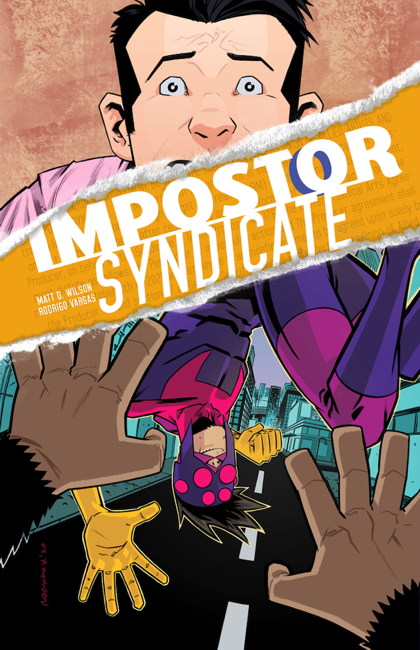
First, old internet pal Matt D. Wilson (whose melodious voice you hear every week on War Rocket Ajax) is raising funds to publish a new comic, Imposter Syndicate, via Zoop. Matt’s a good guy, the comic sounds interesting, the art by Rodrigo Vargas looks great, and I’ve already thrown in my support by pledging for the retailer multi-copy bundle!

• • •

Second, I am sorry to relate that writer Rachel Pollack is reportedly near the end of her life, and as a result folks are talking a lot about her tenure writing Doom Patrol. She was put in the presumably thankless position of following Grant Morrison on the title, and at the time I didn’t quite warm to her work right away, though certain individual issues (the Codpiece!) were a hoot. However, my plan had been to give her run a reconsideration, as I’ve been in the process of reorganizing my collection at home and have set aside my Doom Patrols as a whole for perusal.

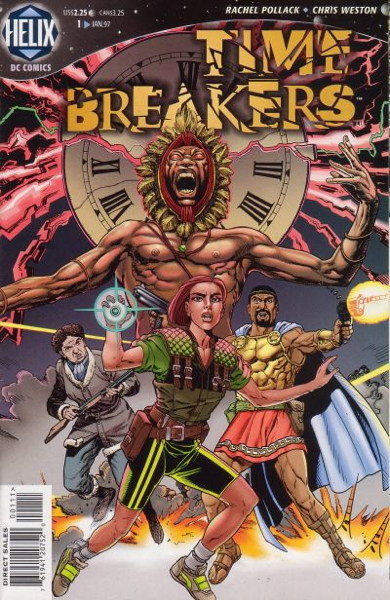
However, I hope people don’t forget the absolutely wild mini-series she wrote for DC’s short-lived Helix imprint, Time Breakers.

It’s an imaginative time travel adventure, and it’s a shame we didn’t get more than just this. Well worth seeking out, though it may be a little hard to find now. It’s not on DC’s digital app, so hunt through those back issue bins and bargain boxes, folks! I can’t even remember if there was a trade paperback for this. But find her comics if you can.

DC recently released an omnibus edition of Pollack’s Doom Patrol, so at least that should be easy to find.

Anyway, I’m sorry to hear Pollack is about to leave us…I hope she’s still capable of knowing about all the outpouring of love and appreciation for the work she’s done.

Grimjack and Dreadstar and Nexus, oh my.

MixMat swirls things around with

“Dont forget Jon Sable Freelance and American Flagg! though i’d stop when Grell and Chaykin stop drawing, their stories arent the draw-its when their creative juices are flowing and inspiring them to draw that both series are at their best. Sadly, Flagg only had 12 Chaykin drawn issues. Jon Sable Freelance had 30 or so beautifully drawn issues by Grell, with compelling superior stories too. Imnsho.”

Howard Chaykin was on American Flagg! much longer than that, though in general I think people hold those initial twelve issues as the peak of the series. Chaykin wrote and drew through issue #26, with guest-artists on #13 (James Sherman/Rick Burchett) and #14 (Pat Broderick/Burchett).
Issue #27 was the full-length conclusion to the Alan Moore/Don Lomax back-up stories that had run through the previous few issues. (And talk about your forgotten Moore work — not highly regarded at the time, if I recall, but I thought it was amusing.)

Then after that it’s Chaykin on scripts only (though still doing the covers), with Joe Staton and Hilary Barta on art chores for #28-30 (Burchett and Barta on inks for the last issue). Honestly, I liked Staton’s work on the book, but I typically like anything Staton draws anyway.

The next storyline is when Chaykin drops off the book entirely. Mark Badger and Randy Emberlin are on art, Chaykin scripts issue #31, with the script for #32 credited to both Chaykin and Steven Grant. #33 is by Grant and Badger, which remains the creative team through #37. Chaykin’s last cover was #30, with Badger doing cover illos for that run.

Chaykin comes back to covers with #38, with a story by J.M. DeMatteis, and Badger and Emberlin still doing the art. And than that remains the creative team (though Badger starts inking himself with #41) through #45.

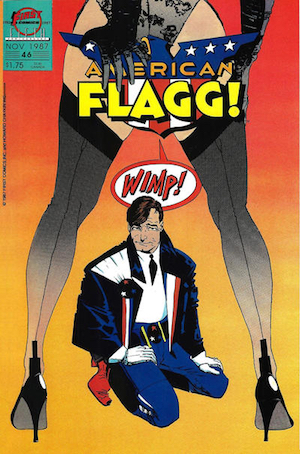
Issue #46 is the return of Chaykin to the interiors, as he starts to wrest the book back into shape, along with DeMatteis, Mindy Newell, Mike Vosburg, and Paul Smith. #47-8 features a Chaykin plot, with Newell scripting and Paul Smith drawing. #49 replaces Smith with Vosburg. Then the last issue of this series, #50, is Chaykin on script, Vosburg on art.

When then leads into the 12-issue Howard Chaykin’s American Flagg!, which I had remembered as being just all Chaykin, all the time, but issue #1 is Chaykin with Newell scripting, and Vosburg on art. #2 is Chaykin with John Moore scripting, Vosburg still on art with Richard Ory inks. That’s how it stays through issue #8. #9 is Moore as the sole script credit, same art team, and that’s how it goes through the end of the run. Chaykin and Vosburg collaborate on the covers in various combinations. I think this second run, while not being all Chaykin, was likely closer to his vision than the “in-between issues” on the previous series, hence the new title.

I have to admit, I checked out of the series myself during that first run after Chaykin left the book entirely, though I am tempted to go back and read those DeMatteis issues. I seem to recall it was specifically the direction the book took at that point that Chaykin sorta openly mocked once he was back on the title, but still, you know, I was the one guy who liked the Moore/Lomax thing, I suspect I can survive DeMatteis Flagg!

Now as to Jon Sable, Freelance…no, no, don’t run away, I’m not going to do the same cribbed-from-comics.org cataloguing like I did above. But I will agree with Mixmaster Mat that the series was at its best when 1) Grell was writing and drawing it, and 2) Grell was interested in drawing it, as there were a few issues near the end there where even Grell’s art was a little on the…flimsy side, shall we say. I think I dropped the book before Grell left, as I believe the art began to decline around the same time the cover price jumped up, so, you know, that was that. Those earlier issues still hold up, though, but I do have a fondness for this later issue.

“There was also Crossroads that kinda, sorta was First’s major miniseries Crisis type crossover, though i thought the art was dreadful.”

I enjoyed this series quite a bit, myself, though I was less interested in the first issue (teaming Whisper with Jon Sable) and more enthralled with the Grimjack/Nexus/Dreadstar final issue (by Mike Baron, Luke McDonnell and Val Mayerik) which was just about everything I hoped it would be. I do admit a fondness for the fourth issue (Grimjack and Nexus‘ Judah Maccabee) as it was drawn by longtime favorite Shawn McManus. Joe Staton drew an issue, Cynthia Martin drew that first one…I think overall these had pretty good art teams, but it has been a while since I’ve looked at them, so maybe I’m remembering them through a nostalgic filter. But, hey, everyone likes what they like, so who am I to judge. I stand by that last issue, however…it’s, as the kids say, a banger.

By the way, I have Zot! for sale at my store.

Thom H. asked, way back when last week

“These early ’80s indie superheroes happened just before I came to comics. I’ve always been curious about them, but a little daunted by all the starts and stops, changes of publishers, etc. Which would be the best/easiest one to hunt down all these years later: Zot!, Nexus, or Badger?”

Well, the easiest would be Zot! if only because 1) it’s just 36 issues (not counting the Matt Feazell one-offs), 2) it’s only from one publisher, and 3) I have 98% of the run currently available for sale at my store! And aside from this big unanswered question, it’s pretty much self-contained and comes to a reasonably satisfying conclusion. (Plus you can also read this webcomic for free, that takes place after the series.) They remain relatively inexpensive (especially the ones I’m selling!) and the trick is just tracking them all down (most of which are at my store, so that part is probably easy!).

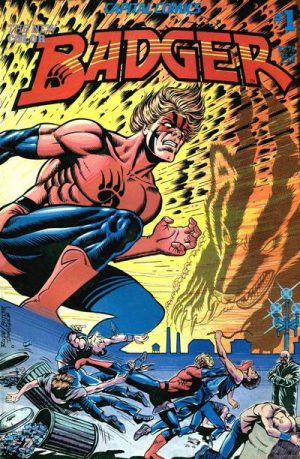
After that, The Badger might be the next-easiest to figure out, as all you really need is the original series itself (issues #1-4 published by Capital Comics, #5-70 from First Comics) and the Hexbreaker graphic novel, which is actually sorta important to the character’s development. There were several Badger things published after this series ended, but it my opinion they weren’t…quite up to the level of the initial series. But the good news is that if you do want to collect them, the very nature of the Badger character and his stories means that you can pick ’em up and read ’em pretty much in any order without worrying about things like “continuity.”
Even the original series itself is of varying quality, with the better material in the first half or so of the run. It actually sort of peaked in the initial Capital run, but there’s still some good material in later issues.

And then there’s Nexus, which, like Badger, began at Capital and continued to First Comics, but it’s a little more complicated in that Nexus started with three magazine sized black and white issues, then continued as a color series with a new #1. That color series transitioned over to First Comics starting with issue #7 and then ran ’til issue #80. Mostly good, the best issues are the ones drawn by co-creator Steve Rude but many of the other artists that fill in for him are very good as well (with only a couple of clunkers). Paul Smith draws a few issues, and c’mon, you know that guy is good.

It’s after that run ends that the onslaught of minis and one-shots start, and honestly you’re gonna need a Wiki or an FAQ or something to get those straight. Or just look it up on comics.org to figure out when which series was released and figure out the story that way. There are a lot of these tie-ins, however, so be forewarned. (God Con, a two-parter from Dark Horse, may be my favorite of the bunch — self-contained, drawn by Rude, and pretty wild.)

• • •

Anyway, there are more questions and comments from you guys over the last week or so that I still want to address, but I’ve reached the end of my blogging time for the night so it’ll all have to wait. Thanks, as always, for reading and participating, pals.

Deadbert.

So it was in the early ’90s, not long after Dilbert‘s debut and my discovery of the strip, that I did a circuit through all the local bookstores attempting to track down the handful of reprint books that existed at that point. Dilbert hadn’t quite become the huge sensation it was about to be, or at least word that it was a sensation hadn’t got around to those bookstores, as it took some doing to find those particular volumes.
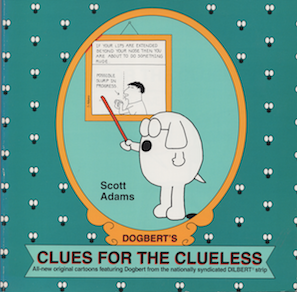
I believe there were only four of these books at the time, and technically one of them (Dogbert’s Clues for the Clueless, pictured here) didn’t contain reprints but rather was all-new material. I continued to buy these as they were released over the years, a few dozen publications that, as I just checked in my home library, occupy a good portion of a shelf. Along the way I had a Dilbert desk calendar, and somewhere I still have a squeezable Dilbert stress doll. I subscribed to the email newsletter. I watched the TV show adaptation (which surprised me by featuring an opening theme reworked from the Mystic Knights of the Oingo Boingo’s, and Danny Elfman’s, theme for the movie Forbidden Zone).

In other words, I was pretty much all in on the strip. It wasn’t unusual for me to want to track down all the reprint books for a strip I suddenly became enamored of. I came across a copy of a Foxtrot book completely by accident a decade or two ago, and I’m still buying those even now. I scraped together whatever money I had for each Bloom County reprint. I walked out of a mall bookstore with the then-latest Calvin and Hobbes I’d just purchased, only to run into a classmate who mockingly asked “why’d you get that?” “Because it’s awesome,” I told her. …And up until I kinda burnt out on the strip, I had every Doonesbury collection.

And that’s just a few. That doesn’t even bring up Peanuts (of which I had plenty, but the complete reprinting by Fantagraphics was a godsend), and my scattershot paperbacks of series that haven’t had the complete treatment yet (like B.C., the early strips of which remain wildly uproarious).

Like I mentioned regarding Doonesbury, sometimes I would say “okay, I’ve read enough” and just fall off buying the books. In Doonesbury‘s case, it wasn’t anything specific that turned me off. I still liked the strip just fine. It may been as simple as “I didn’t have the budget to keep going.” But for whatever reason, I stopped, though I do occasionally wonder what those characters are up to now, and kind of miss getting the year’s worth of continuity (or however long it was) in a new volume to plow through.

Dilbert had what one could charitably say was a “utilitarian” art style, just barely as good as it needed to be to deliver the jokes. As the strip continued and evolved, that art’s early quirks and inconsistencies eventually coalesced and smoothed out into a consistent style, one that maybe perhaps wouldn’t be lauded with the grand masters of the form, but at least had a level of professionalism that made it look less slapdash.

And the jokes were usually pretty good, and the characters were amusing (the put-upon title character, the hapless boss, the cunning Dogbert, and my favorite, the perpetually industriously-lazy Wally), and the strip kept my interest for many, many years.

Perhaps more years than I really should have.

There was…something the strip’s creator did, or said…I forgot what, exactly, that made me feel a twinge of guilt the next time I ordered a copy of the newest reprint volume. I think there may have even been a strip or two in that book that addressed whatever it was, in a way that of course put the cartoonist and his point of view into the right. I lack the specifics only because I’ve never gone back to reread this book and more solidly affix this event in my memory.

I may have brushed this off as an example of “well, pobody’s nerfect!” and bought the following volume as well. But I stopped very shortly after that, I believe either in response to yet another thing he said/did, or simply because of my increased awareness of some of his opinions, as noted in this article about “The Metafilter Incident”, in which he pretended to be an online fan of himself to…do something, I guess.

So I was already off the Dilbert train when his latest hoohar, and apparently last straw for just about everyone, was unleashed. I know he’s saying nobody’s giving the full context of his comments (I mean, here’s the full context, but probably not what he was hoping for), but it’s his usual strategy: say something that gets him called out, claim nobody understands his genius and that his fourth-dimensional chess successfully baffled his opponents, repeat. It is, sadly, nothing new. And equally sadly, it’s something that took me a long time to realize.

It’s perhaps a little strange in this circumstance to mourn the loss of characters with whom you’ve spent a large chunk of your life. I’ll miss the more innocent times with them, and regret that wherever they go from here, it’ll likely be on a journey too distasteful to follow.

(NOTE: I’m leaving comments open, but I’ll likely have to delete abusive remarks by drive-by commentators. If you happen across any here, don’t bother responding…I’ll take care of them eventually.)

Sorry, pals…

…just wasn’t a blogging week for me this time ’round. Look, I’ve been at this site for nearly 20 years, I’m allowed to slide a little.

I’ll be back next week with Actual Content. Thanks for reading, and I’ll see you then.

The nexus between price and value.


Nexus by Mike Baron and (usually) Steve Rude has been one of my favorite comics for a long time, dating back to almost, but not quite, the beginning of the series. I started reading Nexus (and Baron’s other book, Badger) when First Comics started publishing them. Fortunately, this was relatively early in both titles’ runs, so picking up the relative handful of previous issues published by Captial Comics wasn’t so onerous a task. However, I did pick up First’s trade paperback reprinting the original three Nexus black and white magazines, instead of buying all the originals. (I did eventually get the third magazine, because of the included flexidisc.)

So anyway, I’ve been a fan for a long time, and look forward to any new material featuring Nexus. After a bit of a dry period, we got some serialized stories in the 2011-4 run of Dark Horse Presents (reprinted as the Into the Past TPB), the Nexus Newspaper Strips TPB (which I think reprints material produced through Kickstarter or something similar, someone correct me), and there was also that 3 or 4 issue run (depending on how you count it) published in 2007 or so by Rude himself.

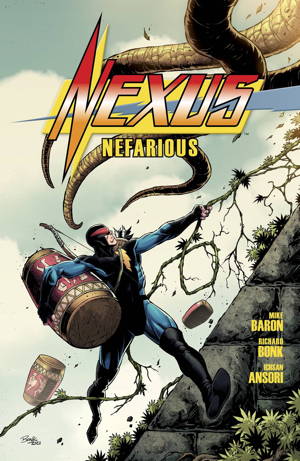
And then, this past week, we got a new Nexus graphic novel, Nefarious. It’s written by Baron, and illustrated by Richard Bonk, who does a good job, I think, and you can see sample pages over at Dark Horse’s site.

The story is relatively simple…Nexus gets accidenntally stranded on what amounts to being a prison planet without his powers. And, as it turns out, the prisoners may not deserve to be there. It moves quickly, with Nexus gathering allies (and encountering one strange old “friend” that I hadn’t expected to see again) and, probably not a spoiler, going after the person responsible for these unjust imprisonments (and worse).

It feels like classic Nexus, like the pre-First era, in that events are almost…dreamlike in their progression, no time is wasted on long exposition or explanations. Sometimes it is to the detriment of the narrative (like, I’m not sure entirely what happened when Nexus had to prove his identity to a pair of aliens early on…maybe I’m forgetting something from the original series involving that particular race), but overall it’s a fun read.

My main issue with this release is the format and cost. While it’s marketed as a “64 page hardcover” the story itself is 54 pages, with 8 pages presenting black and white copy-free artwork from that story, and a final page with an ad for the newspaper strip book. I know this is a format Dark Horse has used in the past, like with some standalone Hellboy stories (such as 2016’s 56-page Into the Silent Sea for $14.99), but $17.99 for this book seems…just a little too much. Maybe there are publishing and/or economic reasons for not just releasing this as a staplebound one-shot for, I don’t know, $6.99, where it would likely have stronger sales off the new comics rack.

I’m sure “longer shelf life” is a big part of it, and getting it into bookstores, too. But it was bit of a sticker shock when I saw that price. I’m not trying to pick on the Nexus book here, as this format at $14.99 I feel like was pushing it. $17.99 just seems like going a little too far, even with consideration for inflation and such. As a store owner, I have to consider perceived value, what prices would my customers consider reasonable for certain items. This has been a problem as comic periodical prices slowly creep up and up, but graphic novels have, at least, seemed to maintain that price/perceived value balance, more or less. It simply seems to me that this Nexus book is too far on the “less” side, which does a good comic a disservice.

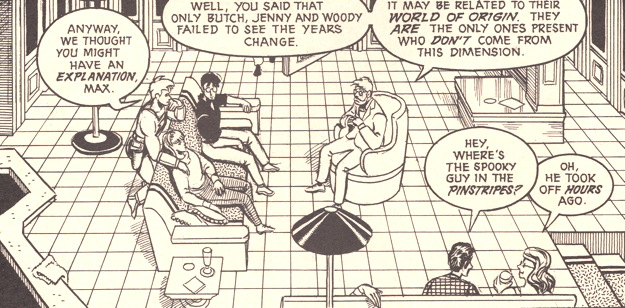
The “spooky guy in pinstripes” was 9-Jack-9, I have more to say about him in a later post.

So Zot! is a solidly satisfying read from beginning to end, not leaving you hanging at the end of issue #36 (or even really at the end of the webcomic), but there is one huge dangling thread left unaddressed. SPOILERS ahead for Zot! #27 (1990):

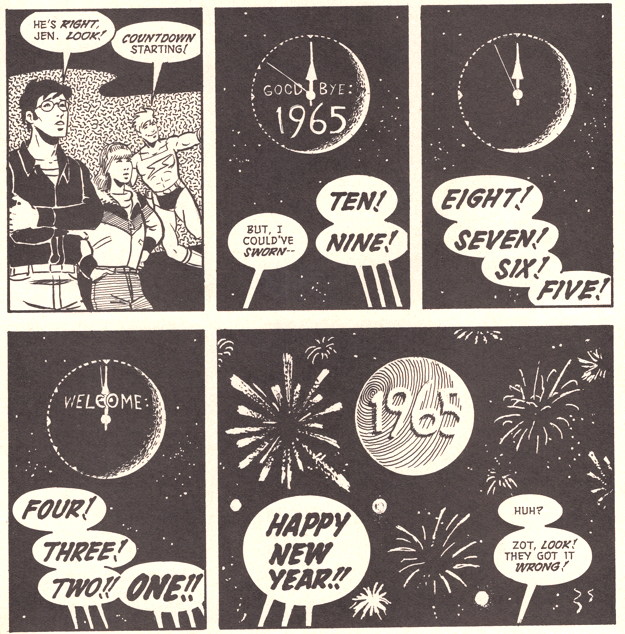
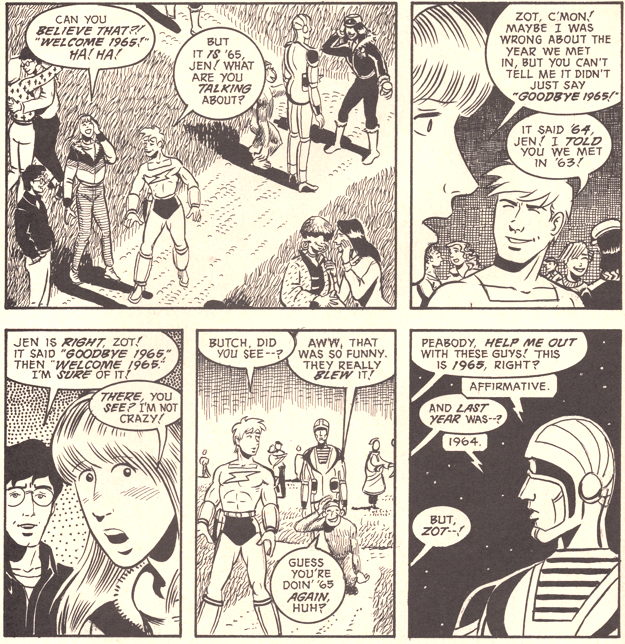
It’s New Year’s Eve on Zot’s Earth, and Jenny, her brother Butch (who is a monkey in Zot’s world, long story) and their pal Woody are visiting from “our” Earth to enjoy the celebrations. Everyone (or at least everyone with this particular view of the moon) watches the countdown, though just prior to this there is a discussion between Zot and Jenny as to when they actually met. Jenny believes it’s 1966 on Zot’s world, as the two met “a year and a half ago” when it was 1965. Zot says no, that was 1964, it’s 1965 now, and it’s about to turn 1966. And then….


It quickly becomes clear that everyone from “our” Earth saw the year “change” from 1965 to 1965, whereas everyone from Zot’s Earth saw something different:


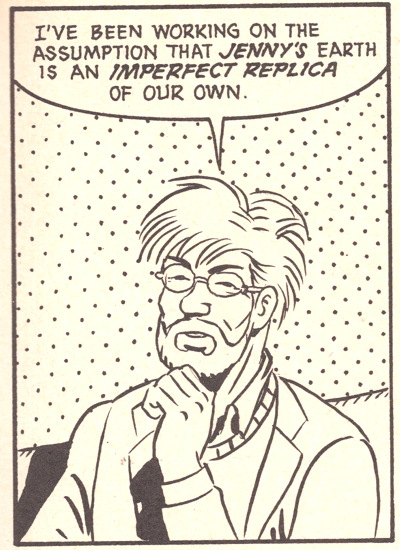
Later, Zot’s Uncle Max hypothesizes about what happened, addressing it in such a way that it makes it seem like there was something wrong with Jenny and the rest’s perceptions:


…which I always liked as a storytelling choice. From our presumably objection observation as “reader,” the information we’re given by the story is that the year did in fact fail to change. It’s possible we’re seeing it through Jenny’s subjective point of view, but I don’t believe there’s any evidence in-story to indicate what we’re seeing is “wrong.”

Max continues:


…which probably seems at least somewhat plausible to the characters in the narrative, since Zot’s Earth is a sci-fi wonderland and Jenny’s Earth still has crime and pollution and grape-flavored Gatorade and other serious problems.

It’s bit of a frustrating set-up, in that we’re left in the position of knowing there’s some kind of mystery here, and the assumption made by the characters contradicts the reader’s observations. And that’s where this particular plot element stops, as we’re off to the concluding run of “Earth Stories,” where Zot and Jenny are cut off from Zot’s world.

I was trying to find the particular citation, which I thought was either in the story itself, a reply in a later letter column, or in an interview with Scott McCloud, where it was said this revelation may point to an “artificiality” about Zot’s Earth, but I couldn’t find it in time for what passes for a deadline around here. But if what’s left of my brain is remembering that correctly, that may be our one clue as to what’s going on. The hows and whys and whats as to what would have made that other Earth (in opposition to Max’s idea) a copy of “our” Earth…who can say?

Well, Scott can say, but I don’t know if he ever intends to return to that particular milieu. (I have an idea how to bring it back, but unless I am somehow gifted the keys to that castle, I’ll have to save it for my extensive line of Zot! fanfic, where they all meet and hang out with their new best friend, the incredibly talented and handsome Spike Merling.)

Thus, fair warning to anyone coming to Zot! for the first time…well, one, you shouldn’t have read this, I warned you at the start, and two, you’ll end up thinking about this bit of business for the next 33 years, like a certain unnamed comics blogger/retailer might have done.

I did come across another potential future story idea addressed by Scott in the Zot! letter columns that didn’t (or not yet, he said optimistically) appear in a comic, but I’ll save that for next week! Tune in next time, same Zot! channel!

Also you should find a copy of McCloud’s Destroy!! while you’re at it.

Ray Cornwall asks regarding Scott McCloud’s Zot!

“I know there’s a trade of the B&Ws, but are they newer versions that should be read over the originals?”

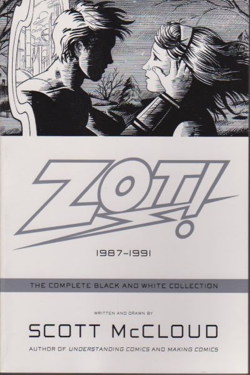
As of now, The Complete Black and White Collection remains the definitive reprinting of that run of stories. However, it should be noted that there’s a two-part story from issues #19 and #20 that was drawn over McCloud’s layouts by Chuck Austen that is not included in its completed form. Only McCloud’s layouts are included. Also not reprinted are “#10 1/2,” the mini-comic drawn by Matt Feazell, and the full-sized “#14 1/2” also by Feazell.

One caveat is that, while otherwise this book reprints these stories as they originally appeared in print, the actual page size of the paperback is slightly smaller than the original comics. That’s the only real major change between the two presentations. So if I get what you’re asking, Ray, no, it’s all pretty much the same.

I am not sure of the printing status of this particular volume…Diamond Distributors doesn’t have it, but it appears readily available from Amazon.

The color issues were reprinted in a single volume by Kitchen Sink Press in 1997. Needless to say, it’s out of print. I checked out Amazon and there was a copy for (egads) $195, but other copies were available for $35 and up, so shop around a bit here and on eBay and such.

There are two more volumes in this Kitchen Sink book series that reprint up to issue #27 (except for the Austen-drawn #19-20). These are pretty much supplanted by the Complete Black and White volume.

I should also point out that Eclipse Comics published a small trade of the first four color issues, in case you wanted to know.

So basically, if you want the complete print Zot! comics collection, either buy all the comics individually (most of which I have available for sale at my shop right now, almost all signed!), or you buy that first Kitchen Sink trade, the black and white collection, the original print copies of #19 and #20, and the two Matt Feazell thingies.

Print, I said. Which leads me to what adam has to say

“I discovered zot thru scott’s website in the 90s. has anyone ever collected that series? don’t know how youd print that amazing episode thats just about falling thru the sky tho”

Adam is referring to the Zot! webcomic published at Comic Book Resources a good couple and a half decades ago.

It’s never been put into physical print, especially that one chapter adam mentioned with the long fall panel, designed for scrolling on a screen more than being divvied up across several pages in a book. I suppose it could be put in a single hardcover or something, though, as Scott himself notes, the artwork is a little “jaggy” and may not present well outside this context. Frankly, though, I think it looks fine. Printing it with jaggies an’ all would give it a solid retro feel, I think!

So, Zot! — it’s good, you should read it!

• • •

Speaking of collected editions, the newest issue of Groo: Gods Against Groo, #3, has the latest word from Mark Evanier about reprint collections of our favorite The Wanderer. And that word is “they’re looking into it,” basically trying to find a print format that 1) won’t cost you all your kopins, and 2) wouldn’t break any bones if you dropped it on your foot.

My personal feeling is that mimicking Marvel’s current “Epic Collections,” which are thick softcovers that contain about, I don’t know, about 15 to 20 issues or so, and usually costing about $40, may be the way to go. There are, what, at least a couple hundred Groo comics, plus the two graphic novels, plus other appearances here and there. That is about the equivalent of around 13 or 14 of Marvel’s Epic collections. Feels doable to me, but I’m not a comics publisher who’d have to pay for all that and then, hopefully, keep them reasonably in print.

At least that seems within reason, and that Sergio and Mark are actively trying to figure it out is good news. Sergio Aragones is a master cartoonist and that so much of it is out of print is a real shame. Thankfully the individual issues remain relatively inexpensive when you find them, so at least there’s that if nothing else.