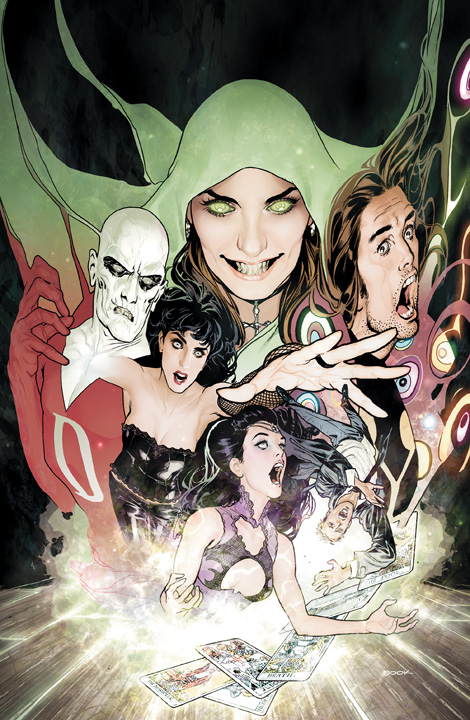
“Aye, ’tis an ill omen, Hellblazer.”

So, when I first read DC Comics’ announcement of Justice League Dark, a series teaming up John Constantine, Madame Xanadu, Deadman, and others to fight supernatural-type thingies:


…the first thing that crossed my mind was, of course, my most fervent hope that Constantine will be wearing the costume he had in Doom Patrol #53 (March 1992), the Jack Kirby parody/tribute issue:


If you claim not to want this as well, I shall call you a dirty, dirty liar.

…Also, apparently the new Swamp Thing series is official, written by Scott Snyder and drawn by Yannick Paquette. Well, that sounds like it might be good. I’ve not read anything by Snyder, but I know his American Vampire series is well-regarded, as is his recent run on Detective, and I’ve enjoyed Paquette’s work in the past. So…um, yeah, I’ll pick this up in three months’ time. But was there ever any real danger of me not picking up a Swamp Thing comic?

I wonder what it would take for me not to buy a Swamp Thing series. …Don’t say “if it were written and drawn by Rob Liefeld” because I’d buy the hell out of that.

images from (presumably) Justice League Dark #1, cover by (also presumably) Mikel Janin, and Doom Patrol #53 (March 1992) by Grant Morrison and Ken Steacy

I’m really not on top of this whole “digital comics” thing.

Just to clarify…I don’t really think we won’t get an Action Comics #1000 when the time comes. That’s still about eight or so years off, and I’m sure between the restart at #1 and then, DC will revert to the original numbering on at least some books, following Marvel’s strategy of riding out that sales boost from a new first issue, and replacing it with another sales boost by switching back the numbering just before a round-numbered anniversary issue. So honestly, that’s not a real criticism…I was just being facetious.

And speaking of the relaunches…pal Dorian pointed out to me that this line-wide reversion to #1s is more about creating a promotional push for the digital-release plans than about making any kind of sales improvement in the direct market. And…yeah, I hadn’t really been thinking about it from the digital side, but of course that makes sense. Pretty much no matter what, the direct market isn’t going to grow, or at least grow quickly enough to keep the publishers happy (brief spurts of media-driven sales aside). The primary print sales strategy of late is extracting more money from the same folks…no one thinks a half-dozen Avengers or Green Lantern titles are bringing in new readers. It’s just getting the same ol’ Avengers or Green Lantern fans to dig a little deeper (or, more likely, drop another marginal book) to afford yet another negligible variation on a title they’re already reading.

In contrast, the digital initiative could potentially reach a much larger audience that would never set foot in a comic shop, and the additional incentive of “hey, get in on the ground floor” with the first issues may help. Whether this leads to more readers seeking out print editions in shops, or just subsidizes the print editions to keep prices down for just a little longer, or whether anyone will bite at all, or whether it just saves the scans_daily folks a step, I’m not sure. We’ll see what happens, of course.

The pricing for digital releases has been announced, and just from my limited observation of the response, people don’t care for the price levels being offered. (Basically, same price as print edition, dropping a dollar after a month.) Of course, the general reaction to pricing for any online entertainment that’s anything other than “free” tends to be abject horror*, and I suspect at even the frequently-suggested 99-cent price point there wouldn’t still be some headshakers moaning “too much, too much,” but…well, not sure what people were expecting. If DC undercut the comic shops, retailers would’ve raised holy hell, I’m sure, and they can’t afford to alienate those folks just yet. Especially if this whole digital thing falls flat. But…yeah, it could be over before it begins if people reject the pricing.

Boy, some insight, huh? “IT’LL WORK UNLESS IT DOESN’T.” Man, I have no idea what’s going to happen. My gut feeling is that print sales will bump up briefly, then fall back to normal, with a lot of culling of the weaker titles right quick, while digital sales will be okay, but not outstanding, with pricing being cited as the primary obstacle. Maybe a discounted digital subscription will be offered as response, assuming it can get by under retailers’ radar. Basically, I see business being as usual, with a few months of annoyance all around mixed in there while everything shakes out.

Anyway, you probably have seen DC’s announcement of some of the new titles and creative teams, and…well, surely this will be the Aquaman series that will catch on! And as a Firestorm fan, I’m looking forward to another series with the character, especially one written by Gail Simone.

There’s a new Hawkman series, too, and this is one of those cases where a full-on from-scratch reboot would probably be doing the character a favor. Hawkman doesn’t need the last couple of decades’ worth of mishmashed continuity issues weighing him down…he just needs to be awesome. “Flying dude dressed as hawk fights crime with a mace” – that’s all you need, man.

However, if you want a complete list of all the titles from The New DC, I believe Bully the Little Stuffed Bull might have that for you. #27 is the best. The. Best.


* I’m exaggerating slightly for humorous effect. Please do not “um, actually” me, or I will have you…dealt with. Remember, I’m friends with a stuffed bull.

I’m not going to be terribly happy if this means I won’t see an Action Comics #1000 in my lifetime.

So I’m guessing most of you have heard by now about DC Comics’ plan to restart all their superhero series from #1, along with some attendant retoolings and revampings (and not a line-wide rebooting of every single character from scratch, as had been assumed). Basically, it looks like they’re slapping a new coat of paint on everything, giving some characters new costumes, and giving folks new jumping-on points. And there’s the same-day digital releases that will be available for all these series as well, which…well, as a funnybook retailer, I’m not entirely sure how I feel about that, but that’s a whole ‘nother issue I’ll get into at some later date.

But first…fifty-two new number ones in a five-week period, during the traditionally-slow sales month of September, in this economic climate where the cost of a new DC comic would also get you most of a gallon of gasoline…that’s a bit intimidating, when you first look at it. But I suspect most readers will just carry over with the titles they’re already reading as long as they don’t change too drastically. If you’re enjoying Secret Six at number…what, #36, maybe it’ll be at when the reboot hits, then I suspect you’ll still enjoy it when you pick up the new #1, assuming the creative team remains relatively intact. And if the comics are good and you enjoy them, then it shouldn’t matter if it’s issue #1 or #801.

Of course, the problem with creating new jumping-on points is the oft-stated fact (at least by me) that they’re also good jumping-off points, which is a bad idea particularly now with, as I said, the current economic climate. Some people are itching for reasons to drop books, but they hate to quit in middles of stories…give ’em a definite ending, like wrapping up the series in preparation for a relaunch, they may split and never come back.

And then there are the series that just recently started, like Batman: The Dark Knight. At this point, with #3 of this series running behind, they might as well just throw a #1 on that issue and wait ’til the relaunch to put it out. I’m also assuming in-progress mini-series like DC Universe Online Legends aren’t going to restart with #1s in the middle of their runs. Could be wrong. Have no idea.

Speaking of late books, with all the series restarting at #1 at about the same time, it’s going to be that much easier to spot the comics having scheduling problems in a few months. When everyone’s at issue #11 or #12, and, say, Detective (to pick one at random) is at issue #7, that’s gonna stand out.

Of course, the news was only announced yesterday, so it’s a bit early to enter panic mode. Obviously I’m just blathering on here with my immediate reactions to the announcements. However, I am curious as to how the various series and characters will be altered, and am particularly interested in the effect of this initiative on some of DC’s long-running projects, like Grant Morrison’s Batman Inc.. That’s a franchise-wide rejiggering of the Batman concept that seems like it still has a way to go before its eventual resolution and return to the status quo…I’m guessing it’ll be carried over into the relaunched titles, and not cut short, but again, I don’t have the details.

While I’m curious as a fan about what DC is doing, as a retailer I’m a little worried. Not just about the jumping-off point thing I noted already, but also about how I’m going to explain this to the customers who are going to be caught completely by surprise by DC’s plans. I know it sounds strange, since all of you reading this are plugged into the Web Matrix-style via interface ports at the bases of your skulls, but I have regular customers for whom their exposure to comics news comes from walking into the store and looking at the rack to see what’s new. I can hear them already: “Hey, why is Superman at issue #1 again? And Batman? …And, hey, Legion of Super-Heroes? Again? What’s going on?” Which is fine…that’s part of my job, to explain what new dumb thing a comic publisher has done to confuse and frighten its readership this week.

But as a pal of mine noted to me in email, if this particular publishing initiative falls flat on its face, where does DC go from there? This is an awfully drastic and wide-ranging strategy that won’t be easy to reverse without some consequences. And not just of the “fans and Marvel Comics laughing at DC’s failure” kind, but having highers-up at Warner Brothers looking at the crash-and-burn and thinking “that didn’t work, so why are we bothering with these pamphlet-thingies? Let’s just do cartoons and movies with these characters, and make some real money on them.”

Hopefully, this all doesn’t mean that we’re one step closer to the answer to “comic books? They still make those?” being “no.” Yeah, yeah, I know people have been predicting the end of comics (at least, the “mainstream” Big Two comics) for years, but this feels more like an end-of-their-rope/nothing-left-to-lose move than normal.

Most importantly: if this screws up Swamp Thing’s return to comics, I’m going to be pissed. Unless all the series are being revamped to include Swamp Thing, which I’d be okay with. Swamp Thing and the Outsiders, Batman and Robin and Swamp Thing, Swamp Thing Corps…you know, like that. Gotta keep my sense of perspective.

“…He stands in imminent peril of becoming the eternal pawn of THE INFERNAL ONE.”

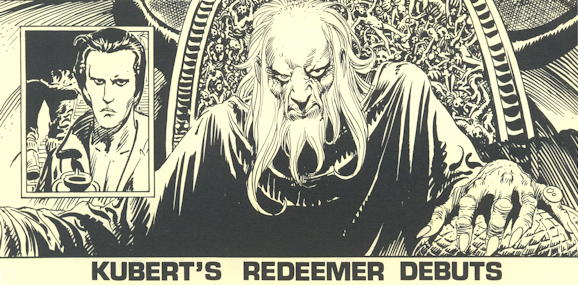
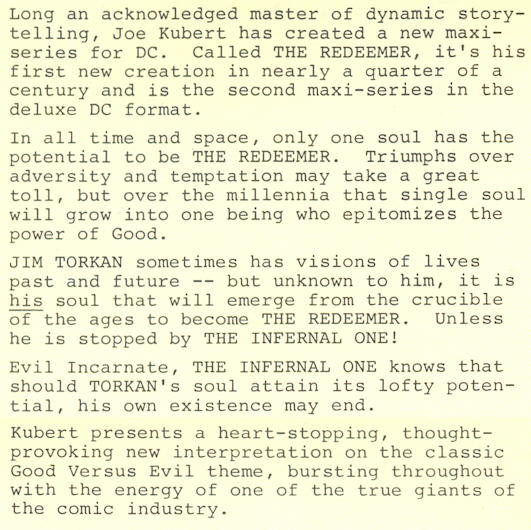
I have an odd fascination with the unpublished Redeemer series written and drawn by Joe Kubert, and originally intended for release in the mid-1980s from DC Comics. It may be because it was one of my early encounters with the comic book version of “vaporware” – an advertised and hyped product (prominently featured in a favorite comics ‘zine at the time, Amazing Heroes, containing several completed pages of the first issue) that ended up never appearing.

At the shop, we newly uncovered another old box or two of promotional comics material, including a handful of DC’s “Coming Attractions” flyers listing forthcoming funnybook releases, dated October 1983 through January 1984. The front page feature of the October flyer was Redeemer:


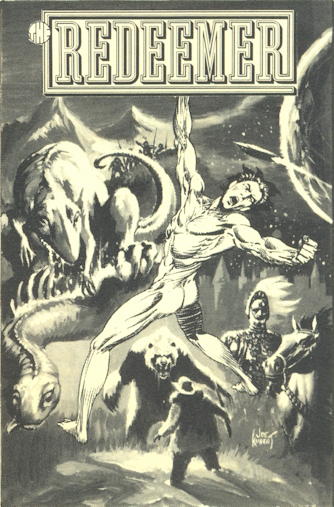
And here is the specific information for the first issue, including what I’m assuming is the cover, though I suspect some kind of, um, Speedos or something would have been colored onto the final product:


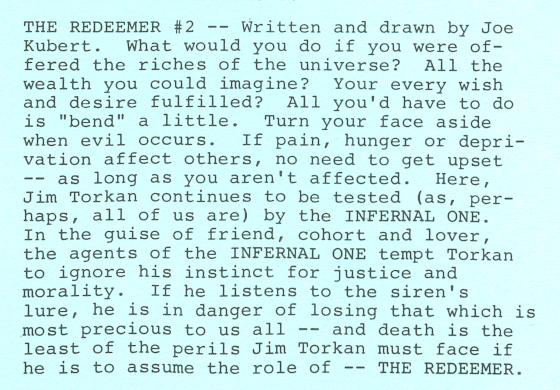
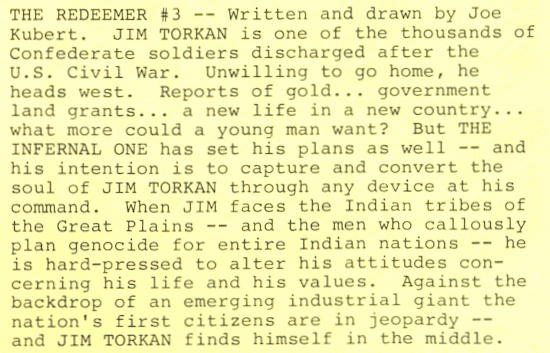
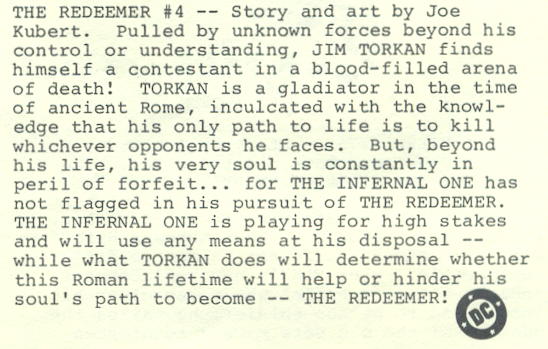
And over the next thee installments of “Coming Attractions,” we get the info for issues #2-#4:


No idea if it got any farther than that before folks realized this series wasn’t going to happen and, hey, we should probably stop telling people about it. But reading those descriptions…just picture Kubert drawing all that. This would have been one crazy and beautiful-looking series.

Bob Rozakis writes briefly about the series’ demise, citing, among other reasons, complaints regarding the religious connotations of the title. (Wonder how those people reacted to Preacher?)

This interview indicates that the completed Redeemer stories may yet appear in a forthcoming Kubert anthology series. Can’t wait to see ’em. (Also, Kubert is doing a new Hawkman story for this anthology series, and I know you folks want to see that!)

"(GASP!) EEEE EEAIIIIIEEE!!"

from Adventures into Darkness #14 (April 1954)


Someday I’d like to see a collection of all the space-filling short humor strips used to fill out comics back in the day. Also…was this Weird Watson’s only appearance? How can you not love that guy?


What fresh hell is this? Weekly World Newsshutting down? Bat Boy…homeless? Ed Anger…even angrier?

Weekly World News has had several connections to the comic book world, such as editors Paul Kupperburg and Bob Greenberger, writer Andy Mangels, and, of course, Peter Bagge’s run of initial “Bat Boy” comic strips, among others.

The supermarket just won’t be the same without Weekly World News staring back out at you at the checkout line. Another little piece of Americana slips away.

(First spotted via Metafilter.)


A couple more follow-up questions from the ’90s bust discussion:

  • Commenter Phil asks

    “One thing I’ve started wondering about your memories of the speculative boom – how much cash would your average collector buying multiple copies for investment value actually have sent down the toilet, in terms of purchase price versus current value?”

    That’s a hard question to answer. Well, maybe not…the general response would be “a lot,” but it would depend really on what multiple copies they purchased (and assuming they kept them in sellable shape, which, as I noted Friday, was rarely the case).

    But even if they did end up investing in a boom-era comic book with some current demand and a reasonable aftermarket price — say, for example, Spawn #1 — is the 30% to 50% (if you’re lucky) of that aftermarket price you’re going to get by selling it to a dealer, or on eBay, worth the fifteen years you’ve stored them? And if you have a lot of them, you might run into the problem I mentioned here…you might be able to sell 5 or 10 or even 20 copies of Spawn #1 to the same buyer, but it’s not likely you’ll be able to sell a full case of a couple hundred copies to that buyer. At least, not without taking an enormous loss on them. I can use some Spawn #1s for the shop, but I’m not going to tie up a lot of money in 200 copes that might take me a decade or more to sell. If you want me to buy a full case of Spawn #1, it better be cheap.

    And if you’ve got something nobody wants, like, say, Brigade #1, you’ve gone from the “you may make a little bit of your money back” situation with Spawn to the “too bad it’s not soft enough to use as toilet paper” side of things. Sure, the price guide might say it’s worth cover price or so, but they’re not actually selling for that. To anyone. Ever. They’re not even selling in our bargain bins, much less at full price. Anyone who invested in Brigade will find themselves…well, I believe the technical term is “losing one’s ass.”

    Speaking of asses and the loss thereof…another thing to consider, when it comes to value of many of the boom books…some of you folks may remember that our shop was clearing out some backstock, selling about 100,000 units to somebody who needed comic books in bulk, regardless of title or publisher. We unloaded tons of ’90s crash-era comics at the princely sum of one shiny nickel per funnybook. Alas, I doubt you’ll see that pricing reflected in the listings of your favorite price guide (“SECOND LIFE OF DR. MIRAGE #1 – $0.05 in NM condition”).

    So, anyway, to actually answer the question: while I’m sure there are some success stories, the vast majority of people who invested in multiple copies probably only realized pennies for each dollar spent, if even that.

  • Commenter Mathew has a question about something a little more recent:

    “Do you think 52 would have sold as well if DC published it as a monthly trade rather than a weekly pamphlet?”

    If they had gone the monthly paperback route, 52 would have been a drastically different creature. (For one, they would have called it 12.) It was designed as a weekly serial, with cliffhangers, and its impact (and novelty) would have been diminished had it been yet another monthly publication. Not saying there isn’t room for DC to experiment with a superhero story serialized as a monthly trade paperback, but 52 was primarily designed to take advantage of the weekly new comic pamphlet release schedule, which contributed to its sale success.


Another good sequence from Adventures into Darkness #14:

More racial sensitivity in comic books, plus more ’90s stuff.

I don’t normally buy current publications from Archie Comics, and when I do, it’s almost always books that reprint their work from the ’60s and earlier. Such was the case with last week’s Archie Digest #236, which reprints Archie’s first appearance from Pep #22, along with a full reprinting of Archie #1 from 1942.

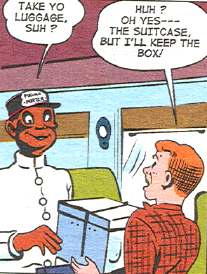
One of the stories from Archie #1 has Archie involved in a series of mix-ups on a train with another passenger, and the poor railroad porter gets caught in the shenanigans as well. The porter looks and talks like this:


I realize it’s no shock to anyone familiar with comic book history that racist caricatures of black people (and Asians, and Native Americans, and so on) were common in early stories (and this isn’t even the worst example from this particular story, with other panels including dialogue like “I done thought…” and “Mus’ be dat bump on yo’ had!”). Not having an original Archie #1 lying around the house, I’m going to assume the porter has been recolored slightly for the reprint, even though all his stereotypical dialogue appears to have remained intact.

I’m not saying this shouldn’t have been reprinted as is. If you’re going to reprint your old material for historical purposes, it should be reprinted as it was, warts and all*. And that’s what folks have been doing…a glance through your Shazam Archives and your Golden Age Wonder Woman Archives, among others, will show you examples of political incorrectness similar to that bit of business with the porter. But these are high end reprints, aimed at comic collectors, who are presumably familiar with the poor way minority groups were portrayed. Disclaimers aren’t uncommon, noting the usage of such caricatures were typical of the time, and left unchanged for historical reference.

This Archie digest, however, is aimed at a young, general audience. It’s one of the few modern comics actually sold in places where people who aren’t comic fans shop. At my grocery store, they’re right up there at the checkout line, next to the TV Guide and the Weekly World News. How will kids take the porter’s portrayal — how will the parents? — particularly since there is no disclaimer that I can find noting the historical reasons for that portrayal.

I’m very curious as to the response Archie Comics will receive.


Okay, one last round of “Mike Remembers Barely Making It Through the 1990s:”

  • Commenter Stavner asks

    “Do you think we’ll ever see comic books back in supermarkets and convenience stores?”

    It’d be nice, and in some cases apparently you can find comics in some convenience stores…but a widespread revival of this manner of distribution? Not unless 1) comics get a whole lot more popular, and 2) the profit potential for them is enough for store owners to risk valuable space on them.

    “Do you think Gemstone will keep publishing Disney comics for very long?”

    Hard to say…my gut feeling says “no,” since their number of publications has declined, and their prices have gone up. Their last Don Rosa reprint book has sold very well for us, though, so maybe there’s some life there yet.

  • H of the Comic Treadmill doth ask

    “There are those who insist that monthly super-hero comics will be dead sooner rather than later. Do you see a trend in that department? What’s your take on the viability of our beloved monthlies?”

    I think if the price point of the standard comic book goes much higher, something is going to have to give. My guess is a regular comic book will eventually undergo some form of evolution, possibly into a much thicker publication with more stories, at a slightly higher price point (but giving a higher perceived value to the reader), and just loaded with ads to help subsidize the cost of the magazine.

    There are a lot of economic factors there that I’m overlooking (such as whether or not a comic book publication could attract enough ads, and get enough money from them). At the very least, I don’t think monthly books will go away, but they’ll have to become something new to give readers more perceived value for their money.

  • Commenter Roel asks

    “Where the hell did all these investors come from in the first place? I mean, why did everyone suddenly get the idea that these comics would be worth a lot of money? Comics had been around for decades and decades, and then — all of a sudden, out of nowhere — all these non-comic book fans start investing in them? Why? Was there some sort of triggering event? I don’t get it.”

    Apparently there was a large crash in the sports card market just prior, and it was just a lateral shift from collecting one thing to another…I don’t have exact details, but it appeared to be common knowledge at the time. I can personally testify to the number of investor-types requesting “comic book Becketts” — Beckett being the publisher of several sports card price guides — so that lends credence to that theory.

    Also, the greater awareness of comics among the general populace, driven by movies and media-hyped events, combined with a possible economic downturn and plenty of newspaper stories dragging out the old “did you know old comics are worth money?” thing…that made comics a large, attractive target for investing, without all that “dealing with brokers” stuff.

    “Oh, another question — why are you so remorseful about selling pogs? How is that any worse than selling, say, a trading card or an action figure? People wanted pogs, and they wanted to give you money in order to own them. What’s the big crisis of conscience there?”

    Because I can see the value of a trading card or an action figure. Though technically, I realize, there’s only a slight difference between a trading card and a POG, but least trading cards were numbered, sometimes had cardback text, and could be put into sets. They had something to them. POGs (or, rather, milkcaps) were, with some exceptions, just random pictures on bits of round cardboard, and just felt to me like it was worthless junk. The alleged “game” involving milkcaps was essentially jacks or marbles, without the skill….you threw a heavy disc down onto a pile of cardboard discs. and you kept the ones that turned over, or some damned thing.

    I understand this might just be bias on my part, since there are plenty of folks who think comics are worthless junk too, but even if customers were willing to part with their money for POGs, I felt like I was giving them nothing of value in return. I was essentially turning their money into crap. I know I should feel like this when I sell someone a copy of, say, Purgatori, but I don’t.

    Yeah, cheap shot at Purgatori, sorry, but I can accept that someone might find entertainment value in that comic. Somehow. I just don’t see that value in milkcaps.

* As far as story content goes, anyway…I realize the comics in question have been recolored and (it seems) relettered for clarity.

Thank you, come again.

As I’m sure most of you know, several 7-11 convenience stores across the country were redecorated into “Kwik-E-Marts,” as an elaborate tie-in to the soon-to-be-unleashed Simpsons movie. As part of the remodeling, the stores were also stocked with several Simpsons-style items, like the Frosted Krusty-Os cereal and Buzz Cola. (You can see a typical Simpson-ized store and its product line at this site.)

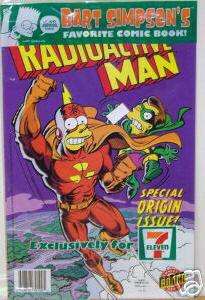
What I didn’t realize, until Customer Glenn clued me in on Thursday, was that one of the items was an exclusive issue of Radioactive Man comics…number 711, naturally:


Apparently, the Simpsons merchandise is supposed to be available at all 7-11s, not just the ones turned into Kwik-E-Marts, but neither the 7-11 Glenn checked, nor the one I tried yesterday evening in Oxnard, had the comics.

I suppose I could go the eBay route, since there seems to be a lot of copies on there (that’s where I snagged the above pic) but I don’t know that I want to give any of those guys my money. Particularly the guy trying to sell a lot of 50 copies for $450. I’ll keep checking the 7-11s and hope for the best, I guess.

I’m not even sure what the contents are…the cover is blurbed “Special Origin Issue,” so I suppose it’s at least a partial reprint of the first issue of the original Radioactive Man mini-series. But, hey, it’s still pretty neat, and at the very least, it got comics in 7-11s again. (My local 7-11s stopped carrying comics years ago, and I’m assuming it’s the same everywhere. Let me know if I’m wrong.)


A couple follow-ups to my Flash post from Tuesday:

A few people here and there have challenged my assertion that the Bart Allen Flash series was always intended to be a mini-series, which is fair enough. That’s my interpretation coming from statements made by DC’s Didio and other folks. The opposing interpretation, that the reboot wasn’t decided upon until late in the game as a response to fan reaction and/or sales, may be just as valid. I can’t really prove or disprove either.

However, during some back and forth in the comments section, I whipped out this link, which sales reports on DC titles. According to the several months’ worth of sales figures on the Bart Allen Flash series, the series had dropped down from about 120,000 on the first issue to about 47,000 on issue #11. Issues 9-11 were in about the 46,000 to 47,000 range, with sales bumping up slightly on #11. Those aren’t great numbers, by any means (few comics today have great sales), but it still outsold other DC titles like Robin, Nightwing, Bird of Prey, Green Lantern Corps, Supergirl and the Legion of Super-Heroes…none of which are, to my knowledge, getting canceled and/or restarted anytime soon.

I’m not privy to the inner workings of DC Editorial, of course, but I don’t know why they felt a restart was necessary so soon, unless they liked that 120,000 print run on the first ish and wanted to try again with a new series that hopefully wouldn’t shed readership by the tens of thousands. Or, like my crazy theory, the finite nature of this series was planned from the beginning.

Anyway, I think that 47,000 print run wasn’t anything to sneeze at, and given that sales may have started to go up (or at least go down less quickly…they’ve certainly been up at our shop), and that, far as I can tell, people in our shop and online started to be a little more positive about the book (with the exception of that awful last issue, which may have been more “editorial edict” than the writer responsible for its quality), it’s possible that 47,000 could have increased over time. Maybe not fast enough to give the book the profit margin that yet another restart may give it…at least for an issue or two, anyway.


I don’t talk about this particular artist on my site any more, but that won’t stop me from linking to the mighty Cole, who rips Mr. Name-Not-Mentioned-Here a new one in regards to a pissy comment about Grant Morrison writing the intro to the Jack Kirby’s Fourth World omnibus, basically implying Morrison was a poor choice because he did so little work with Kirby’s material.

Cole already explained why this is an entirely wrong-headed argument, but I’ll support him with my little quiz:

Which do you think Kirby would have preferred to see younger creators do in his honor?

A. Slavish devotion and copying of work Kirby had already done?

B. Going out and working on their own whacked-out, original concepts?

I’m reasonably certain there’s only one correct answer, and it ain’t “A.”


Congrats to Chris Sims for getting a pull-quote on the inside cover of Marvel’s new Anita Blake hardcover. Why he got a pull-quote, I’m not entirely sure, since each time a new issue of Anita Blake comes out, Chris goes after it, guns blazing, like it was made of Hitler. At the very least, it shows that the folks behind the Anita Blake comic have a good sense of humor about what Chris does to them with his AB annotations.


A couple more things about this week’s comics: 1) The Thor Suydam zombie-Thor variant and the Suydam non-zombie Thor variant variant are delayed ’til next week. Hopefully that won’t bite (har har) into sales. 2) The Fallen Son: Iron Man “oh noes they’re burying Captain America, lookit all the media coverage” issue we were all warned about, that there may be some minor media-enhanced demand for it…that demand never materialized. No lightning striking twice here. I’ll try to contain my surprise.

Also, Action Comics #851…if you bought it…did you get the 3-D version or the regular version? Or, God help you, both?

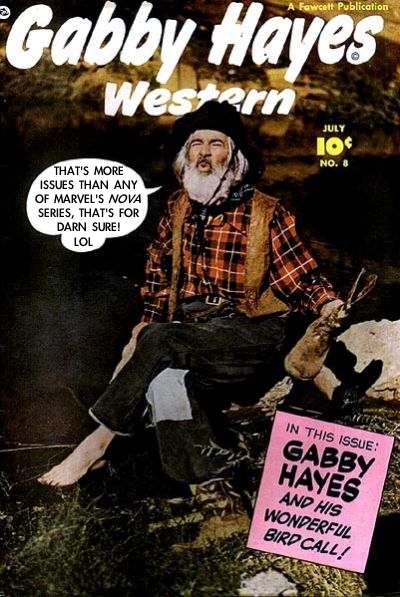
Things I love about comics, part 1764.

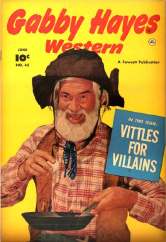
That the marketplace was able to support a Gabby Hayes Western series for 59 issues.


It probably sold about 200,000 copies (or more) an issue, too.


For more info about Gabby Hayes, may I suggest this site?

For those of you who happened to see it…yes, this is a reworked version of a post that was up briefly yesterday. I wasn’t happy with it, plus it contained a factual error that blew a gag I was trying to make. That original post is now a Rare Collector’s Item, so be sure to keep it safe in its Mylar bag!


Updated 4/2017

The Secret Crisis of Infinite Wars.

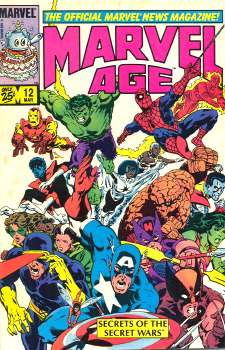
A few days ago, I was paging through some early issues of Marvel Age at the shop, reawakening those nostalgic feelings for the magazine that I’d noted before. For only a quarter (or thirty-five cents, or fifty cents, or…well, you get the idea) you got a 32-page full-color comic filled with previews of coming events, sketch pages, interviews, promo art…sure, it was full-on hype for Marvel product, and technically you were paying for 32 pages of ads, but you knew what you were getting. It was an unabashed house organ, but you got some fun cartoons from Fred Hembeck in a bunch of issues, some of the back-cover calendar gags were amusing, and you got plenty of creator interviews…not deep, meaningful stuff (well, except maybe for the Hembeck cartoons), but overall it was a fun little mag, and what the heck, it was cheap. Well, for a while, at least.

Anyway, I was looking at issue #12 of Marvel Age, reading the hype for the then-forthcoming Marvel Super-Heroes Secret Wars crossover mini-series, when I came across this paragraph:

“This monumental adventure figures importantly in the continuity of nearly every single Marvel title. Events in this maxi-series will permanently and shockingly alter the histories of everyone from Captain America to the X-Men to Spider-Man! No matter who your favorite Marvel hero or villain is, you’ll find yourself absorbed in THE SECRET WARS to stay on top of the catastrophic changes in that superstar’s life!”

Of course, as most of you know, the changes weren’t quite as dramatic as the hype would have had you believe. Hulk broke his leg (lasted a couple months), She-Hulk joined the Fantastic Four (around for a couple years), and…did something happen to Captain America? I don’t remember. I think Colossus and Kitty Pryde broke up because of events in this series, maybe. And of course there was Spider-Man’s new black costume, probably the only lasting impact the series has had, though the evolution of that costume into his arch-nemesis Venom was more after the fact than because of anything in Secret Wars itself.

Marvel took some grief from fans and the fan press about the hyped changes that ended up being no real big deal, and when it came time to push Secret Wars II in Marvel Age #27 (June ’85), writer/editor-in-chief Jim Shooter took the opportunity to do a little back-pedaling:

“You know, a lot of fuss was made about ‘The Big Changes in Secret Wars!’ And the fact is that change was not the point of Secret Wars. It was never the point. I don’t know how the talk started because here at Marvel, we always have changes. […] So the fact that in the twelve issues that made up the saga of Secret Wars there were significant events in the heroes and villains’ lives, considering how many issues there were, how could there not be changes?”

Most of these company-wide crossover series seem to promise big changes, new characters, new directions, permanent alterations in the status quo…and a few years, or even a few months, later, it’s as if nothing at all had happened, particularly if you’ve had yet another crossover series in the meantime.

Probably the only significant change at Marvel or DC that had its origin in a crossover series was from DC’s Crisis on Infinite Earths, which changed the very structure of DC’s shared universe by doing away with the decades-old multiple-Earth concept. Whether that was a good change or bad, I’ll let you decide, since twenty years on we’re still dealing with the repercussions of that series.
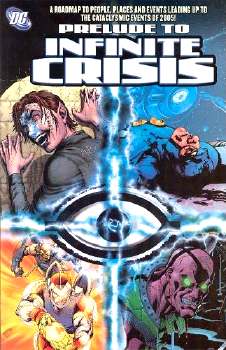
Crossover series also kill off or retire characters, which doesn’t matter because they’re usually revived or replaced with a new character with the same name sooner or later. Supergirl died in Crisis…and was replaced with a new Supergirl a couple years later (who was herself replaced with yet another Supergirl, just recently, with an origin similar to the original, but now showing more skin). To address more recent events, a while back I joked about Sue Dibny: Rebirth and Blue Beetle: Rebirth, reviving characters killed off in the most recent spate of DC’s crossover events…but all it takes is an editorial change and some new, hot writer who decides he really wants those characters back in the land of the living, and, surprise, there they are, as if nothing had ever happened to them.

New characters and titles are usually launched out of these events as well…DC’s Bloodlines and one year’s worth of Marvel Comics annuals introduced a whole boatload of new characters, most of which disappeared in short order (Hitman being Bloodline‘s big exception, though even that character has run its course). Most of these relaunches don’t last, unless it’s with an already established character (like The Flash or Wonder Woman). Again, to go back to Infinite Crisis…while Checkmate and the new version of Blue Beetle may be entertaining, chances are they won’t be around five years from now. But then, most new titles from Marvel and DC don’t last five years.

I know there are others…we got a good run of Starman out of Zero Hour, for example, though it too had run its course. But basically, this is why I don’t worry overly much about all the “significant changes” and promises that “things will never be the same.” Things may change for a while, but they’ll change back sooner or later. And if you don’t care for something unpleasant that was done to a character you like (for example, Wonder Woman having to break the neck of a bad guy), don’t worry…in short order it’ll be as if it never happened at all. How often is Superman’s execution of three Kryptonian criminals brought up nowadays? At the time, people were pissed…I bet at least a few of you reading this now have no idea what I’m referring to.

Let’s look again at Infinite Crisis. Did DC promise big changes because of this series? Yeah, probably, I don’t remember and don’t feel like looking up all the hype. I’m sure you all read it anyway. But what changes are we getting? Relaunched Wonder Woman, Flash, and Justice League comics, which would have happened anyway even without crossover events, since DC wouldn’t let those names languish for too long. Superboy is dead, and depending on the repercussions of recent legal decisions some Superboy or another will probably be back. Superman doesn’t have his super powers for the time being, which of course isn’t a permanent state of affairs. IC feels more like “course correction,” attempting to reintroduce and revitalize some of the characters and concepts in the DC Universe, rather than changing things wholesale.

I know I primarily discussed DC’s current events above, but all that applies to Marvel, too, in their four or five big event comics they’re currently running. Did I read correctly, that a Marvel character will have his secret identity revealed to the world during the course of Civil War? I’m guessing Spider-Man, since it would seem like a bigger deal for that character than for, say, Iron Man…and I don’t know if there are any other characters at Marvel where it would be a big deal. If so, someday someone at Marvel may decide that wasn’t a good idea, and cook up a storyline where, say, Dr. Strange casts a spell to make everyone forget Spider-Man’s secret. There, big change reverted, status quo successfully maintained.

So that was a long row to hoe basically to say “I don’t believe ‘big change’ comic book hype.” Just give me some good comics to read out of these events, that’s all I ask.


Nothing to do with the topic just discussed, but this amused me: in Marvel Age #12, Stan Lee (or a close approximation) writes about his work on a ’50s humor magazine:

“Years ago, about the time that Mad magazine was a’borning, yours truly produced a similar publication called Snafu.”

Phrased like that, it makes it sound as if Snafu simply simultaneously arose with Mad out of the same cultural zeitgeist that drove the need for new sources of parody and satire. But looking at the dates involved — Mad preceding Snafu by about three years — it becomes clear that Snafu came about for the same reasons all those other ’50s humor magazines did: the need to rip off the incredibly successful Mad. Yeah, I know: “What? Marvel copied someone else’s successful idea? The devil you say!”
Okay, I was thinking a little more about the images I used here

…the pics used for Amy Grant and Kate Bush are pretty clearly unauthorized usages — Grant’s camp raised a stink about it, but I don’t think Bush’s people did. I have no idea if the “inspiration” for the Media Starr cover was ever acknowledged by the publisher.

The Miguel Ferrer thing is (as I noted already) just me seeing a resemblence between Bradstreet’s interpretation of the Punisher and the actor, and certainly not me trying to imply any images of the actor were used to create the illustration. As was pointed out to me, Bradstreet uses his own models for his work, and you can see that in action on his site.*

The Rowan Atkinson image was an homage, and very much in line with the occasionally tongue-in-cheek style of the Incredible Hulk comic Peter David was writing at the time. I don’t think he was as recognized in the U.S. then as he is now …most Americans know him as “Mr. Bean,” the hip people know him as “Blackadder,” and the people who know him as “Raymond Fowler” are just plain showing off. However, I do recall a letter in a later issue of Incredible Hulk identifying the homage, and the editors owning up to it.

Lassie I just threw in because we happened to have a copy of #1 at the store.

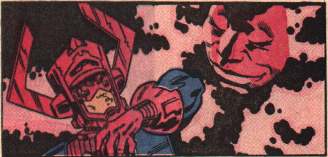
Okay, now the Whoopi Goldberg thing…this character apparently popped up in Power Pack and I know some of you out there read this series. Was the Whoopi inspiration ever acknowledged? Was it as obvious as it certainly is in this Marvel Universe illustration? And isn’t this the cutest drawing of Galactus you’ve ever seen?**


Some other celebrities have popped up as inspirations for funnybook characters…there was “Serji-X Arrogantus,” a Sergio Aragones look-a-like drawn by Howard Chaykin in early issues of Marvel’s Star Wars comics.

Pal Bryan mentions that Miguel Ferrer’s appearance was used for a character in one of Innovation’s Lost in Space comics, but since Mr. Ferrer wrote it, I’m sure he’s probably aware of it.

I seem to recall a Basil Fawlty-esque character popping up in Justice League Europe, designed after John Cleese.

Pal Mojo also points out the Sting/Constantine connection (which I’ve previously discussed here), and though the Sandman/Robert Smith link rings a very small, tinny bell in the recesses of what I laughingly call my brain, I can’t dredge up any specific memories. Oh, if only there were some kind of, I don’t know, Internet search…”engine,” let’s say, that could help me look up such information. Oh, okay, I’m just messin’ with you…a quick look turns up this FAQ that says Morpheus wasn’t based on Smith. And since it’s on the internet, it must be true.

And lest I forget the most famous inspiration for a comic character’s appearance…Fred MacMurray for the original Captain Marvel. There are a whole bunch more real-life inspirations for Marvel Family characters identified here.

Then there was the reverse in action, with Captain Marvel Jr. inspiring one of Elvis’ costumes, but that’s a whole other can of worms. Plus, there was this guy, who claimed to be the original model for Siegel and Shuster’s design of Superman. Not true, of course.

Okay, that’s enough of that…you all must be sick of hearing about this by now. But, if any of you can come up with any more, feel free to stick it…

…in my comments section!

* I couldn’t access the site with either Netscape or Firefox, but IE and Safari pulled it up fine. It might be just my particular set-up.

** Somewhere out there is a super-deformed manga-style Galactus drawing that’s even cuter, and I’m going to hate you in advance for even pointing me in its direction.