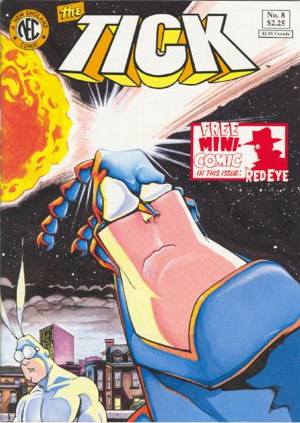
The Final ’80s Countdown, Part Twenty-Two.

Movin’ along the Favorite ’80s Comic Poll list to our first four-vote-getting entry:

Grendel (Comico 1983-1984)
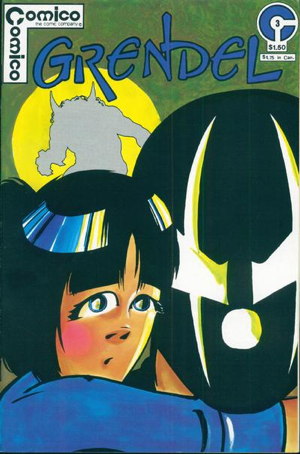
This is another case the listing the first ongoing series featuring the character in the header there is a little misleading as to the size and impact of the property. After first appearing in the second issue of the Comico anthology book Primer in 1982, Matt Wagner’s character launched in what was supposed to be a six-issue series the next year. It was crude and amateurish but had an undenialable energy beneath its striking covers that put it a step above most of the other black and white boom comics of the era.

The series ended prematurely after three issues. In 1984, Comico started publishing Wagner’s next big project Mage: The Hero Discovered, a full-color urban fantasy adventure. Starting in issue #6 of that series in 1985, and running through #14, Wagner included a serialized Grendel back-up story. This story retold the tale that was intended for that aborted mini, in a more experimental caption-heavy format.

The premise of the Grendel comics, at least at the beginning, can most simply be summed up as “the villain is the hero,” where Grendel, AKA rich socialite Hunter Rose, is a handsome, witty and appealing, while living a secret life as a murderious crime lord. The hero of the story is Argent, a misshappen and grotesque wolf-like being, flipping on its head the usual superhero/supervillain dynamic one would see in comics. It’s not an unusual inversion…I mean, you can’t throw a rock without hitting a Godfather or a Breaking Bad where we’re invested in the bad guys. Even in John Milton’s Paradise Lost, all the good bits involve Satan and all the Heaven stuff is boring.

Now, at the end of that initial story, Hunter Rose is killed, and the next Grendel series launches in 1986. The first 12 issues of that, written by Wagner, illustrated by the Pander Brothers, takes place in the near-future of…sometime around 2010 or so in which the “grandaughter of Grendel” (Christine Spar, the daughter of Hunter Rose’s adopted child) takes on the costumed identity. From there, the idea of “villain as hero” evolves into Grendel being more an examination of violence and aggression as the mantle passes from person to person and the “spirit of Grendel” supposedly influences people and events.

That Grendel series ends with issue #40 in 1990, with the title of Grendel being held by the conqueror of Earth in the 26th century, so clearly the premise had gone through some permuations. Past this, Grendel comics move to Dark Horse Comics with a number of mini-series by various creative teams, either continuing in this future world, or filling in backstory (like a mini featuring the tragic adulthood of Hunter’s adopted daughter Stacy), or a handful of series telling more tales of the original Grendel. Of note are two mini-series pairing up the character with Batman (one with Hunter, the other with Grendel-Prime, a future Grendel who arrives via time-travel). There’s also Gredel Vs. The Shadow in 2014, so long as we’re talking about crossovers.

The most recent series, Grendel: Devil’s Odyssey, ran from 2019 to 2021, written and illustrated by Wagner. To be frank, I gave up briefly on some of the earlier Dark Horse minis set in the far future, as I just didn’t have the interest. I did pick up the later Hunter Rose minis, and that Devil’s Odyssey I have to read eventually, but it started during the height of my eyeball issues so it’s ended up in the “read these later when I can see again” stacks and I haven’t gone back to them yet. It looks good, though!

Now, if you want to read any of this stuff…a lot of it is still available in paperback, primarily through four omnibuses, starting with the Hunter Rose era and working its way through to the future Grendel Prime era. The “Devil by the Deed” story that ran as the back-ups in Mage has been reprinted on its own several times, including an 8 1/2 by 11 inch graphic novel from Comico, and a couple of comic-book sized reprints from Dark Horse. The non-Wagner Grendel material has been reprinted in two Grendel Tales omnibuses, but only the second one appears to be available currently.

The original black and white Grendel stories from Comico, the Primer short and the three released issues of the mini, were collected in Grendel Archives from Dark Horse, but that hardcover appears to be unavailable. Most of the Grendel run has been reprinted in one form or another over the years…I had a paperback at my shop recently that Comico had released in 1988 of the Christine Spar Grendel story, and the story that had followed in the 1986 run, illustrated by Bernie Mireault, had been collected on its own as well. There’s lots of out-of-print books out there, you just have to keep your peepers peeled for them.

Shipping in November of this year is Devil by the Deed Master’s Edition, a brand new retelling of the Hunter Rose story, written and drawn by Wagner. So, there’s more yet to come!

One oddity I hadn’t mentioned was a slim 16 page Grendel comic, Devil’s Vagary, which was included in the Comico Collection slipcase. The slipcase, which is actually a pretty nice item featuring a Grendel design, was a “sampler package” (i.e. Comico trying to clear out the warehouse) of a handful of random back issues, which featured this exclusive Grendel story (written by Wagner, drawn by Dean Motter). I’m sure this story must have been reprinted somewhere, probably in the first Omnibus, but there’s no indication on the comics database page I linked. Maybe someone can let me know.

If you’re new to Grendel and want to try it out, I honestly think you can’t go wrong with any of the Hunter Rose stuff. It’s Basic Grendel, the purest distillation of the concept, and the source from which everything else follows. The 1986 series that begins with Christine Spar and moves on from there is good as well, though as the series progresses further into the future, and the mini-series by Other Hands kick in, the franchise gets a little lost in the weeds, I think. Your Mileage May Vary, as they say.

And I should probably bring up the fact that a live-action Grendel series was pretty much all ready to go on Netflix, until Netflix decided this was the one series they weren’t going to throw at a wall to see if it stuck. Ah well. Hopefully it’ll get out there somewhere.
“Stop her! She’s got Mike’s keyboard!”

I apologize for the interruption in service here, as my computer keyboard at home decided to stop working and it took a try or three to get a sufficient replacement with the features I required. (Those features being “button that posts stills from Frank Miller’s The Spirit” and, well, that’s pretty much it.)

Anyway, I’ve got a new keyboard that I kinda have to get used to, as it’s a slim, flatter style and my clumsy fingers are currently fumbling all over it. Thus, please excuse any typos. I mean, more so than usual.

So anyway, let’s just cover a couple of things of interest here:

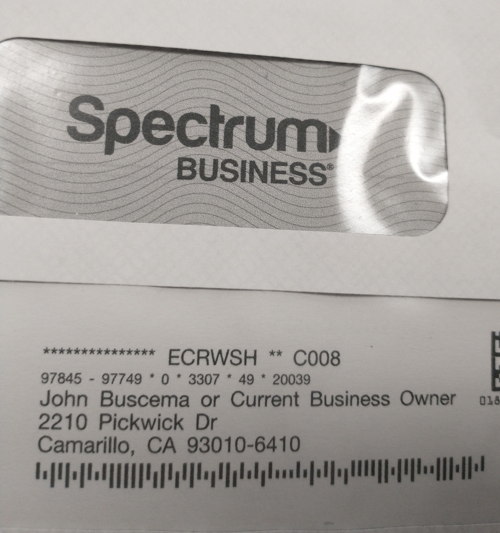
First, I got this in the mail the other day:


It’s a piece of junk mail from a cable company sent to my store and addressed to “John Buscema or Current Business Owner.”

That’s…a little strange. I’ve received (and still receive) mail at this location for previous tenants, including one named “John,” but his last name is nowhere close to “Buscema.” And given that “John Buscema” is a legendary comics artist, the name being on this piece of mail is surely not random happenstance, but it eludes me how this could have happened. I’m sure someone out there might know some possibilities.

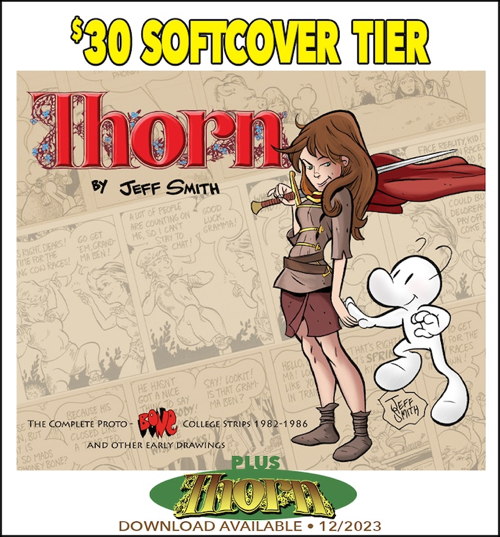
In other, Kickstarer-related, news, the campaign for the Thorn collection, Jeff Smith’s college newspaper strip that preceded Bone, is up and running and already blew well past its goal.


I was a big fan of the Bone comics as they were coming out, and after finding out there was a college strip, well, that caught my attention. I do love me some college strips, and collections thereof, so I kinda kept half an eye out for the original 1983 Thorn: Tales from the Lantern in case an affordable copy ever happened my way.

Well, “affordable” is the real trick, I guess, since it, you know, never was. One of the tiers in the Kickstarter would get you an original copy of that 1983 book along with the new collection, but at $10,000 a throw I’m afraid I’d have to decline. I’ll be satisfied with this nice softcover, thank you.

Of note are the already unlocked “stretch goals,” achieved when the campaign hits certain financial levels. In this case, we’ll be getting facsimiles of the original Fone Bone comic booklets Smith drew as a kid. Those sound amazing.

There’s also a Nexus Kickstarter, with Steve Rude re-releasing a trade paperback from a couple of years ago in a larger format with a signed bookplate. I like the idea of a larger book, easier on your pal Mike’s old eyes to enjoy Rude’s always beautiful artwork.

Okay, thanks for your patience, everyone, and hopefully I’ll be back to my regular schedule next week.

“HDMI Jack” doesn’t have quite the same ring to it.

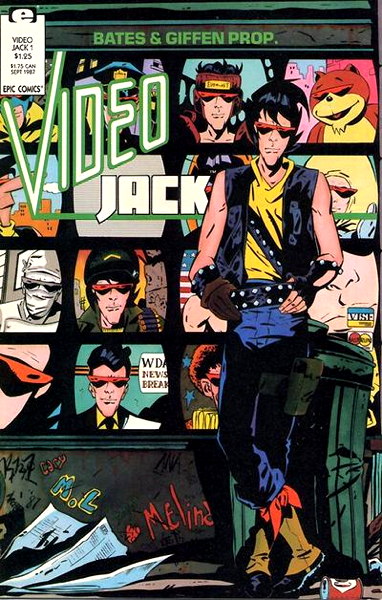
So in response to my post about the passing of Keith Giffen, LouReedRichards brings up a title that I’m sort of shocked at myself for not remembering. On one hand, I couldn’t list everything, but on the other hand, I really should have pointed out this comic from 1987:


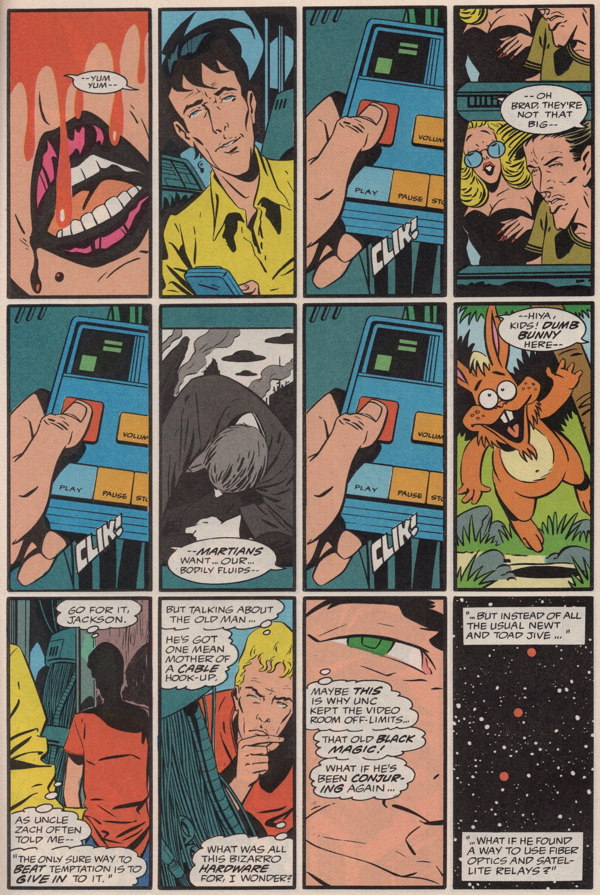
And here’s a sample page from the first issue:


Did ol’ Keith do 12-panel pages throughout the series? Oh he sure does, for the most part, with some smatterings of six and nine panel pages, so this is one series dense with storytelling. Even the last issue, featuring several guest artists (like Fred Hembeck! Walt Simonson! Trina Robbins! Jim Starlin!) is mostly 6 or 9 panel grids. There’s the occasional breaking of the format, including a pretty stunning two-page spread in the first issue.

So here’s the thing about this comic.

I remember really looking forward to it. I even picked up one of the promo posters at the comic shop, where they had a stack they were giving away, and had it put up at home. And I bought each issue off the stands as it came out, its release coinciding with my beginning months of college.

And I’m pretty sure that was the one time I read it. Well, okay, I probably reread the whole series once it was complete. And it’s been 35+ years and I remember very, very little of it. As I flipped through my copies, extracted from what remains of the Vast Comics Archive, I remembered bits here and there, some of the conceits of the series, the character designs, etc. But there is a lot going on and I’m sure there are plenty of details I’m forgetting.

Hell, I even forgot that this was written by former DC Comics stalwart Cary Bates.

I remember really liking the series. But I couldn’t tell you really anything substantial about it, beyond “dude falls into a TV world” and I’m not even sure that’s 100% correct. But glancing through it, it’s definitely a showcase for this era of Giffen’s art. I definitely would love to be able to reread it, but “rereading older comics” is on the backburner while I’m still trying to catch up with the new stuff. As I posted on Bluesky:

“Well, if I’m going to reread every book and comic I’ve bought and kept over the last five decades, I’d better get started.”

In some cases, it may be just enough to remember that you liked a thing, even if it no longer lives in your memory and you don’t have time to revisit. Ah well.

And it took three and half decades, but I finally get the punny joke of the title. …No one’s ever accused me of being too on the ball. Do I need to tell the Ms. Tree story again?

Keith Giffen (1952 – 2023).

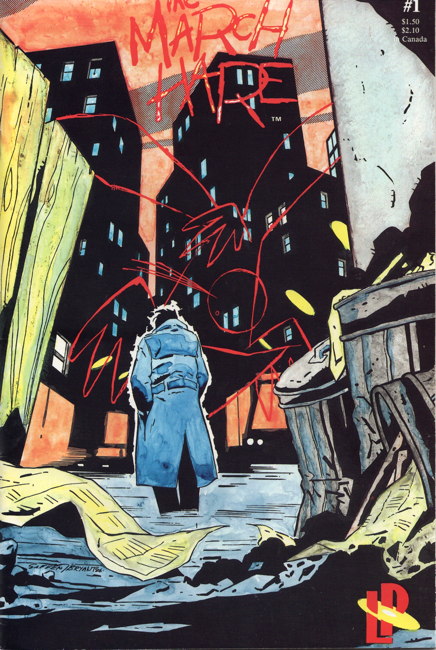
So in 1986, after having read Keith Giffen and Robert Loren Fleming’s various, and hilarious, Ambush Bug short stories and mini-series over the previous few years, I was excited to pick this up:


…a new comic book by the same creative team, featuring a fellow accompanied by magical, and invisible, rabbit. Y’know, like Harvey, only slightly more homicidal.


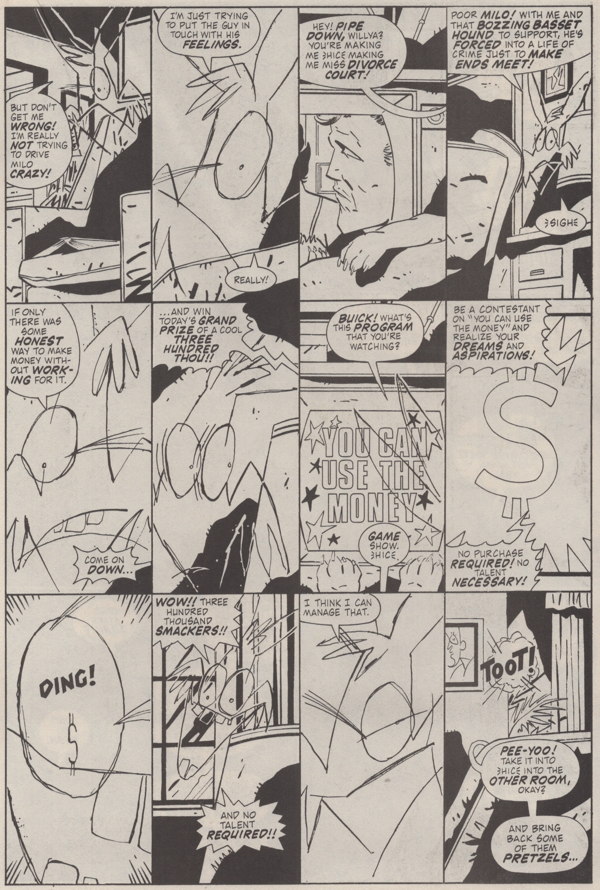
Drawn in a style that was (somewhat infamously) inspired by Argentinian cartoonist José Muñoz, it was an edgier, more darkly humored affair that had promised more issues, but sadly, the one issue was it. (Though there apparently is a short March Hare story in an anthology somewhere that I’ve never seen.)

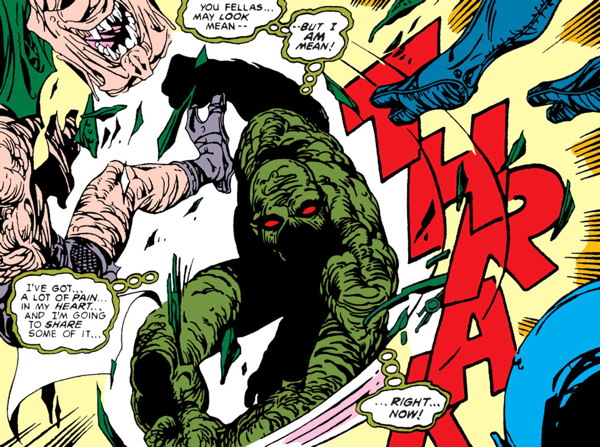
That may be one of the more obscure Giffen works, a small-press book from the black-and-white boom era of the direct market, but it was one I happily bought off the shelf and have kept in my collection this whole time. (Above scans are from my personal copy.) Another maybe slightly more known job of his was from the late 1970s, when he was paired with writer Gerry Conway to produce some issues of Challengers of the Unknown. Of interest to me here was special guest star, a Mr. S. Thing:


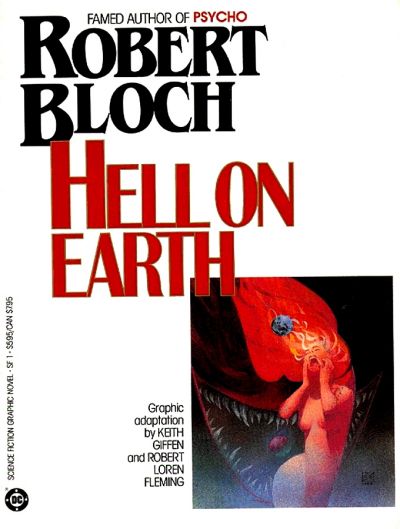
Another fave of mine was Giffen and Fleming adapting Robert Bloch’s story “Hell on Earth” for DC’s science fiction (and, well, horror too, I guess) graphic novel line:


Told in tight-grid panels with close-ups and shadowy abstract imagery, it made a scary tale that much more creepy.

Much of Giffen’s other work, either as writer or artist or both, is probably much more familiar. Legion of Super-Heroes. Justice League. OMAC. Hero Squared (from Boom!, that was a good’un). Omega Men. Lobo (which he co-created). Dr. Fate. Heckler. Vext. And much, much more…there are very few properties untouched by Giffen at either Marvel or DC.

Giffen’s involvement in pretty much anything guaranteed 1) immense creativity in the storytelling, and 2) good humor, both probably necessary elements for the superhero books he usually worked on. I’m sure he had a lot more wild weirdness to unleash upon the world within that ever-churning mind of his, and it’s a great loss that he had to leave us so soon.

But don’t listen to me. Listen to longtime Giffen cohort J.M. DeMatteis and to what he has to say about his departed friend. And Giffen recently released three episodes of a podcast of him talking about his career and some shenanigans in which he’d been involved. Note: the sound quality is…not great, but listenable, and the actual name of the podcast may be a little upsetting, but wherever Giffen is now, he probably thinks it’s hysterical.

This is a hard one. My condolences to his family, friends, and fans. So long, Keith.

“Kryptonite…well, maybe a little more.”

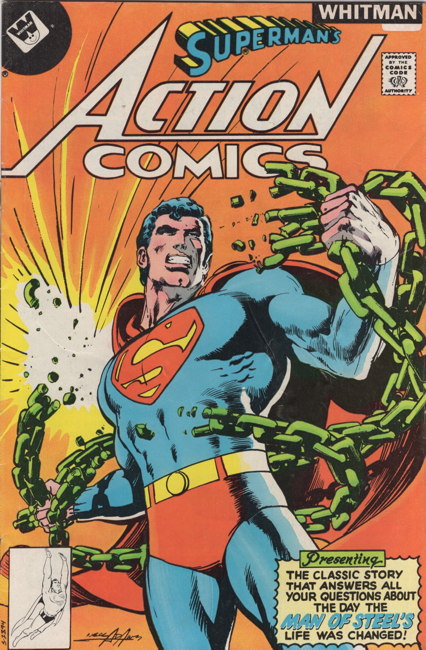
So I had a copy of this comic fall into my hands the other day, Action Comics #485 (1976):


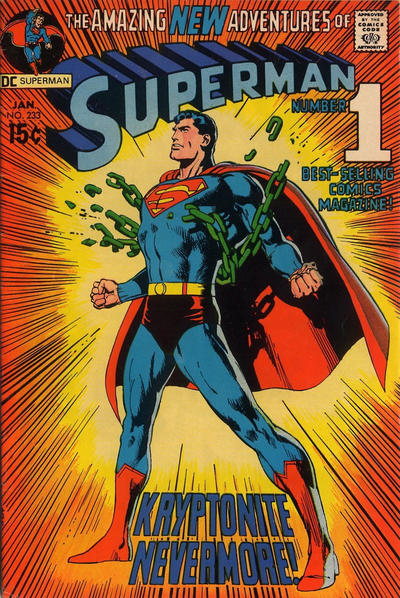
…which caught my eye as it was the Whitman variant, and would be worth a little money if this copy hadn’t been around the block a bit. But still, it’s nice to see, with its Neal Adams cover reminiscent of Adams’ cover for Superman #233 (1971):


And reminiscent it should be as the Action issue is a reprint of that Superman issue. Despite having run across plenty of copies of that Action over the years, I never bothered to look inside as I figured “just a reprint of Superman #233, move along.”

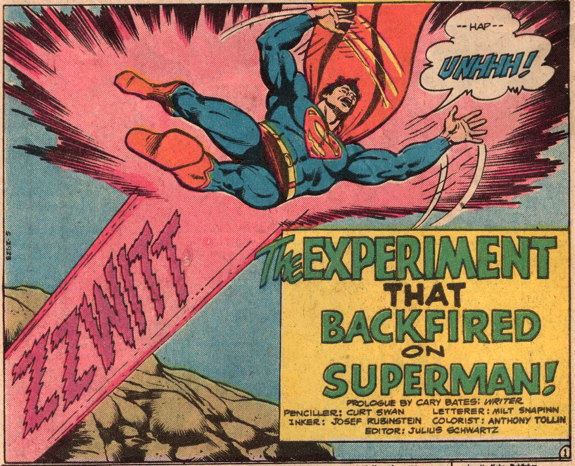
But this time I did look inside, and lo and behold, there’s a new framing sequence by Cary Bates, Curt Swan and Josef Rubenstein:


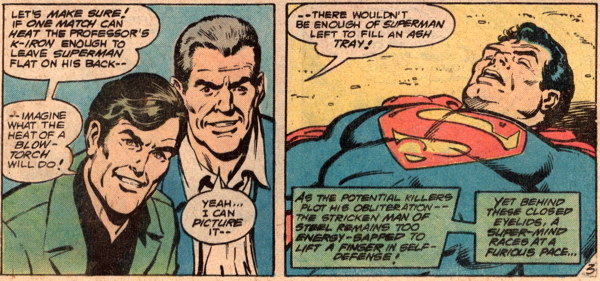
Three pages at the beginning, which segues into the reprint of the the older Denny O’Neil/Swan/Murphy Anderson comic after Superman is zapped by a weapon in the intro:


…and we see the then five-year-old classic tale of the End of Kryptonite, an attempt to revamp the book by both removing the story crutch of that deadly mineral and depowering Superman slightly:


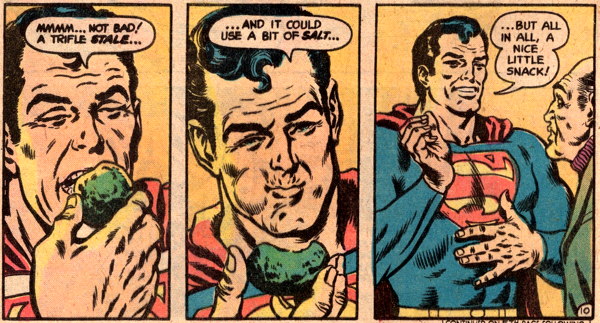
And then Flashback Over, as Superman awakes and defeats the bad guys in the last page (with one new panel drawn at the bottom of the last page of the reprints as a transition).


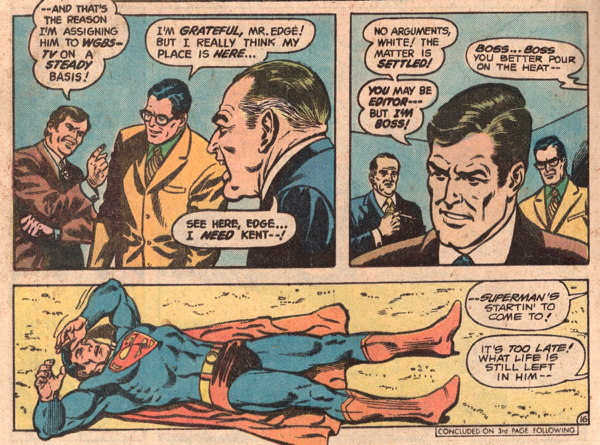
As you see, 1971’s Superman #233 is the issue where Clark Kent moves over the WGBS to be a TV reporter, a change to the status quo that’s still active by the time the story’s reprinted in Action a few years later. Unlike the whole “end of Kryptonite/Superman is weaker” business which, I believe, was over and done with fairly quickly. In fact, it’s a little surprising this story was chosen for reprinting as that particular shake-up to the Superman mythos was unshook as fast as it was. But still, it gave them a reason to run another variation of that Adams cover, a popular and eye-catching image, and it’s a good story regardless.

And I’m glad I took a peek inside the comic this time and found some surprise new-to-me Curt Swan work. We’re not getting any more new art from him, so it’s good to treasure what we have.

Ducks.

So like I was talking about in this post from last week, I find myself trying to pick between reading a lot of comics and getting the backlog cut down, or reading a single graphic novel in that same time.

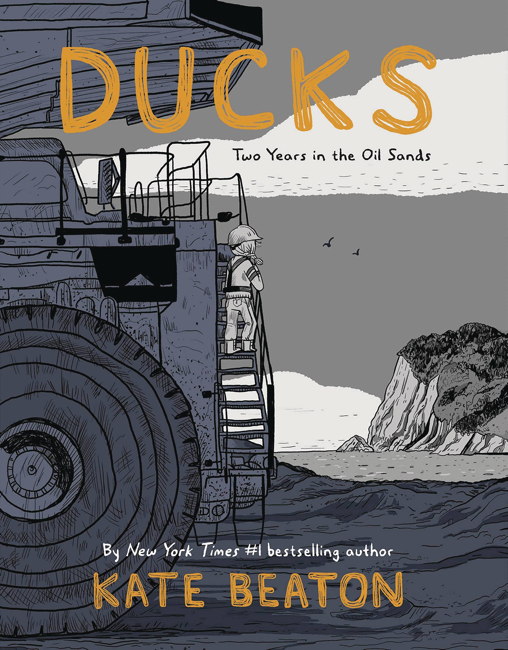
Well, I finally decided to pick up Kate Beaton’s autobiographical graphic novel Ducks:


…and I’m only halfway through, but I definitely lost time Sunday evening reading this volume, looking at the clock, thinking “oh sure I’ve got time before I have to go” and then checking again and realizing “oops, I’m late.” That’s probably a sign of a good book, right?

It’s the story of Beaton’s post-college jobs in the Canadian oil fields, which she took to pay off student loans. It’s both fascinating in the details of the work she’s doing, and harrowing in the casual sexism and harassment a young Beaton has to face. It’s densely told, usually lots of panels per page, but it never feels cramped. And for my long-suffering eyeballs, the lettering and the black and white art are both crisp and easy for me to read.

Usually one should finish a book entirely before giving a recommendation, but even at the halfway point I feel confident telling folks this is one worth getting your mitts upon. I’ve long enjoyed her shorter humorous works, and I’m finding her longform dramatic storytelling to be just a compelling.

Yes, I know this isn’t every Nancy book.

So Ray asked

“Do you have a link or anything to the full strip that includes the nightmare fuel panel?”

Well, I immediately went to my shelf and pulled down my copy of the strip reprint book Nancy’s Dreams and Schemes, published by Kitchen Sink Press back in 1990. I mean, the strip would obviously fall under that particular theme, right? But I didn’t see it at first glace, and I realized “oh wait, I sourced the scan on that Sluggo Saturday entry,” where I reminded myself it was from 1988’s The Best of Ernie Bushmiller’s Nancy. (That book was gifted to me by pal Andres, which is why he’s thanked in that post…but I haven’t seen Andres in years. Where are you, Andres?)

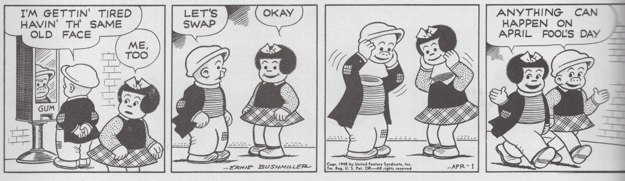
Anywhere, here’s the strip with the panel in context (note I couldn’t get a clean scan of the last panel, as that was too close to the gutter there, and look, I like you Ryan, but I’m not breaking this book’s spine for you):


Oh, Bushmiller, you scamp!

But looking through Nancy’s Dreams and Schemes and Best of Ernie Bushmiller’s Nancy put me in mind of two things.

First, the Bushmiller (and Company) original strip I own is in Dreams and Schemes, which I’d forgotten!

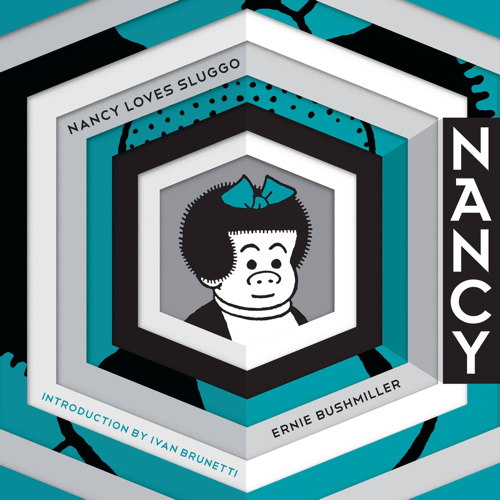
Second, all those nice Fantagraphics strip collections are out of print, and appear to be staying that way.


And, unsurprisingly, they’re going for a premium on eBay. Which is a shame, I was hoping for more volumes past the third one, but ah well.

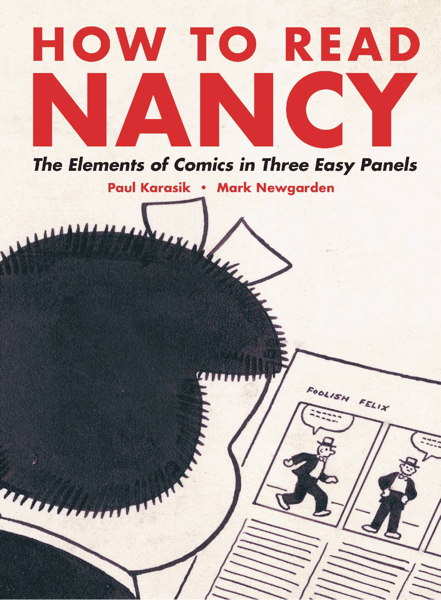
Still available, however, is How to Read Nancy by Paul Karasik and Mark Newgarden, which features Bushmiller’s artwork:

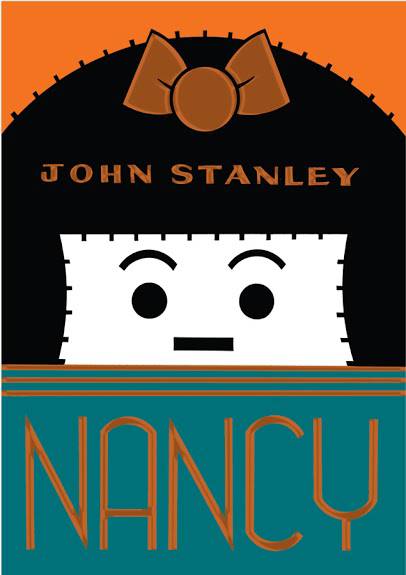
And while not by Bushmiller, the first three volumes of John Stanley’s Nancy are still available:


The collections of the recent Olivia James Nancy strips don’t appear to still be available from Diamond, but I suspect you can still get them from real book distributors.

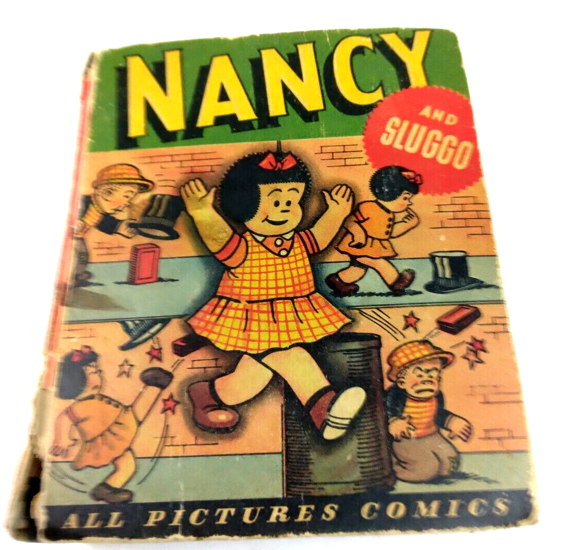
And this Nancy Big Little Book from the 1940s?


Definitely out of print. Don’t even bother.

In which I complain about reading too few comics.

So it’s been a while since I’ve done just straight up reviews of the new comics on this site, which is primarily because I don’t tend to read the new comics during the week they’re new. Either I’m reading things well ahead of time (as the Marvel and DC books usually show up at the shop a week before their on-sale date), which is rare, or I read them well after release, which is more likely.

My eyeball troubles during their initial phase, when my vision was cloudy or just blacked out entirely, kept me from reading more or less anything for about a year and a half. I was able to read text on my computer screen by enlarging fonts, doing high contrast white-on-black colors, etc. But comics were a no-go for a while. And while I still continued to accumulate books to read during this period, they went unread for quite some time.

I’ve got quite the backlog, even with deciding to give up on some titles to thin out the stack. Adding to the problem is that now I’m able to read again, I’m not reading as quickly as I used to. And this is just comics. I’m not even bringing the prose books I’ve gathered up recently into this.

I’m trying to make time to read comics and get through these stacks. I have entire series that I’m eventually going to have to sit and buzz through their runs. I just did this with Ahoy Comics’ Second Coming and The Wrong Earth, and Howard Chaykin’s Hey, Kids! Comics! is up next.

Graphic novels are kind of a roadblock in this process, in that I could read 1 graphic novel or I can read (x) number of comics in that same period of time. Again, I read more slowly than I used to, so it’s a real decision to make.

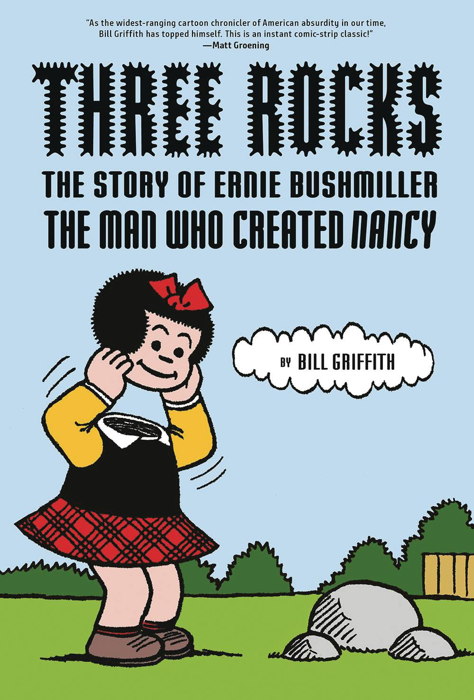
But it’s no decision at all when Bill Griffith gets a book out:


I mean, of course I’m going to read a biography of Nancy creator Ernie Bushmiller. It’s a dense retelling of not just Bushmiller’s career, but of the history of comic strips in general, going into details of the business from Bushmiller’s era. It’s not as emotionally devastating as his previous biography, Nobody’s Fool, the story of real-life pinhead Schlitzie, but watching Bushmiller’s rise and developing his methods of operation are both compelling and exciting.

There are several asides, from Nancy and Sluggo themselves (using redialogued Bushmiller art), and from Griffith himself, making appearances as the curator of an imaginary Nancy museum. Certainly strange, certainly fitting given the comics being discussed.

Good book, well worth spending the time absorbing this work. I would highly recommend this to anyone interested not just in Nancy and Bushmiller, but in the business of strips.

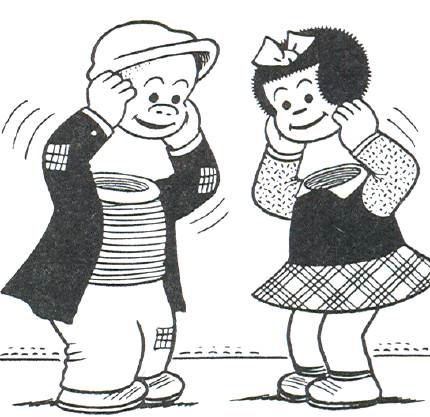
I do love the cover, taken of course from one of Bushmiller’s more nightmare-inducing strips:


…which I of course used as a wallpaper on my original flip phone, and also appeared in my Sluggo Saturday feature. (I see someone else out there is using the “Sluggo Saturday” name — ACCEPT NO SUBSTITUTES.)

The book does bring up his use of assistants of course, which I was aware of even when I bought this original Nancy strip a few years back. Like I said in that post, even so it was nice to have something produced under Bushmiller’s watch. And seeing that period of Bushmiller’s career in Griffith’s book, it was nice to think “I have something from this point in his life.” It’s a solid, real connection to this story, and in its way, maybe Three Rocks is as affecting as Nobody’s Fool, at least to me and my personal minor link to Bushmiller.

The Final ’80s Countdown, Part Twenty-One.

Back to Ye Olde Favorite ’80s Comicks Polle for our latest entry:

The Tick (New England Comics 1988-1995)

I’m a’gonna get the shameful confession out of the way first. I…never really got into any of the Tick comic books or its many, many spinoffs beyond the initial issues by creator Ben Edlund (those cited in the heading just above).
I know, I know, don’t yell at me. People loved the Tick, as per my observations as a humble funnybook seller over the decades. Folks didn’t just get one series and skip the others…they bought all Ticks, all the time, as fast and as many as were published. Even recently, after I acquired a giant pile of Tick back issues for the shop, they remain regular sellers. (Wither new Tick comics? More on that in a moment.)

Now, that first Tick series launched around the same time I started working at the local comic book store, and was also attending college. I didn’t start buying it from the beginning, despite the fact 1) I was always looking for new and weird offbeat books, 2) I always checked out the black and white comics for idiosyncratic visions, and 3) I liked comics that were funny.

But it took a college pal, Ray, who also worked just down the street from the comic shop and would buy comics from me occasionally, to turn me onto the book. Just hanging out between glasses one day, Ray asked me if I’d been reading The Tick, and after I said no, he regaled me with a handful of funny bits from the comic…enough so that next time I was at work, I decided to try it out.

And it was a good decision. That first series, under Edlund’s pen, was a wild ride of a superhero parody, starring a mysterious, oversized, “nigh-invulnerable” dude in a blue costume with antennae fighting crime in his own peculiar way. Eventually accompanied by Arthur, his moth-costumed pal who, as far as I remember, only went by “Arthur” as his superhero name.

Tick started as a mascot created by Edlund for the New England Comics store, appearing in newsletters until graduating to its own full-sized comic. (And I mean “full-sized” as it was printed at “Golden Age” size, larger in dimensions than other not-as-funny comics on the stands.) It ended up being enormously popular, with multiple Tick series (Karma Tornado starting during the initial series’ run) following by Many Other Hands. And that’s not counting spin-offs like Paul the Samurai and Man-Eating Cow.

Look, a lot of great people worked on these other non-Edlund comics. I admire the craft and consistency and willingness to just continue keeping Tick on the shelves and in front of people. But…what tickled me about those original Ticks didn’t seem to be in these other releases. Probably a “me” problem, since humor is very subjective. Again, don’t yell at me, please.

Now, if you want to read the Tick…well, nothing is currently being published, and the Tick offerings for recent Free Comic Book Days have even dropped off of late. On the plus side, a lot of Tick comics and trade paperbacks reprinting those comics have been unleashed over the years, so there should be plenty of these out there to track down. The most recently available book, brought back into print on occasion over the last few years, is a trade paperback reprinting the Complete Edlund stories (plus the Psuedo-Edition #13, produced to provide the thirteenth issue Edlund planned but never did).

I didn’t list all the series and reprints and variants and whathaveyou here just because there are so many. My suggestion is try out the Edlund material first, and if you like that, ignore cranky old Mike’s opinions and try out some of the spinoffs, which most people like just fine.

Should also note the media spinoffs, including a well-regarded animated series, a beloved single season of a live action show starring Patrick Warburton, and a couple seasons of a more adult-oriented but still hilarious Amazon Prime series starring Peter Serafinowicz. Oddly enough, I loved the live action shows (more the Warburton one than the Amazon one), but I never warmed to the cartoon. Look, I know that makes me a weirdo…the path I follow is not an easy one.

Another lazy post.

So another night where things got away from me…I do plan on the next installment of the Final ’80s Countdown, which I’ll try to get to next week. But in the meantime:

Sean asked about the alternate history Spider-Man comics published in Mexico, post-Gwen’s death. Apparently Mexican fans, and the folks making the comics, weren’t having it, so they continued along with new stories where Gwen didn’t get thrown off a bridge by the Green Goblin and then get killed when Spider-Man grabbed her in mid-air, snapping her neck. This article in the Guardian tells you all about it (and even interviews the original artist of those stories).

It’s brought up in the article, but it is very surprising to me that an English translation hasn’t been released in the U.S. But then, Marvel has so much Spidey stuff produced in the U.S. to pull from for trades and hardcovers, the added expense of hiring a translator to redo all the text may be enough to put them off. So I guess y’all better start hunting the back issue bins to put together your own run. I think in the 35 years I’ve been selling comics, I’ve seen an issue from this series…maybe twice. So good luck!

Mike Loughlin notes that Wizard said about pricing foreign edition comics

“…The UK edition of the ’60s Avengers comic was worth less than the US edition.”

…and that was likely true at the time. But Wizard died off before the weird, almost frantic drive to find “hot” comics that afflicted collectors starting not all that long ago, and driven to extremes during the height of society actually acknowledging a pandemic was happening. Things not as hot before were a lot warmer now, including international “variants” of American books. It was, and still is, a weird time, what can I tell you.

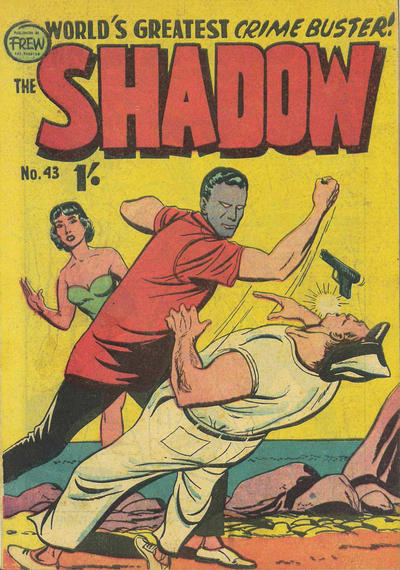
Sean also asked if I could get into the alternate version of various characters like the Captain Atom and the Shadow published in Australia. I didn’t have to resond, but in swoops Chris B with some Aussie comical info.

Here’s one, as s sample:


I don’t know…Casual Day for the Shadow isn’t really that great of a look.