Smicha1 cashes in with
“Mike, how do you handle it as a retailer when you feel that a product just isn’t worth the money? Are you pretty candid with your customers? You seem like a pretty ethical guy so I imagine you must be occasionally kinda torn between maintaining the trust of your customers and making that scratch. Have you ever felt compelled to actively dissuade someone from buying something because you know they will be disappointed?”
It’s…not always easy. Yes, of course I want to make a buck, even quite a few bucks, at all times in order to maintain my lavish* lifestyle. But here and there I cut costs on things to 1) encourage sales, and 2) lessen the burden on customers, such as probably charging less on comic supplies like bags, boards and boxes than I should be. And a lot of my back issues are very cheap, he humblebragged, but that’s mostly a case of pricing accurately due to condition. I probably kept my Funko Pops at a lower price than I should have for too long, and now that I’ve raised the price a buck or so I actually seem to sell even more of them. And there are other things around the store, mostly more merchandise, where I price ’em out at a buck or two below retail.
I have been known to angle some customers away from some comics and towards other comics that may be more to their liking, based on either what they say they’re looking for, or based on my knowledge of their tastes if I happen to have that in the ol’ mental database. That’s just a function of salesmanship. I don’t just come right out and announce “boy that sucks, don’t buy that” to everyone in the shop, because my taste ain’t your taste, some person might like it.
This was a point of discussion in the old comicsweblogosphere a decade or so back, about some folks who just broadcast to their entire clientele via newsletter reviews telling them to either “buy” or “not buy” comics that, um, they were carrying, which seems self-defeating. One on one suggestions with individual customers is one thing, just telling everyone “don’t buy this comic, it’s the worst” is another. The distinction, sadly, was lost, as the internet is where nuance goes to die.
My favorite example of this is the fella what slagged some Big Two event book to all his customers, then wondered a few months later “huh, wonder why [said event] isn’t selling for me?” Boy, get Hercule Poroit on that case.
What I’m trying to say, in between dragging out old grudges, is that I do try to find ways to keep my customers happy, and to help them spend their dollars wisely. I try to focus more on the “you might want to check this out” versus the “I don’t know if that’s for you” tack, but in the latter case I try to offer something else they would like as an alternative.
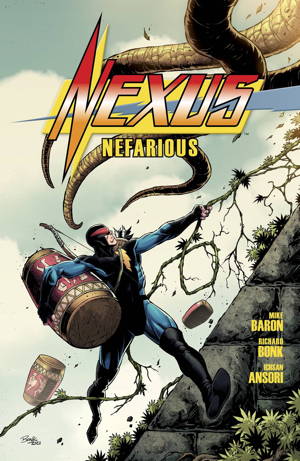
An additional note on that post about the most recent Nexus graphic novel: I was looking at the Nexus Wikipedia entry, where it states that Mike Baron and Steve Rude have “parted ways,” and that Rude is doing his own graphic novel. I talked about the recent Baron Nexus story, and with a new story by Rude apparently coming…does that mean the ongoing Nexus saga is split into separate continuities, with each creator deciding independently on what to do with the character? That’s going to seem a little strange. But then again, Nexus has always been a little strange, that’s part of the appeal. We’ll see what happens, I suppose.
Okay, I’m going to skip over responses to the Dilbert post in order to keep with the current locally-centered zeitgeist of ’80/’90 indies. Anyway, y’all had good comments there, with the exception of a recurring dipshit who popped up to say something stupid, but I left his shame intact for future generations to gawk at.
So, onto the next post, where none of you deadbeats have bought my Zot!s yet…but you left lots of good comments, so I guess that’ll do.
Cassandra Miller asks
“Do you, by any chance, have the Matt Feazel issues? Because I’m missing those…”
Those Feazel issues seem to be the popular ones…the mini-comic #10 1/2 and the full-sized issue #14 1/2. I did have a 14 1/2 but that sold right away. Sorry about that.
As a consolation prize, please enjoy this early post on my site (from within the first month of its existence!) about my even earlier encounter via the mails with Mr. Feazell. WARNING: link rot ahoy!
Daniel T tees me up with
“Mike, did you like Badger: Shattered Mirror? That was the only post-First thing I read and I thought it was pretty good.”
What Daniel T is talking about here is one of the two mini-series published by Dark Horse Comics after the demise of First Comics, the previous publisher of the Badger.
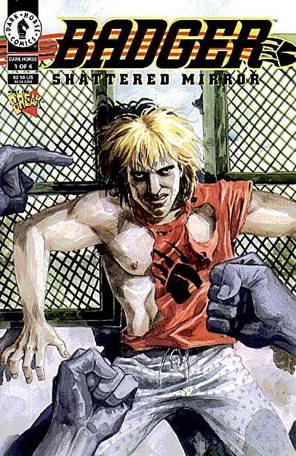
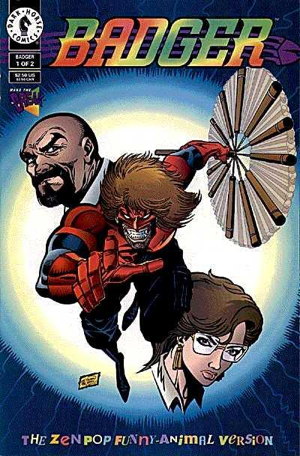
Released in 1994, these two series presented essentially mutually-exclusive origins for the character, Shattered Mirror being the serious one, and Zen Pop etc. being the wacky one.
Now it’s been nearly 30 years since these came out, and thus probably nearly 30 years since I’ve read the darn things. I am sure I liked them well enough, though I can’t honestly remember a thing about them. Badger is on my upsettingly long list of things to reread while my mortal coil remains unshuffled-off, so maybe I’ll get around to them again someday. However, my current sense of the Badgers funnybook history as a whole is, as I may have mentioned before, that some subtle lifeforce that powered the appealing balance of serious/wackiness of the Badger’s tales had begun to peter out near the end of the First run, and was never quite acquired again. Maybe a solid reread of the series may alter that opinion, but that’s my overall memory of everything.
“…Do you have anything to say about the language changes made in the B&W collection?”
Daniel’s referring to the Zot! book reprinting that series black and white run of issues from 11-36. And I have to say…I didn’t know there were language changes! I presume “word choices,” and not that they’re all suddenly speaking Swahili or something. Scott himself says he “fine-tuned the source material” on his site, and I suppose that means more than just touching up the art for republication.
So I tried looking for examples online and didn’t have any luck, so if there are any out there I missed, or, Daniel, if you want to tell me specific citations, I’d love to see them. But to answer your question in general…if Scott thought the changes were necessary, then it’s his book, I’m perfectly fine with whatever he did. Unless he, like, hid new drawings of Sluggo or Swamp Thing throughout, in which case I’d be ecstatic.
And before I pack it in for the night, let’s see what Customer Sean has to say
“Mike, as long as you are talking about Capital Comics characters who went on to First Comics, what about Whisper?”
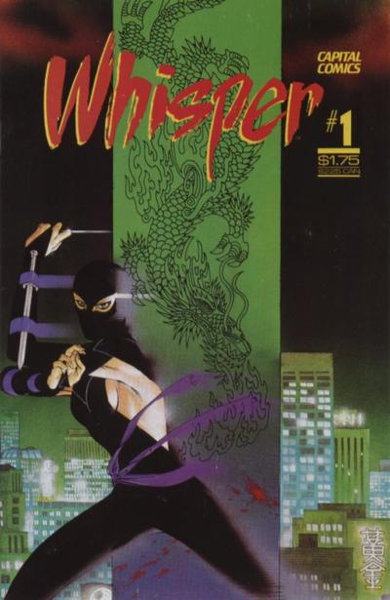
I gotta say, I didn’t pick up on Whisper at the time. Looked a little too ninja-y to me, and my eyes just kinda glazed over whenever “ninjas” were brought up in whatever comics I was reading (aside from the Teenage Mutant Turtles who were also you-know-whats, of course).
With the comics ninja craze long behind us, I’m probably a little more open to checking them out. If only I’d thought about it before my previous place of employment went the way of HBO Max programs, as I’m sure they had a full run of every iteration of the series. Plus, with my backlog already thoroughly logged, I’m not sure when I’d get to it anyway. As it stands now, I think the opening issue of First’s Crossroads series may be the one thing I’ve read featuring the character. Ah well, can’t read everything.
And Sean’s second question is about the late, lamented Pacific Comics, but I’ll get to that next time. Thanks for checking back in, pals.
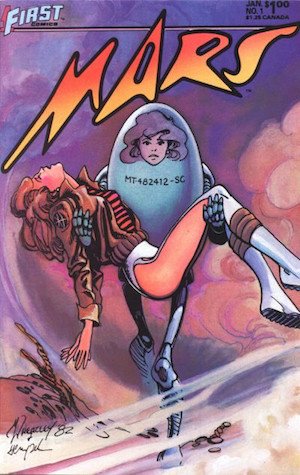 Ah, yes, Mars, by Mark Wheatley and Marc Hempel, released for 12 issue sin the mid-1980s. This was a favorite series of mine, marred only by occasional back-up features I didn’t much care about beyond wondering why they were eating up 8 perfectly good pages that could have been devoted more to Morgana, Dawn, and the mystery of Mars. That cover pictured here grabbed my attention (“why is that lady’s face also on the robot?”) and only set the stage for the more serious weirdness to come.
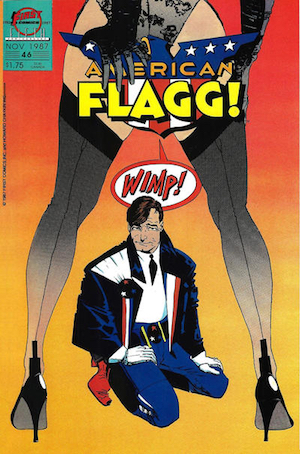 Howard Chaykin was on American Flagg! much longer than that, though in general I think people hold those initial twelve issues as the peak of the series. Chaykin wrote and drew through issue #26, with guest-artists on #13 (James Sherman/Rick Burchett) and #14 (Pat Broderick/Burchett).
 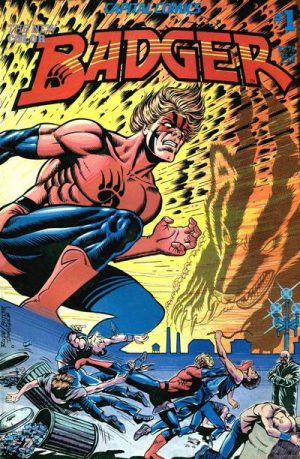 After that, The Badger might be the next-easiest to figure out, as all you really need is the original series itself (issues #1-4 published by Capital Comics, #5-70 from First Comics) and the
 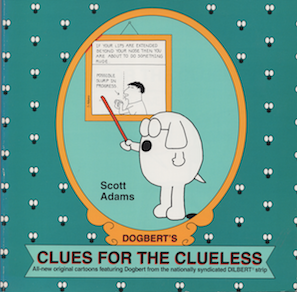 So it was in the early ’90s, not long after Dilbert‘s debut and my discovery of the strip, that I did a circuit through all the local bookstores attempting to track down the handful of reprint books that existed at that point. Dilbert hadn’t quite become the huge sensation it was about to be, or at least word that it was a sensation hadn’t got around to those bookstores, as it took some doing to find those particular volumes.