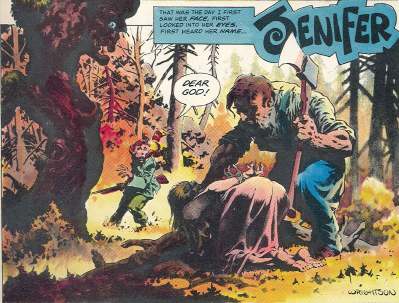
This was news to me: a DVD release of Masters of Horror: Jenifer by Dario Argento, a live-action adaptation of “a short story by Bruce Jones,” it says in the Amazon listing…a story I first encountered in comic strip form illustrated by Bernie Wrightson several years ago. It originally appeared in one of the black and white Warren magazines, and it was later reprinted in color in the PC/Eclipse-published mini-series Berni Wrightson Master of the Macabre.
Well, better add that to the Netflix queue. Not sure how the beautifully grotesque comic will translate into film, but if anyone’s gonna be able to do it, it’ll be Argento.
So in response to this morning’s post, commenter Jeff reminds us of DC’s War of the Gods, another company-wide crossover series that was heavily dependent on specific timing of all the tie-in titles. Specifically, that the series had scheduling problems of its own, with issues coming out of order and spoiling things in other issues and…well, as Jeff notes, that’s surely what Marvel desperately wanted to avoid.
Of course, it wasn’t so much a problem with War of the Gods, since the series wasn’t really all that good anyway (even with the George Perez art), and as such I don’t know if that many people were really captivated by the events in that series to the extent that they are with Civil War.
And despite my misgivings with how the Civil War schedule was handled — if you have an event series upon which the scheduling of the rest of the line is dependent, you’d better make sure it comes out on time — it had been succeeding in the goal it shared with all other crossover series: it got readers looking at other books Marvel publishes. That’s really the only object for series like this…it’s not “NOTHING WILL EVER BE THE SAME AGAIN” (because any significant changes will be undone in short order), but rather that it’s advertising for the company line. It got a number of customers at our store, at least, excited about each new chapter that was released, and checking out books they normally wouldn’t buy just to keep up with the story.
Now whether those customers stick with the new titles they’re trying out is a whole ‘nother question altogther, but at least Civil War got some people excited about their comics again, and that’s nice to see. As a funnybook seller, I like to see more comics in more people’s hands, which Civil War was facilitating. I don’t expect the delay to make much of a dent in readership, other than maybe losing some of the casual readers attracted by the real-world news coverage the series had been receiving. But, it’s still frustrating how this production turned out.
Okay, that’s enough Civil War talk for now…you’ve been seeing it everywhere else, you don’t need to see me grousing about it too.


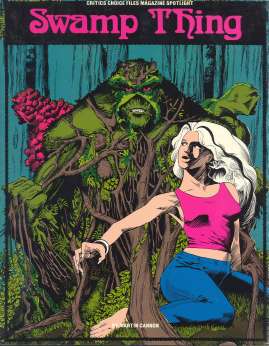
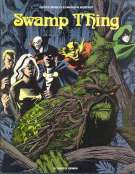


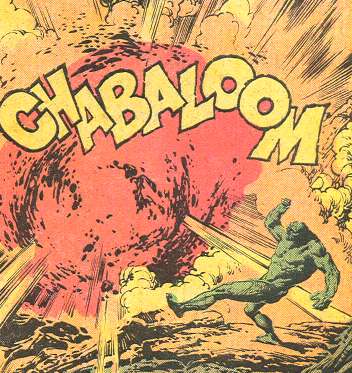
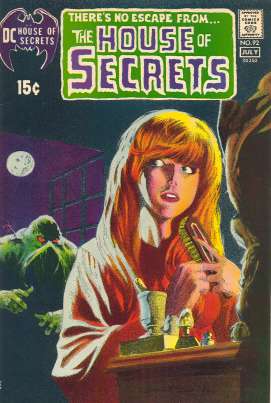
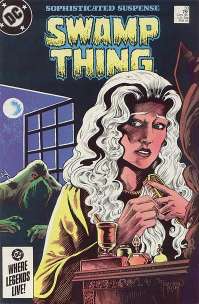 Saga of the Swamp Thing #33 (February 1985) was a fill-in issue of sorts, which contained a reprint of the House of Secrets story, making this Copy #2 of this story in my collection. The new framing sequence for this story, which drew a connection between the original Swamp Thing and the newer Alec Holland version of the character, makes what could have been just a fill-in into one of the most important and influential comics of the series. Not only did it establish that the current Swamp Thing was the latest in a long chain of swamp creatures throughout Earth’s history (a plot thread that would play out through the rest of this series), but it also gave us the first “modern” usage of the old DC horror comic hosts Cain and Abel. Cain and Abel, formerly humorous wiseacres introducing short scary comic stories in their respective anthology titles, were now explicitly described as the Cain and Abel from Christian theology, Cain continuously murdering Abel in an eternal repeating cycle. This new (or old, I suppose) interpretation of these hosts was carried into Neil Gaiman’s Sandman and its spin-off, The Dreaming.
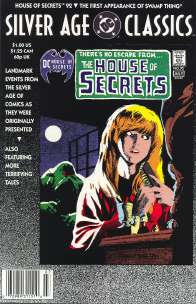 DC Silver Age Classics House of Secrets #92 (1992) – To commemorate the end of their printing comics at the World Color Press plant in Sparta, IL, DC released a series of classic comic reprints that were the last books off of those presses. Among the “Silver Age Classics” was House of Secrets #92, which kinda stretched the definition of “Silver Age” a little, but, since I apparently needed Copy #6 of the original Swamp Thing story, I was willing to overlook that little fact.