The Legend of Bagged Variants.

So back in this post I made note about publishers polybagging for safe display comics containing adult material. Specifically I was talking about Barry Blair’s Leather and Lace from 1989, but I also made note of Howard Chaykin’s very adults only Black Kiss from the previous year.

Now I don’t recall if Black Kiss was the first modern(-ish) comic book to be bagged for content reasons. I’m reasonably certain there had been comics pre-bagged before (were there 3-D comics that were bagged with glasses? there must have been) but I feel like the polybag covering of Black Kiss was enough of a novelty to drive attention to it. I mean, even more attention above and beyond “dirty comic by Howard Chaykin.” (And of course the factory-bagging continued on some non-adult issues of note later on.)

Now Black Kiss didn’t have any variants as such for its individual issues, which may have you wonder why it’s in this variant cover-age post. Gettin’ to that, honest, but it does have to do with what eventually happened with some of the Black Kiss covers. A couple of issues in, the covers on the title started to get a tad too racy for general display in a store, so rather than see them relegated to that curtained area in the back of the shop behind the shelves of Rolemaster games and Ral Partha miniatures, an opaque overlay was inserted into the bag with the comic to cover its shame:
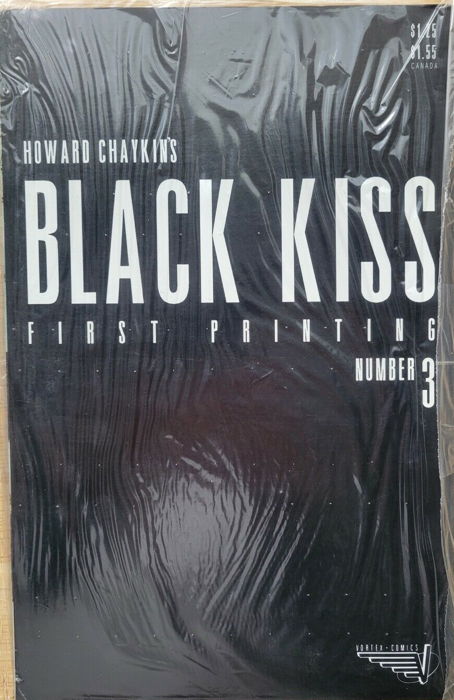
(Image liberated from an eBay auction, not because I couldn’t scan it if I had a sealed one, but because I don’t have a sealed one…all my copies of this are opened, though I still retain those card inserts because I’m a weirdo.)

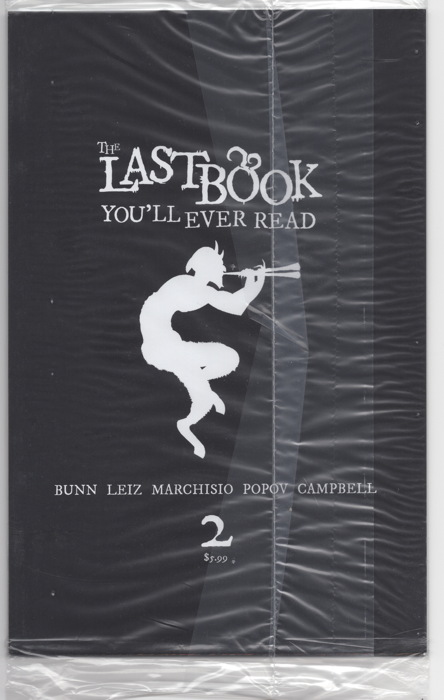
Now the reason I mentioned all that is this style of protective covering was an inspiration later on for current marketing gimmicks in relation to, yes, variant covers. Take, for example, the currently-in-release series The Last Book You’ll Ever Read from Vault Comics. Each issue so far has had multiple variant covers…a couple of which are laid bare to public viewing, acceptable for all ages, and one filthy dirty filthy variant sealed for America’s protection in a polybag and opaque cardboard covering:

This of course isn’t the only comic to use this strategy of “what you see is what you got, what you don’t see might be hot!”* to entice readers into picking it up and ripping open the package to see what’s been hidden from them. Preferably after they pay for it, naturally. The most famous recent example is the uncomfortably-titled Sex Criminals:


…which went all out on their bags to get you to drop the extra 70 cents to buy this version instead of the plain ol’ ordinary covers recommended by schools and churches.

And other comics are doing this, too…the slightly less uncomforatbly-named Money Shot from Oni Press started with the bagged and boarded naughty cover variants relatively recently. And the Bettie Page comics from Dynamite are eschewing the board altogether and issuing “black bag” variants, where, as the name implies, the bag itself is opaque and you can’t see Bettie…I don’t know, gardening on that particular variant. I bet that’s it, she’s probably gardening.

There have been the occasional packaging issues with these variants in the past. I think there was a Sex Criminals where the bag was insufficiently opaque or manufactured in some way that inadvertently revealed the cover. Plus, there was at least one comic recently where the covering board was inserted on the wrong side of the bag, leaving the sexy side unveiled for all. (I honestly can’t remember which comic that was now…was it Money Shot? “Here, let me type ‘money shot’ into Google….” “MIKE, NO”)

It’s a little amusing that a protective packaging strategy from an era where comics where under fire from folks “concerned” for their content (but mostly just trying to get their names in papers by hitching themselves to something popular) continues today as part of a marketing gimmick to sell alternative versions of comics for higher pricetags. Not that it wasn’t a gimmick in the first place, but it certainly saved us a bit of time at the shop having to bag ’em up ourselves. Having an open Black Kiss, or Faust, or something similar, just sitting on the shelf within the grasp of kids would have been a bit much. It became enough of an issue that “privacy bags” (black with a small window at the top for logos) began to be marketed for retail use.

Now, does the “bagged adult variant” thing work, saleswise? …I’d think “yes,” more or less. For the most part, when people have titles that have these variants on their pull lists at my shop, they specify the bagged editions. When I have the Bettie Page black bag variants available, they sail off the racks, I’m guessing to gardening fans. By and large, they do what they’re supposed to do, and that’s grab attention. But not too much attention from the wrong (i.e. too young) eyes, which seem to just pass right over them in favor of more dynamic covers on Amazing Spider-Man or whatever.

And that’s another variant style down, after nearly six months of talking about ’em (almost) every Monday! I’m not done yet, so tune in next Monday to see what else I’m cooking up. If you have anything to add to today’s discussion, or have a request, be sure to let me know!


* Attributed to Jamie Farr, from an episode of The Gong Show, according to my old pal Rob. Never heard it for my own self, but surely it must be true as it’s too good not to be.

Not mentioned in the post: the Christmas-themed Tank Girl window painting we had in 1991.

Hey, I’m bugging you, the folks what still read the blogs, for your comic industry/medium/hobby related questions…put ’em in the comments for this post and I’ll get to them! Well, eventually!

For example, that accursed will richards (as Dr. Doom would call him) says

“Hi Mike, hope the peepers aren’t giving you too much gip.”

Holdin’ together so far!

“I just wondered if you’d had much interest in British Comics (other than 2000ad/Dredd) in the shops you’ve worked in? Thanks”

The 2000AD family of publications and characters do cast a long shadow over the American comic business. If you ask your average comic reader to name a British comic, yeah, chances are they’d say “Dredd.” Possibly Britain’s most mainstreamed comic book character in the U.S. is a British satire/parody of the U.S., which is somehow fitting.

Once the “British invasion” of the 1980s happened in the comics industry, it felt like your general comic reader perhaps got a little more interested in where all these English folk came from, and you started seeing folks trying to track down, say, Alan Moore’s work before he turned up on Swamp Thing. (Not at all pulling from personal experience for this by the way, says the fellow with the full set of Maxwell the Magic Cat.)

There was some increased interest in the UK comics magazine Warrior, for example, the source of Marvelman AKA Miracleman comics that Eclipse started reprinting in the 1980s to huge success. Warrior would feed other U.S. reprint series, like Laser Eraser and Pressbutton, which had a slight following at our shop as well.

Should note now, better late than never, that this isn’t going to be a comprehensive cataloging of every comic with British content that turned up around this time. Just trying to focus on the big ones, and boy howdy Miracleman was one of the biggest ones.

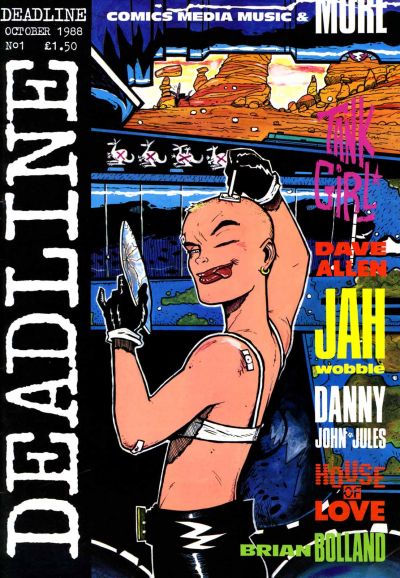
A little bit later at our shop, we stumbled onto a British magazine that a mix of comics and prose articles about music and other pop culture. Several of the strips inside tickled our respective fancies, making us fans of artists like Philip Bond and Jamie Hewlett. In particular, we became big proponents of one of the mag’s stars, the character of Tank Girl:


That’s the first issue from ’88 pictured there…unfortunately, we didn’t get in on the ground floor there. Deadline had been around a year or two before we realized what a goldmine of cartooning it was. I eventually made the drive down to this one store in Los Angeles and made a deal with the folks there for many back issues of the series, going back to that first issue. Just through word of mouth we turned a number of our customers onto the mag (and especially Tank Girl) and we now had quite the demand for this material.

I feel like those are the two Big Ones when it comes to customer interest in British comics. Not to say there weren’t other British comics and graphic novels and such that had a following at our shop (I personally was a huge follower of Eddie Campbell’s Bacchus and related comics) but outside of the 2000AD family, Miracleman and Deadline were the main attractions. I mean, we did try The Beano for a bit, but I don’t think our clientele was ready for anything quite that British!

Oyling the mind with questions.


It’s been almost exactly a year since I’ve thrown open the floor to questions from the audience, so I suppose it’s time to do it again! Plus, I had one of those days at the shop the have left me not wanting to think too much about funnybooks during my free time today, so I figured I’d just ask you folks for content ideas when I’m more in a mood to talk about comics.

If you (yes, you) have a question or general topic of discussion for me, preferably in reference to the comics industry, throw it into the comments here and I’ll get to it…in relatively short order, maybe.

The most important rule:

ONE QUESTION PER PERSON, PLEASE

I’m old and weak and can only take so much strain, so no giant lists of questions, please!

Thanks, pals, and as always I look forward to whatever responses you have!

Isn’t platinum a little more whitish in color than that?

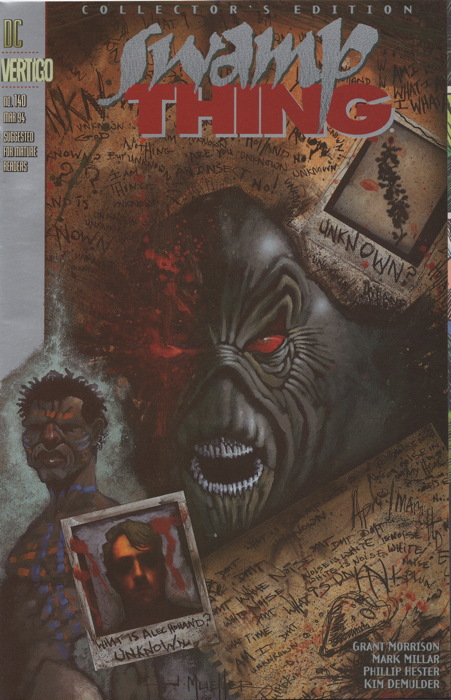
The only platinum edition comic I personally own is, as should come as no surprise, this “Collector’s Edition” (no, really, it is, it says right at the top) of Swamp Thing #140 (March 1994):


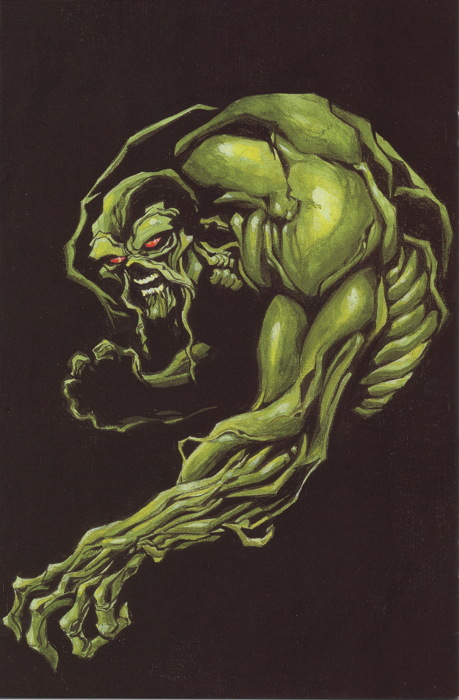
In addition to having the silvery-ink sidebar, logo, and other cover highlights, this edition replaced the ad normally on the back cover with this Swampy image by Phil Hester:


You’ll have to forgive me, it’s been (urgh) about 27 years since I got my mitts on this particular variant, so I forget the exact details surrounding its release. I thought maybe it was a Vertigo anniversary thing, or commemorating some soft relaunch of the imprint, or something along those lines. But no, a little digging showed DC doing a number of platinum editions around this time, just signifying some new notable title launch or storyline or whatnot.

Generally distributed one per store, these platinum variants carried some secondary market value as I vaguely recall, though a look at eBay nowadays shows plenty of copies of most platinum editions available for sale, and mostly not very expensive at that. Someone’s got a Books of Magic #1 (May 1994) platinum edition up for a Buy It Now of five bucks, as I type this.

To be fair, there were a lot of platinum editions in the Vertigo line. I’d remembered that Books of Magic issue, and, oddly enough, the platinum edition for the slightly more obscure Extremist #1 (September 1993). But I forgot about this particularly nice-looking platinum Black Orchid #1 (September 1993).

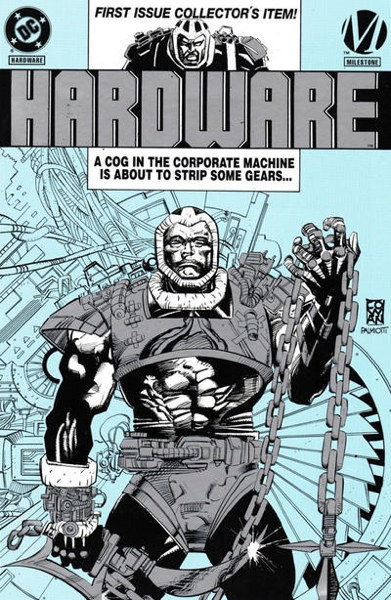
Of course it wasn’t just the Vertigo titles that got this treatment, however. Check out this platinum cover for Milestone Media’s Hardware #1 (April 1993) that I don’t think ever knew existed:


And there was a platinum edition of Static #1 (June 1993) as well.

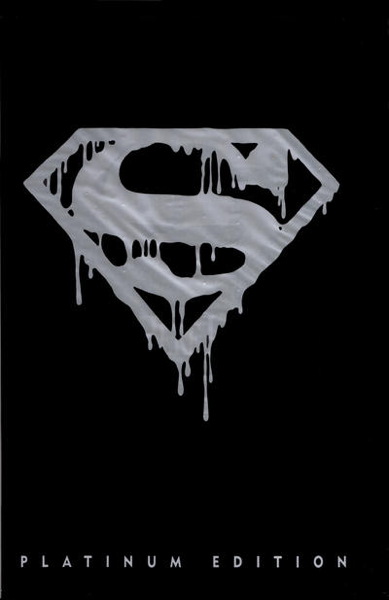
Most famously, though, and I don’t know why I didn’t put the Vertigo “platinum” trend at DC together with this in my head, were the Death of Superman-related “collector’s editions.” There was of course the actual Death of Superman issue, Superman #75 (January 1993), in a black bag that replaced the bloody “S” logo with a silvery one, and slapped the words “PLATINUM EDITION” along the bottom:

A search of copies on eBay showed plenty of graded ‘n’ slabbed copies out of the polybag*, and the front of the comic itself looks no different from the platinum one. However, the back covers feature a big white space and a serial number:


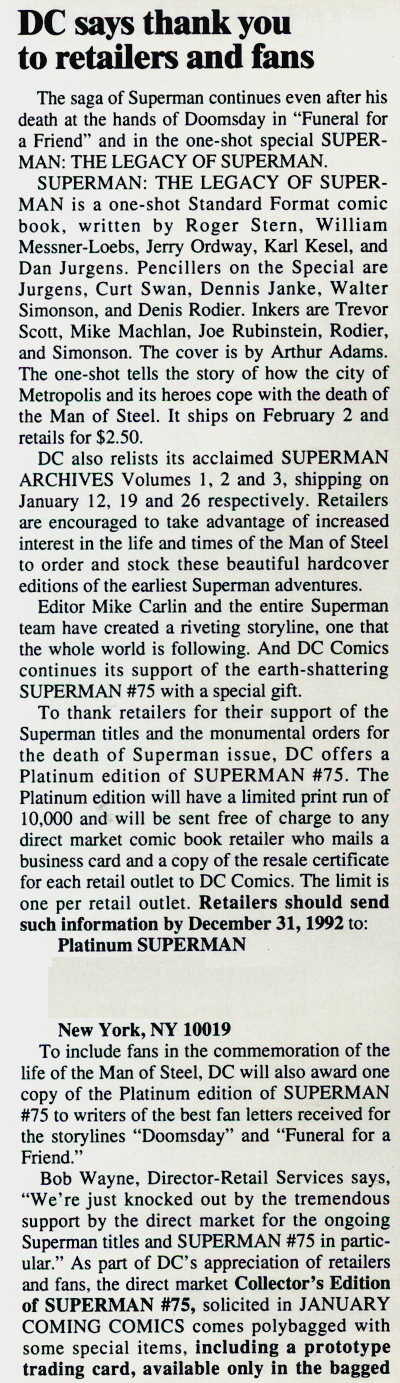
The Grand Comic Database entry states these were possibly numbered between 1,000 and 11,000, though there’s been no official confirmation from DC. This excerpt from a retailer letter I posted a couple of years back definitively states that it was a limited edition of 10,000. Also, you had to send in your business card and a copy of your resale certificate. Here, I’ll save you a click and just post the scan again:


Back in the old days, you had to work for your special platinum variants, they weren’t just handed out to stores willy-nilly!

DC later released a platinum edition of the white-bagged Adventures of Superman #500 (June 1993), which as you may remember kicked off the whole “Return of Superman” hoohar.

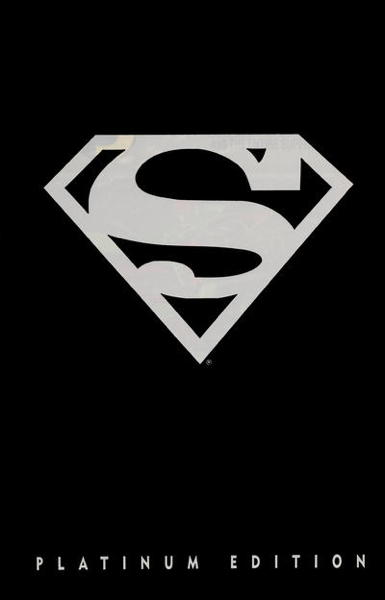
Black-bagged instead of white, silver non-bloody “S” logo on the front, “PLATINUM EDITION” along the bottom…don’t get it mixed up with the #75 above!

Unlike the actual cover of #75, which isn’t immediately apparent that it’s any different from the regular edition unitl you turn it over and see the serial number, ADV500 is instantly identifiable with its…whatever that color is cover instead of black:


I mean, is that “light mint?” What would you call that? Or is that just white in weird lighting? I honestly can’t tell, and it could just be my eyes. And it’s been so long since I’ve seen one in person I can’t tell you from memory.

Anyway, don’t think this one was serially numbered, at least as far as I can tell. And I think this was just sent out to folks who carried the comic, as perhaps DC didn’t want to further aggravate retailers already stuck with copies by making them jump through hoops to get…yet another copy.

I’m sure I missed mentioning a few…I wasn’t trying to be absolutely comprehensive here, but perhaps I can append a list later of all of DC’s platinum editions if necessary. But man, considering I didn’t even know about a couple of them is going to make it tricky to track down. And I didn’t even touch on platinum editions for other publishers. But it felt like such a weirdly DC thing I decided to just focus on them.

Plus, I got to show off my Swamp Thing comic.

* And yes, there’s perhaps some minor debate over the value of bagged comics and their opening or not opening thereof. I know the price guide allows for a bagged comic to be neatly opened and all contents retained to keep that high price and grade, but in the wild…man, sealed copies always sell for more than even the most neatly-opened copies. What can I tell you.

Sorry…

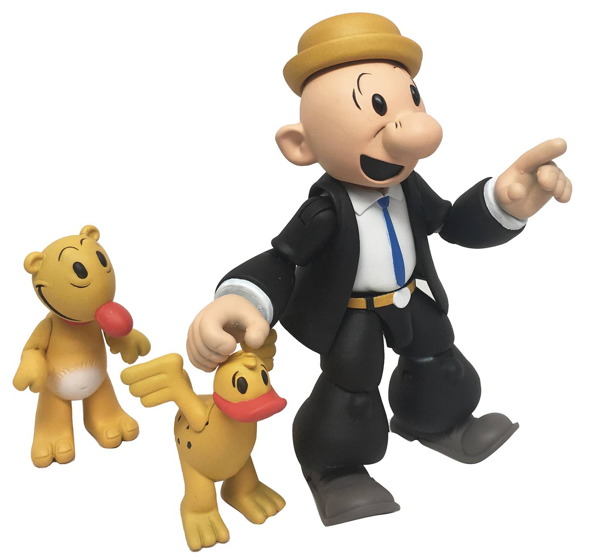
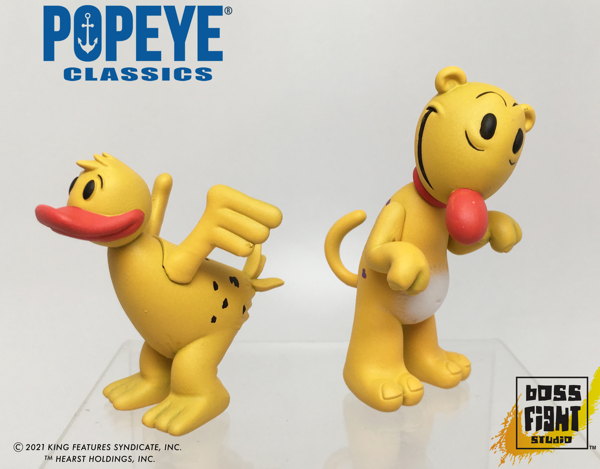
…but it’s been a long day and I’m Too Pooped to Post™. So let me leave you with this image of the forthcoming Castor Oyl action figure:

…which I almost passed on ordering along with the Popeye, Bluto, and Olive Oyl figures I was getting for myself from the latest Previews, until I saw that Castor had “Eugene the Jeep and Bernice the Whiffle Hen” included in his package:

Look, I know I’m weak. Also, did you know the Whiffle Hen predates Popeye his own self in the funny pages? IT’S TWOO, IT’S TWOO

Okay, definitely time for beddy-bye. See you pals on Monday.

Look, I’m calling them “Aliens,” you can call them “Xenomorphs” if you want.


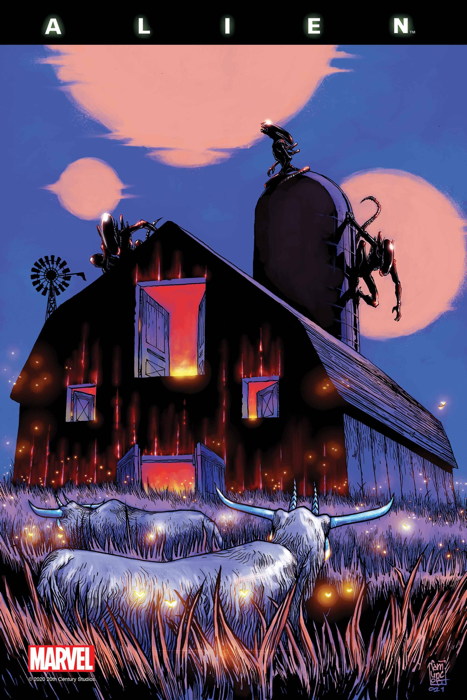
First, let me say I really have been enjoying this new Marvel era of the Alien comics, after not having read a whole lot of comics based on this franchise for the better part of…what, twenty years now? Has it really been that long? That’s not a judgement on the quality of the Alien comics that had come before…I’d simply had my fill and gave decided to give it a rest.

It seems like there are only two types of Alien story: people gotta get their hands on Aliens and things go badly, or Aliens suddenly show up where people don’t want them and things go badly. Oh, and the third type, “fighting Predators/Batman/Superman/etc.” And maybe a fourth type, “weird-ass story written by Jim Woodring.” And several stories, including the very first movie, are mixes of the two. In general, though, tales tend to lean one way or the other between those first two possibilities.

The first story arc was more “people want to get Aliens,” and with issue #7 and its new story arc, we’ve swung over to the other side and we’re getting “Aliens show up and distress ensues.” Which is perfectly fine, given we’re invested in the characters involved and the circumstances in the Aliens find themselves. The trick of course is making these things just as, if not more, interesting than the Aliens themselves.

I realize that’s very much a “your mileage may vary” sort of situation, in that perhaps not everyone finds the Aliens as interesting as I do…I mean, I could read a comic that’s just, like “A Day in the Life of the Aliens” that show ’em building nests, carrying eggs around, salivating, that sort of thing. But, you know, this is an Alien comic, and if you’re picking it up I’m presuming Aliens have at least some appeal to you, and you’re not just reading it for, I don’t know, romance between the lead human characters or anything.

This new story arc is off to a good start, with an infested ship crashing into a colony that’s just on the verge of independence from Earth, with a lead human character who’s put off having her terminal illness treated to ensure the colony’s survival. By which I mean contractual survival, not survival of an Alien attack, but I imagine we’ll be seeing more of that next issue. Anyway, she’s introduced as a strong and relatively deep personality, which will make for a good POV for the Alien fun to follow.


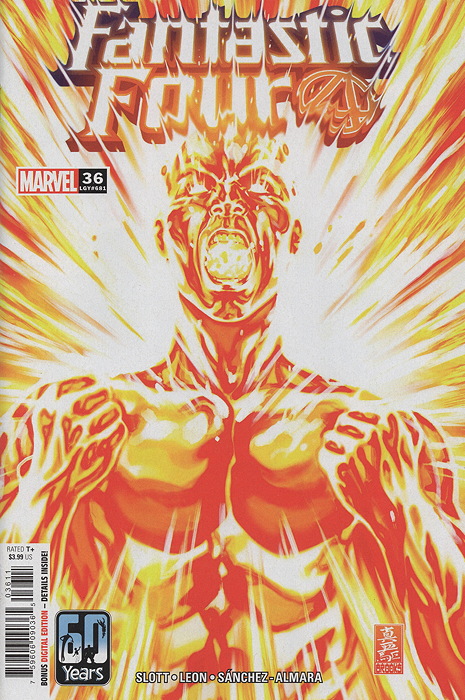
It’s only been a week since the last issue, which is a littly annoying from a retailing point of view, but from a comic-reading fanboy POV, it’s good timing as I’m really enjoying this “Johnny stuck flamed-on all the time” storyline. What I’m enjoying is how much story is put into each issue…still not a patch on how much Lee & Kirby would cram into their pages way back when. But still it feels like a lot of stuff is happening, and we’re getting plenty of new and weird situations, which is what I want from an FF book.


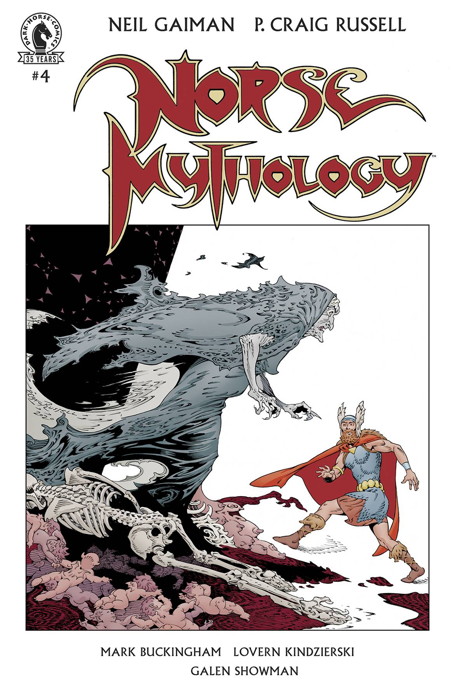
A long time ago, when I was but a wee Mikester, I had a book that contained a whole lot of Norse myths. One of the stories that stuck with me into adulthood was where Thor ‘n’ pals encounter the Giants and then are tasked with multiple challenges that they should be able to take on easily but are handed humiliating defeats. The secret behind how the Giants won these victories has amused me for decades, and how here it is in illustrated form. Not much to say here except “glad to finally see it.”

Don’t take any wooden variants.

So I’ve written about publishers test-marketing variations on their comics before, specifically when DC tried out more kid-friendly covers on a couple of their titles. I experienced those (well, at least one of those) in the wild, in real time as it happened, so I have a little more direct understanding of what was happening there (even if I had some initial confusion over “whoa, Firestorm looks different this month).

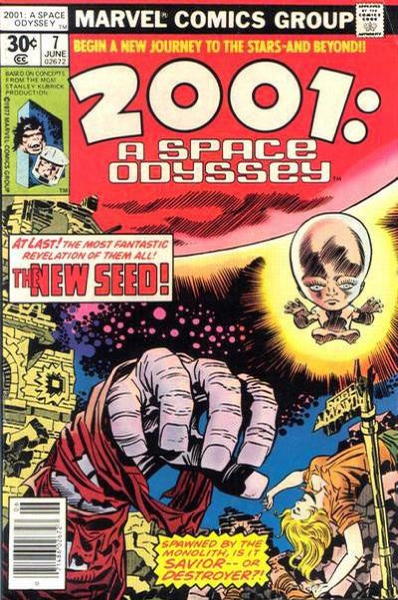
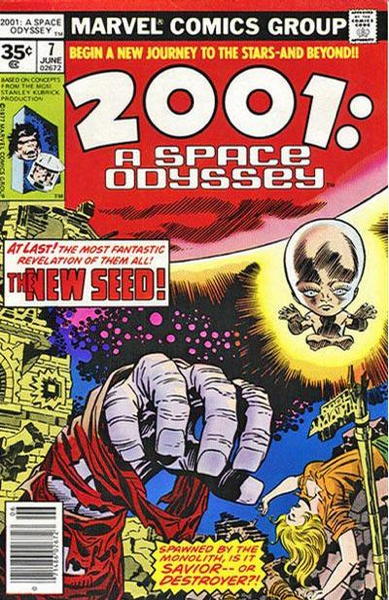
Some of the 1970s test-marketing, however, I only really experienced in the secondary market, during my extensive tenure at the previous place of employment. At some point, we began to realize that there was an increase in demand for some price variations of certain 1970s Marvel books. In particular, the 35-cent covers on comics that were at the time normally 30 cents. As an example (using scans borrowed from the immensely useful resource, the Grand Comics Database), this issue of 2001: A Space Odyssey #7, cover-dated June 1977.

First off, the widely available 30 cent cover, as acquired by the hoi polloi:

And the 35-cent variant, obtained off the newsstands by a few select elite for whom we must all show reverence:

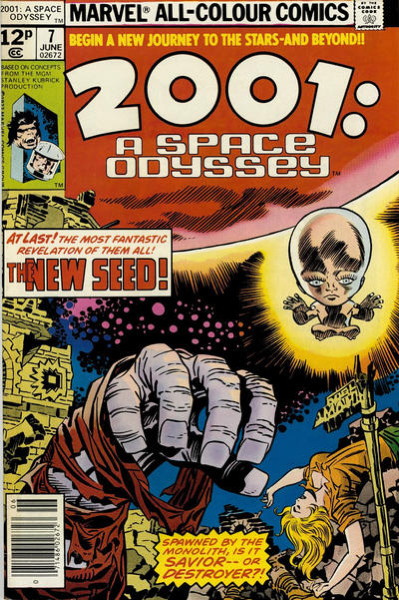
And apparently there’s a British price variation, too, but I’ll get to those some other day if I have anything to say about them aside from a “look at that weird space money they’re charging on those covers” take:


I was trying to pin down exactly when we realized “hold on, people are spending crazy money on these,” thus spurring us on to scour the many, many “end-of-Raiders-of-the-Lost-Ark-esque” boxes in our backroom looking for them. I want to say it coincided with our late-1990s move to eBay, where it was easier to see as it was happening countrywide, and worldwide, trends in comic collecting demand. And I feel like there was also an uptick in customers dropping by and specifically asking for those 35-centers as well.

I did a little research (okay, I Googled) and as it turns out, an Overstreet adviser was catching on and starting spreading the word about these variations. This would jibe with my memory of when we started experiencing increased demand for them. Now I’m sure folks running comic shops and tabling at conventions must have noticed when they had copies of an issue of something-or-other and each had two different prices, but it took this enterprising person to catalog just how widespread this was. And once word got out and it made it into Overstreet, well, that was that.

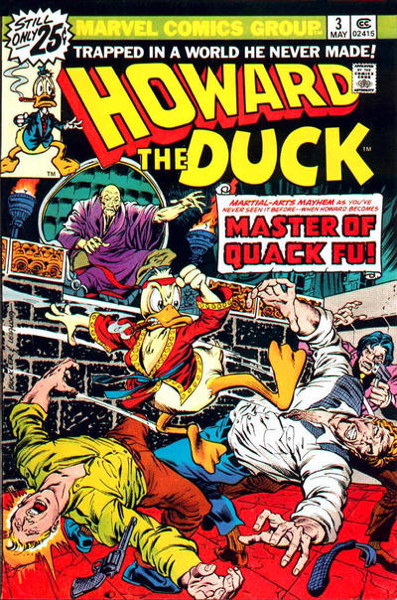
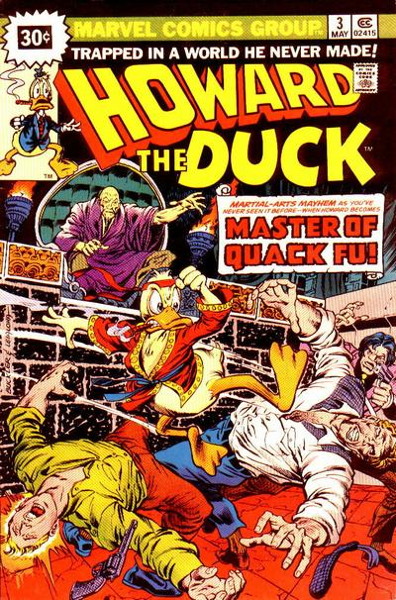
Now this test-marketing went on for a few months in 1977 (and including Star Wars #1, which is almost an entire variant cover-age article in its own right). The previous year, however, also saw some test-marketing from Marvel on price points, by trying out 30-cent prices on their 25-cent comic line. Behold Howard the Duck #3 (May 1976), first in its 25 cent configuration:

…and then in its shocking 30 cent glory:

(A hint to any readers from decades ago seeing my site with their future-scopes: once a comic starts saying “Still Only” in front of their prices, get ready for that price to go up.)

Now this website actually identifies the six areas where these higher priced books were distributed (c’mon, Boston, you can afford that extra nickel!). One of those spots was San Jose, CA, which is relatively close-ish, so I’m sure at the old job we must have at least some of these variations come through. I don’t remember anyone making a particularly big deal out of those at any point, not like with the 35 cent comics, but the latter certainly had a lot more publicity at the time.

It’s weird to think of a period of time where comic book companies would go through that much effort to discover how much kids would balk at dropping a few extra cents on their funnybooks. (And as my former boss Ralph reminded me the other day, Dell Comics did it too, and I’m sure they weren’t the only ones.) Of course, comics had much larger readerships then, and wider distribution in general marketplaces, rather than being restricted to a small-ish number of specialty shops today that only cover a portion of the sales areas comics used to reach. Now it feels like the test-marketing of prices is just done to everyone at once, with Marvel and DC seeing how many $4.99 and $5.99 and $9.99 books their print audiences will tolerate.

Fifteen years ago I would have had my rake and torch out.

I almost don’t even want to talk about this now, after tweeting about it the other day and then doing an audio post about it on my Patreon. But someone’s seemingly silly assertion that “men only read Swamp Thing to feel smart by getting the literary references” is…quite the reach, to be honest.

I’ve never heard that particular observation before. I’ve never encountered that sort of behavior in regards to Swamp Thing comics in the wild. And I’m pretty sure the “literary references” were not the main focus of the comics and not what the readers glommed onto. For all I know, this person (who is also a comics writer) was just deliberately trolling Twitter users.

My initial fear — given the phrasing of “why do men…” — was that some unsavory comics “fan” online collective latched onto Swamp Thing and began singing its praises, tainting the character and comics for other, somewhat more socialized, folks.

But no, it was just a tossed-off question, with a boatload of responses coming to the defense of Swamp Thing comics. I did my own small defense in my Twitter thread linked above, and…well, honestly, it’s not something I really need to get all worked up about, says the guy writing a blog post about it. And who knows…I’ve never encountered anything like this, but maybe that person who wrote the tweet encountered some folks being all hoity-toity about Swamp Thing and caused that particular reaction?

I used to get really bent out of shape when it came to “someone is wrong on the internet!” type stuff, and in more recent years I’m trying to take it a little easier in regards to that sort of thing. Even this response is more out of “well, I’m a Swamp Thing fan, better say something about it” than “LET SWING THE FLAMING SWORD OF VENGEANCE” or anything like that. I just thought it was a weird comment for someone to say. But, eh, not like I haven’t spent nearly 18 years making weird comments on my own site here.

Anyway, I’m really just glad it wasn’t because internet weirdos decided Swamp Thing was “theirs” and ruined it for everybody. Look, I’m the internet weirdo in charge of Swamp Thing around here, and I’ll brook no challengers.

Honestly, I think he’s a grown-up Herbie Popnecker (and that he’s teamed up with Herbie does nothing to dissuade me).


This issue of Marel Two-in-One was the first Fantastic Four-related comic I remember reading. Sometime after that I remember looking at some random issue of Fantastic Four my cousin had, which one I can’t remember, but I do know it was in the middle of some ongoing story and it was weird and strangely fascinating to someone mostly used to DCs and the occasional Charlton.

It wasn’t until the early ’80s that I began my full-on dive in Marvel Comics readin’, and my gateway was…an issue of The Thing, which brought me to John Byrne’s run on Fantastic Four (starting with the then-current issue and picking up the previous ones as I could) and then on to just about everything else Marvel-ish.

Fantastic Four, though, was one of the main two I stuck with (the other being Incredible Hulk and all its later permutations). I would occasionally not follow the title (there’s a big chunk of ’90s FF I skipped) but I have all those Byrne issues, the Waid run, the Millar run (which I still think is actually pretty good), Fraction and Hickman, Simonson, and now Slott…all readable, enjoyable and imaginative. I’ve also since read all the original Lee/Kirby stuff, with all its primal energy, laying the foundation for a fictional universe that is essentially dominating all popular culture today (even if its mostly been without the FF’s direct interaction, though not for lack of trying a couple of times).

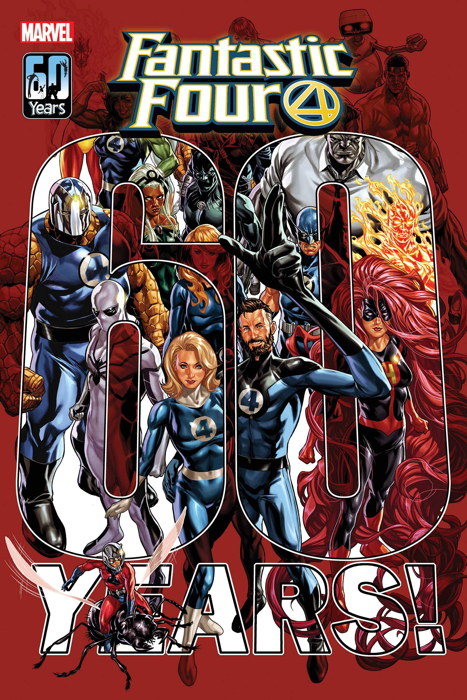
None of this really says anything about the comic, so let me just say it’s a fun tribute to the team’s long history, with cute “chapter break” images that really drive home the time the team has spanned. You will not be surprised at all by one of the story’s “twists,” but really, it’s a wild trip though the FF’s history and that’s entertainment enough. It’s mostly a standalone book (though one major subplot does carry through from the previous issues, but the exposition train pulls into the station long enough to catch you up) so if you haven’t read FF in a while, it’s a good sampler of the title’s current status, and worth checking out.

• • •

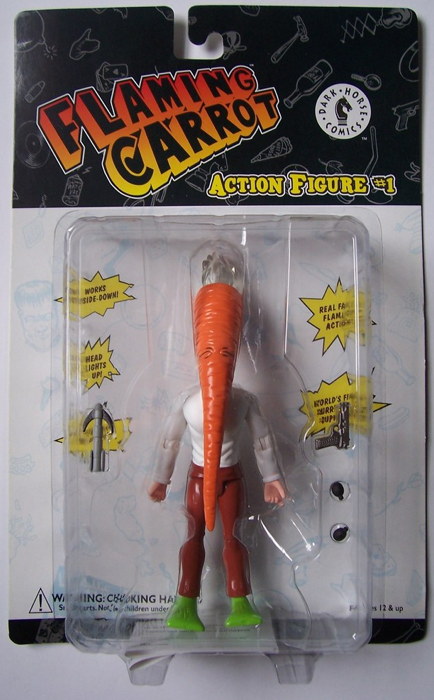
On a copmpletely different topic, I was looking at my old Flaming Carrot action figure the other day. It has a feature where if you twist the little plastic plume of “flame” that sticks out of the top of his head, it will light up. Or would light up if the battery wasn’t long dead, I thought as I twisted the doodad, but lo and behold:


…LET THERE BE CARROT LIGHT. I wondered just how old this figure was, as I couldn’t recall exactly when I picked it up from the previous place of employment. A peek into Diamond’s database revealed 1) it was still listed in said database, and 2) it came out in December of 1998. Nearly 23 years later, that little light is still working. Amazing. Now if we can only fnd out what the Carrot’s actual secret identity really is, and where that speaker in his chest came from.

The official Dark Horse Comics site still has a page devoted to the figure (which gives a release day of November ’98). A closer look is in this pic I “borrowed” from an online source:

All that does is make me wish I hadn’t discarded the packaging for my figure.

It’s more fun to play the variants way.

John asked

“What about Superman The Man of Steel #30, the vinyl cling/’colorform[®]’ cover. Would that make it the ultimate variant cover? Apologies if this has already been mentioned. I’ve been following the site and haven’t seen it. Keep up the great work!”

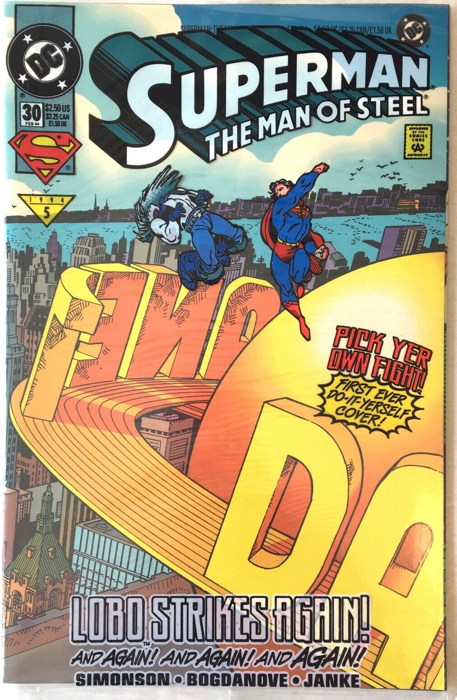
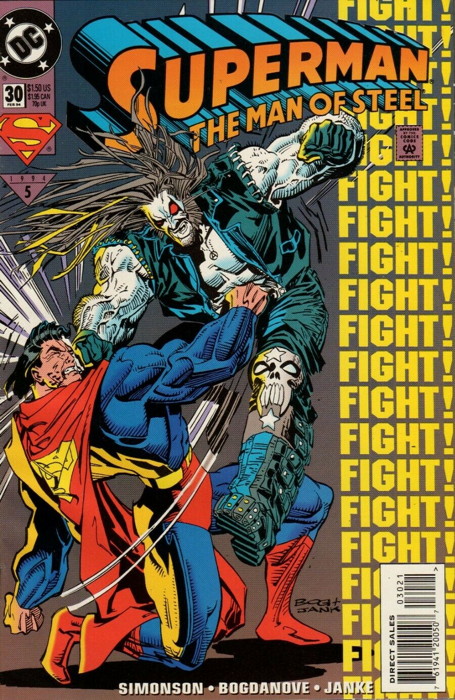
Ah, yes, what about Superman: The Man of Steel #30 indeed? Let us take a gander at this comic, cover dated February 1994, released December 1993:

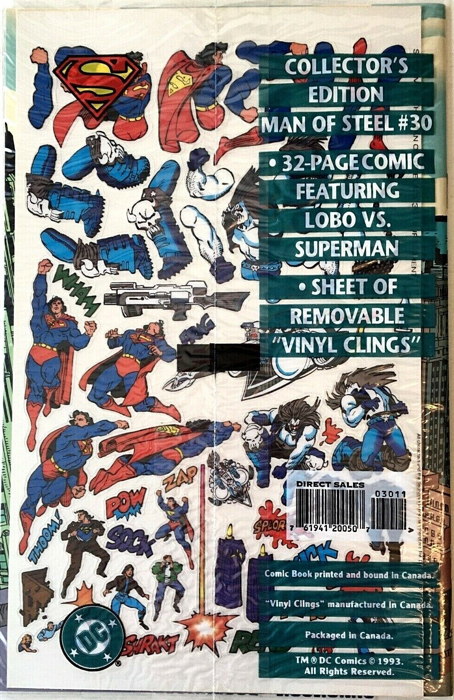
Here is the front of the “collector’s edition,” sealed in a polybag:

The back cover, showing the Colorforms® er, “vinyl clings” that John mentioned:

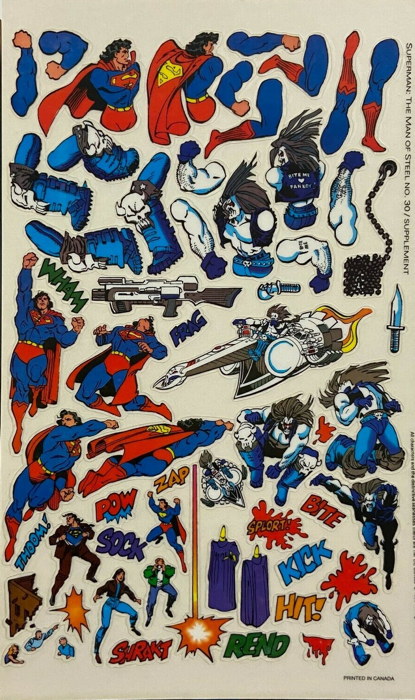
Here’s a better look at them, without the printing on the polybag:

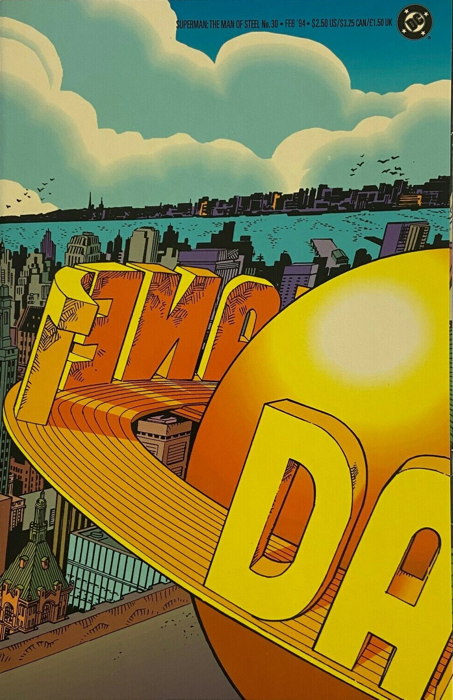
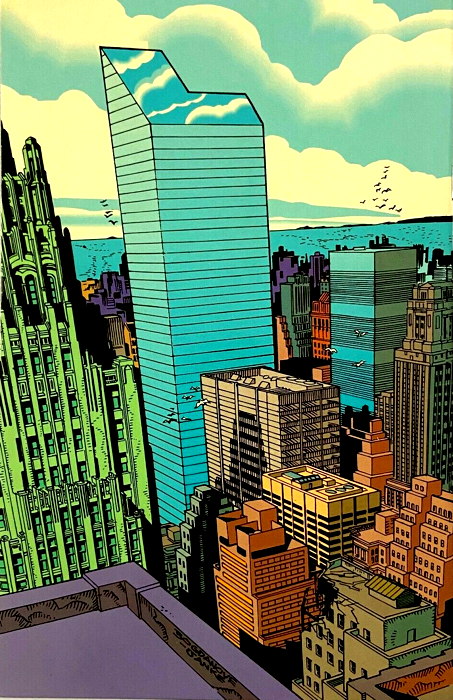
And here’s what the cover looks like out of the polybag, front:

And back:

And for comparison, here is the “regular” edition of the issue, AKA the “newsstand” edition (though pictured is the one sold through comic shops, as per the “direct sales” tag in the UPC):

Now I just totally stole all these images from the eBays, because 1) my own copy of the collector’s edition, still with the polybag (neatly trimmed open along the top so I could pull it out and read it) and clings, is currently inaccessible due to some current house rearranging-type stuff, and 2) I don’t currently have a working scanner at home and haven’t quite made the time, or loosened up the cash, to get a new one, so, hence, the liberating of scans from elsewhere.

And as John noted…the Collector’s Edition sort of is the Ultimate Variant Cover, as you make whatever design you want affixing your clings however you’d like, removing them and moving them around. If you’re not familiar with Colorforms® and similar toys, these aren’t stickers as such, but rather, as we keep saying, “vinyl clings” (hey, don’t blame me, the quotation marks are on the packaging) that are reusable and can stick to the slick, thick cover of the comic, then peel ’em off and move ’em around as you see fit. And when you lay the comic flat and opened, you get that nice shot of Metropolis on that wraparound cover by Jon Bogdanove and Dennis Janke, which makes for a nice playfield for your clings.

It’s a very clever gimmick…and yes, we’re straddling the line between “gimmick cover” and “variant cover” here, but the gimmick is a “Do-It-Yerself” cover as noted on the polybag, so I think we’re…er, covered. Now, I was going to say this was a unique gimmick, as I couldn’t recall anyone attempting such a weird thing again, However, a quick Googling reveals that writin’-about-funnybooks pal Brian Cronin just talked about this very comic only a few months ago, so, um, oops, sorry Brian, hope I’m not stepping on any virtual toes here. But he noted that DC itself repeated the gimmick for the Worlds Collide Milestone/DC crossover event which I didn’t remember (I mean, I remembered the crossover, not the clings). Anyway, read Brian’s article as he goes deeper into the history of Colorforms® and the reasons why gimmick covers such as this were so prevalent in the ’90s.

I remember this selling pretty well for us at the time…Superman sales were still pretty strong post-Death of, even in those ’90s crash days. But this particular edition with the clings was just odd enough to attract extra attention, and it continued to be a good back issue seller for years afterwards. Even now, when I get a copy in, it tends to go out again in relatively short order. I’m not even sure if I have one in stock right now.

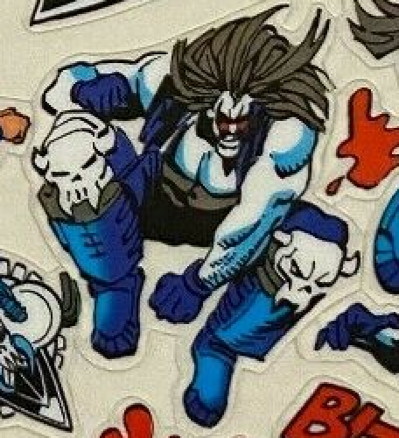
What’s great is that, as I recall, the slick cover stock used for Man of Steel #30 is identical, or close enough, to the “cardstock variants” DC is currently burdening offering on nearly all of their current releases. Thus, imagine having this Lobo cling:

…just leaping in on, oh, say, this cover:

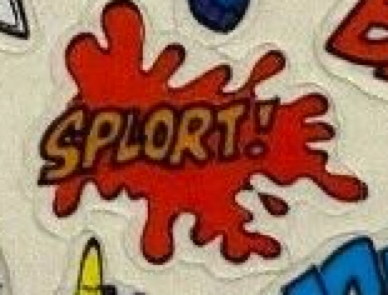
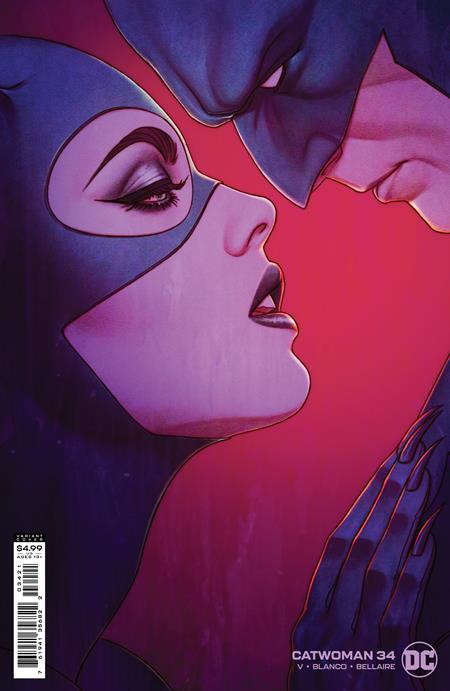
Or God help us, this:

being used on this:

The possibilities are endless. Everything (or at least everything with the proper paper type as a cover) is a variant now. I HOPE YOU’RE HAPPY, JOHN.

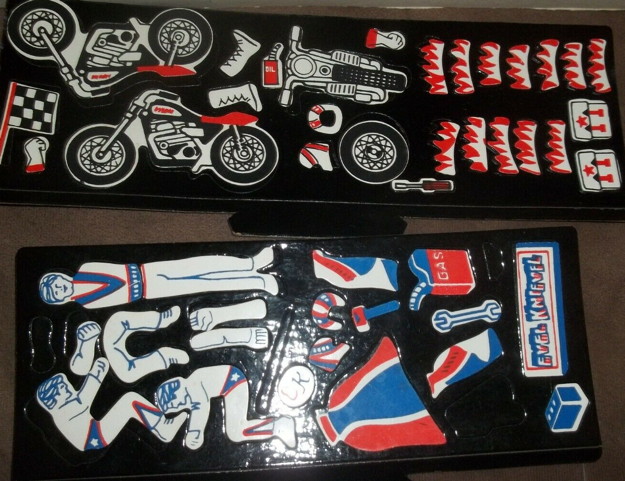
Now, my secret shame: I never played with the clings on my own copy of Man of Steel #30. Not sure why…not like I’m planning on reselling any of my Superman comics, no reason to worry if everything’s in “mint” or not. And I’ve played with this sort of toy as a kid…I was the proud owner of the 1974 Evel Knievel Colorforms® set, after all:

…and I do still have my Swamp Thing Presto Magix Totally Not Colorforms® set. Hey, that’s an idea…Evel and Lobo racing their respective cycles while Superman goes toe to toe with Arcane and his Un-Men, all over the streets of Metropolis! Okay, now I have good reason to regain access to my Superman boxes and dig out that issue! GREATEST SUPERHERO BATTLE EVER, HERE WE COME.