Well, still going through the one-voters from that “fave ’80s comics” survey I ran a while back. It’s been fun going through those and finding what, if anything, I have to say about these “golden oldies.” And I apologize to anyone I just aged into dust by calling these comics from the 1980s “golden oldies.”
This time ’round there’s gonna be a series of which I haven’t read one panel, and even as I’m typing this I have no idea what I’m going to say. Let’s find out together, shall we?
The Rocketeer (Pacific/Eclipse/Comico/Dark Horse 1982-1995)
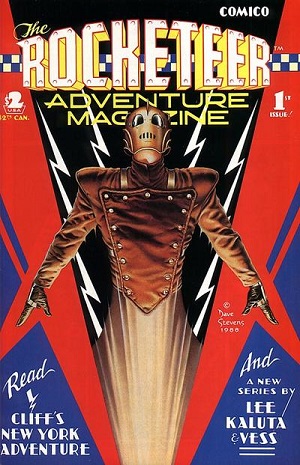 So here’s another exception to the “list just the initial series” in the header. The Rocketeer was serialized over several years, through several publications and publishers, in what was essentially one ongoing narrative, so I just lumped ’em all together here.
The story, written by Dave Stevens and drawn by him with the occasional assistance on layouts ‘n’ such from folks like Jaime Hernandez, began as a back-up story in Starslayer #2 and #3 from Pacific Comics. From there it continued with two more chapters in consecutive issues of the Pacific Presents anthology (1982-3), then on to a longer installment in The Rocketeer Special Edition #1 from Eclipse in 1984. Comico then released two issues of what would be technically the first Rocketeer “ongoing” series, The Rocketeer Adventure Magazine in 1988-9. And then finally, in 1995, the last part of Stevens’ story would be released as Rocketeer Adventure Magazine #3 by Dark Horse. Phew!
The early chapters, pre-Adventure Magazine, are reprinted in a full-color graphic novel from Eclipse in 1985 (which includes a couple of extra new story pages). In the 2000s, IDW would release collected editions of the whole shebang.
It is a fun story, pulpy 1930s adventure featuring a guy and his rocket-pack, and his pals, including his girlfriend Betty, very obviously patterned after real-life model Bettie Page. Stevens’ art was beautiful and meticulous and there was nothing quite like it on the stands. Sometimes the art felt a little stiff to me, without any real sense of action, but that’s a minor quibble. Despite all the delays, including a car accident, a lawsuit (Marvel suing because they said there’d be market confusion between this character some minor villains called “the Rocketeers” from the ’70s, really about as bullshit a suit as they come), a movie (perhaps you’ve heard of it), Stevens persevered and completed his story on his own terms.
Stevens would never do any more Rocketeer stories, and passed away in 2008. However, there are plenty of other Rocketeer comics out there, including the 1991 adaptation of the film published by Disney’s comics division. Probably of note due to artwork by the legendary Russ Heath, over a Peter David script. Also in 1991 was Rocketeer 3D, which was oddly another adaptation of the film drawn by Neal Adams/Continuity Studios and in, as you may have guessed, 3D.
After Stevens passed, IDW acquired the rights to do new comics, starting with the Rocketeer Adventuresanthology in 2011. Now, the IDW comics can be of…varying quality, but by and large they’re entertaining even as everyone involved is surely aware they’re trying very hard to fill some big shoes. Keep an eye out for the Rocketeer/Spirit crossover from 2013, by Mark Waid and Paul Smith. That’s a good’un.
Savage Henry (Vortex/Rip Off 1987-1993)
 The temptation to go to ChatGPT and ask it to write this particular section for me is overwhelming. But, learning the lesson from these lawyers getting caught out doing the same thing, I will opt to tell you what I can, considering I’ve not read a single panel of any of these comics.
I remember selling Savage Henry on the rack, but mostly I remember the other series by Matt Howarth from about the same time, Those Annoying Post Bros.. Howarth did some other comics here and there, and at the previous place of employment we just had a “Matt Howarth” section in the back issue bins where we kept them all together. On the somewhat infrequent occasion we had someone looking for his books, that customer was generally looking for issues of all of them, and just keeping them in the same place seemed to make sense.
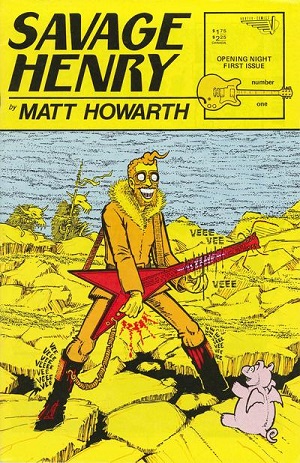
This comic is in fact a spin-off of Those Annoying Post Bros., a sci-fi/fantasy adventure featuring the band The Bulldaggers and its lead guitarist, the titular Savage Henry. Yes, I had to go to the Wikipedia entry amongst my research (“Siri, tell me about Savage Henry”) and apparently there was a whole pile of real-life musicians who popped up in here. I mean, I knew the Residents popped up in Howarth’s books…I definitely remember that…but, like, Steve Roach? Hawkwind? Andrew Weiss? (No, not that Andrew Weiss.)
I always thought the covers stood out, and Howarth’s art is, I think, pretty neat. I’m sorry I never got around to reading these, I’m sure they’re enjoyable.
Oh, and Savage Henry ran 13 issues from Vortex, before switching over to Rip Off Press for another 17. From that point it had a few new minis from MU Press and Caliber. No collected editions as far as I can tell, but if I’m wrong, let me know.
Scout (Eclipse 1985-1987)
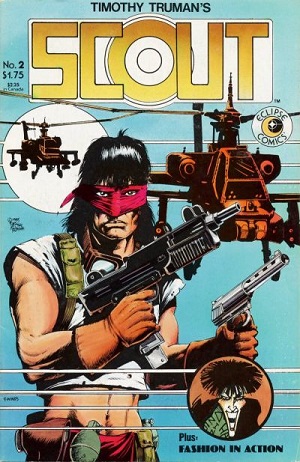 Scout was one of those titles I decided at one point, early in my career of funnybook retailin’, to collect and complete. I only ended up getting the first few issues, and can’t remember why I didn’t get more. It certainly wasn’t the quality, as the series was All Tim Truman, All the Time (except for some back-ups and a couple of guest-artist stints, by fellow Joe Kubert School alumni Rick Veitch, Steve Bissette, and Tom Yeates).
The comics feature the adventures of Native American Emanuel Santana in the near-future of a fallen America, seeking out the Great Monsters of the Apache. Inexplicably I do not own #17, which a tie-in to Tales of the Beanworld.
The initial run of Scout was 24 issues, and a couple of related mini-series not by Truman (New America and Swords of Texas. Truman would return with Scout: War Shaman, which would end after 16 issues in 1989. There’s also a Scout Handbook in there somewhere. More comics were planned, but as of yet had not been released. A hardcover for the third part of the planned saga, Scout: Warauders, was recently just funded on Kickstarter, so it looks like there’s more to come.
And I would be remiss if I didn’t brag mention my copy of the “Marauders” vinyl record by Timothy Truman and the Dixie Pistols. Becauyse, you know, it contains an 8-page Scout mini-comic. No collection is complete without it!
Reprints: Eclipse published a couple of trades back in the day, running up through issue #14 of the original series. Dynamite published a couple of reprint volumes in the early 2000s, which get up to issue #15, so…a full comprehensive printing has not yet been unleashed.
Anyway, it’s Truman, therefore it’s good. Look for those issues in the bargain boxes. There’s only a few dozen to track down, it’s not like you’ve got anything else to do.
And there’s your three for the day! Yes, I know this is taking forever but honestly it takes a lot to even do just three comics for these entries. A new entry in the Final ’80s Countdown is coming soon…thanks for reading, pals!
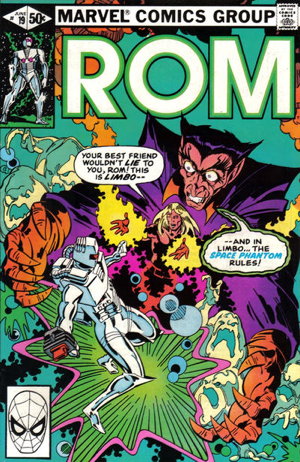 Well, this was as real week for “that’s the last thing I expected to hear”-type news, starting with the
 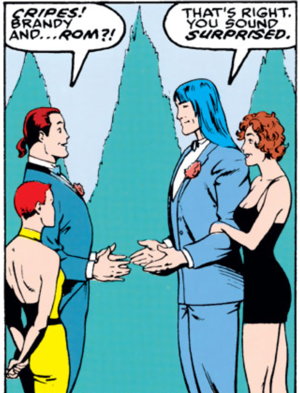 And I don’t know if Marvel would be allowed to reissue some of their other trade collections that previously omitted any ROM appearances. Most notably, there’s an issue of Incredible Hulk that prominently featured the Spaceknight,
 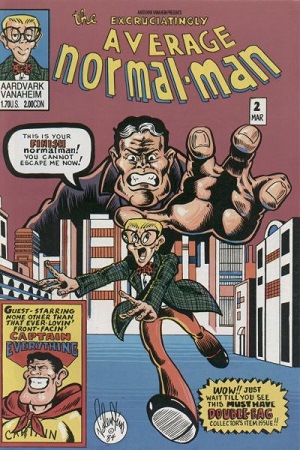 If I can let you in on a little blogging secret here…I wrote the middle bit about Pirate Corp$ first, and spent a lot of time doing so, which doesn’t leave me much time for the other two entries here. As such, I’m going to cheat a little and quote from
 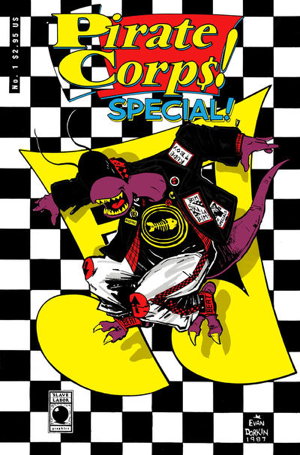 Okay, usually what I try to do here is list the first ongoing series for each property I discuss here, post a representative issue from that intial run, then in the body of the text I mention the other related series, if any. In this particular case, after the Eternity/Malibu four issue run, there was a transitional issue, the Pirate Corp$ Special released by Slave Labor in 1989 before starting their own ongoing series. That’s what I’ve got pictured here, because that was the first issue I ever bought of this title, for the primary reason that the Fishbone band t-shirt the fella’s wearin’ on the cover caught my eye. Being quite the Fishbone fan at the time, I had to pick it up and check it out, and I’m glad I did.
  Again, see my intro for normalman above, as I’m not leaving myself much time to write about this lushly-illustrated series. You owe it to yourself to find the originals for the covers alone, as they don’t make it into
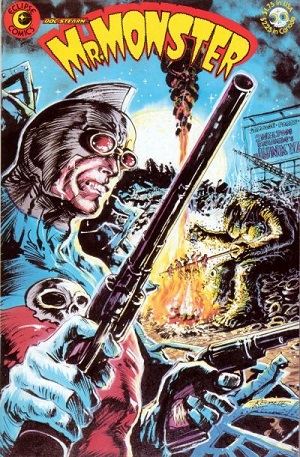 …Whoops, entered it on my master list of ’80s vote-getters under “Mr. Monster” instead of the full real name, as shown above, which is why I didn’t get to it ’til the Ms. Sorry, person who voted for this comic and was probably wondering why I skipped it!
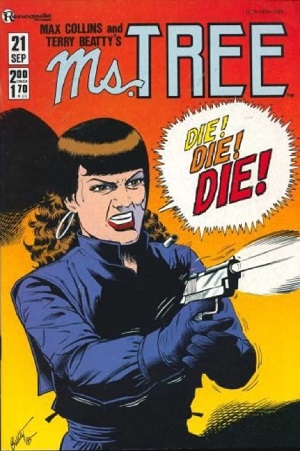 Okay, how many times have I told this story? I was buying the Ms. Tree comics, an ongoing saga about a lady detective and the tangled web her violent tactics can weave, for quite some time before getting my job working at a comic book store. Early at that job, someone asked for the Ms. Tree back issues. I replied, “sure, let me get the Ms. Trees for you…wait, hold on. ‘Ms. Tree.’ ‘Mystery!’ I get it!”
 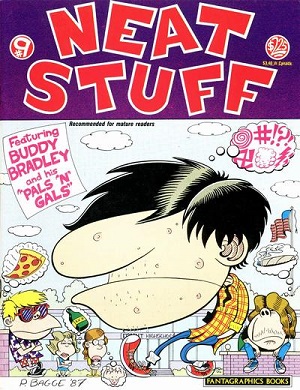 For whatever reason, though I was on the lookout for new alternative material around the mid-1980s, and I was buying Fantagraphics label-mates like Love and Rockets and Lloyd Llewellyn, among others, I didn’t really catch onto Peter Bagge’s Neat Stuff until, well, way into its run. Like, “the last couple of issues” late.
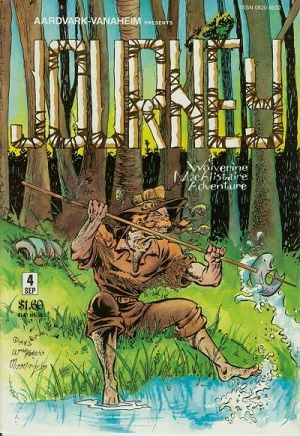 William Messner-Loeb’s magnum opus, this series featuring the adventures of frontiersman Wolverine McAlistaire in the 1800s had a not-long-enough run of 27 issues. There were a couple of back-ups in Cerebus that precede the series, and there was an aborted follow-up mini Journey: Wardrums that only had two of its proposed six issues released. The Fantagraphics benefit series Anything Goes (
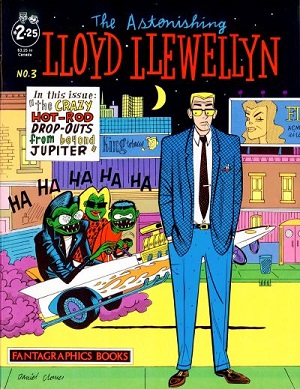 I saw the first issue of this magazine-sized publication on the shelf at the comic shop, and as a teenager who still liked superhero comics but was always on the lookout for something new and weird, I immediately picked it up, and all the follow-up issues as they came out besides. Strange, funny adventures by a nascent Dan Clowes, with more than a touch of influence from the Silver Age. You can see the beginnings of what would later blossom in Eightball, only barely constrained to the conceit of the title character’s detective-y endeavors.
 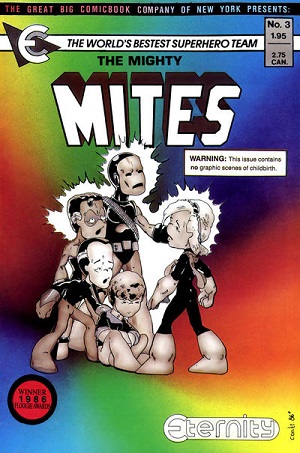 Well, here’s one of those series where I don’t have a lot to say about it, aside from what I already wrote about