Okay, one more brief post on Alistair’s question regarding licensed comics and the relationship between “official-ness” and fan acceptance. (Here’s post #1 and post #2.)
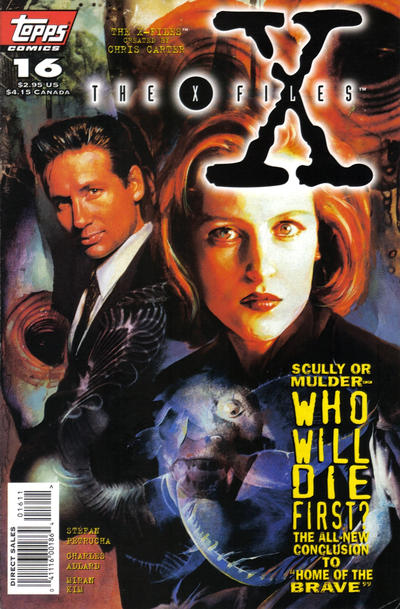
First off, Chris V has some several points to make about the various iterations of the X-Files comic, and I can’t really argue with any of it, so I’m just going to direct you there.
I’d written about the X-Files comics before (here and here…and look, there’s Chris V again in that second link!) As I recall, at the old shop we drastically underestimated the popularity of the first X-Files comic from Topps, so we were caught flat-footed by the demand for it…hence the proliferation of reprints and the then-soaring prices, long since dissipated, in the collectors’ market.
Also in that second link, the one with the ubiquitous Chris V, I touch upon the topic currently at hand, whether a licensed comic performs better if it’s explicitly part of official continuity. That post sorta supports Chris V’s comment from my Wednesday entry, in which he suggests that the X-Files comics were better off when they didn’t tie into the shows themselves. Of course, the example I’m using is the actual adaptations of episodes Topps produced, and Chris V also provides all the extenuating circumstances as to why sales where how they are.
Now, onto the stuff I wanted to mention today, which I’ll keep brief: licensed comic books based on animated cartoons/movies. For these, it would seem that fidelity of the tie-in to the original, at least visually, would be paramount. Or, at least close enough given the stylistic flourishes of the artists involved.

For example, I mentioned the other day that early in the production of Simpsons comics, there was one where the artwork was just…askew a little bit, and off-putting. Someone was attempting the house style, got close, but not close enough, and it made the book hard to look at.
Now, eventually we would see some artistic variety in the Simpsons comics, particularly in the Treehouse of Horror anthologies (where just about anything goes) or with Sergio Aragaones’ various contributions. Those, of course, aren’t off-putting…those are artists just drawing the Simpsons characters in their own way, adapting the house style to their own. So…drawn perfectly: Yes. drawn just shy of perfectly: No. Drawn in a completely different art style by a talented artist but still recognizably Simpsons? Yes again.
But otherwise…the art is the (relaively speaking) easy part. Either it looks like what it’s adapting or it’s not. But the stories….
To be fair, I’m sure in most cases, for all licensed comics, someone representing the owner of the license is keeping an eye out, making sure Finn doesn’t behead the Ice King or something. So it’s really up to the reader…”does this comic book based on an animated presentation rightfully represent the original work?”

There are lots of changes from screen to page at times. Like, the Road Runner and Wile E. Coyote are suddenly very talkative in the comics, and Mr. Runner, who speaks in rhyme, apparently has three…sons? Nephews? Something like that. But it all still feels like the Road Runner somehow.
Tom and Jerry, that cat ‘n’ mouse duo, also find their voices in the comics…and it didn’t seem to bother anyone there since the comic ran for nearly 350 issues over several decades.
Let’s not forget the Disney comics, taking characters primarily known for comedic short films and putting them into lengthy adventure stories. (Maybe I’m forgetting a cartoon where, I don’t know, Goofy climbs the forbidden mountains and finds the Old Gods, but I think you get what I mean.)
And there are plenty of comics over the years where they seem to jibe with the source just fine. Adventure Time, Teen Titans Go, Ren and Stimpy Show more or less, I particularly liked that last one, least until the whole thing was tainted by the creator’s issues.
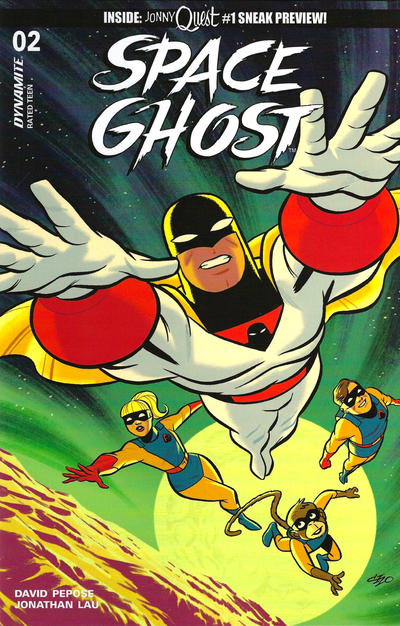
There’s also that new breed of licensed children comics, the Serious Adventure Take, which…well, okay, for a nominally sci-fi adventure like Thundercats, sure, but Your Mileage May Vary when the same is done to Space Ghost. (Which, I should mention, is very popular at my shop, and getting good notice, and I’m not trying to disparage it…just commenting on the distance between the mild camp of the cartoons and the current interpretation.)
End result is that things are a little less cut ‘n’ dried when it comes to the licensed animation comics. Completely faithful versions and new updated versions (Mark Russell’s Flintstones, anyone?) rise and fall on their own merits, regardless of fidelity to the property.
This was a quick overview, for which I apologize…got a late start Thursday evening. However, you’re welcome to contribute in the comments sections, as always, and maybe I can do a follow-up post in the near future. Thanks for reading, pals, and thanks to Alistair for the great questions!
Man, I’m loving the new Space Ghost series. It’s even more extreme than you mention because (at least in my head) it’s taking the SGC2C canon and playing the characters and locations seriously, rather than the original cartoon.
I’m just here to show that I also comment on any content that mentions ALF, not just the X-Files.
Well, if you won’t bring up ALF, I will. It’s actually a very good example for this sort of subject. That was my favorite childhood comic, I have read every issue, and it took MASSIVE liberties with its source material, which was a dual adaption of the sitcom and Saturday Morning cartoon. There’d be a story in the Tanner house and then in the next ALF would say “I remember the time…” and it’d flash back to the prequel cartoon.
Even though the sitcom was about an alien creature, Paul Fusco wouldn’t allow anything too out-there or sci-fi to get into his TV scripts. It was just supposed to be about this obnoxious furry thing that lived in someone’s house and annoyed everybody. The most adventurous the show ever got was a giant cockroach.
Writer Michael Gallagher ignored that rule and went heavily sci-fi and sometimes into outright fantasy, having ALF pull out one new gadget from his spaceship every issue and having hijinks ensue. ALF had a belt that made him fly, he went back in time, he battled talking trees, you never knew what you were gonna get next.
I believe licensed comics are MUCH better and more entertaining when the writer is allowed to use their imagination to the fullest and break canon mercilessly. The most famous example, which you briefly touched on, is Carl Barks being handed Donald Duck and, instead of writing silly slapstick stuff, he went way off the rails and built his own entire universe. And the world was better for it.
The only interesting Star Wars comic is Doctor Aphra because she is not in the movies and does not have a solid, unbreakable canon to restrict her. Her world is much more open than Luke or Han or anyone else whose story has already been mined and cannot be altered. And lo and behold, what’s the longest-running Star Wars comic since the Marvel handover? It’s Doctor Aphra!
Dark Horse has printed Stranger things comics for a while now and that’s a property you could do a lot with if you were allowed to. But instead most of them suck because they are strictly, rigidly canon and have to settle for mundane stuff that might’ve happened in between the seasons. No one wants a side story about how the Demogorgon was shipped over to Russia. Who even cares? Bring in new monsters and Mind Flayer attacks and actual things for the main cast to do! Break the canon, you cowards!
“the Road Runner and Wile E. Coyote are suddenly very talkative in the comics…
Tom and Jerry, that cat ‘n’ mouse duo, also find their voices in the comics”
Perhaps readers would have felt ripped off without text in their comic books? You can also cover a lot more ground and use facial movements with silent animated storytelling that you can’t really get away with looking at still panels on a page. This reminds me of a thought I had while watching Peanuts movies about how different Snoopy the animated character is (silent, save a few growls) vs Snoopy the comic strip character (constant running monologue).
I’m hoping this dive into licensed comics covers the ill-fated two issue run of Sledge Hammer! eventually.
In terms of similarity to the source material, there’s the story about the “Seaquest DSV” comic that was cancelled after one issue, because the lead actor Roy Scheider thought it had been excessively violent and action-oriented, and withdrew permission to use his likeness.
There’s that Yosemite Sam comic where he’s apparently a pirate in every issue for 80 issues. I assume that’s what inspired the pirate comics in Watchmen.
We short-ordered on Topps for sure. But we would pre-order, at times, by how many customers wanted books
on the pull list. The book we sold out most was REN & STIMPY. Was THE FRINGE a Topps comic?
We weren’t selling the Topps comic by Kirby.Then we put a bann with an arrow at a rack and it helped. We stopped ordering almost all the Topps.I still believe it was a case of new imprint fatigue.
In terms of sheer volume, probably Dell Comics, and then Gold Key/Whitman Comics, published the greatest number of licensed film and TV series adaptations from the Atomic Age through the Bronze Age. Charlton Comics also had a fair amount of licensed TV series comics in the Bronze Age. And one would think that Dynamite Comics ranks at the top for licensed TV series-based comics over the last several decades.
@ Wayne
I have bought some of those Topps Comics in dollar bins, and I will say that the Kirby comics are kinda fun to read. There is definitely a nostalgia factor at play, because those Copper Age Comics (Captain Glory, Bombast, Night Glider, and Secret City Saga) feature some of the late period artwork by comics industry legends Kirby, Steve Ditko, Don Heck, Dick Ayers, John Severin, Frank Giacoia — all associated with the early days of Marvel Comics. Then, you also have Bronze Age Marvel writers Roy Thomas, Gerry Conway, Tony –or Jenny Blake–Isabella, and Gary Friedrich writing the stories. I think that Jack Kirby’s Secret City Saga no. 0 with the great Walt Simonson artwork is probably the best book in the bunch. Then there were also the Jack Kirby’s Teen Agents, and Satan’s Six books, which, I think, could have benefited by using the old school Marvel artists–Ditko, Heck, Ayers–instead of the ’90s cartoony artists. Weren’t George Tuska, Carmine Infantino, Dave Cockrum, Gil Kane, or Marie Severin available?
Then there were also the Silver Star (with inking by Terry Austin), and Victory one-shots, which Kurt Busiek wrote. I do like the fact that the Victory comic featured the return of Captain Victory, has art by Keith Giffen, and tried to tie all of the Kirbyverse characters into one storyline.
I know that Image Comics also had a short run of Jack Kirby’s Phantom Force, and Icon Comics published a short run of Jack Kirby’s Galactic Bounty Hunters. And, of course, Dynamite Comics has licensed and published various short runs of Kirby characters, including Captain Victory, Silver Star, and Dragonsbane–and the Kirby:Genesis limited series by Kurt Busiek, Alex Ross, and Jack Herbert, which integrated all of the Kirbyverse characters into one big story arc was ambitious and interesting.
I do wish that the Kirbyverse characters could manage to have ongoing comics series,or even mini-series, wherein Steve Rude, John Byrne, Steranko, Jerry Ordway, Jim Starlin, Sal Buscema, Ron Frenz, and other classic Bronze Age artists could supply the artwork.
The other possibility would be to let Tom Scioli, Jim Rigg, Tradd Moore, and Michel Fiffe loose to breathe new life into the Kirbyverse characters. Or how about Tim Vigil drawing Jack Kirby’s Galaxy Green?
“I’m hoping this dive into licensed comics covers the ill-fated two issue run of Sledge Hammer! eventually.”
I hope Mike still reads these comments despite already writing a followup post.
As a huge fan of SLEDGE HAMMER! I spent months trying to track down these two issues. When I did, I was… underwhelmed. It tried to mimic the show’s style of humour but was largely unsuccessful. And yet, a poster-sized version of the first splash page (redrawn by me) hung on my bedroom wall for years.
Always been curious to know how that series came about – and if it’s similar to the three-issue A-TEAM series a few years earlier.
“The most famous example, which you briefly touched on, is Carl Barks being handed Donald Duck and, instead of writing silly slapstick stuff, he went way off the rails and built his own entire universe. ”
a less famous example would be Evan Dorkin on Marvel’s BILL & TED comic.
Chris Gumprich: “SLEDGE HAMMER!”
Agreed! Love the show, the comics sucked.
“and if it’s similar to the three-issue A-TEAM series a few years earlier.”
Having read those also- it was just as lame!
The A-Team seems like a more LIKELY thing for Marvel to adapt, though. Thety just didn’t do it well. That crap made TEAM AMERICA look good.
@ Snark Shark
What if Marvel did an A-Team/Team America/Captain America Team-Up limited series,ay?
It would not sell!