The Final ’80s Countdown, Part Six.

Okay, we’re getting to titles where I may need to do a little ‘splaining about how I’m notating them here. For the most part, I’m going to try to list titles by their initial runs…if that initial run continues numbering through multiple publishers, I’ll list the publisher in the heading (like I did with Dreadstar). If they have multiple series with distinct, separate numbering from either the same or different publishers, I’ll just list the first series in the heading (like I did with pretty much every series in today’s entry). I’ve been trying to note when and if series continue elsewhere, and if it’s appeared in another book before, so…hopefully everything’s clear.

Anyway, here we go….

Faust (Northstar/Rebel Studios 1989-2012)
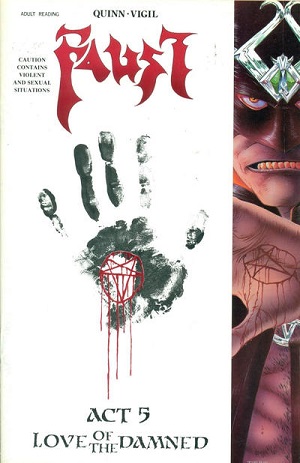
My earliest memory of Faust was figuring out quite what to do with it, since we couldn’t exactly just put it on the shelf as is between Checkmate and Daredevil. We put a single copy in a sealed bag on the shelf, with a little sign attached saying that copies were available at the counter. I think if I were to do that today, I’d probably bag each of ’em, or I’d do what we did with very adult material later at the shop and put them in the customer-accessible “naughty box,” but I discussed that in depth here.

And Faust was very adult, in that it featured some lovingly detailed sex and violence as presented by David Quinn and Tim Vigil. This was the book that I think really put Vigil on the map, though his previous violent action title Grips had achieved some notoriety. To be frank, I can’t remember if that initial rush of Grips demand was prior to Faust or concurrent with it, but regardless it was Faust that made Tim Vigil into Tim Vigil, if you get my meaning.

Yes, the series took some time to complete, publishing its last issue in 2012. But along the way, there were various one-shots and tie-ins from Avatar Press released as well. Oh, and don’t forget the 2000 movie. As to what it’s all about, I’m just going to direct you to the Wikipedia entry, because I can’t easily boil it down. I will add that entry says the series began in 1987, but I started in comics retail in 1988 and that first issue was released after that. Was there an earlier prototype-like release or something I missed?

It was quite popular, at least in the ’80s/early ’90s, going through multiple printings (including the first six issues released by Northstar being reissued by its new publisher Rebel Studios). I tried reading the first few issues myself, but fell off relatively quickly as it Wasn’t For Me. But it was for many of my customers, at least for a while.


Fish Police (Fishwrap Productions 1985-1987)
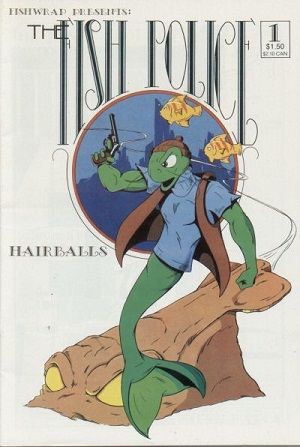
So Steve Moncuse’s Fish Police was not a series I read, but I do recall that the first issue of this series was, for a time, “hot,” perhaps part of that It had a pretty good run, as Comico picked it up following the initial Fishwrap run, and then continued under the Warp Graphics label after Comico went under.

Most notably, and possibly the main reason the property is remembered now, is that it was a very short-lived animated series that ran on network television in 1992. It was canned after only three episodes, leaving three unbroadcast (at least on American airwaves). However, the existence of this TV show got Marvel to briefly pick up the rights and republish the original six Fishwrap issues in color (with a nice big “AS SEEN ON TV!” blurb).

In addition to Fish Police, Warp also published a six issue side series called Fish Shticks, which is both a great and terrible name for a comic. It featured shorter, more humorous stories (I believe) outside the main plotlines of the primary series. And while Fish Police ended its rack life in the early 1990s, there was an IDW reissue of the old trade paperback Hairballs, reprinting the first six Fishwrap comics. And, surprise, a new story by creator Moncuse that popped up in Dark Horse Presents #22 in 2013.

I haven’t said much about the stories themselves, since I hadn’t read them, but in case it’s not clear, it’s a detective/crime comic starring anthropomorphic fish and other sealife. The one element of the series that intrigued me the most (though I don’t know if it was a major part of the story or just hinted at) was the idea that [SPOILER] the lead, Inspector Gill, had in fact once been a human being. I would like to have known what happened there, but as I said, I’m not sure anything regarding that was resolved.


Groo the Wanderer (Pacific 1982-1984)
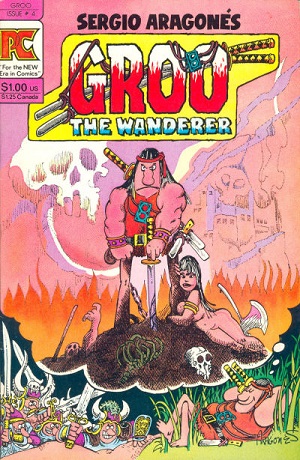
Hoo boy, my entries here are getting a bit long. And given that I’ve been a fan of Groo for decades, this could go on forever, but I’ll try to keep it down. Created by Serio Aragones, Groo first appeared in the benefit comic Destroyer Duck #1 in 1981 (previously discussed in this series), made a couple more back-up appearances in Starslayer, then got his own series running eight issues from Pacific Comics.

Quickly joined by cohort Mark Evanier, Aragones presented these cartoonish parodies of the barbarian fantasy genre, filled with wordplay, silly jokes, great visual gags, and crowd scenes in the inimitable Sergio style. Groo himself was, well, a big dummy, though very early on he wasn’t quite as big a dummy as he would later evolve into. You can see this progression just in this first series, where Groo feels just a little off-model from his more familiar form, speaking more like a slightly-goofier Conan type, but by the end he’s pretty much Groo as we know him today.

Groo’s gone through a few series and publishers, with a special one-shot, intended to be released by Pacific, ending up at Eclipse Comics after Pacific’s bankruptcy. Then it was on to Marvel Comics, where Groo showed up in an issue of Epic Illustrated before moving on to a 120-issue run under the Epic imprint from 1985 to 1995. (It was during this run that the final piece of the Groo puzzle, his best pal Rufferto the dog was added to the book.) From there it was on to Image for 12 issues from 1994-5, then after that Dark Horse Comics got the guy and has been publishing him in a series of mini-series ever since.

Over the years, the series has built up quite the cast of supporting characters, along with a parade of running jokes, all of which recur on a regular basis but always seem fresh and entertaining thanks to the cleverness of the creators. Aragones’ art skill has not diminished one iota with age, and every issue is lushly illustrated with fantastical and impeccably detailed creatures and landscapes and architecture. Evanier’s scripting/polishing/whatever it is he does-ing adds the textual humor to the visual gags for a double-threat of hilarity that never fails to amuse.

Of note: my former boss Ralph appears as a character in the Marvel/Epic run issue #28. But don’t let that dissuade you from checking out the series. And since I don’t have anywhere else to put it, here’s a post where I discuss my second-favorite Groo story (my favorite is the puppet show one, which I haven’t discussed here yet for some reason).

The one real shame is that there is no significant quality reprinting of the comics in book form. Dark Horse will release trades of their minis, but those never seem to be around for long. When Marvel published Groo, they released a few paperbacks reprinting four issues at a time, but obviously those are long out of print. Someday they’ll figure out a way to get all these into some kind of archival editions that some publisher will be able to keep in print. In the meantime, the actual individual issues should be relatively easy to find and affordable.

• • •

Well, I certainly didn’t keep it short on the Groo entry, either. Ah, well. That’s it for the ’80s countdown this week…I’ve got Free Comic Book Day this weekend, so guess what Friday’s post is going to be about. Hopefully I’ll be back to it on Monday…and I equally hope you folks are enjoying my excessive typing on the topic here. Thanks, and I’ll see you next time.
The Final ’80s Countdown, Part Five.

So it’s come to this…I’m continuing my look at your picks for your favorite 1980s indie comics, starting with the single vote-getters (no shame on single votes, everything is loved) and working my way up. Usually I have plenty to say about most of the comics we’ve discussed here, but this time I’ve got three books that I don’t have a lot of specifics to share here. I busted out my Amazing Heroes Preview Specials and my copy of the Slings and Arrows Comics Guide softcover for reference, and I’m going to do my gosh-darnedest to fill this post with something useful.

That said, awaaaay we go:

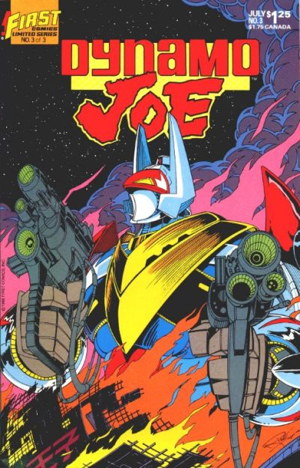
Dynamo Joe (First 1986-1988)

I made an oblique mention of Dynamo Joe in this post, where I’d mentioned that First’s Mars series contained back-ups I was…disinterested in. I didn’t call them out by name, but one of those was indeed that most dynamic of Joes, starting in issue #10 (1984) and running ’til Mars‘ end at #12.
From there it would continue as part of the anthology title First Adventures before getting its own three-issue mini-series. But huzzah, apparently it was popular enough to continue past that third issue to 15 total, It’s that 15-issue series noted here. A (1987) would reprint the material from Mars.

I am sure I read, or attempted to read, that back in Mars, but all I recall is that Id’ rather have had more Mars content in the comic, and less non-Mrs material. Alas, they didn’t listen to me, and look, Mars ended at #12. Coincidence? As such, I know very little about this, though I can tell you it’s about a giant battle robot piloted by living people, fighting a war against alien invaders or somesuch. Early on John Ostrander scripted over Doug Rice’s plot and art, but later on Phil Foglio would take over for Ostrander. Also, Ben Dunn drew an issue or two, spelling for Rice.

That Phil Foglio was involved gets my interest up a little, but not quite enough to have sampled more of the series beyond those Mars back-ups. But I know it had its followers…I can recall a little back issue movement on this title, but alas, all things had their day and ol’ Joe had his. Its? I don’t know. Slings and Arrows calls the series “surprisingly unpredictable” with the aside that some plots seem to pop up later on Babylon 5? Okay, that got my interest.


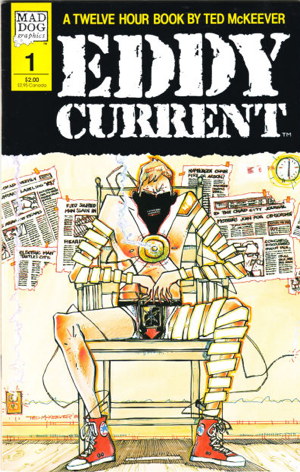
Eddy Current (Mad Dog Graphics 1987-1988)

Was this the series that put Ted McKeever on the map? I feel like this was the comic that introduced his particular and peculiar vision to the world.
I do remember seeing this series in the wild when it was originally coming out, but I didn’t buy it, instead going for McKeever’s other series Transit from Vortex Comics. I mean, I liked Transit okay, I suppose, but I guess I figured one Ted McKeever series was enough, on the limited comics budget I had, and as it turned out I put my metaphorical nickel down on the wrong book as Transit was the one that was cancelled partway through, and Eddy Current was the one that made it to the finish line, to some acclaim. (I would later pick up McKeever’s Metropol series from Marvel/Epic, and the Metropolverse, as it was never called I think, eventually encompassed the previous two titles.)

Eventually I did read Eddy Current when I picked up that nice hardcover collection Dark Horse did in ’91. Unfortunately, I sold it off during one of my infrequent purges, but I would later get the Atomeka Press 2005 reissue, which came in three small softcovers.

It’s been a long time since I’ve revisited this story, and as I recall it’s quite good, an excellent introduction to McKeever’s sensiblities. Our titular hero gets a supersuit from a comic book ad then gets caught up in world-saving…or is it just city-saving…shenanigans. Like I said, it’s been a while. Each issue of the series represents one hour in the narrative, which is a fun gimmick, and one I don’t see too often in the funnybooks. (Was it that Doomsday Clock prelude issue of Batman that took place over the course of…a minute, or something like that? That’s the first thing I thought of along those lines.)


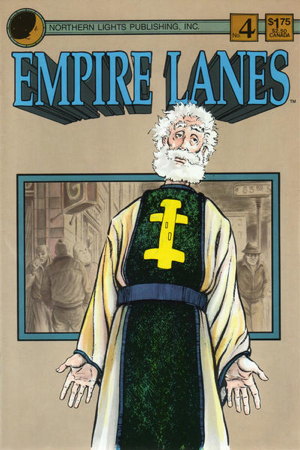
Empire Lanes (Northern Lights 1986-1987)

Okay, you got me, I know nothing about this comic. I mean, I remember seeing it at the shop, but I can’t tell you a darned thing about it.
Well, okay, looking around online I can tell you that Peter Gross wrote and drew it, and as I recall Peter Gross is a talented artist. You can see that from the cover gallery for this series. I can also relate that the story is about folks from medieval times (no, not Medieval Times) who, through misadventure, end up in our modern world of, well, 1986-1987 I suppose. I do like the sound of that, so again, my loss for not paying attention to it before. This series of posts about ’80s indies is really going to end up with me searching out and buying a bunch of back issues for my own collection, isn’t it?

Interestingly, Comico would published a new #1 for a follow-up series in 1989, and then another new and different #1 in 1990? Am I understanding that correctly? Perhaps someone can clarify and I can update this entry. But there was for sure a paperback collection for the original series published by Comico (Empire Lanes: Arrival) in 1990.

This was reminding me of a specific movie, but I couldn’t remember the name, so when I went to Google I found out there were several movies along these lines, so there you go. But I bet the Peter Gross comics look the best. (The movie I was trying to think of was The Navigator, by the way.)

• • •

Despite my general lack of specific knowledge on these books, turns out I could still type a lot about them anyway. If you have more useful information on them than I had, feel free to drop that info in the comments. We’ll pick up again next week!

Watch your hand there, Cliffy.

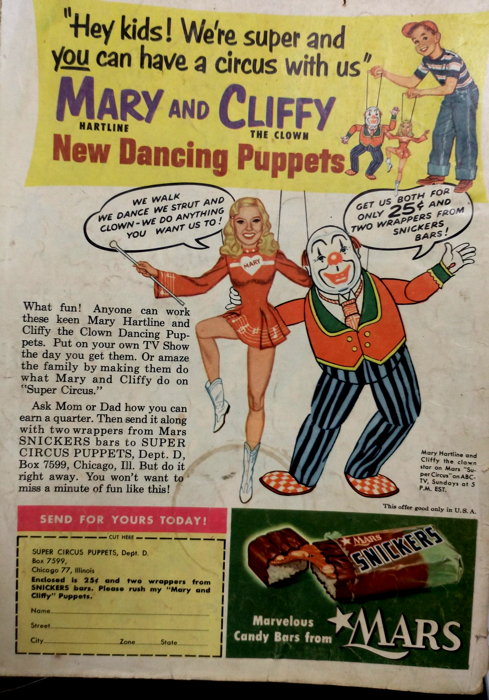
So I was processing a whole bunch of 1950s Western comics (stuff like Lash Larue and Gene Autry) when I came across this ad in one of them:


Pic’s a little askew since I took it with my cellphone instead of scanning it properly. Ah well, good enough. But looking at the ad had me wondering just want kind of puppets you’d get for a quarter and a couple of candy bar wrappers. Even in 1950s money, I don’t think 25 cents would result in full-on high quality marionettes.

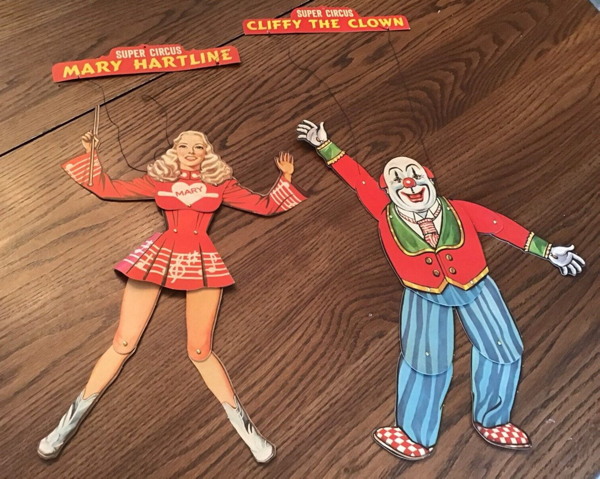
Anyway, say you were a big fan of the Super Circus TV show, and you were itching to make Mary Hartline and Cliffy the Clown to do anything you want them to do. (“Anythinnnnnng?” [steeples fingers]) Thus, following the ad’s suggestion, you ask your Mom and/or Dad how you can earn that money, and three weeks later, after you’ve finished building the bomb shelter in the backyard, you get that shiny coin in your hand, pack it along with those grubby candy wrappers and send off to Chicago for your wonderful prizes.

And what you got, after they rushed you your Mary and Cliffy puppets 8 to 12 weeks later, were these (courtesy scans I found on the eBays):

The full color fronts:

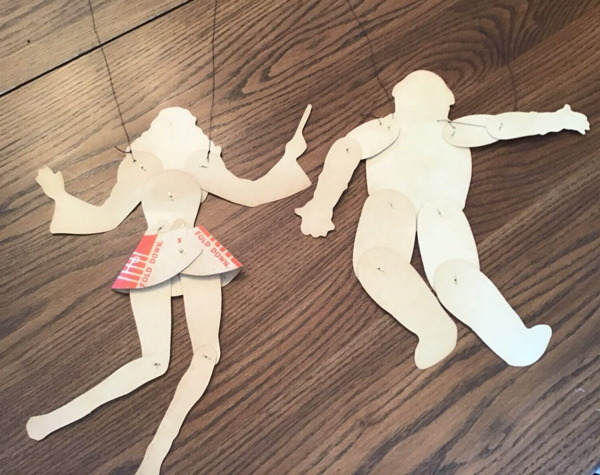
And the Grant Morrison Doom Patrol-looking backs:


Okay, yes, they’re just flat jointed cardboard things, like those Halloween skeleton decorations you’d put on your door or in a window or whatever. And they only seem to be strung at the shoulders, so I’m guessing the joints are at least a little loose so that the limbs would flop around as you bounced the handle. Or they were reasonably stiff so you could pose them as you like before amazing the family.

At any rate, I know the proper response is “whaddaya want for a quarter (and two wrappers)” but I am sure there were at least some kids imagining that they’d be receiving something a little more…substantial. Or maybe at the time this was the state of the art in mail-away TV show tie-in puppetry and what kids got was exactly what they expected. Look, I’m no puppet expert.

It was satisfying, however, to find this ad in a 70+ year old comic, wonder about what the actual product looked like, and then immediately find out via an online search. What a world, what a world.

The Final ’80s Countdown, Part Four.

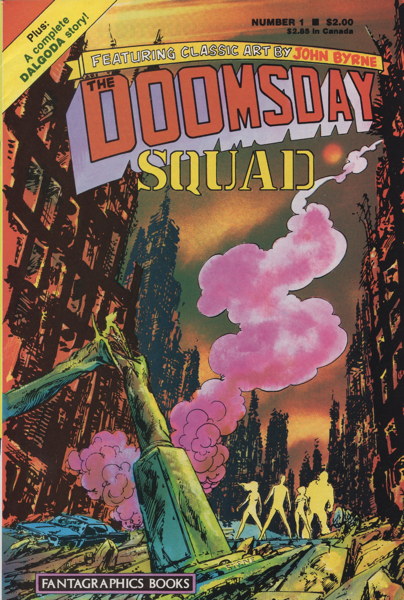
DALGODAGATE CONTINUES, as, in addition to the original Dalgoda mini-series, the follow-up Flesh and Blood, and the short story in the A1 anthology, reader Lane points out

“There was a Dalgoda story in the back of Doomsday Squad #1. That was Fantagraphics reprint of John Byrne’s Doomsday+1. Each issues had a new backup story, one issue had a Usagi Yojimbo.”

And lo, indeed there was a Dalgoda story in that series, as pictured here, scanned from my own copy of this comic (so I should have remembered):


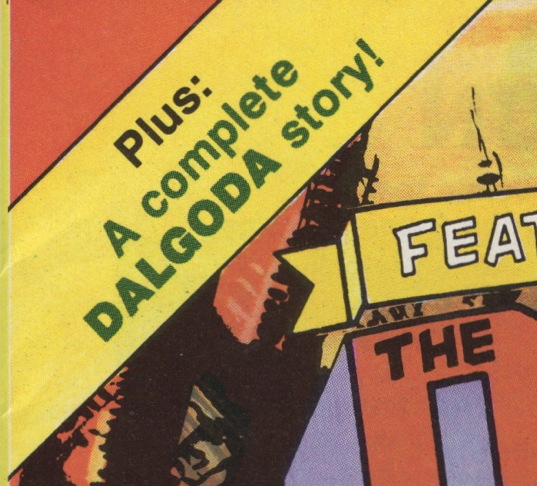
A closer look, because why not:


And as Brad points out, there was also a Lloyd Llewellyn story by Dan Clowes in one of the issues. Each issue had a back-up…of note was an Adventures of Captain Jack story by Mike Kazaleh. Well, that’s of note to me, I love Captain Jack.

My memory of the main Doomsay+1/Squad comics themselves by Joe Gill and John Byrne was that they weren’t too bad. Getting reprinted on better page in Squad and recolored certainly helped the story’s presentation. Interestingly, the original Doomsday+1 ran 12 issues, with the first six coming out from 1975 to 1976, and then those first six stories getting reprinted as #7-12 starting in ’78. (The stories in the seventh issue of Squad were taken from the Charlton Bullseye mag.) Imagine having had been a big fan of this series, disappointed that it ended at #6, then getting excited seeing #7 on the rack a couple of years later only to find it’s a reprint! Anyway, I’m pretty sure it was reprinted like this due to Byrne’s popularity.

I’m not sure why the title was changed for the reprint…Doomsday+1 is a better name. I’m sure it’s explained somewhere. There was a reboot of the concept by Byrne in 2013 at IDW, titled Doomsday.1.

Okay, enough about that…let’s back to more of our single-vote getters from the “Favorite ’80s Indie” informal poll from a decade or three back.

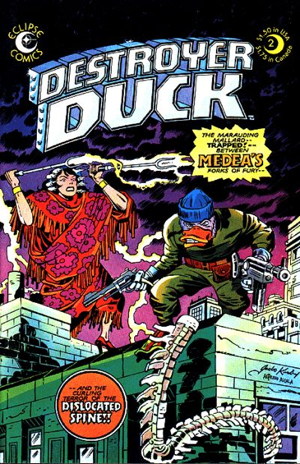
Destroyer Duck (Eclipse 1982-1984)

Created as a benefit book to help Steve Gerber scrape together some dough for his lawsuit against Marvel Comics, the seven issue run contained some interesting work. Not least of which was the lead, featuring the title character, written by Gerber and illustrated by Jack Kirby and Alfredo Alcala. The first issue alone contained work by Dan Spiegle, Mark Evanier, Marty Pasko, Joe Staton, Shary Flenniken and more…plus the first appearance of Groo the Wanderer by Sergio Aragones!
The entire series is a great sampling of work from creators from all over the comics biz, and well worth seeking out. Also, there was a Savage Dragon/Destroyer Duck one-shot released by Image in 1996. Written by Gerber, and illustrated by Chris Marrinan, it essentially functions (in pairing with the Gerber-scripted Spider-Man Team-Up #5) as a way to sneak Howard (in disguise) out of the Marvel Universe and into Gerber’s creator-owned control. Devious, but I don’t think anything ever came of it. Did Howard’s new identity of “Leonard the Duck” ever turn up anywhere else?

But back to that first series…yeah, it’s pretty great. The parody of the aforementioned John Byrne as “Booster Cogburn” is one of the great dunks in dunking history (playing off Byrne’s comment somewhere or ‘nother at the time that he was a willful cog in Marvel’s machine, leading to a wider discussion/free-for-all about creators and their relationship with publishers).

Anyway, good comic, solid pick for the best indies of the ’80s.


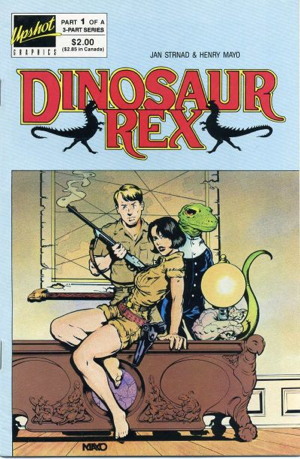
Dinosaur Rex (Fantagraphics 1987)

Welp, you got me, here’s a comic I know very little about. I mean, I know it exists, we carried it at my previous place of employment, even sold a few out of the back issue bins. But I never cracked open a cover on any of the three issues released.
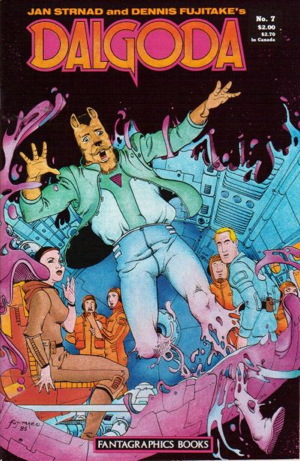
Which is my loss, because it was written by Jan “Dalgoda” Strnad and drawn by Henry Mayo, and included a back-up strip in each issue by William Messner-Loebs and Dennis “Also Dalgoda” Fujitake. So, you know, pretty much guaranteed Solid Comics Work.

This was under Fantagraphics’ “Upshot Graphics,” which was more or less the company’s general audiences/adventure line. It included the aforementioned Flesh and Bones series, Miracle Squad, stuff like that. It was a place for material “like that” as opposed to the more indie/altcomics stuff like Love and Rockets. It’s probably because the “Fantagraphics” label meant a certain kind of book to people, and may have been thought of as a barrier to sales to certain customers in the direct market. I don’t know, just sorta speculating here, but that’s my guess.

Also, if I recall correctly, somewhere in one of the Amazing Heroes issues is a sketchbook section featuring Mayo’s art, which was quite impressive. Which makes it even more of a mystery why I didn’t pick up this comic at the time. Ah well, something to keep my peepers open for in case they ever turn up in a collection.


Dreadstar (Marvel/Epic/First 1982-1991)

Well, here we go, a comic that, as opposed to Dinosaur Rex, I know almost too much about. In fact, when I intially started this topic, it was this series that was going to get my vote for favorite ’80s indie. It did not, however (we haven’t yet got to the title that did) but boy oh boy was it a close one.
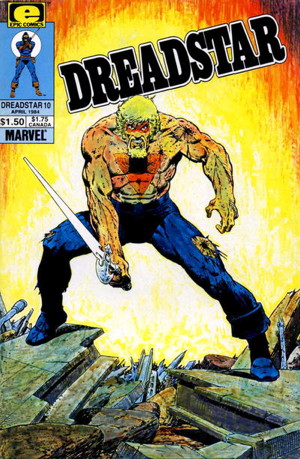
Spinning out of the “Metamophosis Odyssey” story serialized in the early issues of Epic Illustrated, Vanth Dreadstar was a feller fighting tolitarian regimes an’ such with his merry band of misfits. It’s just pure weird cosmic space opera as only the man himself Jim Starlin could present it. (And later as only Peter David could present it, when he took over as writer and filled Starlin’s shoes mostly admirably, save for the final couple of issues being a cringey Star Trek parody).

It’s funny, it’s strange, Starlin kept the story moving and never let the status remain quo for too long, like when he put Dreadstar in a superhero outfit, which, whoa, happened way earlier in the comic than I remembered. I suppose that’s a testament to just how much was happening in the comic that I figured that costume change was, like, around issue 30 or so, not showing up on the cover with freakin’ #13.

Despite the occasional doom and gloom and melodrama that’s an integral part of this series (I mean, “Metamorphosis Odyssey” concludes with SPOILER the heroes blowing up the Milky Way galaxy — don’t worry, they had good reason, kinda — and the narrative just pushes on from there), it remains as a wildly entertaining adventure strip that holds up even now. The one caveat is Starlin’s penchant for recaps, as a whole lotta issues seem to have a bunch of exposition explaining What Had Come Before, even if it was just an issue ago. But, eh, you know, if you read a lot of comics every month that probably came in handy, so who am I to judge.

While this series is the primary Dreadstar content, there was other material before this series started (a short post-“Metamophosis Odyssey” story in Epic, a graphic novel from Marvel and one from Eclipse), and material after (a mini-series with Dreadstar’s daughter from Malibu/Bravura by David and Ernie Colón), an appearace in one of the ‘Breed series by Starlin). He also turned up in the First Comics crossover event Crossroads. And there’s new material still, with a Kickstartered graphic novel Dreadstar Returns a while back (which I got but apparently didn’t cover here…I’ll have to address that when I can) and a new equally-Kickstartered graphic novel coming very soon. And yes, both are All Starlin All the Time.

• • •

Good gravy, that’s enough typing. I’ll try to get to more titles on Friday (honest, I’ll really try next time) and we’ll see what weirdies I’ve dreamed up for you on Wednesday. Thanks for reading, pals.

Bloggus interruptus.

So my Thursday evening blogging plans fell through, so I’ll pick up our ’80s indies coverage on Monday. Thanks for reading, pals, and I’ll see you then.

The Final ’80s Countdown, Part Three and a Half.

Got an early morning doctor’s appointment, so I’m not staying up late to do a full ’80s indie entry, but I wanted to address a couple of questions from the last post.

First, in regards to my inability to recall where else Dalgoda had appeared, Damien rushed in to the rescue:

“There was a Dalgoda story in issue 4 of the British anthology A1 by Jan Strnad and Kevin Nowlan. That might be the one-off you were thinking of.”

Yup, that’s the one. I have it (the full British run, and the later Marvel/Epic mini…didn’t follow the later ones), and I could picture some of the art in my head, which is how I knew it wasn’t original artist Dennis Fujitake on the story. But Nowlan is a good replacement. At this late date I can’t recall the actual plot, but I do remember being surprised to see the character again, even if it was just for a bit.

Customer Sean asks, hopefully facetiously

“Did Cutey Bunny and Omaha the Cat Dancer ever have a crossover story?”

While it’s possible they were both in the same jam drawing or something somewhere, as far as I know the two characters never met. Certainly the tone between the two is different (Cutey Bunny being very silly gag-filled stories vs. Omaha’s melodrama) and the naughtiness levels were certainly night-and-day (Cutey at most a little risque with no nudity, Omaha just full-on tab-A-into-slot-B action). So beyond the superficial element of each being sexy anthropomorphic animal types, they’re quite different.

Brad Walker notes

“You won’t get all the jokes in Laffin’ Gas #5 if you haven’t read Boris the Bear #1; likewise, you won’t appreciate the opening of Boris the Bear #8 (Return of the Ninja Critters) if you haven’t read LG#5.”

Well, I have read and enjoyed all of Boris the Bear, still one of my favorite runs. As such, I should get all the jokes in the LAffin’ Gas parody…which I should have in my hands Any Day Now as I found a run of issues #1-5 for cheap on the eBay. And I’m looking forward to seeing how that parody enriches the experience of Boris the Bear #8.

Which reminds me I made a…“joke” on Twitter about how I wanted to get a complete collection of 1980s black and white boom comics, sorta inspired by my purchase of those Laffin’ Gases. Now I’m likely just going to keep the #5, but I’ll look through #1-4 but those are probably destined for resale in my shop. I seem to do okay with these black and white books of the period. But all this, thinking about b&w boom books, doing the ’80s book thing here, has got me in a nostalgic mood, and those boom books are scratching that itch a little.

How far am I going to go? I mean, I have been on a search for Shadow of the Groundhog for quite some time. I imagine more will come up. I’m pretty sure I have an issue or two of Geriatric Gangrene Jujitsu Gerbils in the shop right now…will I keep them? Will I start seeking out those elusive issues of Fat Ninja? We’ll see!

Anyway, Brad has a link to a review of Laffin’ Gas #5 from a few years back in case you don’t have a copy for your own perusal.

That’s it for now, back Friday for more ’80s books!

The Final ’80s Countdown, Part Three.

Back to addressing your picks for best 1980s indie comics, as I continue to look at the books that got one “vote” apiece. Again, I always like to emphasize this isn’t a reflection of their quality, but rather a demonstration of just how much good stuff was coming out in that particular period of time. Thanks, my friends, for indulging this nostalgic walk through what was a fun time for me personally to be collecting comics.

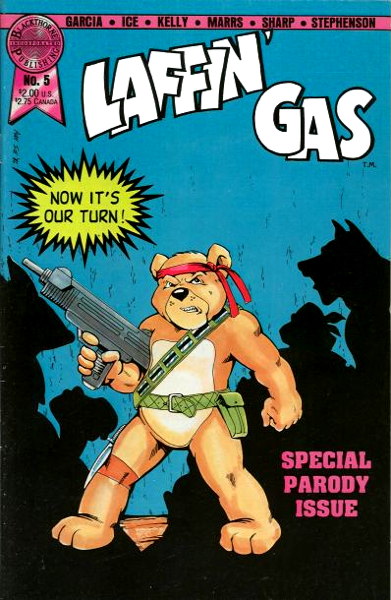
First, a brief update on my Boris the Bear entry, where I couldn’t recall the name of the parody comic that parodied Boris, itself a parody book. Well, it’s reader Brad to the rescue, as he came up with what my rapidly declining brain could not and reminded me that it was Laffin’ Gas #5 from Blackthorn Comics in 1987:


I think I see a Teenage Mutant Ninja Turtle and Dalgoda (more on Mr. Dalgoda in a moment) in the background there. This is one of those comics I didn’t ever really consider picking up when we had plenty of copies at the old shop, but now those are all long gone, I desperately want one. I’m probably going to have that problem with several comics in our Final ’80s Countdown here. Ah well. Thanks, Brad, for letting me know.

So here we go with today’s three ’80s series:

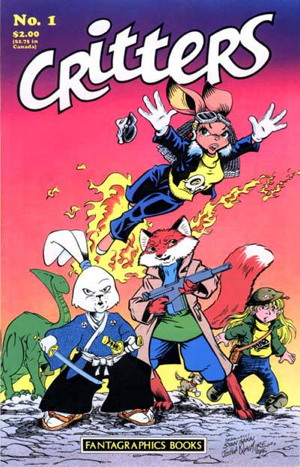
Critters (Fantagraphics 1986-1990)

Well, here’s another comic which had an issue I could have bought from the old shop for relatively dirt cheap, but just never got around to it. It’s that first issue, pictured right here, which I wanted for the Cutey Bunny content, but is now apparently a Hot Collector’s Item because of ol’ Usagi Yojimbo there.
Despite that disappointing omission from my collection (I actually went into what’s left of the vast Mikester Comic Archives to see if I did have it and just forgot), I do own scattered issues from the series. Most notably I have issue #23, containing the flexidisc with “March of the Sinister Ducks” (lead vocals: one Alan Moore), mentioned waaaaay back on this site in this probably link-rotted post. And I have this “Not the Adventures of Captain Jack” issue from the latter part of the run where they deemphasized the Critters logo in favor of the title of the featured story.

I notice I haven’t made it clear exactly what Critters is, exactly. It’s a black and white anthology series featuring funny animal and anthropomorphic stories by a whole lotta creators, including stories over several issues with the aforementioned Usagi Yojimbo by Stan Sakai. Also of note is Steven Gallaci’s “Birthright,” “Ambrose” by William Van Horn, “Gnuff” by Freddy Milton, a couple of Sam & Max stories by Steve Purcell…the list just goes on and on. And the more I look at the comics database entry for the series, the more issues I find I wish I’d bought. Sheesh.

But this was a solid anthology book containing lots of great work, at least based on the issues I do own, and based on what I’m seeing in my research, so it’s well worth sampling an issue or two. The extra-sized last issue, #50, is an excellent sampler.


Crossfire (Eclipse 1984-1988)

I like Mark Evanier’s writing. I like Dan Spiegle’s art. So why didn’t I read this series? Because I’m a dummy, I guess.
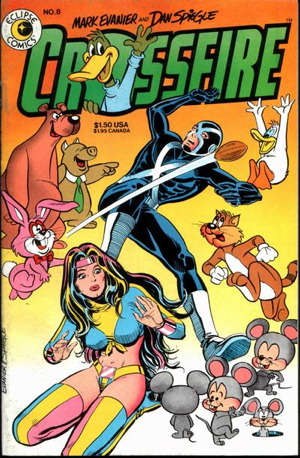
This spin-off from the super-team series DNAgents stars Jay Endicott, bail bondsman, who has assumed the identity of a deceased costumed villain to fight crime from the inside, which I’m gathering from the Wikipedia entry I have open in another tab. Well, okay, actually I did know at least some of that just from simple comic-selling osmosis and handling these books for years and years. But as I said, this remains a huge hole in my reading as there is nothing about this series that doesn’t say “Mike would enjoy this immensely.” Seems like many storylines revolve around showbiz-type material that Evanier knows quite well, something I quite enjoyed in the later Hollywood Superstars series.

There’s also a mini-series called Crossfire and Rainbow (Rainbow being a DNAgents member and Crossfire’s girlfriend, pictured on the cover here). I suspect most of these comics are fairly inexpensive to find, with the exception of issue #12 with the Marilyn Monroe cover by Dave Stevens. Darn you and your talent, Dave Stevens!


Dalgoda (Fantagraphics 1984-1986)

Okay, this series I read every issue (and the follow-up Flesh and Bones mini, and I feel like a short Dalgoda story popped up in an anthology somewhere…it better not be Critters or I’m going to be embarrassed).
The story (by Jan Strnad and Dennis Fujitake) is basically an alien life form lands on Earth in the near-future, and it’s Dalgoda, an intelligent humanoid being with more than a passing resemblance to a dog. Only fitting, as his name is an anagram of, well, you know. As can be expected, drama and hininks ensue, and…look, it’s been a while since I’ve read it, but I can assure you that I really enjoyed it as it was coming out. I still have all those issues in my collection, so let’s add that to the “reread before I die” list.

A couple things I do recall about the series: one, the art was impeccable. Nice, clear and clean storytelling throughout the book, almost Moebius-like. The other was the setting, that this was a future Earth (a couple hundred years or more in the future, as I recall) and other than tech being more advanced, it looked more or less like modern day, which struck me as an interesting take. Again, been a while since I’ve looked at it, maybe I’m remembering that incorrectly, so feel free to jump in and let me know what I got wrong. But I’m not wrong about the art — it’s purty.

Dalgoa got a pretty good marketing push from Fantagraphics, with plenty of ads and some retailer promos (like Open/Closed and No Smoking signs).

Starting with issue #2, there was a fantasy back-up “Grimwood’s Daughter” (by Strnad, drawn by Kevin Nowlan) which…I’m sorry, the art was beautiful as should be expected considering who’s responsible, and Strnad is a great writer, but try as I might I couldn’t get into it. I was here for Space Dog, not elves, I guess. Maybe with my probably theoretical rereading I can give it another go and 40-years-older me can appreciate it more now than 40-years-younger-me could.

Anyway, if I recall correctly (and I may not) Dalgoda never really got a proper wrap-up. I don’t know if anyone involved would want to return to the project at this late date (presuming everyone’s still with us). Tacking on a new maybe-concluding chapter and releasing it all as a fancy hardcover (like Don Simpson’s Border Worlds) would be nice. One can dream.

• • •

That’s three more of your ’80s indie picks down! I’ll try to get to more this Friday. Thanks for reading, everyone…I hope you’re liking this trip down Mike’s fading-memory lane as much as I am!

Al Jaffee (1921-2023).

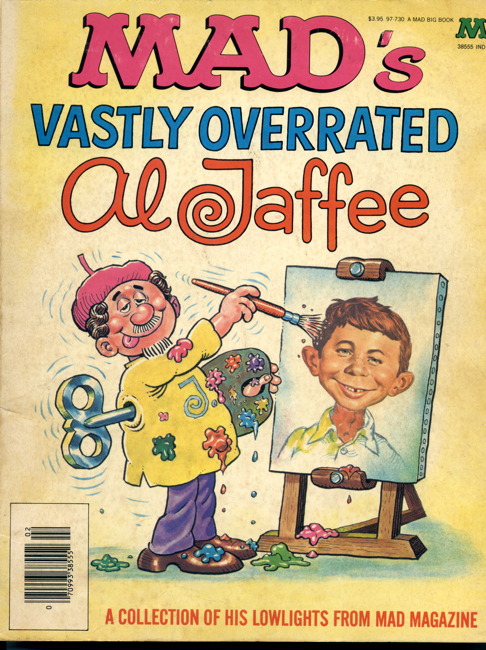
So on the occasion of Al Jaffee’s 99th birthday (and my 51st) I wrote about getting this wonderful book:


…which remains one of my prize possessions. Like I said in that post, I was but a young Mikester and had to save my allowance a bit to afford this extravagant purchase. But it was money well invested, as the book was provided me many solid laughs over the decades, not just from reading it but simply from remembering it and the joy it brought me.

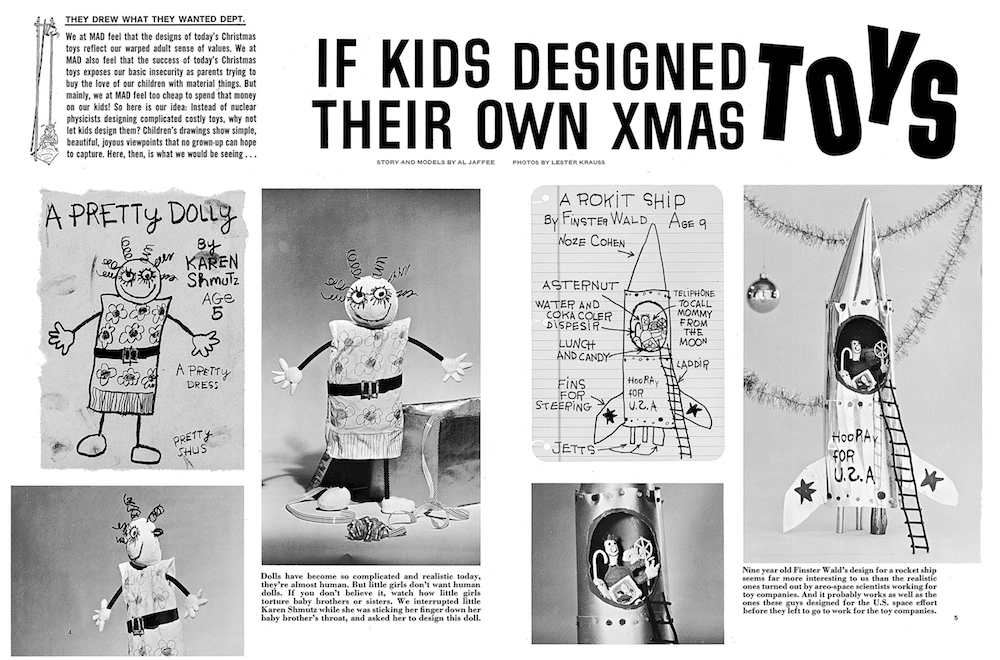
One of my favorite articles in that book, and one that still comes unbidden to my mind on a more regular basis than you might think, is the one where Jaffee built actual physical models of purported kids’ drawings:


It’s an odd example of Jaffee’s work, as it doesn’t showcase his illustrations (aside from those alleged kid drawings) but it’s memorable nonetheless.

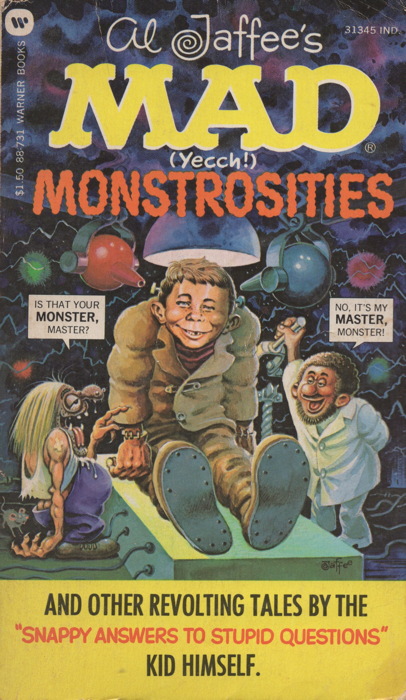
And as per my last post, I found at least one of the MAD paperbacks pictured on Mark Evanier’s site, MAD Monstrosities:


Alas, nearly all my paperback books remain boxed up and not terribly easy to access, but I did manage to find this one. My MAD Book of Magic remains AWOL, but I know it’s around here somewhere. But Monstrosities is filled with great mostly full-page cartooning filled with delightful grotesqueries as only Jaffee can lay them down on the page. I don’t know how long I’ve had this, but I must have picked it up during my prime MAD reading age, so probably around 1979-1981.

Searching my shelves I found another book that, frankly, I’d forgotten I had:


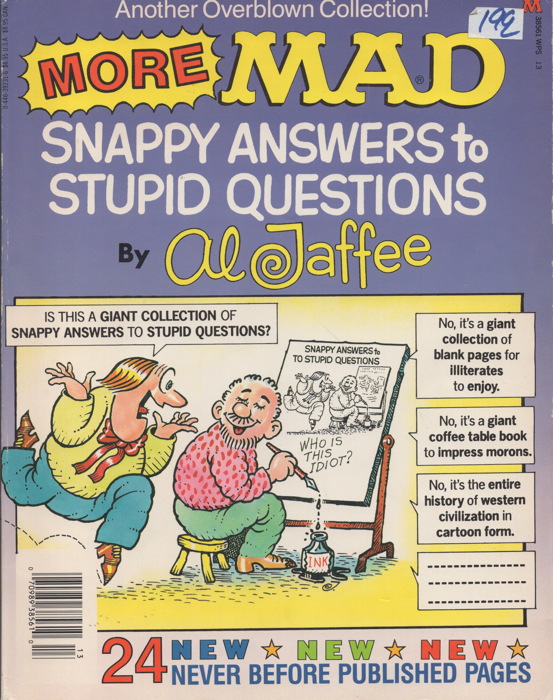
Based on the price sticker in the corner, this was obviously a thrift store pick-up. I’m not the biggest fan of the “Snappy Answers to Stupid Questions” gags…I mean, I like ’em fine, obviously enough to drop $1.99 on this book, but I always preferred Jaffee’s other efforts. But his artwork is always wonderful to behold, especially in this larger format (and no one does A Prance quite like Jaffee, as you can see on that person on the left of the cover there). Plus, I do have to say I did always like the added touch of an extra empty word balloon for you to add your own Snappy Comeback. Were they as snappy as Big Al’s? Probably not, but it was nice of him to offer you the chance.

Also, come to think of it, that’s kind of a Snappy Answer to a Stupid Question on the cover of that Monstrosities book, isn’t there? It’s also interesting that “Snappy Answers” is what’s referenced on the cover, and not “Fold-ins” but, as shown on the cover, you were likely to get more of one than the other in here, and why remind people of a feature that’s not present in the book?

What he’s probably going down in history for is the aforementioned Fold-ins, a play on the “Fold-Outs” you might find in, say, certain gentlemen’s magazines of note. It’s clever, it’s intriguing (as you try to guess the final image before folding and finding out), and a little annoying if you’re a comic shop owner dealing in old comics and magazines and you have to grade down most MADs you get in because the back cover is creased. But, such is the sacrifice for art.

And what art it was. I didn’t even mention his “Hawks and Doves” strips. Or the articles about new, needed inventions or how he drew the absolutely best vomit in the biz. Or that one issue of MAD where instead of a Fold-In he created a gag strip where if you held it up to the light, an image of Alfred E. Neuman would appear. Or his Tall Tales strips. Or the fact that he was drawing for several Golden Age books long before MAD was even around.

He was in all respects a legend. I’m glad he lived such a long life and could see how much everyone loved him and appreciated his work.

So long, Al.

The Final ’80s Countdown, Part Two.

Before I dive into the next batch of books, I definitely need to note the passing of comics legend (and sharer of my birthday) Al Jaffee at the age of 102. More than just “The Fold-In Guy,” Jaffee did so much great cartooning for so long that my quick little mention here will never do him justice. I’ll try to get more written about him soon, not that there’s a dearth of material coming out right now. Mark Evanier has a good remembrance of the man here, which includes a shot of a couple of my favorite Jaffee paperbacks, MAD Book of Magic and MAD Monstrosities. I’ll have to dig those out (nearly all of my paperbacks are boxed up) and give ’em a reread.

• • •

Okay, as explained last time, I’m going through the titles you guys picked as your favorite 1980s independent comics, starting with the comics that only got one mention apiece. Again, all good books, al deserving of a little love. Starting with

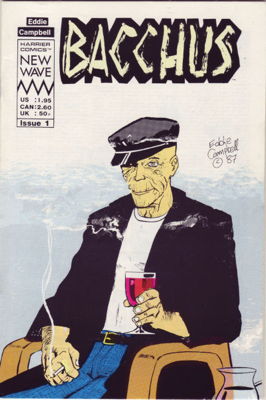
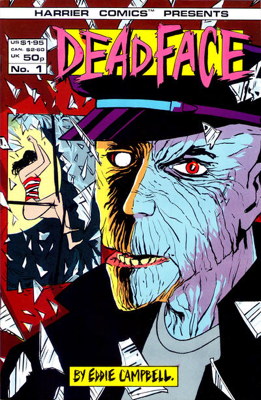
Bacchus (Harrier 1988) and Deadface (Harrier 1987-8)

I mean, well, technically I suppose I should have put Deadface first and alphabetized this under “D” but eh, I only think about this particular franchise under the name “Bacchus” anyway.

Deadface and its spin-off/continuation Bacchus were the beginning of a long-running project by cartoonist Eddie Campbell, putting Bacchus from ancient Greek mythology into modern times. Both moody and funny, it was a compelling read, particularly for your pal Mike who’d always been interested in the stories told in these myths and found Campbell’s retelling/reinterpretation of them quite enjoyable.

The Bacchus comics continued on through most of the ’90s in various places and formats, primarily in the series Eddie Campbell’s Bacchus that ran from 1995-2001. There were several short stories that appeared in various anthologies (like Dark Horse Presents) and one-shots and tie-in minis (The Eyeball Kid!) and I read them all, but boy what a series to collect because you never knew where they’d turn up next. There are a couple of omnibii from Top Shelf that appear to collect everything together into one place, which makes things easier.

Anyway, great comics and writing about them makes me want to reread them all, like, you know, I have the time!


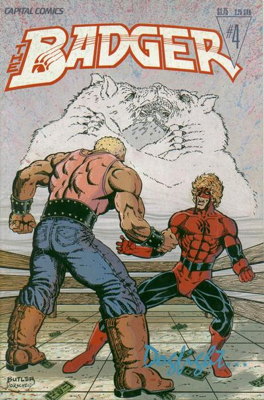
The Badger (Capital/First 1983-1991)

…And there were several one-shots and minis after that initial run. The Badger has come up on the site recently, but let me quote what I said about the character back in 2016 when they were trying again to get the character off the ground:
“…The Wikipedia description of the character made it sound like a string of clichés, and to someone unfamiliar with the Badger, like presumably a good chunk of folks in today’s comics market, that surely doesn’t do him any favors. A dry description doesn’t accurately represent the actual tone of the book, as I tried to explain in Johanna’s comments. There was an overwhelming sense of…well, just plain weirdness, an off-kilter sense of humor at work in the comic that I could only describe in comparison to writer Mike Baron’s other major series, Nexus. It was wacky when it wanted to be, dead serious when it needed to be, with quirky dialogue and clear storytelling. It was more than the sum of the parts listed in that Wiki entry.”

I would go on to say, as I said again recently, that later revivals didn’t quite capture the same tone as that initial run. Even the initial run had trouble maintaining itself in the latter part of series, but when that comic was running on all cylinders, it was a hoot. I suspect revisiting the series now would turn up some humor that…hasn’t aged well (it’s been noted that one of Badger’s multiple personalities, a gay man, plays off a little better in earlier appearances than later ones). Those early issues, particularly the first 12 or so, are probably the best, and the first issue may be about as good as the Badger gets, probably one of the best debut issues in modern times.


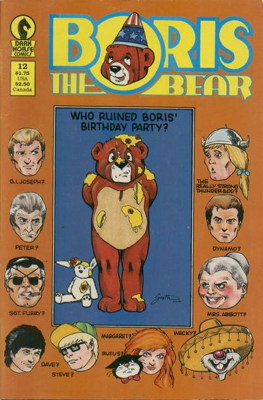
Boris The Bear (Dark Horse/Nicotat 1986-1991)

Another series I adored. Began by Mike Richardson, Randy Stradley and James Dean Smith, later taken over mostly by Smith), the initial issue had Boris going after (i.e. outright slaughtering) thinly-veiled parodies of Teenage Mutant Ninja Turtles knock-offs (and other funny animal comics launched in their wake). The next issue went after the giant robot genre, and so on. While parody was always a part of the series, it fairly quickly began to focus a little more on Boris’s life and friends and less on the ol’ ultraviolence.

It was a polished, professional comic book, but it always had this…amateurish edge to it. Not in the bad way, I hasten to add, but its origins in the waning years of the black and white boom, that touch of “do-it-yourself”-ness, always remained clinging to the comic. That tiny lack of polish was just part of the charm, reminding you this was someone’s personal vision, not just a churned-out piece of cynical marketing.

There were a couple of tie-in series, like color reprints of the early issues, and Boris Adventure Magazine which would focus on the parodies more so than the parent series. And somewhere along the way there was a parody of Boris the Bear in another black and white humor title, the name of which eludes me at the moment, but I think there was some sort of circle closing there.

• • •

Hoo boy these are talking longer to write than I expected! I may skip doin’ them this Friday but I’ll be back Monday to continue the countdown. Thanks for reading, pals, and I’ll see you next time.