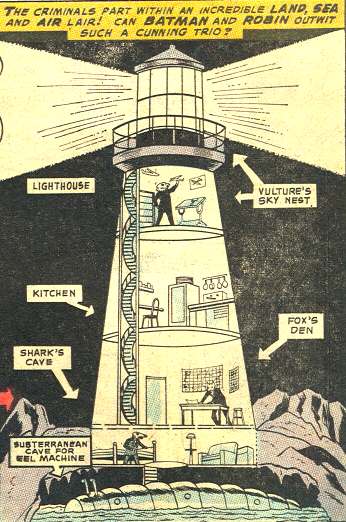
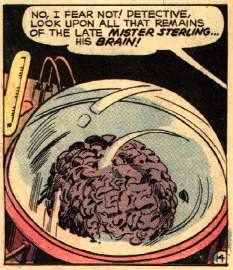
“Can Batman and Robin outwit such a cunning trio?”


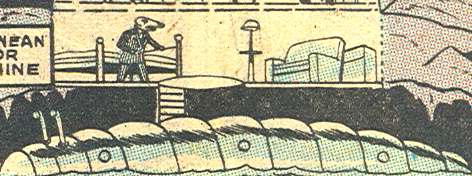
Now while that does look like an impressive lair for this trio of Batman baddies, one can’t help but notice some…deficiencies. I’m willing to entertain the possibility that this cutaway does exclude necessities that, perhaps, were located in the area that was cut away, allowing for a more uncluttered view.

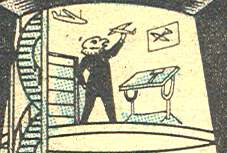
Even with that being so, the Vulture doesn’t appear to have much room for anything:


Sure, he’s got plenty of room to play “Dogfight” with his model pla…er, I mean, “generate and practice strategy for future aerial criminal endeavors.” I’m guessing he has room, maybe, for a fold-out couch or something…maybe that was against the opposite wall.


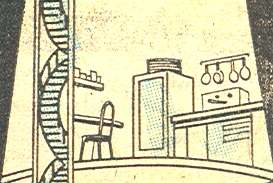
The kitchen’s not bad…pretty sizable, and while I’m sure we’re missing something that’s been cut away, the presence of pots and pans implies at least some form of stove…unless they’re being used to prepare cold foods, or, ahem, they’re being used to address the bathroom problem (see below).

I can’t tell if that’s some kind of vent about the fridge, or a stack of really large pancakes, or big serving platters, or what. (EDIT: Read the comments to see me get schooled in the ways of ’50s refrigerators.) I don’t see a door to get in, either.

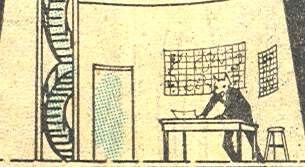
The Fox has it pretty good:


Plenty of room, even has a stool, and lots of theoretical not-visible-in-this-cutaway space for a bed, or some kind of barcalounger.

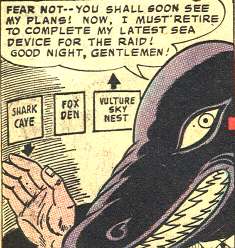
It’s the Shark that got screwed, at least when it comes to headroom:


At least he seemed to be reasonably furnished, and plus, he has direct access to the ocean. I don’t see anyway way in, but since he’s beneath ground level, maybe there are some exterior “basement access” doors we’re not seeing.

Another thing I’m not seeing is any kind of plumbing, which again, might be obscured by the cutaway. Or maybe there’s an outhouse just off panel we’re not seeing. Or, as I referred to earlier, perhaps those pots and pans are being used to collect their leavings for later disposal (i.e. dumped into the ocean). The Shark’s got it easy…he’s already got a big hole in the middle of his floor….

images from Detective Comics #253 (Mar 1958), reprinted in Batman #176 (Dec 1965)

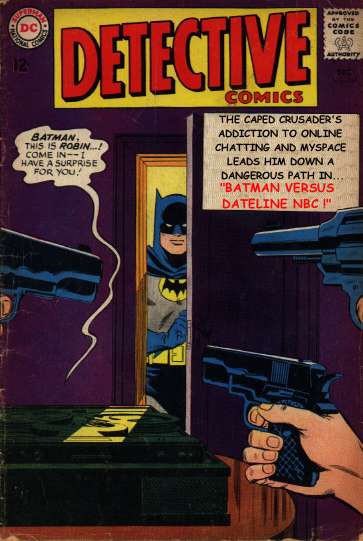
The best idea for a "versus" discussion I’ve read in a while.

VS

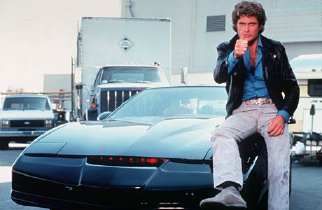
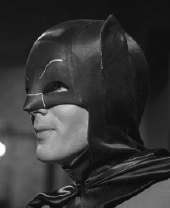
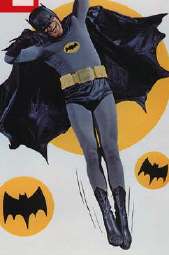
“The Batmobile versus Kitt, Batman vs Michael Knight, who would win?”

“The Bat against The Man Who Does Not Exist! After that Bruce Wayne and Michael Knight have a date with Babe Watch.”

“Kit beats the Batmobile because it has the voice of ‘Mr. Finney’ from Boy Meets World powering it.”

“Ah, Kitt might beat the Batmobile, but then Bats would drag Hoff around by his pretty hair and then use him as a speedbump. Kitt would be so devastated having entrenched his long time friend/partner that Bats would then override Kitt’s defense system and dismantle him until he could further study the technology. Of course Hoff would spend months in traction, but his injuries would not be mortal.”

“KITT would destroy the Batmobile. That thing gets destroyed like almost every appearance. KITT was twice. I think it was 2? If you count the crappy Knight Rider 2000 movie.”

“Batman- one of his earth’s greatest martial artists, utilty belt, tons of cash and resourves=weapons,instant comm link to Oracle

Micheal Knight- has a talking car, ‘bad boy’ leather jacket and an 80s perm.”

“1. Which Batmobile? The DKR Tank-like beast would crush KITT
2. Any version of Batman would crush Michael Knight”

“…Neither Kitt nor Micheal Knight has ever dealt with the level of mayhem and chaos that Batman and the batmobile regularly encounters on a nightly basis.”

The question of prep time prior to battle is asked, to some chagrin. To wit:

“Prep time or no prep time?”

“well, if da hoff had the prep time, and he had thanos, galactus, darkside, and an army of a million daleks backing him up…..hmmm”

“How much “prep time” do they normally get in comic stories? Often the hero or villain meets up in the midst of battle or get tossed together. Prep time is just stupid.”

One person sees a quick way to a conclusion ending for this epic battle:

“On the other hand, suppose they swapped opponents?

Michael Knight would take a crowbar and destroy the nonsentient, immobile Batmobile.

Kitt would just run over Batman.

Points to the Knight Rider team!”

Batman Defeated by Joker – Seven Decades of Superheroing Come to End

NEW YORK – Batman appears to have finally met his match – at least for now – at the hands of his longtime nemesis, the Joker.

The caped crusader is unconscious, knocked out by one of the Joker’s nefarious traps, in the new issue of his namesake comic, which hit stands this Wednesday. At the end of the issue, the Joker stands triumphant over his fallen foe, leaving Batman with no chance of surviving whatever evil fate is in store for him.

It appears to be the end of a long run for Batman, created in 1939. Best known for the 1960s television adaptation, the character has also sold millions of comics and countless pieces of merchandise, making a great deal of money for the character’s publisher, DC Comics, and the parent company, Warner Brothers.

However, in the world of comics, a last-second triumph against overwhelming odds is not entirely unknown, and DC Comics president and publisher Paul Levitz said Batman grabbing victory from the clutches of defeat wasn’t out of the question.

Even so, the character’s shocking loss came as a blow to creator Bob Kane, or it can be assumed it would have, if Kane himself hadn’t died in 1998.

Across the country, fans have been clamoring for copies of “the last Batman comic,” catching retailers off guard due to the increased demand. “Honestly, I don’t see what the big deal is,” says Mike Sterling, 37, manager of the Ventura Fun Time Comic Book/Magic Card Store and Video Deli. “Villains always appear to beat the superheroes, just before getting their rears handed to them. It’s typical of the genre!”

Sterling continues, “Why in God’s name would DC put out a press release for this? It’s nothing special! It’d be like putting out a press release for every cliffhanger, every apparent character death, and every other usual plot trope that appears in superhero comics! It’s creating artificial expectations for a product that won’t be met!”

“Remember the ‘Death of Superman’ all those years ago? And all the hype around it? To this day, I encounter people who see the Superman comics on the rack and ask me, ‘Superman comics are still around? I thought he was dead.’ I just don’t see the advantage to convincing a public that’s barely aware of comics in the first place that your most recognizable, marketable characters are no longer being published, all for the sake of a storyline that’ll be resolved in, at most, a few months! What’s wrong with you people? Why are you buying into this?” At this point, Sterling was guided into the back room of the store for some quiet time.

In the comic book universe, defeat is not always final. But even if the Joker has finally defeated Batman once and for all, it’s not the end of the Dark Knight: the character will still live on in merchandise and movies and television shows, where the real money is.

I’m very, very sorry.


This is Employee Aaron’s fault for putting the idea in my head. You can see the original here.

Origins.

(SPOILERS ahead for The Killing Joke, Batman: Gotham Knights #54, and some decades-old Bat-comics)

So I was discussing something with pal Dorian the other day…when the Joker was introduced in the Batman comics, he was (I believe) just another deformed villain. I don’t think any explanation was given for his appearance at the time…if I’m wrong, set me straight.

A decade or so later, the Joker’s history is revisited, as we find out why he looks the way he does…he was a crook called the Red Hood who fell into a vat of acid.

Then, in the late 1980s, we find out why he was committing crimes as the Red Hood, in Alan Moore and Brian Bolland’s The Killing Joke…his career as a stand-up comedian was flopping, and he needed the money for himself and his pregnant wife. This is presented as a possible backstory for the Joker, as the narrative itself gives the out that, due to his insanity, the Joker doesn’t always remember his own past accurately.

And then, a few months ago, Batman: Gotham Knights #54 revisits the scenario presented in The Killing Joke, establishing that (with some minor timeline changes) the backstory presented there is the actual one. Part of it is apparently witnessed by a young Edward Nigma, AKA the Riddler, so at least part of the story has independent confirmation. (Now, I’m not a regular reader of Gotham Knights, so perhaps this has all been contradicted by later events in the comic.)
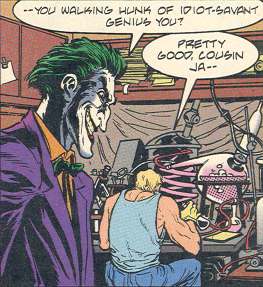
Of special note, in the Gotham Knights story, the Joker’s real first name (Jack) is revealed for the first time, in comic book continuity (as opposed to the Tim Burton film, though it’s “Jack” there, too). It had been hinted at in a comic before (in Legends of the Dark Knight #50, when the Joker’s cousin calls him “Ja–” before being interrupted).

So, over a period of 60 years, the Joker’s backstory/origin has slowly been revealed…and, as Dorian said during our discussion, that probably means that the Joker’s origin, when you get right down to it, isn’t important to the character. He’s a crazy deformed murderer, straight outta Dick Tracy, and that’s really all you need to know. The first two times we received backstory was as a surprise ending to the Red Hood story (“…and the Red Hood turned out to be…the Joker!”), and as a contrast to the lives of Batman and Commissioner Gordon (in The Killing Joke). The third occurrence, in Gotham Knights, was to kick off a subplot/storyline/something-or-other that may very well still be going on, for all I know.

I have no real point here (and boy, aren’t you glad I’m admitting it now after reading all that?) aside from thinking how odd it is that a character as well-known and established as the Joker has had so little revealed about him over the years. His backstory is rarely revisted (as opposed to, say, Superman, whose home planet of Krypton is constantly brought up, or Lex Luthor – the Silver Age version at least – whose childhood and family was well documented). Aside from some expansion on the Joker’s pre-Joker life in the cartoons and movies, he still remains more or less a mystery.

There were other characters whose origins went untold for decades…the Golden Age Starman didn’t have his full origin told until All-Star Squadron #41 (cover date Jan ’85), and, if memory serves, the formative moments of another Batman villain, the Penguin, weren’t revealed until a new one-page origin sequence in a digest otherwise filled with reprints (Best of DC #14) from 1981. And I’m sure there are several superheroes and villains from the Golden Age that have never had origins, as new characters with fantastic powers were rushed out to capitalize on the initial success of Superman without much thought to who they are and where they came from.

At the other end were the characters whose origins were left purposefully obscure, with clues dropped here and there about the character’s history without ever coming together into a cohesive whole. Wolverine would be the prime example of that, though most of the big questions have been answered between Barry Windsor-Smith’s “Weapon X” story and the Origin mini-series (which, I believe, was instigated by the fear that the X-Men movies were going to establish their own origin for Wolvie). The creation of the X-Men character Cable tried to follow this pattern, by presenting a full-blown superhero character with a mysterious backstory dribbled out in bits and pieces, to lesser effect.

And then there’s the Phantom Stranger, whose origins are purposefully obscure, though he’s either an agent of God (or of the Lords of Order, as in this mini-series). An issue of Secret Origins provided four possible origins, though, given the character’s later treatment, it seems Alan Moore’s origin of “an angel who rebelled against God and later changed his mind” seems to be the one most people are going by.

Any other superhero-genre characters that you can think of whose origins have remained relatively unknown (by design, or by accident – i.e. early cancellation)?
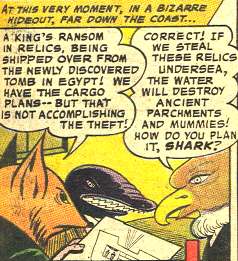
“Also, his foot. And that weird mole on his chest, no idea why we kept that.”

from Batman #240 (March 1972) by Denny O’Neil, Irv Novick, & Dick Giordano


At the store today:

Kid Chris: “Did the police in Gotham City ever solve any crimes?”

Me: “I think that’s what Gotham Central is about.”

KC: “I mean, before Batman showed up…it seems like he does all the work for them now. They should just make him Commissioner.”

Me: “‘Commissioner Batman?'”


So this All-Star Superman cover…I know it’s been discussed to death by now, but I just wanted to chime in with “it…it’s gorgeous!” Frank Quitely handles a pen quite nicely, he said with no innuendo whatsoever.

But speaking of innuendo, apparently there are a few folks out there who think that there’s some kind of “homoerotic” underpinning to the illustration, and as such undermines the character, or attacks family values, or some darn thing. An image of Superman just sittin’ on a cloud, relaxing, glancing over his shoulder has been interpreted as a “come hither” look…give me a break. Besides, if you want “homoerotic,” drink this in, baby. (Thanks to pal Corey for reminding me!)

EDIT: Another thing I was just reminded of…apparently the other problem with this cover is that it doesn’t “represent” Superman, that’s it’s not “iconic” enough. And, of course, what everyone means by that is “he’s not hitting anyone.” Well, we’ve had nearly 70 years worth of “Superman punching someone” covers, and now there’s one “Superman being relaxed” cover. I think the Union will stand.

For my favorite interpretation of the cover, I point you in the direction of my esteemed colleague, pal Dorian.


Apologies to the right and good Tony Isabella, who reminded me that, um, perhaps this post would have made a little more sense had I actually remembered to include the link to his article as I intended.

If you haven’t been visiting his site, regularly updated every couple of days or so, you’re missing some great reviews and commentaries from this industry veteran. So go check it out already…help assuage my guilt!


(Another EDIT) Due to being a victim of my own excess, I am rapidly approaching the limits of the monthly bandwidth allotted to me by my webhosting service. I think I’ve got it taken care of and my site shouldn’t go *poof* tomorrow when the limit is reached…but just in case, don’t panic if you get an error message. Believe me, I’ll be panicking enough for the both of us.

See you tomorrow…I hope!

Thinking too much about The Killing Joke

Am I the only person who reads the end of Alan Moore and Brian Bolland’s Batman: The Killing Joke as the death of the Joker?

Why do I think this?

1. The constant assertions by Batman during the story that either he and the Joker will most likely die by the other’s hands.

2. The focus of the story is the Joker believing “all it takes is one bad day to reduce the sanest man alive to lunacy,” and his unsuccessful attempts to prove this with Commissioner Gordon. “Maybe ordinary people don’t always crack” asserts Batman to the Joker – “maybe it was just you all this time.” Despite Batman’s attempt to differentiate himself from the Joker, constantly stating that he wants to do things the right way, he very obviously did crack…otherwise he wouldn’t be, as the Joker says, “dress[ing] up like a flying rat.”

3. When Batman releases Gordon prior to going after the Joker, Gordon insists to Batman that Joker be “brought in by the book” – showing that Gordon has not cracked under the pressure applied to him. Batman’s response? A mostly noncommittal “I’ll do my best” – not exactly an ironclad promise.

4. Batman tells the Joker at the end of the story that “maybe this is our last chance to sort this bloody mess out…if you don’t take it, then we’re locked onto a suicide course.” The Joker doesn’t take the chance…he resigns himself to the fact he can’t escape the “suicide course” the two men find themselves on, that “it’s far too late for that.”

5. The last page of actual story, where the two characters are sharing their laugh over Joker’s “two lunatics in an asylum” joke (the joke obviously referring to Batman and the Joker themselves, thus reinforcing their similarities)…between panels six and seven, the loud laughter that had been present in the previous panels suddenly stops, though we can still hear the siren from the approaching police car (which doesn’t appear to be any louder, or enough to drown out the laughter, given this page’s sound effects convention that “bigger = louder”).

It’s at that point, between panels 6 and 7, that I believe Batman kills the Joker. It’s even possible, given the “suicide course” talk, that they kill each other. We don’t see them in the final panels, leaving their fates vague.

Or I could just be reading too much into the story. Besides, the point is completely moot since we’ve obviously had more Batman and Joker stories than we can stand since this was published…Good Lord, 16 years ago? Oy. Also, given events in the most recent issue of Batman: Gotham Knights, the Joker’s family backstory from The Killing Joke (heavily implied to be the actual “origin” though Moore gives the possible out of the Joker remembering multiple pasts) is now officially part of DC Universe continuity. So there you go.

Another observation made by pal Dorian, flipping through The Killing Joke…”how many of these Joker panels have since been…’borrowed’ by other artists?”
 
 
(post updated 8/2016)