In which I bother noted comics people online.

So, a couple of follow-ups:

First, in regards to Amadeus Cho’s explanation for the Hulk avoiding death tolls in his rampages, I said I wasn’t sure if that was per an editorial edict or not. Turns out over on Bluesky, the fella what wrote that comic, Greg Pak, straightened things out saying that it was all him making that decision, not anyone higher up.

Granted, I’m sure the Marvel high muckety-mucks were glad to have something to point to and say “see, our hero who is in Avengers movies and makes us lots of money is not a killer.” And frankly, I’m glad of it too. It’s fun to see Hulk smash up buildings and punch tanks, it’s not quite as much innocently-violent fun (usually) to think about him murdering people in the process. Just one of those “willing suspension of disbelief” deals.

I did just reread the Garth Ennis/John McCrea Hulk Smash two-parter from 2001:


…and in the series, Hulk fights the army, natch, and it is very heavily implied that several soldiers are killed in the process.Tanks are smashed, planes are blown up real good, and you do see men scrambling out of hatches or parachuting to safety. However, deaths are implied in dialog, but there is perhaps enough wiggle room to claim that soldiers have survived but are out of the battle.

Chris K noted the 2001 Startling Series: Banner series by Brian Azzarello and Richard Corben:


This was an out-of-continuity story that, I have to admit, I haven’t read probably since it was released, but it does tell the story of a Hulk who does leave a body count in its wake. As I recall, it’s dark and a little depressing, so if you had a killin’ Hulk on a regular basis, that may be what it’d feel like.

• • •

Again on the Bluesky, I quote-posted famed comics writer Kurt Busiek, because he was talking how DC Comics missed an opportunity by not going wild with out-there storylines right before Crisis on Infinite Earths swept threw and reset everything.

He mentioned as an example of DC kinda/sorta half-heartedly doing that sort of thing was “Supergirl [getting] married in a story no one remembers.” Well, I remember it, because I bought that very issue new off the shelf back in late ’85:


Now this was by Cary Bates, Curt Swan and Al Williamson, and I haven’t read it in forever, but my memory is that it was…not good. I mean, nothing wrong with that creative team, of course, but the story itself seemed misguided and, well, weird.

As per this Wednesday post, I’ve been reading a lot of late-era pre-Crisis/pre-Byrne reboot Superman comics. I keep avoiding this particular issue as I recall not liking it, but talking about it this much may have be revisiting it sooner rather than later. Anyway, I did hit on kind of a similar point in that past post, which I mentioned to Mr. Busiek, about Steve Lombard’s progress as a character this late in the game was curtailed by Crisis and the reboot.

Busiek’s response was that around this period, DC was producing Superman story inventory for overseas publication, and then trying to use them up in the U.S. comics, so that actual permanent continuity changes were tricky to pull off. Now, I know DC did release stories in other countries that were eventually reprinted here, such as every issue of the Superman Special, as well as the proto-graphic novel Superman Spectacular.

The Grand Comics Database is usually pretty good in noting when a comic is reprinted from another source. But I can’t find any of the late pre-Crisis era Superman and Action books noted as initially coming from an overseas publisher, while the examples above do. Doesn’t mean they don’t, I just can’t find info confirming it. It would be interesting if that were the case, so I’ll have to look further into it.

As opposed to a “Power Action Computer Kick.”

Okay, first off, before I get into the rest of the post, I want to get this link in here because I was dumb and forgot last time. Old pal Mark, co-creator of Fake AP Stylebook on what used to be Twitter, and co-editor of the spinoff book Write More Good, can use your help.

Mark is currently in an uncomfortable living situation and needs some funds to rehouse himself. He’s reached his stated financial goal, but he can use more scratch just in case, you know? Please contribute if you can:

Thanks for anything you can do.

• • •

Not that I don’t have enough physical comics piled up to read, after being behind for the last several years, I’ve been using the DC Comics digital comics app to look at some old stories I may have missed, and revisit some books that I gave up to the shop/don’t feel like digging out of my boxes at home.

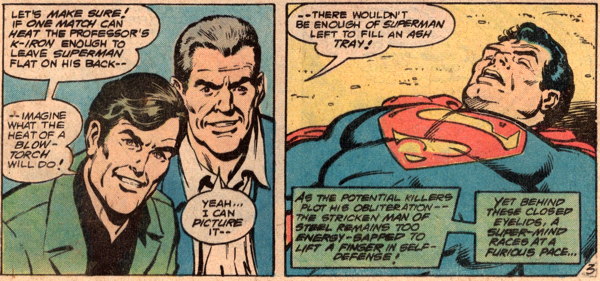
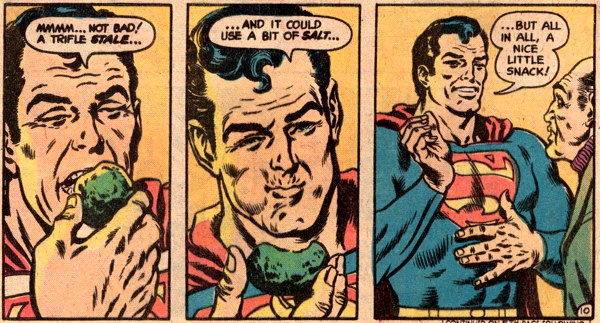
Since I’ve been on an Armored Lex kick lately, I reread this three-parter, probably for the first time since it appeared in print back in 1985:


That’s the middle chapter of a story that ran in Superman #410, #412 and #413 (#411 was a surprise issue celebrating Superman’s editor Julius Schwartz), written by Cary Bates, illustrated by Curt Swan and Al Williamson, covers (which I liked!) by Klaus Janson.

I’ve written before about different inkers’ effects on Swan’s pencils, but I was struck by the expressiveness in the faces here in this particular sequence of panels from #412:


Isn’t that nice? Those are some good looks from Superman that you don’t normally see.

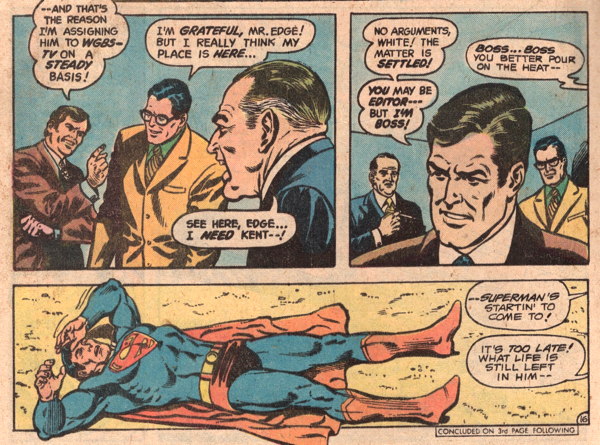
But what I wanted to mention for sure here was…well, let me give you a brief set-up. The story is about Clark reporting on an event Superman was involved in, only it turns out Superman imagined said event and it makes it look like Clark fabricated the whole thing. Clark is fired, and his reputation is shot so he can’t get another reporting job.

Obviously this is a plot by You-Know-Who, but Clark is left adrift in the meantime. As such, he pays a visit to another former Daily Planet/WGBS employee, Steve Lombard, who is currently running a sporting goods store. As you recall, Steve was the one continually pulling pranks on Clark in an attempt to pick on him (pranks that usually backfired due to Clark using some super power or ‘nother).

Now, the digital archive is incompelete for the Super-books, and my own memory of the stories from the time is a little spotty, so I don’t recall the circumstances of Steve losing his job, or on what terms he and Clark were on. But in this particular issue, we see the characters reunite:


…and Steve’s tomfoolery aside, it looks like the two get along just fine. They are genuinely pleased to see each other, and in fact Steve gives Clark a part-time job.

I thought this was a nice bit of character growth for Steve after, what, a decade or so of him being a pain in Clark’s rear? It feels like some of his arrogance has worn away, laughingly admitting his own foolishness in the panels above. It’s a real shame this is butting right up against the Byrne reboot, which would wipe this all away, as I would have liked to have seen more of this mildly less-obnoxious Steve Lombard. Ah well.

• • •

And here, since this seem relevant to the recent Superhero Violence post from the other day, is a panel found by Bluesky pal WormDrivePRO. From Spectacular Spider-Man #118 (1986) by Peter David, Mike Zeck and Bob McLeod, comes this inversion of the “Abandoned Building Battleground” trope:


Huh, just like Thom H. said!

WormDrivePRO is a good follow if you like nice big scans of curated comic panels. It’s a fun feed that I recommend!

Old Timer Mike here with some important blogging for you.

Yes, it’s another Post of Miscellany for you to enjoy, for varying values of “enjoy.”

PART THE FIRST: Just to follow up on my 2024 Free Comic Book Day post-mortem, there was some concern that no children were spotted in my photos of the store in the midst of Free Comics action.

Well, let me assure you that there were plenty of children passing through the shop to get their free comics, and many, with the assistance of the parents and/or guardians, took advantage of the storewide sales. Some kids showed up in costume (one as the Miles Morales version of Spider-Man, anoother as the Kamala Khan Ms. Marvel). A girls softball team showed up, in uniform. Plenty of children thanking me for their comics, A whole bunch of smiling faces.

As was pointed out in my comments, probably not a cool thing to take pics of kids and post ’em to my site without permission. So you’ll just have to take my word that they were there. I promise.

PART THE SECOND: Miracleman talk is back in the news, what with the release of Neil Gaiman and Mark Buckingham’s The Silver Age in trade paperback form this week. This article on The Beat is about the lack of excitement over the completion of this long-interrupted story. Surprisingly, it includes a link to my own writings on the very same topic from back in January. I’m so used to shouting into the void here, since Linking to Blogs is a thing that folks don’t do much of that anymore, but it is nice to be acknowledged.

Anyway, on Bluesky Mr. Gaiman his own self linked to a New York Times article ballyhooing the release of the book, saying

“It’s interesting seeing the comics press going ‘Why isn’t there more talk of Miracleman: The Silver Age?’ Meanwhile, we get the kind of review that those of us who made comics in the dawn times dreamed of as a kind of grail.”

Now, look, I’ve done my part, which y’all can see right here in this category link, but…I think I’m correct in reading this more as “isn’t it ironic that one world ignores the book, meanwhile this other world is paying attention,” instead of “the comics press are a bunch of dummies, of course people are talking about it.”

The New York Times article doesn’t really counter the idea that Miracleman is mostly ignored within the comics world, and that actual sales aren’t want you’d think they should be, if “you” is me, a guy who waited the decades for Miracleman to start up again. I don’t have to go into again, see what I said at my self-link above, but the passing decades, the delays, the botched presentation by Marvel, all got in the way of a new audience discovering a lost unfinished classic in the process of being completed. Which is a shame. It honestly is very good. Even the initial kinda clunky chapters by Alan Moore have a style and power few comics can match today.

I said this a couple times in response to various discussions on Bluesky, but I feel like maybe the Moore/Gaiman/Buckingham/etc. era of Miracleman won’t properly get its due until it’s all done and collected into trades. At that point it can be sold as a finished masterpiece…assuming Marvel can keep the books in print.

PART THE SECOND AND A HALF: Just for some perspective: In 1985 I was sixteen, still in high school, when I bought the first issue of Eclipse’s Miracleman #1 new off the stands. I am now 55, waiting to eventually place orders for my store for the final chapters of the story begun back then.

PART THE THIRD: So anyway, here’s a picture of Superman from the movie coming out next year:


I mean, it’s fine. The top part looks a little too much like he’s wearing a sweater. I suppose we’ll have to see it in action (either live or CGI) to give it a full judgement. But lookin’ at that picture…c’mon, Supes, buddy, speed it up a bit, there’s something you need to attend to going on outside your window there.

The debate is raging on as to whether this is a good costume or not, whether there’s too much texture on there or if they should’ve gone for a Christopher Reeve-style smooth ‘n’ skintight spandex. I think the latter look, more accurately reflecting appearances in the comics, may be out of favor with studios, but given how superhero movies have been doing lately, what have they got to lose. However, having Wolverine in his classic comic togs for the Deadpool/Wolverine flick, a film that has a very good chance of getting that billion-dollar box office that’s been eluding Marvel for a while, may change some costuming trends.

At the very least I would have liked a brighter, maybe more optimistic look, but again, it’s just one promo photo. All depends on what they do with it. And it’s James Gunn, who actually made people care about Guardians of the Galaxy, so I’m still giving him the benefit of a doubt. I mean, c’mon, Metamorpho, the Fab Freak of 1,000 and 1 Changes, is gonna be it, I’ve gotta see that.

I’d bought World’s Finest #300 new off the stands not having any idea that was what was going on.

Another big change to the Superman mythos made in John Byrne’s 1986 reboot mini-series Man of Steel was the bustin’ up of the long friendship between Supes and the Dark Knight his own self, Batman.

The two characters have been buddy/buddy for decades, almost from their very inception, as seen here on the cover of World’s Best Comics #1 from 1941:


This of course was the first issue of the series that would become known as World’s Finest starting with #2. And the early issues of the comic would feature covers pairing the two (along with Robin, usually) and showing them doing something fun, like, oh, I don’t know, fishing:


The team-ups were just on the covers, however, as Batman and Superman had separate stories inside, along with other characters and their own stories. Eventually the extra-sized comic reduced its page count, and instead of cutting either Superman or Batman out of the book, the two were squeezed together into one story (starting with issue #71). And aside from a brief stint of team-ups featuring Superman with other characters in the early ’70s, and the whole “Super Sons” thing, this was the Supes/Bats crimefighting pals team book ’til its end in 1986.

Except.

There was a short storyline in this series regarding a split between Batman and Superman, spiraling off from Batman’s resignation from the Justice League in Batman and the Outsiders #1:


This development gets followed up in World’s Finest #294 (1983) which presents further acrimony between the two old friends:


See, it says right there in the footnote, “see Batman and the Outsiders #1,” I didn’t lie to you.

Anyway, the two of them are at odds with each other for the next few issues, until this particular storyline comes to its conclusion at the end of the extra-sized anniversary issue #300 (1984):


And all was right with the world until 1986, when John Byrne presented his new status quo for the Superman/Batman relationship in Man of Steel #3:


In that preview article from Amazing Heroes #96, Byrne’s ideas on what the relationship between Superman and Batman are made clear:

And sure enough, in Man of Steel this new more adversarial interaction is revealed right out of the gate as Superman shows up in Gotham to take in this infamous vigilante:


Once Superman sees Batman in action over the course of the story, he softens his stance — i.e. he won’t immediately haul Bats off to the grey-bar hotel — but he’s still not entirely on board:


…leaving Batman with this wistful wink to the audience who just saw the Old Ways swept out the door for the Way Things Are Now:


And that was the status quo for…well, a little while, ’til, like all post-Crisis changes, folks started to turn things back to how they were in little ways. The UnCrisis-ening continues to this day, but this particular portrayal of the Superman/Batman relationship, coupled with what we saw between the two in Frank Miller’s Dark Knight Returns, has had a little more staying power.

I mean, obviously not the “you’re a criminal who should be turned in” part, but definitely the emphasis on “our approaches to crimefighting are different” has remained to a far greater extent than it ever did in the older books. It was probably also an influence on Batman’s general gruffness and reluctance to open up to friendships and such in recent years, not to mention the idea of his having contingency plans to take down the whole Justice League, that sort of thing.

However, the Superman/Batman pairing is too strong an idea, with too much inertia behind it, for it to be forever relegated to “frenemies.” We’ve had multiple Superman/Batman team-up mini-series and regular series, certainly with an emphasis on their differences, but definitely having them as pals again. The current World’s Finest absolutely feels more like the original series with that name.

I appreciate Byrne’s point about Superman and Batman just being too different to be friends…but honestly, having them at such odds with each other was the aberration. It’s having them as friends that feels like the correct, logical, choice.

My British accent is impeccable.

More specifics about the actual content of the 1980s Superman reboot will come in future posts (yes, it’s continuing into next week). You can find the previous posts under the newly-created “byrne reboot” tag, so I don’t have to keep adding a large list of links to past posts at the top of each entry.

Today, I wanted to post up something else I found in that long preview articles from Amazing Heroes #96 (1986). Now, I’d read this ‘zine when it originally came out, and I know I absorbed every column inch of this article in anticipation of the Byrne reign of Superman. It’d been several…well, decades (egads) since I’ve read it, and peeking back at it as reference for this series of posts have reitroduced me to some interesting bits of information.

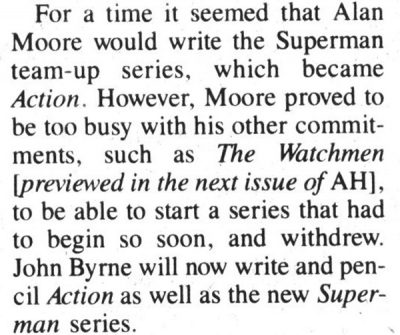
Specifically, this plan for a Superman team-up comic (like the defunct DC Comics Presents) as part of the reboot, written by…well, take a look:


When I spotted this, I immediately popped it up on Bluesky and it generated some discussion.

Bully the Little Fanzine Bull noted that this magazine “was pretty infamous for just letting creatives run at the mouth and printing that as news, though,” which, you know, fair enough. That is the foundation for many a ‘zine, prozine and fanzine alike, and while this article does appear to be informed by primary sources, I’m sure some of the noted plans weren’t firmed up yet, or no more than floated ideas.

Like, this Alan Moore thing sounds like it was no more than “can you do it?” “strewth, I don’t have the bloody time, mate” “oh okay thanks” and that was that. At that point in Moore’s career, I’m sure he got lots of job offers like this. “Can you write West Coast Avengers for us?” “Flippin’ ‘eck!”

Adam Knave had the probably very correct response in saying “I’m sorry we never got it and glad he didn’t do it at the same time.” I mean, yeah, Watchmen (or The Watchmen) would end up being an ugly mess re: merchandise royalties and creator ownership, not to mention being plundered by lesser talents for knockoffs. Probably best that there’s not also a one or two year run of Superman team-up stories by Moore to provide content to be clumsily reinterpreted later by writers whose names might rhyme with Reff Rohns.

But on the other hand, would we have read a run of Alan Moore-written Superman team-up comics? Oh, you bet your sweet bippy we would. Imagine, like, 24 or 36 issues of comics on par, or even better, than this one. That would be an absolute treasure, Moore just traipsing through the DC Universe.

On the other other hand, this was the period when Moore was at his deconstructive height, pulling apart the very idea of superhero comics and looking at their components in a new light. I don’t know if DC, in their fragile “we’re not sure entirely what’s going on here” post-Crisis phrase, trying to rebuild continuity after the structural damage inflicted by Crisis on Infinite Earths, would want Moore going through its new direction upending things even more.

Just picture the aftereffects on Adam Strange, after his brief 1987 appearance in Moore’s Swamp Thing run, and how his reinterpretation there still affects Adam Strange stories to this day. Now picture that with dozens more characters in addition to the ones he’d already touched with his wizardy powers. It really would be Alan Moore’s DC Universe now.

But even if the Moore thing had been a done deal, as blogging brother Andrew said on Bluesky, “the question then would be ‘how long until Byrne and Moore got on each other’s nerves and one/both quit'” and he ain’t wrong. I feel like the two would not play very well together. All it would take is Byrne saying “hey what you’re doing here with Superman isn’t in line with my vision,” and Moore would be all “blimey, you’re a barmy bloke, I’m gutted” and he’d be in the wind.

Anyway, thought that was an interesting bit of forgotten trivia involving this particular time in funnybook history. I don’t know how close this actually came to happening (like I said above, probably not too close), but it’s still quite the thing to think about.

Orange is the new Luthor.

So last time I talked a bit about the first issue of John Byrne’s Superman revamp, and how it felt to encounter it as it was happening, after having read Superman comics prior to this and witnessing the changes to the franchise in real time. I pointed out a number of those changes that happened just in that one comic, but a few of you beat me to the punch and started bringing up other alterations later in the Man of Steel mini-series.

Right out of the gate in the comments, David slings the following at me

“I always felt like the biggest change in Man of Steel was the change to Lex Luthor. His pre-Crisis persona was genius supervillain. Man of Steel established him as a genius businessman, who hated Superman, which moved him to villainy.”

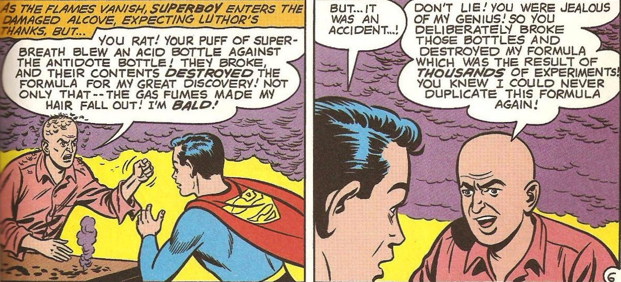
Luthor went through several changes in the character’s history (a number of which I listed in this long-ago post which may amuse). The “mad scientist who hates Superman” remained fairly consistent from Luthor’s inception up through this point in the 1980s, cosmetic costume/hairstyle overhauls aside. The biggest alteration to the character was the adding the idea of Luthor having grown up in Smallville, concurrently with Clark/Superboy, and establishing the origin of his hatred (i.e. blaming the Boy of Steel for the loss of his hair).

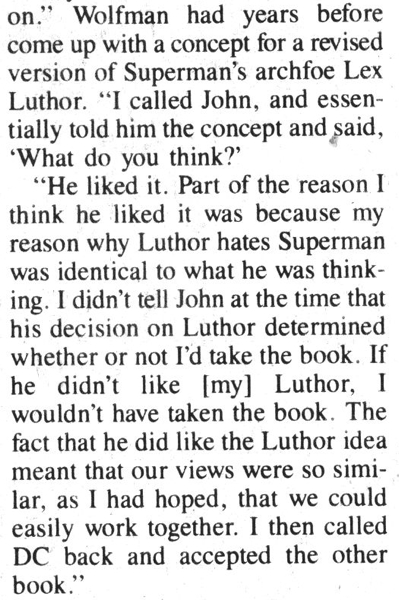
But with the reboot comes A New Take (not to mention the loss of Superboy — more on that in a future post — effectively removing Smallville from Luthor’s backstory) and apparently Marv Wolfman had the idea for Big Businessman Luthor some time before Byrne came along. Here’s a bit from an article in Amazing Heroes #96 (1986), previewing the reboot:


Now the new idea as to why Luthor hated Superman had to do with him being the most powerful man in Metropolis…until the Man of Tomorrow showed up.

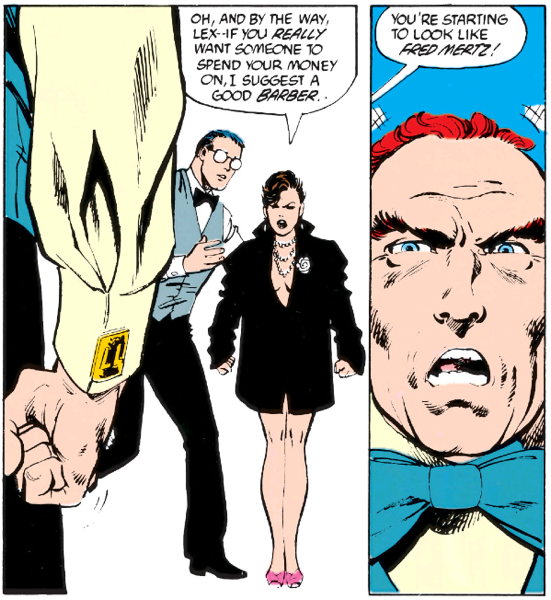
Hair still comes into play, as Superman’s first post-reboot encounter with Luthor in Man of Steel #4 ends with Lois hairline-shaming him:


Yes, I borrowed these scans from a two-year-old post where I go into a little more detail about the changes in Luthor’s motivations over the years. I’ll repeat here what I said there, in that there were some comments at the time that New Luthor bore some resemblance to Marvel’s “respected businessman” villain Wilson Fisk, AKA the Kingpin. Interestingly, both characters have had their evil shenanigans become increasingly more public knowledge as time has gone on, though still being able to hold high political offices (Luthor as President, Fisk as Mayor of New York).

Speaking of which, Byrne/Wolfman Luthor had that veneer of legitimacy crack a bit in that very “first” appearance, where Luthor was arrested. And as the years have continued, and DC continued its trend of backpedaling on the sweeping changes from both Byrne and Crisis on Infinite Earths, Luthor slowly became more and more like his pre-Crisis incarnation, to wearing versions of his early 1980s superarmor, to regularly being shown in prison. The “businessman” era still exists in current continuity, but now has more or less merged with previous versions.

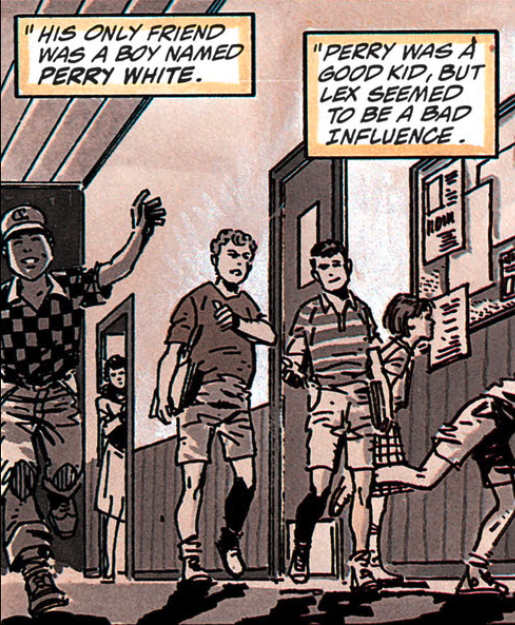
Yet more reboot fiddling had initially made Luthor a much older man than previously portrayed. As you saw above, Lex and Clark were contemporaries in Smallville. In the reboot, he was at least a couple of decades older…he had to be old enough to believably have a son in his 20s, per a storyline a few years later. In Lex Luthor: The Unauthorized Biography (1989), he’s shown as a child, and friends with a young Perry White:


However, Luthor has gradually become younger, both with an in-story explanation of his brain being transplanted into a youthful clone body, and with a no-explanation “he’s just younger now” pushing him back to around Clark/Lois’s ages. In fact, he’s now back to having have lived in Smallville and hangin’ with Teen Clark. I think this return-to-form was first evident in the continuity-or-not mini Birthright, discussed here (where the series’ writer himself chimes in).

So this new version of Luthor was indeed a significant modification to the Superman saga. But like many of DC’s changes from the period, the inertial effect of previous portrayals force at least some reversals of those decisions. If DC can make (multiple) attempts at bringing back the multiverse concept done away with in Crisis on Infinite Earths, it shouldn’t be surprising that Luthor has traded his business suit back in for his prison greys (or oranges).

And that he played football in high school, that was somethin’.


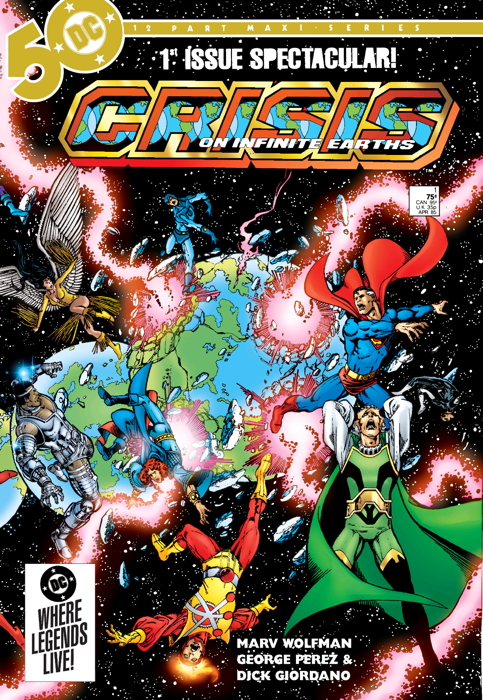
I know I’ve talked about this before, but bear with me for a moment. I will hear modern day criticisms of Crisis on Infinite Earths, DC’s continuity-changing mini-series from 1985, where it is essentially summed up as being “a bad story.” Beautifully drawn, there’s no argument about that. But the actual plot and script itself are held up as flawed.

And, I mean, fair enough. I once posted on Bluesky “thou shalt not read Crisis for its prose,” as just reading it for the story is only part of the experience. And the part of the experience that is arguably most significant is one that simply can’t be captured decades later, by people who weren’t there for it in 1985 as it debuted. It especially can’t be captured after the onslaught of universe-changing events and crossovers and reboots and rejiggerings that have been churned out since Crisis.

It was the excitement at the time that fed into the Crisis experience. Yes, maybe the storyline was, to be kind, slightly nonsensical. But DC Comics promised BIG CHANGES in their series, at a time when readers weren’t quite so jaded to assurances like these, and right from the get-go we were getting those changes in this series. As you picked up each succeeding issue, you were left wondering “what happens next? What worlds will live, what worlds will die, what will never remain the same?” Things were happening in this series, seemingly irrevocable things, and readers were left in suspense month to month as to what was next.

Well, that was then, this is now, DC has spent nearly 40 years trying to undo Crisis, and after seeing, like I said, reboot after relaunch after reboot, the primary oomph that moved the series along has faded away, leaving a nicely-drawn comic with a story that no longer has the energy it once did. It’s like reading about a roller coaster that had been torn down long ago and you can no longer ride. Meanwhile, old farts like me are all “you just don’t get it, that roller coaster was awesome back in the day.”

Which brings me to Man of Steel #1 from 1986.
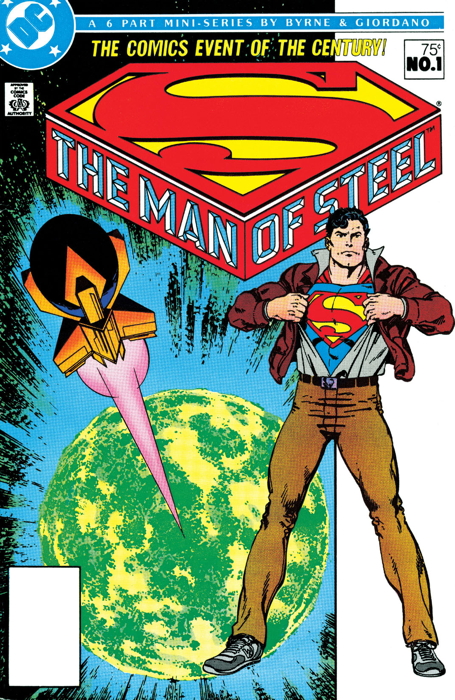

Crisis wasn’t the only engine of change over there at mid-1980s DC Comics. Superstar comic book artist/writer John Byrne moved from Marvel to their rivals to take command of a “reboot” of the Superman line of comics.

The previous five decades’ worth of Superman comics would be brought to an end, the two main titles (Action and Superman) would be put on a brief hold, while Byrne’s six-issue mini-series The Man of Steel would be released on a biweekly basis. That series would essentially restart the Superman line from scratch, with a new canonical origin, redesigns of old establishing elements, and a shaking up of Everyhing We Know about the character.

Right from the first page we’re presented a new vision of Krypton:
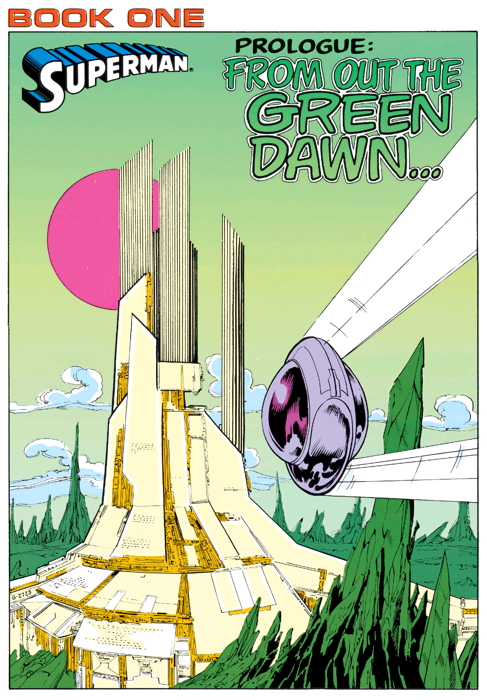

Inspired in part its depiction in 1979’s Superman: The Movie, this new version of Krypton does away with the sci-fi pulp style cities we’d previously seen. We now have a cold and sterile environment, where the inhabitants shun contact with each other, where babies (like Kal-El) are created in a “birth matrix” without all the fuss and muss of mixing genetic material the old-fashioned way.

As I recall, Byrne’s intent was to create a Krypton that wasn’t a high-tech fantasyland, a wonderful and magical place, but rather a loveless world that was already dying even withoiut the whole “about to explode” thing. A place that a young Kal-El was lucky to escape from.

There were other changes in this first issue, too, such as establishing that Clark’s powers didn’t really come in full ’til he was older, thus doing away with the Superboy (and Superbaby!) era of the character. That only one piece of Kryptonite made it to Earth. That there was some sort of “aura” around Superman’s body, a thin one just above the surface of his skin, that would prevent damage to, say, a skin-tight superhero uniform made out of ordinary Earth materials. (As opposed to resewing super-strong Kryptonian blankets in which he was swaddled as a baby.) That Superman wouldn’t let on that he even had a secret identity, letting folks think he was just Superman all day, every day.

There were other little changes, plus plenty more in the rest of this mini-series, but the big change, the BIGGEST change:
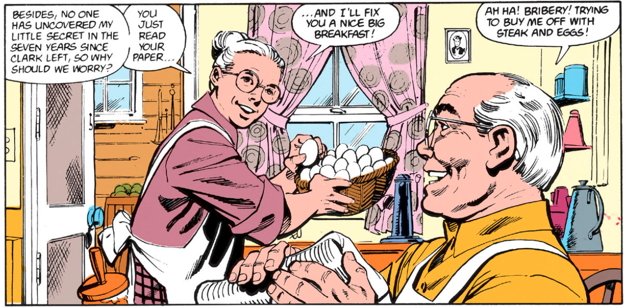

…is Ma and Pa Kent still being alive.

This was the wild one, the choice that really struck me out of all the other decisions made for this new version of Superman. For years, one of the big emotional elements of the character was ultimately how alone he was…I mean, despite his cousin Supergirl and a whole freakin’ Bottle City of Kandor in his Fortress of Solitude. This was long before Lois new the secret, of course, which was still a reboot away. And I suppose he had his super-pals in the Justice League.

But when it just came to Superman in his own books, he was pretty much just on his own. No confidantes, no family (unless Supergirl was guest-starring), just him and his thoughts. Most notably there’s those scenes when he goes back to Ma and Pa’s now empty Smallville home (which he still owns, of course), and putters around there for whatever reason, sadly recalling his younger days. It’s especially evident when you compare this to, say, DC’s former line-up of superhero TV shows, where every hero has a support team, either back at the home office or out in the field, who all know his secret, who all fight beside him.

The other change this makes to the mythos is that we lose out on the lesson Superman learns, that there are just some things even a Superman can’t do.
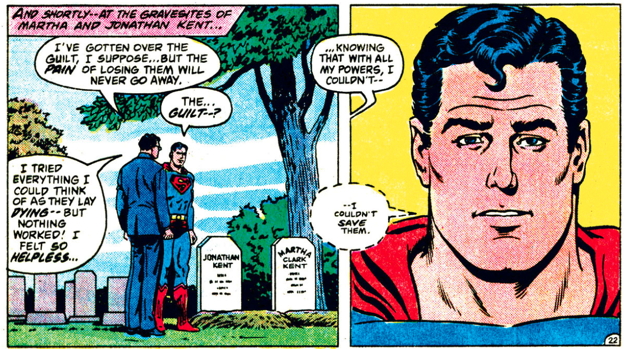

That’s from DC Comics Presents #50, where Supes and Clark are split into two beings…long story. But the important element is there…”with all my power, I couldn’t save them.” Now the “save them from what specifically” isn’t important. In some comics it’s just old age, in others it’s a deadly virus picked up during a time travel vacation to piratey days (because Superman comics), but the result is the same. It’s an important lesson, one that even makes it into the ’79 flick.

Despite that, it is kind of fun to have them around, to have a home that Superman can go to and have actual parents around, versus ghosts and memories haunting him pre-Crisis. They add a little emotional depth to the proceedings. In recent years it was a little unclear what their status was…George Pérez had famously stated he couldn’t get an answer as to whether they were alive or dead for the New 52 relaunch. But Pa Kent died during a storyline prior to that, and post-New 52/Rebirth they had both apparently died in a car wreck, but [SPOILER] revived due to universal shenanigans in Doomsday Clock. So I guess they’re still around now, which is nice.

Now the Man of Steel mini itself, even at the time, took a little critical drubbing from reviewers and fans. Part of it was, I think, just out of spite. Folks thought a certain way about Byrne and they were always looking for a way to knock him down a peg. Plus Superman, despite having low-selling comics for quite a while prior to the reboot, was still an object of “well, this is the way it should be” backlash from some quarters, objecting to the alterations. And on top of all that…yeah, the series was a little clunky in parts. Byrne was trying to rush through several years’ worth of continuity and world-building in these six issues, catching Superman up to the “present day” of the DC Universe.

Like Crisis (remember Crisis from way back at the beginning of this?) this is a book that also suffers a bit in retrospect. I think it may be a little easier for readers new to it to understand that this book was a Big Deal at the time, given it was tackling the Biggest Hero in Comics and giving him a fresh start. And that, when all is said and done, this is the Superman that is still around today, despite whatever fiddling was done with continuity, despite the asides we got with the absolutely-distinct-from-the-post-Crisis-version New 52 Supes. Our current Superman is the John Byrne Reboot Superman. You can still draw a line directly from Man of Steel #1 to the latest issues of Action and Superman.

But that said…I feel like any readers not old enough to have read Man of Steel back in the mid-1980s may be in a similar position as those new to Crisis. They weren’t there, in real time, watching the pre-Crisis Superman getting wrapped up and put away, while this new series came along to reintroduce the hero. The excitement of change was there, as we wondered what this Byrne fella had in store for us as Man of Steel wrapped up and the new Superman titles launched and/or relaunched. It’s a particular frisson that’s missed when coming to the stories now, especially after all the retoolings both Superman and the DCU at large have undergone since then.

Special thanks to Sam Hurwitt for reminding me of that DC Comics Presents sequence.

“Kryptonite…well, maybe a little more.”

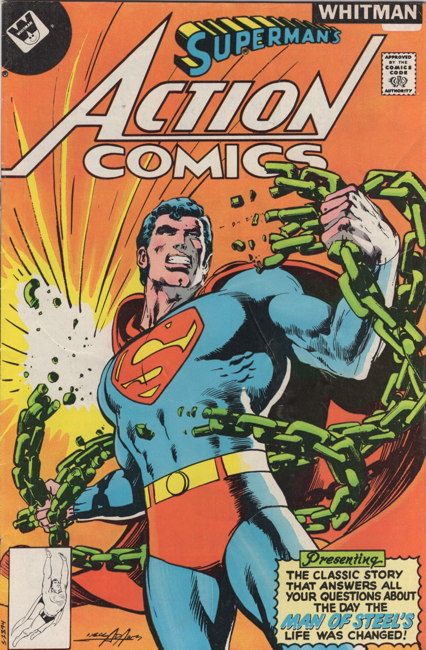
So I had a copy of this comic fall into my hands the other day, Action Comics #485 (1976):


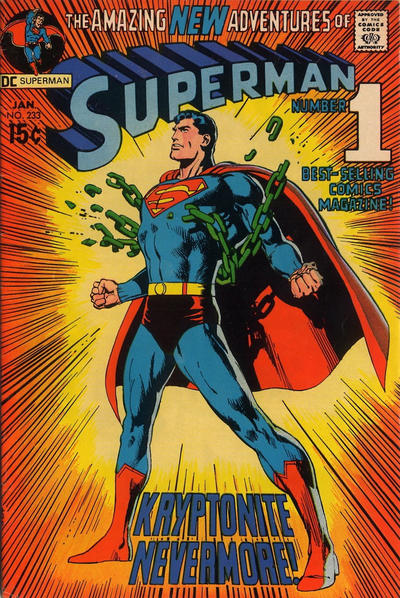
…which caught my eye as it was the Whitman variant, and would be worth a little money if this copy hadn’t been around the block a bit. But still, it’s nice to see, with its Neal Adams cover reminiscent of Adams’ cover for Superman #233 (1971):


And reminiscent it should be as the Action issue is a reprint of that Superman issue. Despite having run across plenty of copies of that Action over the years, I never bothered to look inside as I figured “just a reprint of Superman #233, move along.”

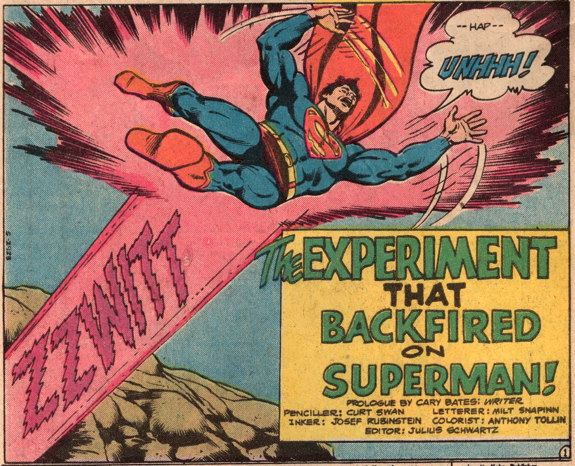
But this time I did look inside, and lo and behold, there’s a new framing sequence by Cary Bates, Curt Swan and Josef Rubenstein:


Three pages at the beginning, which segues into the reprint of the the older Denny O’Neil/Swan/Murphy Anderson comic after Superman is zapped by a weapon in the intro:


…and we see the then five-year-old classic tale of the End of Kryptonite, an attempt to revamp the book by both removing the story crutch of that deadly mineral and depowering Superman slightly:


And then Flashback Over, as Superman awakes and defeats the bad guys in the last page (with one new panel drawn at the bottom of the last page of the reprints as a transition).


As you see, 1971’s Superman #233 is the issue where Clark Kent moves over the WGBS to be a TV reporter, a change to the status quo that’s still active by the time the story’s reprinted in Action a few years later. Unlike the whole “end of Kryptonite/Superman is weaker” business which, I believe, was over and done with fairly quickly. In fact, it’s a little surprising this story was chosen for reprinting as that particular shake-up to the Superman mythos was unshook as fast as it was. But still, it gave them a reason to run another variation of that Adams cover, a popular and eye-catching image, and it’s a good story regardless.

And I’m glad I took a peek inside the comic this time and found some surprise new-to-me Curt Swan work. We’re not getting any more new art from him, so it’s good to treasure what we have.

Mixed Pickles.

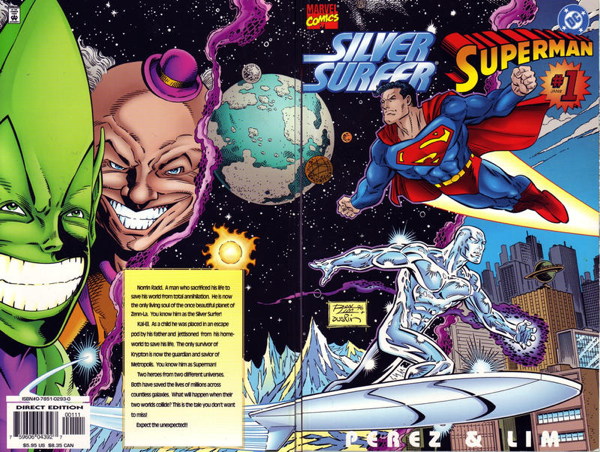
So I forget where I saw it referenced, but somewhere out there someone had mentioned the 1996 Silver Surfer/Superman one-shot, which got me to wondering if I still had it. I had bought nearly all of the Marvel/DC crossover comics that were cranked out during that period of the 1990s when both companies were desperate to attract sales by doing pretty much anything, and that included joining forces to publish things like this.

Anyway, when I opened the shop, I pulled a boatload of comics out of my own collection to populate the back issue bins, and that included a lot of the attention-grabbing intercompany crossovers between DC and Marvel, once ubiquitous but now getting more and more difficult to find in the wild. I did give up my Superman/Fantastic Four treasury edition, foolishly, and I’ll need to replace that, but I did keep my other Superman-related Marvel crossovers, including that Silver Surfer/Superman comic by George Perez and Ron Lim:


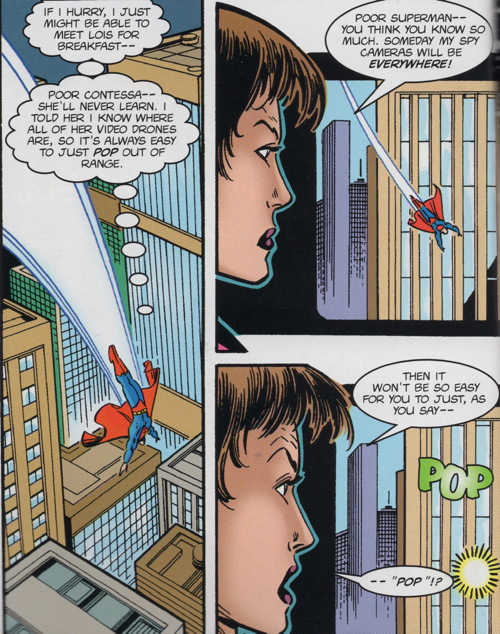
Like how the “Death of Superman” story is Of Its Time, featuring the now-headscratching-to-newcomers elements of Red-Haired-And-Bearded Australian Son of Lex Luthor along with Artifical Glob-Life-Form Thingie Supergirl, Silver Surfer/Superman involves, for at least part of the book, the Contessa. Yeah, I know, “Who?” I’d completely forgotten about her, though once she popped up in the story I was all “oh yeah, that lady.”

She basically usurped Luthor’s position as the head of his company Lexcorp after…well, read this if you need to know her deal, and how she was sorta unceremoniously removed from the book. Anyway, she’s here in this SS/S funnybook for about the first half, and this sequence of panels features what I’m pretty sure is a writing/editing mistake EDIT: I’m wrong, I misread it:


Superman thinks the phrase “just pop out of range,” and the Contessa, just a couple of panels later, starts to mockingly quote what he thought, only to be interrupted before she could say “pop” by an actual “POP!” by the teleported entrance of the Impossible Man. And how did the Contessa hear what Superman was thinking? Did she have mind-reading powers that I forgot about? EDIT 2: Somehow I missed the “I told her” part. Ah well.

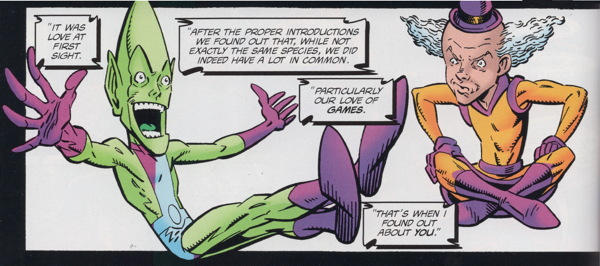
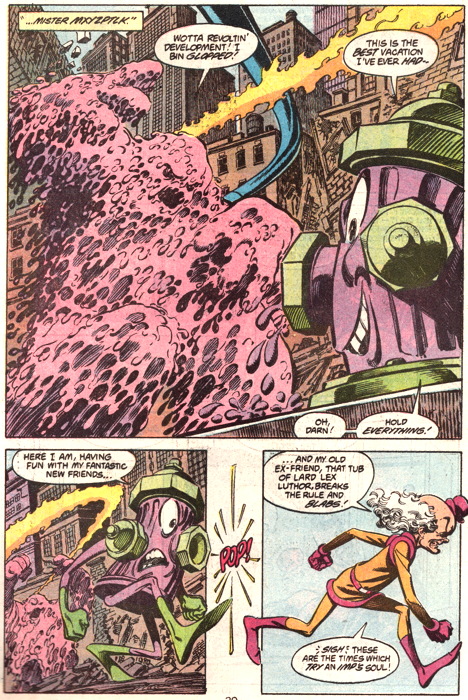
But speaking of Impossible Man, having him and Mr. Mxyzptlk as the antagonists of this story was a nice touch. The temptation of having the two heroes face off against Luthor and, say, Mephisto in a more serious conflict was likely strong.


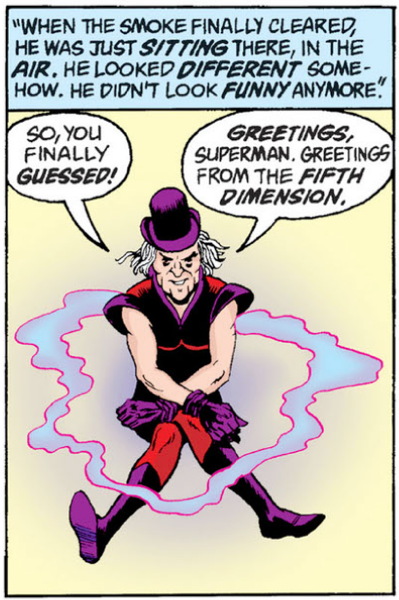
The plot involves Mxyzptlk and Impossible Man swapping “universes” and heroes, pitting Mxyzptlk against the Surfer and so on. Which of course brings to mind Superman #50 from 1990, where it is implied heavily that Mxyzptlk travels to the Marvel Universe and torments the Fantastic Four as the Impossible Man, establishing the two characters are one and the same.


I don’t particularly like this early post-Crisis/early Byrne’s Superman run version of Mxyzptlk where he was a little nastier, a little more malevolent. I guess it was fine for one or two appearances, but I like Funny, Wacky Mxyzptlk, which he eventually evolved back into in the comics, more or less. Although I was okay with Goth Mxyzptlk from Alan Moore/Curt Swan/Kurt Schaffenberger in their “Whatever Happened to the Man of Tomorrow” final pre-Crisis Supes story:


Mentioned in the story is the character Access, the Marvel/DC co-owned character whose ability was to cross characters over from either universe, and I’m presuming hasn’t been used much lately. And there’s also some track-covering with the idea that both Superman and Silver Surfer will forget this encounter, allowing it to kinda-sorta stay in regular continuity and explaining why, like, Superman won’t reference the event in a non-crossover-sanctions issue of Action or wherever.

I sort of miss those days where it seemed like every week we got a new crossover between different comic book publishers. They still happen today, of course, but not nearly as often. There’s a new Batman and Spawn book coming soon, for example. But back in the ’90s, I had that brief glimmer of hope we’d get that Swamp Thing/Man-Thing team-up the world deserved. Well, I deserved, I don’t know about you guys.

“To give away the secret would really spoil the fun.”

So one of my regular customers popped into the store the other to show off a couple of his goodies from his collection. He wasn’t interested in selling, despite my generous offer of a nickel apiece, or even after I doubled it to a dime apiece. However, he did allow me to shoot some pics so that I may share them with you, the dozen or so people who still look at comical blogs.
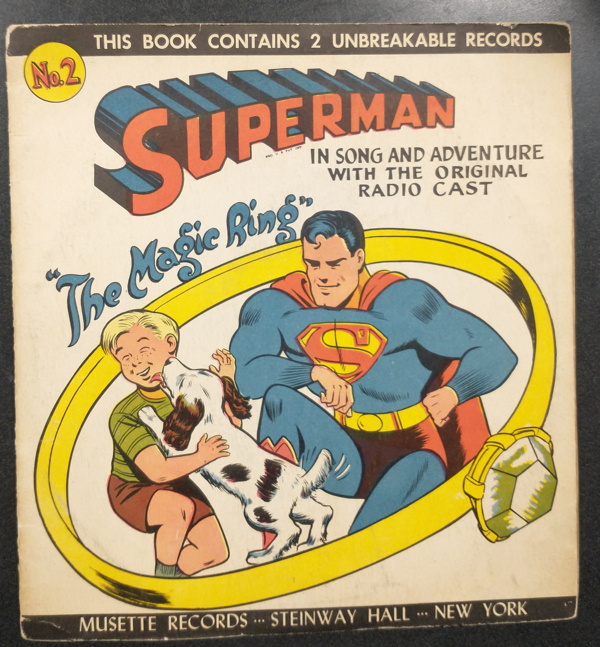
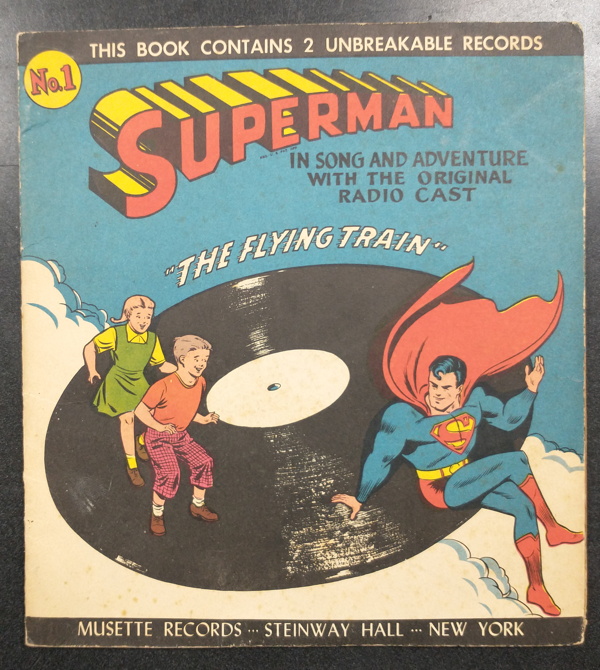
What he’s brought in were two 1947 Superman record sets, each featuring stories “in song and adventure with the original radio cast!” Here’s the first one:

Followed by, naturally, the second one:

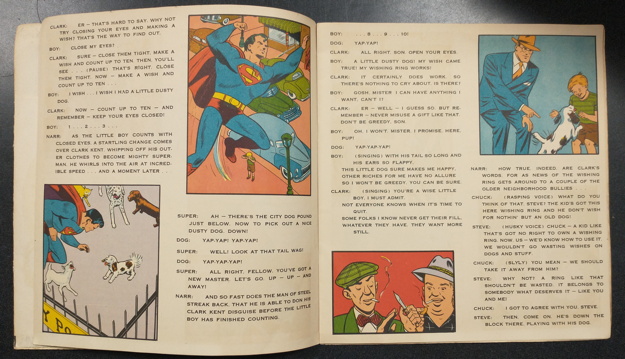
Inside the book was the story in radio play format so that the young’uns could read along (or even perform the story themselves in their unauthorized underground guerrilla theaters), accompanies by illustrations that I think were taken from the comics and not original to the booklet, but I could be wrong:

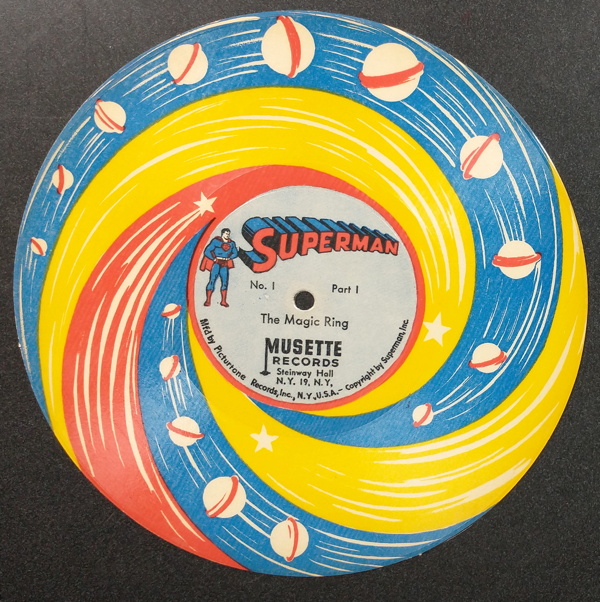
Each set came with two 7-inch records, that were remarkably colorful (and had the same design for both releases):

Now the cover ballyhoos these records as “unbreakable,” and I did give ’em the slightest bit of a flex to check their give, but I wasn’t about to put someone else’s 75-year-old discs through a full stress test. I believe the records were either a very thin vinyl, or each side was even thinner vinyl, like flexidiscs, glued to maybe a cardboard insert sandwiched between the two? I can’t say for certain. But it was certainly lighter than your standard vinyl disc of about the same size.
No, I didn’t play them on the store record player (again, someone else’s 75-year-old records) but thanks to YouTube, the Land Where Copyright Goes to Die, I can give you a sample of one of these recordings in action:

By the way, they’re not kidding about “in song” – characters do straight up break out into that very thing. Maybe you won’t listen to the whole thing, but at least check out the opening theme. And also maybe stick around to hear the voices of the bad guys “Frog” and Snicker.” Holy cow.