Somehow the links still work.

1. I hope you all enjoyed International Read A Comic Book Naked Day today. Alas, I tried to celebrate my own variation, Manage A Comic Book Store Naked Day, but you can probably imagine how the customers felt about that.

2. In case you haven’t seen it before: the legendary “Man of Steel, Woman of Kleenex” essay by Larry Niven.

3. (SPOILER for Superman: Birthright #8) – so, what, Lex Luthor has Dr. Doom’s origin now?

A mini post.

Mark Evanier has a short article about those Marvel Mini-Books that were published in the mid-60s. I actually had my hands on a couple of those not too long ago…they were in very nice condition, which meant that they’d never been read, because to actually try to read one of these things meant certain death for the mini-book’s spine. I did peek inside the Nick Fury one (being very careful not to break the darn thing) and noticed that there was a character named “Roy Thomas” in the story.

No real point to this post…just thought it was worth mentioning.

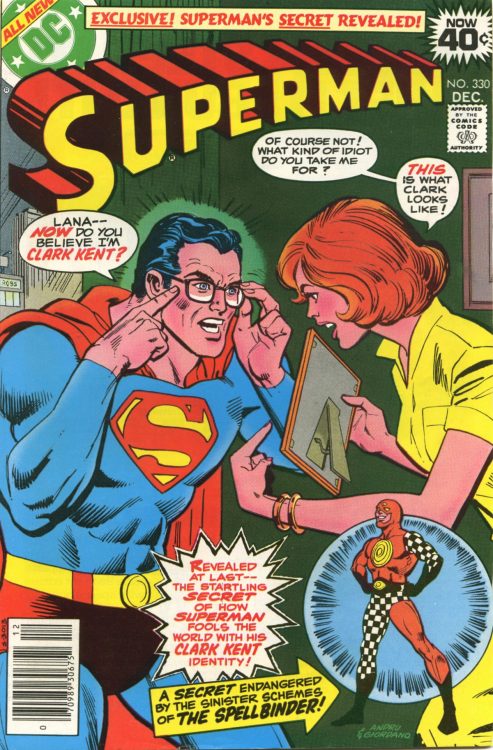
"NOW do you believe I’m Clark Kent?"


Superman #330 (Dec. 1978) by Martin Pasko, Curt Swan & Frank Chiaramonte
cover by Ross Andru & Dick Giordano


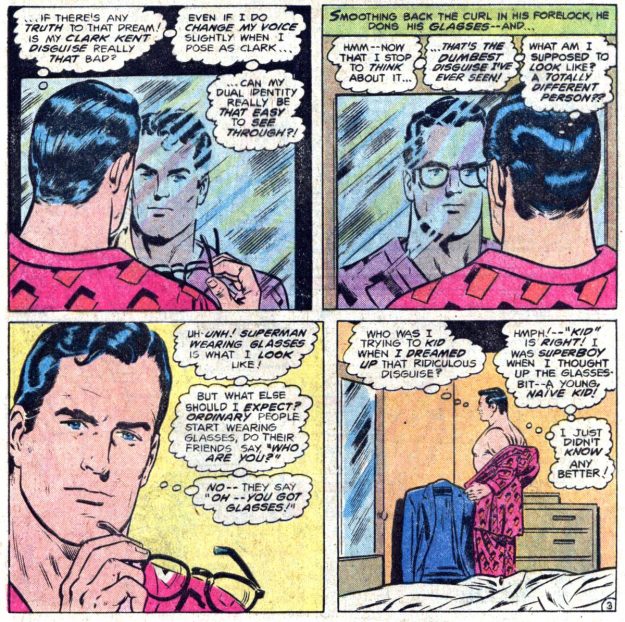
The story begins with Superman waking from a dream where his Daily Pla…excuse me, WGBS coworkers apparently know he and Clark are one and the same. This leads to a rare occurrence from 1970s Superman comics…Superman acting like a rational adult:


Well, then there’s some nonsense about a super-villain with hypnotic powers which really doesn’t matter, except it leads to revelations about the true nature of Superman’s dual identity. Superman is forced to use his own power of “super-hypnosis” (God bless the Silver Age) to protect the good citizens of Metropolis from the villain’s powers…specifically, he commands them to “resist all hypnotic influences!”

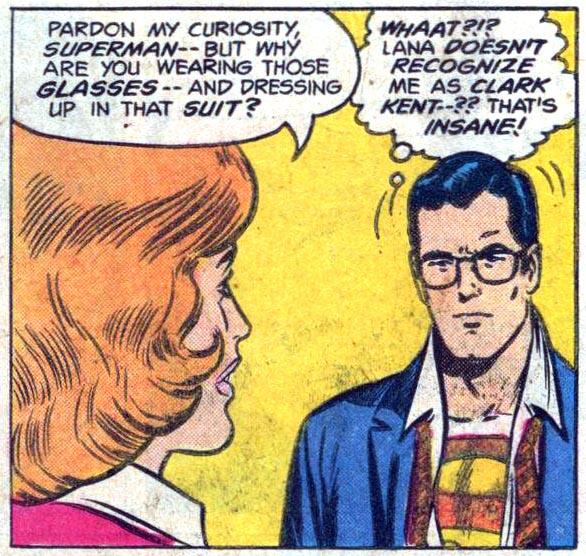
Later, Supes begins to get a clue that something’s up when Lana Lang catches him in the act of changing:


When Superman tells Lana that he’s disguising himself as Clark Kent, Lana dismisses the notion, saying that Superman looks nothing like Clark.

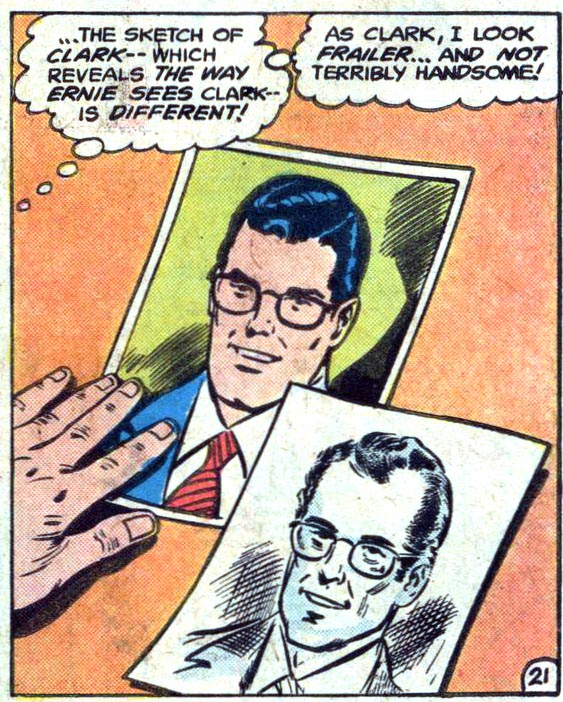
Later, after the villain has been dispatched, Clark gets some sketches made of himself in both his identities…only to find that while the Superman sketch is dead-on…


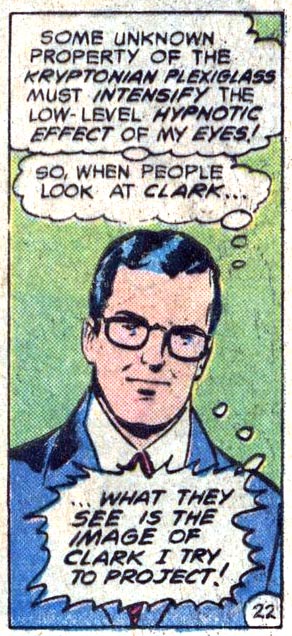
Clark determines that it is his own power of super-hypnosis that is convincing everyone that Clark looks so much different from Superman…and that the pieces of glass from the Kryptonian rocket ship that brought him to earth that were used to create his glasses* enhance that effect:


His eyes are always apparently emitting some low level hypnotic power, but when passing through the Kryptonian glass, his subconscious desire to separate his Clark and Superman identities is made manifest. A comment is made about camera’s reproducing the effect perfectly, which is why photos of Clark don’t seem to reveal his true appearance to anyone.

So, when Superman commanded everyone to resist hypnotic suggestions, he unwittingly undid his own hypnotic hoodoo, which is why Lana didn’t see Superman as Clark, even when wearing Clark’s get-up.

Anyway, there are holes in this story you can fly Krypto through, but the upshot is that Superman used super-hypnosis to make himself look different as Clark Kent, the idea was suggested by a reader of the comic (a then-prolific letterhack), and after this issue was published, it was very wisely ignored. Except by me.

* You see, the Kryptonian glass is as indestructible as Superman is, so Supes can use his heat vision while wearing the glasses without melting them. Yeah, I know….


Updated 4/2023 – special thanks to Bully the Little Hypnotizing Bull for the new scans!

Sidekicks.

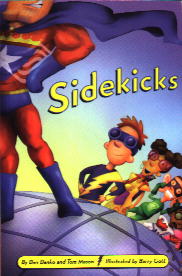
I was recently sent copies of the first two volumes of a new children’s book series that might be of interest to comic book fans…the series is called Sidekicks (published by Little, Brown), and it’s written by Marvel and Malibu writers/editors Dan Danko and Tom Mason. Yes, the same Tom Mason that brought us the naughty fun of Dinosaurs for Hire.

The first volume (of a projected six), called simply Sidekicks, introduces us to 13-year-old Speedy (the world’s fastest kid) and his fellow sidekicks to the Justice League-a-like League of Big Justice. His private life, like all good superheroes (and sidekicks) in this post-Marvel era, is rife with personal problems, as he is competing with fellow sidekick and schoolmate Charisma Kid for the attentions of the beautiful Prudence Cane. The plot details an attack by several supervillains upon the League of Big Justice’s headquarters, and it’s up to Speedy to save the day. Along the way several funny potshots are taken at the cliches that make up superhero adventures (including the sidekicks voting on what their battlecry should be, and a wise warning against pushing Big Red Buttons). It’s very silly and good fun, and even if the kids reading the books are only familiar with superheroes in the context of Cartoon Network’s Teen Titans and Justice League shows, there’s enough context given for all the jokes to keep up. You don’t have to be a comics fan to enjoy the books…but if you are a comics fan, you’ll find plenty of self-aware comics humor to keep you entertained.

As you might be able to infer from the name “Charisma Kid,” the superheroes are all played pretty much for laughs, with super-abilities and costumed identities included more their ability to generate gags than for any kind of practicality. There’s the sidekick “Boy-in-the-Plastic-Bubble-Boy,” who’s stuck inside a giant hamster ball. Speedy’s own patron, Pumpkin Pete, appears to have the super-abilities of having a pumpkin for a head, and…well, that’s pretty much it, aside from licensing and running away at the first sign of danger. But, you know, that’s fine…this isn’t intended as a Watchmen-esque deconstruction of the modern superhero. It’s a spoof, a farce…it’s designed to make kids laugh, and on that level it certainly succeeds.

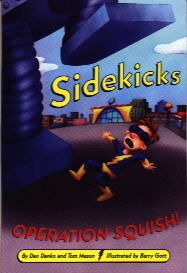
The second book – Operation Squish! – pits Speedy against the menace of Dr. Robot (called by everyone else “Dada Robah” since they all misheard his name)…and adds a little more depth to Speedy with his own growing disillusionment with the League of Big Justice’s apparent focus on merchandising and self-aggrandizement. There’s a nice moment of self-referential humor when a chapter in this book appears only to establish subplots for a future book…and the title of that chapter essentially says as such. We also begin to get the impression that Speedy may be the one member of the League of Big Justice and associated sidekicks that takes his job seriously.

Other nice moments from these books:

  • quite possibly the greatest superhero/sidekick name I’ve ever heard, almost painfully obvious once you see it: Spelling Beatrice.

  • the moments of surprisingly adult humor that pop up now and again (the appearance of Latchkey Kid, for example, or that Speedy was able to join the elite team of sidekicks not due to ability, but due to his parents’ check clearing).

  • the charming illustrations by Barry Gott that head each chapter.

  • each book includes perforated full-color trading cards inserted inside the front cover…Speedy and, probably the one true superhero to appear in the books, King Justice are in the first volume, Pumpkin Pete and Spelling Beatrice are in the second.

I’ve said in the past that the best children’s entertainment can be equally enjoyed by adults…Looney Tunes cartoons, for instance, or Carl Barks’ Disney duck comics. I’m three times the age of the recommended age group for these novels (and you have no idea how much it hurt to type that), but I got a kick out them, and I would recommend them to young comic fans, adult comic fans, and adult comic fans’ children, nephews, and nieces.

A giant-size demand.

1. I hereby call for a moratorium on jokes based on the 70s Marvel Comics title Giant-Size Man-Thing. Yes, we all can’t believe that Marvel actually published it either. But, after nearly 30 years, we’ve all heard just about every variation on the joke there is, and, really, it needs to stop. I know, what with the movie opening soon on an airplane near you, that the temptation is there to drag the joke back out again, but you need to resist. Besides, once J.M. DeMatteis used the joke in an actual issue of the 90s Man-Thing series (out of the beak of Howard the Duck, no less), it’s come full circle, and there’s nothing more to add.

1a. But if you have to wrap your hands around a Giant-Size Man-Thing (har har), make it issue #4, with the absolutely heartbreaking “The Kid’s Night Out” by Steve Gerber, Ed Hannigan, Ron Wilson, and Frank Springer…it’s one of the few comic books to make use of extended text pieces in such a way that it doesn’t drive you crazy. Plus, there’s a great Howard the Duck back-up.

2. I read a post on a message board (you can probably guess which one) where the person claims that you could read three consecutive pages of any comic that Grant Morrison has written and “correctly extrapolate” (that person’s words) every other comic Morrison has written. Um, there must be some other “Grant Morrison” writing comics, because that doesn’t describe the one I’m thinking of. You can look at St. Swithin’s Day and extrapolate The Filth? You can read Animal Man and extrapolate Kill Your Boyfriend? You can read G.I. Joe European Missions #3 and extrapolate The New Adventures of Hitler? Okay, in all fairness this message board poster was probably exaggerating to make a point, that Morrison does like to repeatedly explore certain themes, but, you know, that’s what writers sometimes do. Deal.

2a. A Grant Morrison bibliography.

3. Speaking of Morrison, there was a letter in the most recent issue of New X-Men in which the letter writer complains that the issue with a solo adventure of Xorn appears to contradict the later revelation about that character. All I can say is that this letter writer has apparently never heard of the concept of “the unreliable narrator.”

4. Non-comics-related Mac OSX joke: it’s a shame that Apple Computers didn’t advertise their new GarageBand software with the very obvious tagline “Rock out with your Dock out.”

5. I was going to post more on Rich Tommaso’s 8 1/2 Ghosts, but Bill Sherman beat me to it. Go read his review, and mentally insert my voice saying “yup, he’s right” after every sentence.

“Big-boned Ninja,” thank you.

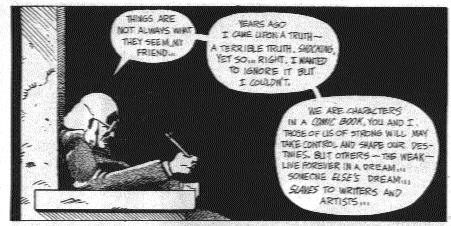
About four years before another certain superhero discovered he was just a character in a comic book, a villain in Fat Ninja, published by Silverwolf Comics, was clued into the exact same thing:


from Fat Ninja #3 by Gary Amaro and Emilio Soltero


Compared to the rest of the Silverwolf/Greater Mercury output, Fat Ninja was one of the better titles, with an appealing cartoony style and a tongue very firmly in cheek. Think a slightly less-silly Tick.

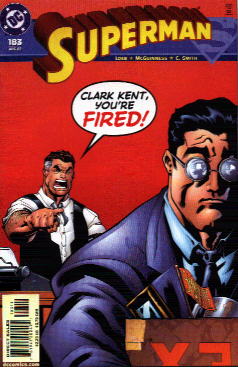
"YOU’RE FIRED!"


Okay, so I happened to be looking at the above cover the other day, when I noticed something peculiar. If you were to take this cover as a literal representation, and not just symbolic, here’s how the sequence of events would have gone:

1. Perry (or some other higher-up) fires Clark.

2. Clark cleans out his desk.

3. Clark starts heading for the door with his box of personal effects.

4. Perry pops up again to remind Clark (and everyone within listening distance) that he’s fired.

So, basically, Perry’s a big jerk who’s going to follow Clark out the door, shouting “YOU’RE FIRED” at him repeatedly, heaping additional humiliation on him during his Walk of Shame.

Or maybe it’s just symbolic. Yeah, I think I’d better stick with that.