So I spent a lot of time talking about John Byrne’s 1980s run on the Fantastic Four, probably focusing too much on the specifics without saying, in the big picture, that it was classically-done superheroing. Imaginative, usually well-drawn, stories that, with the occasional exception, paid off and rewarded the reader for their investment of half-a-buck or so.
One time (warning: name-drop ahead) Scott McCloud asked me what was the current title on the stands that perfectly encapsulated the standard of A Superhero Comic. What was “One Exact Unit of Superhero Funnybooking,” one could say. At the time, in the late ’90s, I told him “Avengers by Kurt Busiek and George Pérez,” and not just because Scott and Kurt are old friends. It was genuinely the Platonic idea of a superhero comic…well-written, well-drawn, rewarding to read. Had Scott asked me a decade and a half earlier, I would have said John Byrne’s Fantastic Four.
But all things come to an end, and Byrne’s run, having begun in 1981, finally reaches its end in 1986’s #293:
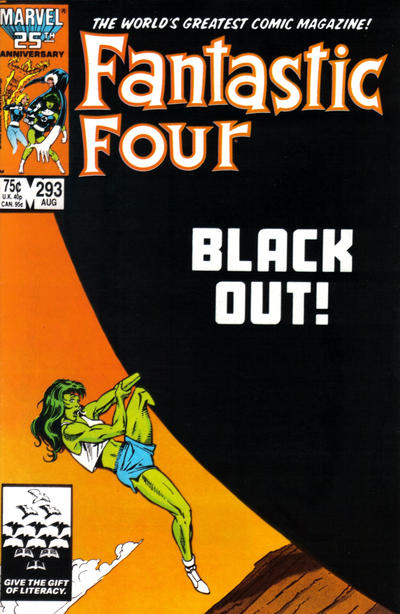
First of all, it doesn’t feel like Byrne’s run was only five years long, given its reputation. It is a significant milestone in the series as a whole, essentially “resetting” the series that had, to some extent, gone a bit off the rails in the years following Lee and Kirby departures from the book. Byrne’s “Back to Basics” approach gave the title a new baseline from which to work, a several-year run that was almost entirely jumping-on points for new readers.
And it’s not like five years is anything to sneeze at. Every issue, plus the annuals, written and drawn by Byrne (with #266 mostly penciled by Kerry Gammill, though Byrne inked it all and did pencil three pages of it), even while he was working on other projects. This did affect the art somewhat, ’til Byrne wisely brought inkers on board to assist in the back half of his tenure.
Second, #293 has only the second cover on one of Byrne’s FF issues to not have been drawn by him (the other being Eliot Brown’s Doctor Doom mask cover). I’m pretty sure I knew already that Byrne was going to be departing, but it was a strange thing actually to see that David Ross/Joe Rubinstein image on the physical copy of the comic in my hands. Even looking at it to this very day makes me recall that sense that there’s a monumental change afoot.
I was in my mid-teens then, but this may have been the time I had personally experienced such a transition on a comic I was following. I was used to multiple teams of artists and writers on comics, of course, but I think Byrne was my initial exposure to The Superstar Creator, the Big Name doing Significant Work on a signature title. Such an immense talent, I thought, would be a hard act to follow. In fact, how could one follow Byrne on a title that he so very much made his own?
It’s a feeling I would have again, when Alan Moore left Swamp Thing, when Peter David left Incredible Hulk. Absolutely classic runs where the creators left their imposing marks, and also giving readers the feeling “who could possibly even follow that?” In the case of Swamp Thing, we got Rick Veitch as the next writer/artist of the series, who turned out to be just the guy to pick up where Moore left off, giving us his own wild run that, while unfortunately truncated at the time, is ginally getting its due.
In the case of Incredible Hulk, it took…a little while longer for the comic to find its footing, though it became very clear that David’s long run did away with the viability of the simple “Hulk smash!” formula that he disdained. The more successful follow-ups delved more deeply into the variable personalities of the Hulk character, such as the immensely popular Immortal Hulk series from a few years back.
Fantastic Four was more a case of the latter than the former, where Byrne’s run cast a long shadow, and the creators that followed found they had big shoes to fill. Eventually, we’d get some significant new directions, but the path from here to there did hit some rough spots along the way. For next time, I’ll delve a little more deeply into this specific story that ends the Byrne run, and where the book goes from there. A lot of changes are ahead, as folks come aboard and try to deal with the pieces that were left behind by this sudden departure of so outsized an influence.
Chris Claremont’s X-Men has to be the one main example of a superstar creator leaving with the feeling of “who could follow that?”, having stayed on the book for seventeen years, making it his own. More than any other title I can think of the answer is “no one” (not even Claremont returning). At least, not until Grant Morrison came aboard New X-Men. Which was followed by another gap of “who could follow those two?”, with another answer to the negative.
As you mentioned, Veitch ended up doing a more-than-adequate job of picking up where Moore left off on ST. Hulk had a harder time recovering from David leaving (a run second only to Claremont in length for a Marvel title), but after a brief Joe Casey stint, Marvel also relaunched the Hulk comic after David; so in that sense, the Hulk was sort of given a fresh start. FF did go through some rough patches, but it found Walt Simonson far sooner than X-Men found Morrison.
Byrne leaving was definitely the first time I felt like a creative change impacted me. I wasn’t always clued into comic news back then, mainly getting it from monthly sources, if that. So when a new creative team turned up I was pretty thrown. I gave it a chance for a while, but then realized “Maybe I don’t need to buy Fantastic Four for ever.”
If I ever met Scott I definitely know what I’d ask him about.
The Sculptor is one of the most depressing comics ever made, and thus is not to my taste. But it’s also about the fear of being forgotten after you die, and it seems to come from an authentic place. What I don’t understand is how Scott can have this fear.
Scott won’t be forgotten. He made his mark already. They’ll still be using Understanding Comics in college courses 500 years from now. Why would he still harbor the fear of being forgotten after accomplishing this?
“The Sculptor is one of the most depressing comics ever made…”
It’s also bloated, reliant on twists which would shame M. Night Shyamalan, straining for profundity, and with a thoroughly unlikeable protagonist.
This review of Byrne’s Fantastic Four has clarified something for me. It was a little bit of a mystery to me why I enjoyed the first part (half?) of his run so much but not the second part. And I think it’s because his treatment of the characters changed.
From the outset, it was clear that Byrne had a lot of affection for the main cast of the book, and he even took pains to make the villains sympathetic. He positioned Sue as the contented heart of the team (and growing powerhouse), Ben as a loveable but insecure figure, Reed as a distracted but devoted family man.
Later in the series, Sue has a miscarriage. She’s mind-controlled and turns against her family in a rage. Reed gains an estranged father and weird memory loss. The two of them are literally tortured in hell. Ben quits the team in a fit of self-doubt. Jen is grossly exploited by a pornographer. Johnny inspires a kid of self-immolate, for goodness sake.
What happened? The team always faced threats, sure, but they succeeded with a combination of smarts and compassion. They had their problems, but they were a well-integrated unit. Later, the threats not only seem more…personal? invasive?, but they begin to eat away at the structure of the team. It seems less fun and more grueling for the characters themselves.
This is obviously just my opinion, but Fantastic Four always works best as an optimistic book, a carry-over from the era of progress and scientific advancement. Leave the interpersonal strife and internal doubt to the X-Men and Chris Claremont.
I guess it’s just interesting to watch that switch happen over the course of Byrne’s tenure on the book. It went from adventures with occasional serious consequences to real psychological distress for the heroes. That kind of playing around was fun in Alpha Flight, but Fantastic Four doesn’t seem like the right venue.
This was the only Byrne FF I bought when it was a new issue, so it didn’t strike me, personally, as an “End of an era” thing at the time. I was new to comics, so Byrne’s name didn’t mean anything to me, he was just the guy doing FF, the Hulk, and the covers for the Marvel Handbook, then suddenly he wasn’t. I remember stumbling upon Byrne’s message board almost 20 years ago where he and his followers would always moan about modern creators not understanding the need to “put the toys back in the box” when they were finished their runs on a series, and I’d always think, “Didn’t Byrne leave Banner and the Hulk separated from each other and a Fantastic Four with She-Hulk instead of the Thing?”
This story’s “Giant black bubble where time passes quickly” engaged me, because I wondered how they would deal with the rapid ageing of the characters, but for as much as I re-read this issue in 1986, I never bothered with the follow ups, and probably didn’t read the rest of the story (under Roger Stern) until about 15 years ago. I remember being surprised that Byrne was credited with the plot to FF 294, as I’d thought this split from Marvel had been a total one. The next issue I bought after this was the 25th anniversary issue with Stan Lee’s script and many different pencilers. Looking at the covers, I definitely bought the issue after that, but from that point on, I think I was keeping tabs on what was happening in FF via “Marvel Age” magazine, and it just seemed like they were throwing anything against the wall to see what stuck (Johnny gets married, Reed and Sue leave and join the Avengers, Crystal re-joins, Ms. Marvel joins and mutates into a version of the Thing herself). It’s funny that it had five years of stability then stumbled around under different creators for years afterwards.
Writers plot out their stories (or should anyway) well ahead of time. So, Byrne would have submitted his plot for a few issues ahead of publication time to the editor before publication date. The editor still had the plot left by Byrne, and when Byrne left Marvel, they turned the unfinished story’s plot over to the new scripter (in this case Stern) who uses the plot to finish the story left behind by the prior writer. Then, Byrne gets credit as the plotter, even though by that point he’s already gone from Marvel.
As far as stumbling around with different creators, while I wish he would have left a lot sooner, Tom DeFalco was writing the Fantastic Four from 1991-1996 for a total of 60 issues, although it would seem like much longer.
@ Thom H.
I think you raise some good points about Byrne’s run on the FF, and I have to say that I agree with your take on the first half being more enjoyable than the second half; although I did always enjoy Wyatt Wingfoot being brought back in.
@ Bryan
I stopped buying FR shortly after Byrne’s departure, but I have wondered from time to time when seeing back issues of FF in bins who the “She-Thing” character was–it looks like it was Carol Danvers? Wow! Poor Carol–how many ways was she done wrong by Marvel in the ’80s and ’90s?
I’m actually surprised that Stan Lee or Jim Shooter or somebody didn’t try to set up an all female supet-team during the ’80s which could have featured Ms. Marvel, She-Hulk, Spider-Woman, Dazzler, and a few other characters…maybe Clea, Satanna, or Shanna as members. It could have been a new take on “The Lady Liberators” or something.
Sean-It was the Sharon Ventura version of Ms. Marvel, not Carol Danvers. She was a friend of Ben Grimm who got her powers from the Power Broker (a storyline running in Captain America at the time). She figures out that the Power Broker is a criminal, and at some point it’s implied that she was raped by villains in the employ of the Power Broker. Due to her treatment, she develops a hatred of all men and being touched. Ben Grimm decides that joining the FF would be a good way to deal with serious PTSD. On one of her first missions, she is exposed to cosmic rays and mutates into the She-Thing form. At first, she is suicidal, but she eventually decides she enjoys having that form because men won’t be attracted to her. I’ll stop here. Steven Englehart in the late-1980s, folks.
Englehart’s attempts to write Sharon as a PTSD victim of rape were about as delicately handled as his attempts to write gay, Japanese and Black British characters in Millennium and The New Guardians.
(And I don’t mean any of the above as a compliment.)
@ Chris V.
Oh, I had no idea that there was also another Ms. Marvel in between Carol Danvers and the current Ms. Marvel. Was Sharon Ventura actually called “She-Thing” or did she have a different superhero name? Is she still around in Marvel continuity at all? Was there ever a “She-Thing” vs She-Hulk battle?
@Oliver
It is disappointing to learn that the Englehart stories of the ’80s or ’90s (Copper Age?) apparently went way downhill from the Englehart stories of the ’70s, which I tend to hold in high regard. And I thought Coyote was an enjoyable Englehart series from the early ’80s. It is also disappointing that he was indelicate in his handling of some of the diverse characters in Millennium and The New Guardians.
Looking some of this stuff up, I think I have a vague memory of buying a few issues of Millennium back in the day, but don’t recall if I read the entire series. I totally forgot about the Oans having mates–was that concept only introduced in the Millennium series, or had the Zamarons been show before? Making Wally West’s dad a Manhunter seems like a goofy choice.
It looks like Englehart split or was taken off of The New Guardians early on and that Cary Bates took over as writer. Are the Bates issues of New Guardians a better
read? And it looks like at least a few New Guardians–Jet and Gloss–went on to join the Global Guardians.
Speaking of the Global Guardians, has DC done anything with them lately? What would and “Absolute” Global Guardians book be like? How would it navigate these turbulent times that were are living through on a global scale?
But back to Carol Danvers, why was the decision made in the first place to change her from Ms. Marvel into Binary? And then why didn’t she remain as Binary? For that matter, even though it was a big event at the time, I think Mar-Vell shouldn’t have been killed off. I always liked him as a character, especially with his second costume design.
I think “She-Thing” was more of a fan creation at the time, although I think retroactively Marvel may have given her that as her code name. I forget what happened to Sharon Ventura after Englehart left FF, but I think Dr. Doom cured her of being a “She-Thing”.
New Guardians wasn’t a bad comic. Englehart’s portrayal of a gay man just…wasn’t exactly sensitive or subtle. Englehart either got fired or quit writing NG (I forget which) due to some (ahem) blowback after he created a villain who gained power by snorting cocaine. The Bates’ issues adequately picked up where Englehart left off with little change in the time or content of the stories.
As far as I know, the reasoning behind transforming Carol from Ms. Marvel to Binary was Chris Claremont’s idea. Eh…Carol was, well, raped (yeah, it was not a good idea to be Ms. Marvel in the 1980s, sigh) by her “son” while the Avengers cheered on the relationship. Claremont wrote an Avengers Annual where he basically had Carol return to tell the Avengers they were @sses, which was also the issue which saw the debut of Rogue, who while using her powers accidentally stole all of Carol’s powers. Claremont wanted to build Carol Danvers back up as an even more powerful character after what had been done to her in those other Avengers stories.
That should read: “The Bates’ issues adequately picked up where Englehart left off with little change in the TONE or content of the stories.”
Of course, they could have called her “Ms. Thing”…
Morrison reimagined the Global Guardians as the International Ultramarine Corps in JLA and JLA Classified, but that was…27 years ago?
Wikipedia tells me the Global Guardians most recently regrouped in Absolute Power in 2024.
If you’re looking for a team comprised of members from different cultures, Deniz Camp’s new version of the Ultimates probably comes closest.
“ I totally forgot about the Oans having mates–was that concept only introduced in the Millennium series, or had the Zamarons been show before?”
The Zamarons date from early Silver Age issues of Green Lantern — they’re the ones who empowered Carol Ferris as Star Sapphire — but there was no hint they were connected with the Oans until Englehart’s work.
“Making Wally West’s dad a Manhunter seems like a goofy choice.”
There was a mandate to have a member of the supporting cast in every book turn out to be a Manhunter. From the ones I’ve read, Rudy West was the *best* implementation of that, which doesn’t say much for the others.
@ James Moar
Thank you for the explanation. I have only read around a dozen Silver Age Green Lantern comics, so I wasn’t familiar with the Zamorans and their importance in the creation of Star Sapphire.
Speaking of Star Sapphire, it would be cool if DC would print facsimile editions of Carol’s first appearance as SS, and also that issue of Action Comics where Superman is kneeling before SS…
Re: The Manhunter mandate, I just find it corny when a hero’s close relative is revealed to be a villain roughly twenty years after that relative first appeared. I also object to the revisionist Barry Allen family history.
I preferred it when Barry didn’t have a grim and gritty backstory like Bruce Wayne.
Way late to the party on this one.
A couple of things:
@Thom H.
I think your analysis is spot on and has helped me realize why I enjoy the first half of the run so much more than the back half. There are certainly great moments in the second half, but yeah a lot of torment of characters I love – Thanks for that!
It’s been a while since I saw the cover for #293, don’t know if I ever realized back in the day that it wasn’t a Byrne cover. Looking at it now it seems obvious, but it is still a nice and strikingly designed cover. I STILL love the last page with the FF statue, wanted a poster of that for years!
Funny to think that this comic is exactly 40 years old, and I remember buying it at the very tail end of 8th grade – yeeesh!
I’ve spoken on here several times about the heartache I felt after Byrne left. I went back and looked and I kept buying until issue #304 or #305, but man my heart just was not in it after #295.
How I wish Ordway/Gordon would have stayed on the title, those issues are beautiful.
A combination of reading articles in Comics Feature about the 70’s period after Kirby and the stagnation that many felt affected the title, coupled with obsessively reading the Marvel FF Indexes which were coming out at the time (which I still love, love, love) only deepened my sense of “here we go again.”
The artwork by the legendary talents of the Buscema bros. was just heartbreakingly bland. To me, John Buscema is one of the top 3 or 4 best artist the FF ever had, but his 80’s work just feels like a pale imitation of his former glory. A lot of times it feels like the example pages from How To Draw Comics The Marvel Way of what NOT to do instead of the ones you should aspire to. To be fair, the panels are clean and convey the story well enough, but it just feels so rote. To be fair though, how many other books were each of the brothers working on while still doing the FF?
When Pollard and Sinnott come on it looks much better, but still kinda like a band you love churning out albums that are pleasing enough, but just repeating past glories.
Apologies, I know all of this sounds so negative, I really do try to find the good in things… honest.
@Sean – I totally agree with you about the Flash!
@LouReedRichards
Thanks!
Re: Fantastic Four artists, here’s my top 10:
1. Jack “King” Kirby — no contest!
2. John Buscema, for his first run on the FF in the early ’70s, and his redefining of the “Marvel House Style” for the Bronze Age. His art at this time was fluid, dynamic, and moved the plots along well!
3. John Byrne — arguably the second most important FF writer–but in my opinion his art on the series suffers from his own inking, changing the classic Jack Kirby costumes when there was really no reason to do it, giving Sue and Johnny bad haircuts, and his panel layouts. Also, story-wise, replacing The Thing with She-Hulk in the second half, and kinda going in a sadistic direction with his trauma-inducing treatment of the team isn’t that great.
4. Rich Buckler–he kinda synthesized Kirby and Buscema’s styles during his time on the book in the ’70s. He comes in for criticism for swiping Kirby panels or whatever, but if that was what Marvel wanted at the time, he obliged them.
5. George Perez –he built up his skill level in a few short years while drawing the FF–and other Marvel Comics –from the mid-to-late ’70s.
6. Keith Pollard–he kept the House Style going, along with Buckler and Perez, while bringing his own touches to the book
7. Bill Sienkiewicz–he added a Neal Adams-lije realism to his depiction of the FF.
8. Walt Simonson–great artist, but I’m not a fan of the She-Thing, or the alternative FF or whatever…
9. Paul Ryan–I haven’t read that many FF issues from his run, but he seems to be a competent artist who draws a lot like Jerry Ordway.
10. Jerry Ordway, inked by Al Gordon. They should have stayed on the book longer, after Byrne departed, but they only did a few issues.
Honorable mention to Joe Sinnott as best FF inker who made the ’70s FF look smooth by inking a bunch of Buscema, Buckler, Perez, Pollard, early Byrne, and Sienkiewicz penciled issues, after having inked a bunch of Kirby issues as well!