Before I get into the main “trying your patience” portion of this post, let me note a couple of things:
First, pal Tegan celebrates installment #1000 of her “Tegan Reads a Comic Book” video series, where she looks at that anniversary issue of Fantastic Four I discussed not too long ago. She was kind enough to acknowledge my efforts here researching the origins of that comic, and she has, as she always does, interesting things to say about the book.
Second, I just discovered a few days ago that there was a five-part podcast series looking at the Fantastic Four movies entitled “Fantastic Fouray,” which was news to me. Well, I don’t think there should be any confusion between that podcast and my overlong text pieces, but just in case: I Am Not Affiliated with That Podcast, Honest, I Wasn’t Trying to Step on Any Toes Here. Anyway, reviews of the FF films sound like fun, so go check ’em out, let me know how they are.
Now, onto the mainstream of this evening’s symposium:
So when we last met, we were at that point in the Fantastic Four run, in late 1986, where John Byrne’s direct involvement has been over and done with for several months now. However, his influence still lives on, as we saw in the extra-sized anniversary issue #296, which followed a general outline of his initial plans but shaved off some of the details. And here we are in #297, by Roger Stern, John Buscema and Sal Buscema, dealing with the emotional detritus left behind by some of Byrne’s storytelling decisions.
As you can see on this cover (which I presented last time):
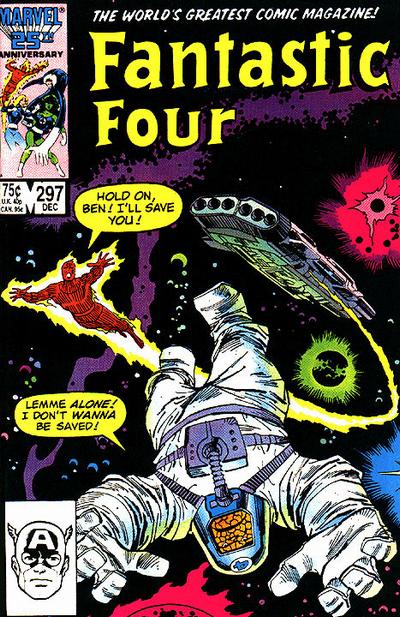
…the Thing is clearly not in a great place. Don’t worry, I’m not going to spend another full post on just a cover again, but there is a distressfully dark tone to that cover. Without actually saying the word “suicide,” you clearly get what is implied here. Needless to say, ol’ Ben is not in the best place right now. I mean, this cover isn’t a patch on “This Man, This Monster” as drawn by Jack Kirby:
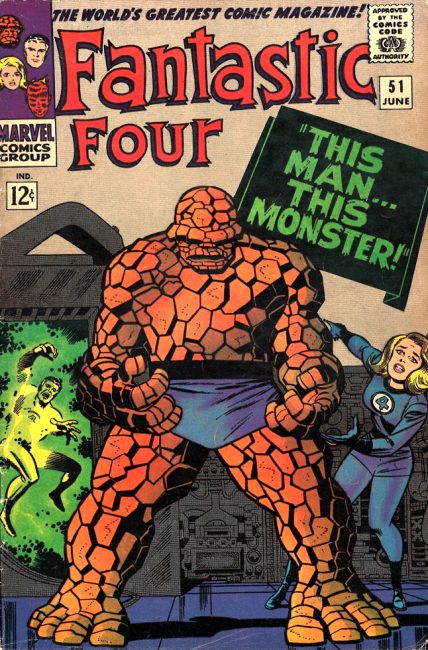
…but it’s of a kind.
The cover only tells part of the story of what’s inside, as it’s got subplots a’plenty in the Mighty Marvel Manner, but you’d be disappointed if it didn’t. What supposedly are the A and B plots of the issue are the Fantastic Four working on some science doohickeys for the U.S. government to address some strange fluctuations in the Sun. Meanwhile, somewhere out in space, there’s war raging on a distant planet between two powerful warlords who just happen to be brothers. Here’s a quick family photo of the two of them:
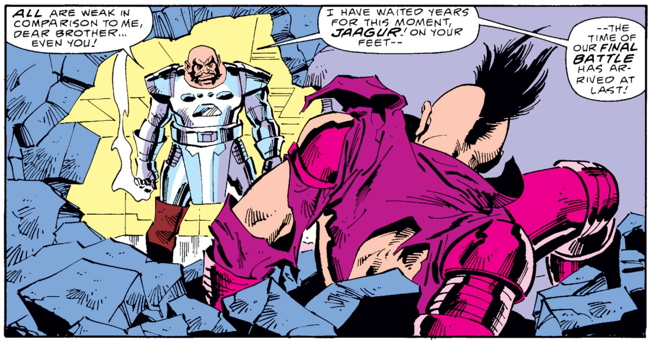
If you think those initial two plots are going to collide at some point, well, give yourself a cookie.
And, of course, the third plot, the emotional journey of Ben Grimm from “depressed” to “probably even more depressed.” Despite the A & B plots clearly being on a collision course and the apparent main driver of the book, it’s C that, frankly, we’re all going to be the most concerned with. This is likely the main reason I kept reading the book, even considering Byrne’s departure and the mostly wet thud of the anniversary issue. I wanted to know what happened to the Thing.
At this point, in the few years I’d been reading Fantastic Four and related materials, I’d seen Bashful Benjy go through a lot. Gained his humanity, lost his humanity, been devolved, been further mutated, was stuck adventuring on an alien world, found out he could always turn himself back to human but lost the ability on said alien world, lost his girlfriend Alicia to his best friend, et cetera and so forth.
It wasn’t like I was waiting for an eventual “happy ending,” as the very nature of serialized superhero comic book adventures is happy-ending-adverse. I think I was looking more for an “equilibrium,” some middle ground where the Thing could have something resembling a normal life while still going on adventures. Like, right now, in the Ryan North scripted Fantastic Four series, the Thing is married (to Alicia…yes, that whole situation is eventually resolved, wait ’til you find out how if you don’t already know), he’s not constantly mutating, he’s not emotionally tortured…that’s about what I mean when I say “reached an equilibrium.”
In this issue, though, the Thing isn’t quite there yet, as he remains in a bit of turmoil, angered and shamed by his physical condition and brusque to the man he feels put him in this position, the FF’s leader Reed Richards. Unfortunately, Ben’s attitude results in a little friendly fire involving Reed’s young son Franklin:
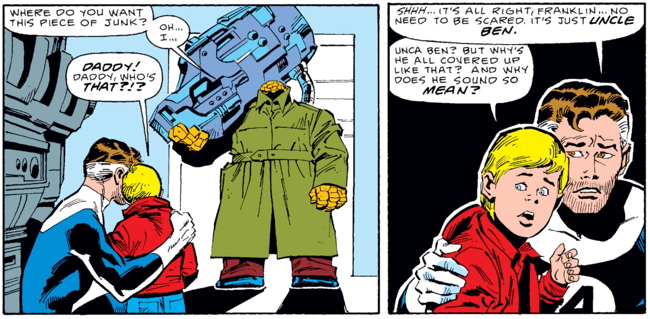
…which of course only exacerbates the Thing’s renewed self-consciousness about his appearance, a symptom of recent events involving mutations of his form and his stint on Monster Island from the anniversary issue.
This drives Ben to don a suit that fully covers his body:
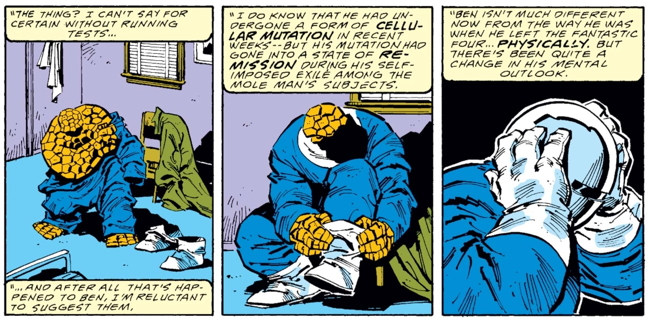
…as seen in this bit of business, where he, somehow unseen, overhears Johnny’s proposal to Alicia:
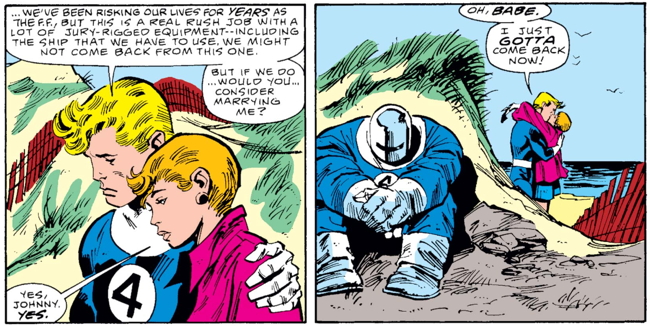
…that of course does nothing for his current state of mind.
The ultimate payoff of this plot thread comes when the FF all hop aboard their ship and take off into space to deploy their Sun-energy-detector-siphon doohickey. Once that’s deployed, the Thing decides to just let himself drift off into oblivion, like what we saw on the cover, only to be caught in the process by Johnny (wearing a Reed-designed outfit that allows him to Human Torch-ify himself in space):
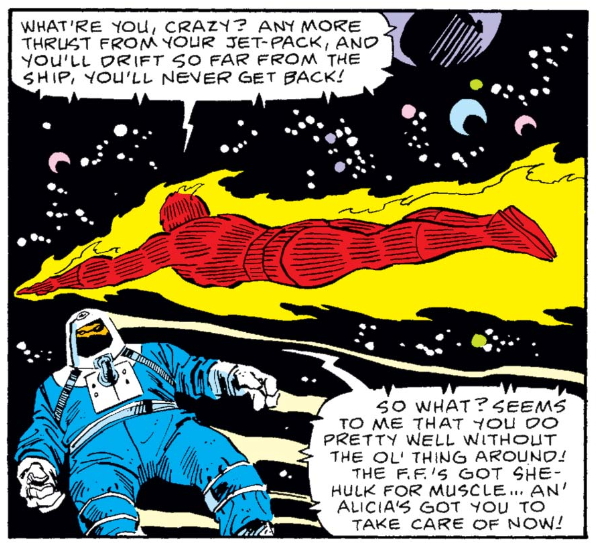
Ben just lays out the reasons why he feels he’s no longer needed (including She-Hulk’s continuing presence on the team, which comes to a head of sorts shortly). Johnny of course thinks it’s a load of bunk and drags him back to safety, nearly doing himself in due to the limited supply of air in his special suit.
By the end of the issue, Ben’s back on board the ship and ready to pilot everyone back home, until the sun-device somehow makes contact with that alien world and drags the warring brothers back to our solar system, somehow merged into one being:
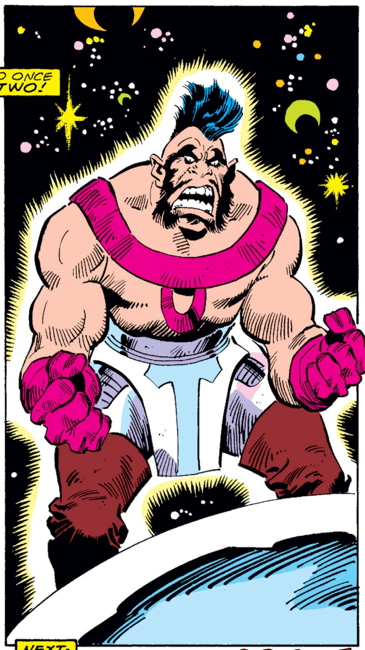
…and that’s our cliffhanger for the next issue.
I didn’t say much about the whole warring alien brothers situation, because, like I said, the important part of the story is the Thing’s continuing alienation from the rest of the team, and from the rest of humanity itself. It’s just all set-up for the big action-packed conflict for the next issue, but that said, I feel there’s still a connection between these two elements of the story. The alien warlords (named Umbra and Jaagur, just for future reference) could be seen as being in parallel to the relationship between Ben and Johnny. And Reed, too, perhaps, but given the main conflict for this story is for the former pairing, that’s the match that makes the most sense.
Between Ben and Johnny, we see an emotional conflict that is…well, not “resolved” as such, but at least brought to a position of understanding. With Umbra and Jaagur, the conflict between the two brings them into outright violent physical conflict, which gets interrupted by outside forces (Reed’s machine). And one presumes being merged into the same body doesn’t resolve those issues, but we’ll see what happens in the next chapter.
The Too Long, Didn’t Read version is that we have two different conflicts between two sets of brothers, both put on hold, with Ben and Johnny in a “but for the grace of God” circumstance in relation to Umbra and Jaagur. I mean, I don’t think Ben and Johnny were in any danger of being merged into a single body or anything, but Ben does bring up the bit of business from Monster Island where Johnny was made “ugly” by the Mole Man’s machinations, so in a way they did “share” a body, or at least a circumstance…and already my Too Long, Didn’t Read summary is longer than the bit I was trying to summarize.
In the end, what we have is a deep dive into the mental state of the Thing, still feeling the aftereffects of what he’d been through as a result of Byrne’s tenure on the book. Even after being gone for most of a year, Byrne still casts a long shadow. But of the remaining explicit changes Byrne made, the Thing’s issues find an eventual resolution (or equilibrium, as I talked about earlier), with Johnny’s marriage to Alicia, and Sue Richards’ alternate identity of “Malice,” stretching on even further still. But, more on those in future installments.