So in 1971, the following two issues of the underground comic Air Pirates Funnies were released:
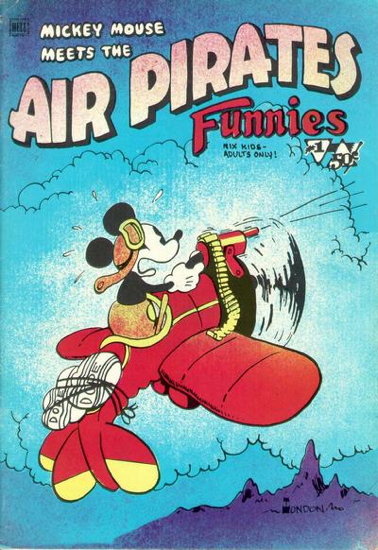
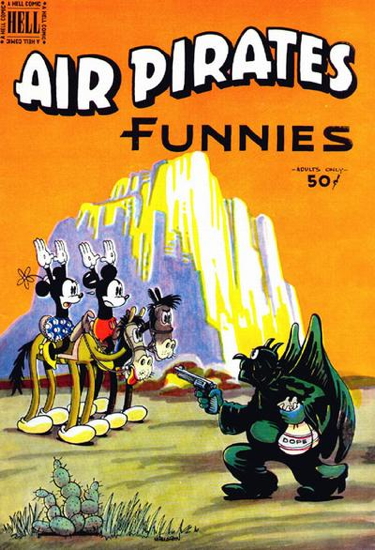
And as you can probably see, these comics are heavy on Disney parody, and being undergrounds, they’re especially heavy on the, shall we say, more adult elements.
As you might imagine, the Walt Disney Company was…unamused, and lawsuits were filed, and court cases were held, and anyway you can read all about that on the Wikipedia page. But the upshot of all of it is that Air Pirates Funnies is very out of print and legally will stay that way.
Or…will it?
A thought occurred to me when I was talking to pal Brook about this comic, that Mickey Mouse, at least the first year version of him, is now public domain. And that got me to wondering…when do the other Disney characters used in Air Pirates Funnies enter the public domain?
Now, I don’t own copies of these, unfortunately, so I’m depending on the Grand Comics Database entries and whatever I’m catching in the issues they have on the Internet Archive to get all the Disney characters used.
Now this is a pretty wide spread of characters, so anybody I may have missed probably fit in this range anyway, but let me know if I missed someone important.
If I may also note, I AM NOT A COPYRIGHT LAWYER OR EXPERT. I’m simply basing these numbers on the “enters public domain after 95 years” calculation. If there are other circumstances at play here that would affect PD status, I do not know them.
So, here we go:
Mickey Mouse – first appeared in 1928, entered public domain in 2024
Minnie Mouse – first appeared in 1928, entered public domain in 2024
Goofy – first appeared in 1932 as “Dippy Dawg,” then known as “Goofy” by 1934. Enters the public domain as Dippy in 2028, as Goofy in 2030
Zeke Wolf AKA Big Bad Wolf – first appeared in 1933 as The Big Bad Wolf, gains the name “Zeke” in 1946. Enters the public domain in 2029 as Big Bad Wolf, and as Zeke in 2042
Three Little Pigs – first appeared in 1933, enters the public domain in 2029
Phantom Blot – first appeared in 1939, enters the public domain in 2035
Pete – first appeared in 1925, entered the public domain in 2021
Sylvester Shyster – first appeared in 1930, enters the public domain in 2026
Chief O’Hara (no, not that one) – first appeared in 1939, enters the public domain in 2035
Horace Horsecollar – first appeared in 1929, entered public domain in 2025
There are of course some caveats, as what is entering the public domain is the version from that year…later depictions of, say, Horace, aren’t public domain yet, just how he looked in 1929. And as you see in the Goofy entry, the Dippy Dawg version precedes the Goofy name by a couple of years.
The real sticking point here is Zeke Wolf, who is referred to by that name in the Air Pirates comics. While his character first shows up in a Disney production in 1933, his actual first name doesn’t appear ’til well over a decade later. Thus, the earliest that all the Disney characters in Air Pirates Funnies are public domain, making this comic safe(?) to reprint, is 2042, unless they carefully excise each occurrence of the name “Zeke” in the stories.
If 2042 is the potential date for a reprinting, then by that time later versions of the other characters would have entered the public domain as well. Even if they do edit out the “Zeke” usage and get the reprints out in 2036 (when the Phantom Blot enters the public domain), I think it’s likely okay. The Disney parodies are mostly based on the Floyd Gottfredson newspaper strips, and those versions of the characters would, I think, be mostly public domain by the mid 2030s.
I know, I know, I’m talking about this like it’s a sure thing, that someone will do it and risk the Giant Burning Eye of Disney shifting its baleful gaze upon them. But Erik Larsen got was with Mickey and Minnie in some recent-ish issues of Savage Dragon where Mickey performed some Not Corporately-Approved Shenanigans, and far as I know Disney hasn’t crushed Larsen beneath a truckload of cease-and-desists.
But I think it’s important for the study of parody and copyright law and our legal system, and a good book reprinting the comics with plenty of historical context and interviews would be of immense value to the comics industry, and to anyone else working in satire and parody.
The ‘Air Pirates’ comics, however entertainingly outrageous, were the copyright equivalent of painting a target on your back, standing outside Disneyland and yelling, “Come and get me, suckers!” I’m no defender of the Mouse, but how could they NOT sue?
Ty Templeton’s ‘Oh The Places You’ll Boldly go!’ and the Seuss estate would be a more recent example.
Which was apparently exactly Dan O’Neill’s plan, based on his recollections of the event. He was hoping Disney would sue. I guess he even sent copies of Air Pirates Funnies to Disney, in order to make sure they were noticed (otherwise, there’s a chance Disney may not have even found out about this as it’s not like the comics were published by Marvel or DC).
He said his plan was to “lose, appeal, lose, defy, and force the law to either send him to prison or rule in his favour”. Since he was never sent to prison, he claimed he “won the case”, even though the courts never ruled that he had the right to continue pursuing his copyright infringement.
I long hoped that Fantagraphics would sneak these back into print, like in its FU line or something, after having published Bob Levin’s book a while (quite a while) back, but once they landed the real Gottfredson Mickey license, there went that possibility.
So, Did Air Pirates Funnies pave the way for the creation of Mickey Rat? Wasn’t that an underground comix title published in 1972?
Also, did the various duck characters that popped up in assorted underground comix–like the Daily Duck in Yellow Dog Comics–pave the way for Steve Gerber to create Howard the Duck?
And was Wonder Wart-Hog the first anthropomorphized character to come out of the underground comix movement–or maybe Fritz the Cat bears that distinction? And Felix the Cat must be in the public domain by now if anybody wants to use his likeness in a new underground story.
As to the Air Pirates Funnies, why not just have the stories reprinted giving the characters altered names? It seems that if presented that way, it would qualify as a satire and should be safe from legal action. Even if they were to wait until 2042 or whenever to reprint it, due to Zeke the Wolf, I’m pretty sure that the cover to issue number one would have to be altered, and couldn’t be titled: “Mickey Mouse Meets the Air Pirates Funnies” due to Disney retaining the trademark on the name “Mickey Mouse,” even if the character’s early depictions are in the public domain. So, any reprint or facsimile edition for issue no. 1 couldn’t have the words “Mickey Mouse” printed on the cover without Disney suing.
Here’s a link to an interesting video clip on Dan O’Neill & The Air Pirates:
https://youtu.be/tXRLam5kfUU?si=bC3VsWWYBQj-wCS0
I picked up a nice copy of the first issue at heroescon this year for a reasonable price. I had only read a few reprinted panels here and there. It’s definitely an interesting piece of comics history. Dummy magazine recently devoted the entire second issue to these comics and gives a lot of great information.
Sean – I think any supposed reprint of these comics could be in a single trade (or hardcover), replacing the title on #1 with “The Complete Air Pirates Funnies,” or something like that. Inside they can probably keep the covers intact as printed, they just can’t market the book, either in ads or on the outer covers themselves, as “Mickey Mouse in….”
“And was Wonder Wart-Hog the first anthropomorphized character to come out of the underground comix movement–or maybe Fritz the Cat bears that distinction?”
The earliest Wonder Wart-Hog strips date from in 1962 — yes, the Hog has been around as long as Spider-Man! — published in several college humor magazines in Gilbert Shelton’s native Texas.
Robert Crumb may well have drawn Fritz the Cat in his sketchbooks before 1962, however.
Thanks for the clarifications, Mike, and Oliver.
On the subject of using public domain pop culture characters in underground comic, I stumbled upon a Zine Fest at the Santa Barbara Summer Solstice Workshop headquarters today and met artist Virginia Graham, who made a very cool Prop Comic–utilizing the likeness of Olive for her protagonist in a surreal, existential and humorous tale.
Here’s a link:
https://www.instagram.com/p/DKAEWeKpnQq/?igsh=MzRlODBiNWFlZA==
*Veronica Graham–not Virginia
Here is a link to a review of Graham’s Prop Comics (with Olive Oyl used as a public domain character) by The Comics Journal
Arrivals and Departures – May 2025 – The Comics Journal https://share.google/fWkza1Ti5bGeS1fuH
Interesting. If you’re looking for a complete deep dive into the Air Pirates story, Dummy #2 is the place to go. 92 pages of conversation with all members and tons of rare art.
https://dummyzine.bigcartel.com/