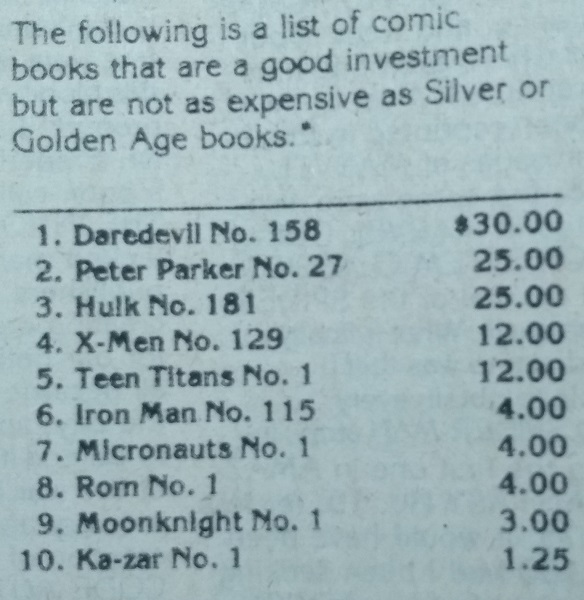
So, going back to Friday’s post, I’ve got a little bit of follow-up. First, very briefly, as was pointed out in the comments there and on the Twitters, the early ’80s Ka-Zar was something of a popular comic at the time, as borne out by my own perusal of former boss Ralph’s early ’80s order forms. Not only was Ralph ordering nearly as many Ka-Zar as he was of Avengers, he was actually ordering more Ka-Zar than Amazing Spider-Man. Now whether this says more about the popularity of Ka-Zar or about possible sales doldrums for these flagship Marvel titles, I’m not sure.
Secondly, commenter Matthew asked:
“So if you don’t like ‘Bronze Age’ as a term, are there terms you do like?
“And do you think we need more ‘ages’? The current ‘modern age’ has been (according to Wikipedia) going since 1985, and so is longer (34 years) than the silver (1956 – c. 1970) and bronze (c. 1970 – c. 1985) ages put together (30 years).
“If you were to create more ‘ages’ what would they be and what would be the signifiers?”
These are all perfectly reasonable questions. I’ve discussed the whole “comic ages” thing before, perhaps a tad derisively. Though I quoted it there, it bears repeating that the Overstreet Guide itself resisted the term “Bronze Age,” defining it thusly in their 28th edition:
“Non-specific term not in general acceptance by collectors which denotes comics published from approximately 1970 through 1980.”
Well, it’s pretty much a thing now, I guess. Like I said last time, creating a “Bronze Age of Comics” more like a deliberate marketing strategy to get those copies of Human Fly out the quarter bins and into glass cases with “KEY BRONZE AGE BOOK” written on the price stickers. But, you know, it’s here now, and I just gotta live with it. Mostly I was just complaining without providing any alternatives, a thing no one in any fandom ever does I’m sure you’ll agree.
Do I like any terms? Well…”Bronze Age” may have stuck in my craw a bit, and here in an old blog post filled with linkrot I transcribe a somewhat paraphrased discussion between pal Dorian and me about said ages and our incredulity at same. Now it’s been…egads, fourteen years, so I’ve got the current Overstreet here with me and let’s check the definitions of terms:
Golden Age: 1938 – 1945
Silver Age: 1956 – 1970
Bronze Age: 1970 – 1984
Copper Age: 1984 – 1992
Modern Age: “catch-all term applied to comics published since 1992”
As you see, there are some gaps there, which I’ve seen folks describe as “pre-Silver Age” or “post Golden Age” and so on, though others just simplify matters and call a 1948 book “Golden Age.” I don’t think the Price Guide Police will get ’em for doing so. And yes, there’s a little overlap…I don’t think Bronze ends May ’84 and Copper picks up in June or anything, but I suspect if anyone really wants to split that hair I guess it’s a case of “I know it when I see it” in trying to decide if J’emm, Son of Saturn is Bronze or Copper. To be fair, I don’t see “Copper Age” used too much in the wild…guess I’m not hanging out with the right people.
There are other general terms, like “pre-Code” (anything put out prior to the Comics Code Authority being established in 1956) and “pre-superhero Marvel” (stuff I thought just meant “whatever came out before Fantastic Four #1, but apparently very specifically meaning Journey into Mystery before Thor showed up, Tales to Astonish before Ant-Man, etc.).
Okay, do I like these terms, Matthew asked? Well, it’s too late for me to do anything about them now, and my post here on this silly blog (remember blogs?) isn’t going to change anything. I’m fine with them, I suppose…I “get” the divisions, more or less. And “Modern Age” does sound better than “Holy Shit The Entire Comics Market Just Collapsed Age.”
Modern Age seems to be tied to the whole Image launch thing, which is about as definitive a division in eras as we’ve had in recent comics history. One can easily recognize a “before Image” and an “after Image” in the industry. While the Overstreet definition of “Modern Age” isn’t as long as the period is descried by Wikipedia that Matthew noted, it’s still over a quarter of a century. However, I can’t really think of a specific line to draw at any point here that seems like a definable “age” in the sense of the previous ages. I joked in the title of this post about “Downloadable Torrent Age,” but…maybe that’s close? Maybe we’re in the Digital Age, where that’s a significant source of distribution not just for the big comic companies, but for smaller creators too? That’s not perfect, but it’s a possibility. It’s more likely that any such further delineations will come about with more distance from the present and we can look back and get a better picture of how things played out over time.
We all know the facetious suggestions, like the “Polybag Age” or the “Chromium Die-Cut Foil Cover Age” or the “Jemas Age.” Okay, that last one I just made up right now, which I would describe as a period of increased antagonism between Marvel and DC. Or, maybe, the “Rebirth Age,” by which I don’t mean DC’s post-New 52 initiative, but that time when DC was actively trying to undo major events in the past to bring back Barry Allen as the Flash, Hal Jordan as Green Lantern, and so on. Maybe a period of attempts to return to form after upending all the characters for, like, a decade or two. Sort of company-specific, but then, so are the definitions of Gold and Silver.
So, to recap answers Matthew’s questions: I don’t care for the term “Bronze Age,” but now that it’s here I guess it’ll do.
No, I don’t particularly think we need new ages, but new divisions will likely become more apparent once we look back on this time with some distance.
And I do have a few semi-jokey ideas for new ages. “Rebirth Age” still sounds as likely as any to me. But I suppose “The Mike Sterling Age of Comics” is still in the running.