And that millionaire’s name? Probably Nat.

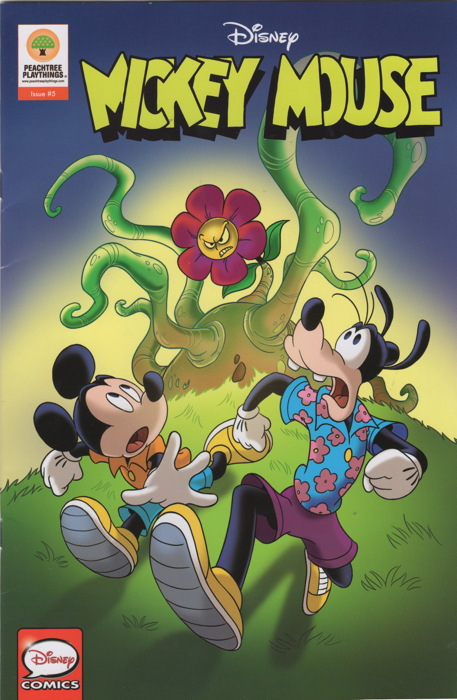
So my man in the street, Huggy Bear pal Nat, informed me a while back that the Dollar Tree chain of stores has been carrying Disney comics. And not old copies of, say, warehoused copies of unsold Gladstone comics or anything.

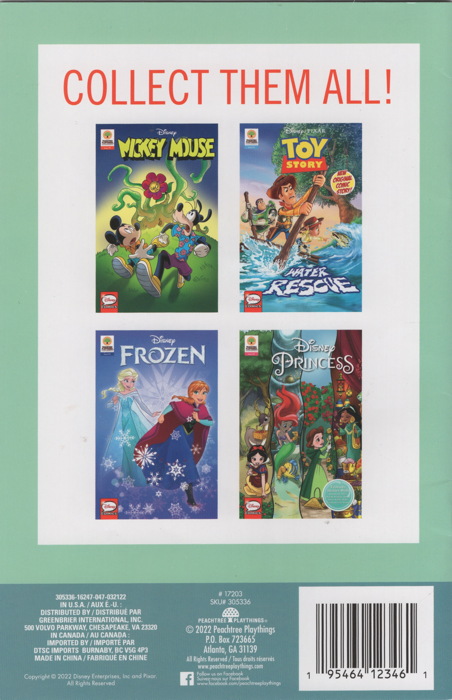
Instead, these are newly-published comics produced by a company called Peachtree Playthings, which appears to specialize in producing products based on various licenses.

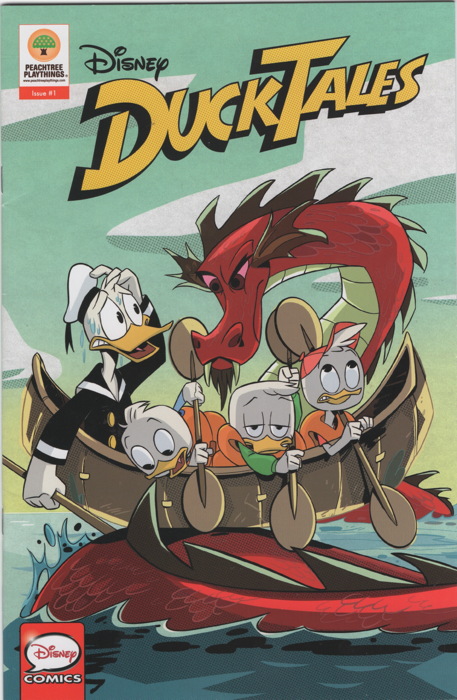
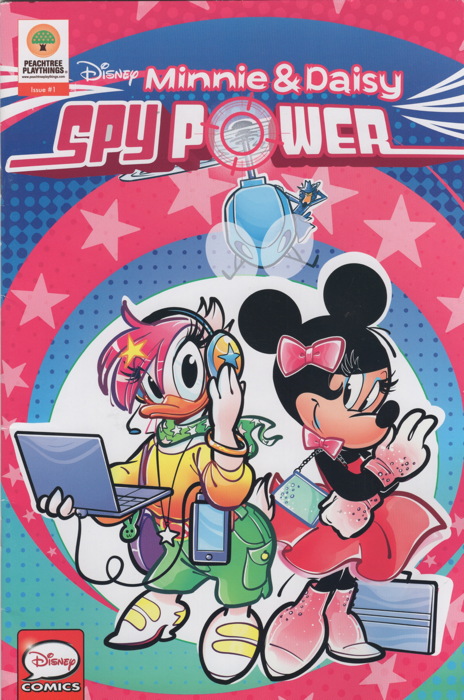
Far as I can tell, these are repackagings of previously published material, such as the above DuckTales comic, which contains a story that originally saw print in the U.S., Italy and France in 2017. And then there’s Spy Power which, if I’ve looked this up properly on Inducks.org, was originally published in Germany in 2020.

These are standard comic book size, 24 pages plus covers, full color on nice paper. The only ads appear to be in-house. The covers are slick and thicker than your normal comic book’s. I’ve seen 2021 and 2022 copyright dates on these books.

Nat has noted that he’s not seen too many of these at any single Dollar Tree location…apparently they haven’t been at the store right across the street from where my store is located. But when he does find them, they’re only a couple in stock and they’re mixed in with the coloring books, so whether he’s finding them at the end of the sales cycle where only a few are left, or they’re not getting a lot in stock in the first place, who’s to say. And the copies Nat’s been finding have seen a little battle damage, so you mint hounds seeking out copies of these have your work cut out for you.


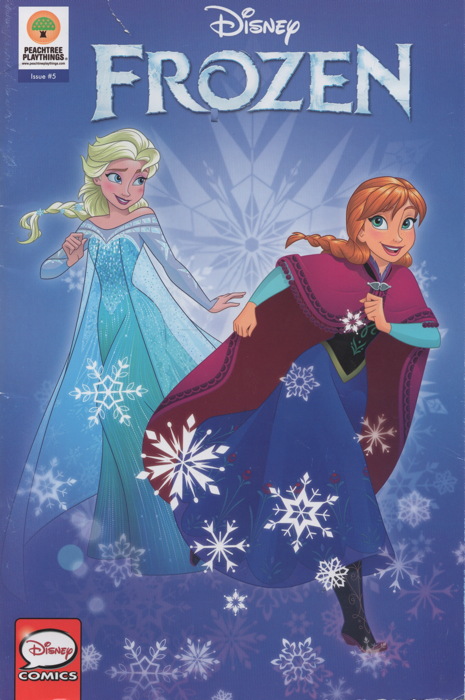
Some of these have apparently been around a bit…that Frozen up there is issue #5, and there’s a next issue ad inside for #6. Even the Spy Power comic has a next issue tag, and from what I see on Inducks I’m not even sure how much more material they have to reprint.

I’m not sure what the distribution is like on these. Just from Nat’s reports, it sounds like it’s pretty spotty but perhaps they’re available in more quantity and more consistently in other areas. And I was going to say something along the lines of these being relatively “rare” as Disney comics go, but again, I’m just basing that on local conditions. Plus, I don’t know what the print runs were like on, say, some of IDW’s Disney periodicals. But I think it’s safe to say anyone hoping to send these off to CGC is going to be disappointed, unless they find that Only Mint Copy in Existence and to them, I say “Congrats, New Millionaire.”

Catches variants just like flies.

So, in the culmination of a process that’s taken, oh, about a year and a half, I found myself finally in possession of Amazing Spider-Man #1, #2 and #3, as well as a copy of Amazing Fantasy #15. I’ve been buying (and occasionally consigning) Silver Age Marvels from this particular person for a while now, and I knew he had those early Spideys but he wasn’t quite ready to part with them…until NOW.

Well, by “NOW” I mean “a couple of days ago” and before you ask, I only have the #3 left as of this writing and even that will likely be gone shortly after you read this. Or long before you read this, if our giant-brained, spindly-bodied descendant are reading this ancient archived post in the very distant Weird Science-ish future.

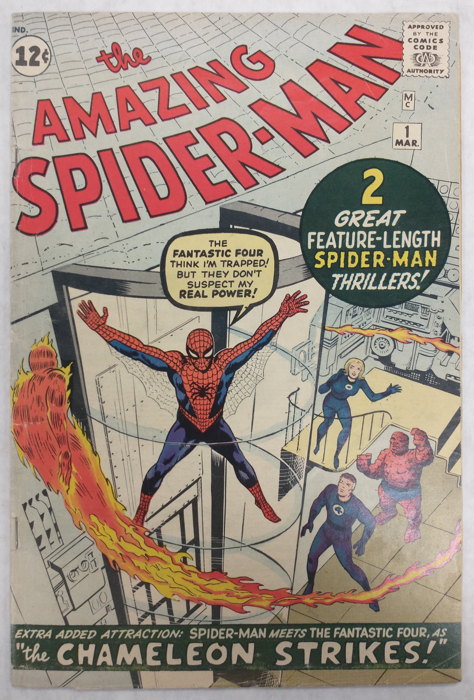
But that’s not what I’m here to talk to you about, mostly. What I’m here to talk to you about is another item that came along with this early Spideys…another early Spidy of some note. But first, let me show you a picture I took of the actual, real, straight-from-1963 issue #1 that I briefly had my mitts all over:


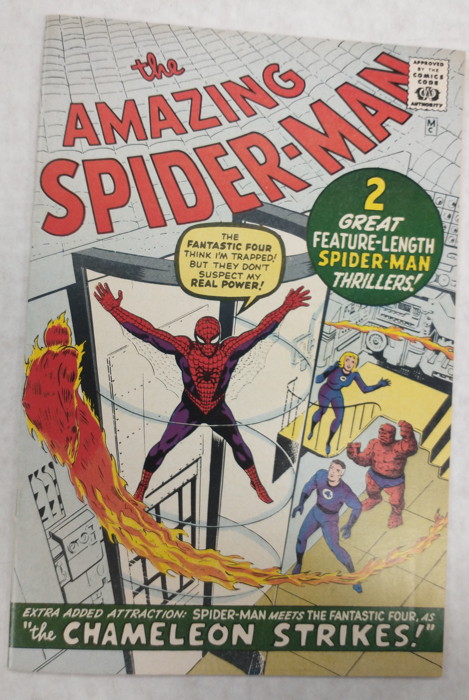
And here is the other Spidey…can you tell the difference between the two (other than my inability to take a decent photo that’s not at a weird angle)?


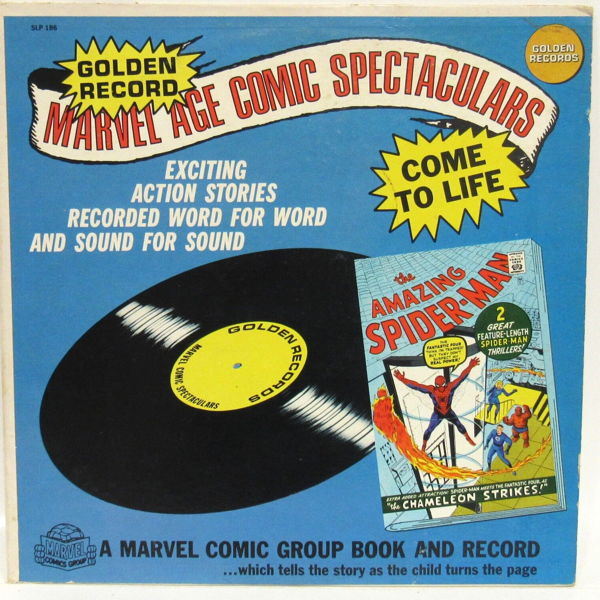
Yes, the 12-cent price is missing. And that’s because this comic is the reprint included in the Golden Records Book and Record Set from 1966, pictured here in an image “borrowed” from eBay:


Nope, I didn’t get the record, just the comic. But if you absolutely have to, you can listen to it via the YouTubes. WARNING: will challenge your ability to listen immediately.

There are a number of other differences between the two versions of the comic, as I’m sure comes as no surprise. The big one is the reprint has fewer pages, having removed all the ads. They also removed all the credits from the stories, much to Stan Lee’s chagrin I’m assuming. The story pages were also renumbered…in the original, once the second story starts, the page numbering starts over with “1” but the reprint just continues along enumerating the pages from 1 to 24. I’ll show you an example in a moment.

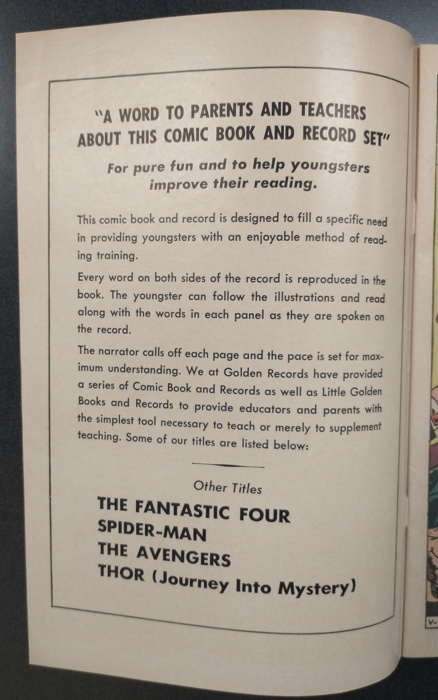
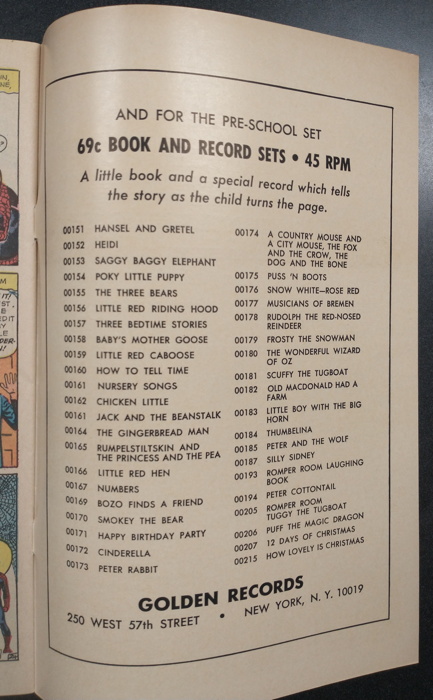
There were a few pages devoted to espousing the virtues of Golden Records and advertising their wares, such as this message to parents and teachers on the inside front cover:

And here’s a list of other records in the series. Tag yourself, I’m “Bozo Finds a Friend:”


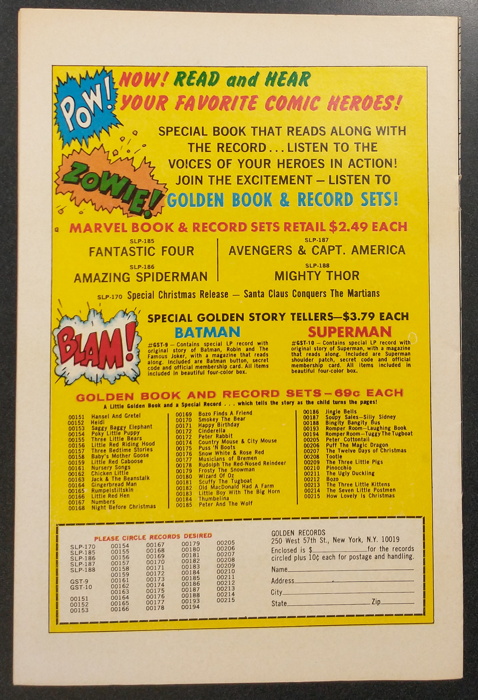
And here’s the back cover, with a convenient order form that I’m going to clip out and mail in right away:


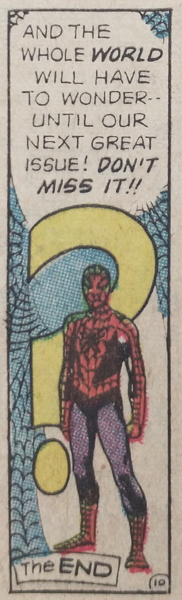
The most interesting difference is this, I think. The very last panel of the second story of the comic looks like this in the 1963 original:


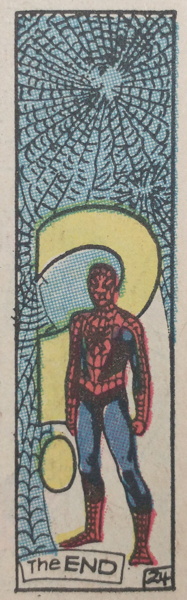
Here it is in the Golden Records reprint, with the blurb removed (and you can see the page number now reads “24” instead of “10,” since, as it says in the parents/teachers note, the narrator reads off the page numbers and starting over again from #1 might have been confusing):


Someone had to go and draw in that little web to fill the panel. I’m assuming some art guy at the record company, or maybe Marvel did it for them. Unless that was something Steve Ditko did originally in that panel and it was covered by a pasted-in caption, but from what I know about actual comic production, that doesn’t seem likely. I don’t know, but still, it’s pretty neat. What a weird panel to end a story on in the reprint…and without that blurb, how will kids know there were any more Spider-Man adventures? Maybe they thought this was it! Spider-Man tried to get a job with the FF, then fought the Chameleon, and then was never seen again.

Anyway, neat item…and something I noticed when pricing the book was that in the latest Overstreet price guide, this comic is worth more on its own than with the record, which is…weird? And not something that was true in previous years’ guides, far as I can tell. It’s also not like that for the Fantastic Four Golden Record. I’m guessing it’s an error and prices got switched…or it’s simply a case of that’s just how the sale prices reported to the guide worked out. Strange, and I guess we’ll see how it looks in the next edition of the Guide.

Should also note that yes, this technically isn’t a variant, but a reprint…but what the heck, close enough. It’s been a while since I’ve done a variant covers post and it’s probably not a bad idea to remind people this series of posts exists.

• • •

By the way, as of this month I’ll have been in comics retail for 35 years.

Okay, fine, it’s Abra Kadabra.

Picking up on Monday’s “Trial of the Flash” post, Daniel T links to an interview with its writer, Cary Bates, with relevant info. Daniel T has a choice quote from the interview about Crisis and how it affected his story (and what could have come afterwards).

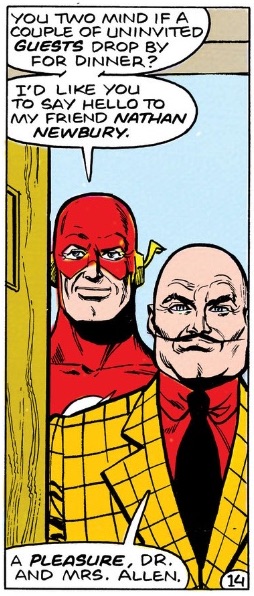
And Scipio…ah, Scipio, fellow veteran of the early 2000s comicsweblogosphere, the horrors we’ve seen. Anyhoo, Scipio popped in to remind me of one of the more…out-there elements of the whole “Trial of the Flash” storyline: Nathan Newbury:


Okay, SPOILERS for a nearly 40-year-old story just below.

Mr. Newbury was an accountant who was serving on the jury for the Flash’s trial. But, as we learn eventually, Mr. Newbury was…”psychically possessed” by a mind from the distant future who was convinced of the hero’s innocence. And also spoke in an overly elaborate manner that I think was said future mind having to communicate using Newbury’s ingrained speech patterns, but I don’t know if that was ever made explicit. (Sorry, I just reread #350, wasn’t going to dive back into the whole series, like, tonight.)

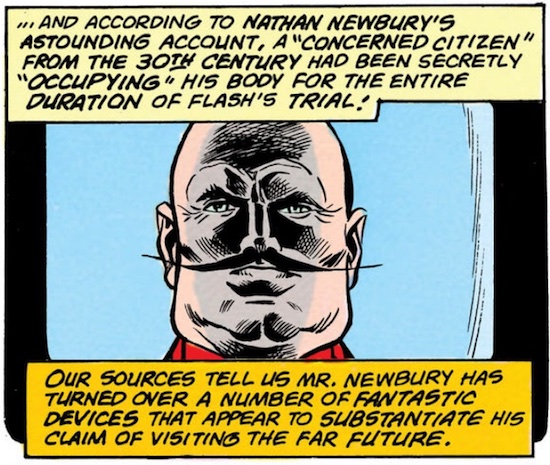
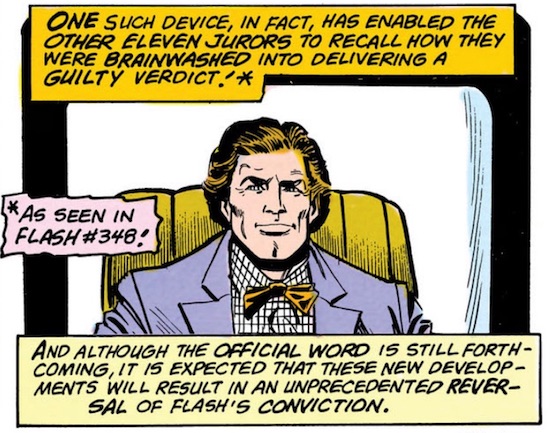
Now by any reasonable standard, once ths court found out about this level of jury-tampering, it’d all be declared a mistrial and they’d start over, right? Well, not according to this news report:


I’ve said before that the nightly news in the Marvel Universe would be indistinguishable from watching wrestling, and that the televised news reports in the DC Universe would instead inspire fear and madness in those who watched. I think this bit of insanity supports the argument. Though I suspect a certain forthcoming Big Trial in the real world may surpass even these wild events. I’m putting my nickel down on “space aliens” in the office pool.

From what I read of Nathan Newbury’s appearance in #350…I mean, it wasn’t so bad. It wasn’t quite the deus ex machina it feels like it should be, if only because the future mind in question has a prior connection to the Flash. And it’s not like Flash comics haven’t been rife with time travel shenanigans over the decades.

So ultimately the most troubling thing about Mr. Newbury is his moustache. That’s a moustache that challenges you. And frankly, the true surprise villain of the piece has a sidekick in this issue with the name of “Snurff,” and that, my friend, is the real crime.

What’s nice about Flash #350, the last of the series, is that Bates (according to the interview linked above) was given enough warning and time to lay groundwork for events coming in Crisis on Infinite Earths via foreshadowing and fore-blatantly-just-saying-he’s-gonna-die-ing.

Plus, there’s the fact that the issue’s villain (I don’t know why I’m being coy, I said there’d be spoilers) is trying to resolve “time turbulence” caused by all the time-traveling bullshit that had been going on (like the Reverse-Flash dying centuries before he was born). For selfish reasons, he’s actually trying to do a good thing, even somehow, it’s implied, saving the Flash from his impending death. He’s practically begging the Flash to let his plan play out even as he’s caught, but to no avail, adding to the coming tragedy that Barry Allen could’ve escaped but for his own actions.

Pretty wild stuff for the final issue of the superhero that ushered in the Silver Age (unless you’re one of those Martian Manhunter truthers). The final caption boxes on the last page read “And they lived happily ever after…for a while…” just to twist that knife a little more. Ah well, it’s all moot now, as thanks to DC’s ongoing plan to make Crisis “never not was” it’s mostly been undone, with Barry being dragged back into current continuity with varying levels of success.

Back then, though, before all the death and return and death again of characters, some of whom don’t even have the decency to stay dead a full month or so before being brought back after their highly publicized demise — it’s a little hard to convey the uncertainty DC fans had, knowing that characters could die or at least be fundamentally changed in this coming Crisis event. And that if the Flash could go, who else is safe? It was quite the feeling, one that was unique to superhero comics of the period.

And continues, and continues, and….

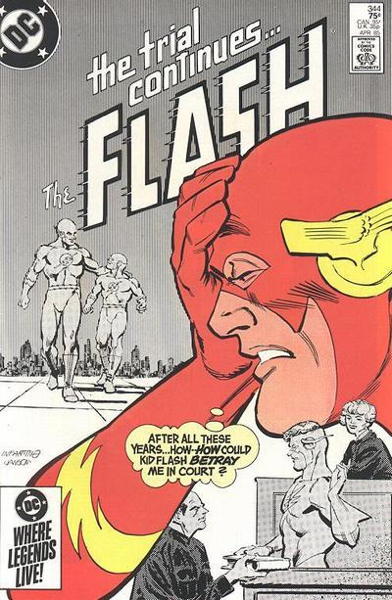
So my mention of Cary Bates in my last post got some of you talking about the storyline that got Barry “Silver Age” Flash marked for death in the soon-to-follow Crisis on Infinite Earths, “The Trial of the Flash.”


As I am once again getting a late start on the ol’ blogging yet again, I’m just going to say a few words about this series and we can pick up the discussion in the comments or maybe later as another full post.

I’m taking the issue numbers that comprise this run from the one (and I think only) time it was all reprinted under one cover, the black and white Showcase Presents thick paperback. The book includes #323-327, #329-336, and #340-350 (the last issue of the series.) Why they skip #337-340 is something of a mystery, aside from the issues themselves maybe not referencing the trial in-story. (#328 was a reprint issue.) The first issue is a Pied Piper story, and then the next two are the first appearances of Big Sir. The latter omission is most puzzling given that an event in that story leads directly to a dramatic reveal in the trial itself.

For the uninitiated, “The Trial of the Flash” is a story about our hero killing (accidentally or not) his enemy the Reverse Flash as he attempted to murder the Flash’s new bride. As a consequence, the Flash enters the legal system as the courts try to decide whether or not the Fastest Man Alive was guilty of…MOIDER.

At the time, apparently some people thought this was the Slowest Story Alive, as they quickly tired of this interminable plotline. To be fair, it was only a couple of years long, but still at this point at DC Comics, an extended storyline like this was the exception, not the rule, particularly in comics like The Flash which had mostly Done-in-One or the occasional two or three-parter stories. I remember, just a couple of years earlier, the story that opened Saga of the Swamp Thing got some pushback from readers for its length.

It seems a little odd to me, in that it wasn’t like we weren’t getting mostly standalone stories along the way, with the continuing subplots interspersed with the primary plot of the issue (both in Flash and Swamp Thing. Though perhaps in Flash, once the trial became the primary driver for the last year’s worth of books, it got to be a bit much, I suppose. Balancing the need between satisfying monthly reads and an extended plotline can be tricky, and for readers accustomed to a different sort of reading experience.

Personally, I enjoyed the trial storyline, which was something you really hadn’t seen in comics before…a superhero facing legal consequences for a fatalitiy committed in the course of his actions. And it kinda sorta played out in a real time, almost, in that in The Real World a trial like this takes forever. I mean, most trials don’t end with, like, time travel, far as I know.

I have to do a little more research, but I think sales were…not great on this series as it reached its eventual ending at #350 (relatively speaking…I’m sure comics people now would push their own grannies off cliffs for the numbers it was getting). I’m sure that was one of the factors that went into deciding the Barry Allen Flash would be on the chopping block for the then-imminent Crisis on Infinite Earths.

But I still think it wasn’t a bad run of The Flash, that maybe was just a little too ahead of its time for the story it was trying to tell.

“Holding, What, Two or Three Titles at $2.99.”

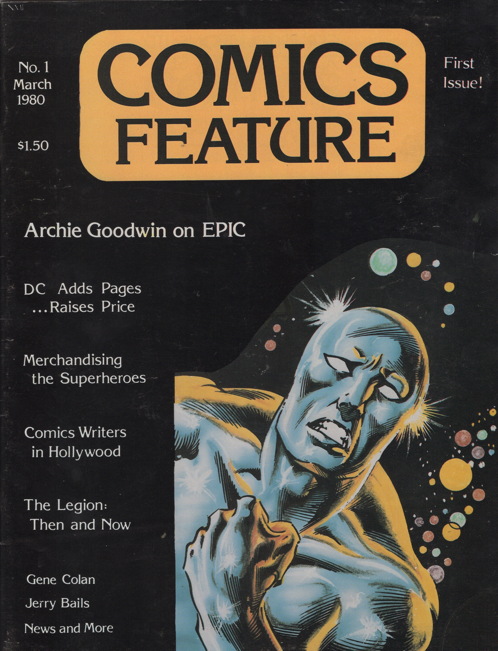
Picking up on the promise from this post, I finally brought home the pile of ‘zines I had sitting at the shop. BEHOLD: Comics Feature #1 (March 1980):


The stack included the first three issues of the run, along with 5-6 and 8-9. These were rescued from my former boss Ralph’s stash of books from the last days of that old shop, and I finally badgered Ralph into selling them to me. So, here they are, more stuff in my house to be sorted into the collection which is already in disarray.

But enough about that. The magazines have some pretty cool features blurbed on the covers I think I’m most interested in the Cary Bates interview in #8, though I’m sure the Len Wein interview in #6 will be fun as well.

What I like seeing on the first issue pictured above is the “DC Adds Pages…Raises Price” tag, reminding me of the days when the adjusting of the standard funnybook’s cost was Big News. Not to be outdone, Marvel gets its own cover blurb on #2 regarding their own page count/price increase news. When was the last time comic price changes were a big point of discussion like this (I mean, aside from DC’s “Holding the Line at $2.99” thing, or just general complaining about how they cost too much?)

Another item on the cover to #1 that…bemuses me, I suppose, the “The Legion [of Super-Heroes]: Then And Now,” if only because I can picture the culture shock if they were to just peek ahead a couple of decades. “Hello fanzine writer! Let me tell you a little about something called ‘Five Years Later.'”

As implied by my statements here, I haven’t had much of a chance to actually crack these open and read the things, aside from a glance or two. I did see a news blurb about Marv Wolfman and Dave Cockrum creating an inventory story teaming Batman with the Blackhawks. I love seeing stuff like this…news about someone creating a fill-in story that may or may not see print. In this case, however, it did, in Brave and the Bold #167, cover date October 1980.

I look forward to finding more gems like these squirrled away in the pages of these ‘zines. Lot of interesting folks working on these, too…Carol Kalish, Don and Maggie Thompson, Carl Macek, Dean Mullaney, Kurt Busiek, Richard Howell, Peter Gillis, Peter Sanderson, Cat Yronwode…the list just goes on and on.

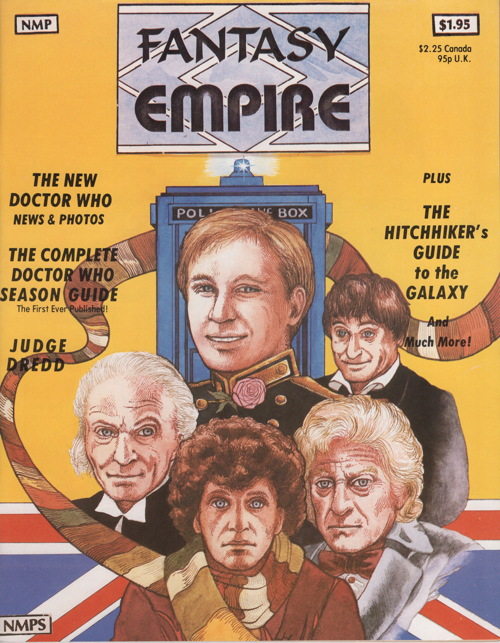
Also, along with these Comics Features, I also grabbed the first issue of this (from 1981):


Look, they got me with the Hitchhiker’s Guide to the Galaxy article, okay? But I’m not sure about all this “Doctor Who” business…that’s probably never gonna last.

The Final ’80s Countdown, Part Nineteen.

So next up on the ol’ Final ’80s Countdown, the following three-vote getter:

Miracleman (Eclipse Comics 1985-1993)
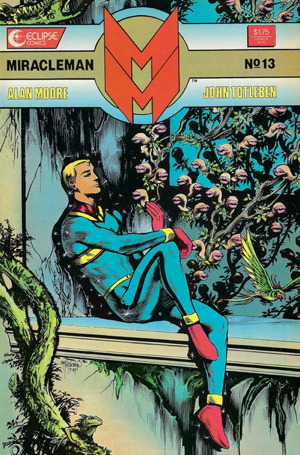
Hoo boy, where do I even start? Well, technically, I’ve started already, as I’ve got a whole category on this very site talking about Miracleman and its long history and hiatus and revival and hiatus again and revival again. Well, talking, and whatever this is.

Anyway, let me give you a very brief rundown. A British publisher, L. Miller and Son, had rights to publish Captain Marvel (the Shazam! one) stories in the UK, until Fawcett Comics stopped publishing them in the 1950s. However, L. Miller and presumably also the Son were having good sales on these comics, and had Mick Anglo rework the Shazam! Family of characters into the hopefully-lawsuit-avoiding-but-similar Marvelman Family. This revamped series ran though the early 1960s.

In 1982, the character was revived for the British comics anthology magazine Warrior in its first issue. The creative team, Alan Moore and Garry Leach, took an “adult” and “realistic” approach to Marvelman, addressing the clichés and tropes of the superhero genre in a form familiar to anyone who’s read Watchmen and pretty much anything else that was inspired by Marvelman.

Did I say brief? I’m trying, honest. So in 1985 Eclipse Comics got the rights to reprint the Marvelman stories in the U.S., with the minor problem of a little company named Marvel Comics possibly not being amused by another publishr using “Marvel” in a comics title. Hence, the change to “Miracleman,” the name by which the character has been known ’round the colonies ever since. (With a few exceptions, I’ll tell you in a moment.)

That run from Eclipse was 24 issues, which reprinted nearly all from Warrior magazine (save for one short story) by Leach and Alan Davis. That was followed with new material, illustrated by Chuck Austen, Rick Veitch, and John Totleben. Moore departs with #16, and the remainder of the run is by Neil Gaiman and Mark Buckingham.

And then Eclipse went out of business and Miracleman went into limbo and there all sorts of questions of who owned what (with Todd McFarlane believing he owned the character at one point, and attempted to integrate the character into his Spawn comics as well as releasing some limited merchandise).

Eventually things get as straightened oout as they’ll ever be, and Marvel, ironically enough I suppose, now owns the rights to the character. They kicked off their reign with reprints of original Marvelman material from the ’50s, before launching into reprints of the Eclipse run. The promise was that after the reprints concluded, Gaiman and Buckingham would be back to continue the story. Well, technically they did, I suppose, though the reprints ended in 2016 and the new Miracleman stories would not appear until very late in 2022.

Now don’t shout at me if I missed anything…I’m sure I left a bit out of the character’s compliated publishing path. The Wikipedia entry gives a more complete overview (though it notes complaints about the “birth issue” were mainly in fanzines, without noting a particular distributor was certainly not pleased about it).

There was also a mini-series Eclipse released called Miracleman Family, reprinting ’50s material, as well as Miracleman: Apocrypha, a three-issue mini featuring new short stories by various creators. Eclipse also released the Miracleman 3D one-shot, reprinting the UK Marvelman Special, which was a new Moore/Davis framing sequence around more ’50s Marvelman reprints.

Marvel also had some extra material outside the main story, once it got its mitts on the property, with a couple of annuals, Apocrypha-style, with new stories by other creators.

And one should also probably note, once Gaiman and Buckingham were back doing new issues, Buckingham went back and redrew the previous two issues with parts one and two of “The Silver Age” before moving on to the never-before seen story in #3.

Granted, it’s been a little bit since the latest issue of the new Miracleman comics (last one released early May), but at least something has come out after such a long drought. I mean, how many comic book series have had a hiatus of nearly three decades and come back with the same creative team? Not a whole lot, I’m guessing.

Now, what’s the best way to read all this mess? With the Eclipse comics, I’d say…the original comics is the best way, if you can get your hands on them. Or the trade paperbacks released by Eclipse, which I believe reprint through issue #22. There is an Apocrypha trade as well. The problem with any of these options is that they can be a bit on the pricy side. Even Apocrypha is slowly getting up there, after years of being a cheapie (and not yet having been reprinted by Marvel, near as I can tell).

Best bet for an “affordable” version…Marvel had individual collections for the material, which in typical Marvel form are all out of print (save for a volume reprinting all of “The Golden Age” segment, Gaiman and Buckingham’s opening chapters, plus a back-up from Total Eclipse). There is a Miracleman Omnibus with all the material prior to that, including a “Warpsmith” story from the A1 anthology.

If you’re going to read the comic book versions of Marvel’s reprints, keep in mind that Miracleman #14 (2005) had a drastic printing error that Marvel never bothered to fix in the periodical format, but hopefully got right in its trades.

For sampling the earlier material released in England, try the Marvel Tales: Miracleman which includes stuff from Warrior, among other sources.

Okay, I talked a lot about where you can read it and how it came out, but is it all worth it? I would say…yes, yes indeed. It was going the superhero “deconstruction” thing back when it was still a fresh idea, and it’s filled with wonderful and bizarre concepts and new takes on an old genre. (It should be noted that it’s been said that the novel Superfolks has had a strong influence on this series, and other works of Moore’s.) It blew my mind as a young Mikester, and it definitely helped steer where things were going in the comics industry at the time.

I shouldn’t let pass the fact that Marvel, despite being, you know, in charge of the Marvel brand (well, okay, Disney actually is, but go with me here), still kept the name “Miracleman” on the revived series. I suspect very much it’s to keep the very not-Marvel-House-Style-y version of the character as its own separate thing, leaving the company free to introduce its own separate version of the character into the Marvel Universe proper with the less-burdened moniker of “Marvelman.” This feels like what’s going on with the DC Rebirth one-shot-esque revelation at the end of this State of the Marvel Universe special Timeless that M(something)man is going to pop up eventually.

Now I’ve joked that this particular revelation could point at the fact that, following “The Golden Age” and “The Silver Age” Miracleman chapters, we could get from Gaiman and Buckingham “The Marvel Age,” with MM fighting Galactus or Stilt-Man or whoever. If this were the case, I would find myself in the very peculiar state of being simultaneously extremely pissed off and supremely delighted.

But no, I’m guessing we’re getting a Marvelman event in the Marvel Universe entirely aside from the Miraclman thing. Which leaves us with the question of which name will they use for the eventual Marvel movie that will underperform?

I’m getting off-track here. Miracleman was a great comic that I think holds up even today. It’s very early Alan Moore, with some clunky writing at times, but still exciting and compelling. And Gaiman and Buckingham’s follow-up material, picking up from a very definitive conclusion by Moore and Totleben, remains wondrous and fascinating. If you were turned off from reading the series because of Marvel’s initial terrible handling of the material (with overpriced comics stuffed with unwanted material padding out the few pages of interest), give the collected books a go.

(And I didn’t mention it, but you guys probably will if I dont, but Moore had his name removed from Marvel’s reprints, and it was replaced with “The Original Writer.” And lo, there was much frivolity when this was revealed. Look, Moore’s not a big man of Marvel, he could have said “no” to having his stuff reprinted at all, so I’m just glad the material’s available in the first place.)

Monday mscellany.

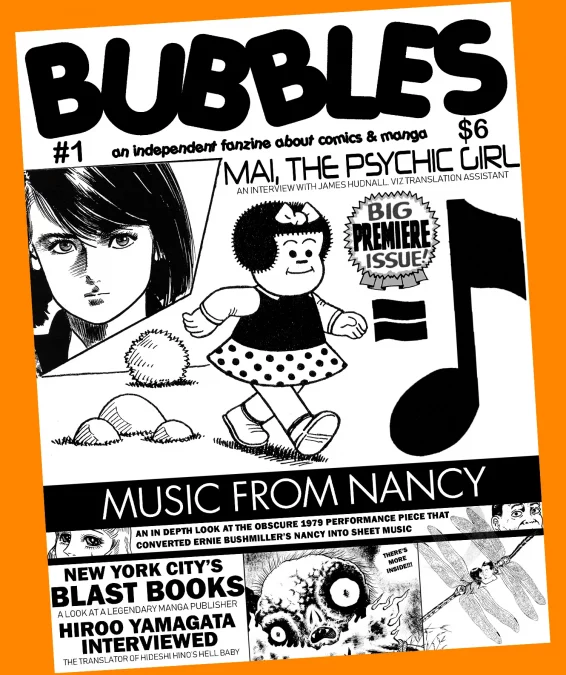
So Matthew recommended the newer comics ‘zine Bubbles, and you know, if you’re gonna get me to buy a ‘zine, put Nancy on the cover:


I also ordered a copy of #2 as well, and I’m sure this is going to result in me collecting up the whole series a couple issues at a time. Anyway, this looks good and thanks to Matthew for pointing it out to me.

• • •

Also wanted to point out that a couple of Joshua Quagmire’s friends have left comments on the post about his passing. They came in a bit later, thus I wanted to point them out so you didn’t miss them.

• • •

I will be getting back to the Final ’80s Countdown later this week. Thank you for your patience!

• • •

I have essentially scaled back my Twitter (or “X”) usage to just using the direct messaging system (as I do a lot of business with folks there still), and no longer post on my main feed. My primary social media shenanigans are on Bluesky, where you can find my account at mikester.bsky.social. I can be found less frequently on Mastodon as well. You can also keep tabs on me at mikesterling.com (or mikester.net).

At this point it’ll take the removal of Elon Musk from Xwitter and a reversal of his decisions (along with removal of the bigots, harassers and other assholes so emboldened on the platform) for me to go back to regular usage, but that seems unlikely. Anyway, if you’re on there, I highly recommend departing for safer and friendlier waters.

What a way to find out Fu Manchu is dead.

Sorry again, it’s been busy at Chez Mike this week, so the dreaded Low Content Mode struck again at Progressive Ruin Industries. Don’t worry, I’m still here, I’m still “blogging” on my “website” here on “the Internet,” and despite popular demand, I’m not going anywhere.

But I saw that in the comments to my last entry folks were mentioning other cool comic ‘zines of the ’80s, and, well…here’s the thing. I was going to dip into the ol’ magazine boxes and pull out my copies of various ‘zines that were mentioned, but, well, I’m in the midst of a huge reorganizing project with my collection, and not everything is where it should be. I know, for example, I have Comics Features, or at least the one with the Steve Bissette/John Totleben Swamp Thing art gallery inside. And somewhere I have the first issue of Comic Collector.

I did find my fun of Comics Scene, which was a good mag that brought comic news to the general public in an appealing way. (I believe it was an article in Comics Scene that first got me interested in Cerebus.) And I found the one issue I own of Four Color Magazine, a slick color news/interviews mag.

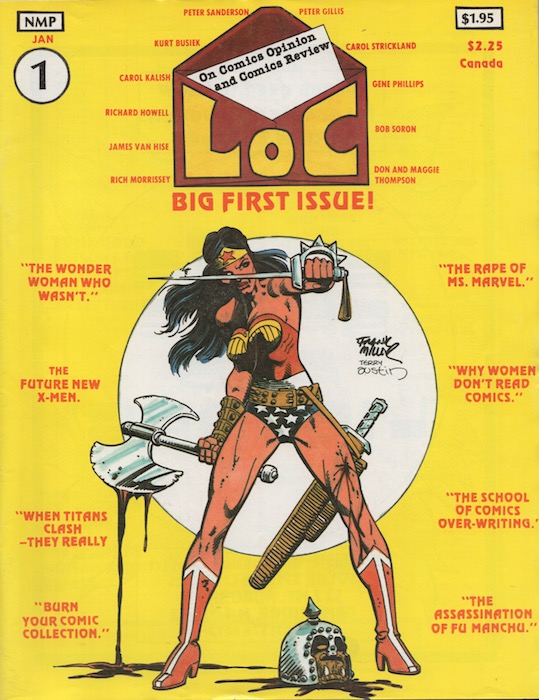
Something else I did find, and this is a relatively recent acquisition, is LOC #1 from 1980:


Taking its name from the abbreviation for “Letters of Comment,” the black and white magazine featured news, reviews, and general commentary pieces. You can kind of get an idea looking at some of the subjects on the cover there (and I feel like the placement of the “Why Don’t Women Read Comics?” blurb right below one of the possible answers is on purpose.)

I don’t recall seeing it on the stands at the time, though it’s possible it may have ended its run before I started frequenting comic book stores and other unsavory joints. But I have a few of these things and they have quite the interesting line-up of contributors. That #1 has a cover by Frank Miller and Terry Austin. Contributing writers include Kurt Busiek, Peter Gillis, Carol Kalish (who wrote the “Why Don’t Women Read Comics” article), and several other familiar names.

At my store, I know I have more copies of this magazine, along with a few more Comic Features and other ‘zines of the period, but I’m leaving them there until I get the mag situation at home nailed down.

So, did any of you read LOC at the time? Any other comic news/reviews mags that you can think of the from period? Let me know in The Usual Spot!

Amazing prices.

So last time, I mentioned that Amazing Heroes #45 (1984) was the first issue of that news/interviews/reviews mag I’d ever read. In chatting over on Bluesky with Johanna from Comics Worth Reading, she mentioned that was the only issue of the ‘zine she purchased read from her husband’s collection (for the “Sherlock Holmes in Comics” article).

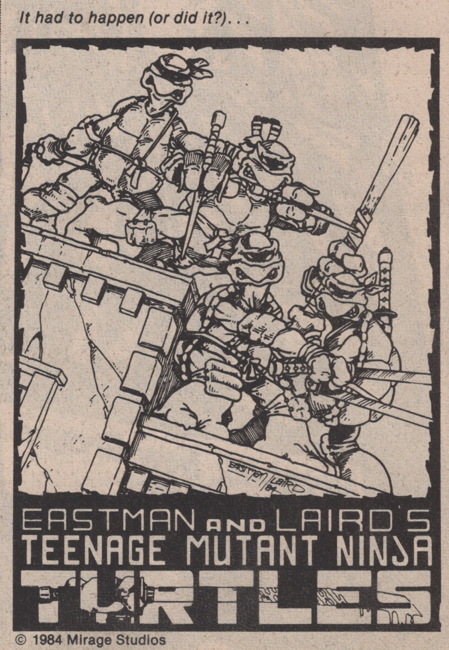
She also noted that it apparently contained the first published artwork for the Teenage Mutant Ninja Turtles, a comic book of some note. I was aware folks desperate to make anything collectible and, hopefully, expensive, were moving into things like ‘zines and distributor catalogs and house organs like Marvel Age to try to establish supposed “early” or “first” appearances of various characters. I’ve said in the past that I was lucky I bought all the ‘zines I did back when they were cheap, like getting a dozen Comic Readers for ten bucks, when now you’re lucky if you can get one issue of Comic Reader for less than that.

And that was just the result of people realizing “hey, some of these ‘zines are hard to get now,” with the attendant boost in secondary market prices. But this new wave of forced collectibles, pushing things like a solicit in Previews as a hot item (Spawn’s appearance apparently garnering $400+) are bumping up prices above and beyond what you’d think normal supply and demand would cause.

But, it’s still supply and demand…I don’t know how many copies of Amazing Heroes #45 are out there, but I’m guessing there aren’t a lot, and according to this entry on the Hot Comics App, there are a couple of reasons why it would command demand:


That…is absolutely buck wild. Note it doesn’t say “first” TMNT, but this is definitely an early appearance, with this illo (and accompanying patented editorial comment from our Fantagraphics pals) showing up in the news section:


The actual news blurb is headed, in bold capital letters “JUST WHAT WE NEED” before giving a basically straight description of the comic. It’s funny to see that the reaction, at least from this mag, to the advent of Turtledom was in effect a rolling of the eyes at this nonsense.

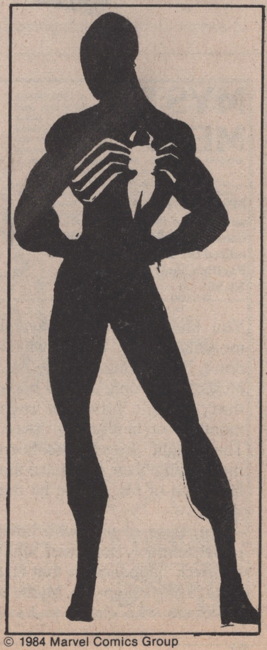
The Spider-Man black costume illo appears in the “Comics in Review” column, accompanying the critique of Amazing Spider-Man #252 where said costume first appeared in a narrative.

Again, I’m pretty sure this is just an early appearance of the costume, as I’m sure sketches and promo illos have popped up elsewhere prior to this Amazing Heroes…I think an issue of Marvel Age is considered its in-print debut, maybe? Though honestly I think it’s this Marvel Previews catalog sent to retailers for product appearing in 1992, when the line was still “2093” and he only creative team member they had listed was Stan Lee on Ravage.

Oh, I should note that the review for Amazing Spider-Man #252 is a positive one. As well it should be…beyond all the hype and “collectaqbility,” it’s actually a pretty good issue as I recall.

Anyway, I’m not selling my copy of Amazing Heroes #45 and breaking up my run. Also, like I said, this was the first issue of the run I’d ever bought, so it has some sentimental value to me. But I’m certainly glad that was the issue I’d started with, because I’d hate to be looking for a copy of it now.