And so it came to pass, in the mid-1980s, that John Byrne wrapped up his five year run on Fantastic Four, as reported here in the March 1986 issue of The Comics Journal:

(Please forgive the pixelation, as I increased the size from the source image from here.)
It’s all very…politic, with Byrne’s “on everything” seemingly bearin a lot of weight, especially in light of some later interviews. The Comics Journal mentions instances of editorial interference on some of Byrne’s books in then-recent months, such as pages of Fantastic Four #286 being redrawn, and an issue of his Incredible Hulk run being pulled from publication*.
A link found on this page shows up this 2005 Comic Book Resources interview, now accessible at archive.org, where Byrne says
“JB: A lot of factors, most internal office politics, contributed to my finding myself in a position, creatively, where doing the best work I could was simply not good enough. Not for the FF, anyway. I fear I am one of those artists who is heavily impacted by the environment in which he works. The work suffers if I am not happy, and in those final years of Shooter’s reign, I was most definitely not happy!”
This 1999 interview on Sequential Tart (linked at the same Fandom page) adds the detail that he’d likely reached the end of wanting to work on the title:
“JB: Six years on the same book, basically. That works out as a long time, even when you love the characters as much as I love the FF. It simply started to get old, and, around the same time, things in the office got dicey, and I used that as an excuse to leave.”
In the Comics Journal article, he notes that he’s still open to working for Marvel, even though the only work he had going at that moment was the covers to the Official Handbook to the Marvel Universe Deluxe Edition covers (which he leaves after #11 from October 1986). But, at that point he had his Superman reboot gig over at DC Comics (which he also leaves after about a year, but that’s another story).
I was reading the ‘zines at the time, as well as the Marvel books Byrne was working on, so I knew about the abrupt departures and editorial shenanigans that may or may not have brought Byrne to his decision.
And it was abrupt, as Byrne started a multi-part story in what would end up being his last full issue, #293, which I talked about last time. A huge bubble covers a city, and the FF enter to find that time passes much more quickly inside than outside, resulting in centuries having passed. Also in the issue, Kristof (the young boy programmed with Doctor Doom’s memories) is briefly shown, setting up threads for a possible future plotline.
But with #294, Byrne was no longer writing or drawing, and credited only with the plot as Roger Stern took over scripting, with Jerry Ordway and Al Gordon on art chores. With #295, the conclusion to the story, Byrne’s contribution is reduced to a “special thanks” in the credit box.
To be honest, as creative team transitions go, this was an easy one to make. Roger Stern is of course an absolute pro, and can write entertaining superhero comics with the best of them. And the art team of Ordway and Gordon is a pleasure to look at:
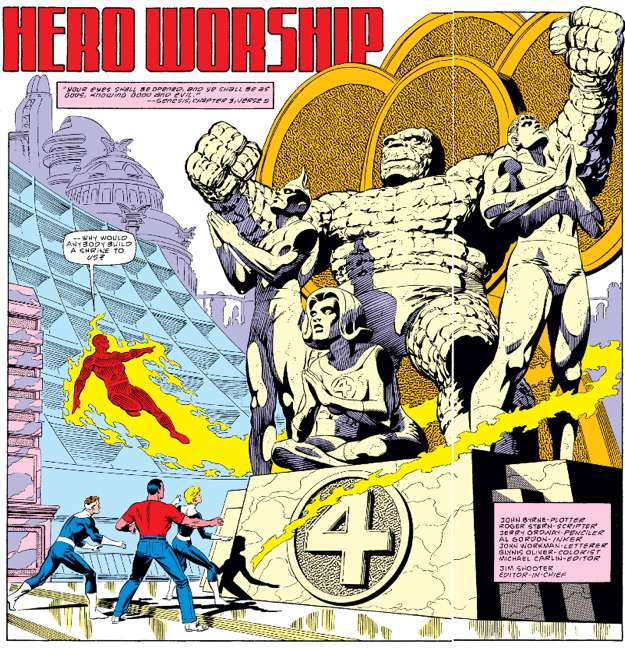
Whether it was due to the influence of Byrne’s plot or not, these two issues following up on the opening chapter for this story very much retained the look ‘n’ feel we’d been accustomed to during Byrne’s run on the book. Maybe the art was a little more smoothly refined compared to Byrne’s own self-inked work (which, don’t get me wrong, appealed greatly to me), but certainly of a piece compared to the art in Byrne’s later issues that was inked by others (including Ordway and Gordon, in fact, adding to artistic continuity). The overall tone of the story felt familiar to what we’d been reading for the previous half-decade, so the pain of losing one creator was mollified by the excellence of the replacements.
And so, I thought, that was that. Things were going to be fine. We were still getting our regular dose of John Byrne over on the Superman books, and this swell replacement team of Stern, Ordway and Gordon were going to be knockouts on the FF.
It didn’t quite work out that way, alas. Stern would stay on the book for a bit, though with a different, if fascinating, art team, and the title would slowly move away from the Byrne era of The Superstar Creator Doing His Thing and more toward something a little more…traditional, maybe? While still dealing with the repercussions of what had gone before.
It was an interesting time for the team, and while I had primarily stayed on the book for Byrne’s work, I found myself wondering how Marvel was going to follow that act. Thus, I stuck around for quite a while after his departure to see what they’d try next. And while Stern and that Mysterious Art Team (that you can totally Google, I don’t know why I’m being coy about it) would give us some readable entertainment, we had a giant anniversary issue in #296 to get through first.
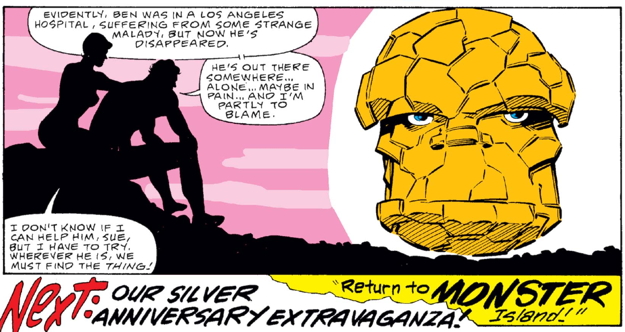
And, hoo boy, it’s certainly somethin’.
The next lengthy run on FF (what came after Stern), Steven Englehart, would be anything except traditional. It wasn’t good, but it was far from traditional.
Fantastic Four #294 was the first issue of the series I ever read. I got it as part of a multi-pack of old comics from Sears in Canada in the early ’90s. (I remember also getting issues of The Phantom Zone and The Avengers #268.) I never read much FF, Avengers, or Superman, so clearly none of them grabbed me that much.
Still, the fact that it was sold that way seems to imply that it was severely overprinted.
I think that Jerry Ordway is underrated as an artist. He has done so much consistently good work; even as recently as the pages he drew for The New History of the DC Universe. Of course, his issues of All-Star Squadron will always be my favorite Ordway work. And more importantly, in an era of comics where highly stylized flashy art (which often lacked a basic understanding of how to draw proper human anatomy) became all the rage, Ordway seemed to be an artist who had studied the work of Wally Wood, Al Williamson, and Russ Manning, and absorbed their skill sets and techniques while bringing his own distinct flair to his work–which was always in service to the stories.
Why didn’t Ordway and Gordon stay on as the art team on the FF? Did DC make them a better offer? I seem to recall Ordway became the artist on The Adventures of Superman, but I don’t recall how soon that was after his FF work. I always liked Al Gordon’s inking, which I first noticed on DNAgents.
What was the reason that Byrne’s Hulk story was relegated to being used in Marvel Fanfare later on? And I am intrigued to know more about the Byrne/Shooter rift, as at one point I thought Byrne was Marvel’s top artist (or maybe tied with Frank Miller). I also recall the satire of Byrne in Destroyer Duck as the “company man,” so what caused the fall out?
I guess the next posting will be about the anniversary extravaganza–which didn’t include any new Jack Kirby art.
The Hulk controversy stemmed from John Byrne turning in an issue of Hulk that was all splash panels. Denny O’Neil was Byrne’s editor on the Hulk at the time. O’Neil had okayed the idea with Byrne initially, according to Byrne. Basically, Jim Shooter had been upset with O’Neil as an editor, claiming that O’Neil was using his time as an editor to pursue his freelance writing (which O’Neil admitted was true) and that he did no work as an editor (which O’Neil said was totally untrue). O’Neil had second thoughts about publishing an all-splash panel story in a monthly Marvel comic, feeling that Shooter would get upset with him and use it as more ammunition to claim that O’Neil did not do his job. O’Neil pulled the Hulk story, telling Byrne that Shooter would not approve of it (Shooter disliked the Snowbird fights a Wendigo in a blizzard issue of Alpha Flight). Byrne got upset, as he had already finished the story, and put the majority of the blame on Shooter. Byrne told Shooter he was quitting on Hulk and his reasons. Shooter got even angrier at O’Neil, blaming O’Neil for one of Marvel’s hottest artists quitting (in O’Neil’s own words), and fired O’Neil, once again claiming that O’Neil was doing his own work on Marvel’s time and getting paid for doing zero editing work.
Since Byrne had already completed the all-splash panels Hulk story, Marvel agreed to publish it in Marvel Fanfare instead, feeling that the “experimental” quality of it fit better with the remit for Fanfare than a regular Marvel comic.
@ Chris V.
Thanks for filling me in on all the details.
It is funny how all of these guys who basically started as fanboys who became writers during the Silver Age: Jim Shooter, Denny O’Neil, Roy Thomas, Marv Wolfman, Len Wein, Gerry Conway, and a few others, seen to have been constantly having “turf wars” over whether or not they got to have their cake and eat it to in the wild frontier of Bronze Age comics!
*too
@ Mike Sterling
Re: your Bluesky posting about Great Frog, I think DC should release a Black Label Teen Titans limited series set during the ’70s Bronze Age. A subplot can concern Roy Harper and his band Great Frog ( I’m trying to recall if Mal Duncan was in the band as well, or did he play trumpet as a jazz musician?). Maybe Great Frog opened for Led Zeppelin or Black Sabbath or Hawkwind during the ’70s. We could get an Ozzy or Jimmy Page or Lemmy cameo–maybe they go to a witches’ rave with Lilith…
Happy 70th Birthday Bat-Woman!
She first appeared on May 22, 1956 in Detective Comics #233, making her, arguably, DC’s first Silver Age superhero!
BATWOMAN AT 70: An Anniversary Celebration of 1956’s DETECTIVE COMICS #233 — and Beyond | 13th Dimension, Comics, Creators, Culture https://share.google/f8Sy46yejdF3mVDLL
Sean, no disagreement whatsoever regarding Jerry Ordway’s considerable talents! As an inker he can improve pretty much any and every penciller too.
@ Oliver
Agreed. I recall that on All-Star Squadron, before he took over on pencils, Ordway kept a nice continuity going as the inker on the pencil art of both Rich Buckler and Adrian Gonzales. And, of course, Ordway’s inks over George Perez’s art on COIE were amazing! There’s the wrong way, and then there’s the Ordway!